
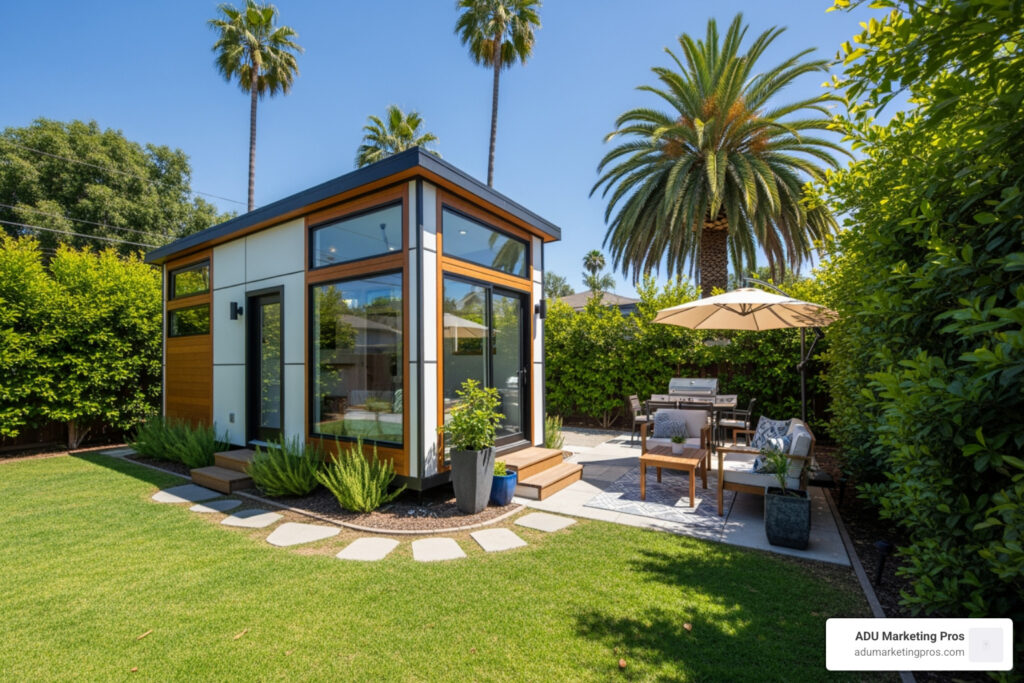
California’s Tiny House Movement Is Bigger Than You Think
Tiny house California is one of the fastest-growing housing trends in the state — and for good reason. For decades, the “California Dream” was synonymous with sprawling suburban estates and manicured lawns. However, as the median home price in the Golden State continues to climb toward the million-dollar mark, that dream has shifted. Today, the dream is about financial freedom, sustainability, and the ability to live in high-demand coastal or mountain regions without being “house poor.”
The tiny house movement in California isn’t just a niche lifestyle for minimalists; it is a strategic response to a massive housing shortage. By utilizing smaller footprints, homeowners are finding ways to stay in their communities, house their families, and even generate passive income. This guide explores why California has become the epicenter of the tiny living revolution and how you can navigate the path to ownership.
Quick Reference: California Tiny House Options
| Category | What to Know |
|---|---|
| Tiny homes on foundations | Built under the 2022 California Residential Code (Appendix AQ); treated as permanent ADUs |
| Tiny homes on wheels (THOWs) | Registered with the DMV; follow ANSI/RVIA standards; more flexible placement |
| Park model homes | Up to 400 sq ft; placed in RV parks or mobile home communities |
| Cost range | $30,000–$60,000 to build (excluding land); luxury models up to $100,000 |
| Key counties | Nevada, Santa Cruz, San Benito, Sacramento, San Diego, Los Angeles |
The Economic Driver Behind Tiny Living
California has a serious housing affordability problem. Median home prices in many cities are well above $700,000, and in the Bay Area or Silicon Valley, that number often doubles. Tiny homes offer a real alternative — whether you want a backyard rental unit, a multigenerational living setup, or a full-time primary residence. By reducing the square footage, you drastically reduce the cost of materials, labor, and long-term maintenance.
Furthermore, the state is one of the most tiny-home-friendly in the country. Nearly all California counties allow tiny homes in some form, and state ADU laws have made it easier than ever to place one on your property. The legislative environment has shifted from viewing tiny homes as “nuisances” to seeing them as essential tools for increasing housing density without destroying the character of existing neighborhoods.
But the rules are layered. State codes set the baseline. Then counties add their own requirements. Then cities layer on top of that. Getting it wrong can cost you thousands. This guide breaks it all down — types, regulations, costs, communities, and how to find the right builder for your project.
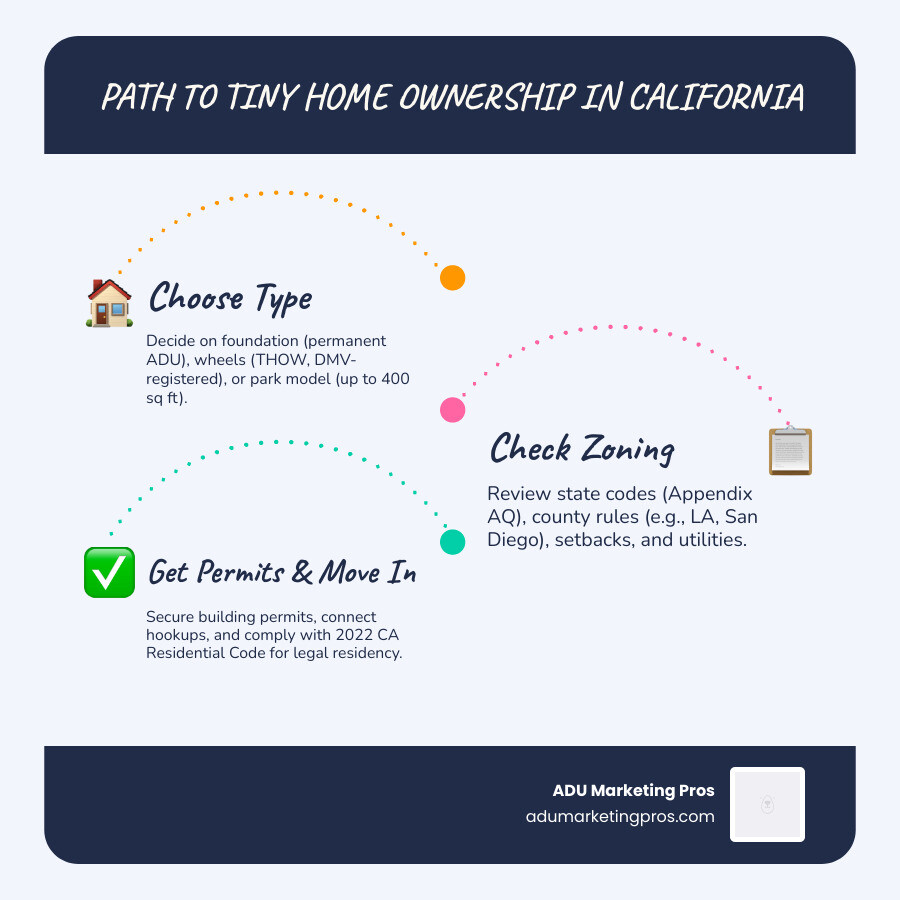
Terms related to Tiny house California:
Understanding the Different Types of Tiny House California Options
When we talk about a Tiny house California, we aren’t just talking about one type of structure. The legal “bucket” your home falls into determines where you can park it, how you pay taxes, and what building codes you must follow. In the Golden State, these generally fall into three categories: homes on foundations, Tiny Houses on Wheels (THOWs), and Park Models.
The distinction is vital because California is a leader in Accessory Dwelling Unit (ADU) legislation. Understanding the adu-vs-tiny-house debate is the first step for any homeowner. While all tiny houses are small, not all are legally considered ADUs unless they meet specific local criteria. For instance, a tiny house on wheels might be considered a “Movable ADU” in Los Angeles but might only be allowed as a temporary guest house in other jurisdictions.
Tiny House California on Foundations
If you want your tiny home to be a permanent fixture of your property, you are looking at a foundation-backed build. These are regulated under the 2022 California Building Code, specifically Appendix AQ. This appendix was a game-changer for the movement, as it officially recognized structures under 400 square feet as legitimate dwellings, provided they meet safety standards.
Building on a foundation means your home is treated as real property. This is the gold standard for those looking to build small-houses that appreciate in value over time. Because they are tied to the land, they must meet strict energy efficiency standards (Title 24) and permanent utility connection requirements. In cities like San Jose and Los Angeles, these are frequently permitted as backyard ADUs to house aging parents or generate rental income. The foundation can be a traditional slab, a crawlspace, or even a pier-and-beam system, depending on the soil and local engineering requirements.
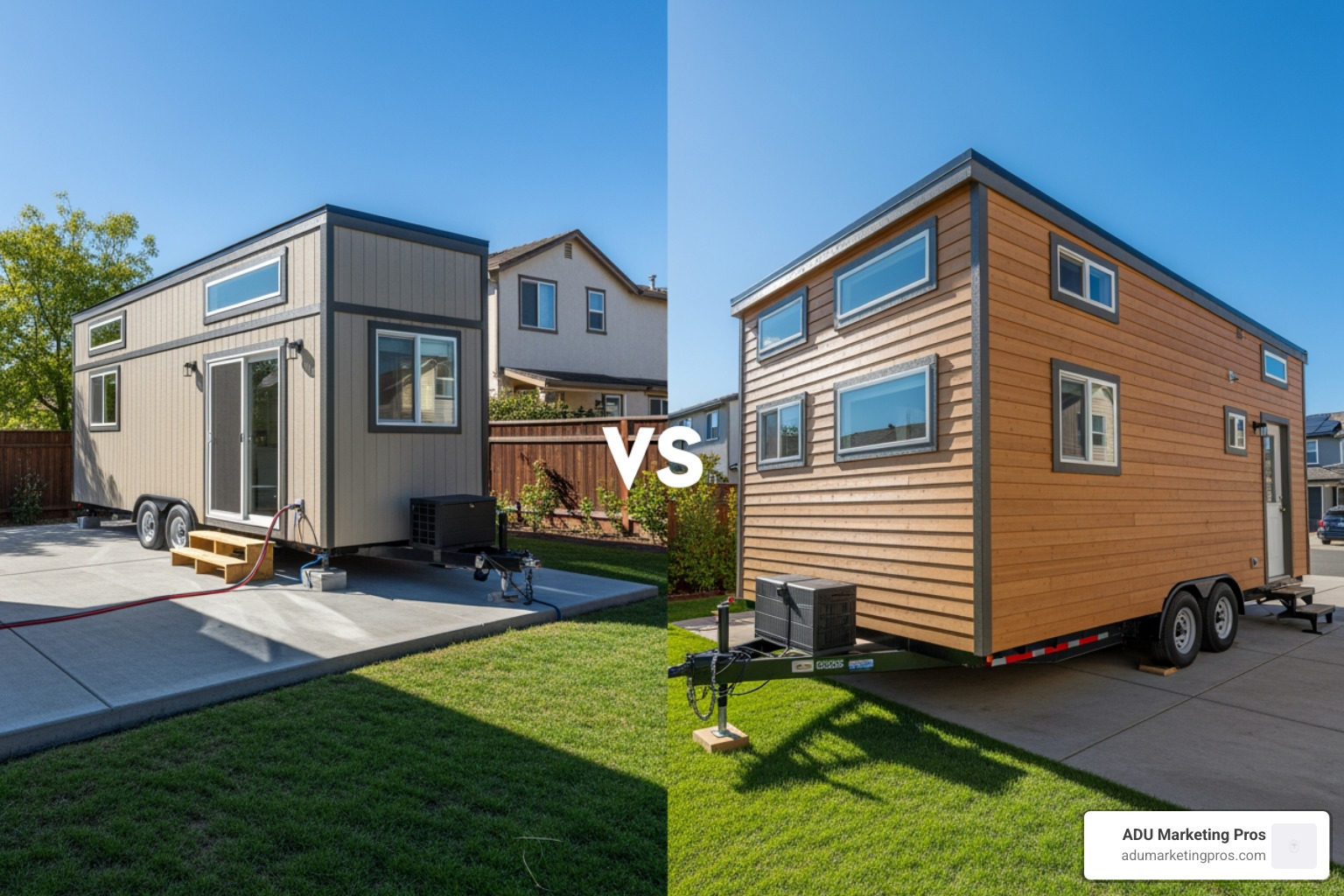
Movable Tiny House California (THOWs)
A Movable Tiny House, or THOW, is exactly what it sounds like: a high-quality home built on a heavy-duty trailer chassis. In the eyes of the California DMV, these are often registered as Campers or RVs. However, for residential use, they must meet RVIA standards or ANSI 119.5 requirements to ensure they are safe for long-term habitation. This certification is crucial; without it, many insurance companies will refuse coverage, and many cities will refuse to issue a placement permit.
The beauty of the THOW is mobility. If you decide to move from San Diego to the San Francisco Bay Area, your home comes with you. Many jurisdictions, including places in Southern California that allow tiny houses, now recognize THOWs as “Movable ADUs.” This allows you to bypass some of the heavy costs of a traditional foundation while still living legally in a residential backyard. However, keep in mind that “movable” doesn’t mean “mobile home” in the 1970s sense; these are modern, well-insulated, and aesthetically pleasing structures designed to blend into residential neighborhoods.
Park Model Tiny Homes
Park models are a hybrid between a THOW and a manufactured home. They are typically wider than a standard THOW (often 10 to 12 feet wide) and require a professional transport company to move. In California, they are limited to 400 square feet of living space. These are popular in dedicated tiny house communities or RV resorts because they offer a more “house-like” feel with full-sized appliances and standard-height ceilings. While they are technically mobile, they are usually intended to stay in one place for years at a time.
Legal Requirements and Zoning for Tiny Homes
Navigating the legal landscape of a Tiny house California requires a bit of detective work. While the state has passed sweeping laws to encourage ADUs, local “zoning layers” still dictate the nitty-gritty details like setbacks (how far the home must be from the fence) and height limits. The California Department of Housing and Community Development (HCD) provides oversight, but your local planning department is your primary point of contact.
| Regulation | Foundation Tiny Home | Movable Tiny Home (THOW) |
|---|---|---|
| Code | 2022 CRC Appendix AQ | ANSI 119.5 / RVIA |
| Taxation | Real Property Tax | DMV Registration Fees |
| Min. Size | 120–150 sq ft | 150 sq ft (typically) |
| Max. Size | Up to 1,200 sq ft (as ADU) | 400–430 sq ft (standard) |
| Permit Type | Building Permit | Local “Movable ADU” Permit |
The 2022 California Residential Code Appendix AQ is the “bible” for permanent tiny homes. It provides relief from standard building codes by allowing for things like steeper stairs and reduced ceiling heights in lofts, which are essential for making a small-houses-for-sale layout actually work. Without these relaxations, most tiny home designs would be illegal under standard residential codes.
Statewide ADU Laws and Tiny Homes
California law has moved aggressively to allow tiny homes to function as ADUs. Under state mandates, most residential lots can accommodate at least one ADU and one Junior ADU (JADU). This has opened the door for tiny homes to be used for:
- Rental Income: Boosting a homeowner’s monthly cash flow in a high-rent state.
- Multigenerational Living: Providing a private space for adult children who are priced out of the market or elderly parents who need to be close to family.
- Primary Residences: In certain rural counties, a tiny home can be the main house on the lot, provided it meets all health and safety codes.
For those in the design phase, working with architects in Southern California who design tiny houses is a smart move. They understand how to maximize a 300-square-foot footprint while ensuring the plans sail through the local planning department. They can also help with “Title 24” compliance, which is California’s strict energy efficiency standard that applies to all permanent structures.
County-Specific Variations: From Santa Cruz to San Diego
Despite state progress, your experience will vary wildly depending on your zip code.
- Santa Cruz County: A pioneer in the movement, allowing one THOW per parcel as a permanent residence, provided it is connected to sewer/septic and water.
- San Benito County: Requires specific skirting to hide the wheels and chassis, ensuring the home looks like a permanent structure. They also have strict rules about utility hookups.
- Nevada County: Recently updated ordinances to allow THOWs as permanent residences in certain zones, provided they meet safety and sanitation standards. This has made it a haven for off-grid and rural tiny dwellers.
- Los Angeles & San Diego: Both cities have adopted “Movable ADU” ordinances. In LA, you can park a THOW in your backyard as a legal dwelling unit, provided it is registered with the DMV and connected to the main house’s utilities.
If you are looking to build in the southern part of the state, checking out tiny-house-builders-in-southern-california is essential to find experts who know these local quirks. Each city may have different requirements for “impact fees,” which are one-time charges for the home’s impact on local infrastructure like parks and schools.
Costs, Placement, and Community Living
How much does a Tiny house California actually cost? While you might see “DIY” videos claiming $10,000 builds, the reality for a legal, permitted home in California is different. The cost of labor and the high standard of building materials required by state law drive prices higher than in other parts of the country.
Generally, a high-quality tiny home build in California ranges from $30,000 to $60,000 for standard models. If you are looking for luxury park models with high-end finishes, custom cabinetry, and smart home technology, expect to pay between $90,000 and $120,000. These costs exclude land, permits, and utility connections. In many California cities, the permit fees alone can range from $2,000 to $10,000, and utility trenching can add another $5,000 to $15,000.
The ROI of Tiny Living
Investing in eco-friendly-small-homes often yields a higher Return on Investment (ROI). Features like solar panels, greywater systems, and high-efficiency insulation not only lower your monthly bills but make the unit more attractive to high-end renters. In cities like Austin or San Francisco, a well-designed tiny home can rent for $1,500 to $2,500 per month, allowing the owner to recoup their investment in just a few years.
Finding Your Place: Communities and Rural Areas
One of the biggest hurdles isn’t building the home—it’s finding a place to put it.
- Backyard Placement: This is the most common “urban” solution. You place the tiny home in the backyard of an existing house. This is legally supported by California’s ADU laws, making it the path of least resistance for most people.
- Tiny House Communities: Places like Park Delta Bay in the California Delta offer a legal, community-oriented lifestyle. These are often zoned as RV parks but cater specifically to long-term tiny house residents, offering amenities like community gardens, clubhouses, and high-speed internet.
- Rural Acreage: In counties like El Dorado, Placer, or Riverside, you may have more luck placing a tiny home as a primary residence on a larger plot of land. However, you must still deal with well and septic requirements, which can be expensive.
- Urban Infill: For those looking at the city life, exploring tiny-house-san-francisco options reveals a market focused on high-density solutions and innovative backyard placements where space is at a premium.
Financing Your Tiny Home
Financing a tiny home can be tricky because they don’t always qualify for traditional mortgages. If the home is on a foundation, you may be able to get a construction loan or a HELOC (Home Equity Line of Credit) on your primary residence. For THOWs, most buyers use personal loans or specialized RV loans. Some builders also offer in-house financing to help bridge the gap.
Frequently Asked Questions
Can I live full-time in a tiny home on wheels in California?
Yes, but it depends on local zoning. In cities like Los Angeles, San Diego, and San Jose, you can live in a THOW full-time if it is permitted as a “Movable ADU” on a residential lot. In other areas, you may be restricted to living in designated RV parks or tiny home communities. Always ensure your home is RVIA certified to meet safety standards, as this is a requirement for legal residency in most jurisdictions.
Do tiny homes count as ADUs under California law?
Yes. California law allows tiny homes on foundations to be classified as standard ADUs. Additionally, many jurisdictions now recognize Movable Tiny Houses (THOWs) as a form of ADU. This classification provides significant benefits, including the right to have a full kitchen, bathroom, and permanent residency status. It also protects the homeowner from certain local zoning restrictions that might otherwise prohibit small dwellings.
What is the minimum square footage for a tiny home in California?
Under the 2022 California Residential Code (Appendix AQ), a tiny home must have at least one habitable room with a minimum of 120 square feet of net floor area. Other habitable rooms must be at least 70 square feet. Ceiling heights in habitable spaces and hallways must generally be at least 7 feet 6 inches, though lofts have more flexible requirements (often as low as 6 feet 4 inches in certain areas).
How do I handle sewage and water for a tiny home?
If your tiny home is an ADU, it must generally be connected to the main house’s sewer or septic system and water line. For THOWs, this is often done via heavy-duty hoses and power cords similar to an RV hookup, though some cities require more permanent connections. Off-grid options like composting toilets are gaining popularity but are not yet legal in all California jurisdictions for permanent residences.
Will a tiny home increase my property taxes?
If the tiny home is on a foundation, it will likely increase your property’s assessed value, leading to a modest increase in property taxes. If it is a THOW, it is usually taxed as personal property (like a vehicle) through DMV registration fees rather than real property taxes, which can save you money in the long run.
Conclusion
The Tiny house California movement is more than just a trend; it is a practical response to the state’s unique housing challenges. It represents a shift in how we think about space, community, and financial independence. Whether you are looking for a sleek backyard office in Sunnyvale, a guest suite in San Diego, or a rustic retreat in Nevada County, the options for “living big” in a small footprint are expanding every day.
At ADU Marketing Pros, we understand the complexities of the California housing market. Based in San Jose, we specialize in helping ADU construction and architecture firms across the San Francisco Bay Area, Los Angeles, and San Diego stand out. We focus on highlighting the expertise and craftsmanship that these builders bring to the table, ensuring they connect with homeowners ready to start their tiny living journey. We know that building a tiny home is a significant investment, and we are dedicated to helping the industry grow through clear communication and expert marketing.
If you are a builder looking to grow your presence in this booming sector, we are here to help you navigate the digital landscape. For homeowners, finding the right partner is the key to success. Start your search by looking at tiny-house-builders-california to find professionals who can turn your vision into a permitted, legal reality.
California tiny living is about more than just square footage—it’s about freedom, flexibility, and finding a place to call home in the West. As the state continues to refine its laws and more communities open their doors to small-scale living, the future of the California tiny house looks brighter than ever.