
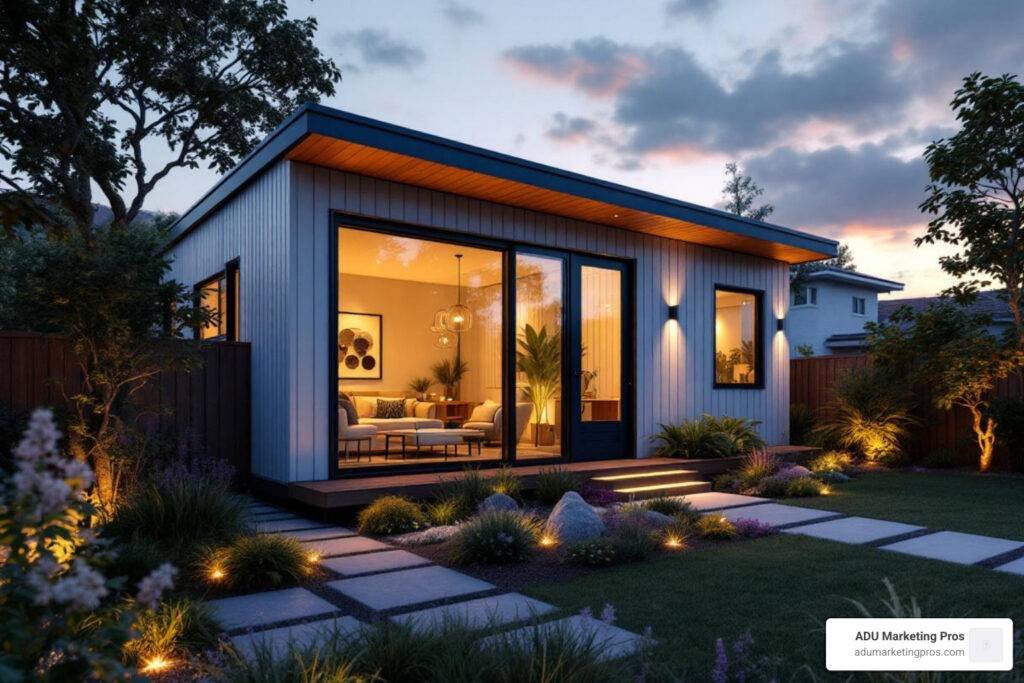
Why Affordable Prefab ADUs Are Changing Backyards Across America
Affordable prefab ADU options typically range from $56,700 to $304,000 all-in, depending on size and finishes. The most budget-friendly models include:
- Studio units (150-350 sq ft): Starting at $26,000-$80,500 for shells; $190,000-$228,800 turnkey
- 1-bedroom units (400-450 sq ft): $219,000-$320,000 installed
- 2-bedroom units (600-670 sq ft): $290,000-$347,000 installed
Key factors affecting affordability include base unit price, site preparation, foundation, permits, transportation, and utility hookups. Prefab ADUs offer predictable costs and 3-4 month installation timelines versus 9-12+ months for traditional builds.
The dream of expanding your living space—for family, work, or rental income—often collides with the reality of high construction costs and lengthy project timelines. In places like California, traditional construction can cost upwards of $300 per square foot with unpredictable delays.
Enter the affordable prefab ADU.
These factory-built accessory dwelling units offer a smarter path forward. Unlike tiny homes on wheels that do not typically add property value or stick-built projects that can drag on for a year, prefab ADUs combine legal permanence with construction efficiency. They are built to the same codes as traditional homes but in a controlled factory environment that reduces weather delays and material waste.
However, the advertised “starting at” prices rarely tell the whole story. A unit listed at $75,000 might cost $150,000 or more once you factor in delivery, foundation, permits, and utility connections. This guide cuts through the marketing language to show you what an affordable prefab ADU truly costs, how the process works, and how to choose the right option for your property and budget in markets like Los Angeles, San Diego, and the San Francisco Bay Area.
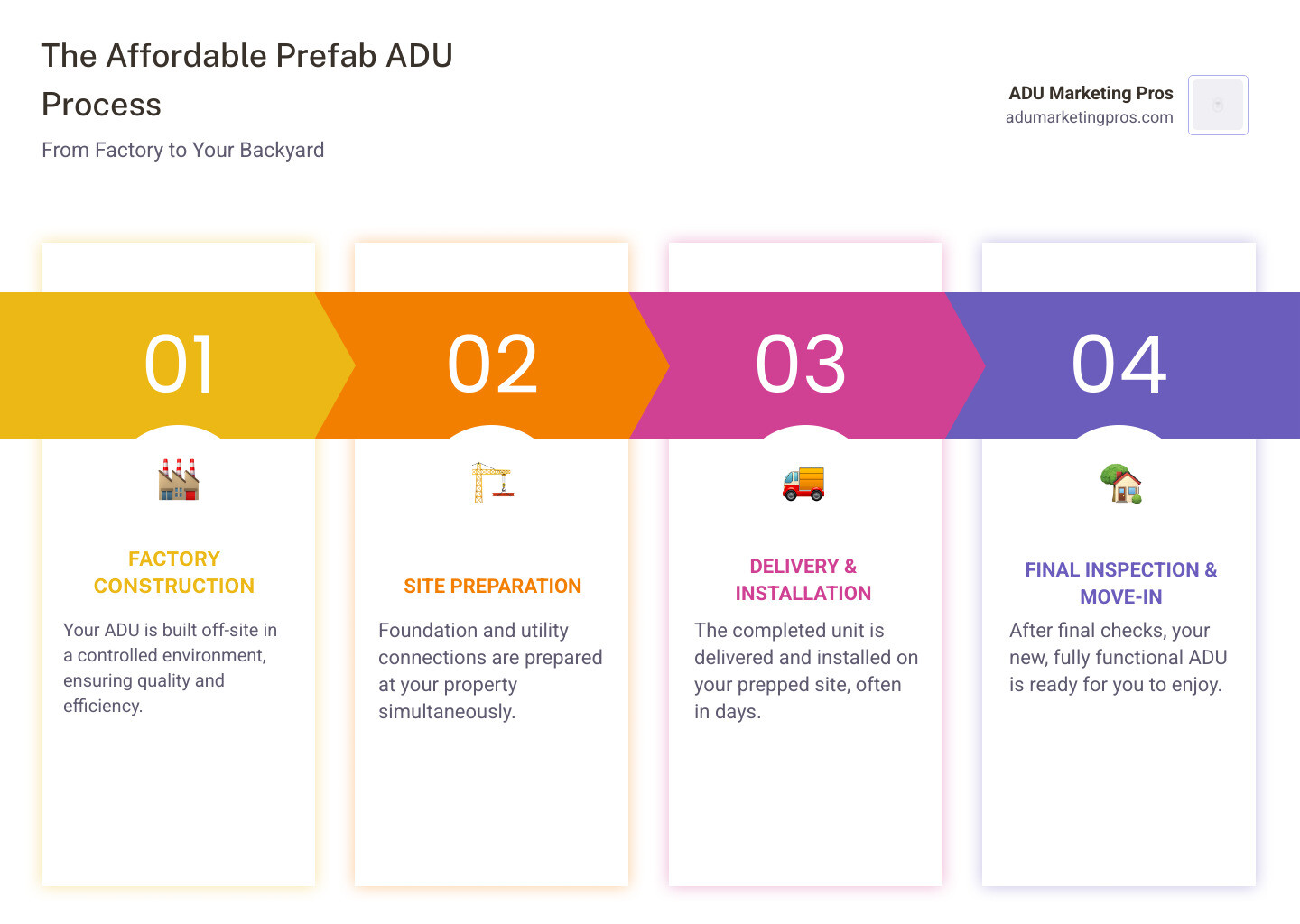
Affordable prefab ADU terminology:
Understanding Prefab ADUs: More Than Just a Tiny Home
Before diving into costs, it’s crucial to understand what a prefab ADU is and how it differs from other small living structures. This knowledge will help you steer local regulations and make the best investment for your property.
What is a Prefab ADU?
A prefabricated Accessory Dwelling Unit (prefab ADU) is a secondary home constructed largely or entirely in a factory. The completed unit is then transported to your property and installed on a permanent foundation. Unlike temporary structures, a prefab ADU is a legal dwelling and a permanent real estate asset. It must meet the same state and local building codes as a traditional home, ensuring its safety, durability, and value. This factory-built approach is increasingly popular in high-demand areas like California. For more on this housing solution, explore our insights on ADU modular homes information.
Prefab ADU vs. Stick-Built ADU vs. Tiny Home
The terms for secondary dwellings can be confusing. The table below clarifies the key differences between a prefab ADU, a traditional stick-built ADU, and a tiny home.
| Feature | Prefab ADU | Stick-Built ADU | Tiny Home |
|---|---|---|---|
| Legal Status | Fully legal, permitted, and recognized as housing | Fully legal, permitted, and recognized as housing | Usually classified as RVs; not legal housing |
| Foundation Type | Permanent | Permanent | Often on wheels (mobile) |
| Appraisal Value | High appraisal; significantly increases property value | High appraisal; significantly increases property value | Depreciating asset. Adds little to no property value |
| Customization | Moderate; limited by factory models | High; custom to your property | High (for interior); limited by size/trailer |
| Construction Time | 2-4 months (factory build + site work) | 6-9 months on average, depending on design | Quick (already built on trailer) |
As the table shows, tiny homes on wheels are typically classified as RVs, which means they are not considered permanent housing in California and do not add to your property’s appraised value. Both prefab and stick-built ADUs are permanent, legal structures. The primary difference is the construction method, which impacts timeline and cost predictability. For a deeper dive, see our ADU vs. Tiny Home analysis.
Key Types: Modular vs. Panelized Prefab ADUs
Prefab ADUs come in two main types: modular and panelized.
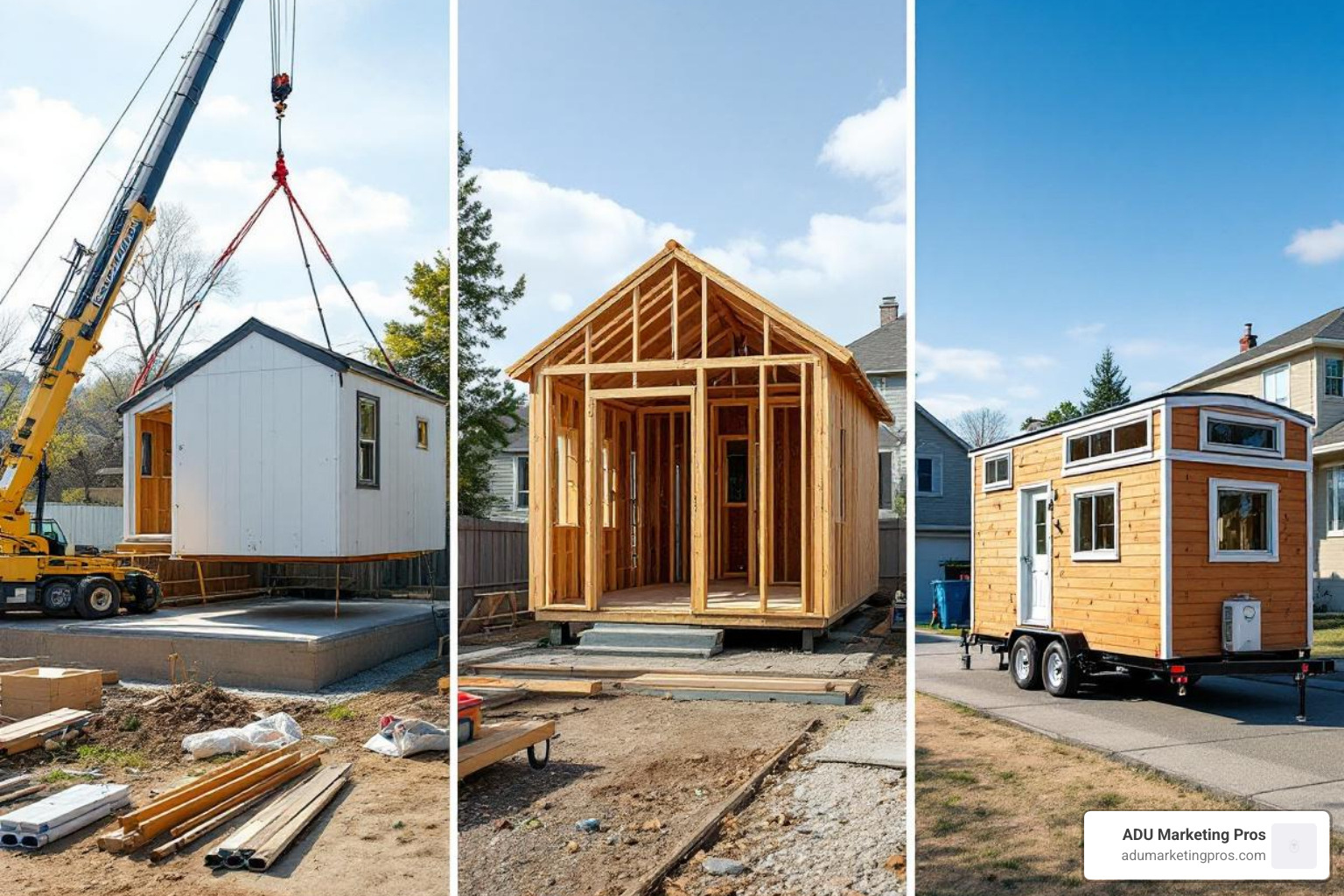
Modular ADUs are built as complete, three-dimensional modules in a factory, including most interior finishes. These are transported to your site and craned onto the foundation. This method is extremely fast, with on-site installation often taking just a few days. However, it offers less customization and can pose logistical challenges for sites with limited access.
Panelized ADUs (or kits) are built as two-dimensional wall, floor, and roof panels in a factory. These flat-packed panels are shipped to your site and assembled by a crew. This approach allows for more on-site customization, especially for interiors, but requires more on-site labor than modular units.
Both types offer the benefits of factory quality control and reduced waste. The choice depends on whether you prioritize maximum speed (modular) or greater design flexibility (panelized). Learn more by Comparing Panelized vs. Modular Prefabricated Homes.
The True Cost of an Affordable Prefab ADU
The word “affordable” can be misleading. While prefab ADUs offer great value, their advertised base prices rarely tell the whole story. Understanding the total, all-in cost is the most critical step in planning your project.
Deconstructing the Price Tag: Base vs. All-In Costs
The advertised “starting from” price for an affordable prefab ADU is almost always the base price for the unit itself, and sometimes just a ‘shell’ kit. The all-in cost, which covers the entire project from start to finish, is the number you need to budget for.
This total cost includes:
- Base Unit Price: The factory cost of the ADU.
- Site Preparation: Clearing, grading, and preparing the land.
- Foundation: A required permanent foundation (e.g., concrete slab).
- Utility Hookups: Connecting to water, sewer, and electrical lines, which can involve trenching and panel upgrades.
- Transportation: Moving the unit from the factory to your property.
- Permits and Fees: Local government application, inspection, and impact fees.
- Installation/Assembly: Craning the unit into place and final on-site construction.
- Finishes: Costs for kitchens, bathrooms, flooring, and appliances if not included.
For a realistic budget in California, expect turnkey studio ADUs (350 sq ft) to range from $190,000-$304,000, while a 1-bedroom (400-450 sq ft) might be $219,000-$320,000. A 2-bedroom (600-670 sq ft) could run $290,000-$347,000. For a full breakdown, see our ADU building costs breakdown.
Key Factors That Influence Your Final Price
Several key variables will determine your final project cost:
- Unit Size and Model: Larger units cost more. Companies often offer different series, from compact studios (150-250 sq ft) to spacious 2-bedroom models (650-1,200 sq ft). Our ADU square footage guide offers more insights.
- Finishes and Materials: Upgrading from standard fixtures, flooring, and cabinetry to high-end options can add tens of thousands to your budget.
- Location and Labor Costs: Labor rates for site prep, foundation work, and installation vary significantly by region, with areas like the San Francisco Bay Area typically being more expensive. For region-specific insights, see our breakdown of Bay Area ADU costs.
- Site Complexity: A sloped lot requires more extensive (and expensive) foundation work, such as stepped foundations or retaining walls. Limited street access for cranes or delivery trucks can also increase installation costs significantly. Furthermore, the distance and condition of existing utility lines are critical. Trenching 100 feet to a sewer line is far more costly than a 20-foot connection. If your main home’s electrical panel is at capacity, a costly upgrade will be required to support the new ADU.
- Soft Costs and Site-Specific Reports: Beyond the physical construction, you’ll encounter “soft costs.” These include fees for architectural plan modifications, structural engineering calculations, energy compliance reports (Title 24 in California), and potentially a land survey or soils report. While a prefab company may bundle some of these, others might be separate line items that can add several thousand dollars to your budget.
Are Prefabs Really the More Affordable Option?
When comparing all-in costs, a prefab ADU and a stick-built ADU of similar size and quality often have a comparable final price tag. The idea that prefabs are always dramatically cheaper is a common misconception.
However, prefabs deliver affordability in other crucial ways:
- Cost Predictability: Prefab companies can provide a firm price for the unit, significantly reducing the risk of budget overruns common in traditional construction. This financial certainty is a major advantage.
- Faster Construction Time: A shorter timeline (3-4 months vs. 9-12+ months for stick-built) means you save on construction loan interest. It also means your ADU can start generating rental income or be used by family much sooner.
- Efficiency Savings: Factory production reduces labor costs and minimizes material waste, and building indoors eliminates costly weather delays.
While the per-square-foot cost might be similar, the speed, predictability, and efficiency make prefab construction a highly competitive and financially sound choice. Compare costs with our ADU cost per square foot comparison.
The Prefab ADU Journey: From Factory to Your Backyard
The prefab process is a well-orchestrated dance between the factory and your property. While it’s significantly faster and less disruptive than a traditional build, it involves several key phases that every homeowner should understand.
A Step-by-Step Timeline: Design to Move-In
A key benefit of an affordable prefab ADU is the accelerated timeline. While a custom ADU can take over a year, a prefab project is often completed in 6 months by performing site work and factory construction at the same time.
Here’s a typical timeline:
- Design & Feasibility (1-2 months): This initial phase is crucial. You’ll choose your model and any available customizations for finishes. Simultaneously, the prefab company or a partner contractor will conduct a site visit to assess feasibility. They’ll check for crane access, utility line locations, and potential obstacles. This is also when you’ll likely need a site survey to confirm property lines and a soils report to inform foundation design, especially in certain geological zones. This due diligence prevents costly surprises later.
- Permitting (2-4 months): The prefab company submits plans to your local building department. Pre-approved designs can streamline this phase, but it remains the most variable part of the timeline.
- Site Prep & Factory Build (2-3 months): While your ADU is built in the factory, a local contractor prepares the foundation and utility connections on your property. This involves clearing the site, grading the land, digging trenches for water, sewer, and electrical lines, and pouring the concrete foundation.
- Delivery & Installation (1-2 weeks): The completed unit is transported to your site, craned into place, and secured to the foundation.
- Final Inspection & Move-In (1-2 weeks): After final utility hookups and finishing touches, a local inspector approves the project, and you receive a certificate of occupancy.
This efficient process minimizes disruption and gives you a usable space faster. Learn more in The ADU building process explained.
Navigating the Maze of Permits and Legal Requirements
Building a legal affordable prefab ADU in California requires navigating state and local regulations. While prefab companies often manage this process, it’s important to understand the basics.
- State vs. Local Rules: California has passed laws to encourage ADU construction, setting standards for size, setbacks (typically 4 feet), and height. However, cities like Los Angeles, San Diego, and San Jose have their own specific requirements. See our California ADU regulations overview and Los Angeles ADU regulations for more.
- Factory Inspections (HCD): A major advantage for California prefabs is that the state’s Department of Housing and Community Development (HCD) inspects and pre-approves the unit’s structure, plumbing, and electrical systems at the factory. This means local inspectors cannot require changes to the factory-built portion.
- On-Site Inspections: Your local building department will still need to inspect and approve the foundation, utility connections, and final installation. This ensures the on-site work meets all local codes before the ADU is occupied.
- Pre-Development Reports: Before a permit can even be submitted, your city may require specific reports. A soils report from a geotechnical engineer might be needed to design the foundation correctly, especially on hillsides or in areas with expansive soil. A topographical survey may be required to show the exact contours and features of your lot. These reports are essential for a safe and compliant build but add time and cost to the pre-construction phase.
- Expert Management: A reputable prefab provider will have experience with your local jurisdiction and should manage the entire permitting process, saving you time and preventing costly errors. For more on this, see The ADU permit process.
Open uping Value: The Benefits and ROI of Prefab ADUs
Beyond the construction process, an affordable prefab ADU offers a wealth of benefits, from enhancing your lifestyle to providing a significant return on investment. It is more than just a building; it is a flexible asset that grows with your needs and can be especially impactful in high-cost regions like San Jose, Sunnyvale, and Palo Alto.
The Top Benefits: Speed, Predictability, and Less Disruption
Choosing a prefab ADU offers clear advantages that improve its overall value:
- Speed: With concurrent off-site and on-site work, projects are often completed in 6 months, a fraction of the 9-12+ months required for a traditional build.
- Cost Predictability: A fixed price for the factory-built unit provides cost certainty and reduces the risk of budget overruns.
- Minimal Disruption: Most of the construction happens off-site, meaning far less noise, mess, and disruption in your backyard compared to a traditional build.
- No Weather Delays: Indoor factory construction helps your project stay on schedule, regardless of the weather.
Common Uses for Your New Backyard Home
An affordable prefab ADU is a versatile asset that can adapt to your changing needs. Common uses include:
- Rental Income: Generate passive income by renting to long-term tenants or, where permitted, as a short-term rental on platforms like Airbnb. This can help offset your mortgage and build wealth. Learn more about Generating ADU rental income.
- Multi-Generational Living: Provide an independent, private space for aging parents (an in-law suite) or adult children saving for their own home.
- Flexible Lifestyle Space: Create a dedicated home office, art studio, guest house, or even a pool house to improve your daily life and property.
Property Value and Appraisal Insights
A prefab ADU is a smart financial investment that can significantly increase your property’s value. Because it is a permanent, permitted structure, it is appraised as part of your real estate.
- Increased Resale Value: Adding a legal dwelling unit makes your property attractive to more buyers. A 2021 Porch Survey found that homes in the Pacific region with an ADU saw an average 35% increase in resale value.
- Appraisal Value: Unlike a tiny home on wheels (which generally depreciates like an RV), a prefab ADU is recognized by appraisers as legitimate living space that adds substantial value.
- Return on Investment (ROI): Between the boost in property value and the potential for rental income, an ADU can provide a strong long-term ROI, often paying for itself over time. For broader context on ADUs and property values, resources from organizations such as the Urban Institute can be helpful.
For a deeper financial analysis, explore our guide on Calculating your ADU return on investment.
How to Choose the Right Company and Model for Your Needs
With a clear understanding of the costs, process, and benefits, the final step is selecting the right partner and product. This decision will shape your entire experience, from initial design to final move-in.
Vetting a Prefab ADU Provider: Key Questions to Ask
Choosing the right company for your affordable prefab ADU is critical for a successful project. Prioritize providers who are transparent and experienced in your local California area. Here are key questions to ask:
- What is included in your all-in price? Insist on a detailed, itemized quote covering every cost from the unit to installation.
- Who manages the permitting process? A good partner will handle all permitting with your local city.
- Can I tour a completed model or visit your factory? Seeing a finished ADU provides a true sense of quality and space.
- What warranties do you offer? Understand the coverage for the structure and the installation work.
- How do you handle site challenges (e.g., sloped lots, limited access)? Discuss their approach to unique property characteristics.
- Do you have references from clients in my area? Speaking with past customers is invaluable.
Our guide to Find ADU builders near you can help you start your search.
Finding the Best Affordable Prefab ADU for Your Budget
Finding the “best” affordable prefab ADU is about balancing cost, quality, and your specific needs.
- Budget for Contingency: Set aside an extra 10-20% of the total estimated cost for unforeseen site-specific issues.
- Prioritize Needs vs. Wants: Decide what’s essential. Standard finishes can save you thousands over high-end upgrades.
- Explore Financing: Look into ADU financing options like home equity loans or construction loans. In California, you may be eligible for the CalHFA ADU Grant Program, which offers up to $40,000 for pre-development costs.
- Consider a Shell Kit: If you’re handy, finishing the interior of a ‘shell’ kit yourself can significantly reduce costs.
Frequently Asked Questions about Affordable Prefab ADUs
Can I customize my prefab ADU?
Yes, to an extent. Most prefab companies offer a menu of pre-selected finishes, fixtures, and color palettes. You can often choose different kitchen and bathroom layouts from a set of options. However, major structural changes to the floor plan are generally not possible with modular units, as this would undermine the efficiency of factory production. Panelized kits may offer slightly more flexibility for interior customization during on-site assembly.
How long do prefab ADUs last?
Prefab ADUs are built to the same building codes as traditional homes and are designed for longevity. With proper maintenance, they can last 60 years or more, a lifespan comparable to a site-built house. To withstand transportation, they are often engineered to be even more durable than required by code. Some manufacturers use materials like steel frames, claiming they are built to last even longer than standard wood-framed homes.
Do prefab ADUs increase property taxes?
Yes. Adding any legal dwelling unit to your property will increase its assessed value, which in turn increases your property taxes. However, under California law, your property is not fully reassessed. Only the value of the new ADU is added to your tax bill. This modest tax increase is typically far outweighed by the boost in property value and the potential for rental income. For more details, see our article on More on ADU property taxes.
Conclusion
Choosing an affordable prefab ADU is a powerful way to add space, flexibility, and value to your property. The key to success lies not in finding the cheapest sticker price, but in understanding the complete, all-in cost and process. By prioritizing a predictable budget, a faster timeline, and minimal disruption, prefabs offer a compelling alternative to traditional construction, particularly in the high-demand markets of California.
With careful planning and the right professional partners, your dream of a budget-friendly backyard home is well within reach. For ADU builders and architects aiming to connect with these educated homeowners in cities like Los Angeles, San Diego, San Jose, Mountain View, and Menlo Park, a targeted marketing strategy is essential. That is the specialty of firms like ADU Marketing Pros, located in San Jose, CA, and serving the entire California market.
If you are an ADU construction or architecture firm looking to attract higher-quality leads instead of competing on price alone, ADU Marketing Pros can help you stand out with data-driven SEO, PPC, and content strategies custom specifically to the ADU market.