
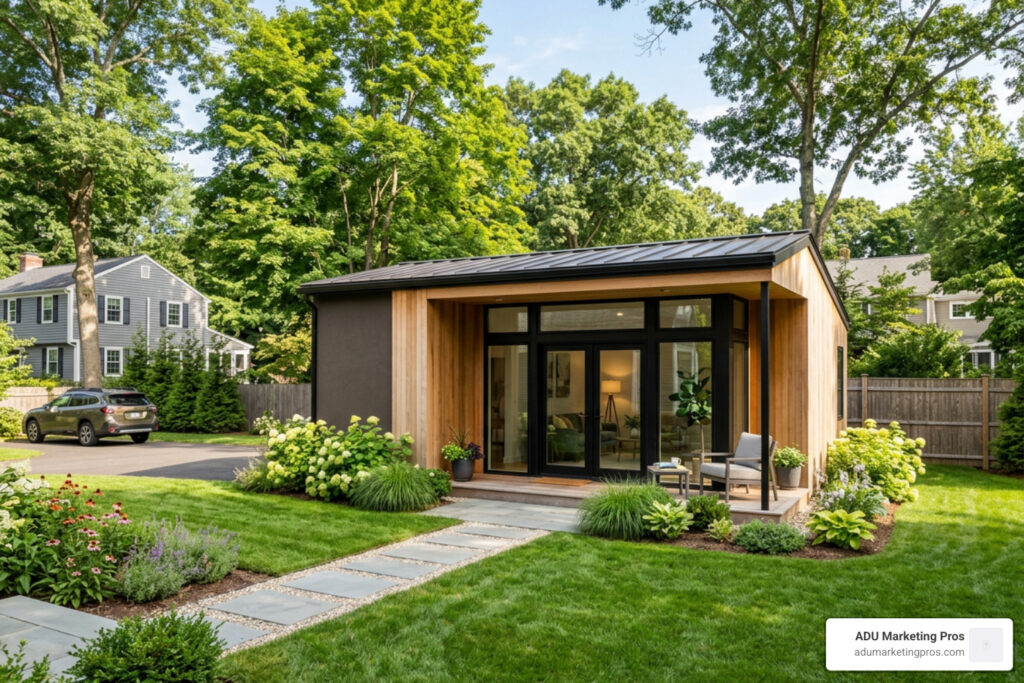
Why an ADU Grant Massachusetts Program Could Fund Your Next Build
ADU grant Massachusetts programs are opening up meaningful financing options for homeowners who want to build an accessory dwelling unit, from pure grants and zero-interest loans to subsidized construction financing. As housing costs remain high across the Commonwealth, state and local leaders are using ADUs to add smaller-scale housing in established neighborhoods without requiring major redevelopment. The current housing crisis in Massachusetts has reached a tipping point, with inventory at historic lows and prices continuing to climb, making these small-scale solutions more critical than ever for the state’s economic health.
For Massachusetts homeowners, investors in multigenerational living, and ADU professionals tracking this market, here is a snapshot of notable funding sources available now or expected soon:
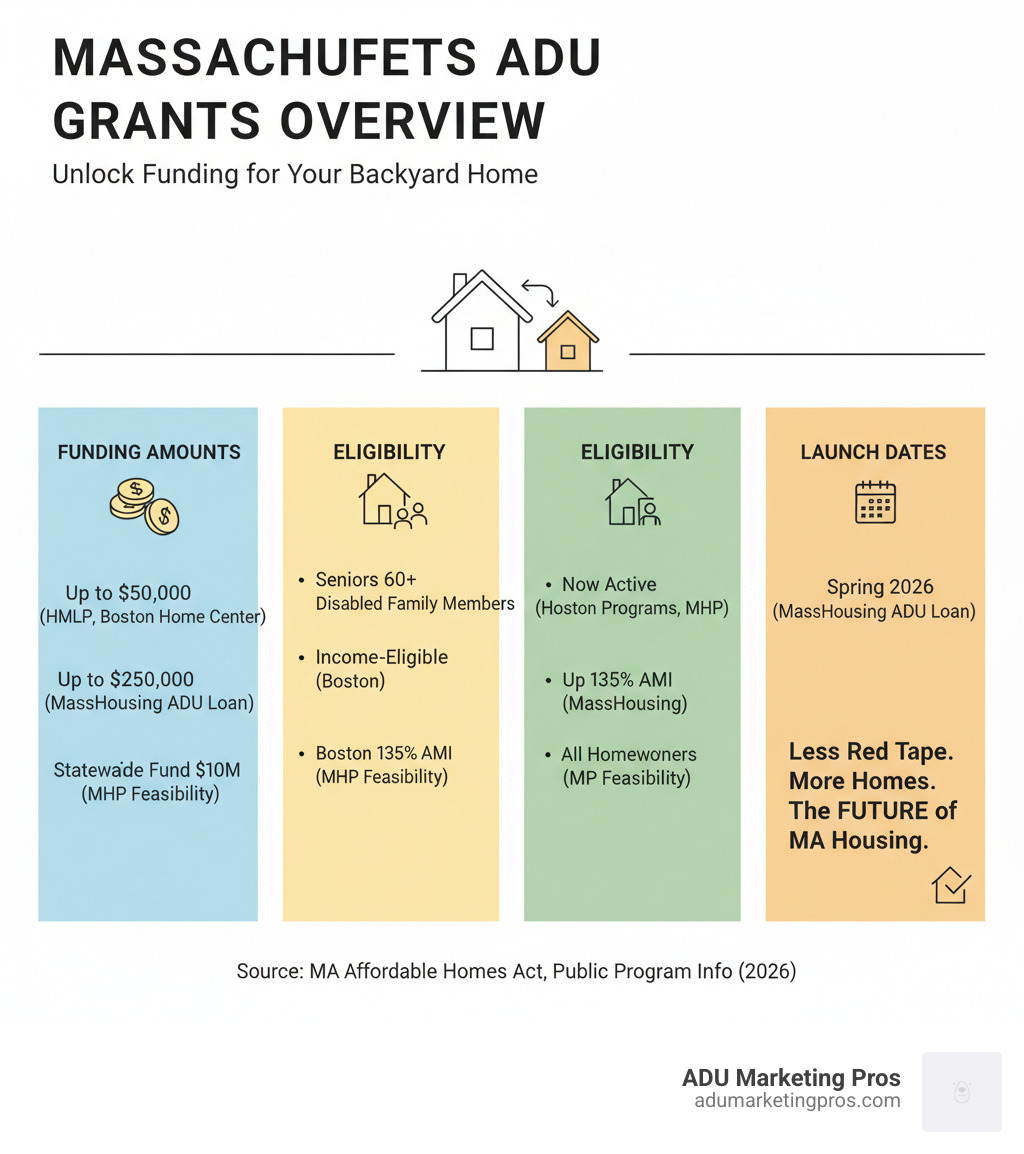
| Program | Max Funding | Interest | Who Qualifies |
|---|---|---|---|
| Home Modification Loan Program (HMLP) | $50,000 | 0% | Seniors 60+, homeowners with disabled family members |
| Boston ADU Technical Assistance Grant | $7,500 | N/A (grant) | Income-eligible Boston owner-occupants |
| Boston Home Center ADU Loan | $50,000 | 0%, deferred | Owner-occupants of 1-3 unit homes in Boston |
| MassHousing ADU Loan (Spring 2026) | $250,000 detached / $150,000 attached | Low fixed rate | Up to 135% area median income |
| MHP ADU Incentive Program | $10M statewide fund | N/A | Statewide homeowners (feasibility studies) |
Massachusetts is in the middle of a significant housing policy shift. The 2024 Affordable Homes Act made it legal to build an ADU by right in single-family zoning districts statewide, reducing a major barrier that had long slowed small-scale housing creation. This legislation represents the most significant change to Massachusetts zoning laws in decades, effectively overriding restrictive local bylaws that previously made ADUs nearly impossible to build in many affluent or suburban communities.
That legal change matters because zoning reform alone does not pay for design work, utility upgrades, code compliance, or construction. The real obstacle for many homeowners is still financing. That is where the adu grant massachusetts landscape becomes especially important. These programs can help cover planning costs, accessibility upgrades, and part of the overall construction budget for homeowners who want to house a parent, create space for an adult child, or add long-term rental income. By providing a financial bridge, the state is ensuring that the right to build an ADU is not just a theoretical legal win, but a practical reality for middle-class families.
Permit activity shows the level of interest. In the months following the law’s passage, hundreds of ADU permit applications were filed statewide. For builders, architects, and marketers serving this space, that growth signals a rising market in need of clear educational content and strong local positioning. At ADU Marketing Pros, we work with ADU construction and architecture firms across the country, including those expanding into high-growth East Coast markets like Massachusetts. Our team, based in San Jose, CA, helps ADU companies stand out through expertise-led marketing rather than price competition, whether they serve homeowners in California or the Bay State. We understand that the Massachusetts market requires a nuanced approach that respects local architectural traditions while embracing modern efficiency standards.
The Affordable Homes Act: A New Era for the ADU Grant Massachusetts Landscape
For decades, building an accessory unit in Massachusetts was a Herculean task. Homeowners were often forced to navigate a labyrinth of local zoning boards, where “special permits” were the norm. This process was not only expensive, often costing thousands in legal and architectural fees before a single nail was driven, but it also offered no guarantee of success. A single disgruntled neighbor could derail a project during a public hearing, leading to months of delays and thousands of dollars in wasted investment. This “not in my backyard” (NIMBY) sentiment effectively stifled the production of diverse housing types for a generation.
The Affordable Homes Act has fundamentally changed this dynamic. By legalizing ADUs “by right” in all single-family districts, the state has effectively removed the discretionary power of local boards to deny these projects based on subjective preferences. This is a massive win for property rights and housing equity, allowing homeowners to utilize their land in a way that serves their family’s needs without fear of arbitrary rejection.
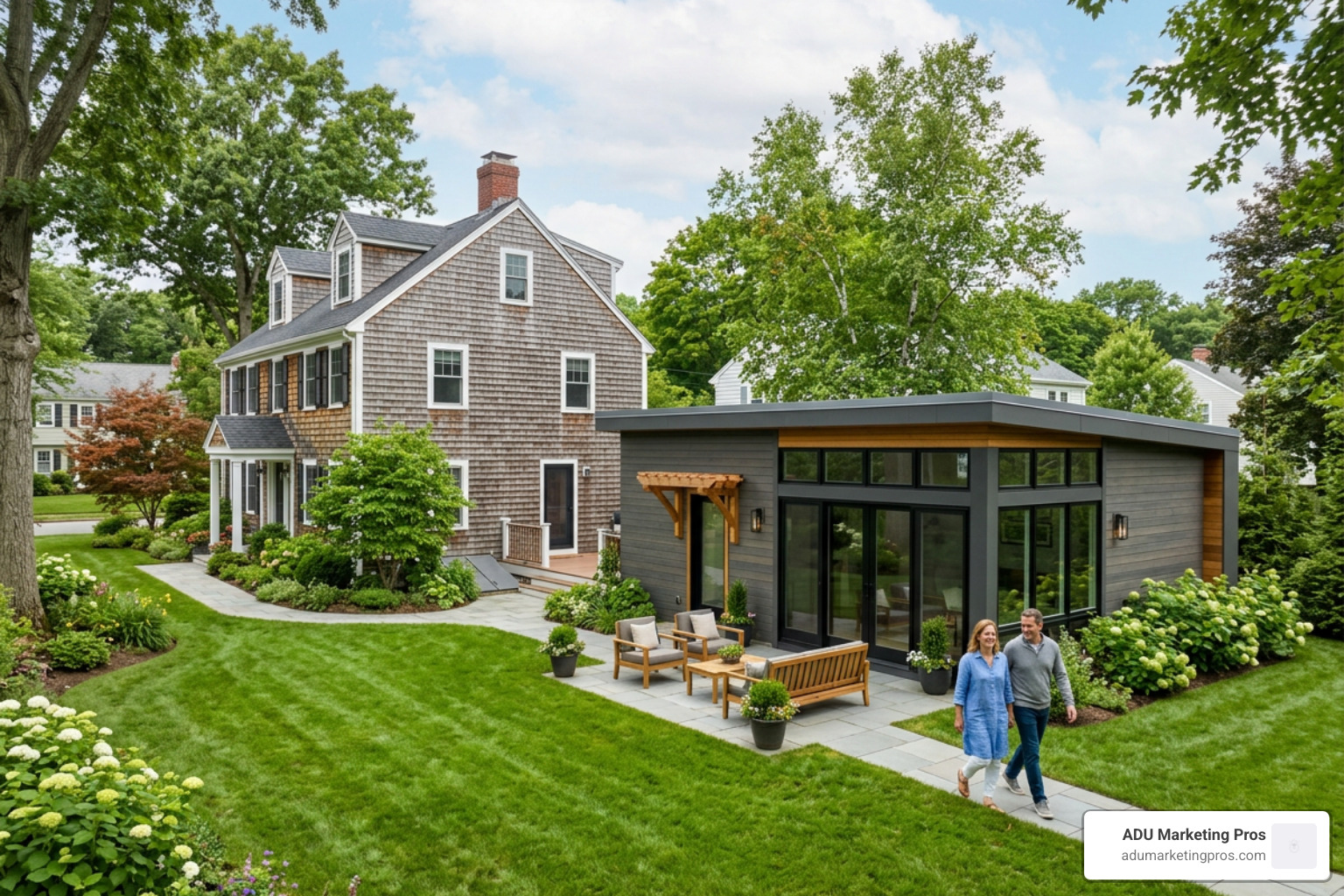
Effective February 2025, homeowners across the Commonwealth have the legal right to construct units up to 900 square feet (or half the size of the primary residence, whichever is smaller). This legislative foundation is what makes the adu grant massachusetts programs so viable. Without the legal certainty of “by-right” construction, lenders and state agencies would be far more hesitant to provide the necessary funding. Now that the legal path is clear, the focus has shifted to financial feasibility and ensuring that the construction process is as streamlined as possible.
Understanding By-Right Construction and ADU Grant Massachusetts Eligibility
In the context of Massachusetts real estate, “by right” means that if your project adheres to the state building code and local dimensional requirements—such as setbacks from property lines and height restrictions—you are entitled to a building permit. You no longer need a special vote from a Planning Board or a Zoning Board of Appeals. This shift significantly reduces the “soft costs” of development, as homeowners no longer need to hire expensive land-use attorneys to argue their case before local officials.
Under Section 8 of the new law, an ADU must be a self-contained housing unit with its own separate entrance, kitchen, and bathroom. It must also meet all modern safety codes for egress and fire protection. While the state has cleared the zoning path, homeowners must still be diligent about technical requirements. For instance, if your property relies on a septic system rather than city sewer, you must ensure your system complies with Title V requirements for the additional flow. This is where adu funding grants are particularly useful, as they can help cover the “soft costs” of engineering and soil testing that are required for septic upgrades. Title V compliance is often one of the most significant hurdles for rural ADU projects, and having grant funding to address these environmental requirements is a game-changer.
Municipal Flexibility and Local Restrictions
It is important to note that “by right” does not mean “unregulated.” Municipalities still retain the authority to impose reasonable regulations on the design and placement of the unit. A town can require a “site plan review” to ensure that the new structure does not create drainage issues for neighbors or that it maintains a certain aesthetic harmony with the primary residence. These reviews are intended to be objective and technical, rather than subjective and political.
Furthermore, towns have the right to prohibit the use of ADUs as short-term rentals (STRs). This is a common restriction intended to ensure that ADUs contribute to the long-term housing stock rather than becoming part of the Airbnb market. The goal of the state is to create permanent homes for residents, not temporary lodging for tourists. However, the state has also stripped towns of certain restrictive powers; for example, a municipality cannot require additional off-street parking for an ADU if the property is located within a half-mile of a public transit station. This is a critical provision for urban and transit-oriented communities where land is at a premium. For a deep dive into what your specific town can and cannot require, we recommend reviewing the Accessory Dwelling Units Guidance issued by the Executive Office of Housing and Livable Communities.
State-Level Financial Assistance: HMLP, MassHousing, and MHP Incentives
As the state pushes for more housing production, three major financial pillars have emerged to support homeowners. These programs are tailored to different demographics, ensuring that the ADU boom is accessible to seniors, middle-income families, and those with specific accessibility needs. By diversifying the types of financial aid available, Massachusetts is creating a robust ecosystem that supports housing creation at every level of the economic spectrum.
The Home Modification Loan Program (HMLP) for Accessibility
For homeowners building an ADU to support a family member with a disability or to allow a senior to age in place, the HMLP is one of the most generous programs in the nation. Since its inception in 1999, the program has helped over 3,000 Massachusetts residents modify their homes to improve safety and independence. The program recognizes that “aging in place” is not only more dignified for seniors but also significantly less expensive for the state than long-term institutional care.
The HMLP provides loans of up to $50,000 at 0% interest. For many participants, these loans are “deferred,” meaning no monthly payments are required. The balance is only repaid when the property is sold or the title is transferred. This makes it an ideal solution for families who have the space for an ADU but lack the liquid cash to fund accessibility features like ramps, roll-in showers, or specialized sensory spaces. The deferred nature of the loan ensures that seniors on fixed incomes are not burdened by new monthly debt. If your ADU project is centered on caregiving, you can find application materials at the Home Modification Loan Program Details page.
MassHousing ADU Loan Program and Income Limits
Recognizing that many homeowners do not have enough equity in their homes to secure a traditional construction loan, MassHousing is launching a massive new initiative in Spring 2026. This program is specifically targeted at the “missing middle”—homeowners who earn too much for traditional subsidies but not enough to easily afford a $200,000+ construction project. This demographic has historically been underserved by housing policy, often finding themselves caught between high market rates and low-income assistance thresholds.
The funding tiers are substantial and reflect the actual costs of construction in the current market:
- Up to $250,000 for detached ADUs (backyard cottages or carriage houses).
- Up to $150,000 for attached ADUs (basement apartments or garage conversions).
According to the MassHousing Program Announcement, the income limits are remarkably inclusive, set at 135% of the Area Median Income (AMI). In high-cost areas like Greater Boston, this means a household earning over $200,000 could still qualify for these low-interest second mortgages. This program is designed to turn the “equity gap” into a “housing opportunity,” allowing families to leverage their primary asset to create new housing and long-term wealth.
MHP ADU Incentive Program and Predevelopment Support
The Massachusetts Housing Partnership (MHP) is tackling the “analysis paralysis” that many homeowners face at the start of a project. Building an ADU involves complex decisions regarding utility hookups, foundation types, and site orientation. Many homeowners are intimidated by the technical requirements and give up before they even begin. MHP is administering a $10 million technical assistance fund to help homeowners navigate these early hurdles.
Through the ADU Incentives Program, homeowners can apply for grants to fund feasibility studies. These studies provide a professional assessment of your property’s capacity for an ADU, including utility capacity, soil stability, and preliminary design options. By funding these predevelopment steps, the state ensures that homeowners don’t spend their life savings on a design that is ultimately unbuildable due to site constraints. This “de-risking” of the early phase is essential for encouraging widespread adoption of ADUs.
City-Specific Support: The Boston ADU Financial Assistance Program
Boston is at the epicenter of the state’s housing crunch, and the city has responded with one of the most aggressive ADU support programs in the country. The Boston Home Center understands that urban construction is uniquely expensive, with costs often exceeding $275 per square foot due to tight lot lines, the complexities of working with older infrastructure, and the high cost of labor in the city. Boston’s program serves as a model for other high-density municipalities looking to increase housing stock without altering the character of historic neighborhoods.
Qualifying for the $7,500 Technical Assistance Grant
The first few months of an ADU project are often the most expensive in terms of “out-of-pocket” costs. Before you can even apply for a loan, you need architectural drawings, land surveys, and permit filings. These costs can easily reach $10,000 or more before a single shovel hits the ground. Boston’s $7,500 Technical Assistance Grant is designed to cover these exact expenses, lowering the barrier to entry for residents who may not have significant savings.
To be eligible, you must be an owner-occupant of a 1-to-3 unit residential property in Boston. There are income and asset limits—specifically, you cannot have more than $100,000 in liquid assets (excluding retirement accounts and home equity). This grant ensures that lower-income homeowners aren’t priced out of the planning phase. The city also provides a list of approved architects and consultants who are familiar with Boston’s specific building codes and ADU requirements. You can review the full eligibility criteria in the ADU Technical Assistance Grant Fact Sheet.
Utilizing the $50,000 Zero-Interest ADU Loan
Once the planning is complete, Boston offers a $50,000 zero-interest loan to help with actual construction. This is intended to serve as “gap financing.” For example, if your project costs $200,000 and you can only secure a $150,000 home equity line of credit (HELOC), the city’s loan fills that $50,000 hole. This gap is often what prevents projects from moving forward, as traditional lenders are sometimes hesitant to lend the full cost of an ADU build.
Like the state’s HMLP, this loan is deferred. There are no monthly payments, and the interest rate is 0%. The loan is only repaid when you sell the home or transfer the deed. Furthermore, the city provides a layer of protection for the homeowner by offering construction monitoring. A city-assigned specialist will periodically check the site to ensure the work is being done according to the approved plans and that the licensed contractor is meeting safety standards. This oversight is invaluable for homeowners who may be managing a construction project for the first time. More information can be found in the ADU Loan Fact Sheet.
How to Apply for an ADU Grant Massachusetts Homeowners Can Access
Navigating the application process for an adu grant massachusetts requires a structured approach. Because these are public funds, the state and municipal governments require a high level of transparency and planning. You cannot simply hire a handyman and hope for the best; you must work with licensed professionals and provide a clear financial roadmap. The process is designed to ensure that the resulting housing is safe, durable, and compliant with all state regulations.
Mandatory Workshops and Financial Readiness
For many of the programs, including Boston’s and the upcoming MassHousing initiative, participation in educational workshops is a prerequisite. These include the ADU Design Workshop and the ADU Budget Workshop. These sessions are designed to ground homeowners in the reality of modern construction costs and to help them avoid common pitfalls such as underestimating utility connection fees or over-designing for their specific lot.
In these workshops, you will learn that the average ADU in Massachusetts currently costs approximately $275 per square foot. For a 750-square-foot unit, that’s a $206,250 investment. To qualify for funding, you must submit a detailed ADU Budget Narrative. This document must account for every aspect of the build, from the foundation and framing to the final plumbing fixtures and landscaping. A well-prepared budget narrative is the key to securing approval from grant committees and lenders alike.
Combining Multiple Funding Sources
The most successful ADU projects often “stack” multiple sources of capital. A homeowner might use a $7,500 technical assistance grant for the design, a $50,000 HMLP loan for accessibility features, and a primary construction loan from a local credit union. This multi-layered approach allows homeowners to minimize their out-of-pocket expenses while maximizing the quality of the build. It also provides a safety net in case of unexpected construction costs, which are common in the Northeast due to soil conditions and weather delays.
There are also specialized regional programs to consider. In Western Massachusetts, the MassCEC ADU Accelerator provides funding specifically for all-electric, prefabricated ADUs. This program is part of a $500,000 initiative to promote sustainable, high-efficiency housing in the Pioneer Valley. By focusing on all-electric builds, the state is aligning its housing goals with its climate goals. Additionally, rural homeowners may be eligible for USDA Section 504 loans, which offer 1% interest rates for home repairs and modernizations. For a step-by-step guide on how to align your project with these various funding cycles, visit our resource on the accessory dwelling unit grant program.
Frequently Asked Questions
What is the maximum income to qualify for a MassHousing ADU loan?
The income limit is set at 135% of the Area Median Income (AMI). Because the AMI varies by county, the specific dollar amount changes based on where you live. For a family in Eastern Massachusetts (including Boston and Cambridge), the limit is approximately $205,335. In Worcester County, it is roughly $165,345, and in Hampden County, it is about $129,870. These limits are adjusted annually and also depend on the number of people in your household. It is important to check the most recent HUD data for your specific municipality.
Can I build an ADU if I live in a single-family zone?
Yes. Under the 2024 Affordable Homes Act, ADUs up to 900 square feet are now permitted by right in all single-family zoning districts across Massachusetts. While you must still comply with local dimensional requirements (such as how far the unit must be from your neighbor’s fence), the town can no longer prohibit the construction of the unit itself. This law effectively ends the era of exclusionary zoning for small-scale housing in the Commonwealth.
How long does the ADU grant application process take?
Homeowners should prepare for a 3 to 6 month predevelopment phase. This includes attending mandatory workshops, conducting feasibility studies, and obtaining architectural plans. Once your funding is approved and your building permit is issued, the actual construction phase typically takes an additional 6 to 9 months, depending on whether you are building a detached unit or converting an existing space like a basement. Total project time from concept to completion is usually 12 to 18 months.
Will building an ADU increase my property taxes?
Generally, yes. Adding a habitable unit to your property increases its assessed value, which will likely lead to an increase in property taxes. However, the rental income generated by the ADU often far exceeds the increase in tax liability. Many homeowners find that the ADU pays for itself while also building long-term equity. Additionally, some municipalities are exploring tax abatements for ADUs that are rented at affordable rates.
Can I use an ADU as an Airbnb in Massachusetts?
It depends on your local town’s bylaws. While the state law legalizes the construction of ADUs, it allows municipalities to regulate their use. Many towns have banned short-term rentals (less than 30 days) for ADUs to ensure they are used for long-term housing. You should check with your local building department or planning board before planning to use your ADU as a vacation rental.
Do I need a separate utility meter for my ADU?
While not always required by state law, many homeowners choose to install separate meters for electricity and water to simplify billing for tenants. However, some grant programs may have specific requirements regarding utility connections, especially those focused on energy efficiency. Your architect or contractor can help you weigh the upfront cost of separate metering against the long-term benefits.
Conclusion
The outlook for anyone researching adu grant massachusetts options is stronger than it has been in years. With statewide by-right ADU legalization, city-level assistance in Boston, and larger financing tools scheduled to roll out, homeowners now have more realistic paths to fund small secondary homes for rental income, aging in place, or multigenerational living. The shift from a restrictive, permit-heavy environment to a supportive, incentive-based landscape marks a turning point for the Massachusetts housing market.
For ADU companies, this is also a clear signal that Massachusetts is becoming a more active and competitive market. As regulations evolve and homeowner demand grows, firms that publish useful local content, explain funding clearly, and demonstrate real expertise will be better positioned to win qualified leads. This pattern mirrors what we have seen in California markets like San Jose, Los Angeles, and San Francisco, where ADU-focused firms that invest in educational content consistently outperform competitors relying on generic advertising. The Massachusetts market is ripe for professionals who can navigate the intersection of historic preservation and modern building technology.
That is where ADU Marketing Pros fits in. Based in San Jose and serving ADU-focused firms across major markets nationwide, we help construction and architecture companies build visibility through niche SEO, PPC, and content strategies tailored specifically to the ADU industry. Whether your firm is based in Massachusetts or looking to expand into East Coast markets from a California home base, our focus is on helping ADU professionals attract the homeowners who are actively researching projects like these. We provide the digital infrastructure that allows your expertise to shine in a crowded marketplace.
If you want to better understand how funding-focused content can support your ADU business growth, explore our guide to the accessory dwelling unit grant program and related resources on ADU lead generation. The ADU revolution is here, and the firms that lead with education and transparency will be the ones that define the future of housing in the Commonwealth.