
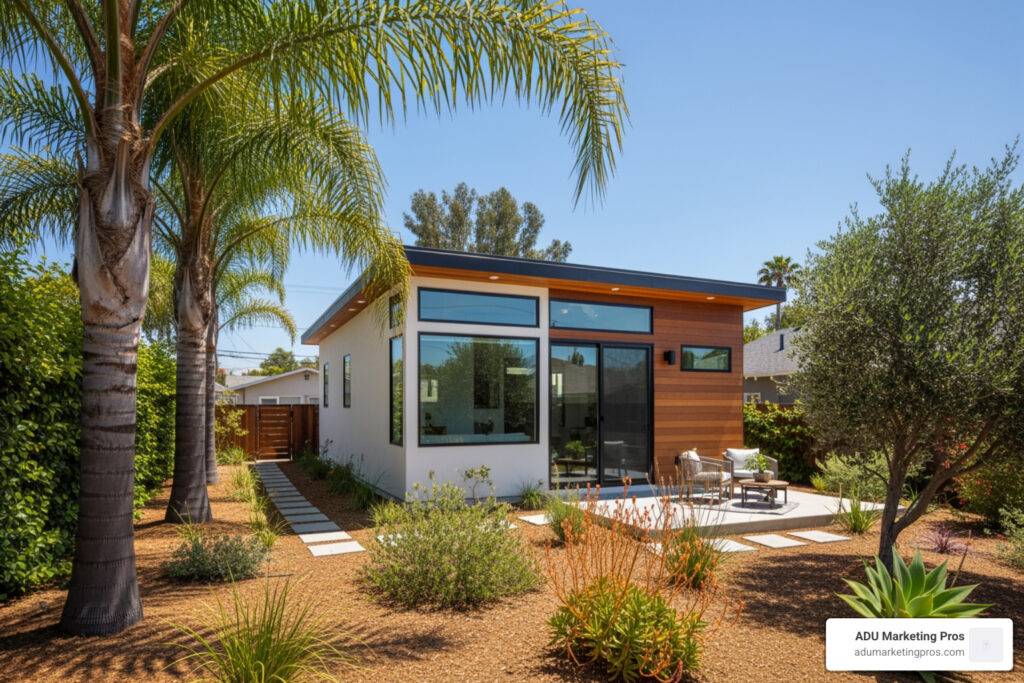
Why Building a City of San Diego ADU Is Easier Than You Think
A city of san diego adu can unlock rental income, boost property value, and add much-needed housing without buying a new property. San Diego has become a national leader in ADU adoption by reducing red tape and encouraging gentle density consistent with its long-term planning goals.
Quick Answer: City of San Diego ADU Basics
- What you can build (typical single-family lot): one detached or attached ADU, one converted ADU (such as a garage), and one Junior ADU (JADU).
- Size limits: ADUs up to 1,200 sq ft; JADUs up to 500 sq ft.
- Parking: usually not required, with limited exceptions in certain coastal areas outside transit-rich zones.
- Permits: a building permit is required; a Coastal Development Permit may also apply in parts of the Coastal Overlay Zone.
- Bonuses: affordable units can unlock additional ADUs through the city program.
- Financing: the SDHC program may offer eligible homeowners loans up to $250,000.
Between 2021 and 2024, the city permitted 5,720 ADU homes across 4,388 projects. Recent updates also aligned local rules with state law and clarified bonus program and safety requirements, including changes adopted through the citys broader Housing Action Package.
This guide covers the essentials: what ADUs and JADUs are, how many you can build, size and setback rules, parking exemptions, density bonus basics, coastal considerations, permitting steps, and how to legalize existing unpermitted units. We also summarize key differences between City of San Diego rules and County rules so you can confirm which jurisdiction applies.
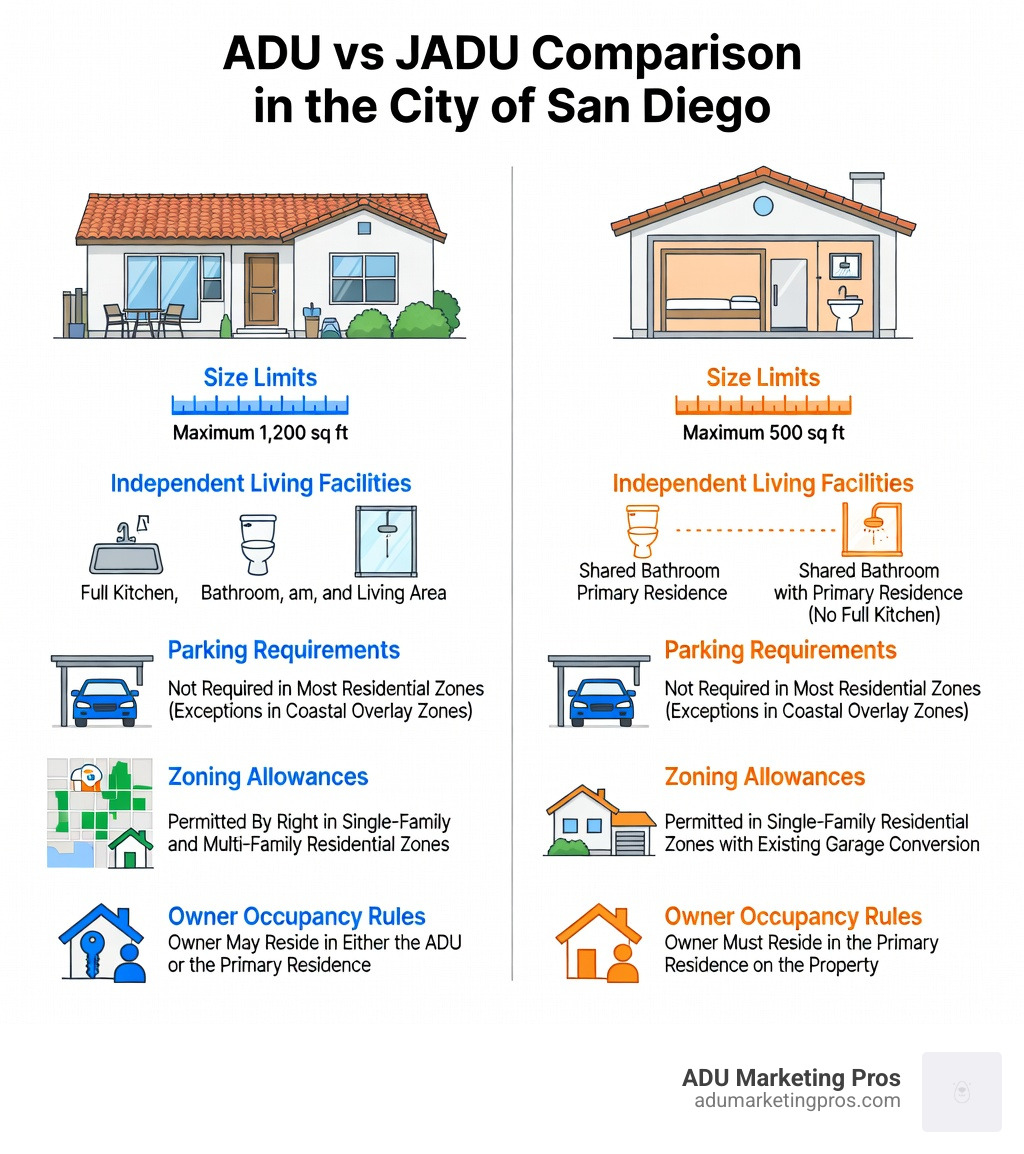
Basic city of san diego adu terms:
Understanding City of San Diego ADU and JADU Basics
When we talk about adding a secondary home to your property, we are usually looking at two distinct categories: the Accessory Dwelling Unit (ADU) and the Junior Accessory Dwelling Unit (JADU). In the City of San Diego, these are treated as “separately regulated uses” under the San Diego Municipal Code. Understanding the nuances between these two can save you thousands in construction costs and months in the permitting phase. The city has aggressively updated its local ordinances to exceed state minimums, creating a unique environment for “gentle density.”
An ADU is a complete, independent living facility. This means it has its own kitchen, bathroom, and sleeping area. It can be attached to the main house, detached (like a backyard cottage), or converted from an existing space like a garage. On the other hand, a JADU is a more “lite” version of a secondary suite. It must be contained within the walls of an existing or proposed single-family home (or an attached garage) and is limited to 500 square feet. JADUs are designed to be the most affordable way to add housing, often utilizing a spare bedroom or a portion of the main house.
Before you start picking out finishes, we always recommend a thorough zoning check. You can run a Property Summary Report using your Assessor’s Parcel Number (APN) to see exactly what your lot allows. For the deep-dive legal requirements, the Chapter 14, Article 1, Division 3 of the Municipal Code is the primary source of truth for san-diego-adu-laws.
What Defines an ADU and JADU?
In the city of san diego adu landscape, size and autonomy are the key differentiators:
- ADU (Accessory Dwelling Unit):
- Maximum Size: 1,200 square feet. This is a generous limit compared to many other California cities, allowing for full three-bedroom units.
- Facilities: Must include permanent provisions for living, sleeping, eating, cooking (a full kitchen with a stove/oven), and sanitation.
- Entry: Must have a separate exterior entrance, ensuring privacy for both the primary residents and the ADU tenants.
- JADU (Junior Accessory Dwelling Unit):
- Maximum Size: 500 square feet.
- Location: Must be within the primary residence or an attached garage. Recent 2025 updates have clarified that JADUs cannot be placed in detached structures.
- Kitchen: Requires an “efficiency kitchen” which must include a sink with a minimum drain size, a permanent cooking appliance (like a built-in hot plate or microwave), and a food preparation counter.
- Sanitation: Can have its own bathroom or share one with the main house, provided there is internal access.
- Requirement: A “Junior Unit Agreement” must be recorded with the County Recorder before the permit is issued. This is a legal covenant that restricts the unit from being sold separately from the main house.
Number of Allowed Units for a City of San Diego ADU
How many units can you actually fit on your lot? This depends heavily on whether your property is zoned for a single-dwelling unit or multiple-dwelling units. San Diego is unique in that it allows for “triplexing” single-family lots by right, effectively bypassing some of the more restrictive density limits found in other jurisdictions.
| Lot Type | Converted ADU | Detached ADU | JADU | Total “By Right” |
|---|---|---|---|---|
| Single-Family Lot | 1 | 1 | 1 | 3 Units |
| Multi-Family Lot | 25% of existing units | 2 | N/A | Varies |
For single-family lots, the standard allowance is one JADU, one converted ADU, and one detached or attached ADU. This effectively allows a single-family property to become a three-unit premises. This is a powerful tool for homeowners looking to maximize their land use without needing a complex re-zoning process. For multi-family lots (apartments or duplexes), the rules are even more generous. You can add up to two detached ADUs by right. Additionally, you can convert non-habitable spaces (like storage rooms, boiler rooms, or attics) into ADUs without a specific unit limit, provided they meet building codes. You can also convert habitable space into ADUs up to 25% of the existing unit count. For more on maximizing these numbers, check our guide on adu-san-diego.
Size and Height Regulations
San Diego has set specific boundaries to ensure ADUs fit into the neighborhood fabric while remaining functional. These standards are designed to prevent “mansionization” while still allowing for comfortable living spaces.
- Minimum Size: All units must be at least 150 square feet, which is the minimum size for an efficiency unit under the California Building Code.
- Maximum Size: ADUs are capped at 1,200 square feet of interior livable space. JADUs are capped at 500 square feet. Note that if you are building an attached ADU, it cannot exceed 50% of the primary dwelling’s size, though the city must allow at least an 800 sq ft unit regardless of this ratio.
- Height Limits:
- A detached ADU is generally allowed to reach 16 feet in height.
- However, if the property is within a Sustainable Development Area (SDA), or if it meets certain setback requirements, it can often reach 30 feet to allow for two-story designs. This is particularly useful for small lots where building “up” is the only way to preserve backyard space.
- Fire Hazard Zones: If your property is in a High or Very High Fire Hazard Severity Zone, additional height and setback restrictions may apply to ensure emergency access. In these areas, the city often requires a 4-foot setback even if state law would otherwise allow for less.
Navigating these limits is where adu-contractors-san-diego prove their worth, as they can help you maximize square footage without triggering expensive discretionary reviews or neighborhood appeals.
Development Standards: Setbacks, Height, and Parking
Design standards are about safety, privacy, and ensuring the unit can be permitted without delays. Every city of san diego adu must comply with the California Building Standards Code, including Title 24 energy requirements and applicable fire and life-safety rules.
A common cost question is solar. Under the California Energy Code, newly constructed detached ADUs typically require solar photovoltaic (PV) systems. Conversions (such as an existing garage or existing interior space) may be treated differently under the energy code, which can reduce upfront cost. Confirm requirements early with your designer or plan checker.
Setback and Landscape Requirements
Setbacks control how close you can build to property lines.
- Side setback: 4 feet.
- Rear setback: 4 feet.
- Front setback: generally follows the underlying base zone, but the city cannot enforce a front setback that would prevent an 800-square-foot ADU allowed by state law.
Landscaping can also apply. Some projects trigger street-tree requirements intended to maintain the urban canopy. The city has referenced standards such as providing two trees per 5,000 square feet of lot area in certain contexts, and these details were discussed as part of the Housing Action Package 1.0. Existing trees may count depending on your site conditions and city review.
Parking Exemptions for Your City of San Diego ADU
In most cases, ADU projects do not require new off-street parking, which helps keep projects feasible on small lots.
You typically do not need to provide parking if:
- The ADU is within a Sustainable Development Area (SDA) (generally within 1 mile of a major transit stop).
- The unit is a JADU.
- The unit is created within the existing primary residence or an existing accessory structure (such as a garage conversion).
- The property is in a designated historic district.
- The property is within one block of a car-share location.
Beach Impact Area exception: If your property is in the Beach Impact Area of the Coastal Overlay Zone and not within an SDA, you may be required to provide one off-street parking space for a detached ADU over 500 square feet. Even then, garage conversions generally do not require replacement parking. This is particularly relevant for owners planning long-term rentals in high-demand coastal neighborhoods; see adu-rentals-san-diego for rental-focused considerations.
The ADU Home Density Bonus and Affordability Programs
San Diego is famous among housing advocates for its “Density Bonus” program. This is the “secret sauce” that allows some property owners to build far more than the standard three units. While most of California allows for two or three units per lot, San Diego’s local ordinance allows for significantly more density if the homeowner is willing to provide affordable housing. This program is a cornerstone of the city’s strategy to increase the supply of naturally occurring affordable housing.
The core idea is simple: for every deed-restricted affordable ADU you build, the city allows you to build one “bonus” market-rate ADU. This creates a powerful incentive for private homeowners to contribute to the city’s affordable housing stock without requiring direct government subsidies.
How the Bonus Program Works
- The Ratio: 1 affordable unit = 1 bonus market-rate unit. This means if you build one affordable unit, you can build two total ADUs. If you build two affordable units, you can build four total ADUs.
- Affordability Term: The affordable unit must be deed-restricted for 15 years. During this time, the rent is capped based on the tenant’s income level, and the agreement is recorded against the property title.
- Income Limits: The units must be affordable to households earning at most 80% of the Area Median Income (AMI). For 2024, 80% AMI for a single person in San Diego is approximately $77,200. This makes these units accessible to the “missing middle”—teachers, first responders, and service workers who are often priced out of the coastal market.
- Location Matters:
- Inside Sustainable Development Areas (SDAs): There is effectively no cap on the number of bonus units you can “stack,” provided you keep the 1:1 ratio and meet building code requirements. This has led to innovative “ADU apartment” projects in transit-rich areas like North Park and City Heights.
- Outside SDAs: You are generally limited to one bonus unit.
- Lot Size Caps: To keep projects in scale with neighborhoods, the city recently introduced caps in 2024. On lots of 8,000 sq ft or less, you are capped at 4 total ADUs (including bonuses). On lots over 10,000 sq ft, the cap is 6. This prevents massive complexes from being built on standard suburban lots.
For more details on the math, we recommend the ADU Bonus Program Quick Facts. If you’re looking for designs that fit these multi-unit layouts, More info about pre-approved plans can help you get started.
Fees and Community Enhancements
While ADUs under 750 square feet are exempt from Development Impact Fees (DIF) per state law, San Diego has introduced a “Community Enhancement Fee” for bonus ADUs. This fee helps fund infrastructure like parks and fire stations in the neighborhoods where density is increasing. It is a way to ensure that the growth pays for itself and doesn’t degrade the quality of life for existing residents.
Other fees you should budget for include:
- General Plan Maintenance Fee: A small fee that applies to all building permits to fund long-term planning efforts.
- School Fees: Usually required if the ADU is over 500 square feet. These fees go directly to the local school district (e.g., San Diego Unified) to account for potential new students. Expect to pay between $4 and $5 per square foot.
- Inclusionary Housing Fees: May apply if the total number of units on the lot exceeds 10 (or 5 in the Coastal Zone). However, most ADU projects fall well below this threshold.
- Water and Sewer Capacity Fees: While the city cannot charge these for ADUs under 750 sq ft, larger units may trigger a “capacity charge” to account for the increased load on the city’s infrastructure. These fees are calculated based on the number of fixtures (sinks, toilets, etc.) added to the property.
Coastal Overlay Zones and 2025 Regulatory Updates
Building near the water? The Coastal Overlay Zone adds a layer of complexity. Because the California Coastal Act protects public access to the beach and preserves coastal resources, any development in this zone is subject to stricter scrutiny. Most ADU projects in this zone require a Coastal Development Permit (CDP).
However, the city has streamlined this into a “Process One” ministerial permit. This means that as long as you meet the specific checklist of requirements, the permit is issued automatically as part of your building permit. You don’t have to go before a planning commission or the City Council for approval, which significantly reduces the risk and timeline of your project.
Housing Action Packages 1.0 and 2.0
San Diego’s Housing Action Packages (HAP) have introduced 25 comprehensive reforms. Key highlights from HAP 2.0 and the 2025 updates include:
- Separate Sale (AB 1033): San Diego has adopted provisions allowing ADUs to be sold separately as condominiums. This is a game-changer for homeowners looking to provide “starter home” opportunities. It allows a homeowner to build an ADU and sell it to a first-time buyer, though it requires a formal condominium subdivision and the creation of a Homeowners Association (HOA).
- Fire Safety: New requirements for 4-foot side and rear setbacks in fire-prone areas to ensure defensible space. This overrides the state’s 0-foot setback allowance for certain conversions in these high-risk zones.
- Evacuation Routes: Bonus ADUs in fire zones must now demonstrate clear evacuation routes. This ensures that as we add density, we aren’t creating safety hazards during a wildfire event.
- JADU Revisions: JADUs are now prohibited in detached garages to ensure they remain part of the primary residence structure. This maintains the “Junior” nature of the unit as a subset of the main home.
You can find the full text of these updates in O-21758. These updates are part of a continuous effort to refine the code based on real-world feedback from homeowners and builders.
City vs. County of San Diego Rules
It is vital to know if your property is in the City of San Diego or an unincorporated area of the County. This is a common point of confusion, especially in areas like El Cajon, Escondido, or parts of La Jolla that may have different jurisdictional boundaries.
- City Rules: More aggressive density bonuses, allows JADUs and ADUs on the same lot, and has specific Sustainable Development Area benefits. The City is generally more “pro-density” than the County.
- County Rules: Focuses on unincorporated areas like Fallbrook, Lakeside, or Ramona. While they previously had a fee waiver program, it ended in early 2024. The County follows state law precedence but has different size limits for attached units (up to 50% of the main house) and different setback requirements for large rural lots.
- Amnesty: Both jurisdictions now offer paths to legalize unpermitted units under AB 2533, provided they meet basic health and safety standards. This is a “no-penalty” way to bring your property into compliance.
For properties outside city limits, visit the County of San Diego’s website to verify their specific setbacks and size caps.
Permitting, Financing, and Legalizing Unpermitted Units
The permitting process in San Diego has moved entirely online, which has greatly increased transparency and speed. You can now submit your city of san diego adu application through the Development Services Department’s (DSD) Online Permitting Account. This portal allows you to track the status of your review in real-time, respond to comments from city engineers, and pay your fees securely from your computer. The city has also implemented a “no-touch” permit path for certain simple conversions.
Thanks to AB 1332, if you use pre-approved-adu-plans-san-diego, the city is required to complete its review within 30 days. These pre-approved plans have already been vetted for structural and life-safety compliance, meaning the city only needs to review your specific site plan—how the unit sits on your lot and connects to utilities.
SDHC ADU Finance Program
One of the biggest hurdles to building is the cost. Construction costs in San Diego can range from $250 to $500 per square foot depending on finishes and site conditions. To help, the San Diego Housing Commission (SDHC) offers a fantastic ADU Finance Program for low-to-moderate-income homeowners:
- Loan Amount: Up to $250,000 for construction costs.
- Interest Rate: 1% during the construction phase, which prevents interest from ballooning while you aren’t yet collecting rent. It then moves to a fixed 4% for the permanent loan term.
- Eligibility: Homeowners earning up to 150% of the Area Median Income (approx. $236,600 for a family of four in 2024).
- Requirement: You must rent the ADU to a household earning 80% AMI or less for at least seven years. This program is perfect for homeowners who want to build a unit for a family member or a lower-income tenant while keeping their monthly debt service low.
Legalizing Unpermitted ADUs (Amnesty)
If you have an “off-the-books” granny flat built before January 1, 2020, now is the time to legalize it. Many homeowners are afraid that coming forward will lead to fines or a demolition order, but the current “Amnesty” laws are designed to be helpful, not punitive. Under AB 2533 and SB 1226, the city cannot deny your permit based on building code violations that don’t pose an immediate health and safety risk.
For example, if your unpermitted unit has slightly lower ceilings than the current code requires, the city can grant a waiver as long as the unit is structurally sound and has proper fire exits. We can help you navigate the “Substandard Structure Checklist” to bring these units into compliance retroactively. This process protects your investment, increases your home’s appraised value, and allows you to rent the unit legally without fear of code enforcement complaints or liability issues. Legalizing a unit also allows you to include the rental income when refinancing your primary mortgage.
Frequently Asked Questions about City of San Diego ADUs
Can I sell my ADU separately from my main house?
Potentially. Under AB 1033, cities may adopt rules allowing ADUs to be subdivided and sold as condominiums. San Diego has adopted local provisions that allow this path in certain situations, but it generally requires a full condominium subdivision process and the creation of an HOA. Units built under affordability or bonus programs may have additional deed restrictions that prevent separate sale for a set period.
Do I need to live in one of the units?
For a standard ADU, owner-occupancy is generally not required under current state rules for units permitted between 2020 and 2025. For a JADU, owner-occupancy requirements can apply under state law, meaning the owner must live in either the JADU or the primary residence. Also note that San Diego ADUs are intended for long-term housing: ADUs must generally be rented for a minimum of 31 days, and short-term vacation rentals (like Airbnb) are typically prohibited for newly permitted ADUs.
Are fire sprinklers required for my ADU?
Fire sprinklers are generally required only if they are required for the primary dwelling. However, if you are building a detached ADU and the main house does not have sprinklers, you usually do not need to add them to the ADU unless it is located in a specific high-risk fire zone or is over a certain size. Always confirm this during the initial plan check phase.
Can I use a manufactured home as an ADU?
Yes. San Diego allows manufactured homes (built to federal HUD code) to be used as ADUs. They must be placed on a permanent foundation system and comply with the same setback and height regulations as site-built ADUs. This can be a significantly faster and more cost-effective way to add a unit to your property.
Will an ADU increase my property taxes?
Yes, but typically only based on the value of the new construction. Under California’s Proposition 13 framework, adding an ADU generally results in a “blended assessment.” The base value of your existing home remains the same, and only the value of the new ADU is added to your tax bill. This prevents a full reassessment of the entire property.
Can I have separate utility meters for my ADU?
Often, yes. Many owners choose separate electric metering so the tenant can hold their own account with SDG&E. Water and sewer metering rules vary by project type and size. While the city cannot require a separate water meter for some smaller ADUs or certain conversions, an owner can choose to add a sub-meter to track usage and bill tenants accurately.
Conclusion
Building a city of san diego adu is one of the smartest ways to maximize your property’s potential. Whether you are looking to house an aging parent, provide a space for a returning college student, or generate a steady stream of rental income, the current regulatory environment in San Diego is the most favorable it has ever been. With the city’s aggressive density bonuses, parking exemptions, and the SDHC’s low-interest financing, the barriers to entry have never been lower.
At ADU Marketing Pros, we specialize in helping construction and architecture firms navigate these complex regulations to attract high-quality leads. We believe in focusing on expertise over price, ensuring that every project is built to the highest standard of compliance and design. The San Diego market is moving fast, and staying ahead of the 2025 updates is key to a successful build. Whether you are looking to build a simple garage conversion or a multi-unit affordable housing project, the tools and resources are at your fingertips.
Ready to take the first step toward expanding your property’s footprint? Start your project with pre-approved plans to save time and money on your San Diego build, and join the thousands of homeowners who are helping to shape the future of housing in America’s Finest City.