
Why California ADU Incentives Are Your Secret Weapon for Affordable Housing
California ADU incentives are a powerful suite of financial programs specifically designed to help homeowners overcome the significant costs associated with building an accessory dwelling unit (ADU). In a state grappling with a severe housing shortage and soaring property values, these incentives are more than just a bonus—they are a critical tool for creating affordable housing solutions in your own backyard. Through a combination of grants, fee waivers, low-interest loans, and rebates, these programs can save you tens of thousands of dollars, making your ADU project not just possible, but profitable.
This comprehensive guide is for any California homeowner who has considered building an ADU but felt intimidated by the price tag. Whether you’re looking to generate rental income, house a family member, or simply increase your property’s value, understanding these incentives is the first step toward success.
Quick Answer: Top California ADU Incentives in 2025
- CalHFA ADU Grant Program: Provides up to $40,000 in grant money (which you don’t pay back) to cover pre-development costs like design, permits, and site prep. This program is subject to funding availability and is highly competitive.
- Local City/County Programs: These hyper-local incentives can include waivers of expensive permit and impact fees, cash rebates up to $7,500, and even forgivable loans up to $40,000 for homeowners who agree to rent to low-income tenants.
- ADU-Specific Loans: A growing number of lenders offer specialized financing, including HELOCs, construction loans, and renovation loans. Many of these products feature favorable terms based on the property’s future value with the completed ADU.
- Tax Benefits: Building an ADU comes with significant tax advantages, including property tax protections under Prop 13, annual depreciation deductions on the rental unit, and potential tax credits for energy-efficient construction.
California’s housing crisis has made accessory dwelling units a practical and popular solution. However, the cost to build an ADU can range from $150,000 to over $300,000, with permits and plans adding tens of thousands more. This is precisely why California has rolled out a robust network of state and local incentive programs to make ADU construction financially feasible for the average homeowner.
The flagship CalHFA ADU Grant, when combined with local rebates and specialized financing, can slash your upfront costs by $40,000 or more. The result? An ADU that can generate $2,000-$4,000 per month in rental income, increase your property value by an estimated 15-30%, and pay for itself much faster than you might imagine.
The Flagship Incentive: Unpacking the CalHFA ADU Grant Program
At the very top of the list for California ADU incentives is the renowned CalHFA ADU Grant Program. Administered by the California Housing Finance Agency, this program is a direct effort to accelerate housing production by removing the initial financial barriers that stop many ADU projects before they even start. It’s the state’s most significant and sought-after incentive.
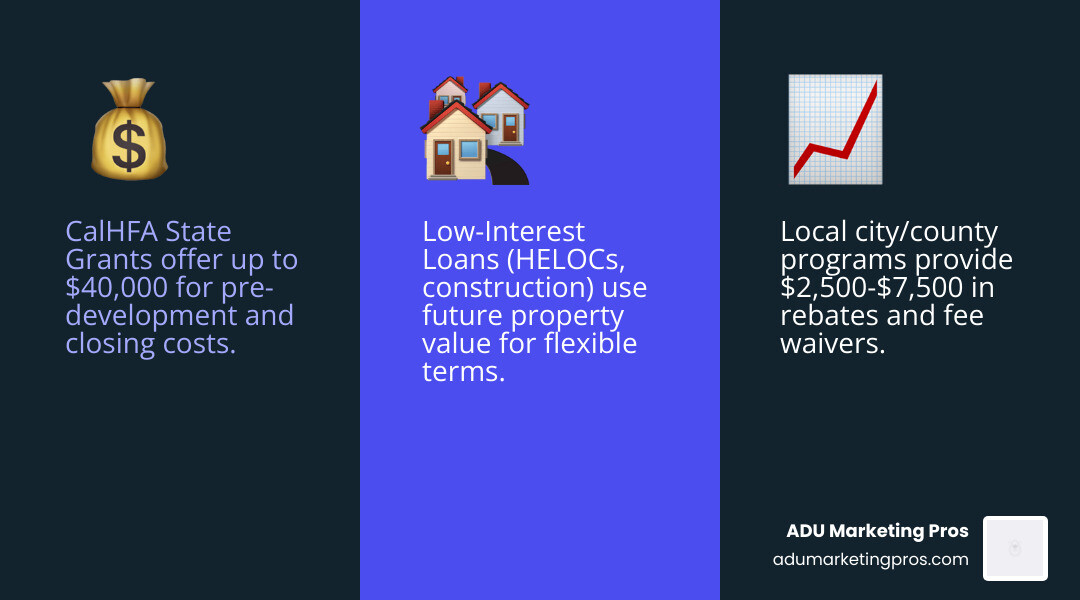
Eligible homeowners can receive up to $40,000 as a grant—not a loan—to cover a wide range of pre-development and non-recurring closing costs. This funding is designed to get your project off the ground without draining your savings. You can find the latest details and funding status on the official CalHFA ADU Grant Program page.
However, it’s critical to understand that demand for this grant is extremely high. The most recent funding rounds were exhausted within days, sometimes hours. It is crucial to check CalHFA’s website regularly for announcements about new funding allocations. For a deeper dive into the program’s history and strategies for applying, our guide on the Accessory Dwelling Unit Grant Program offers additional insights.
What Costs Does the Grant Cover?
The CalHFA grant specifically targets the soft costs—the pre-construction expenses that can quickly add up and deplete a budget before a single nail is hammered. Covered costs include:
- Architectural Designs & Structural Engineering: Fees for creating your ADU blueprints and ensuring they are structurally sound.
- Permits: The cost of submitting plans to your local jurisdiction and obtaining the necessary building permits. This can often run from $5,000 to $20,000.
- Soil Tests: Required in some areas to determine foundation requirements.
- Impact Fees: Fees charged by local governments to offset the impact of new development on public services. These can be substantial, and the grant can help cover them.
- Property Surveys: To establish property lines and ensure the ADU is placed correctly.
- Energy Reports: Title 24 reports required in California to ensure energy efficiency.
- Non-Recurring Closing Costs: Lender-related fees associated with your primary construction financing.
Having these expenses covered allows you to allocate more of your own funds directly to the hard costs of construction. To better understand permit expenses, see our article on ADU Permit Cost California.
Eligibility Requirements for the CalHFA Grant
The program is targeted toward moderate-income homeowners who need financial assistance. While requirements can be adjusted with new funding rounds, the key eligibility criteria generally include:
- Property Type: You must own and occupy a single-family residence, manufactured home, or a duplex in California.
- Income Limit: Your household income must be at or below 150% of your county’s Area Median Income (AMI). This threshold varies significantly by county.
- Financial Standing: You will need a credit score of at least 640 and have no outstanding judgments or liens (other than your existing mortgage).
- ADU Type: The grant can be used for a new construction detached or attached ADU, a conversion of existing space (like a garage), or an addition that creates a complete, self-contained living unit.
The application process is not handled directly by the homeowner but through a CalHFA-approved lender. This lender will integrate the grant application into your overall ADU construction financing package.
What to Do if the CalHFA Grant is Unavailable
If you discover that CalHFA funds are currently exhausted, do not be discouraged. This is common. The program operates on funding cycles, and new allocations are expected as the state continues to prioritize housing solutions. Here’s what you can do while you wait:
- Get Pre-Approved: Contact a CalHFA-approved lender to get pre-qualified for your construction loan. This will put you in a prime position to apply the moment new grant funds are released.
- Prepare Your Documents: Gather your income verification, property details, and credit information so you are ready to move quickly.
- Explore Alternatives: The CalHFA grant is a fantastic tool, but it’s just one of many california adu incentives. Use this time to research the numerous alternative paths California offers. Many cities and counties run their own incentive programs with fee waivers, rebates, and forgivable loans. Additionally, specialized ADU loan options can bridge the funding gap. Our guide on ADU Funding Grants explores more of these options.
Beyond the Grant: Alternative ADU Financing and Loan Options
While grants are the most attractive form of funding, securing a loan is the most common and effective way to finance an ADU project. These financing strategies are designed to cover all project costs—from design to construction to final inspection—allowing you to build now and pay for the project over time using the rental income it generates.
Lenders increasingly recognize that an ADU is an income-generating asset that adds significant value to a property. Some will even consider the future rental income your ADU will generate when evaluating your loan application, making it much easier to qualify. To explore the full landscape of financing, check out our comprehensive guide: From Loans to Investments: Navigating ADU Financing.
Types of ADU Loans Available in California
California’s mature ADU market means homeowners have access to a robust variety of loan products. Here are the most common options:
- Home Equity Line of Credit (HELOC): A flexible, revolving line of credit secured by your home’s equity. You draw funds as needed during construction and only pay interest on what you use. This is great for managing cash flow, but rates are often variable, which can be a risk.
- Home Equity Loan: A lump-sum loan with a fixed interest rate and predictable monthly payments. This is ideal if you have a firm, set budget for your ADU and prefer the stability of a fixed payment.
- Construction Loans: These are short-term loans specifically for building projects. Funds are released in stages (called “draws”) as your project hits specific milestones. They often convert to a permanent mortgage upon completion.
- Renovation Loans: Products like the Fannie Mae HomeStyle® or FHA 203(k) loan allow you to bundle ADU construction costs with other home improvements into a single mortgage, either as a purchase or a refinance.
- Cash-out Refinance: You can refinance your existing mortgage for a larger amount than you currently owe and use the cash difference to fund your ADU. This can be a good option if interest rates are favorable.
- Specialized ADU Loan Programs: Some local credit unions and dedicated ADU finance companies offer low- or zero-interest loans to qualifying homeowners, often in partnership with local governments. For more details, visit our page on ADU Financing Options.
How to Qualify for an ADU Loan
Qualifying for an ADU loan is similar to applying for a traditional mortgage, but with some helpful twists unique to ADUs. Lenders will assess your:
- Credit Score: A score of 680 or higher is generally preferred, but some lenders and programs work with scores as low as 620.
- Stable Income: You’ll need to provide pay stubs, tax returns, and bank statements to prove you have the income to make the loan payments.
- Debt-to-Income (DTI) Ratio: Most lenders prefer a DTI below 43%, which compares your total monthly debt payments to your gross monthly income.
- Property Appraisal: The lender will assess your property’s current value and, in many cases, its projected after-renovation value (ARV). This ARV appraisal, which includes the value of the completed ADU, can allow you to borrow significantly more than a standard home equity loan.
The true game-changer for california adu incentives is that some lenders will factor in your ADU’s potential rental income when calculating your DTI ratio. This forward-thinking approach, officially supported by guidelines from both Fannie Mae and Freddie Mac, can dramatically improve your borrowing power and make it much easier to qualify for the loan you need to complete your project.
Local Heroes: City and County-Specific California ADU Incentives
While the CalHFA grant gets the most attention, some of the most valuable california adu incentives are found at the local level. Many city and county governments offer their own unique programs tailored to local housing needs. These programs can provide significant financial relief through fee waivers, direct cash rebates, and innovative loan programs. The California Department of Housing and Community Development (HCD) offers a great overview of these statewide efforts on their Accessory Dwelling Units page.
These local incentives are designed to complement state-level efforts and can often be stacked with other forms of financing, creating a powerful combination of savings.
Examples of Standout Local Programs
Across California, cities and counties are getting creative to spur ADU development. Here are a few examples that showcase the variety of programs available:
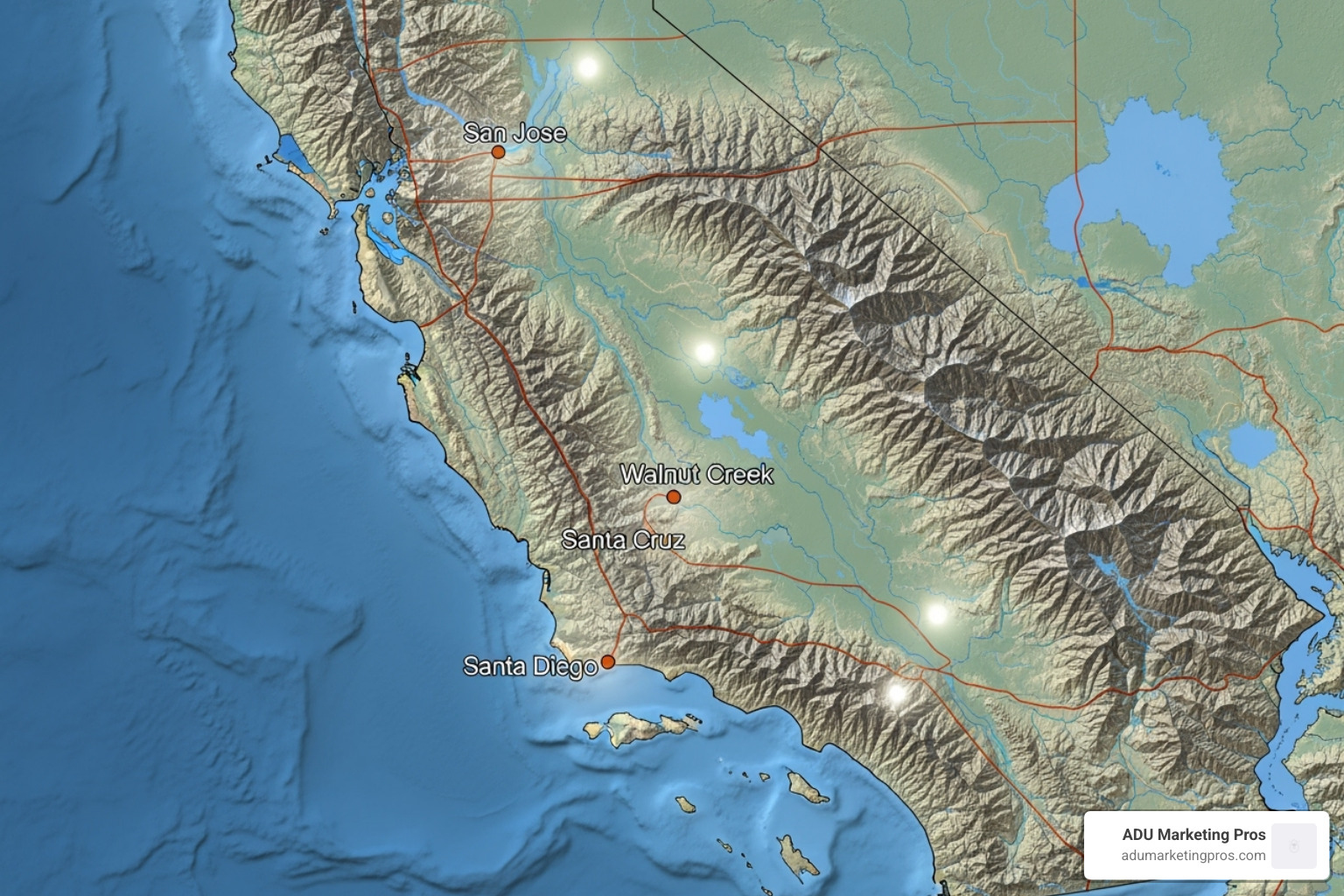
- San Diego: The ADU Finance Program offers construction loans up to $200,000 and provides hands-on technical assistance to guide homeowners through the entire process.
- Santa Cruz County: A forgivable loan program offers up to $40,000 to homeowners who build an ADU and agree to rent it to low-income households for a set period. After that period, the loan is completely forgiven.
- Walnut Creek: This Bay Area city offers cash rebates up to $7,500 upon project completion, with higher rebate amounts awarded for smaller, more affordable units.
- San Mateo County: The One Stop Shop Program, often run in partnership with non-profits, provides free or low-cost support for design, permitting, and project management, saving homeowners thousands in professional fees.
- Chico, San Jose, and Encinitas: These cities, among others, offer pre-approved ADU plans (sometimes called “permit-ready” plans). These plans are already vetted by the planning department, which can dramatically reduce architectural costs and slash months off the permitting timeline.
Even in major hubs like Los Angeles, where incentives can change frequently, understanding the specific ADU Guidelines Los Angeles is crucial for homeowners to identify opportunities for fee waivers and other benefits.
How to Find Local California ADU Incentives in Your Area
Finding these local gems requires some proactive research, as they are not always widely advertised. Here’s a step-by-step guide to uncovering the incentives in your specific area:
- Start with Your City’s Planning Department Website: This is your best first stop. Search for terms like “ADU,” “Accessory Dwelling Unit,” “incentives,” or “fee waiver.” Look for an ADU-specific page or handbook.
- Check Your County Housing Authority: County-level agencies often run programs that cover multiple cities and unincorporated areas. They are a great resource for regional grants and loan programs.
- Contact Local ADU Resource Centers: Non-profits like the Casita Coalition, the Bay Area ADU Collaborative, or the San Diego ADU Coalition specialize in ADU education and can provide up-to-date information on funding and guidance.
- Use Online Tools: Websites like Symbium allow you to enter your address to get a free report on your property’s ADU potential, which sometimes includes information on local incentives.
- Talk to ADU Professionals: Architects, designers, and builders who specialize in ADUs in your area are often the most knowledgeable about the latest local incentives and how to apply for them.
By taking these steps, you can maximize the california adu incentives available in your community and potentially save thousands, or even tens of thousands, of dollars on your project.
Navigating the System: Applications, Regulations, and Key Definitions
Building an ADU in California involves more than just construction; it requires navigating an administrative landscape of applications, regulations, and legal definitions. Understanding this system upfront is not just helpful—it’s essential for saving time, avoiding costly mistakes, and maximizing your financial incentives.
Think of the application process for california adu incentives and permits as your gateway to financial relief and a successful build. While California has worked hard to streamline ADU permitting, knowing the rules is still your responsibility. For a detailed walkthrough, our guide on the ADU Permit Process California breaks it down step-by-step.
How to Apply for Grants and Incentives
Applying for ADU incentives follows a general pattern, whether it’s a state grant or a local fee waiver. Success often comes down to preparation and timing.
- Research Eligibility First: Before you do anything else, thoroughly read the eligibility requirements for any program you’re interested in. Pay close attention to income limits, property type, and owner-occupancy rules.
- Gather Your Documentation: Have your documents ready to go. This typically includes proof of income (tax returns, pay stubs), property records (deed, mortgage statement), and, for most programs, detailed construction plans and a cost estimate.
- Submit Applications Early: Many programs, especially grants, are funded on a first-come, first-served basis. Being ready to submit your application the day a program opens can make all the difference.
- Work with Program Facilitators: For state grants like CalHFA’s, you must work with an approved lender. For local programs, there may be a specific city staff member or non-profit partner assigned to help you. Use these resources—they are there to ensure your application is complete and correct. For context on the entire timeline, see our guide on the ADU Building Process.
Understanding Key California ADU Regulations
California is one of the most ADU-friendly states in the nation, thanks to a series of progressive state laws designed to override overly restrictive local ordinances. Key state-level regulations that benefit homeowners include:
- Setbacks: Side and rear yard setbacks are generally limited to just 4 feet. This allows ADUs to be built in tight spaces where they were previously prohibited.
- Parking: Parking requirements are often waived. For example, no additional parking is required if the property is within a half-mile of public transit, in a historic district, or if the ADU is part of an existing structure (like a garage conversion).
- Owner-Occupancy: As of 2020 (and extended through 2025 by AB 976), cities cannot require the owner to live in either the primary home or the ADU for new ADUs. This is a major benefit for investors.
- Permit Streamlining: Local agencies must approve or deny an ADU permit application within 60 days of receiving it. If they fail to act within that timeframe, the application is automatically deemed approved.
- Size and Height: State law allows for a detached ADU of at least 800 square feet and 16 feet in height, regardless of other local development standards like Floor Area Ratio (FAR) or lot coverage.
These regulations are constantly evolving. We cover them in greater depth in our articles on California ADU Regulations and New ADU Regulations California. A recent landmark bill, AB 1033, now allows local agencies to permit ADUs to be sold separately from the primary residence, like a condominium. This could be a game-changer for homeowners, though local adoption will vary.
ADU vs. JADU: What’s the Difference?
Understanding the distinction between an Accessory Dwelling Unit (ADU) and a Junior Accessory Dwelling Unit (JADU) is crucial for planning your project and maximizing incentives. A JADU is a smaller, more integrated unit that offers a lower-cost path to adding living space.
| Feature | Accessory Dwelling Unit (ADU) | Junior Accessory Dwelling Unit (JADU) |
|---|---|---|
| Location | Attached, detached, or a conversion of existing space (e.g., garage) | Must be created within the existing walls of a single-family home (e.g., a spare bedroom) |
| Size | Typically up to 1,200 sq ft (detached), often 50% of primary dwelling size (attached) | Maximum 500 sq ft |
| Kitchen | Requires a full kitchen (sink, cooking appliance, refrigeration, counters) | Requires an efficiency kitchen (sink, cooking appliance, and small refrigeration units) |
| Bathroom | Must have its own full, independent bathroom | May have its own bathroom or may share a bathroom with the primary dwelling |
| Owner-Occupancy | Generally no state-mandated owner-occupancy for new units (post-2020) | Requires owner-occupancy of either the primary dwelling or the JADU |
| Separate Entrance | A separate exterior entrance is required | A separate exterior entrance is required |
| Parking | Often waived or reduced based on state law | No additional parking is ever required for a JADU |
| Utilities | May have separate utility connections or share with the main house | May share central systems (e.g., HVAC) and utility connections with the primary dwelling |
Strategic Choice: JADUs are an excellent, low-cost option for adding a small living space for a single person, like a student or an elderly parent, with minimal construction. ADUs offer far more flexibility in size, location, and privacy, making them the superior choice for generating significant rental income or housing a small family.
The Bigger Picture: ROI, Taxes, and Long-Term Benefits
Beyond the immediate savings from california adu incentives, building an ADU is a strategic long-term investment with compelling financial and personal returns. While the initial investment can be significant—typically ranging from $150,000 to $300,000 for construction, plus additional fees for permits and design—the return on investment (ROI) is often rapid and substantial. Our guide on ADU Building Costs can help you budget effectively for your project.
Calculating Your Potential ROI and Rental Income
An ADU’s ability to generate consistent rental income is the primary driver of its financial ROI. In many parts of California, a well-designed one or two-bedroom ADU can command $2,000 to $4,000 per month in rent. This steady cash flow can often cover the monthly loan payment for the ADU and still leave a profit.
ROI Case Study:
- Scenario: A homeowner in San Jose builds a 600 sq. ft. one-bedroom ADU for a total cost of $250,000.
- Financing: They secure a loan with a monthly payment of approximately $1,500.
- Rental Income: They rent the ADU for $2,800 per month.
- Monthly Cash Flow: $2,800 (Rent) – $1,500 (Loan) = $1,300 positive cash flow per month.
- Annual Income: $1,300 x 12 = $15,600 per year.
More importantly, homes with ADUs often see a resale value increase of 15-30%. In our San Jose example, the $250,000 investment could easily add $350,000 or more to the property’s value in the current market. This instant equity, combined with the passive rental income, transforms your ADU into a powerful wealth-building asset. Explore these financial aspects further in our guides on ADU Rental Income and ADU Return on Investment.
Tax Implications and Benefits of Owning an ADU
The financial benefits of an ADU extend to your taxes in several key ways:
- Property Tax Protection: Under Proposition 13, building an ADU does not trigger a reassessment of your entire property’s value. Your existing home remains at its current assessed value. Only the value of the new ADU itself is added to your tax bill, resulting in a modest and predictable increase.
- Depreciation: If you rent out the unit, you can claim depreciation on the ADU structure as a business expense. This non-cash deduction reduces your taxable rental income each year, saving you money.
- Expense Deductions: All ordinary and necessary expenses for the rental ADU—such as repairs, insurance, property management fees, and a portion of your mortgage interest and property taxes—are deductible against your rental income.
- Energy Efficiency Credits: Installing energy-efficient features like solar panels, high-efficiency windows, or a heat pump water heater may qualify you for federal and state tax credits, further reducing your costs.
While rental income is taxable, these powerful deductions can significantly reduce your overall tax burden. For more details, check out our guide on ADU Rental Income Taxes.
Benefits Beyond the Bank
The value of an ADU transcends pure finances. These units provide flexible solutions for modern family life and community challenges.
- Multi-Generational Living: ADUs are a perfect solution for keeping family close while maintaining privacy. They provide independent, ground-floor living space for aging parents or a stepping stone to independence for adult children saving for their own home.
- Aging in Place: For seniors, an ADU allows them to downsize into a smaller, more manageable home on their own property while renting out the main house for income. This allows them to stay in the community they love.
- Flexible Living Space: An ADU can adapt to your family’s changing needs. It can serve as a private space for a live-in caregiver, a quiet home office, a creative studio, a classroom for homeschooling, or a guest suite for visitors.
- Community Impact: By adding gentle density to existing neighborhoods, ADUs contribute to solving California’s housing shortage without altering the character of the community. Each new unit provides a much-needed home for a teacher, a nurse, a student, or a young family.
Conclusion: Your Path to a Successful ADU Project
The landscape of california adu incentives offers a clear and compelling roadmap to making your ADU project financially feasible. From the game-changing CalHFA ADU Grant offering up to $40,000 to a rich tapestry of local rebates, fee waivers, and specialized loans that consider future rental income, these programs are designed to dramatically reduce your out-of-pocket costs and accelerate your return on investment.
The benefits are too substantial to ignore: the potential for $2,000 to $4,000 per month in rental income, a significant property value increase of 15-30%, and numerous tax advantages that build wealth over time. Beyond the numbers, ADUs provide invaluable flexibility for families, support aging in place with dignity, and contribute a meaningful solution to California’s housing crisis—one backyard at a time.
At ADU Marketing Pros, we have seen firsthand how a well-planned strategy that layers these incentives can turn a homeowner’s dream into a tangible reality. The key is to be proactive, diligent, and strategic.
Your ADU Action Plan: Next Steps
Ready to move forward? Here is your checklist to get started:
- Define Your Goal: Clarify why you want to build an ADU. Is it for rental income, a family member, or a flexible space? Your goal will shape your design and budget.
- Research Local Rules: Visit your city or county planning department’s website. Understand your local zoning, setback, and height requirements.
- Investigate Incentives: Systematically research state and local incentives. Create a list of programs you may be eligible for, noting their application windows and requirements.
- Consult with Professionals: Talk to an ADU-savvy architect, designer, or builder. They can provide a realistic cost estimate and help you navigate the permitting process.
- Get Your Finances in Order: Speak with a lender—especially one familiar with ADU financing and CalHFA grants—to understand your borrowing capacity and get pre-approved.
Your ADU is more than just a building; it’s a powerful investment in your financial future, your family, and your community. With the right knowledge and the powerful backing of California’s incentive programs, you can build smart, build efficiently, and create a better future.
Take the next step in your ADU journey by exploring all California ADU incentives