
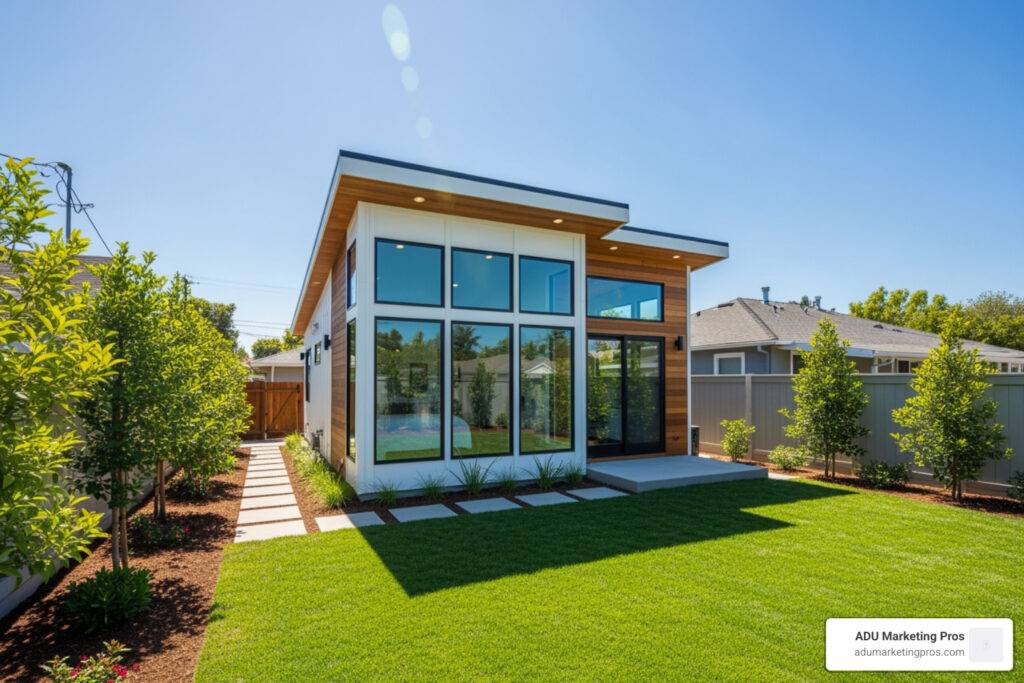
Why Premade ADUs Are Taking Over California Backyards
The California Housing Crisis
California is currently facing one of the most significant housing shortages in its history. As property values continue to climb and the inventory of single-family homes remains tight, homeowners are looking for creative ways to maximize their existing land. The state’s housing deficit is estimated at millions of units, leading to skyrocketing rents and a generation of residents priced out of the market. In response, the premade ADU California movement has emerged as a critical solution. These Accessory Dwelling Units, often referred to as granny flats, backyard cottages, or in-law suites, have transitioned from a niche architectural trend to a mainstream housing solution that provides immediate relief to families and renters alike.
The Legislative Shift Toward Density
The shift is driven by a combination of legislative support and technological advancement. In recent years, the California state legislature has passed a series of bills, including SB 13 and AB 68, designed to strip away the red tape that once made building a secondary unit a bureaucratic nightmare. These laws have effectively ended single-family zoning in many areas, allowing for greater density without changing the character of established neighborhoods. Today, the focus has shifted from “if” you can build to “how fast” you can build. This is where prefabrication shines. By moving the construction process from a muddy backyard into a precision-controlled factory environment, the industry has solved the two biggest pain points of California construction: unpredictable timelines and skyrocketing labor costs.
Premade ADU California options are the fastest-growing solution for homeowners who want to add livable space — without the nightmare of traditional construction. Here’s a quick look at the top premade ADU choices in California right now:
| Provider | Size Range | Starting Price | Key Advantage |
|---|---|---|---|
| Abodu | 340–1,200 sq ft | $228,800 | 10-day permitting, 100% approval rate |
| LiveLarge | 350–1,190 sq ft | ~$245,000+ | 80% faster than traditional builds |
| prefabADU | 150–1,000 sq ft | Under $45K (kit) | Most affordable DIY kits |
| Q Cabin | 150–1,400 sq ft | $135/sq ft (kit) | 8-week shop lead time |
| Container Model 400 | 400 sq ft | $105,700 | HCD-approved, crane or truck delivery |
| Perpetual Homes | 440–2,244 sq ft | $115,900–$285,000 | Largest size range |
The Evolution of the Backyard Home
California’s housing crunch is real. Backyard ADUs are one of the most practical answers — and prefab versions cut build times from 7–9 months down to as little as 4–6 weeks. They cost less, arrive mostly finished, and in many cases come with state pre-approved plans that sail through the permitting process. Whether you’re planning a rental unit, an in-law suite, or a post-wildfire rebuild, the premade ADU market in California has a model designed for your situation and budget. Historically, adding a unit to your backyard meant hiring an architect, waiting months for custom blueprints, and then dealing with a general contractor who might be juggling five other projects. The “stick-built” method is inherently vulnerable to California’s unique challenges, including seasonal wildfires, labor shortages in high-cost areas like the Bay Area, and the sheer complexity of local zoning codes.
Premade units change the equation by treating a home more like a high-end product than a one-off construction project. This productization allows for massive economies of scale. When a company like Abodu or SnapADU builds the same model fifty times a year, they refine the supply chain, eliminate material waste, and ensure that every structural component meets the rigorous California Building Code (Title 24) before it even leaves the factory floor. This level of consistency is nearly impossible to achieve with traditional on-site builds.
The Benefits of Choosing a Premade ADU California Home
When we look at the shifting landscape of California real estate, it is clear that the traditional “stick-built” method is no longer the only—or even the best—path to adding a backyard home. Choosing a premade ADU california unit offers a level of predictability that site-built construction simply cannot match. The primary driver for most of our clients is speed. While a standard contractor might take nine months to navigate weather delays and labor shortages, a prefab unit is constructed in a climate-controlled factory. This environment ensures that every joint is square and every seal is tight, resulting in a higher level of quality control.
Quality Control and Precision Engineering
In a factory setting, builders use specialized jigs and heavy machinery that aren’t available on a standard construction site. This means walls are perfectly plumb, and insulation is installed without the gaps that often occur when working in tight, outdoor spaces. For California homeowners, this precision translates directly into energy efficiency. A tighter building envelope means lower heating and cooling costs, which is essential given the state’s rising utility rates. Furthermore, because the unit is built while your backyard is being prepared, the “site disruption” is significantly reduced. Instead of months of noise and debris, you often deal with just a few weeks of site prep and a single day of installation.
Moreover, factory-built homes are engineered to withstand the stresses of transportation. To survive being lifted by a crane and hauled down a highway at 60 mph, these units are often built with 20-30% more framing material than a standard home. This inherent structural integrity makes them exceptionally durable and earthquake-resistant, a critical factor for any premade ADU california project.
Financial Predictability and Fixed Pricing
Cost-efficiency is another major win. With a premade ADU california project, you are often looking at fixed pricing. This protects you from the “budget creep” that plagues traditional renovations. In a standard build, a 10% or 20% cost overrun is almost expected due to fluctuating material prices or unforeseen site issues. Prefab companies, however, purchase materials in bulk and follow a standardized assembly process, allowing them to offer much more accurate quotes. For more insights on the logistical side, you can Read full article — Your Questions About ADUs Answered. If you are specifically looking for smaller units, check out More info about prefab granny flat California to see how these compact homes maximize every square inch.
Environmental Sustainability
From an environmental standpoint, factory building reduces material waste by up to 30%. Precise measurements mean fewer scraps ending up in California landfills. Additionally, many prefab manufacturers prioritize sustainable materials, such as recycled steel, bamboo flooring, and low-VOC paints, which contribute to a healthier indoor air quality. For those curious about the actual building phase, we have More info about backyard ADU construction that details the transition from dirt to dwelling. The reduction in heavy machinery traffic to and from the residential site also lowers the carbon footprint of the project significantly.
Modular vs. Kit Premade ADU California Designs
Not all premade units are the same. We generally categorize them into three main buckets, each serving a different type of homeowner and budget:
- Modular ADUs: These are fully finished “boxes” delivered to your site. They include the flooring, cabinets, and even the light bulbs. Once craned onto the foundation and hooked up to utilities, they are ready for move-in. This is the most popular option for those seeking a “turnkey” experience. For a deeper dive, see More info about ADU modular homes California.
- Kit ADUs: These are for the DIY enthusiasts or those working with a local builder. Providers like Q Cabin or Avrame send you the “bones” of the house—the structural panels, windows, and doors—and you assemble them on-site. This can be significantly cheaper but requires more “sweat equity” and coordination with local trades.
- Shipping Container ADUs: These utilize the structural integrity of steel containers. Models like the Model 400 are HCD-approved and offer a modern, industrial aesthetic that is incredibly durable. They are particularly popular in desert regions or areas where fire resistance is the top priority.
Why a Premade ADU California Unit Beats Traditional Construction
If you’ve ever lived through a home remodel, you know that timelines are usually suggestions rather than rules. In premade ADU california construction, timelines are 80% faster. We are talking about 4–6 weeks for some models compared to 7–9 months for site-built homes. Labor shortages in major hubs like San Francisco and Los Angeles have driven up the cost of local contractors. Prefabrication bypasses this by using a dedicated factory team. You can find More info about prefab granny flats in California regarding how these streamlined schedules are helping families stay together.
Top Models and Configurations for Backyard Living
Choosing the right layout is about balancing your lot size with your lifestyle needs. Whether you are in Sunnyvale or San Diego, California law allows for a variety of sizes, usually up to 1,200 square feet. However, the “sweet spot” for many homeowners is between 400 and 800 square feet, as this size provides a full living experience without overwhelming the primary residence’s backyard.
| Configuration | Typical Sq Ft | Best Use Case |
|---|---|---|
| Micro/Studio | 150 – 400 | Home office, short-term rental, guest suite |
| 1-Bedroom | 400 – 750 | Rental income, single occupant, minimalist living |
| 2-Bedroom | 800 – 1,200 | Aging in place, small families, in-law suites |
For those looking for a contemporary look, we recommend checking out More info about modern prefab granny flats.
Compact Studio and Micro Units
Micro units, such as the 150 sq ft models from prefabADU or the 172 sq ft Tempe model from H2 Prefab, are perfect for tight urban lots in Palo Alto or Menlo Park. These are often used as “work-from-home” sanctuaries or high-yield rental units. In cities where space is at a premium, these units allow homeowners to monetize their backyard without sacrificing their entire outdoor area. If you are in the Southern California market, there is More info about prefab ADU Los Angeles specifically tailored to the city’s unique zoning and the “Standard Plan” program which fast-tracks specific designs. These micro units often bypass many of the more complex utility requirements, making them the fastest to install.
One-Bedroom “Urban Cottages”
The one-bedroom configuration is perhaps the most versatile premade ADU california option. At 400 to 600 square feet, these units feel like a true home. They typically feature a full-sized kitchen, a separate bedroom with a closet, and a bathroom that can accommodate a stackable washer and dryer. This layout is ideal for a single professional or a couple. Many of these models, like the Abodu One, feature vaulted ceilings and large glass sliders to create an indoor-outdoor flow that makes the space feel much larger than its footprint suggests. These units are the most popular choice for homeowners looking to provide a high-quality rental experience.
Spacious Family-Sized ADU Models
For families looking to house aging parents or adult children, the 2-bedroom models are the gold standard. The LiveLarge L-795 (795 sq ft) or the SnapADU 1,186 sq ft “Build Ready” plan offer enough space for a full kitchen, laundry, and two bathrooms. This ensures that “aging in place” doesn’t feel like downsizing into a closet. These larger units often require more significant site prep and a larger crane for installation, but they offer the highest return on investment in terms of rental income and property value. You can explore More info about modular granny flats California to see how these larger villas are designed for long-term comfort and accessibility.
Streamlining the Permitting Process with State Laws
The biggest hurdle for any ADU has historically been the local building department. In the past, NIMBY (Not In My Backyard) sentiments led many cities to create restrictive zoning laws that made ADUs nearly impossible to build. However, California has passed several landmark laws to make premade ADU california installation much easier and more predictable.
The Power of Pre-Approval
- AB 818 & HCD Pre-Approval: Some companies, like Abodu, use plans that are pre-approved by the State of California Department of Housing and Community Development (HCD). This is a massive advantage. When a plan is HCD-approved, the local building department cannot relitigate the structural integrity or the internal design of the unit. This allows for a 10-business-day permitting pathway in over 90 cities, bypassing the months of back-and-forth usually required for custom builds.
- Government Code 65852.27(b)(2): This is a game-changer for local approvals. If you use a plan that has already been approved in your jurisdiction during the current code cycle, the city must approve or deny your application within 30 days. This prevents local planning departments from sitting on applications indefinitely. You can read the 65852.27(b)(2) Government Code Section for the full legal text.
Mandatory Approval and Setback Reductions
Under current state law, cities must allow at least one ADU of up to 800 square feet on any residential lot, regardless of local zoning or floor-area-ratio (FAR) limits. Furthermore, setbacks have been reduced to just 4 feet from the side and rear property lines. This allows homeowners with smaller lots to fit a premade ADU california unit where it previously would have been illegal. This mandatory approval process has stripped local municipalities of their ability to block these units based on subjective aesthetic or density concerns.
AB 462 and Wildfire Recovery
- AB 462: Specifically for wildfire rebuilds, this allows an ADU to be occupied before the primary home is finished. This is vital for families in fire-prone regions who need to live on their property while they rebuild their main residence. It provides a sense of stability and security during a traumatic recovery process. Cities like San Jose and Mountain View have even launched their own pre-approved ADU programs to further cut down on red tape. It is important to note that Placer County and other regions are preparing for major code updates in 2026, so starting your project now can lock in current regulations and avoid potential future complications.
Standard Features and Customization Options
Modern premade ADU california units are far from the “mobile homes” of the past. They are high-tech, energy-efficient dwellings built to the same (or higher) standards as a luxury custom home. Because they are built in a factory, manufacturers can integrate high-end features as standard offerings that would be expensive upgrades in a traditional build.
Energy Efficiency and Title 24 Compliance
California has some of the strictest energy codes in the nation, known as Title 24. Every premade ADU california must meet these standards, which often include:
- All-Electric Design: Most units come ready for a fossil-fuel-free future, featuring high-efficiency heat pump HVAC systems and induction or electric ranges. This aligns with the growing number of California cities banning natural gas in new construction.
- Solar Readiness: State law requires new ADUs to be solar-ready, and in many cases, detached ADUs must have their own solar panels installed. Prefab manufacturers often offer integrated solar packages that are installed at the factory, ensuring the unit is net-zero ready from day one.
- Advanced Insulation: Expect dual or triple-pane windows and R-value optimized insulation. Many prefab builders use spray foam insulation, which provides a superior thermal barrier compared to traditional fiberglass batts, keeping the unit cool in the summer and warm in the winter.
Durability and Fire Resistance
Given California’s climate, many providers use WUI-certified (Wildland-Urban Interface) materials. This includes:
- Fiber Cement Siding: Brands like James Hardie provide siding that is non-combustible and resistant to rot and insects.
- Standing Seam Metal Roofs: These offer incredible longevity and are highly fire-resistant, making them a popular choice for ADUs in high-fire-threat districts.
- Tempered Glass: Standard in many models to prevent shattering during extreme heat events, providing an extra layer of safety for residents.
Luxury Finishes as Standard
You don’t have to sacrifice style for speed. Quartz countertops, waterproof luxury vinyl plank (LVP) flooring, and stainless steel appliances are standard in many turnkey models. Many companies offer “design packages”—such as Modern, Coastal, or Farmhouse—that allow you to customize the look of your unit without needing an interior designer. For more on the construction standards, see More info about ADU modular homes.
Cost Analysis and Financing for California Homeowners
Budgeting for a premade ADU california requires looking at three distinct costs: the unit price, the site costs, and the “soft” costs (permits and fees). Understanding the interplay between these three is essential for a successful project.
1. Unit Price
This is the cost of the structure itself, including the interior finishes. For a 400 sq ft unit, this might be around $105,700 for a container model or $228,800 for a high-end modular studio. This price is usually the most stable part of your budget because it is determined in the factory environment where material costs are controlled.
2. Site Costs
This is where the most variability occurs. Site costs include:
- Foundation: Usually a concrete slab or a pier-and-beam system. Costs vary based on the slope of your lot and soil stability.
- Utility Trenching: Running sewer, water, and electric lines from the main house to the ADU. If your backyard is 100 feet deep, this will cost significantly more than if the ADU is 20 feet away.
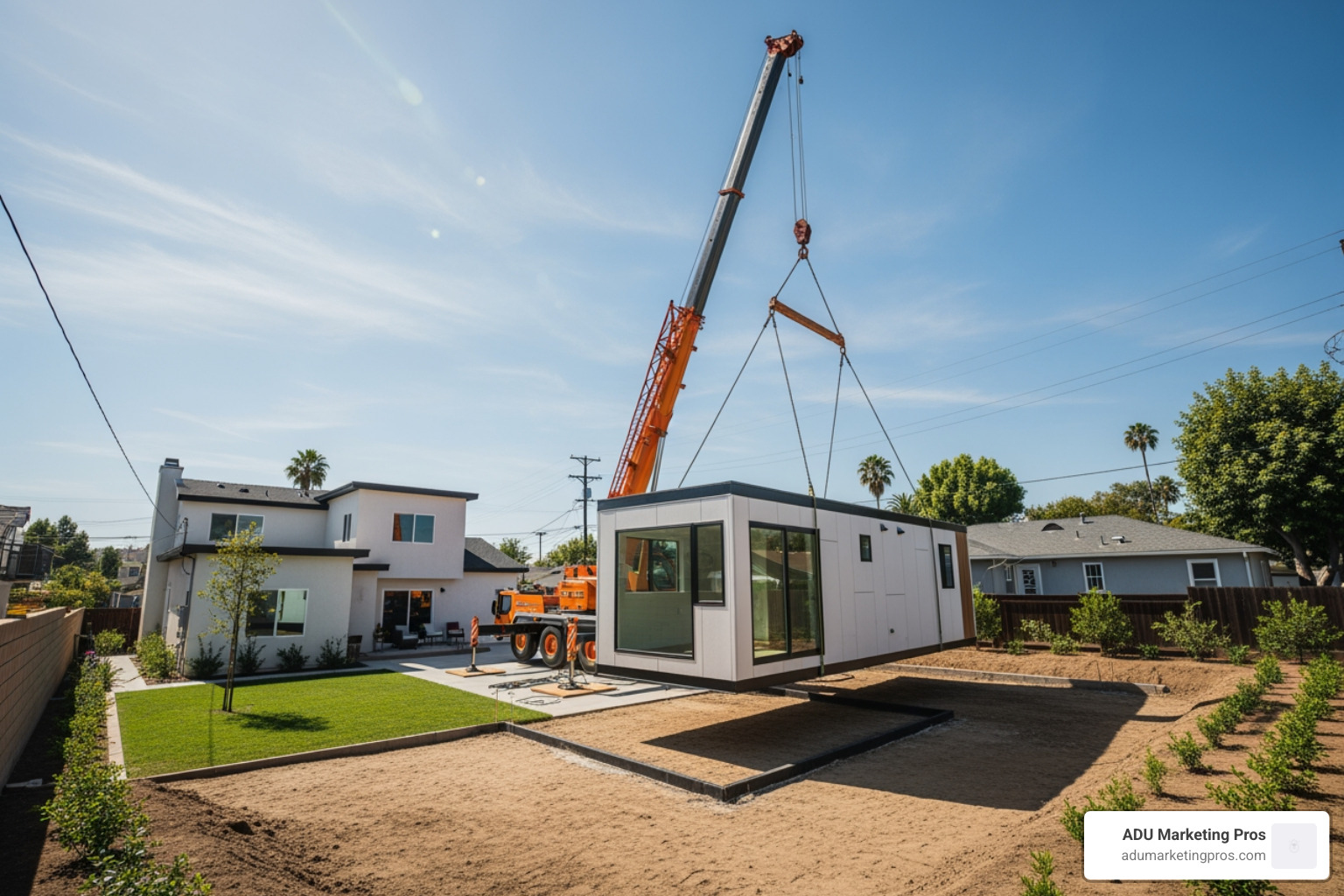
- Crane and Delivery: If your backyard is inaccessible by a truck, a crane will be needed to lift the unit over your house. Crane rentals can range from $5,000 to $15,000 per day depending on the reach required.
3. Soft Costs and Impact Fees
Soft costs include architectural plans, structural engineering, and city permit fees. A major win for California homeowners is that impact fees (fees charged by cities for schools, parks, and traffic) are waived for any ADU under 750 square feet. This can save you anywhere from $10,000 to $30,000 depending on your municipality. For units over 750 square feet, these fees are typically charged proportionally to the size of the primary residence.
Total Turnkey Estimates and ROI
For a mid-range 2-bedroom ADU, a total project cost of $350,000 to $450,000 is common in the Bay Area or Los Angeles. While the costs are significant, the ROI is often impressive. An ADU can generate $2,500–$4,000 in monthly rental income in prime California markets, often covering the mortgage on the unit and providing additional cash flow. Furthermore, an ADU typically adds significant value to your property—often dollar-for-dollar or more compared to the construction cost. You can find a more detailed breakdown in More info about prefab ADU California cost. For those worried about the upfront expense, the City of San Jose has pioneered ADU loan programs to help homeowners bridge the gap. To understand the broader financial hurdles, Read full article — The big cost of small dwellings.
Frequently Asked Questions
How long does it take to install a premade ADU?
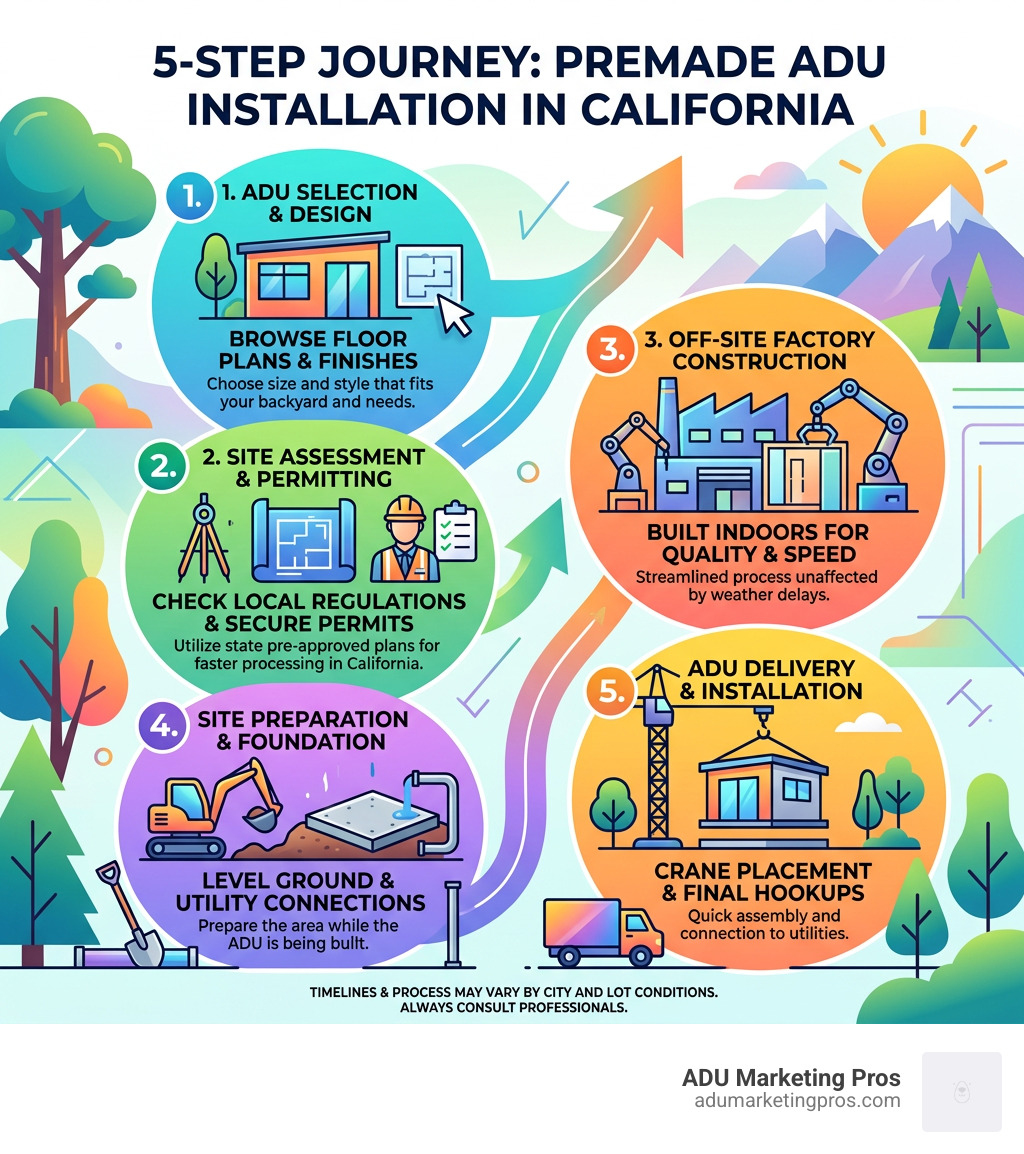
While the factory build takes 4–12 weeks, the actual installation is remarkably fast. Once the unit arrives on a truck, it is typically craned into place and secured to the foundation in a single day. Final utility hookups and inspections usually take another week or two. From the moment you sign a contract to the moment you have keys in hand, the process usually takes 6 to 9 months, which is roughly half the time of a traditional build.
Can I customize the interior of a prefab ADU?
Yes! Most “turnkey” providers offer curated design packages. You can often choose your flooring color, cabinet finishes, and hardware styles. Some companies even allow for “semi-custom” changes, like flipping the floor plan or adding a deck. However, keep in mind that significant structural changes may void the “pre-approved” status of the plans, potentially slowing down the permitting process.
Are premade ADUs as durable as site-built homes?
In many cases, they are more durable. Because they have to be transported on a highway and lifted by a crane, they are built with extra structural reinforcement. They use kiln-dried lumber to prevent warping and are built to the same California Building Code (Title 24) as any other home. They are not “mobile homes”; they are permanent structures attached to a foundation.
Does an ADU increase my property taxes?
In California, adding an ADU will trigger a “blended assessment.” Your primary home’s tax basis will remain the same (thanks to Proposition 13), but the value of the ADU will be added to your total property value. For example, if the tax assessor determines the ADU adds $200,000 in value, your property taxes will increase by roughly 1% of that amount (about $2,000 per year).
Can I sell my ADU separately from my main house?
Generally, no. In most California jurisdictions, the ADU and the primary residence must be sold together on the same deed. However, some cities are beginning to explore “ADU as Condo” ordinances (under AB 1033) which would allow for separate sales. This is currently rare and depends entirely on your local city council’s adoption of the law.
What are the requirements for solar panels on a premade ADU?
Under the current California Building Code, all new detached ADUs are required to have solar panels. However, if the ADU is an addition to an existing structure (like a garage conversion) or if the site is too shaded to make solar viable, you may be exempt. Many prefab companies offer solar as an integrated part of their package to ensure compliance.
Conclusion
The rise of the premade ADU california market represents a fundamental shift in how we think about housing and urban density. By choosing a pre-built solution, you are opting for a faster, more predictable, and often more sustainable way to grow your property’s value. These units are no longer just “extra space”; they are a vital tool for addressing the housing crisis, providing affordable rental options, and allowing families to stay together through multi-generational living.
The Future of California Housing
From the tech-heavy corridors of Sunnyvale and Palo Alto to the sprawling neighborhoods of Los Angeles and San Diego, these units are providing much-needed relief to homeowners. Whether you are looking to house an aging parent, provide a home for a college graduate, or generate a steady stream of rental income, the prefab industry has matured to the point where there is a high-quality solution for every backyard. The integration of smart home technology and sustainable building practices ensures that these units will remain valuable assets for decades to come.
At ADU Marketing Pros, we are proud to support the firms that are building these innovative homes. We specialize in helping ADU construction and architecture firms stand out in this booming market through expert digital marketing and SEO. We understand the nuances of the California market, from the latest HCD regulations to the specific design preferences of West Coast homeowners. If you are ready to see how a backyard home can transform your property, or if you are a builder looking to grow your reach, Start your project with a Prefab ADU in Los Angeles and join the backyard revolution. The future of California housing isn’t just in high-rise apartments; it’s in the innovative, high-quality homes being built right in our own backyards.