
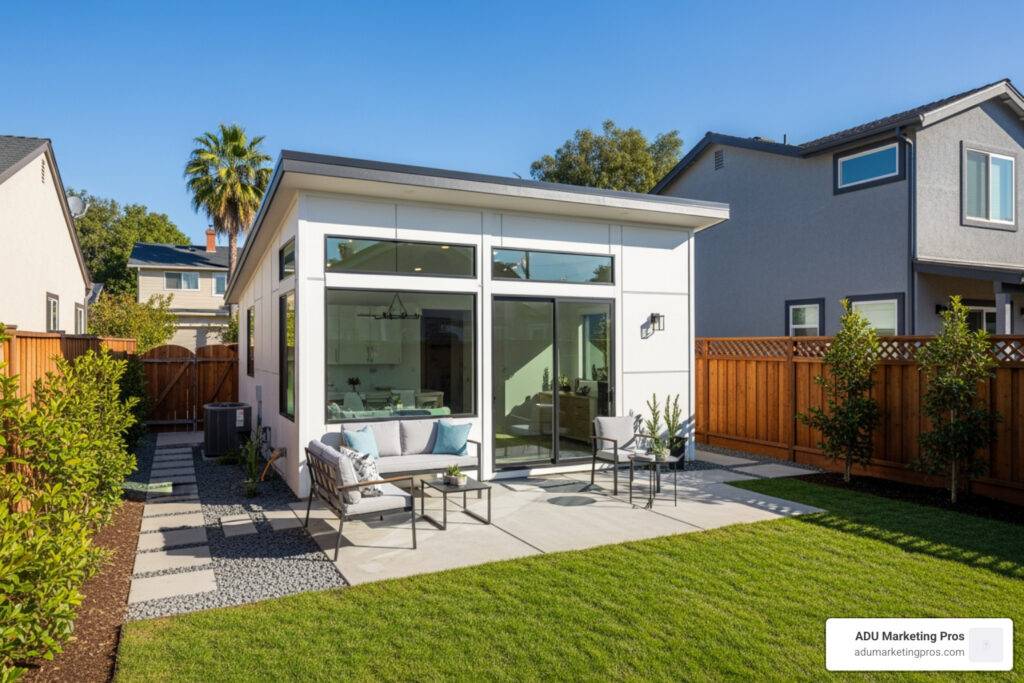
What Are Granny Flat Regulations? A Quick Answer Before We Dive In
Granny flat regulations are the legal rules that govern whether, where, and how you can build a secondary dwelling unit on your residential property. These rules have undergone a massive transformation in recent years, shifting from restrictive local ordinances to a standardized state-wide framework designed to encourage density and housing affordability. For decades, local municipalities used zoning laws to effectively ban these units, but the severity of the housing crisis has forced a legislative revolution.
In California, and specifically within the City of San Diego, the regulatory landscape is now one of the most favorable in the United States. The state has recognized that the housing crisis cannot be solved by large-scale developments alone; it requires the participation of individual homeowners. By utilizing existing residential land, granny flats (formally known as Accessory Dwelling Units or ADUs) provide a “missing middle” housing solution that benefits both the property owner and the community. This shift toward “by-right” development means that if you meet the objective standards, the city cannot deny your permit based on subjective opinions or neighbor complaints.
Here are the key rules that apply in California — and San Diego specifically:
| Rule | What It Means |
|---|---|
| Who can build | Any residential lot with a single-family home may build at least one ADU and one JADU. |
| Max size (detached) | Up to 1,200 sq. ft. in San Diego; state minimum is 850-1,000 sq. ft. |
| Max size (attached) | Up to 50% of the primary residence, max 1,200 sq. ft. |
| Setbacks | Minimum 4 feet from side and rear property lines for new detached ADUs. |
| Parking | Generally 0.5 spaces per bedroom — but many exemptions apply (e.g., near transit). |
| Permits required | Yes, but California law mandates a streamlined “ministerial” review process. |
| Renting allowed | Yes — for stays of 30 days or more (long-term housing focus). |
| Selling separately | No — ADUs cannot be sold independently from the primary home (with rare SB 9 exceptions). |
California has been making it significantly easier to build granny flats since 2017, when the state passed Government Code 65852.2, stripping away many of the local restrictions that had blocked homeowners for decades. Subsequent legislation, including SB 13, AB 68, and SB 897, has further refined these rules to prevent local cities from using “death by a thousand cuts” tactics like excessive fees or impossible design standards. These laws essentially created a “floor” of rights that every homeowner in the state enjoys, regardless of how restrictive their local city council might want to be.
The results have been real. In San Diego alone, 1,114 ADU permits were issued in 2019 and 2020 — a sharp jump driven by relaxed rules, fee waivers, and a housing crisis that has pushed the median home price up nearly 28% in a single year. As of 2024, the momentum continues as homeowners realize that an ADU is not just a place for “granny,” but a powerful tool for rental income, multi-generational living, and property value appreciation. The state’s goal is to add millions of units over the next decade, and ADUs are the primary engine for that growth.
But “easier” doesn’t mean “simple.” Every property is different. Setbacks, zoning, size limits, parking rules, fire codes, utility requirements — there’s a lot to understand before you break ground. This guide walks you through exactly what you need to know, with a focus on California and San Diego regulations, so you can figure out what’s actually buildable on your property. We will explore the technical nuances of the building code and the financial incentives that make these projects viable.
Learn more about Granny flat regulations:
Understanding the Different Types of ADUs in San Diego
When we talk about Granny flat regulations, the first thing we need to clarify is what kind of unit you are actually building. In San Diego and across California, these are formally known as Accessory Dwelling Units (ADUs). Depending on your lot size, existing structures, and budget, you have several paths to choose from. Each type has its own specific set of rules regarding size, placement, and utility connections. Choosing the right type is the most critical decision you will make, as it dictates your construction costs and the potential rental yield.

The state has created a framework that ensures almost every homeowner has a path to adding housing. Whether you want to build from the ground up or repurpose a dusty garage, there is a set of California ADU Guidelines designed to help you succeed. Understanding the ADU Building Requirements for each type is the best way to avoid expensive mid-project pivots. These requirements cover everything from the thickness of the drywall for fire rating to the specific energy efficiency of the windows.
Defining the Junior ADU (JADU)
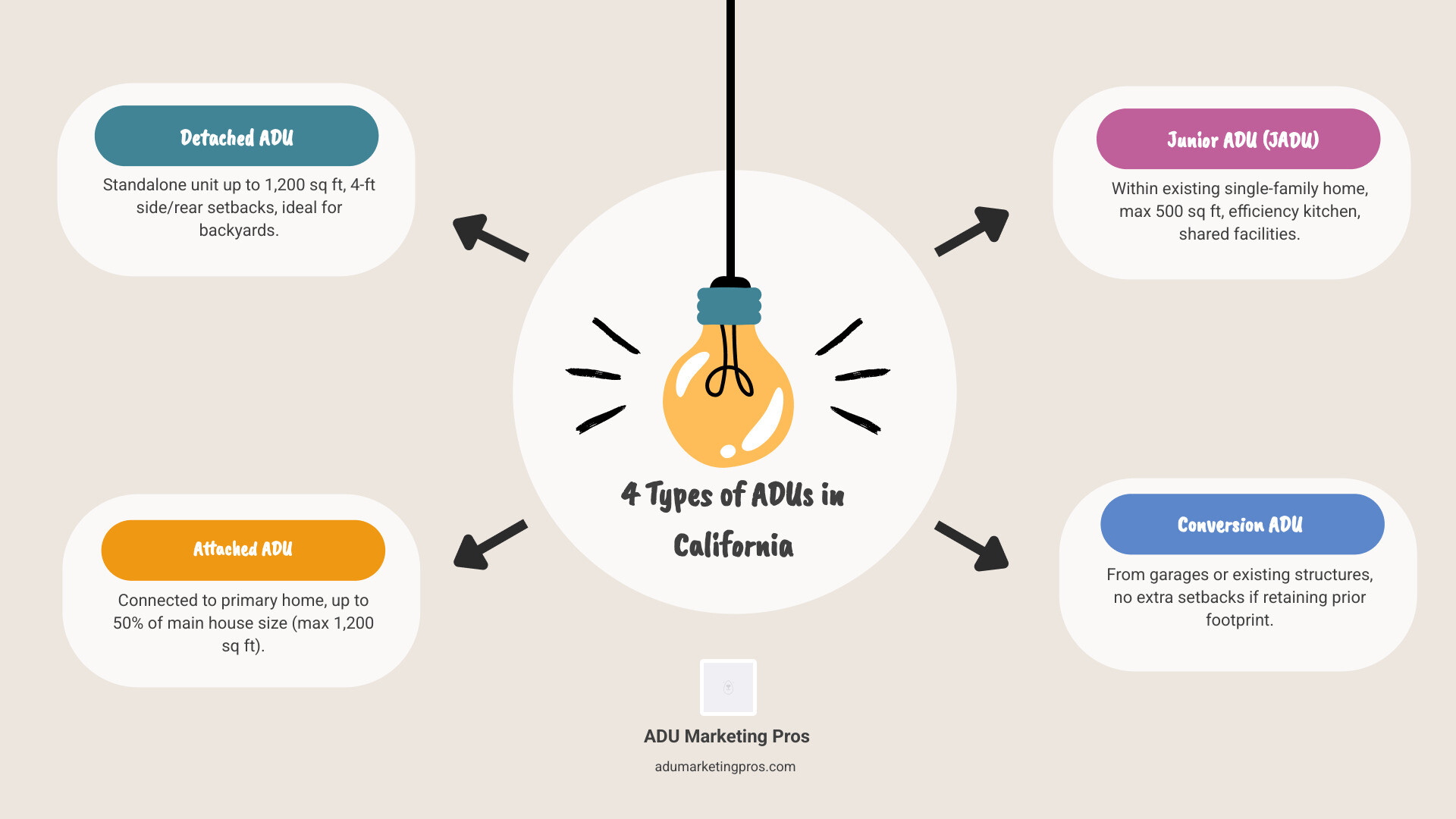
The Junior ADU, or JADU, is the “little sibling” of the ADU world, but it packs a punch for homeowners on a budget. A JADU is strictly limited to 500 square feet and must be contained entirely within the walls of an existing or proposed primary residence. This can include an attached garage, a basement, or a spare bedroom suite. Because they are internal conversions, they are often the fastest and cheapest way to add a legal unit to your property.
What makes a JADU unique under San Diego ADU Laws is its flexibility regarding amenities. While it must have its own “efficiency kitchen” (which requires a sink, a cooking appliance like a hot plate or microwave, and a food preparation counter), it is allowed to share sanitation facilities (a bathroom) with the main house. This makes it a perfect option for converting a portion of the home into a semi-independent living space for a family member or a student. However, keep in mind that JADUs often carry an owner-occupancy requirement, meaning the owner must live in either the main house or the JADU, unlike standard ADUs which currently have no such requirement in California.
Attached vs. Detached Units
If you need more space than a JADU provides, you’ll likely be looking at a standard ADU. These units are fully independent living spaces with their own permanent kitchens and bathrooms. They are considered separate residences for the purposes of the building code, meaning they need their own HVAC systems and independent entrances.
- Detached ADUs: These are stand-alone structures, often built in the backyard. In San Diego, these units can be as large as 1,200 square feet, regardless of the size of your main home. This is more generous than the state minimum, which only requires cities to allow up to 850 sq. ft. (for studios/1-bedrooms) or 1,000 sq. ft. (for 2+ bedrooms). Detached units offer the most privacy and are often the most desirable for high-end renters.
- Attached ADUs: These share at least one wall with the primary dwelling. According to ADU Construction Regulations, an attached unit cannot exceed 50% of the square footage of the primary residence, though it is capped at a maximum of 1,200 square feet.
For example, if you have a 2,000-square-foot home, you could build an attached ADU up to 1,000 square feet. If you have a massive 4,000-square-foot home, you’re still capped at 1,200 square feet for the ADU. This ensures the ADU remains “accessory” in scale to the main house and doesn’t overwhelm the neighborhood’s character.
Conversion ADUs: The Garage and Beyond
One of the most popular ways to build a granny flat is through a conversion. This involves taking an existing structure—like a detached garage, a workshop, or a pool house—and turning it into a legal residence. The primary advantage here is that you can often build within the existing footprint, even if that structure is right on the property line. State law protects your right to convert existing legal accessory structures into ADUs without needing to meet the standard 4-foot setback requirements that apply to new construction. This is a massive benefit for older neighborhoods where garages were often built directly on the alley or property line.
Navigating Granny Flat Regulations: Size, Setbacks, and Zoning
One of the biggest hurdles for homeowners used to be the “not in my backyard” (NIMBY) rules that required massive lots or huge distances from property lines. Those days are largely over. California state law now mandates that local jurisdictions allow at least one 800-square-foot ADU on any residential lot, regardless of lot coverage or floor area ratio (FAR) limits. This is a critical protection: it means even if your main house already uses up the maximum allowed “square footage” for your lot, the city cannot stop you from building an 800-square-foot ADU. This “override” of local zoning is what has unlocked thousands of backyards for development.
| Feature | Detached ADU | Attached ADU | Junior ADU (JADU) |
|---|---|---|---|
| Max Size | 1,200 sq. ft. | 50% of primary (max 1,200) | 500 sq. ft. |
| Min Setbacks | 4 ft (Side/Rear) | Same as main house | 0 ft (existing structure) |
| Max Height | 16–25 ft (varies by zone) | Matches main house | N/A (Internal) |
For the most up-to-date nuances, we always recommend checking the Official California ADU Handbook, but the general rule is that ADU Size Restrictions are more generous than ever. In 2023, new state laws (SB 897) even increased the height limits for ADUs in many areas to 18 feet, allowing for higher ceilings or even two-story units in specific circumstances. This is particularly useful for homeowners with small backyards who need to build “up” rather than “out” to preserve their outdoor space.
Zoning and Property Qualifications
In the past, you needed to be in a specific “single-family zone” to build a granny flat. Today, ADU Zoning Laws have expanded to include almost all residential zones, including multifamily lots. This means if you own a duplex, a triplex, or even a small apartment building, you are likely eligible to add ADUs. This has opened up a massive opportunity for real estate investors to increase the density and cash flow of their existing portfolios without needing to buy new land.
If you own a multifamily property, you can often convert non-livable spaces (like storage rooms, boiler rooms, or garages) into ADUs, or even build up to two detached ADUs on the property. Furthermore, the ADU Minimum Lot Size requirements that used to stop projects in their tracks have been abolished by the state. If you have a house, you likely have the right to build an ADU, regardless of whether your lot is 3,000 square feet or 30,000 square feet. The state has effectively ended the era of “exclusionary zoning” for secondary units.
The “Statewide Exempt” ADU
There is a specific category of ADU often called the “Statewide Exempt” unit. This is a unit of up to 800 square feet, with a height of 16 feet and 4-foot side/rear setbacks. Local cities must allow this unit regardless of any other local zoning rules, such as open space requirements or floor area ratios. When asking How Big Can an ADU Be in California, remember that while San Diego allows up to 1,200 square feet, the 800-square-foot threshold is your “guaranteed” right under state law. This ensures that even the most restrictive cities cannot use “creative” zoning to block your project.
Common Exceptions to Granny Flat Regulations
While the rules are standardized, there are “Transit Priority Areas” and historic districts where things get interesting. In San Diego, if your property is located within a half-mile of a major transit stop, you may be eligible for “bonus” ADUs or even more relaxed parking rules. Additionally, if your property is in a coastal zone, you may still need a Coastal Development Permit (CDP), though the state is working to streamline these as well to ensure they don’t become a barrier to housing production. Historic districts may also have specific aesthetic requirements, but they cannot use those rules to prevent the construction of the unit itself.
Parking, Utilities, and Fire Safety Requirements
Parking used to be the “project killer.” Local cities would demand two new off-street parking spaces for every ADU, which often meant there was no room left for the actual house! This was a common tactic used by municipalities to effectively ban ADUs without saying so explicitly. By requiring a driveway that took up the entire backyard, they made it physically impossible to build the unit.
Under current ADU Parking Requirements, the maximum a city can require is one space per unit or per bedroom. However, in practice, most ADUs in our service areas—like San Jose, San Francisco, and Los Angeles—end up being exempt from parking entirely. ADU California Regulations are very clear about when you can skip the extra driveway, and these exemptions cover the vast majority of urban and suburban lots. This has been a game-changer for the feasibility of backyard units.
When is Parking Exempt?
You do not need to provide parking for your ADU if:
- The unit is within a half-mile walking distance of public transit (this includes any bus stop, train station, or light rail stop).
- The unit is located within an architecturally or historically significant district.
- The ADU is part of the existing primary residence or an existing accessory structure (like a garage conversion).
- When “on-street” parking permits are required but not offered to the occupant of the ADU.
- When there is a car-share vehicle (like a Zipcar) located within one block of the ADU.
For San Diego residents, the San Diego Companion Unit Portal is a fantastic resource to verify if your specific address falls into these exempt categories. Most properties in San Diego’s urban core and surrounding suburbs qualify for the transit exemption, meaning you can use your entire backyard for the unit and landscaping rather than asphalt.
Fire Sprinklers and Safety Standards
A common question we hear is: “Do I need to install fire sprinklers?” The answer is usually tied to the main house. If your primary residence does not have sprinklers, the city cannot require them for the ADU. This is a major win for homeowners, as retrofitting a main house for sprinklers or installing a dedicated high-pressure line for a backyard unit can save you roughly $7,000 to $10,000 in construction costs. However, the ADU must still meet all other California Building Standards Code requirements, including smoke detectors, carbon monoxide alarms, and proper egress (emergency exit) windows in bedrooms. These safety standards are non-negotiable and are checked during the inspection process.
Utility Connections and the Solar Mandate
Regarding utilities, New ADU Regulations California state that for units created within an existing space (like a garage conversion), a separate utility connection is not required. You can simply “sub-meter” the unit from your main panel. For new detached ADUs, a new connection may be required, but the “impact fees” must be proportionate to the size of the unit. In fact, for ADUs under 750 square feet, many impact fees (like those for parks or schools) are waived entirely, which can save you tens of thousands of dollars.
Also, keep in mind that all new detached ADUs in California are now required to have solar panels installed on the roof. This is part of the Title 24 Energy Code. While this adds to the upfront cost, it significantly reduces the monthly utility bills for the tenant and increases the overall value of the property. If the ADU is a conversion or an addition to the main house, the solar requirement usually does not apply unless the main house is also being significantly renovated. This mandate is part of California’s broader goal to reach carbon neutrality.
The Financial Side: Construction Costs, Fees, and Rental Income
Building an ADU is a significant investment, but it’s also one of the most effective ways to build wealth in California. Unlike a kitchen remodel, which might recoup 60-80% of its cost in home value, an ADU is a “cash-flowing asset” that adds both immediate equity and monthly revenue. It is essentially like buying a small apartment building without the high cost of purchasing new land. In a market like San Diego, where land is the most expensive component of real estate, this is a massive advantage.
Construction costs in San Diego typically range from $175,000 for a small studio to over $395,000 for a large, high-end two-bedroom unit. These costs include everything from site preparation and foundation work to interior finishes and appliances. While that sounds like a lot, the ADU Regulatory Updates have made the “soft costs” (permits, design, and fees) much more manageable, allowing more of your budget to go into the actual structure. You are no longer paying $30,000 just for the right to build; that money now goes into better cabinets or energy-efficient windows.
San Diego Fee Waivers and Grants
One of the best things about building in San Diego is the city’s aggressive fee waiver program. For several years, San Diego has waived development and impact fees for ADUs, saving homeowners an average of $17,000 per project. This includes waivers for Water and Sewer Capacity Charges, which are often the most expensive fees in other jurisdictions. These waivers were designed to jumpstart the market, and they have been incredibly successful in making ADUs accessible to middle-class families.
Additionally, programs like the CalHFA ADU Grant Program have offered up to $40,000 to low-to-moderate-income homeowners to cover “soft costs” like architectural plans, soil tests, and permit fees. While these grant funds are often exhausted quickly due to high demand, they represent a significant commitment from the state to make ADUs accessible to everyone, not just the wealthy. It is always worth checking if new funding rounds have been opened before you start your project.
Rental Income Potential and ROI
The return on investment (ROI) for a granny flat is often much higher than traditional stocks or bonds. In San Diego, a 500-square-foot ADU can easily earn between $1,500 and $2,500 per month in rental income, depending on the neighborhood. If your monthly mortgage payment for the ADU construction loan is $1,200, you are looking at a positive cash flow of $300 to $1,300 every single month. This can cover a significant portion of your primary mortgage, effectively lowering your own cost of living.
Even better, adding an ADU does not trigger a “full property reassessment.” According to ADU Permits California, you will only be taxed on the value of the new construction. If your ADU costs $200,000 to build, your property taxes will only increase by about 1% of that value ($2,000/year), while your property value could jump by $300,000 or more. This “blended” tax rate is a massive advantage for long-term homeowners who are protected by Proposition 13, as it allows them to add value without losing their low tax base.
Financing Your Project
Most homeowners finance their ADU through a Home Equity Line of Credit (HELOC), a cash-out refinance, or a specialized ADU construction loan. Some lenders are now even allowing homeowners to use the future rental income of the ADU to help them qualify for the loan. This is a game-changer for families who might not have enough current income to support a new loan but have plenty of equity in their land. By leveraging the future earning potential of the unit, the bank sees the project as a lower risk, which can lead to better interest rates and terms.
Permitting Process and Legal Restrictions
Because of state law, the permit process is now “ministerial.” This is a fancy legal term that means the city must approve your permit if it meets the building code and zoning rules. They cannot subject you to subjective “design reviews” or public hearings where neighbors can complain about your project or your future tenants. This removes the political risk that used to haunt small-scale development and ensures that if you follow the rules, you will get your permit. It has turned a process that used to take years into one that takes months.
Homeowners can expect a ADU Permit Process that takes roughly 60 to 120 days for the city to review. Under state law, if the city does not act on your application within 60 days of receiving a completed submittal, the project is often deemed approved by default. This “shot clock” ensures that local planning departments don’t let ADU applications sit at the bottom of the pile. However, the key phrase is “completed submittal”—if your plans are missing details, the clock stops until you provide them.
Owner-Occupancy and Rental Rules
Can you rent out your ADU on Airbnb? Generally, the answer is no. Most local ordinances, including those in San Diego, require a minimum rental term of 30 days. This is to ensure ADUs help solve the long-term housing crisis rather than just becoming vacation rentals. If you are caught doing short-term rentals in an ADU, you could face significant fines from the city. The state’s priority is creating stable, long-term housing for workers and families, not expanding the hotel industry into residential backyards.
As for living on the property yourself, California has suspended “owner-occupancy” requirements for most ADUs until at least 2025. This means you can live in the main house and rent the ADU, live in the ADU and rent the main house, or rent both out as an investment property. This flexibility has made ADUs a favorite for real estate investors. However, JADUs (Junior ADUs) still typically require the owner to live on-site. You can find more details on the San Diego Short-Term Occupancy Rules page, which outlines the specific enforcement mechanisms the city uses.
Steps to Start Your Project
- Feasibility Study: Use the San Diego Zoning Lookup Tool to see what your lot allows. Check for easements, sewer lines, and power lines that might restrict where you can build. A professional feasibility study can save you thousands by identifying “deal-breakers” early.
- Design-Build: Hire a firm that handles both the architectural drawings and the construction. This “one-stop-shop” approach is usually more efficient and helps keep the design within your actual construction budget. It also ensures that the person designing the unit knows exactly how much it will cost to build.
- Site Plan: Develop a plan that accounts for those 4-foot setbacks and utility hookups. Ensure your plan includes the required energy efficiency measures (Title 24) and solar panel layouts. This is the document the city will spend the most time reviewing.
- Submit Permits: Get your plans into the Development Services Department (DSD). In San Diego, this is done through an online portal. Once submitted, the 60-day clock begins. Be prepared to answer “corrections” from the city during this time.
- Construction: Once the permit is issued, construction typically takes 6 to 10 months, depending on the complexity of the build and the weather. Regular inspections will occur at key milestones, such as foundation pouring, framing, and electrical rough-in.
Frequently Asked Questions about Granny Flat Regulations
Can I sell my ADU separately from my main house?
In almost all cases, no. An ADU is legally tied to the primary residence. While some new laws like SB 9 allow for lot splits in very specific circumstances, a standard ADU must be sold as part of the entire property. This is why they are called “Accessory” units. They add value to the whole property rather than being a separate piece of real estate. However, some jurisdictions are exploring “ADU Condominiums,” but this is not yet a widespread practice in San Diego.
Do I need to live on the property to build an ADU?
Not currently. Under the current San Diego ordinance and state law, you can build an ADU on an investment property without living there. This is a major change from previous years when “owner-occupancy” was a strict requirement. This change was made to encourage institutional and private investors to help solve the housing shortage. However, JADUs (Junior ADUs) still typically require the owner to live in either the main house or the JADU.
How long does the permitting process take in San Diego?
The ministerial review process is designed to be fast. Most homeowners see their “plan check” completed within 60 to 90 days, though complex sites (like those in coastal zones or on steep hills) may take longer due to additional environmental reviews. If you are using a “pre-approved” plan from the city’s program, the process can be even faster because the structural and safety elements have already been vetted.
Can I build an ADU if I have an HOA?
Yes. California law (AB 670) prevents Homeowners Associations from banning ADUs. While an HOA can still have reasonable “design guidelines” (like requiring the ADU to match the color of the main house or use similar roofing materials), they cannot effectively prohibit you from building one or make it so expensive that it becomes unfeasible. They also cannot require you to provide more parking than the state law allows.
What is the maximum height for an ADU?
Under SB 897, the new state-wide minimum height is 16 feet. However, this increases to 18 feet if the ADU is within a half-mile of a major transit stop or if the property already has a multi-story multifamily building. If the ADU is attached to the main house, it can generally be as high as the main house allows under local zoning, which is often 25 to 30 feet. This allows for the creation of two-story ADUs in many urban neighborhoods.
Are there any “Bonus ADU” programs in San Diego?
Yes! San Diego has a unique “ADU Bonus Program” that allows for additional units if you agree to keep one of them affordable for low-income tenants. For every affordable ADU you build, the city may allow you to build one additional “market-rate” ADU. This has led to some properties having three or four units in a single backyard, significantly increasing the housing density in transit-rich areas.
Conclusion
The evolution of Granny flat regulations has turned the dream of backyard housing into a reality for thousands of Californians. By stripping away prohibitive fees and archaic zoning rules, the state has empowered us to solve the housing crisis one backyard at a time. The shift from discretionary local control to a ministerial state-wide standard has removed the uncertainty that once made these projects risky and expensive. We are now in a “golden age” of ADU construction, where the law is finally on the side of the homeowner.
Whether you’re looking to house an aging parent in a safe and familiar environment, provide a starter home for a college grad, or generate life-changing rental income to offset your own mortgage, the current legal landscape is the most favorable it has ever been. With fee waivers in San Diego and streamlined permitting across the state, there has never been a better time to explore the potential of your own backyard. The equity you build today will serve as a financial foundation for decades to come.
At ADU Marketing Pros, we understand that navigating these rules is just the first step. We specialize in helping ADU construction and architecture firms connect with homeowners who are ready to build. If you’re a professional in the industry looking to grow your brand and showcase your expertise in this booming market, we’re here to help you stand out. We provide the digital tools and marketing strategies needed to thrive in this competitive landscape.
Ready to see what’s possible? Check out more info about modern prefab granny flats and start planning your project today! The future of California housing is in our backyards, and the regulations are finally on your side. Don’t let your extra land go to waste when it could be providing a home for someone and a future for your family.