
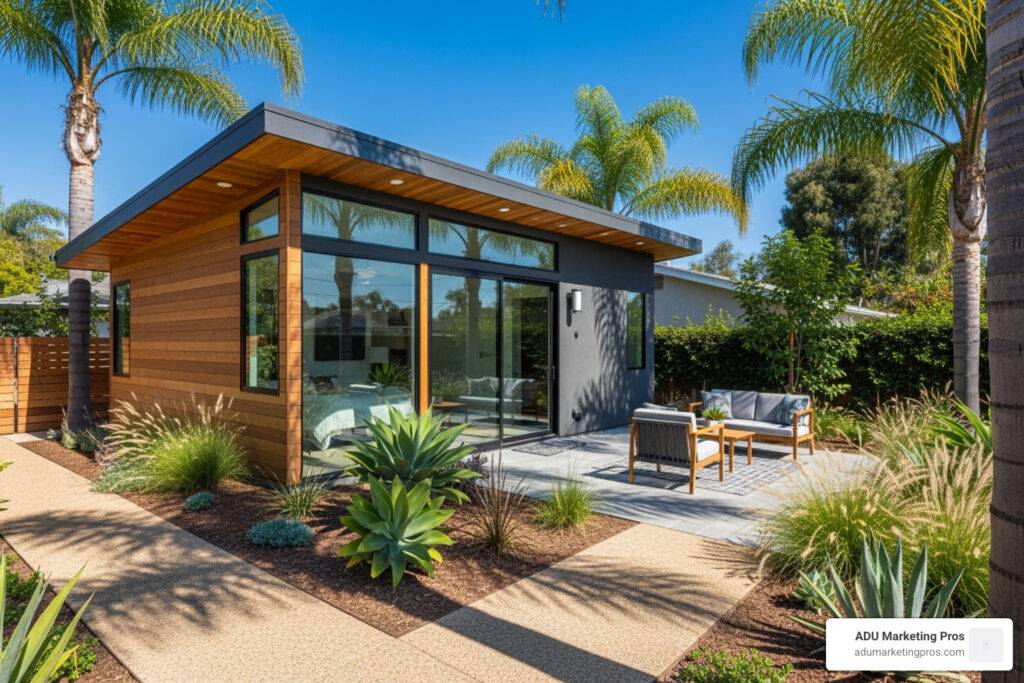
Understanding San Diego County’s ADU Landscape
Navigating the county of san diego adu requirements is a critical first step for homeowners looking to expand their property’s potential. In response to California’s ongoing housing shortage, state and local governments have streamlined regulations to encourage the development of Accessory Dwelling Units (ADUs) and Junior Accessory Dwelling Units (JADUs). These units, often called granny flats, in-law suites, or casitas, represent a powerful tool for creating affordable housing, generating rental income, and accommodating multi-generational families. The County of San Diego has acceptd this movement, establishing a clear framework for homeowners in unincorporated areas to add new living spaces to their properties.
A Quick Guide to County of San Diego ADU Requirements
For those seeking a high-level overview, here are the essential rules governing ADU development in the unincorporated parts of the county:
- Unit Types: The county permits both detached (standalone) and attached ADUs, as well as JADUs created within the primary residence.
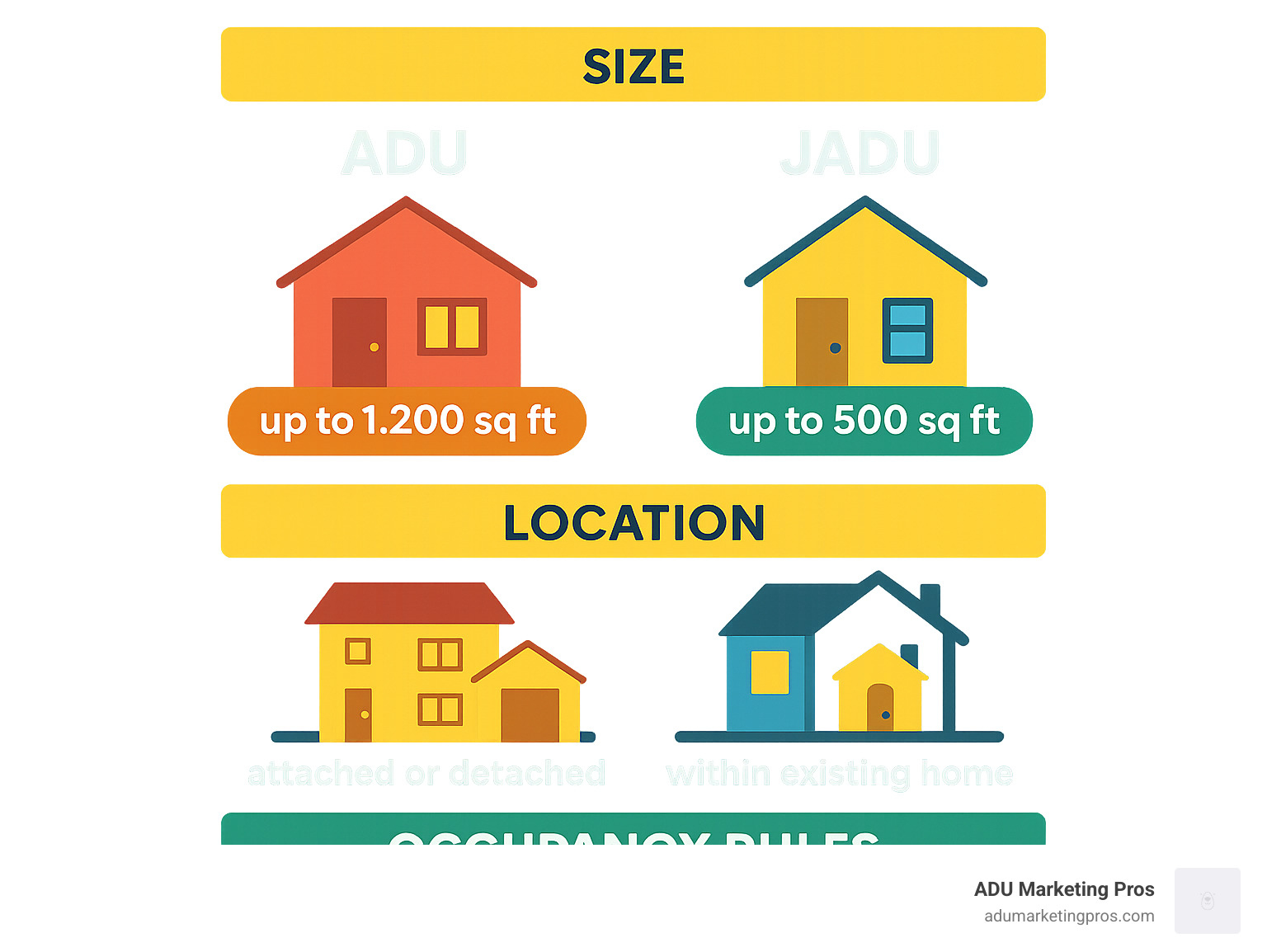
- Maximum Size: Detached ADUs can be up to 1,200 sq ft. Attached ADUs are limited to 50% of the main home’s size, also capped at 1,200 sq ft. JADUs have a maximum size of 500 sq ft.
- Setbacks & Height: Newly constructed ADUs require a minimum of 4-foot side and rear setbacks. The maximum height is generally 25 feet for detached units, allowing for two-story designs.
- Parking: One off-street parking space is required per ADU, but this is often waived if the property is near public transit or if the ADU is a conversion of an existing structure like a garage.
- Permitting: A building permit is mandatory for all ADU and JADU projects. The county’s ADU Fee Waiver Program, which previously reduced costs, officially ended on January 9, 2024. Applicants must now budget for all standard permit and impact fees.
- Rental & Occupancy: A minimum rental term of 30 days is enforced to prevent short-term vacation rentals. Owner-occupancy is not required for a standard ADU but is mandatory for a JADU (the owner must reside in either the main house or the JADU).
What Are ADUs and JADUs?
An Accessory Dwelling Unit (ADU) is a fully independent home with its own entrance, kitchen, bathroom, and living/sleeping area. It can be a new, detached structure in your backyard, an addition to your main house, or a conversion of an existing space like a garage or barn.
A Junior Accessory Dwelling Unit (JADU) is a more compact and integrated option. It must be created within the existing walls of a single-family home and cannot exceed 500 square feet. A JADU requires an efficiency kitchen (including a sink, cooking appliance, and storage) and may share a bathroom with the main house, though a separate entrance is required.
The Crucial Distinction: County vs. City Rules
It is absolutely essential to understand that the county of san diego adu requirements apply only to properties located in the unincorporated areas of the county. These communities include places like Fallbrook, Ramona, Lakeside, Alpine, and Valley Center. If your property lies within the boundaries of an incorporated city—such as the City of San Diego, Chula Vista, Oceanside, Escondido, or Carlsbad—you are subject to that specific city’s ADU ordinance. While all local ordinances must comply with state law, there can be significant differences in size limits, setbacks, and permit processes between jurisdictions. Always verify your property’s jurisdiction before beginning any planning.
Who Can Build an ADU in San Diego County?
The eligibility criteria for building an ADU in unincorporated San Diego County are intentionally broad, reflecting the state’s goal of encouraging new housing development. The regulations are designed to be permissive, allowing most residential property owners to participate.
Core Eligibility Requirements
To be eligible to build an ADU or JADU, your property must meet a few fundamental conditions:
- Location: The property must be situated within the unincorporated jurisdiction of San Diego County. You can verify this using your Assessor’s Parcel Number (APN) with the county’s Property Summary Report tool.
- Zoning: The property must have a zoning designation that allows for residential use. This includes most single-family and multi-family residential zones. If you are unsure about your zoning, the property summary report will provide this information.
- Existing or Planned Dwelling: The lot must have an existing or proposed single-family or multifamily dwelling. You cannot build an ADU on a vacant lot without also building a primary residence.
Owners of multifamily properties, such as duplexes or apartment buildings, are also eligible. They can convert non-livable spaces like storage rooms, boiler rooms, basements, or attics into ADUs, in addition to building new detached units.
How Many Units Are Allowed on a Property?
The county of san diego adu requirements are quite generous when it comes to the number of units you can add, creating significant opportunities to increase housing density.
For Single-Family Residential Lots: You are permitted to add one ADU (which can be either attached or detached) and one JADU to your property. This means a standard single-family lot can legally accommodate three separate living units: the primary home, the ADU, and the JADU. This combination offers maximum flexibility for homeowners seeking rental income and space for family.
For Multifamily Residential Lots: The rules allow for even greater density. Property owners can build up to two detached ADUs, each subject to height and setback requirements. In addition, they can convert existing non-habitable spaces within the multifamily structure into new ADUs. The number of conversion ADUs is generally limited to 25% of the existing number of dwelling units. For example, in an eight-unit apartment building, you could convert two storage areas into legal ADUs.
These regulations, driven by state law, are designed to maximize the housing potential of existing residential parcels.
What Are the Rules for Renting and Occupancy?
Understanding the regulations around renting and occupancy is crucial for financial planning and long-term compliance. The county has established clear rules to ensure ADUs contribute to the long-term housing stock.
Minimum Rental Period: ADUs and JADUs must be rented for a term of more than 30 consecutive days. This explicitly prohibits their use as short-term vacation rentals (e.g., Airbnb, VRBO). The policy is intended to provide stable housing for local residents rather than transient lodging for tourists.
Owner-Occupancy Requirements: The rules differ between ADUs and JADUs. For a standard ADU permitted after January 1, 2020, there is no owner-occupancy requirement. This means the owner can rent out both the primary residence and the ADU. However, for a JADU, the property owner must reside in one of the remaining units on the property—either the primary dwelling or the JADU itself. This requirement is recorded on the property’s deed.
No Separate Sale: An ADU or JADU cannot be sold or conveyed separately from the primary residence. It is considered an accessory part of the main property and must be sold with it. This prevents the subdivision of single-family lots via ADU construction.
It’s also important to distinguish ADUs from “Guest Living Quarters.” Guest quarters are not permitted to have full kitchen facilities and cannot be rented out. A property is generally not allowed to have both an ADU/JADU and guest quarters.
Navigating the County of San Diego ADU Requirements for Size, Setbacks, and Height
The physical parameters of your ADU—its size, its placement on your lot, and its height—are governed by specific development standards. The county of san diego adu requirements are designed to provide flexibility for homeowners while ensuring new units are safe, livable, and compatible with the surrounding neighborhood. Understanding these core rules is the foundation of a successful ADU project.
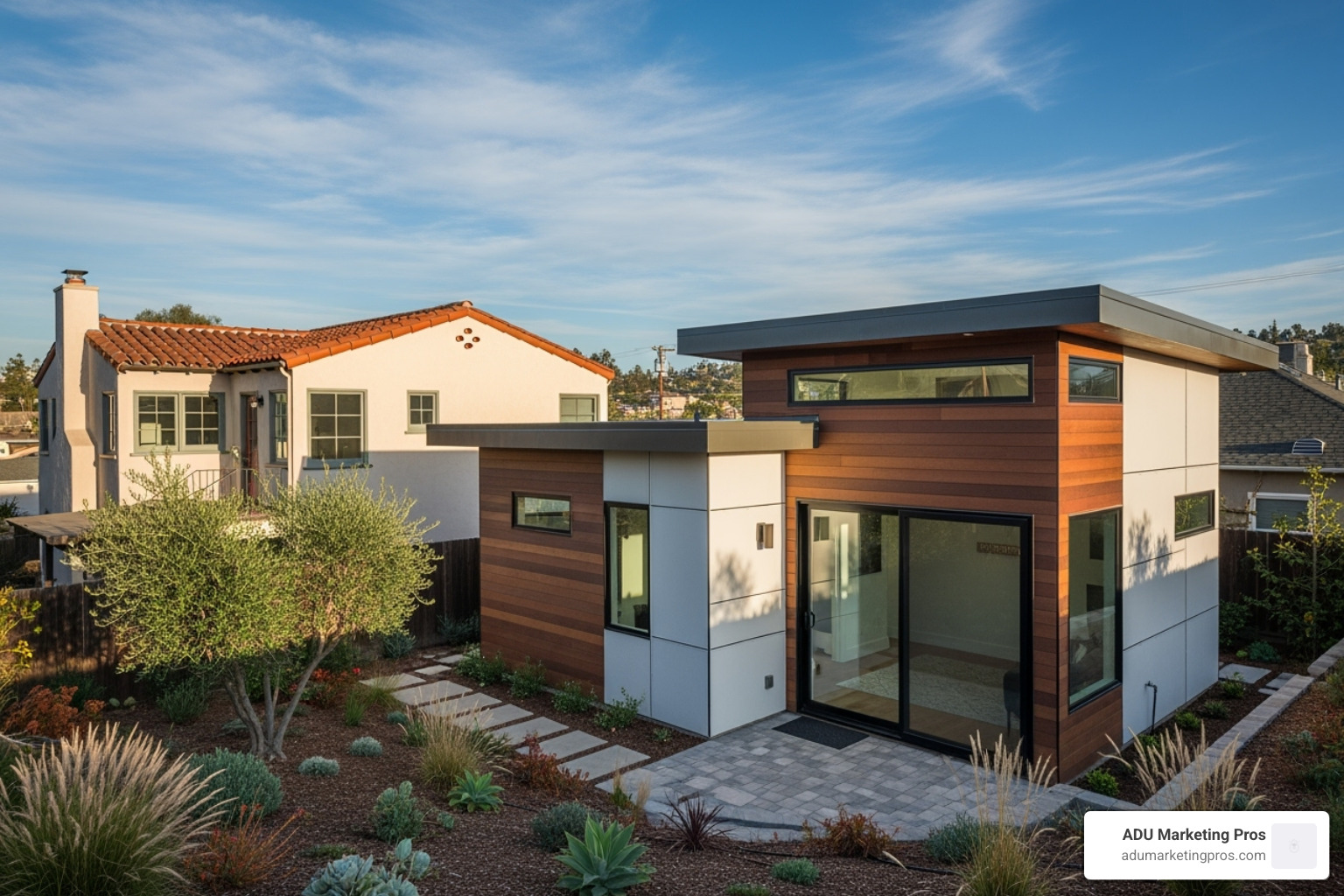
Detailed Size Requirements for Each ADU Type
The county sets clear maximums on the square footage of living space for each type of unit. These limits are crucial for determining your project’s scope and budget.
Detached ADUs: A new, standalone ADU can be built up to a maximum of 1,200 square feet. This size is generous and allows for a comfortable two- or even three-bedroom home, completely independent of the size of the primary residence.
Attached ADUs: An ADU that is attached to the primary home is limited to 50% of the existing primary dwelling’s area, with a final cap of 1,200 square feet. For example:
- If your main home is 2,000 sq. ft., your attached ADU can be up to 1,000 sq. ft. (50% of 2,000).
- If your main home is 3,000 sq. ft., your attached ADU is capped at 1,200 sq. ft., not 1,500 sq. ft. (50% of 3,000).
- State law provides a floor for smaller homes: you are always allowed to build an attached ADU of at least 850 square feet for a studio or one-bedroom unit, or 1,000 square feet for a unit with two or more bedrooms, regardless of the 50% rule.
JADUs (Junior Accessory Dwelling Units): These units are the most compact, with a strict maximum size of 500 square feet. A JADU must be created within the existing footprint of the single-family residence, such as by converting a bedroom or an attached garage.
Conversion ADUs: When converting an existing legal structure, like a garage or an accessory building, into an ADU, the size is generally limited to the existing footprint of that structure. You can convert the entire space, even if it exceeds the 1,200 sq. ft. limit for new construction, and you may be able to expand it by up to 150 sq. ft. for ingress and egress.
Understanding Setback Rules and Placement
Setbacks are the required distances between a structure and the property lines. These rules ensure adequate space for fire safety, privacy, and access.
Standard Setbacks for New Construction: Newly constructed ADUs, whether attached or detached, must maintain a minimum setback of 4 feet from the side and rear property lines. This is a significant reduction from the larger setbacks often required for primary homes, making ADUs feasible on many lots.
Front Yard Setbacks: Generally, ADUs must respect the established front yard setback for the property’s zoning. However, flexibility may be granted if this requirement prevents the construction of an 800 sq. ft. ADU.
Conversion of Existing Structures: If you are converting a legally established existing structure (like a garage) into an ADU, you can maintain its existing setbacks, even if it is located directly on a property line (a zero-foot setback). This is a key provision that makes garage conversions a popular and cost-effective ADU strategy.
Separation Between Structures: For fire safety, a minimum distance of 6 feet is typically required between the primary home and a new detached ADU. This distance is measured from the walls of the structures; the eaves or roof overhangs can be as close as 4 feet.
Height Limitations and Design Possibilities
The county’s height limits provide considerable design freedom while maintaining neighborhood scale.
Detached ADUs on Single-Family Lots: A detached ADU can be built up to 25 feet high. This generous height allowance makes two-story or loft-style designs possible, which can be an excellent way to maximize living space on a smaller footprint.
Attached ADUs: An attached ADU must conform to the height limit of the primary residence or the underlying zone, whichever is more restrictive.
Height Restrictions in Certain Cases: The height limit is reduced to 18 feet for detached ADUs that are located within a front yard setback or on a lot with an existing multifamily dwelling. Smaller ADUs (under 800 sq. ft.) may also be subject to this 18-foot height limit in some circumstances.
Key Considerations: Parking, Permits, and Special Regulations
Beyond the foundational rules of size and placement, a successful ADU project requires careful attention to the practical aspects of development. The county of san diego adu requirements for parking, the permitting process, and site-specific regulations like fire safety and septic capacity are critical problems to clear on the path to completion. Proper planning in these areas can save significant time, money, and frustration.
Are There Specific Parking Requirements?
Historically, parking requirements were a major obstacle to ADU development. However, recent state and local reforms have made these rules much more flexible.
The baseline rule in San Diego County is that one off-street parking space is required for each new ADU. This space can be covered or uncovered and can be located in tandem on an existing driveway. However, this requirement is waived entirely under several common scenarios:
- Proximity to Public Transit: No parking is required if the property is located within a half-mile walking distance of a public transit stop (e.g., a bus stop or trolley station).
- Historic Districts: Properties located within a designated historic district are exempt from the parking requirement.
- Conversion of Existing Structures: When an ADU is created within an existing primary residence (like an attached ADU) or an existing accessory structure (like a garage conversion), no additional parking is needed.
Crucially, if you convert your garage, carport, or other covered parking structure into an ADU, you are not required to replace those parking spaces. This is a significant incentive that directly enables the popular garage conversion ADU model.
The ADU Permit Process and Pre-Approved Plans
Every ADU and JADU project, without exception, requires a building permit from the County’s Department of Planning & Development Services (PDS). This process ensures that the proposed structure meets all building codes, fire codes, zoning ordinances, and health and safety standards.

To expedite this process, the County of San Diego offers a set of pre-approved ADU building plans. These plans, designed by various architects, range in size from 600 to 1,200 square feet and have already undergone the majority of the structural and code review. Using these plans can save homeowners thousands of dollars in design fees and can shorten the permit review timeline. You will still need to hire a professional to create a site plan showing how the pre-approved structure will be placed on your specific property, including foundation details and utility connections. You can view these options on the County of San Diego Pre-Approved ADU Plans page.
The permit application typically requires an in-person submission at the PDS office in San Diego, with multiple sets of physical plans. A complete submittal package will include architectural plans, structural calculations, a site plan, and a Title 24 energy compliance report.
Important Safety and Utility Rules
Properties in the unincorporated county often face unique challenges related to fire safety and wastewater management.
Fire Safety: The county is vigilant about fire safety. You must maintain 100 feet of defensible space around all structures, including the new ADU. This involves clearing flammable vegetation. Fire sprinklers are generally not required in a new ADU unless the primary home also has them. However, your local fire authority will review the plans and may impose specific requirements based on your location and access.
Septic Systems: If your property is not connected to a public sewer system, your septic system’s capacity is a critical factor. An ADU will increase the wastewater load, and you must prove your existing Onsite Wastewater Treatment System (OWTS) can handle it. This requires hiring a qualified professional to assess the system and submitting a report to the Department of Environmental Health and Quality (DEHQ) for approval. In many cases, a new or expanded septic system may be required, which can be a significant project cost.
Solar Panels: Under California’s Title 24 energy code, all newly constructed residential units, including detached ADUs, are generally required to have a solar photovoltaic (PV) system. The size of the system depends on the ADU’s size and energy consumption. The panels can be installed on the ADU’s roof or the roof of the primary home.
Grading and Drainage: The county has strict rules about grading, especially on steep slopes. Development on slopes over 25% is strongly discouraged. Any significant grading will trigger the need for a stormwater management plan to prevent erosion and runoff.
Frequently Asked Questions about San Diego County ADU Rules
Here are detailed answers to some of the most common questions homeowners have when considering an ADU project under the county of san diego adu requirements.
Will building an ADU significantly increase my property taxes?
Yes, your property taxes will increase, but it’s not as drastic as many people fear. California’s Proposition 13 limits tax increases on existing properties. When you build an ADU, the county assessor does not reassess the value of your entire property at current market rates. Instead, they perform a blended assessment.
This means your existing home’s assessed value remains protected under its original Prop 13 basis. Only the value of the newly constructed ADU is added to your tax bill. For example, if your home has an assessed value of $300,000 and you add an ADU that the assessor values at $200,000, your new total assessed value will be $500,000. You will only pay the standard property tax rate on the additional $200,000 of value. Most homeowners find this increase is easily offset by the rental income the ADU generates.
Can I convert an existing unpermitted structure into a legal ADU?
Yes, the county provides a pathway to legalize unpermitted structures and convert them into compliant ADUs. This can be a cost-effective alternative to demolition and new construction, but it requires a specific process.
You will need to hire a professional to create “As-Built” plans, which are drawings that document the structure as it currently exists. These plans are then submitted to the county, along with proposed modifications to bring the entire structure up to current building, health, and safety codes. This may involve significant upgrades to foundations, framing, electrical wiring, and plumbing systems. While the process can be complex, it results in a safe, legal, and valuable housing unit. The first step is to consult with the County’s Zoning Counter to discuss the specifics of your unpermitted structure.
What is the difference between County of San Diego and City of San Diego ADU rules?
This is one of the most critical distinctions to understand. The rules discussed in this article apply only to the unincorporated areas of the county (e.g., Ramona, Fallbrook, Alpine). If your property is within an incorporated city’s limits (e.g., City of San Diego, Chula Vista, Oceanside), you must follow that city’s distinct ADU ordinance.
While all city ordinances are based on state law, local interpretations and specific rules can vary significantly. Key differences often include:
- Size and Height Limits: The City of San Diego, for example, allows attached ADUs up to 1,200 sq. ft. regardless of the primary home’s size, which is more permissive than the County’s 50% rule.
- Setbacks: Some cities may allow zero-foot setbacks for certain ADU types, whereas the County’s standard is 4 feet for new construction.
- Permit Submission: The City of San Diego has a fully digital permit submission process, while the County generally requires in-person submission of physical plans.
Always verify your property’s jurisdiction using your APN before you start designing your project.
How much does it cost to build an ADU in San Diego County?
Costs can vary dramatically based on the type, size, site conditions, and level of finishes. Here are some general ranges:
- Garage Conversion: Typically the most affordable option, ranging from $80,000 to $150,000.
- New Detached ADU: This is the most expensive option, often ranging from $200,000 to $400,000 or more. Costs are influenced by site work, utility connections, and construction complexity.
- Attached ADU: Costs are usually somewhere in the middle, depending on the complexity of tying into the existing structure.
These figures do not include soft costs like design fees, engineering, and permit fees, which can add another 10-20% to the total.
Conclusion: Your Path to a Successful ADU Project
Building an Accessory Dwelling Unit in San Diego’s unincorporated communities is a significant but rewarding endeavor. The county of san diego adu requirements, while detailed, have been intentionally structured to empower homeowners, not to hinder them. By understanding this regulatory framework, you can open up your property’s hidden potential, create much-needed housing, and build a valuable asset for your family’s future.
Let’s recap the most critical takeaways. First, confirm your property is in an unincorporated area where these specific rules apply. Remember the key development standards: detached ADUs can be up to 1,200 sq. ft. with 4-foot side/rear setbacks, while attached ADUs are generally limited to 50% of the main home’s size. JADUs offer a compact, 500 sq. ft. option within your home but come with an owner-occupancy requirement.
Plan your project with the key operational rules in mind. All rentals must be for 30 days or longer, and you cannot sell your ADU as a separate unit. Critically, you must now budget for the full cost of permits and fees, as the ADU fee waiver program has ended. For rural properties, pay special attention to site-specific challenges like ensuring 100 feet of defensible space for fire safety and verifying your septic system’s capacity with the DEHQ.
Building an ADU is arguably one of the most impactful investments a homeowner can make in California today. It directly addresses the housing affordability crisis on a local level while providing you with a flexible space for rental income, aging parents, or adult children. The County of San Diego has made this process more accessible than ever, particularly through its innovative pre-approved building plans, which can save you critical time and money.
While the journey from concept to completion requires diligence and a great team, the path is clear. With the right knowledge and professional guidance, you can successfully steer the regulations and turn your vision into a tangible, income-producing reality.