
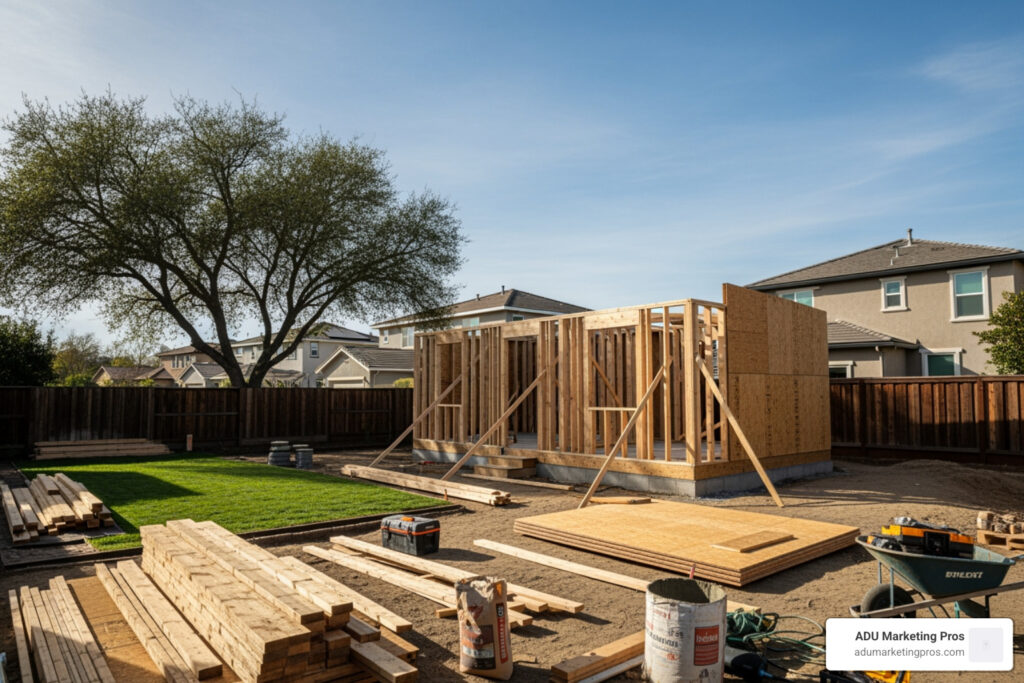
Why Detached ADU Construction Is Changing California Backyards
Detached ADU construction is rapidly transforming California backyards, emerging as a powerful solution to the state’s housing crisis. Fueled by a series of state laws designed to remove barriers to development, homeowners are now empowered to add value, generate income, and create flexible living space on their properties. A detached ADU—also known as a backyard cottage, granny flat, or in-law suite—is a standalone residential unit built separately from the main house. Unlike attached or Junior ADUs (JADUs), these structures offer complete independence with their own entrance, kitchen, bathroom, and living facilities, making them true second homes.
Quick Overview: What Makes Detached ADUs Different?
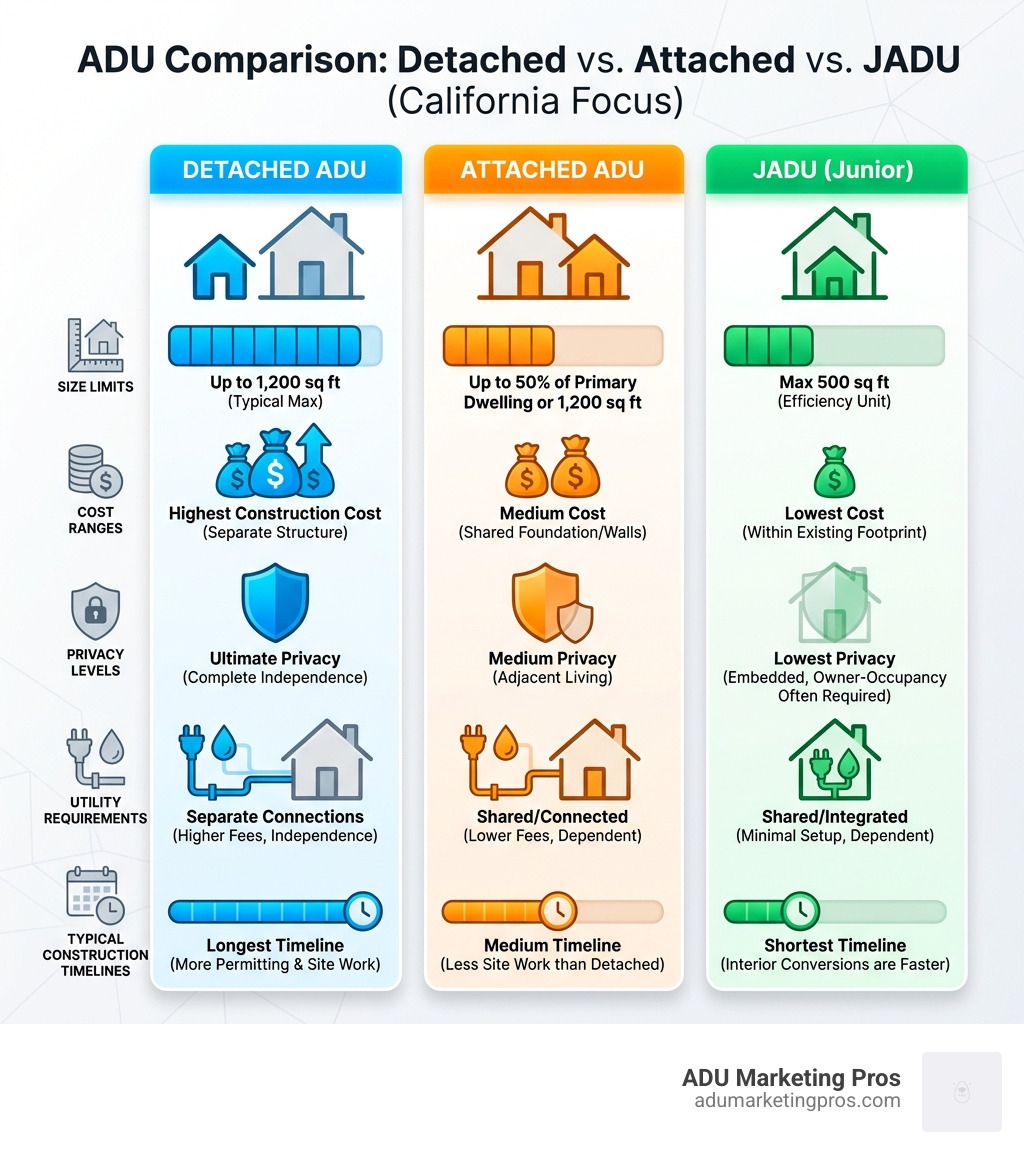
- Detached ADU: A completely separate, standalone structure. Typically allowed up to 1,200 sq ft. Offers the highest level of privacy and rental income potential. Involves the highest construction cost due to new foundation, structure, and utility runs.
- Attached ADU: An addition connected to the main home. Limited to 50% of the primary dwelling’s size or 1,200 sq ft, whichever is less. Offers moderate privacy with a separate entrance. Construction costs are lower than detached units but higher than conversions.
- JADU (Junior ADU): Created within the existing footprint of the primary home (e.g., a converted bedroom). Capped at 500 sq ft and requires an efficiency kitchen. It’s the most affordable option but offers the least privacy and may require owner-occupancy in the main home.
Here’s why homeowners and developers are choosing detached ADUs:
- Ultimate privacy for both occupants and the main household
- Flexible rental income potential without impacting the primary residence
- Increased property value, often exceeding attached units
- Design freedom to create a unique structure
- Predictable construction costs compared to remodeling
However, detached ADU construction has its challenges. These units require more land, involve higher upfront costs due to separate utility connections, and can face complex permitting. They are not always feasible for smaller urban lots where space is at a premium.
Whether you’re considering a detached ADU for aging parents, rental income, or a home office, understanding the construction process, costs, and regulations is essential for success.
Must-know Detached ADU construction terms:
For official state-level guidance, see the California Department of Housing and Community Development’s Accessory Dwelling Unit Handbook and the California Legislative Information page for state ADU laws.
Understanding Detached ADUs: Pros, Cons, and Best Uses
Accessory Dwelling Units (ADUs) are smaller, additional living spaces on the same lot as a single-family home. A complete ADU must include independent areas for living, sleeping, cooking, and bathing, with its own separate entrance. Detached ADUs are the classic ‘backyard homes’ that are completely separate from the primary residence, functioning as an independent dwelling with their own utilities. This offers distinct advantages over attached ADUs (connected to the main house) or Junior ADUs (created within the existing home).
Advantages of a Detached ADU
Homeowners often choose detached ADU construction for maximum autonomy and separation. Here’s why:
- Ultimate Privacy: With no shared walls or entrances, a standalone unit provides unparalleled privacy for both the ADU occupants and the main household. This separation is ideal for rental units or multi-generational living.
- Rental Flexibility: A detached ADU’s independence makes it highly attractive to tenants, often commanding higher rental income. This flexibility helps homeowners maximize their ADU Rental Income.
- Increased Property Value: Detached ADUs significantly boost property value, often more than attached units, because they are viewed as premium, separate living solutions.
- Predictable Construction Costs: New construction avoids the unexpected structural issues common in renovations, leading to more predictable costs, even if the initial budget is higher.
- Preserving Primary Home’s Aesthetic: Building a separate structure maintains the architectural integrity of your primary home. The ADU can be designed to complement the main house or have its own distinct style.
- Design Freedom: A new build offers total freedom to create a custom layout and design, unconstrained by an existing structure. For inspiration, explore ADU Design Ideas California.
Disadvantages and Challenges
Despite the benefits, detached ADU construction comes with challenges:
- Requires More Land: Detached ADUs need enough space for their footprint and to meet setback requirements, making them unsuitable for smaller lots. Understanding your local ADU Minimum Lot Size is a critical first step.
- Higher Initial Construction Costs: Building a new structure from the ground up—including a foundation, framing, and roofing—results in higher upfront costs than conversions or attached units.
- Separate Utility Connections: Extending water, sewer, and electrical lines to a detached unit requires trenching, which adds significant cost and complexity to the project.
- Potentially Complex Permitting: Despite streamlined state laws, detached units can face stricter local zoning and building codes, which may complicate and prolong the permitting process.
Best Use Cases for a Detached ADU
The flexibility of a detached ADU makes it ideal for several scenarios:
- Rental Income Generation: A separate living space is ideal for generating passive income to help with mortgage payments or build wealth.
- Multi-Generational Living: A detached ADU allows families to house aging parents or adult children nearby while preserving everyone’s independence. They are a great solution as an ADU For Aging Parents.
- Guest House: Offer friends and family a private, comfortable space with their own amenities during visits.
- Home Office Retreat: Create a quiet, dedicated home office, studio, or creative space away from the distractions of the main house.
- Housing for Adult Children: Provide an affordable, independent living option for adult children navigating California’s expensive housing market.
Planning Your Build: Site, Zoning, and Design
A successful detached ADU construction project begins with a meticulous feasibility assessment. This phase involves evaluating your property, understanding local regulations, and creating a design that fits your needs and budget. These early decisions lay the groundwork for a smooth build.

Site Selection and Preparation
Choosing the right spot and preparing it properly is key to your ADU’s success.
- Lot Size and Setbacks: Confirm your property has enough space for the ADU and meets local setback rules (the required distance from property lines). Properties with large backyards are ideal.
- Topography: A relatively flat site is most cost-effective. Sloped lots may require more extensive and expensive foundation work and grading.
- Site Access: Plan for clear access for construction vehicles and equipment to avoid damaging your property. This path must also provide safe, legal access for future occupants.
- Clearing and Grading: The build site must be cleared of obstacles and graded to create a level base and ensure proper drainage away from the new foundation.
- Soil Inspection: A geotechnical (soils) report is often required by local building departments, especially on sloped lots or in areas with known soil issues. This report analyzes soil composition, stability, and load-bearing capacity to inform the engineer’s foundation design. Skipping this can lead to costly structural failures like cracking or sinking down the line.
- Drainage: Proper site grading is just the first step. An effective drainage plan is crucial to prevent water from pooling around or under the foundation, which can cause moisture intrusion and structural damage. Solutions can include French drains, swales, catch basins, and using permeable pavers for patios and walkways to help manage stormwater runoff.
For a comprehensive overview, refer to general ADU Building Requirements.
Zoning, Setbacks, and HOA Rules
Navigating the regulatory landscape is often the most challenging part of detached ADU construction.
- Local Zoning Laws: While state laws provide a baseline, your local jurisdiction has the final say on many specifics. For example, a city might impose objective design standards on exterior materials, colors, or roof pitch to ensure the ADU is architecturally compatible with the neighborhood. Always start by downloading your city or county’s ADU ordinance from their planning department website. Learn more about ADU Zoning Laws.
- Setback Requirements: State law typically requires a minimum setback of four feet from side and rear property lines for detached ADUs, ensuring adequate space and privacy.
- Height Limits: Height is often restricted, commonly to a maximum of 25 feet, though this varies by jurisdiction.
- HOA Restrictions: State law (AB 670) prevents Homeowners’ Associations (HOAs) from outright prohibiting ADUs. However, they can enforce “reasonable restrictions” on aspects like siding, roofing, and landscaping. It is critical to submit your plans to your HOA for review early in the design process to avoid conflicts or delays. Review your HOA’s Covenants, Conditions, and Restrictions (CC&Rs) and consult the official California ADU Handbook for authoritative guidance on HOA limitations.
Utility Connections and Parking Requirements
Connecting services and planning for parking have significant cost implications.
- Utility Connections: A major cost for detached ADUs is connecting utilities. This involves trenching to extend water, sewer, and electrical lines. You may also opt for separate meters for easier billing if you plan to rent the unit.
- Parking Requirements: State law typically requires one parking space per ADU, which can often be tandem on an existing driveway. However, parking is exempt if the property is within a half-mile of public transit or in a historic district. For details, see the ADU Parking Requirements.
The Financials: Costs, Property Value, and ROI
Understanding the financial aspects of detached ADU construction is crucial. This includes upfront costs, impact on property value, potential rental income, and financing options. A solid financial strategy ensures your investment yields the desired returns.
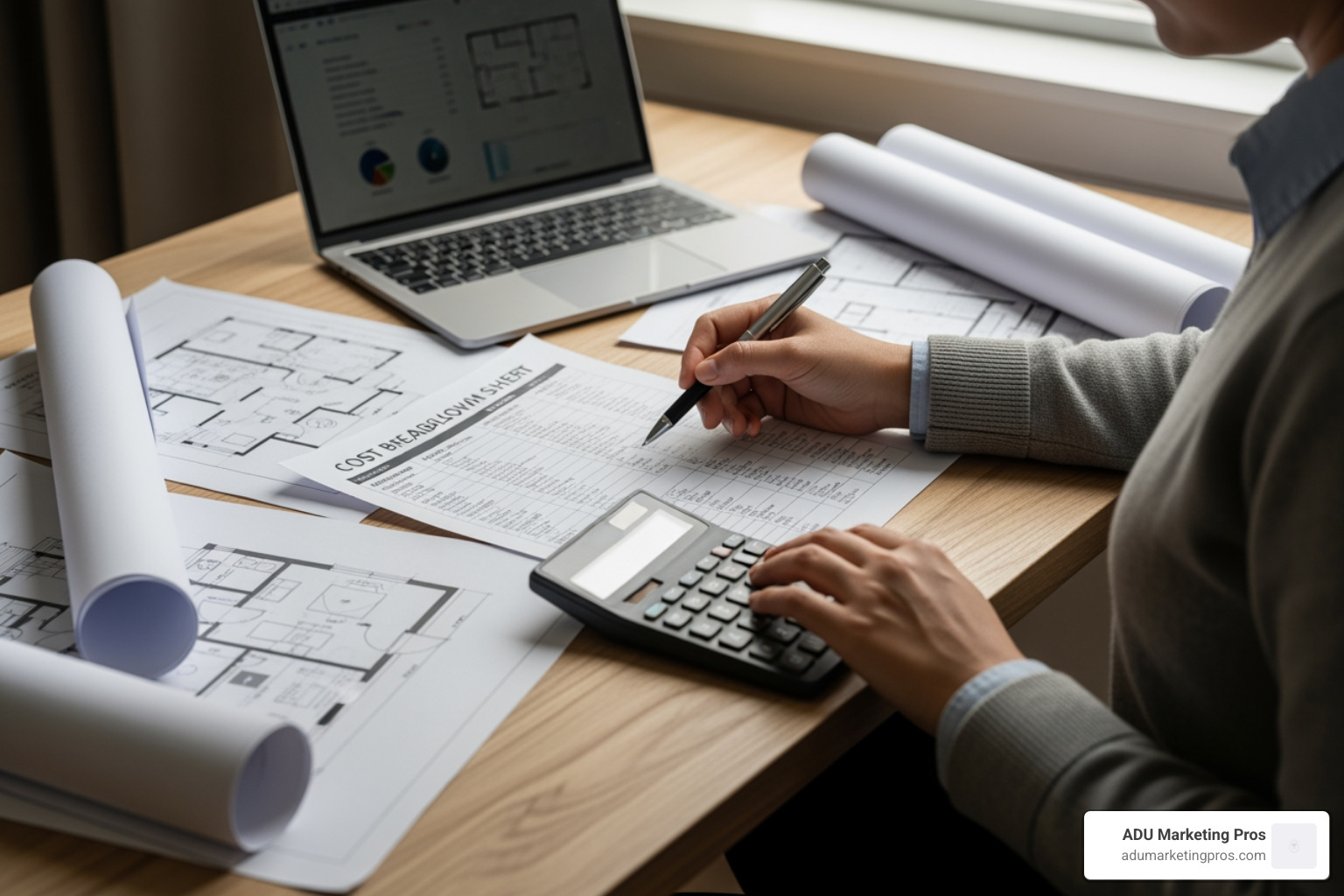
Detached ADU Construction Costs
Detached ADUs come with a higher price tag than other ADU types due to their standalone nature.
- Cost Per Square Foot: In California, expect all-in costs between $300 and $450+ per square foot. This range covers everything from design to finishes. A typical 800 sq ft detached ADU could therefore range from $240,000 to $360,000+. Costs are highest in areas like the Bay Area and Los Angeles. For a breakdown, see our guide on ADU Cost Per Square Foot.
- Soft Costs vs. Hard Costs:
- Soft Costs (~10-20% of budget): These include non-construction expenses like design fees ($10,000-$25,000), structural engineering, permit and impact fees ($5,000-$20,000+), and soil reports.
- Hard Costs (~80-90% of budget): These are the direct construction expenses, including site work, foundation, framing, roofing, MEP (mechanical, electrical, plumbing), insulation, and all interior/exterior finishes.
- Utility Connection Costs: This is a major variable. Trenching and connecting to public water, sewer, and electrical grids can cost anywhere from $10,000 to $30,000+, depending on the distance from the main lines and local utility fees. Upgrading your main electrical panel to support the ADU is also a common requirement.
- Contingency Fund: It is non-negotiable. Always budget an additional 10–15% of your total project cost for a contingency fund. This will cover unexpected issues like discovering poor soil conditions, material price increases, or design changes during construction.
For national lending guidance on how ADUs are treated in appraisals and financing, review Fannie Mae’s official Selling Guide section on ADUs at fanniemae.com.
Financing Your Detached ADU
Several financing options can help fund your detached ADU construction project:
- Home Equity Loans or HELOCs: A Home Equity Loan provides a lump sum, while a Home Equity Line of Credit (HELOC) works like a credit card. Both use your home’s equity as collateral, offering lower interest rates than other loan types. They are a great option if you have significant equity built up.
- Construction Loans: These short-term loans are specifically for building projects. Funds are disbursed in draws as you complete construction milestones, and the lender will inspect progress. They typically require a higher down payment and more detailed project plans upfront. Upon completion, they are often converted into a traditional mortgage.
- Cash-Out Refinancing: This involves replacing your current mortgage with a new, larger one and taking the difference in cash. It can be a good option if current interest rates are favorable, allowing you to lock in a single, long-term loan for both your primary home and the ADU project.
- Government Grants and Programs: Some cities and counties in California offer grants or fee waivers to encourage ADU construction, particularly for affordable housing. Check with your local housing authority for available programs. Explore more ADU Financing Options.
Impact on Property Value and Rental Income
A detached ADU is a strategic investment that can significantly boost your property’s financial performance.
- Significant Value Increase: A detached ADU is a premium asset that substantially increases resale value, an assessment supported by lenders like Fannie Mae.
- Potential Rental Income: Generate consistent income by renting your ADU. Research local market rates to set a competitive price. In California, ADUs must be rented for 30 days or more.
- Property Tax Reassessment: Your property taxes will be reassessed based on the value of the new ADU. Your primary home’s existing assessment will not change. Learn more about ADU Property Taxes.
The Step-by-Step Detached ADU Construction Process
Building a detached ADU is a multi-phase project that typically takes 8–18 months from design to move-in. Timelines vary based on project complexity, permitting speed, and contractor availability, but understanding the general steps helps manage expectations.
Phase 1: Design and Permitting (2-6 Months)
This foundational phase is where your vision is planned and approved.
- Hire a Professional: Work with an experienced architect or designer to create plans that maximize space, meet your budget, and comply with local regulations, including California’s Title 24 energy standards.
- Submit for Permits: Your designer will submit the finalized plans to your local building department for review. This is a critical step in the ADU Permit Process.
- Address Revisions: It’s common for the city to request revisions. Addressing these comments promptly is key to keeping your project on schedule.
- Receive Permit: After approval, you’ll receive the building permit that allows construction to start.
Phase 2: Site Work and Foundation (1-2 Months)
With permits approved, the physical work in your backyard begins.
- Site Preparation: The build area is cleared of debris and graded to create a level, stable base with proper drainage.
- Utility Trenching: Trenches are dug to lay the new water, sewer, and electrical lines that will service the ADU.
- Foundation Pouring: The foundation is installed, providing the structural base for your new unit.
| Foundation Type | Description | Pros | Cons |
|---|---|---|---|
| Slab-on-Grade | Concrete slab poured directly on prepared ground. | Cost-effective, quick to install, good for seismic resistance. | No crawl space for easy utility access, can feel colder. |
| Raised/Crawlspace | Lifted foundation with space underneath. | Easier utility access/repairs, better insulation, good for sloped lots. | Higher cost, longer build time, potential for moisture/pest issues. |
Phase 3: Framing and Rough-in (1-2 Months)
During this phase, the ADU’s structure takes shape.
- Framing and Sheathing: The ADU’s skeletal structure (walls and roof) is built and covered with sheathing for rigidity.
- Rough MEP Installation: Mechanical (HVAC), electrical, and plumbing systems are installed within the walls and floors.
- Initial Inspections: City inspectors review the framing and rough-in work to ensure it meets code before you can proceed.
Phase 4: Exterior and Interior Finishes (2-4 Months)
Your ADU starts to look and feel like a home.
- Exterior Work: The roofing, siding, windows, and doors are installed, sealing the building from the elements.
- Interior Rough-in: Insulation is added for energy efficiency, followed by drywall to create the interior walls.
- Finishing Touches: Flooring, cabinets, countertops, and fixtures are installed. The interior is painted, bringing your ADU to life. Find inspiration with these ADU Interior Design Ideas.
Phase 5: Final Inspection and Occupancy (2-4 Weeks)
This is the final step before your ADU is ready for use.
- Final Connections and Inspections: Permanent utility connections are made, and all systems undergo a final inspection by the city.
- Certificate of Occupancy: Once all inspections pass, the city issues a Certificate of Occupancy, which legally permits the ADU to be inhabited.
- Move-in Ready: Your detached ADU is now complete and ready for occupants!
For a more comprehensive look at the entire journey, refer to More on the ADU Building Process.
Frequently Asked Questions about Detached ADU Construction
Here are clear, straightforward answers to common questions about detached ADU construction.
How long does it take to build a detached ADU?
From design to move-in, a detached ADU project typically takes 8 to 18 months.
- Design & Permitting: This initial phase lasts 2 to 6 months and includes creating plans and navigating the local permit process. This is often the most unpredictable part of the timeline.
- Construction: The build itself usually takes 6 to 12 months, covering everything from foundation and framing to final finishes and utility hookups.
Factors impacting the timeline: Common delays include slow responses from the city planning department, weather disruptions, supply chain issues for materials, and contractor availability. Working with an experienced team that has a good relationship with the local building department can help minimize these risks.
Can I build a detached ADU on any property?
Not every property is suitable. Feasibility depends on local zoning, lot size, setbacks, and utility access. You’ll need enough space in your yard to meet setback requirements (state law mandates a minimum of 4 feet from side and rear property lines, but local rules can vary). A feasibility study conducted by an ADU professional is a crucial first step. This assessment evaluates your property’s potential, identifies potential red flags (like protected trees or utility easements), and provides a preliminary budget before you invest thousands in design.
Are prefab or modular ADUs a good option for detached construction?
Yes, prefab and modular ADUs are excellent options that are growing in popularity. They can be faster and more cost-predictable because up to 90% of the construction occurs off-site in a controlled factory environment. This significantly reduces on-site disruption, noise, and weather delays, potentially shortening the overall timeline by several months.
- Permanent and Code-Compliant: It’s a common misconception that prefab means temporary. These are permanent structures built on a permanent foundation and must meet the exact same state and local building codes as traditional site-built homes.
- Variety of Options: Choices range from fully modular units delivered complete to panelized systems assembled on-site and pre-cut kits for a more hands-on approach. This offers different levels of customization and cost.
- To explore costs and options, check out our guide on Prefab ADU California Cost. They offer an efficient path to building a detached ADU.
What are the biggest mistakes to avoid in detached ADU construction?
The most common pitfalls often stem from poor planning. Key mistakes include:
- Underestimating Costs: Failing to create a detailed budget with a 15% contingency fund can derail a project. Be sure to account for soft costs (permits, design), hard costs (labor, materials), and utility connections.
- Hiring the Wrong Team: Choosing an inexperienced contractor or designer who doesn’t specialize in ADUs can lead to code violations, delays, and costly rework. Always check licenses, references, and their portfolio of completed ADU projects.
- Ignoring Local Regulations: Assuming state law is the only rule is a major error. Local ordinances on size, height, and design are critical. Ignoring them will result in permit rejection.
Do I need an architect for a detached ADU?
While not always legally required for very simple designs, hiring a licensed architect or an experienced building designer is highly recommended. A professional is essential for creating plans that are code-compliant, structurally sound, and optimized for your specific needs and property. They navigate the complex permitting process on your behalf, saving you time and headaches. For a significant investment like a detached ADU, professional design is a small price to pay for ensuring the project is successful and the final product is functional and valuable.
Conclusion
Detached ADU construction represents more than just a building project; it’s a strategic investment in your property’s future, offering unparalleled privacy, financial returns, and housing flexibility. By carefully navigating the key stages—from site planning and navigating ADU Construction Regulations to managing costs and overseeing the build—homeowners can add a significant and valuable asset to their property. Whether your goal is to generate rental income, provide a home for family, or create a dedicated personal space, a well-planned detached ADU is one of the smartest and most impactful additions you can make to a California home. As this trend continues to reshape our neighborhoods, these backyard homes will play a vital role in creating more diverse and accessible housing solutions across the state. For builders and architects in this growing market, a strong marketing strategy is essential. ADU Marketing Pros helps firms showcase their expertise and attract qualified leads. Explore our solutions for modern prefab granny flats and see how we can help you grow.