
What You Need to Know About ADU Laws in Los Angeles (Quick Answer)
ADU laws in Los Angeles have undergone a radical transformation over the last decade, evolving from a restrictive and bureaucratic nightmare into one of the most progressive housing frameworks in the United States. For decades, homeowners in Los Angeles faced insurmountable hurdles when trying to build a simple “granny flat.” Zoning restrictions, excessive parking requirements, and high impact fees made these projects nearly impossible for the average resident. However, as the California housing crisis reached a breaking point, the state legislature stepped in to override local “poison pill” ordinances, effectively mandating that cities like Los Angeles embrace Accessory Dwelling Units (ADUs) as a primary solution for urban infill housing.
Today, the regulatory environment is designed to encourage construction rather than block it. Whether you are looking to house an aging parent, provide a home for an adult child, or generate rental income to offset a high mortgage, the current laws provide a clear, ministerial path to approval. This means that if your project meets the objective building standards set by the city and state, the local government must approve your permit. The discretionary power of neighbors or local officials to block a project based on subjective concerns has been largely eliminated.
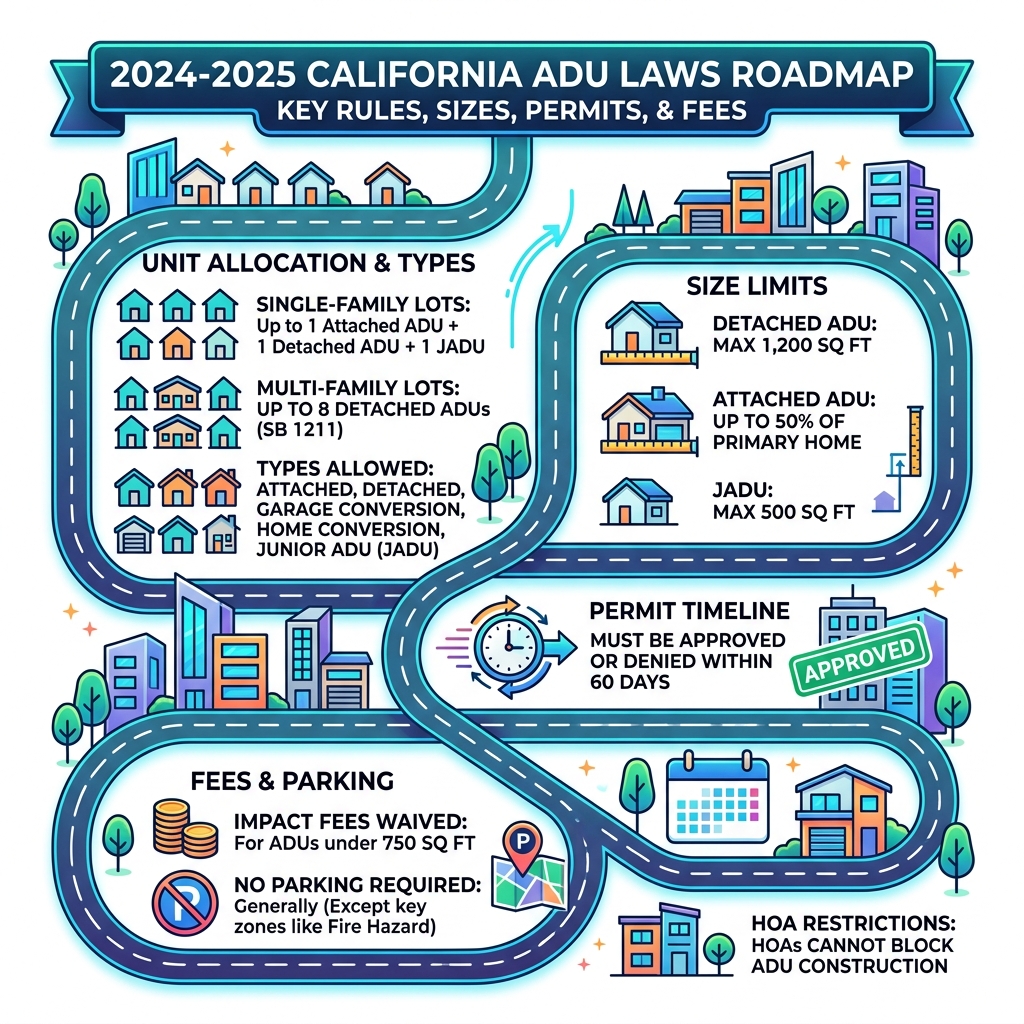
Here’s a fast-reference summary of the key rules currently governing the Los Angeles market:
| Rule | What It Means |
|---|---|
| ADU types allowed | Attached, detached, garage conversion, home conversion, Junior ADU (JADU) |
| Max ADU size | 1,200 sq ft (detached); up to 50% of primary home (attached) |
| JADU max size | 500 sq ft |
| Units allowed on single-family lots | 1 attached ADU + 1 detached ADU + 1 JADU |
| Units allowed on multifamily lots | Up to 8 detached ADUs (SB 1211, 2025) |
| Permit timeline | Must be approved or denied within 60 days |
| Parking required? | Generally no — with key exceptions (fire hazard zones) |
| Impact fees | Waived for ADUs under 750 sq ft |
| HOA restrictions | HOAs cannot block ADU construction |
The Context of the Los Angeles Housing Crisis
Los Angeles is currently grappling with a housing shortage estimated at hundreds of thousands of units. Traditional development—large apartment complexes and high-rise buildings—often takes years to approve and build, and frequently faces intense local opposition. ADUs, by contrast, allow for “gentle density.” They increase the housing supply without fundamentally changing the character of suburban neighborhoods. This is why California has passed a wave of new legislation since 2020 — including AB 68, SB 13, SB 1211, and AB 1033 — that has significantly relaxed local restrictions. The result? More property owners are eligible to build, costs are more predictable, and the permitting process is faster than ever before.
According to research on LA housing trends, 61% of ADUs are built for multigenerational living. This trend is driven by the rising cost of assisted living for seniors and the difficulty young professionals face when trying to enter the Los Angeles real estate market. By building an ADU, families can stay together while maintaining privacy and independence. Furthermore, for those looking at the financial benefits, an ADU can increase a property’s value by 20% to 35%, depending on the neighborhood and the quality of the build.
Whether you’re a homeowner exploring your options or a contractor helping clients navigate the rules, understanding current ADU regulations is essential before breaking ground. The laws are complex, but the opportunities they create are unprecedented in the history of California real estate.
Easy adu laws in los angeles glossary:
- Accessory Dwelling Unit Cost Los Angeles
- Your Guide to Los Angeles ADU Regulations
- Accessory Dwelling Unit Los Angeles
Understanding ADU Laws in Los Angeles: Definitions, Types, and Eligibility
When we talk about an Accessory Dwelling Unit Los Angeles, we are referring to a secondary residential unit that provides complete independent living facilities. According to LAMC Section 12.03, this means the unit must have its own permanent provisions for sleeping, eating, cooking, and sanitation. It is not just a “guest house” or a “pool house”; it is a fully functional residence that can be legally rented out or occupied long-term.
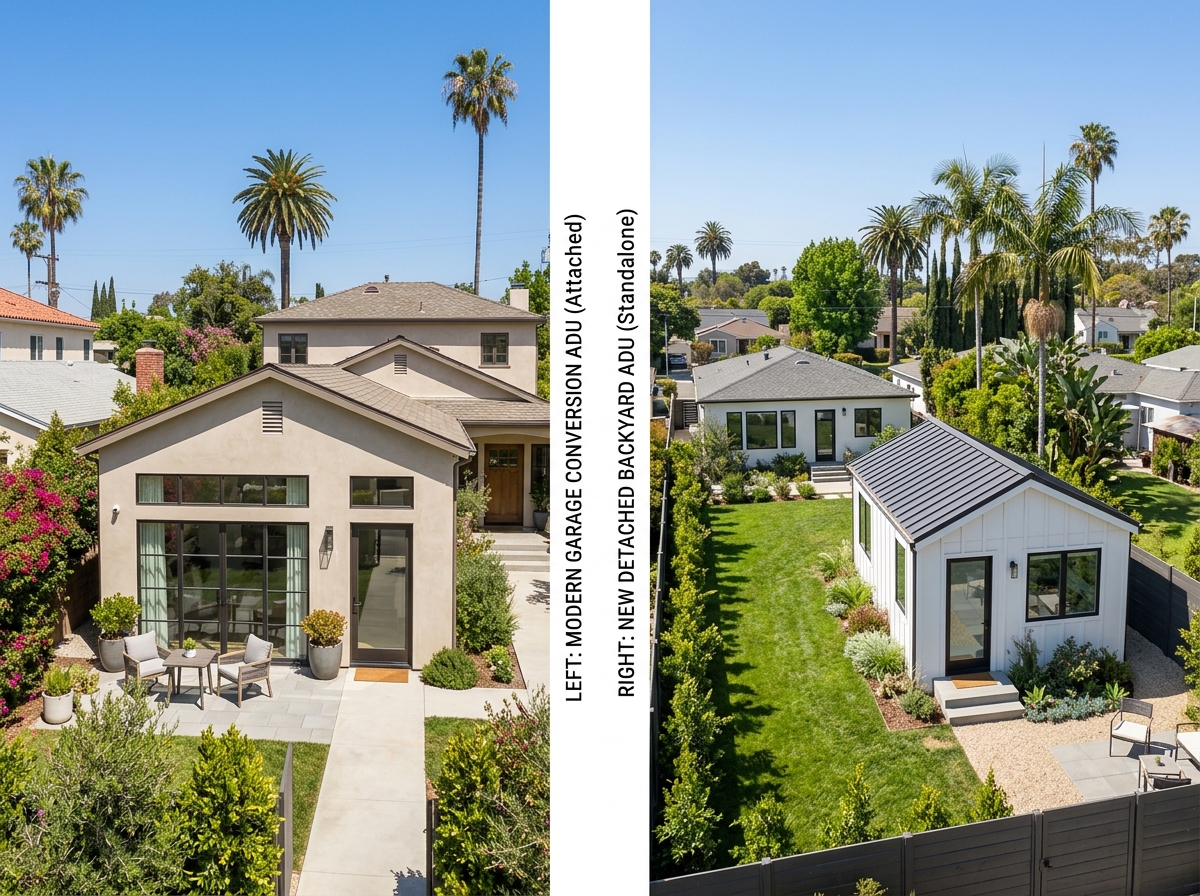
In the eyes of the law, there are several distinct “flavors” of ADUs, each with its own set of rules and benefits:
- Detached ADUs: These are stand-alone structures, often built from scratch in a backyard. They offer the most privacy and are the most popular choice for rental units. They can be stick-built on-site or brought in as prefabricated units.
- Attached ADUs: These share at least one wall with the primary residence. They are often created by expanding the footprint of the existing house. The maximum size for these is capped at 50% of the primary home’s square footage.
- Garage Conversions: One of the most popular and cost-effective options in LA. By converting an existing garage into a living space, homeowners save on foundation and framing costs. Under current law, you do not have to replace the parking lost when you convert a garage.
- Movable Tiny Houses (MTH): A unique and relatively new category in Los Angeles. These are portable units between 150 and 430 square feet, certified to ANSI/NFPA standards, and registered with the DMV. Unlike a standard ADU, they aren’t on a permanent foundation, making them a flexible option for those who may want to move the unit in the future.
ADU vs. JADU Requirements: A Detailed Comparison
Understanding the difference between a standard ADU and a Junior ADU (JADU) is critical for maximizing your lot’s potential. While they sound similar, the legal requirements for owner-occupancy and kitchen facilities differ significantly.
| Feature | Accessory Dwelling Unit (ADU) | Junior ADU (JADU) |
|---|---|---|
| Max Size | 1,200 sq ft (Detached) | 500 sq ft |
| Location | Attached, Detached, or Conversion | Within walls of primary home |
| Kitchen | Full kitchen required | Efficiency kitchen allowed |
| Bathroom | Separate bathroom required | Can share with main house |
| Entrance | Separate exterior entrance | Separate exterior entrance |
| Owner Occupancy | Not required (until 2025+) | Required (in main home or JADU) |
Eligibility and Quantity Limits for Property Owners
One of the most common questions we hear is: “Am I allowed to build more than one?” The answer depends on your property type and how you plan to utilize the space. For single-family lots, current Los Angeles ADU Regulations allow for what many call the “triple threat”: one detached ADU, one attached ADU, and one JADU. This allows a single-family lot to effectively become a three-unit property, providing massive potential for rental income or multi-generational housing.
For multifamily properties (like duplexes, triplexes, or apartment buildings), the rules have become even more generous thanks to SB 1211. Starting in 2025, multifamily owners can build up to eight detached ADUs on a single lot, provided the number of ADUs does not exceed the number of existing principal units. Additionally, owners can convert non-habitable spaces—such as basements, attics, boiler rooms, or storage closets—into attached ADUs. The law allows for at least one such conversion, or up to 25% of the existing unit count. This is a game-changer for apartment owners looking to increase their Cap Rate without purchasing new land.
Junior Accessory Dwelling Units (JADUs) Explained
The JADU is the “little sibling” of the ADU family, but it’s a powerhouse for those with limited space or budget. Under the ADU Guidelines Los Angeles, a JADU must be contained entirely within the walls of a single-family residence (which can include an attached garage).
The beauty of a JADU is its simplicity. It only requires an “efficiency kitchen,” which consists of a sink, a cooking appliance (like a hot plate or convection oven), and a small food preparation counter. It can even share a bathroom with the main house, which significantly reduces plumbing costs. However, there is a major legal catch: the property owner must live in either the JADU or the primary residence. This “owner-occupancy” requirement is intended to prevent JADUs from being used purely as investment properties by absentee landlords, ensuring that the primary home remains owner-occupied.
Development Standards: Size, Setbacks, and Parking Requirements
Navigating the physical constraints of your lot is where the technical aspects of adu laws in los angeles become most relevant. While the state has set broad mandates, Los Angeles has specific interpretations regarding how these units must be situated on a property. Understanding these “development standards” is the difference between a smooth permit approval and a costly redesign.
Size Limits and the “Safety Net” Rule
In Los Angeles, a detached ADU can be as large as 1,200 square feet, regardless of the size of the primary home. This is more generous than many other California cities. However, if you are building an attached ADU, the size is limited to 50% of the primary dwelling’s square footage. For example, if your main house is 1,500 square feet, your attached ADU cannot exceed 750 square feet.
There is also the 800 Sq Ft Rule, which acts as a “safety net” provided by state law. Local governments cannot enforce any standard—such as lot coverage, floor area ratio (FAR), or open space requirements—that would prevent you from building at least an 800-square-foot ADU that is at least 16 feet tall and has 4-foot side and rear setbacks. This ensures that even on small or densely packed lots, homeowners still have the right to build a functional unit.
Setbacks and Height Restrictions
For most new detached ADUs, you need a minimum of 4 feet for side and rear setbacks. This is a significant reduction from the 15-25 foot setbacks often required for primary homes. If you are doing a Garage Conversion Los Angeles, you are allowed to keep the existing setbacks of the structure. If your garage is built right on the property line, you can convert it as-is, provided you meet fire safety requirements for the walls.
Height limits have also been standardized. Detached ADUs are generally allowed to reach 16 feet. However, if the property is within a half-mile of a major transit stop, or if it is a detached ADU on a multifamily lot, the height limit increases to 18 feet (plus an additional 2 feet to account for roof pitch). For a deep dive into the legal text, you can always refer to the Official LADBS ADU Ordinance.
Parking Requirements and the Fire Zone Exception
In the past, the requirement to provide off-street parking was the single biggest barrier to ADU construction. Today, in Los Angeles, you generally do not need to provide a new parking space for your ADU if it meets any of the following criteria:
- It is located within a half-mile walking distance of public transit (which covers the vast majority of LA).
- It is located within an architecturally or historically significant district.
- It is part of the existing primary residence or an existing accessory structure.
- When on-street parking permits are required but not offered to the occupant of the ADU.
- When there is a car-share vehicle located within one block of the ADU.
The Fire Zone Exception: If your property is located in a Very High Fire Hazard Severity Zone (VHFHSZ), the rules are much stricter. In these areas, the city may require you to provide one uncovered parking space for the ADU to ensure that streets remain clear for emergency vehicles. Furthermore, if you convert a garage in a fire zone, you may be required to replace the parking spots you lost for the main house. This is a critical check you must perform with the LADBS before finalizing your plans.
Fire Safety, Soundproofing, and Building Codes
Safety is non-negotiable, and ADUs are held to high standards. Even if your ADU is a Prefab ADU Los Angeles, it must meet the California Building Standards Code (Title 24).
- Fire Sprinklers: You only need to install sprinklers in the ADU if they are required for the primary residence. However, if the ADU is detached and exceeds 1,200 square feet (including any attached garage space), the LA County Fire Department may mandate them.
- Fire Rating: If your ADU is attached to the main house, the common wall must have a 1-hour fire-resistance rating. This usually involves specific types of drywall and fire-rated doors.
- Soundproofing: For attached units, common walls must meet an STC 50 sound transmission rating to ensure privacy between the two households.
- Solar Requirements: Under the current California Energy Code, all new-construction detached ADUs are required to have solar panels. This does not apply to garage conversions or ADUs created within existing space.
Recent Legislative Updates and Their Impact on ADU Laws in Los Angeles
The landscape of adu laws in los angeles is constantly shifting as the state legislature continues to refine the rules. Since 2023, several landmark bills have been passed that aim to close the remaining loopholes used by local jurisdictions to slow down construction. These updates have made the process more “ministerial,” meaning it is based on a checklist of rules rather than the whims of a planning commission.
AB 1033: The “Condo Law” and Selling ADUs Separately
Perhaps the most discussed update is AB 1033. This law allows cities to “opt-in” to a program that lets ADUs be sold separately from the primary home as condominiums. Historically, an ADU could only be sold if the entire property was sold. Under AB 1033, a homeowner could potentially build a backyard cottage and sell it to a third party, much like a townhouse.
While Los Angeles is still in the process of fully implementing the local framework for this, it represents a massive shift in how we think about property ownership. To sell an ADU as a condo, the property must be converted into a condominium project, which involves creating a Homeowners Association (HOA) and drafting CC&Rs. You can Read More About AB 1033 to see the specific legal hurdles involved. This could eventually provide a more affordable path to homeownership for thousands of Angelenos.
AB 976 and the Permanent End of Owner-Occupancy
For years, one of the biggest deterrents for investors was the “owner-occupancy” requirement, which mandated that the owner live on the property to rent out an ADU. AB 976 made the suspension of this requirement permanent. Now, you can build an ADU, rent out the main house, and rent out the ADU simultaneously without ever living on the property. This has turned ADUs into a premier investment vehicle for real estate professionals. Note that this does not apply to JADUs, which still require the owner to live on-site.
AB 434: Pre-Approved Plans and Faster Permitting
To speed up the design and approval phase, AB 434 requires cities to have a Pre-Approved ADU Plans Los Angeles program by 2025. The City of Los Angeles has already launched its version of this, featuring dozens of designs from top architects that have been pre-vetted by the building department. Using a pre-approved plan can shave months off your timeline because the structural and environmental reviews are already complete. You only need to submit a site plan showing how the pre-approved unit fits on your specific lot.
The 60-Day Rule and Ministerial Approval
The most significant impact of state legislation like AB 68 and AB 881 is the 60-day rule. Under these laws, the local agency must act on your permit application within 60 days of receiving a complete submittal. If they do not approve or deny it within that window, the application is “deemed approved.” This prevents the “pocket veto” where a city simply ignores an application they don’t like.
Furthermore, the process is now ministerial. In the past, ADUs were often “discretionary,” meaning they required public hearings where neighbors could complain about “neighborhood character” or “loss of views.” Today, if your plans meet the building code and the objective standards of the ADU ordinance, the city must issue the permit. For more official updates, we recommend checking the California HCD ADU Information portal, which provides the most current state-wide guidance.
Costs, Financing, and the LADBS Permitting Process
Building an ADU is a significant financial undertaking, and understanding the Los Angeles ADU Cost is the first step in a successful project. In the current market, costs are driven by labor shortages, material inflation, and the complexity of California’s building codes. However, the long-term ROI remains strong due to the high rental rates in the city.
Breaking Down the Investment
- Garage Conversions: These remain the most affordable entry point, typically ranging from $100,000 to $150,000. The cost varies based on whether the existing foundation needs reinforcement and how far the utility lines (sewer, water, gas) must be run.
- New Construction (Detached): A ground-up ADU generally costs between $200,000 and $450,000. On a square-foot basis, you should budget between $350 and $500 per square foot. While this is higher than a standard home, remember that an ADU requires its own kitchen and bathroom—the two most expensive rooms to build—compressed into a smaller footprint.
One major financial relief provided by SB 13 is the Impact Fee Exemption. Any ADU under 750 square feet is completely exempt from impact fees, which are charges cities use to fund parks, schools, and infrastructure. In Los Angeles, this exemption can save a homeowner anywhere from $5,000 to $15,000.
Navigating the LADBS Permit Approval Timeline
To get your permit from the Los Angeles Department of Building and Safety (LADBS), you’ll need to follow a specific, multi-step path. It is highly recommended to work with ADU Architects Los Angeles who are familiar with the city’s specific electronic submittal system (ePlan).
- Design and Feasibility: Create ADU Floor Plans Los Angeles that comply with the 4-foot setback rules and height limits.
- Submittal: Submit your plans to LADBS for “Plan Check.” This is where the 60-day clock begins.
- Clearances: Even after Plan Check, you may need “clearances” from other departments. For example, if you are building near a power line, the Department of Water and Power (LADWP) must sign off. If you are in a hillside area, the Bureau of Engineering may need to review your grading plans.
- Addressing: If you want a separate address for your ADU (essential for separate utility billing), you must request a fractional address (e.g., 123 1/2 Main St) from the Mapping Division.
- Permit Issuance: Once all clearances are obtained and fees are paid, you receive your permit and construction can begin.
If you are concerned about the ADU Architect Los Angeles Cost, consider that a good architect can often save you more than their fee by optimizing the design to avoid expensive structural requirements or utility relocations.
Rent Stabilization (RSO) and Just Cause (JCO) Compliance
If you plan on renting out your ADU, you must understand the Los Angeles Housing Department (LAHD) rules, which are some of the strictest in the nation.
- RSO (Rent Stabilization Ordinance): This generally applies to properties built on or before October 1, 1978. If you add an ADU to an RSO property, the new ADU is usually exempt from rent control (meaning you can set the rent at market rate), but the original house remains subject to it.
- JCO (Just Cause Ordinance): Even if your ADU is exempt from RSO, it is likely subject to the Just Cause Ordinance. This means you cannot evict a tenant without a legal reason (like non-payment of rent), and if you perform a “no-fault” eviction (like moving a family member into the unit), you may owe the tenant significant relocation assistance.
- Parking Removal: If you remove a tenant’s existing parking spot to build an ADU, the RSO requires you to provide a permanent monthly rent reduction to that tenant. This is a hidden cost that many landlords overlook.
For a deeper look at these complexities, check out Your Guide to Los Angeles ADU Regulations: What You Need to Know.
Conclusion
The evolution of adu laws in los angeles has turned the “backyard dream” into a viable reality for thousands of homeowners. By streamlining the 60-day approval process, eliminating unnecessary parking requirements, and protecting owners from restrictive HOA rules, the city has paved the way for a housing revolution. We are no longer in an era where building a secondary unit is a legal gamble; it is now a standardized, ministerial process that adds significant value to your property and provides much-needed housing for the community.
However, as the market becomes more accessible, it also becomes more competitive. For homeowners, the challenge is finding the right contractors and architects to execute their vision within budget. For professionals in the industry—construction firms, architects, and developers—the challenge is standing out in a crowded marketplace.
At ADU Marketing Pros, we know that the technical side of building is only half the battle. To succeed in this booming market, you need more than just a hammer and nails—it requires digital authority. We specialize in helping ADU professionals attract high-quality leads through targeted ADU SEO Los Angeles and specialized digital marketing strategies. We help you navigate the noise so that when a homeowner searches for an expert to build their backyard home, your firm is the first one they see.
If you’re a builder or architect looking to grow your revenue and establish yourself as the go-to expert in the Los Angeles area, we’re here to help you scale. For More info about ADU marketing services, reach out to us today and let’s build something great together. The future of Los Angeles housing is in the backyard, and there has never been a better time to be a part of it.