
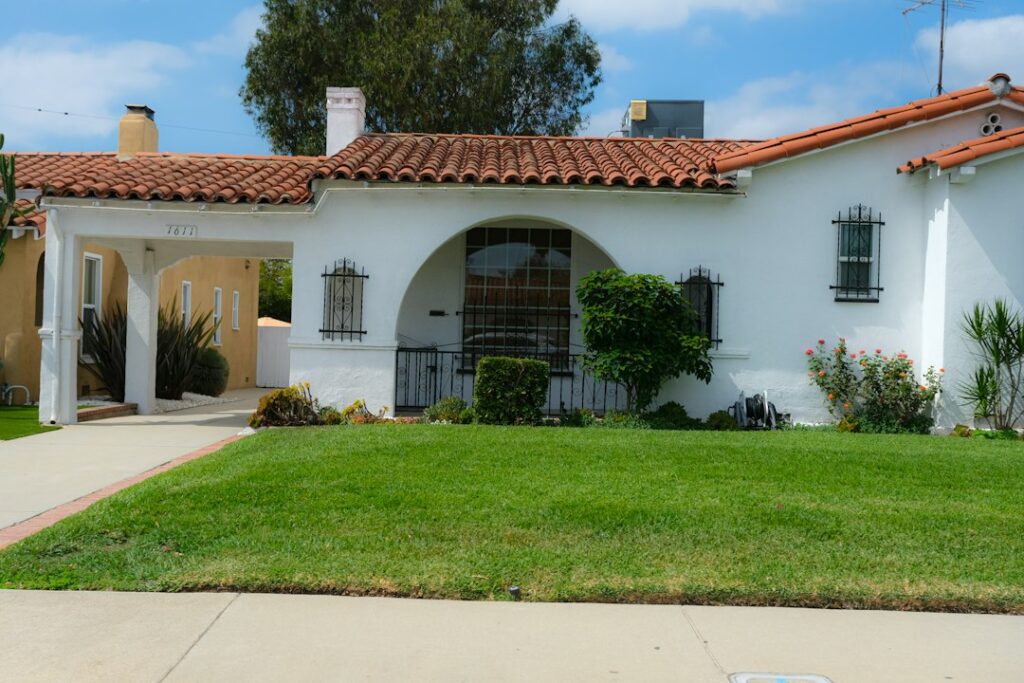
What You Need to Know About Accessory Dwelling Unit Rental Los Angeles Rules in 2026
Accessory dwelling unit rental Los Angeles is one of the fastest-growing income strategies for homeowners in the city — and for good reason. As we navigate the complexities of the 2026 real estate market, the role of the ADU has shifted from a niche backyard project to a fundamental component of the city’s housing strategy. With the California Department of Housing and Community Development (HCD) pushing for higher density, Los Angeles has become the epicenter of the “backyard revolution.”
Los Angeles is in the middle of a housing crisis that has persisted for decades. Rents are high, vacancy is low, and demand for smaller, affordable living spaces keeps climbing. ADUs sit right at the intersection of all of that, providing a “missing middle” housing solution that benefits both the property owner and the tenant. For the homeowner, it represents a hedge against inflation and a way to offset rising property taxes. For the tenant, it offers a unique living experience that combines the privacy of a single-family home with the price point of a traditional apartment.
But here’s the thing: renting out an ADU in LA comes with real legal complexity. The regulatory landscape has evolved significantly since the initial state mandates of 2017 and 2020. Get it wrong and you’re looking at fines of $200–$500 per day for unpermitted rentals — or up to $500 per day for illegal short-term rental violations. The city has ramped up enforcement in 2026, using automated data scraping to identify illegal listings on popular platforms.
Here’s the quick answer most people are looking for:
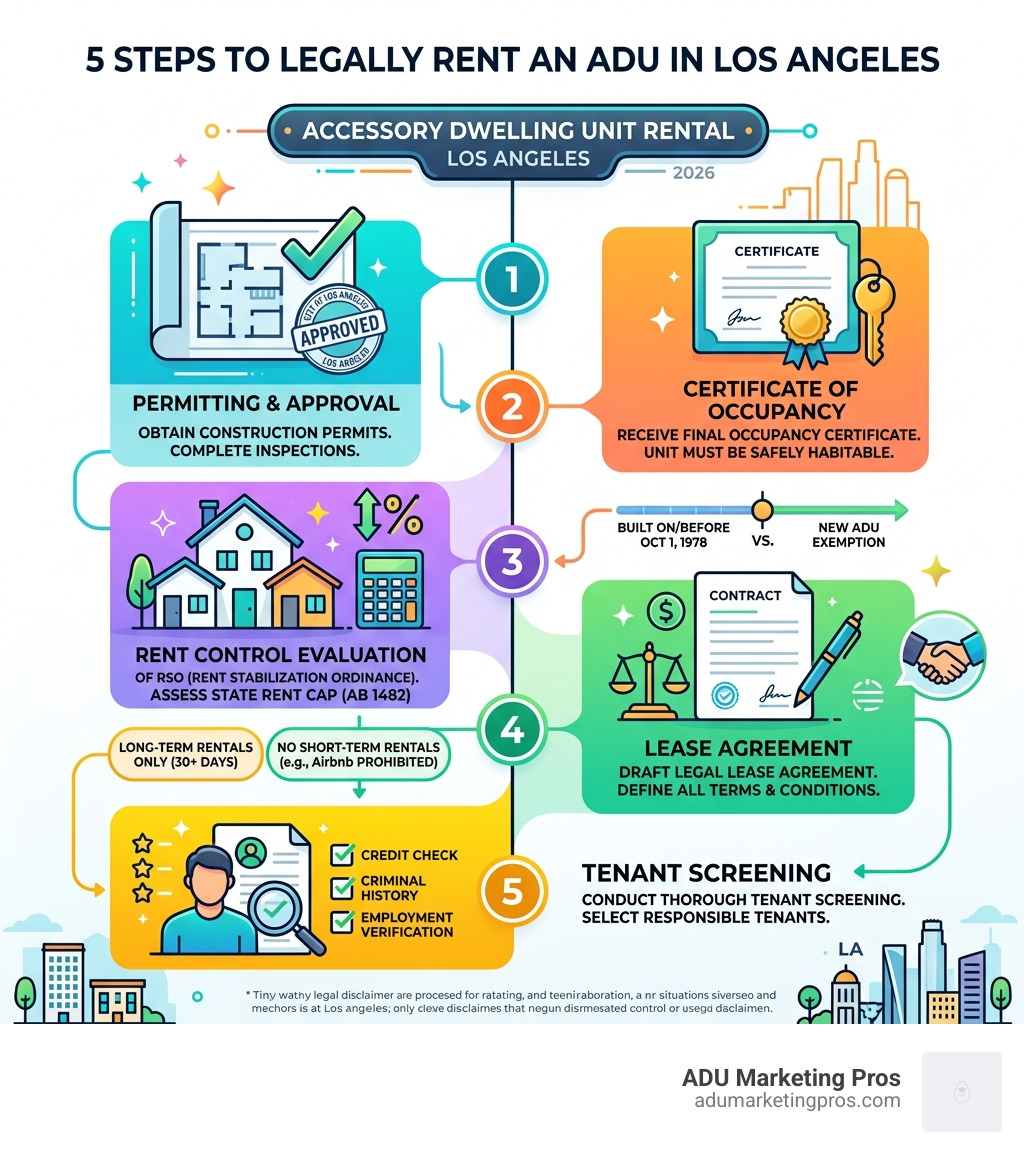
You can legally rent out your ADU in Los Angeles — but only as a long-term rental. Short-term rentals like Airbnb are prohibited citywide for ADUs, even if your main house qualifies for home-sharing. This is a non-negotiable rule designed to preserve the long-term housing stock for residents.
Key facts at a glance:
| Topic | What You Need to Know |
|---|---|
| Legal rental type | Long-term only (30+ days) |
| Short-term rentals | Prohibited citywide for ADUs |
| Permit required | Yes — Certificate of Occupancy required |
| Rent control (RSO) | Applies to units built on/before Oct 1, 1978 |
| New ADU exemption | ADUs built after 1978 exempt from RSO for 30 years |
| AB 1482 rent cap | 5% + inflation, max 10% per year |
| Typical rental income | $1,500–$4,500/month depending on neighborhood |
| Unpermitted ADU fines | $200–$500/day |
Whether you own a detached backyard unit, a garage conversion, or a basement suite, this guide walks you through everything — from permits and rent control to income potential and tax benefits. We will explore the nuances of the 2026 legislative updates and how they impact your bottom line.
Accessory dwelling unit rental los angeles terminology:
Understanding the Accessory Dwelling Unit Rental Los Angeles Market
As we move through 2026, the demand for an accessory dwelling unit rental los angeles has reached an all-time high. With nearly 30% of today’s renters actively seeking smaller, more budget-friendly spaces, ADUs have become the “goldilocks” of the housing market—providing more privacy than a traditional apartment but at a lower price point than a full-sized single-family home. This trend is driven by a combination of remote work flexibility and the rising cost of traditional multi-family housing.
We have observed that ADUs in Los Angeles maintain an incredible occupancy rate of 95% or higher. This is significantly better than the national vacancy averages, which typically hover around 6-7%. For property owners, this means your investment isn’t just sitting there; it’s a reliable workhorse. The “Silver Tsunami” has also contributed to this demand, as older residents look to downsize into ADUs while renting out their primary homes, or vice versa, allowing for aging-in-place solutions that are financially sustainable.
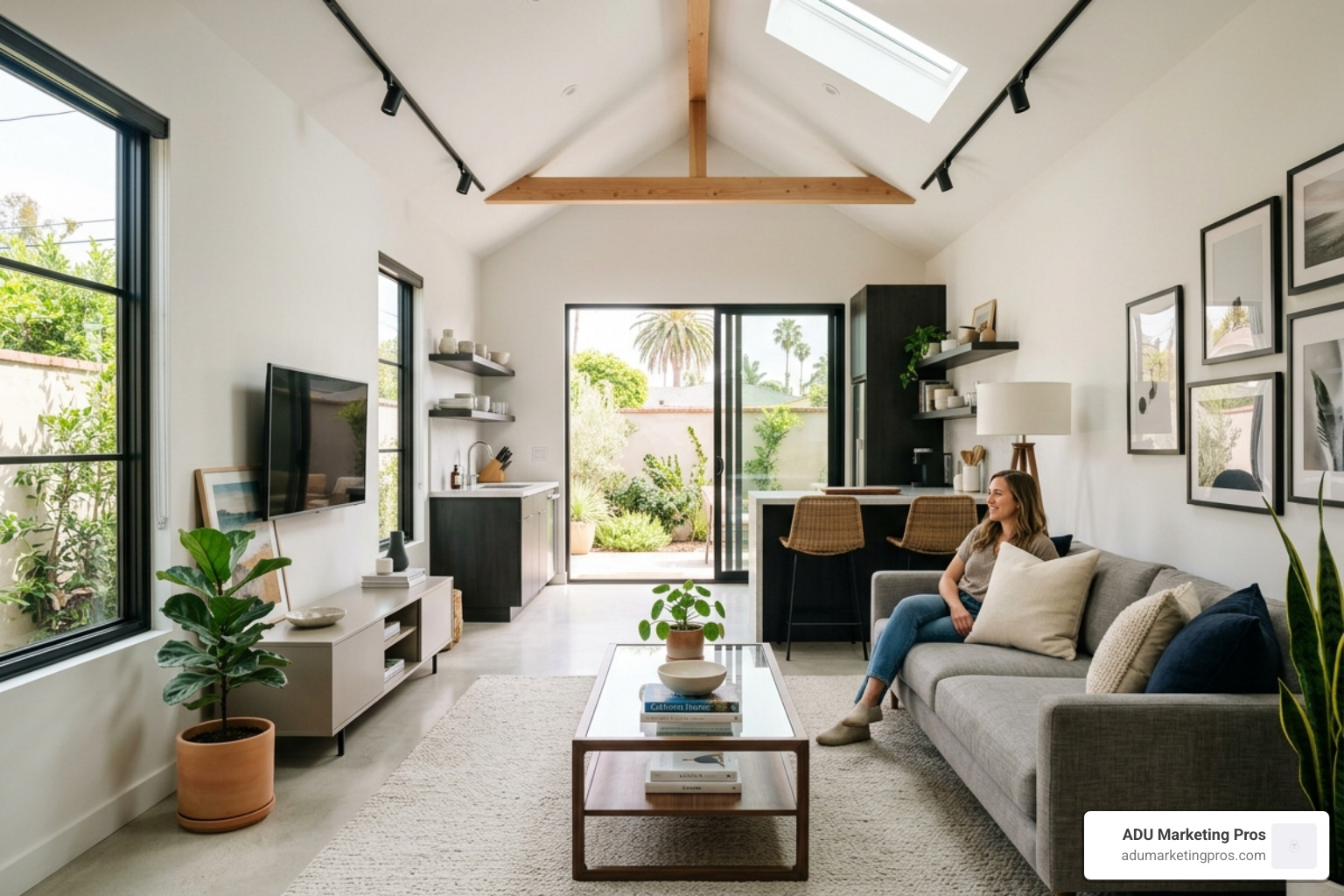
The shift toward urban density has made the Accessory Dwelling Unit Los Angeles a cornerstone of local real estate. Whether it’s a young professional looking for a quiet spot in Silver Lake or a student near USC, the ADU Rental Income potential is robust across almost every zip code. In 2026, we are seeing a particular surge in demand for “eco-friendly” ADUs that feature solar panels and energy-efficient appliances, as tenants become more conscious of their carbon footprint and utility costs.
Types of Accessory Dwelling Unit Rental Los Angeles Options
Not all ADUs are created equal. Depending on your lot size and budget, you might choose one of several configurations, each with its own rental profile:
- Detached ADUs: These are standalone structures in the backyard. They offer the most privacy and command the highest rents. In neighborhoods like Brentwood or Pacific Palisades, these can function as luxury guest houses.
- Garage Conversion Los Angeles: This remains the most popular and cost-effective route. By transforming an underutilized garage into a living space, you can save on foundation and framing costs. Check out our guide on Garage Conversion Los Angeles for specifics on structural requirements.
- Junior ADUs (JADUs): These are limited to 500 square feet and must be contained within the walls of the existing primary residence. They are perfect for converting a spare bedroom or an attached garage. JADUs often have lower utility overhead but may require owner-occupancy in the main unit, depending on the specific year the permit was issued.
- Attached Additions: These share at least one wall with the main house, similar to a duplex setup. These are excellent for maximizing square footage on narrow lots.
- Prefab ADUs: For owners who want speed, a Prefab ADU Los Angeles can be dropped onto a site with minimal construction noise and time. Modern prefab designs in 2026 are indistinguishable from site-built homes.
Neighborhood Rental Income Breakdown
Where you build determines what you earn. We’ve analyzed the data for April 2026, and the numbers show a clear premium for West Side and Central locations. The proximity to major employment hubs like “Silicon Beach” or the entertainment studios in Burbank continues to drive these figures.
| Neighborhood | Unit Type | Est. Monthly Rent |
|---|---|---|
| West Side (Venice, Santa Monica) | 1-2 Bed Detached | $2,500 – $4,500 |
| Central LA (Hollywood, Silver Lake) | Studio/1 Bed | $2,200 – $3,800 |
| San Fernando Valley (Sherman Oaks) | Garage Conversion | $2,000 – $3,200 |
| East LA (Highland Park, Pasadena) | 1 Bed | $1,800 – $2,800 |
| South LA | Studio/1 Bed | $1,500 – $2,500 |
For instance, a high-end unit like the one at 874 Wellesley Avenue #ADU, Los Angeles, CA 90049 showcases how premium West LA locations can leverage luxury finishes to secure top-tier tenants. In these high-demand areas, features like private outdoor space or dedicated parking can add an additional $200-$400 to the monthly rent.
Legal Requirements and Permitting for LA ADU Rentals
You cannot simply build a “guest house” and start collecting checks. To legally operate an accessory dwelling unit rental los angeles, the unit must be fully permitted and possess a valid Certificate of Occupancy. This document is the “birth certificate” of your rental unit; without it, your lease is technically unenforceable in a court of law.
The Los Angeles Department of Building and Safety (LADBS) oversees this process. Every legal ADU must have its own kitchen (with a stove, sink, and fridge), a full bathroom, and a separate entrance. It must also meet current fire and life safety codes, including smoke detectors, carbon monoxide alarms, and proper egress windows. For a deeper dive into the fine print, we recommend reviewing the Accessory Dwelling Units | California Department of Housing and Community Development site, which outlines the state-mandated standards that local cities must follow.
Failing to follow Los Angeles ADU Regulations is a recipe for financial disaster. Unpermitted units face fines of up to $500 per day, and building code violations can range from $100 to $1,000 per occurrence. Furthermore, if an injury occurs in an unpermitted unit, your homeowner’s insurance will likely deny the claim, leaving you personally liable for damages.
The Short-Term Rental Prohibition
This is the most common pitfall for new landlords. In the City of Los Angeles, ADUs are strictly prohibited from being used as short-term rentals (STRs). This means no Airbnb, no VRBO, and no stays under 30 days. The city’s Home-Sharing Ordinance is very specific on this point.
Even if you live in the main house and have a home-sharing permit for your primary residence, that permit does not extend to your ADU. The city’s goal is to increase the long-term housing supply, not create more hotel rooms. Violating this rule can result in penalties of $500 per day. If you want to stay compliant, stick to leases of 31 days or longer. More details can be found in the ADU Guidelines Los Angeles. The city uses specialized software to track IP addresses and listing photos to catch violators, so the risk of “flying under the radar” is virtually zero in 2026.
Local Variations: Beyond the City of Los Angeles
While state law provides a baseline, individual cities within LA County have their own quirks. It is vital to know exactly which jurisdiction your property falls under, as the rules for an accessory dwelling unit rental los angeles can change across a single street.
- Santa Monica: Often has stricter requirements regarding unit size and height, and may require specific “sustainable” building materials.
- Pasadena: Has historically had unique “affordability” requirements for certain ADU types and specific architectural review processes to ensure the ADU matches the historic character of the neighborhood.
- Glendale: May have different setback rules depending on the zoning district and has specific requirements for landscaping around the ADU.
- Unincorporated LA County: Follows the County Planning department’s rules, which recently saw major ordinance updates in late 2024 to streamline the approval of “tiny homes” as ADUs.
Understanding the difference between City and County jurisdiction is vital. If you are in an unincorporated part of the county, you’ll follow the Accessory Dwelling Unit – LAHD – City of Los Angeles guidelines and the County Planning department’s rules. For a comprehensive look, see Your Guide to Los Angeles ADU Regulations What You Need to Know.
Navigating Rent Control: RSO vs. AB 1482
Rent control is often the scariest topic for landlords, but it’s actually quite manageable if you know which bucket your property falls into. In Los Angeles, you are dealing with two primary layers of protection: the local Rent Stabilization Ordinance (RSO) and the statewide California Tenant Protection Act (AB 1482).
The Rent Stabilization Ordinance (RSO)
Generally, the City of Los Angeles RSO applies to properties built on or before October 1, 1978. However, there is a massive silver lining for ADU owners: New ADUs built after 1978 are exempt from the RSO for 30 years. This is a critical incentive provided by the city to encourage new construction.
This means if you build a detached ADU in your backyard today, you have 30 years of freedom from the strict RSO rent-increase limits. However, if you convert a “habitable space” (like a bedroom or an existing permitted guest house) within a pre-1978 home into an ADU, that new unit might fall under the RSO. This is why understanding the Los Angeles ADU Cost and construction type is so important during the planning phase. Converting a non-habitable space like a garage usually qualifies as “new construction” for RSO purposes, but you should always verify with a land-use consultant.
California AB 1482 (Statewide Rent Control)
Even if you are exempt from the local RSO, you are likely still subject to AB 1482. This state law, which was extended and strengthened in recent years, limits annual rent increases to 5% plus the local inflation rate (CPI), with a hard cap of 10% total. It also requires “just cause” for evicting a tenant who has lived there for more than 12 months.
“Just cause” means you cannot simply terminate a lease because you want a new tenant. You must have a valid reason, such as non-payment of rent, breach of lease, or a “no-fault” reason like moving a family member into the unit (which may require paying tenant relocation fees). When designing your unit, look at ADU Floor Plans Los Angeles that maximize utility and appeal, making it easier to find long-term tenants who won’t trigger the need for frequent evictions.
Registration Fees and Compliance
Being a landlord in LA isn’t free. If your property is subject to the RSO, you must pay an annual registration fee of $38.75 per unit. Even if you fall under the newer Just Cause Ordinance (JCO), there is a $31.05 annual fee. These fees fund the city’s housing department and enforcement efforts.
Furthermore, if your ADU construction results in the removal of required parking for the main house, the RSO may require you to provide a rent reduction or a “parking replacement” credit to your existing tenants in the main house. This is a common surprise for homeowners converting their garages. Using Pre-Approved ADU Plans Los Angeles can sometimes help you navigate these site-plan hurdles more efficiently, as these plans have already been vetted for basic compliance issues.
Maximizing Your Accessory Dwelling Unit Rental Los Angeles Income
To get the most out of your accessory dwelling unit rental los angeles, you need to think like a boutique hotelier but act like a long-term property manager. The market in 2026 is competitive, and tenants are looking for more than just four walls; they are looking for a lifestyle.
We’ve seen that units with premium finishes, like marble countertops, vaulted ceilings, and cinematic views—similar to the luxury studio at 3132 Belden Dr House—can command rents nearly 20% higher than “basic” conversions. High-quality photography and a well-staged unit are essential for attracting high-income professionals who are willing to pay a premium for aesthetics.
Strategies for higher yields:
- The Mid-Term Strategy: While STRs are banned, “mid-term” rentals (31 to 90 days) are perfectly legal. Traveling nurses, tech professionals on temporary assignments, and people renovating their own homes often pay a premium for furnished, all-inclusive units. This can often yield 1.5x the income of a standard long-term lease.
- Student Housing: If you are near USC or UCLA, renting by the bed or targeting students can ensure 100% occupancy. Look at 1591 1/2 W 35th Pl, LOS ANGELES, CA 90018 for a great example of a modern 2-bedroom ADU that fits this mold. Students often have parents as co-signers, which reduces the risk of non-payment.
- Furnished vs. Unfurnished: Furnishing a studio can add $300–$600 to the monthly rent. In 2026, “turn-key” living is a major trend for the Gen Z workforce moving to Los Angeles.
- Pet-Friendly Units: Allowing pets can increase your tenant pool by 70% and allow you to charge a “pet rent” of $50-$100 per month.
To ensure your build is optimized for these returns, working with a specialized ADU Builder Los Angeles is a smart move. They can advise on which upgrades (like in-unit laundry or mini-split HVAC systems) offer the best return on investment.
Professional Management and Tenant Screening
Managing a tenant in your own backyard can be awkward. If there is a leak at 2 AM, they are knocking on your door. That’s why many owners opt for professional management, which typically costs 8-12% of the monthly rent. A manager acts as a buffer, handling everything from maintenance requests to rent collection.
If you manage it yourself, do not skip tenant screening. We recommend:
- Using California Association of Realtors (CAR) lease forms to ensure all legal disclosures are included.
- Verifying income (look for 3x the rent in gross monthly income).
- Running credit and background checks through a reputable service.
- Upgrading to Landlord Insurance, which usually costs 15-25% more than a standard homeowner policy but protects you from rental-related liabilities and loss of rent.
You can estimate these ongoing costs using an ADU Cost Calculator to ensure your projected cash flow is realistic.
Financial Impact: Taxes, Property Value, and ROI
Adding an ADU is one of the single best ways to force appreciation on your property. In a city where land is the most valuable asset, increasing the utility of that land is a guaranteed value-add. On average, a permitted ADU increases property value by 39%. In the Los Angeles market, this typically translates to a value boost of $150,000 to $300,000+, often exceeding the actual cost of construction.
The return on investment (ROI) is equally impressive. With annual yields reaching up to 10.5%, ADUs often outperform traditional real estate investments, which usually see 5-6% returns. Because you already own the land, your “entry price” for this investment is significantly lower than buying a separate rental property.
Tax Perks to Consider:
- Deductions: You can often deduct a portion of your property taxes, insurance, and maintenance as business expenses. This includes repairs specifically for the ADU and a portion of shared landscaping costs.
- Depreciation: You can depreciate the cost of the ADU over 27.5 years. This is a non-cash expense that can significantly lower your taxable rental income, often resulting in a “tax loss” even while you are cash-flow positive.
- 1031 Exchange: If you sell the property, you can roll the gains into another investment property to defer taxes. This is a powerful tool for building long-term wealth.
- Property Tax Reassessment: Under current California law, only the new construction (the ADU) is reassessed. Your primary home’s tax basis remains protected by Proposition 13, meaning your total tax bill won’t skyrocket just because you added a unit.
A great real-world example of this investment potential is 1185 Hauser Blvd Los Angeles, CA 90019, where a main home and a new ADU combined generate nearly $95,000 in gross annual income. This level of income can turn a standard residential property into a high-performing commercial-grade asset.
Frequently Asked Questions about LA ADU Rentals
Can I rent my ADU to family members?
Yes! In fact, many people build ADUs specifically for “multigenerational living.” However, if they are paying rent, we strongly suggest having a formal lease agreement. This protects both parties and is often required by insurance companies to prove the unit is being used as a residence. Even if it’s family, the unit must still be fully permitted to be considered a legal residence. Listings like 822 N Fuller Avenue #1/2 show how these units can be perfectly suited for extended family use while maintaining separate lives.
What if my ADU was built without permits?
This is a risky situation. Unpermitted units are technically illegal to rent. If a tenant reports you, or if a neighbor complains, you could face daily fines of $200–$500. Furthermore, if you try to evict a tenant from an illegal unit, the court may rule that the lease is void and you may even be ordered to return all rent previously collected. The city does occasionally offer amnesty programs to help owners bring units up to code. We recommend contacting a professional to discuss “retroactive permitting” before the city finds you first.
Can I use my ADU as a home office instead of a rental?
Absolutely. Many owners use their ADU as a hybrid space—a home office during the day and a guest suite at night. From a tax perspective, if you use it exclusively for business, you may be able to claim a home office deduction. However, check your specific permit; some ADU permits are strictly for “residential” use, meaning you shouldn’t be running a retail business with customers visiting the site. Using it as a personal office is generally fine, but check local zoning if you plan to have employees working there.
Does an ADU need its own address and utility meters?
In the City of Los Angeles, an ADU will receive its own address (usually the primary address followed by “1/2” or a unit letter). While you are not always required to have separate utility meters, it is highly recommended. Separate meters for electricity and gas allow the tenant to pay their own bills directly, which simplifies your management and prevents disputes over utility usage. If you share a meter, you must have a clear agreement in the lease on how costs are split.
Are solar panels required for new ADUs in 2026?
Yes, under the current California Building Standards Code (Title 24), all newly constructed detached ADUs are required to have solar panels. However, garage conversions and ADUs built within existing space are generally exempt from this requirement. The solar requirement adds to the upfront cost but significantly increases the rental appeal by lowering the tenant’s electricity bills.
Conclusion
The market for an accessory dwelling unit rental los angeles in 2026 is a land of opportunity for those who follow the rules. By focusing on long-term rentals, staying compliant with the LADBS, and understanding the nuances of rent control, you can turn your backyard into a high-yield asset that provides both immediate cash flow and long-term equity growth.
As the city continues to evolve, the ADU will remain a vital tool for addressing the housing shortage while empowering individual homeowners. The key to success is preparation. From the initial design phase to the final tenant screening, every step requires attention to detail and an understanding of the local Los Angeles landscape.
At ADU Marketing Pros, we specialize in helping construction and architecture firms navigate this booming sector. We know that the key to success in the LA market is expertise over price. Whether you are a builder looking to attract higher-quality leads or a homeowner planning your first project, understanding the data-driven insights of the rental market is the first step toward a successful investment.
Check out our Everything You Need to Know About LA Accessory Dwelling Unit Rentals master guide to start your journey today and unlock the full potential of your property.