

What You Need to Know About www calhfa ca gov adu (Quick Answer)
www calhfa ca gov adu serves as the primary digital gateway for the California Housing Finance Agency’s (CalHFA) Accessory Dwelling Unit (ADU) Grant Program. This ambitious state-funded initiative was established to provide eligible California homeowners with a grant of up to $40,000 to offset the significant pre-development and closing costs associated with the construction of an ADU. By focusing on the “soft costs”—the financial hurdles that often prevent a project from moving beyond the conceptual stage—the program has become a vital component of California’s multi-pronged strategy to mitigate its severe housing shortage.
CalHFA, which has operated as the state’s affordable housing bank for nearly five decades, launched this program to empower low-to-moderate income residents. The agency recognizes that while many homeowners have the physical space to add a unit, they often lack the liquid capital required for the initial phases of development. This grant effectively bridges that gap, allowing for the creation of new, sustainable housing units in existing residential neighborhoods.
Quick Facts and Current Status
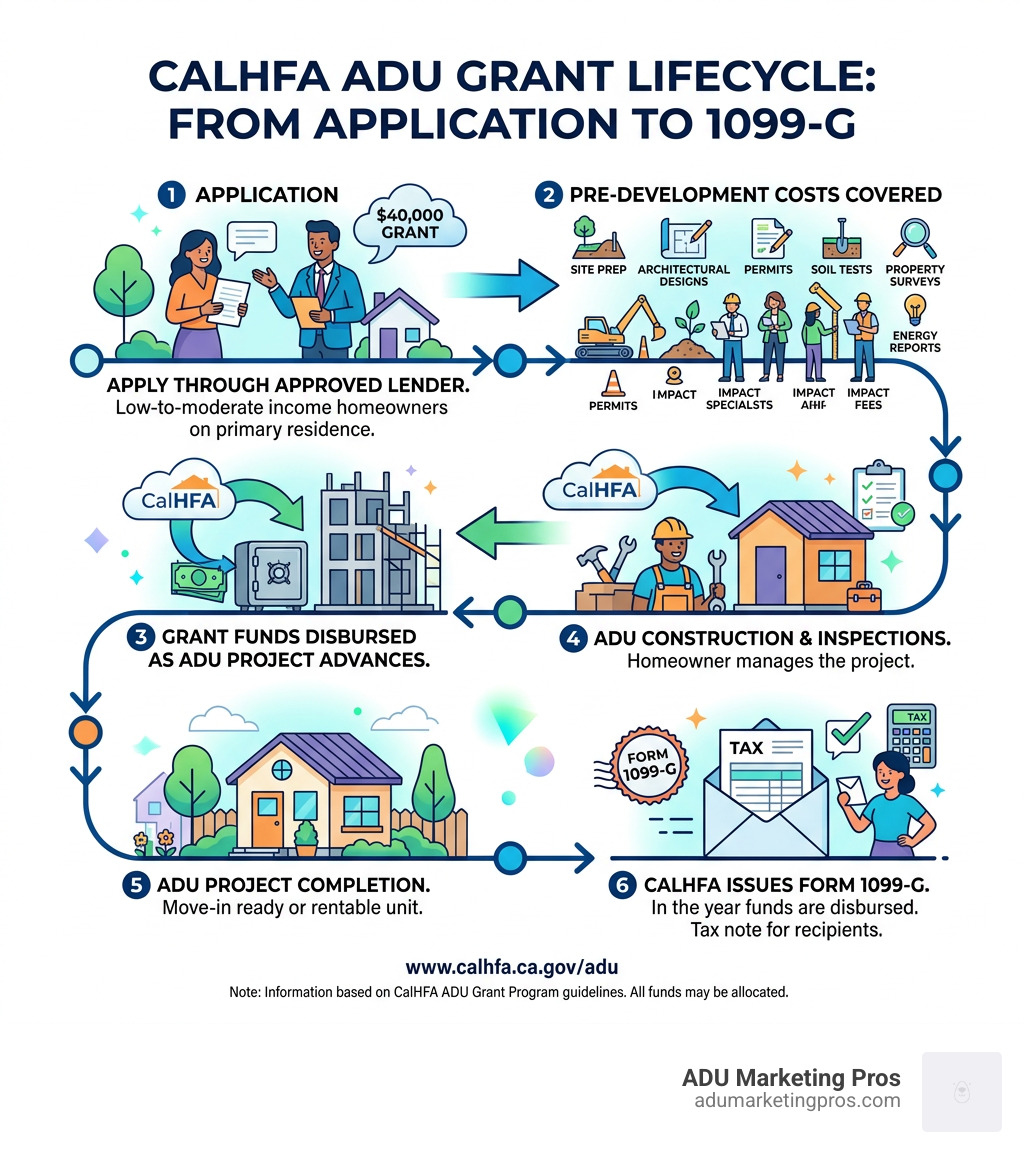
- Grant amount: Up to $40,000 per eligible project, provided as a non-repayable grant.
- Eligible Expenses: These include architectural designs, engineering reports, municipal permit fees, soil tests, property surveys, impact fees, and Title 24 energy compliance reports.
- Current status: As of December 28, 2023, the initial $100 million in funding has been fully allocated and reserved for active projects. The program is currently not accepting new applications, though the portal remains active for pipeline management.
- Target Demographic: Low-to-moderate income California homeowners who occupy the property as their primary, single-family residence.
- Application Method: Homeowners must apply through a CalHFA-approved lender or a qualified non-profit participant, such as HPP Cares.
- Tax Implications: The grant is considered taxable income by the IRS and the California Franchise Tax Board. Recipients will receive a Form 1099-G in the year the funds are disbursed.
The Context of California’s Housing Crisis
California is currently grappling with a housing deficit estimated at 3.5 million units. This shortage has driven property values and rents to historic highs, disproportionately affecting the “missing middle”—essential workers like teachers, healthcare professionals, and first responders. ADUs, also known as granny flats, in-law suites, or backyard cottages, offer a unique solution. They provide high-quality housing without the need for the massive infrastructure investments required by large-scale apartment complexes.
Since its inception in 1975, CalHFA has assisted over 233,000 homebuyers and supported the creation of 85,000 multifamily units. The ADU Grant Program is the latest evolution of this mission, designed to democratize the development process. By providing $40,000 in upfront capital, the state is essentially turning thousands of homeowners into small-scale developers, each contributing to the collective solution of the housing crisis. This guide provides a deep dive into the program’s mechanics, eligibility, and the future of ADU funding in the Golden State.
Understanding the CalHFA ADU Grant Program
The CalHFA ADU Grant Program is more than just a financial subsidy; it is a strategic intervention designed to lower the barrier to entry for residential densification. In many of California’s high-cost metropolitan areas, such as the San Francisco Bay Area, Los Angeles, and San Diego, the “soft costs” of construction can be staggering. Before a single shovel hits the dirt, a homeowner might spend between $30,000 and $50,000 on architects, structural engineers, environmental consultants, and municipal fees. For many families, this represents a significant portion of their savings, making the project financially unfeasible before it even begins.

By offering a grant of up to $40,000, CalHFA removes this initial financial friction. This is a non-repayable grant, meaning it does not function like a traditional loan; there are no monthly payments, no interest accrual, and no lien placed on the property specifically for the grant itself. This initiative is a cornerstone of the California ADU Incentives framework, which aims to maximize the utility of existing residential land. For those interested in the legislative and technical structure of these funds, the Accessory Dwelling Unit Grant Program documentation provides a comprehensive overview of the state’s commitment to housing diversity.
Defining the Accessory Dwelling Unit (ADU)
To qualify for the grant, the project must meet the legal definition of an ADU as established by California state law. An ADU is a secondary, self-contained housing unit located on the same lot as a primary single-family residence. It must provide permanent provisions for living, sleeping, eating, cooking, and sanitation. The state recognizes several distinct types of ADUs, each governed by specific California ADU Requirements:
- Detached ADUs: These are stand-alone structures, such as a newly built backyard cottage or a converted detached garage.
- Attached ADUs: These units share at least one common wall with the primary residence, often created through an addition to the existing home.
- Junior ADUs (JADUs): These are smaller units (maximum 500 square feet) created entirely within the walls of an existing primary residence. They may share sanitation facilities with the main house but must have their own efficiency kitchen.
- Conversion ADUs: These involve transforming existing interior space, such as a basement, attic, or attached garage, into a legal living unit.
In recent years, the California legislature has passed landmark bills like AB 68 and AB 881, which have significantly streamlined California ADU Regulations. These laws have eliminated minimum lot size requirements, capped impact fees for smaller units, and mandated that local jurisdictions approve or deny ADU permits within 60 days. These changes, combined with the CalHFA grant, have made ADUs the fastest-growing segment of the California housing market.
Current Funding Status and the “Pipeline”
It is critical for homeowners to understand the current availability of these funds. As of December 28, 2023, the CalHFA ADU Grant Program funds have been fully allocated. The $100 million set aside by the state legislature has been reserved for specific projects that are currently in various stages of the development pipeline. While this means new applications are not being accepted today, the information on the www calhfa ca gov adu portal remains vital.
CalHFA continues to manage the disbursement of these funds as projects reach their pre-development milestones. Furthermore, the program’s success has sparked ongoing discussions in Sacramento regarding future funding rounds. Homeowners are strongly encouraged to visit the ADU Grant Program Official Info page and sign up for eNews updates to be the first to know if additional ADU Funding Grants are authorized in future state budget cycles. The program serves as a blueprint for how state agencies can effectively partner with homeowners to address systemic housing issues.
Eligibility and Property Requirements for the Grant
To ensure that the $100 million in grant funding reached those who could benefit most, CalHFA established strict eligibility criteria. The program was specifically designed to assist low-to-moderate income homeowners rather than corporate developers or speculative real estate investors. This focus ensures that the wealth-building potential of ADUs remains within the hands of California families.
Primary Residence and Ownership Rules
The most fundamental requirement for the grant is that the property must be the owner’s primary residence. CalHFA verifies this through a variety of methods, including property tax records, utility bills, and homeowner affidavits. The grant is not available for investment properties, secondary vacation homes, or properties intended solely for short-term rentals (such as Airbnb), unless local ordinances specifically allow for it and the owner continues to occupy the main residence.
Adhering to California ADU Guidelines is essential for maintaining the legality of the unit and ensuring the grant funds are not subject to clawback. As the state continues to refine its housing laws, staying informed about New ADU Regulations California is critical, especially for homeowners in high-density or high-cost areas like San Jose, San Diego, and the San Francisco Bay Area.
Qualifying Property Types and Ownership Structures
While the majority of grants are issued for traditional single-family detached homes, the program also accommodates other residential structures:
- Condominiums: Homeowners in condos may apply, provided their Homeowners Association (HOA) rules and Covenants, Conditions, and Restrictions (CC&Rs) allow for the addition of an ADU.
- Planned Unit Developments (PUDs): These are eligible if the underlying land ownership allows for the construction of a secondary structure.
- Manufactured Homes: Double-wide manufactured homes on a permanent foundation are eligible, provided they meet local building codes. Single-wide units are generally excluded due to different structural standards.
Ownership structures are also carefully reviewed. CalHFA allows properties held in Living Trusts or Non-Corporate LLCs, provided the primary resident is the beneficiary or a member of the entity. Tenancy in Common (TIC) arrangements, which are common in San Francisco, are also eligible but require more complex documentation to prove primary residency. For a full breakdown of these nuances, the Property Eligibility Requirements page remains the definitive resource for homeowners and lenders alike.
Income Limits: A County-by-County Approach
The definition of “low-to-moderate income” is relative to the cost of living in a specific geographic area. CalHFA utilizes Area Median Income (AMI) data to set limits for each of California’s 58 counties. For example, a moderate-income limit in Santa Clara County (Silicon Valley) is significantly higher than the limit in Fresno County.
Applicants must provide comprehensive financial documentation, including:
- The last two years of Federal Tax Returns.
- Recent W2 forms and paystubs.
- A full accounting of all household income sources.
Lenders use this data to ensure the borrower does not exceed the maximum allowable income for their specific county. For those who have already secured a reservation, the ability to Check Loan File Status through the CalHFA portal is a vital tool for tracking the progress of their grant disbursement and ensuring all financial milestones are met.
The Application Process and Required Documentation
Navigating the application process for a state-backed grant requires precision and a clear understanding of the partnership between the homeowner, the approved participant, and CalHFA. The agency does not accept applications directly from the public; instead, all applications must be submitted through a CalHFA-approved “Participant.”
The Role of Approved Participants
Approved participants include traditional mortgage lenders, credit unions, and specialized non-profit organizations like HPP Cares. These entities act as the gatekeepers for the program. They are responsible for verifying the homeowner’s income, reviewing the project’s feasibility, and managing the managed escrow account where the grant funds are held.
Most homeowners begin the process by securing an ADU construction loan. Because the grant is capped at $40,000 and the average ADU in California costs between $150,000 and $300,000, additional financing is almost always required. Understanding ADU Permits California and the complexities of From Loans to Investments: Navigating ADU Financing is a prerequisite for a successful project.
Step-by-Step Grant Workflow
For those currently in the pipeline or preparing for potential future funding, the workflow generally follows these five stages:
- Participant Selection: The homeowner chooses an approved lender or non-profit from the official CalHFA list.
- Initial Reservation: The participant submits the homeowner’s income and property data to CalHFA to “reserve” the $40,000 in the system.
- Submission of Scope of Work: The homeowner provides detailed architectural plans and a line-item construction budget. This budget must clearly distinguish between “soft costs” (eligible for the grant) and “hard costs” (not eligible).
- Escrow Funding: Once the scope of work is approved, CalHFA wires the funds to a managed escrow account. The money is never paid directly to the homeowner’s personal bank account to ensure it is used for its intended purpose.
- Disbursement for Invoices: As the homeowner receives invoices for permits, designs, or soil tests, the escrow agent pays those vendors directly from the grant funds.
Compliance with ADU Construction Regulations is mandatory throughout this process. Furthermore, homeowners must stay abreast of ADU Regulatory Updates to ensure that their plans remain valid if local building codes change during the pre-development phase. This structured approach protects both the state’s investment and the homeowner’s project.
Affidavits and Legal Obligations
Both the homeowner and the participant are required to sign legal affidavits. The Applicant Affidavit is a sworn statement that the information provided is true and that the homeowner intends to use the ADU for a purpose that aligns with state housing goals. Misuse of the funds or providing false income data is considered fraud and could result in the grant being converted into a loan that must be repaid immediately with interest. For professionals managing these files, the MAS Login for Lenders is the primary interface for managing these legal documents and tracking reservation statuses.
Benefits, Costs, and Post-Grant Responsibilities
The decision to build an ADU is a significant financial and emotional commitment, but the long-term benefits often far outweigh the initial stress of construction. In California’s high-cost markets, an ADU is more than just an extra room; it is a powerful tool for economic stability, housing security, and intergenerational wealth.
The Strategic Value of an ADU
Homeowners utilize ADUs for a variety of purposes that benefit both their families and the community:
- Rental Income: A well-built ADU in a city like Los Angeles or San Francisco can command significant monthly rent, often covering a large portion of the primary mortgage and providing a steady stream of passive income.
- Aging in Place: Many homeowners build ADUs for their aging parents, allowing them to live nearby for care and companionship while maintaining their independence and privacy.
- Downsizing: Some homeowners choose to move into the ADU themselves and rent out the larger main house, maximizing their retirement income and reducing their maintenance responsibilities.
- Property Value: Adding a legal second unit typically increases the resale value of a property by 20% to 35%, depending on the local market and the quality of the construction.
Whether you are navigating San Diego ADU Laws or Los Angeles ADU Regulations, the goal remains the same: creating flexible housing that adapts to the family’s needs over time.
Eligible vs. Ineligible Costs
A common point of confusion is exactly what the $40,000 can be used for. The grant is strictly for pre-development costs. It is designed to get the project to the point where construction can begin. It cannot be used for the actual labor or materials of the build.
| Eligible Pre-Development (Soft) Costs | Ineligible Construction (Hard) Costs |
|---|---|
| Architectural Designs & Engineering | Lumber, Concrete, and Roofing Materials |
| City/County Permit & Plan Check Fees | Plumbing and Electrical Labor |
| Soil & Geotechnical Reports | Interior Finishes (Flooring, Paint, Tile) |
| School & Park Impact Fees | Kitchen Appliances & Cabinetry |
| Property Surveys & Boundary Staking | Landscaping, Fencing, and Hardscaping |
| Title 24 Energy Compliance Reports | General Contractor Profit & Overhead |
| Utility Connection & Meter Fees | Furniture, Window Treatments, & Decor |
Tax Implications and the 1099-G
It is crucial for homeowners to understand that the IRS and the California Franchise Tax Board generally view government grants as taxable income. Because the ADU grant provides a direct financial benefit to the homeowner, CalHFA is required to issue a Form 1099-G.
This form is issued for the tax year in which the funds were actually disbursed from the escrow account. For example, if your grant was reserved in 2023 but the permits were paid for in 2024, you would receive the 1099-G in early 2025. We strongly recommend consulting with a tax professional to determine how this $40,000 addition to your gross income will affect your tax liability.
Finally, the project is not considered complete until the local building department issues a Certificate of Occupancy. This document is the final proof that the ADU was built to code and is safe for habitation. This process supports the broader goals of the CA Statewide Housing Plan and initiatives like the Veterans Housing and Homelessness Prevention program, which seek to ensure all Californians have access to safe, legal housing.
Frequently Asked Questions about www calhfa ca gov adu
Is there any chance the CalHFA ADU Grant will receive more funding?
While the current $100 million allocation is fully reserved, the future of the program depends on the California State Legislature. Given the program’s immense popularity and its proven effectiveness in creating new housing units, there is often discussion during budget cycles about renewing or expanding the program. Homeowners should monitor the Ask Us tool on the CalHFA website for the most current official statements regarding future funding rounds and legislative updates.
Can I use the grant for a garage conversion?
Yes. Garage conversions are one of the most common types of ADU projects in California. The grant can be used for the architectural plans, structural engineering, and permit fees required to legally convert a garage into a living space. However, the grant cannot be used for the actual construction work, such as framing the new walls, installing the bathroom, or upgrading the electrical panel.
How do I protect myself from ADU grant scams?
As with any high-profile government program, bad actors may attempt to exploit homeowners. To stay safe, follow these guidelines:
- Verify the Source: Official communications will always come from a
.govemail address. Be wary of any emails from generic providers like Gmail or Yahoo claiming to be from CalHFA. - No Upfront Fees: CalHFA does not charge a fee to “apply” for the grant. Any fees you pay should be to your licensed architect, engineer, or as part of your standard loan closing costs with an approved lender.
- Report Suspicious Activity: If you are contacted by someone claiming they can “guarantee” a grant for a fee, report them to
marketing@calhfa.ca.govimmediately. You can also check the CalHFA Scam Alert page for known fraudulent schemes targeting homeowners.
What educational resources are available for first-time builders?
Building an ADU is essentially a small-scale development project, and education is key to avoiding costly mistakes.
- Non-Profit Workshops: Organizations like HPP Cares offer “ADU 101” webinars that walk homeowners through the entire process, from design to completion. You can access HPP Cares Educational Materials for free.
- Housing Counseling: If you are unsure about the financial impact of an ADU, consider speaking with a HUD-approved housing counselor. The NeighborWorks America Training directory can help you find a local agency that offers specialized housing advice.
- Local Planning Departments: Most major cities in California now have dedicated “ADU Desks” or online portals with pre-approved plans that can save you thousands in design costs and weeks in the permit approval process.
Can I build two ADUs on my property with this grant?
State law now allows many single-family lots to have both one full ADU and one Junior ADU (JADU). However, the CalHFA grant was typically limited to one $40,000 disbursement per property/homeowner. If you are planning multiple units, you would need to cover the pre-development costs for the second unit through other means, such as personal savings or a construction loan.
Conclusion
The www calhfa ca gov adu program has proven to be a transformative force in the California housing market. By addressing the “soft cost” barrier, the state has empowered thousands of homeowners to become part of the solution to the housing crisis. From the suburban streets of Orange County to the dense neighborhoods of San Francisco, these new units are providing homes for students, seniors, and the local workforce, all while helping families build long-term financial security.
At ADU Marketing Pros, we recognize that the journey from a backyard dream to a completed dwelling is complex. It requires a synergy of architectural vision, financial planning, and a deep understanding of state and local regulations. We specialize in helping ADU construction firms and architects navigate this landscape, connecting them with homeowners who are ready to invest in high-quality, sustainable housing solutions that meet the needs of modern California living.
As CalHFA celebrates its 50th anniversary, the legacy of the ADU Grant Program stands as a testament to what can be achieved when government and homeowners work together. Whether you are a homeowner waiting for the next round of funding or a professional looking to expand your impact, staying informed through the Accessory Dwelling Unit Grant Program resources is the best way to ensure success in California’s evolving housing economy. The future of California housing is being built one backyard at a time, and the momentum created by this program shows no signs of slowing down.