
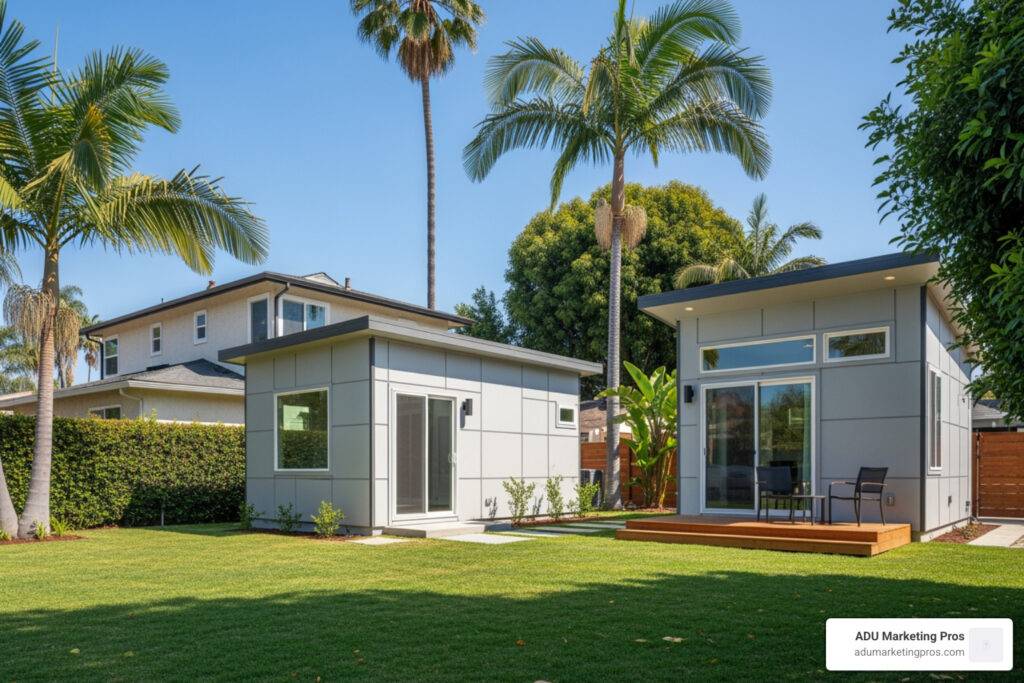
Why Detached ADUs Are Transforming Los Angeles Properties
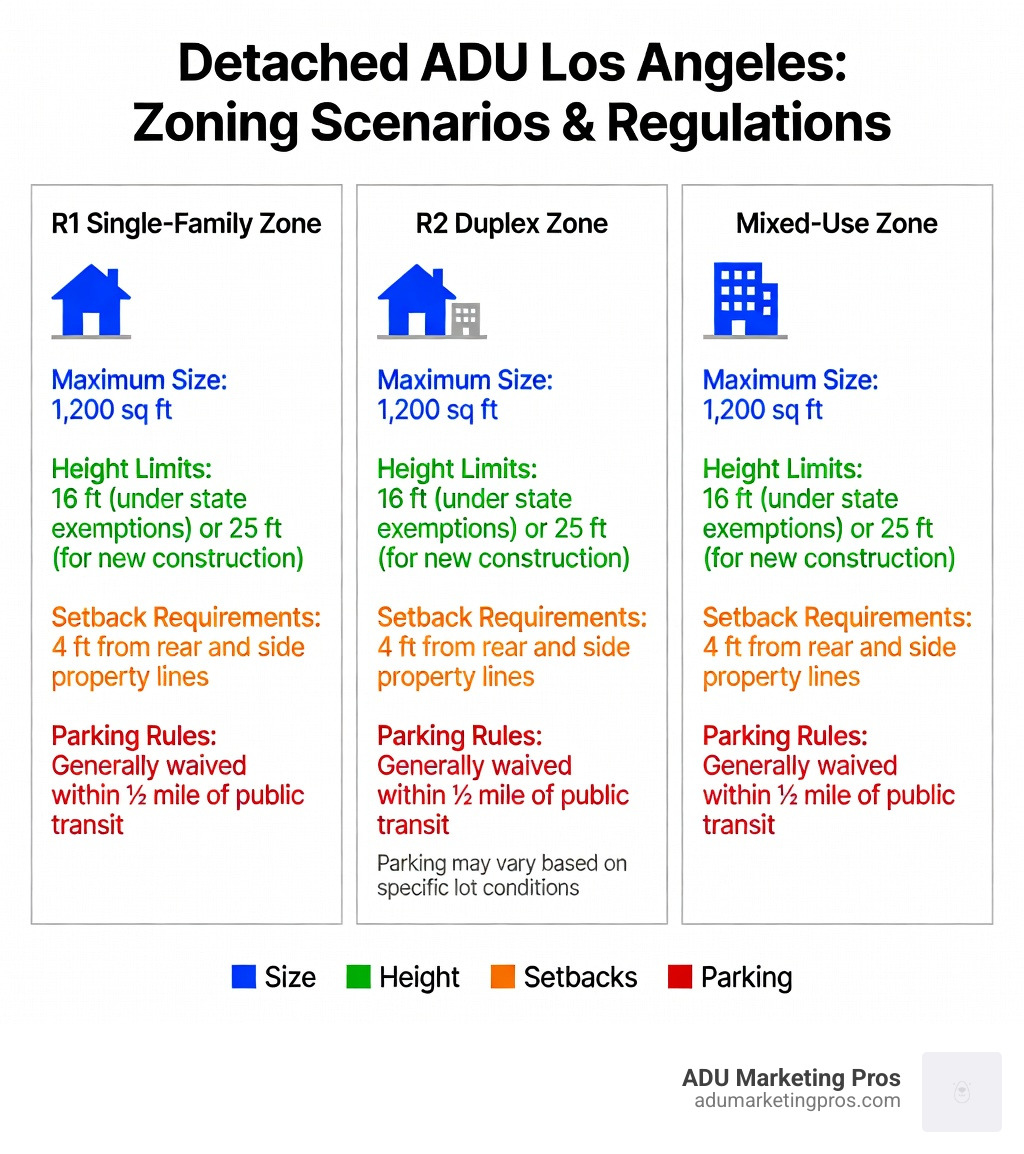
A detached ADU Los Angeles is a standalone accessory dwelling unit—also known as a granny flat or backyard home—that provides independent living space separate from your primary residence. These units can reach up to 1,200 square feet, require only 4-foot side and rear setbacks, and typically don’t need additional parking if located within half a mile of public transit.
Key facts about detached ADUs in Los Angeles:
- Maximum size: 1,200 square feet (regardless of primary home size)
- Height limits: 16 feet under state exemptions, up to 25 feet for new construction
- Setback requirements: 4 feet from rear and side property lines
- Parking: Generally waived within ½ mile of public transit
- Cost range: $350-$450 per square foot ($300,000-$400,000 total)
- Rental income potential: $1,500-$3,000 per month
- Property value increase: $200,000-$500,000
Los Angeles is facing a housing crisis, and detached ADUs have emerged as a practical solution. Since California relaxed ADU regulations in 2017 and 2021, homeowners across the city have been adding these independent structures to their properties. Whether you’re looking to house aging parents, create a home office, or generate rental income, a detached ADU offers more privacy and flexibility than attached units or internal conversions.
The permitting process has become more streamlined through the city’s ePlanLA system, though it still requires careful attention to zoning laws, fire safety regulations, and utility connections. Traditional construction takes three to six months, while pre-fabricated options can be completed in one to three months—though hidden costs for foundations and utilities can quickly add up.
Unlike Junior ADUs (limited to 500 square feet within your existing home) or attached ADUs (capped at 50% of your primary residence size), detached ADUs provide the maximum allowable square footage and the greatest separation from your main house. This makes them particularly attractive to renters and can command higher monthly income.
Quick detached ADU Los Angeles definitions:
Understanding the Detached ADU Los Angeles
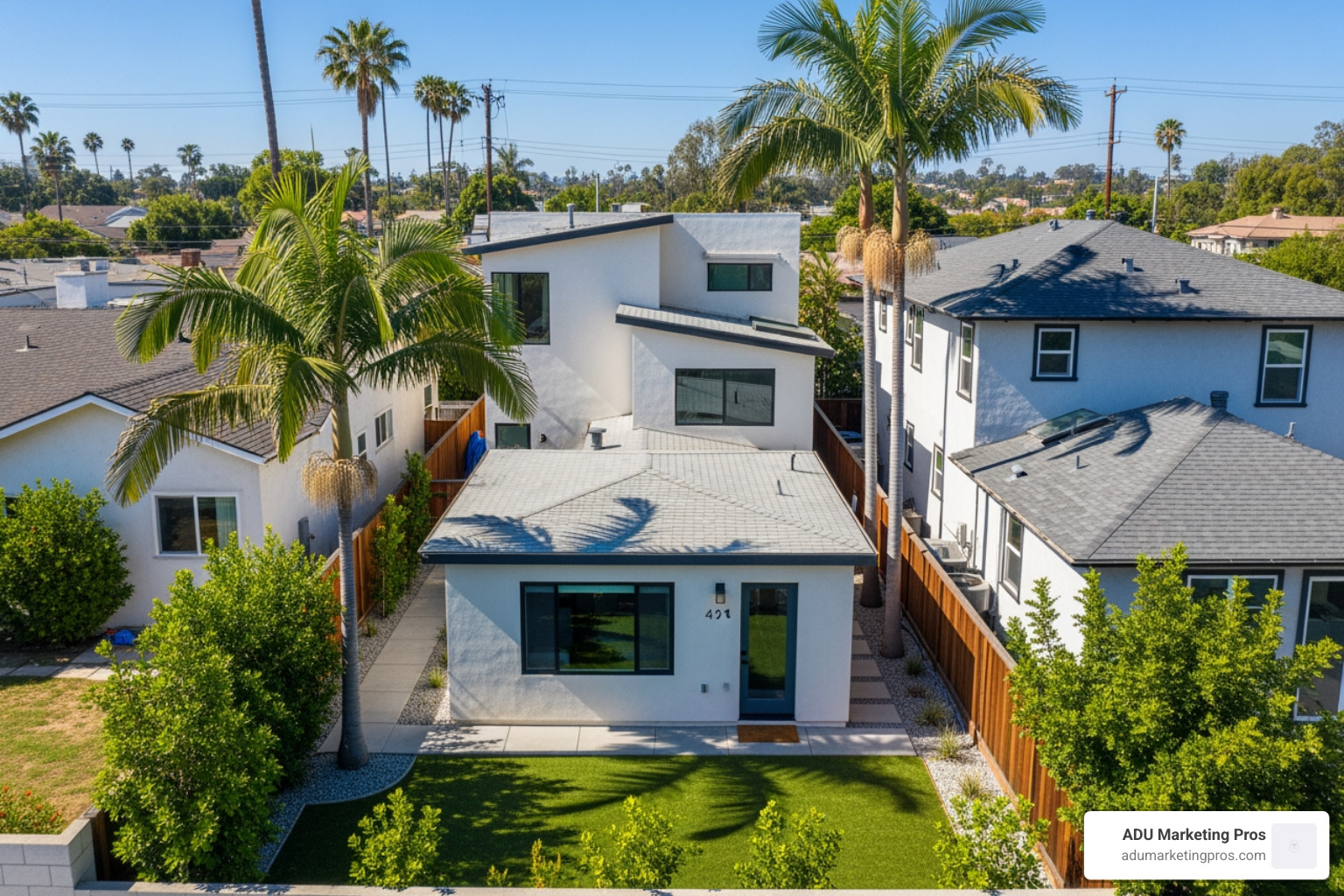
When we talk about a detached ADU Los Angeles, we are referring to a standalone structure that functions as a completely independent living facility. Unlike an addition that shares a wall with your main house, a detached unit sits separately on your lot, often in the backyard. This physical separation is the hallmark of the “backyard cottage” or “granny flat” lifestyle, offering a level of privacy that other ADU types simply cannot match.
Building an Accessory Dwelling Unit Los Angeles allows homeowners to maximize the utility of their land. These units are permanent structures built on foundations—not tiny houses on wheels or RVs. They must include permanent provisions for living, sleeping, eating, cooking, and sanitation. For many, this means a full kitchen and a dedicated bathroom, making it a “real” home in every sense of the word.
For those considering Rebuilding after the Wildfires, ADUs have become a vital tool for increasing density and providing flexible housing options in recovering neighborhoods. The legislative shift that began in 2017 has fundamentally changed the landscape of Los Angeles real estate, turning underutilized backyards into high-value assets.
Defining Detached vs. Attached and JADUs
It is easy to get lost in the alphabet soup of housing acronyms. Here is how a detached ADU Los Angeles differs from its counterparts:
- Detached ADU: A standalone building. It can be a brand-new build or a Garage Conversion Los Angeles where an existing detached garage is transformed into a living space. These units offer the most flexibility in design and placement.
- Attached ADU: These share at least one wall with the primary residence. Their size is often capped at 50% of the primary home’s square footage, which can be a significant limitation for smaller primary residences.
- Junior ADU (JADU): These are small units (maximum 500 square feet) created entirely within the walls of an existing or proposed single-family home. They may share sanitation facilities with the main house and require owner-occupancy in either the JADU or the main unit, a restriction that does not apply to standard detached ADUs.
Understanding these distinctions is the first step in Your Guide to Los Angeles ADU Regulations: What You Need to Know. While JADUs are great for budget-friendly internal conversions, the detached ADU remains the gold standard for those seeking a separate, rentable asset that maintains the integrity of the main home’s living experience.
Primary Benefits of Building Detached
Why do we see so many homeowners opting for Backyard ADU Construction? The benefits are multifaceted and extend beyond simple financial gain:
- Passive Income: A detached unit in Los Angeles can fetch between $1,500 and $3,000 in monthly rent, depending on the neighborhood and unit size. In high-demand areas like Silver Lake or Santa Monica, these figures can climb even higher.
- Multigenerational Living: It provides a dignified way for aging parents to “age in place” while remaining close to family, or for adult children to live at home while maintaining independence. This “sandwich generation” solution is becoming increasingly popular as housing costs rise.
- Privacy: Because there are no shared walls, the “noise transfer” issues common with attached units are non-existent. This makes the unit more attractive to high-quality tenants who value their own space.
- Flexibility: When not used as a rental, these spaces serve as world-class home offices, art studios, or fitness centers. The separation from the main house helps create a mental boundary between “home life” and “work life.”
- Increased Property Value: Real estate experts agree that a permitted detached ADU is one of the most effective ways to increase the resale value of a Los Angeles property, often providing a dollar-for-dollar return on investment or better.
Zoning, Size, and Setback Requirements
Navigating ADU Building Requirements in Los Angeles requires a firm grasp of both state and local law. Generally, if your property is zoned for single-family or multifamily use (such as R1, RD, or R2 zones), you are permitted to build an ADU. One of the most significant wins for homeowners in recent years is that there is no minimum lot size required to build an ADU in Los Angeles, opening the door for thousands of small-lot owners to participate in the program.
| Requirement | Standard (LA City Ordinance) | State Law Exemption |
|---|---|---|
| Max Size | 1,200 Sq. Ft. | 800 Sq. Ft. (Mandatory Approval) |
| Max Height | Up to 25 Ft. (Zoning dependent) | 16 Ft. (Always allowed) |
| Side/Rear Setbacks | 4 Feet | 4 Feet |
| Parking | 1 Space (unless waived) | Waived if near transit |
Maximum Size and Height for a detached ADU Los Angeles
In Los Angeles, a detached ADU Los Angeles can be as large as 1,200 square feet. This is a significant advantage over attached ADUs, which are limited to 50% of the primary dwelling’s size. Whether you have a 1,000-square-foot bungalow or a 5,000-square-foot mansion, you can build a 1,200-square-foot detached unit. This allows for true two-bedroom, two-bathroom configurations that can accommodate small families.
When reviewing Detached ADU Plans, height is a critical factor. Under state law, a 16-foot height limit is the “safe harbor” that cities must allow. However, Los Angeles often allows for taller structures—up to 25 feet for new construction in certain zones—enabling the creation of two-story ADUs. This is particularly useful for smaller lots where you want to preserve yard space by building up rather than out. A two-story ADU can also offer better views and more natural light, further increasing its rental appeal.
Setback and Parking Mandates
Setbacks are the “clear zones” between your ADU and the property line. For a detached ADU Los Angeles, you must maintain a minimum of 4-foot rear and side setbacks. This is a massive reduction from the traditional 15-to-20-foot setbacks required for primary homes, allowing units to tuck neatly into backyard corners. It is important to note that if you are converting an existing structure (like a garage) that is already on the property line, you may be able to maintain those 0-foot setbacks, provided the structure meets fire safety codes.
Parking is another area where regulations have softened significantly to encourage development. You do not need to provide additional parking for your ADU if it is located within a half-mile walking distance of public transportation (which includes most of Los Angeles). Furthermore, if you convert an existing garage into an ADU, you are no longer required to replace the “lost” parking spaces. This is detailed in Ordinance 187,764 Scenario 2: ADU/JADU attached to the original structure, which clarifies how different structures interact with local ordinances. For more design inspiration, you might look into ADU Plans with Garage if you still wish to keep a covered space for your car while adding a living unit above or adjacent to it.
The 800 Square Foot State Shield
One of the most powerful tools for homeowners is the “Statewide Exemption ADU.” California law mandates that local cities must approve any ADU that is 800 square feet or less, has a height of at least 16 feet, and maintains 4-foot side and rear setbacks. This means that even if your local zoning has strict “Lot Coverage” or “Floor Area Ratio” (FAR) limits that would normally prevent you from building more on your lot, the state law overrides those limits for units up to 800 square feet. This ensures that almost every homeowner in Los Angeles has the right to build at least a moderately sized detached home in their backyard.
The Permitting Process and Utility Connections
The ADU Permit Process is overseen by the Los Angeles Department of Building and Safety (LADBS). While the city has made strides to speed things up, the timeline can still range from a few months to over a year depending on the complexity of the site and the current backlog of the department. The process generally follows this path:
- Planning Review: Ensuring the design meets zoning and land use rules, including setbacks and height limits.
- Building Permits: Technical review of structural, electrical, and plumbing plans to ensure they meet the California Building Code.
- Inspections: Multiple site visits during construction to ensure the build matches the approved plans, covering everything from the foundation pour to the final electrical sign-off.
Navigating ePlanLA and the Angeleno Account
To submit your project, you will need to use ePlanLA, the city’s digital submittal portal. This system allows for the electronic submission of plans, which has significantly reduced the need for physical trips to the city’s development centers. Before you can upload anything, you must register for an Angeleno Account, which serves as your single sign-on for all city services, including LADWP and LADBS.
If you are unsure if your plans are up to code, we recommend applying for a Preliminary Plan Check. This allows you to meet with a plan check engineer for advice before your formal submittal, potentially saving thousands in redesign fees. When you are ready, you can schedule an appointment for plan submittal or handle the entire process online. The city also offers a “Standard Plan Program” where you can choose from pre-approved designs that have already been vetted for structural integrity, significantly shortening the review time.
Fire Safety and Utility Hookups
Safety is paramount, especially in a city with varied terrain and high fire risk. If your ADU is located more than 150 feet from a vehicular access roadway, fire safety requirements become much stricter. While ADUs often don’t require fire sprinklers unless the main house has them, many homeowners choose to install them anyway for peace of mind and easier permitting. Furthermore, the ADU must be constructed with fire-rated materials if it is within a certain distance of the property line or the main house.
Utility connections are often the most overlooked cost in the entire project. A professional ADU Builder Los Angeles will tell you that hookups for water, sewer, and electricity can cost between $30,000 and $50,000. While you can often “sub-meter” from the main house, many owners prefer separate meters from LADWP to make billing tenants easier and more transparent. Additionally, new detached ADUs are generally required to have solar panels installed to comply with California’s Title 24 energy codes, which aim to make all new residential construction net-zero energy. This adds to the upfront cost but significantly reduces the long-term operating expenses for the tenant or homeowner.
Costs, Financing, and Property Value Impact
How much does a detached ADU Los Angeles actually cost? In Southern California, construction costs typically range from $350 to $450 per square foot. For a standard one-story unit, you should budget between $300,000 and $400,000 for a turnkey project. It is important to distinguish between “hard costs” (the actual construction and materials) and “soft costs” (permits, architectural fees, and engineering).
The Los Angeles ADU Cost breakdown usually looks like this:
- Blueprints and Plans: $6,000 – $14,000 (Architectural and Structural)
- Permits and Fees: $10,000 – $20,000 (City fees, school impact fees, and environmental reviews)
- Site Prep and Utilities: $30,000 – $50,000 (Trenching, grading, and new utility lines)
- Construction: $200,000 – $300,000+ (Foundation, framing, finishes, and appliances)
While the Cost to Build ADU might seem high, the return on investment is often substantial, especially when considering the long-term appreciation of Los Angeles real estate.
Financing Options for Los Angeles Homeowners
Most homeowners don’t have $350,000 sitting in a savings account. Common ADU Financing Options include:
- HELOC (Home Equity Line of Credit): Borrowing against your home’s existing equity. This is often the most flexible option with lower interest rates.
- Cash-Out Refinance: Replacing your current mortgage with a larger one and taking the difference in cash. This can be advantageous if current mortgage rates are lower than your original rate.
- Construction Loans: Short-term loans that cover the cost of building before converting to a permanent mortgage once the project is complete.
- Renovation Loans (FHA 203k): These allow you to borrow based on the future value of the home after the ADU is built, which is a game-changer for homeowners with limited current equity.
Rental Income Potential and Property Tax Impact
The real estate data for Los Angeles is eye-opening. The average price per square foot for homes with detached ADUs is approximately $1,408. Adding a high-quality unit can increase your property’s resale value by $200,000 to $500,000.
One common concern is property taxes. Under California’s Proposition 13, your primary home will not be reassessed at current market value just because you built an ADU. Instead, the county will perform a “blended assessment,” where they only add the value of the new construction to your existing tax base. This means your tax bill will go up, but only by a fraction of what it would if the entire property were sold and reassessed.
To maximize this value, some owners look for Pre-Approved ADU Plans Los Angeles. These are “standard plans” already vetted by the city, which can shave weeks off your permitting timeline and ensure your unit meets market expectations for a modern rental, featuring open-concept layouts and high-end finishes that command top-tier rents.
Construction Methods: Pre-fab vs. Stick-Built
When building your backyard home, you have two main paths: traditional “stick-built” construction or pre-fabricated (pre-fab) units. Each has its own set of trade-offs regarding cost, time, and customization.
Stick-Built (Traditional):
- Timeline: 6–10 months from groundbreaking to completion.
- Pros: Fully customizable ADU Floor Plans Los Angeles; can be designed to perfectly match the architecture, siding, and roofline of your main home. This is often preferred for historic neighborhoods or high-end custom builds.
- Cons: Longer duration of construction noise, dust, and crews in your backyard. It is also more susceptible to weather delays and labor shortages.
Pre-fab (Modular):
- Timeline: 1–3 months for on-site completion (after factory construction).
- Pros: Faster on-site time; built in a controlled factory environment which reduces material waste and ensures precision engineering.
- Cons: Limited customization; high shipping and crane fees ($30k-$50k extra). You also need to ensure your street can accommodate a massive delivery truck and crane.
The Pros and Cons of Pre-fabricated Units
Pre-fab units are often marketed as the “easy” button, but they require significant site prep that is often not included in the base price. You still need a foundation, utility trenching, and a massive crane to lift the unit over your house. If your backyard is blocked by power lines or large trees, a pre-fab unit might be physically impossible to install.
Design Considerations for Privacy
Regardless of the construction method, privacy is the most important design element for a detached ADU Los Angeles. Strategic window placement (using clerestory windows that are high on the wall), private outdoor patio spaces separated by fencing or landscaping, and soundproofing materials can make the difference between a unit that feels like a “backyard shed” and one that feels like a luxury cottage. Consider the “path of travel” for the tenant; having a separate walkway that doesn’t pass directly by the main house’s living room windows is a major selling point for both the homeowner and the renter.
Frequently Asked Questions about Detached ADUs in Los Angeles
Does the Rent Stabilization Ordinance (RSO) apply to detached ADUs?
Generally, a newly constructed detached ADU Los Angeles is not subject to the RSO (rent control), provided it is built on a lot with a single-family dwelling. This is due to the Costa-Hawkins Rental Housing Act, which exempts new construction from local rent control. However, it will likely be subject to the Just Cause Ordinance (JCO), which regulates evictions and requires unit registration. If you convert “habitable space” from a pre-1978 home into an ADU, the rules get more complex, and both units could potentially fall under RSO. Always verify your specific scenario with a housing expert or the Los Angeles Housing Department.
Can I build a detached ADU in a Very High Fire Hazard Severity Zone?
Yes, but with significant caveats. Properties in a VHFHSZ or Hillside Area must meet stricter fire flow requirements (often 1,250 GPM) and ensure the ADU is within a certain distance of a fire hydrant. You may also be required to provide two means of vehicular access to the property. Brush clearance and fire-resistant building materials, such as non-combustible siding and dual-paned tempered glass, are mandatory in these zones. These requirements can add $20,000 to $50,000 to the construction budget.
Are there restrictions on short-term rentals for ADUs?
Yes. Los Angeles has a strict ban on using ADUs for short-term rentals (less than 30 days). You cannot list your ADU on Airbnb or similar platforms for weekend stays. These units are intended for long-term housing to help alleviate the city’s housing shortage. Violating this rule can lead to heavy fines and the revocation of your ADU permit.
Do I need to live on the property to build an ADU?
Currently, no. Under California state law (SB 13), local agencies cannot require owner-occupancy for ADUs permitted between January 1, 2020, and January 1, 2025. This means you can rent out both the main house and the ADU. However, this rule does not apply to Junior ADUs (JADUs), which still require the owner to live in one of the units.
How does an ADU affect my property taxes?
As mentioned earlier, your property will undergo a “new construction” reassessment. The value of the ADU will be added to your existing assessed value. For example, if your home is assessed at $600,000 and you build an ADU worth $300,000, your new tax basis will be approximately $900,000. This is much more favorable than a full market-value reassessment, which could happen if you sold the property.
Conclusion
Building a detached ADU Los Angeles is one of the smartest moves a homeowner can make in today’s market. It provides a rare opportunity to create significant property value while contributing to the solution of our city’s housing crisis. From providing a home for a loved one to securing a steady stream of rental income, the benefits are undeniable. The regulatory environment has never been more favorable, with state and local laws aligning to make the process more accessible than ever before.
At ADU Marketing Pros, we understand that the ADU landscape is competitive and complex. We specialize in providing marketing solutions for ADU construction and architecture firms, helping them stand out through specialized SEO and data-driven strategies. Our goal is to help the experts who build these homes reach the homeowners who need them most, ensuring that every backyard in Los Angeles has the potential to become a beautiful, functional living space.
Ready to take the next step in your backyard project? Start building your backyard home with an expert ADU Builder in Los Angeles and transform your property today. Whether you are in the early stages of dreaming or ready to submit plans to LADBS, the right partner can make all the difference in turning your vision into a reality.