
What Does a Granny Pod Actually Cost? (Quick Answer)
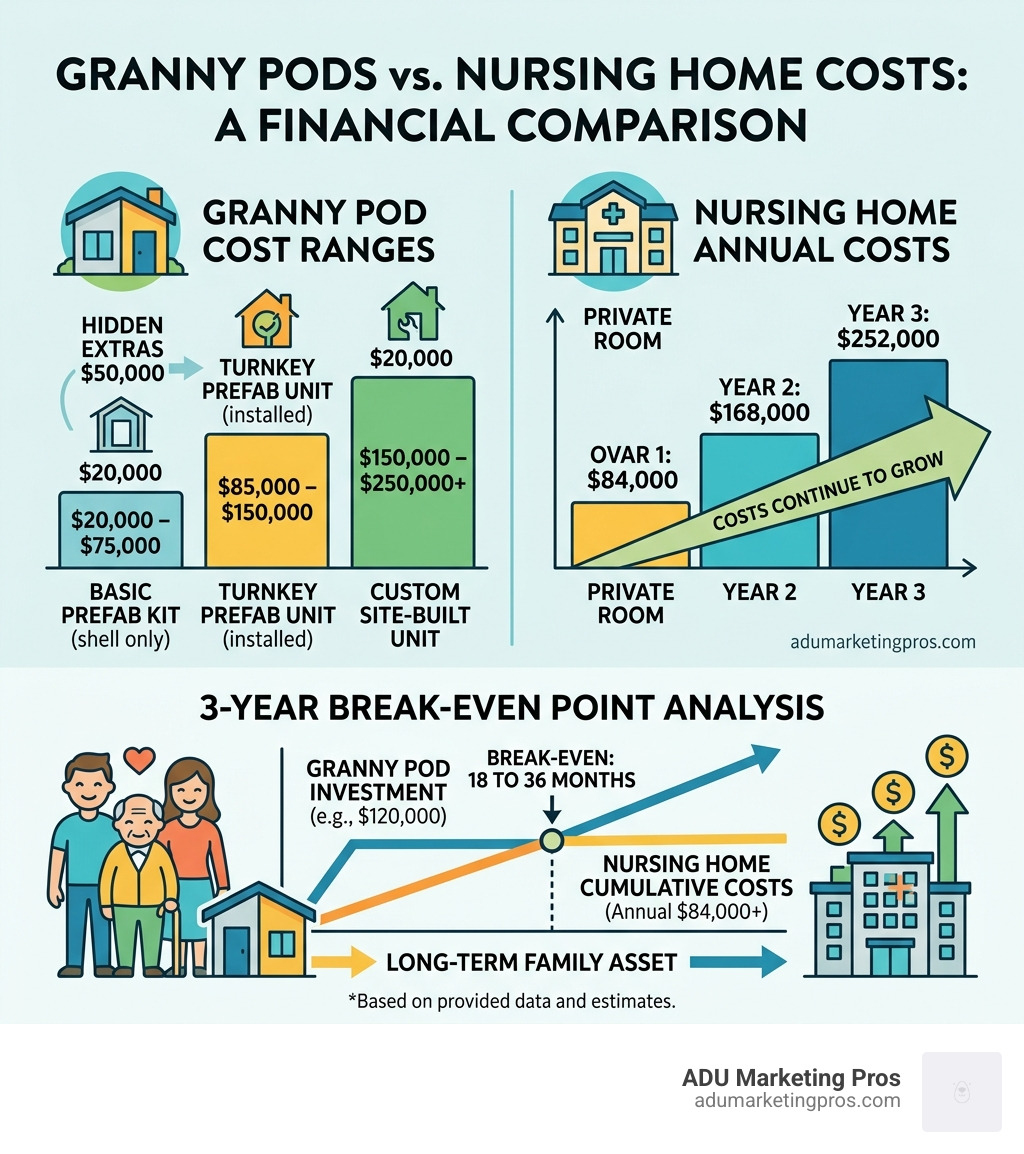
Granny pods cost anywhere from $20,000 to $250,000+, depending on size, type, and location. Most families spend between $85,000 and $150,000 for a complete, move-in-ready unit. This price range reflects the shift from simple backyard sheds to sophisticated, medically-equipped living spaces designed for long-term senior care.
Here’s a fast snapshot of what to expect in the current market:
| Type | Estimated Cost Range | Best For |
|---|---|---|
| Basic prefab kit (shell only) | $20,000 – $75,000 | DIY enthusiasts or those with local contractors |
| Turnkey prefab unit (installed) | $85,000 – $150,000 | Families wanting a hassle-free, fast installation |
| Custom site-built granny pod | $150,000 – $250,000+ | Specific architectural needs or difficult lots |
| Hidden extras (permits, foundation, utilities) | $20,000 – $50,000 additional | Mandatory site preparation and legal compliance |
The Rising Need for Backyard Senior Housing
At some point, most families face the same hard question: where should an aging parent live when they can no longer manage fully on their own? The “Silver Tsunami” is a real demographic shift, and the traditional solutions are becoming increasingly out of reach for the average American family.
Nursing homes average over $84,000 per year for a private room, and in high-cost states like California or New York, that number can easily exceed $120,000. Assisted living runs more than $41,000 annually, and these costs are subject to yearly inflation. Those costs add up fast — and they never stop. Once the money is spent on a facility, it is gone forever, providing no long-term equity for the family.
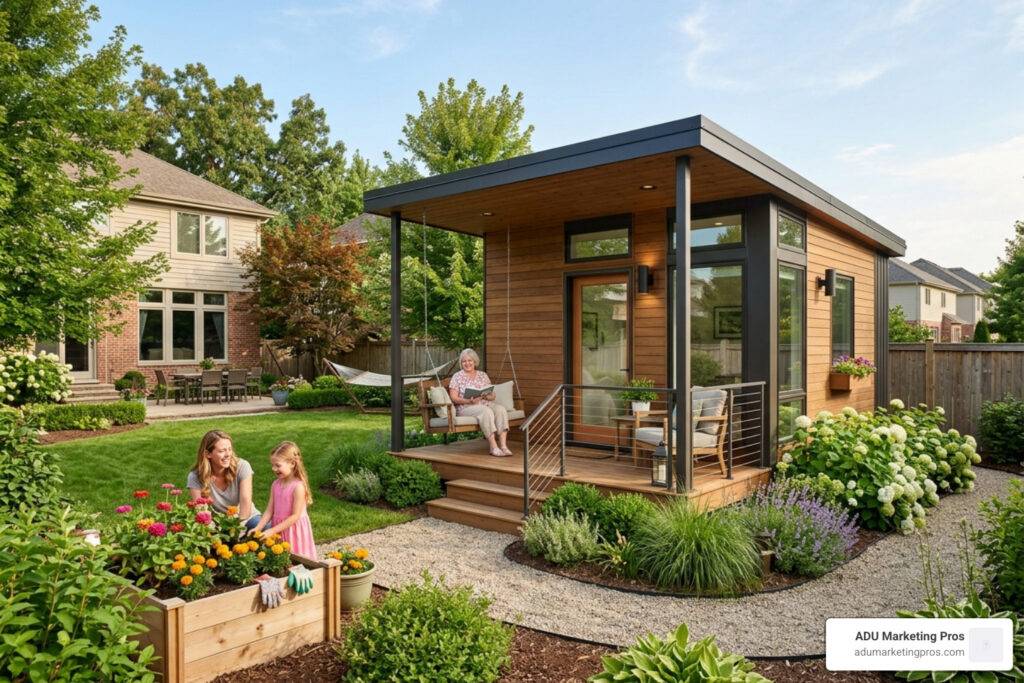
A granny pod is a small, standalone home placed on your property. It gives an elderly family member their own private space, right in your backyard. It’s also called an accessory dwelling unit (ADU), elder cottage, in-law suite, or MedCottage. The idea is simple: keep loved ones close without crowding your main home, while maintaining a level of independence that institutional living simply cannot offer.
The upfront cost feels significant. But here’s the thing — a $120,000 granny pod can break even against nursing home costs in as little as 18 to 36 months. After that, the structure remains on your property as a long-term asset that can eventually be used as a rental unit, a home office, or a guest house.
This guide breaks down exactly what you’ll pay, what’s often left out of the quoted price, and how to make the smartest financial decision for your family. We will explore the nuances of construction, the legal landscape in California, and the specific features that turn a small house into a safe haven for a senior.
Know your granny pods cost terms:
Understanding the Granny Pods Cost: A Comprehensive Breakdown
When we talk about the granny pods cost, we aren’t just looking at a single price tag. The market ranges from DIY-friendly kits to high-end architectural masterpieces. To help you budget, we’ve categorized these units into three main tiers based on current market data from providers like PMHI, Okopod, and Zook Cabins. Each tier offers a different balance of cost, convenience, and customization.
| Construction Type | Square Footage | Typical Price Range | What You Get |
|---|---|---|---|
| Prefab Panelized Kits | 600 – 1,200 sq ft | $25,000 – $75,000 | Pre-engineered wall panels and roof trusses; requires local assembly and finishing. |
| Turnkey Modular Pods | 120 – 400 sq ft | $45,000 – $150,000 | Fully built in a factory; delivered and craned onto your foundation with all finishes. |
| Custom Stick-Built | 400 – 1,000+ sq ft | $150,000 – $320,000 | Designed from scratch; built on-site by local contractors to match your main home. |
For many families in high-cost areas like San Francisco or Los Angeles, understanding Accessory Dwelling Unit Costs is the first step toward financial clarity. While a kit might look like a bargain at $30,000, that price rarely includes the foundation, plumbing, electrical hookups, or the labor required to put the “puzzle” together. In many cases, the labor to assemble a kit can equal or exceed the cost of the kit itself.
The Turnkey Advantage
Turnkey solutions, such as those from Okopod, offer more transparency. For instance, a 312 sq ft “Classic” unit might start around $49,000 for the structure, but once you add delivery and site setup, the all-in price often lands closer to $100,000. These units are popular because they minimize the time your backyard is a construction zone. Instead of months of noise and dust, a modular pod can often be installed and connected to utilities in just a few days.
On the upper end, luxury mobile homes or log cabin-style ADUs from Zook Cabins provide a more permanent, residential feel but come with a price tag to match. These units often feature high-end materials like cedar siding and granite countertops. According to experts at Explore Tiny House, budgeting for a 10-15% contingency is essential to handle the “surprises” that inevitably pop up during construction, such as hitting a rock during excavation or needing a panel upgrade for your home’s electrical system.
Prefab vs. Custom: Which Granny Pods Cost Less?
If you are looking to save money, prefab is generally the winner—but there’s a catch. Prefabricated units benefit from “factory efficiency.” Because they are built in a controlled environment, there is less waste and fewer weather delays. Timber frame construction used in many modern pods also allows for lighter foundations, which can shave thousands off your ADU construction cost.
However, custom stick-built units offer something prefab often can’t: total integration. If your backyard has a strange slope, protected trees, or strict HOA requirements, a custom build might be your only choice. In California, the ADU cost per square foot for custom builds typically ranges from $250 to $650. While prefab units have a lower labor-to-material ratio, you still have to pay for the “soft costs” like site prep and crane rental, which can sometimes bridge the price gap between the two methods.
Hidden Expenses: Beyond the Sticker Price

We often see homeowners get “sticker shock” when they realize the unit price is just the beginning. The “hidden” expenses of a granny pod can easily add $40,000 to $60,000 to your total budget. These are not optional; they are the infrastructure required to make the pod a legal, livable home.
- Site Preparation: This includes clearing trees, grading the land to ensure proper drainage, and soil testing. If your backyard isn’t level, expect to pay $5,000 to $15,000 before the pod even arrives. If you have an old shed or concrete patio that needs removal, that adds to the demolition costs.
- Permits and Fees: The ADU permit cost in California can range from $8,000 to $25,000 depending on your city. This covers building permits, impact fees, and school district fees. Some cities have waived these fees for units under 750 square feet, so check your local ordinances carefully.
- Utility Hookups: Trenching for sewer, water, and electricity is a major variable. If the pod is 100 feet from the main house, you could spend $10,000 to $30,000 just on pipes and wires. If your main electrical panel is old, you may need a $3,000 upgrade to handle the additional load of the pod’s HVAC and appliances.
- Architectural Design: Even with a kit, you may need a local engineer to sign off on the foundation plans to meet California’s strict seismic codes. This ensures the building won’t slide or collapse during an earthquake.
Before you buy, calculate the cost to build an ADU specifically for your lot. A unit that costs $100,000 in a flat yard might cost $140,000 on a hillside due to the need for retaining walls and specialized foundations.
Comparing Granny Pods to Traditional Senior Care
Deciding on the living arrangements for an aging loved one is one of the most significant decisions your family will face. While the initial granny pods cost seems high, it’s helpful to look at it as an “investment in care” rather than a sunk expense. When you pay for a nursing home, you are paying for a service. When you build a granny pod, you are creating an asset.
Traditional senior care is a perpetual, escalating monthly fee. In 2024, a private room in a nursing facility averages roughly $127,750 per year in many metropolitan areas. Even assisted living, which offers less medical support, averages over $41,000 annually. In contrast, a granny pod allows for a “Transitional Home Environment” where family members can provide care, supplemented by in-home health aides if needed. This hybrid approach often results in better health outcomes for the senior, as they remain socially connected to their family.
As noted by Autonomous, granny pods provide a unique balance of independence and proximity. A senior can have their own kitchen and living space while being just steps away from family support. This setup doesn’t just save money; it preserves dignity and strengthens intergenerational bonds, allowing grandchildren to grow up with their grandparents just a few feet away.
Long-term Savings and ROI
From a financial perspective, a granny pod is a “recuperable” asset. Money paid to a nursing home is gone forever. Money spent on a granny pod stays in your backyard and contributes to your family’s net worth.
- Property Value: A legally permitted, high-quality ADU can increase your property value by 20% to 50%. In the competitive Bay Area ADU market, this can mean adding hundreds of thousands of dollars in equity. Appraisers now routinely include ADUs in their valuations, recognizing them as valuable living space.
- Rental Potential: If the unit is no longer needed for a family member, it can be repurposed as a rental property. Rental yields in California often recover 50% to 80% of the initial ADU building costs within a few years. In cities like Los Angeles or San Diego, a 400 sq ft ADU can rent for $1,800 to $2,500 per month.
- Ongoing Costs: You will need to budget for slightly higher property taxes (usually 1% of the added value) and insurance premiums (an extra $200–$800/year). However, shared utilities and the lack of a monthly “facility fee” make the day-to-day cost of living significantly lower than any institutional alternative. You also save on the time and gas money spent driving to and from a distant care facility.
The Emotional ROI
Beyond the numbers, there is the “Emotional ROI.” Studies have shown that seniors who age in place or in close proximity to family experience lower rates of depression and cognitive decline. The ability to maintain a garden, keep a pet, and have a private front door contributes to a sense of agency that is often lost in a nursing home setting. For the adult children, the peace of mind knowing that Mom or Dad is safe in the backyard is invaluable.
Legal Requirements and Zoning for Backyard Dwellings
Is a granny pod legal in your backyard? In California, the answer is almost always “yes,” thanks to aggressive state laws like SB 1211 and AB 68. These laws have largely stripped local cities of the power to ban ADUs, though they can still regulate how they look and where they sit on the lot. The state’s goal is to increase housing density and provide affordable options for seniors and young families alike.
Key things to watch for include:
- Setback Rules: Most California cities require at least a 4-foot setback from the side and rear property lines. Some jurisdictions allow for 0-foot setbacks if the ADU is a conversion of an existing structure like a garage.
- HOA Restrictions: While HOAs generally cannot ban ADUs in California, they can enforce “stylistic criteria” to ensure the pod matches the aesthetic of the neighborhood. This might include requirements for specific roof pitches, siding colors, or window styles.
- ECHO Housing: Some regions allow “Elderly Cottage Housing Opportunities,” which are temporary units designed specifically for seniors that must be removed once they are no longer needed. However, permanent ADUs are usually a better financial move because they add permanent value to the land.
For those in Southern California, checking the Los Angeles ADU cost and local zoning guides is essential, as city-specific incentives (like pre-approved plans) can speed up your timeline significantly. The City of Los Angeles has a “Standard Plan Program” that offers dozens of pre-approved designs, which can cut weeks or even months off the permitting process.
Essential Safety and Accessibility Features
A true “granny pod” isn’t just a tiny house—it’s a home designed for aging in place. To ensure the safety of an elderly resident, certain features are non-negotiable and may be required by California’s Title 24 building standards:
- Zero-Threshold Entries: No steps at the front door or in the shower. This allows for easy access with a walker or wheelchair and prevents tripping hazards.
- Wider Doorways: A minimum of 36 inches to accommodate wheelchairs or walkers comfortably. Hallways should also be wider than standard to allow for easy turning.
- Slip-Resistant Flooring: Essential in kitchens and bathrooms. Luxury vinyl plank (LVP) is a popular choice because it is durable, water-resistant, and provides better traction than polished tile.
- Medical Monitoring: Many modern pods come pre-wired for webcams, vital sign tracking, and emergency alert systems. Some even feature “smart floors” that can detect a fall and automatically notify family members or emergency services.
- Grab Bars and Lighting: Reinforced walls in the bathroom allow for the installation of grab bars. High-intensity, motion-activated lighting helps seniors navigate the space safely at night.
Including these features from the start is much cheaper than retrofitting later. When hiring a professional, the ADU architect cost in Los Angeles often includes specialized “Universal Design” planning to ensure the space remains functional for decades, regardless of the resident’s mobility level.
Financing and Budgeting for Your Granny Pod
How do you pay for a $150,000 backyard home? Most families don’t have that much cash sitting in a drawer. Fortunately, as ADUs have become more common, financing options have expanded. Common financing paths include:
- HELOC or Cash-Out Refinance: Leveraging your main home’s equity is the most popular choice. Because home values in California have skyrocketed, many homeowners have enough equity to fund an ADU entirely through a Home Equity Line of Credit.
- Construction Loans: These are specifically designed for building projects. The lender pays the contractor in “draws” as work is completed, and the loan often converts to a traditional mortgage once the pod is finished.
- Owner-Builder Programs: Some companies, like PMHI, offer specialized financing for those willing to manage the project themselves. This can save you the 15-20% markup a general contractor would charge.
- Family Pooling: Often, the senior sells their primary residence and uses a portion of the proceeds to fund the pod construction, with the remainder going into their retirement savings. This is a win-win: the senior gets a brand-new, accessible home, and the family gets a long-term asset.
- Grants: In California, programs like the CalHFA ADU Grant have historically provided up to $40,000 to help low-to-moderate-income homeowners with pre-development costs like permits and soil tests.
To get a better handle on your specific numbers, we recommend using an ADU cost calculator to see how different sizes and finishes impact your monthly loan payment. Even with a loan, the monthly payment is usually significantly lower than the cost of a senior living facility.
How to Reduce Your Total Granny Pods Cost
If the six-figure price tag is daunting, there are several ways to bring the granny pods cost down without sacrificing quality or safety.
- Garage Conversions: This is the “cheapest” way to get a granny pod. Since the walls and roof are already there, you can often finish a unit for $75,000 to $120,000. You save on the foundation and framing, which are two of the most expensive parts of a build. Check our garage conversion cost calculator for a breakdown.
- Second-Hand or Relocatable Flats: Companies like VanHomes offer expanding suites that can be set up in hours. While more common in agritourism or emergency housing, they are becoming a viable “budget” option for backyard living, though they may not add as much property value as a permanent structure.
- Shared Wet Walls: Design the kitchen and bathroom back-to-back. This minimizes the amount of plumbing work and piping required, saving thousands in labor and material costs.
- Mid-Range Fixtures: You don’t need Italian marble for a granny pod. High-quality laminate flooring and standard cabinetry look great and last longer under heavy use. Focus your budget on safety features like walk-in tubs rather than aesthetic luxuries.
According to the Okopod Pricing Guide, choosing a standardized model rather than a custom size is one of the fastest ways to lock in a lower price. Standardized models allow the factory to buy materials in bulk and streamline the assembly process.
Frequently Asked Questions about Granny Pods
Do granny pods increase property value?
Yes. As long as the unit is a legally permitted, permanent structure, it is considered an Accessory Dwelling Unit. In the California market, a well-built ADU can increase a home’s total value by 20% to 50%. Appraisal factors will depend on the square footage, the quality of finishes, and the local demand for rental housing. In many neighborhoods, an ADU is now seen as a “must-have” feature for multi-generational families.
How long does it take to install a granny pod?
The average timeline is 4 to 9 months. This includes:
- 1-2 months for design and permitting (though this can be faster with pre-approved plans).
- 2-3 months for factory lead times (if prefab) or on-site framing.
- 1-2 months for interior finishes, final utility hookups, and the final inspection by the city building department.
Are granny pods legal in my state?
In California, state law has made granny pods legal in almost every residential zone, including single-family and multi-family lots. However, if you are looking at other regions, such as granny pods in Ohio, the rules are much more fragmented and depend entirely on local municipal codes. Some states are following California’s lead, while others still have strict minimum lot size requirements.
What is the difference between a granny pod and a tiny house?
A granny pod is typically a permanent structure built to local building codes (IRC) and connected to permanent utilities. A tiny house is often built on a chassis with wheels (THOW) and may be classified as a recreational vehicle (RV). Granny pods are generally more expensive because they must meet the same safety and energy standards as a full-sized home.
Can I build a granny pod myself?
While a DIY approach can save on labor costs, it is extremely difficult due to the complex plumbing, electrical, and structural requirements. Most cities require licensed professionals to sign off on the work to pass inspections. If you are handy, you might consider a “shell” kit where you handle the interior painting and flooring while leaving the heavy lifting to the pros.
How do utilities work for a granny pod?
Most granny pods are “sub-metered” from the main house. This means the water, sewer, and electricity lines are extended from your existing home’s connections. You will receive one bill from the utility company, and you can use a private meter to track how much the pod is using if you want to split the costs.
Conclusion
At ADU Marketing Pros, we’ve seen how a well-planned granny pod can transform a family’s dynamic. It’s more than just a construction project; it’s a strategic investment in care, property planning, and family legacy. While the granny pods cost requires a significant upfront commitment, the long-term financial and emotional ROI—avoiding the “cold and unwelcoming” environment of a nursing home while building home equity—is undeniable.
By choosing to build a backyard suite, you are taking control of the aging process. You are ensuring that your loved ones are cared for in a familiar, loving environment while also protecting your family’s financial future. Whether you choose a modern prefab granny flat or a custom-built suite, the key is to start with a clear budget and a deep understanding of your local regulations.
Don’t let the complexity of the process deter you. With the right planning and the right partners, you can create a space that provides safety for your parents and peace of mind for yourself. By keeping your loved ones close, you aren’t just saving money; you’re securing your family’s future for generations to come.