

Understanding the Typical ADU Grant Project Timeline
#
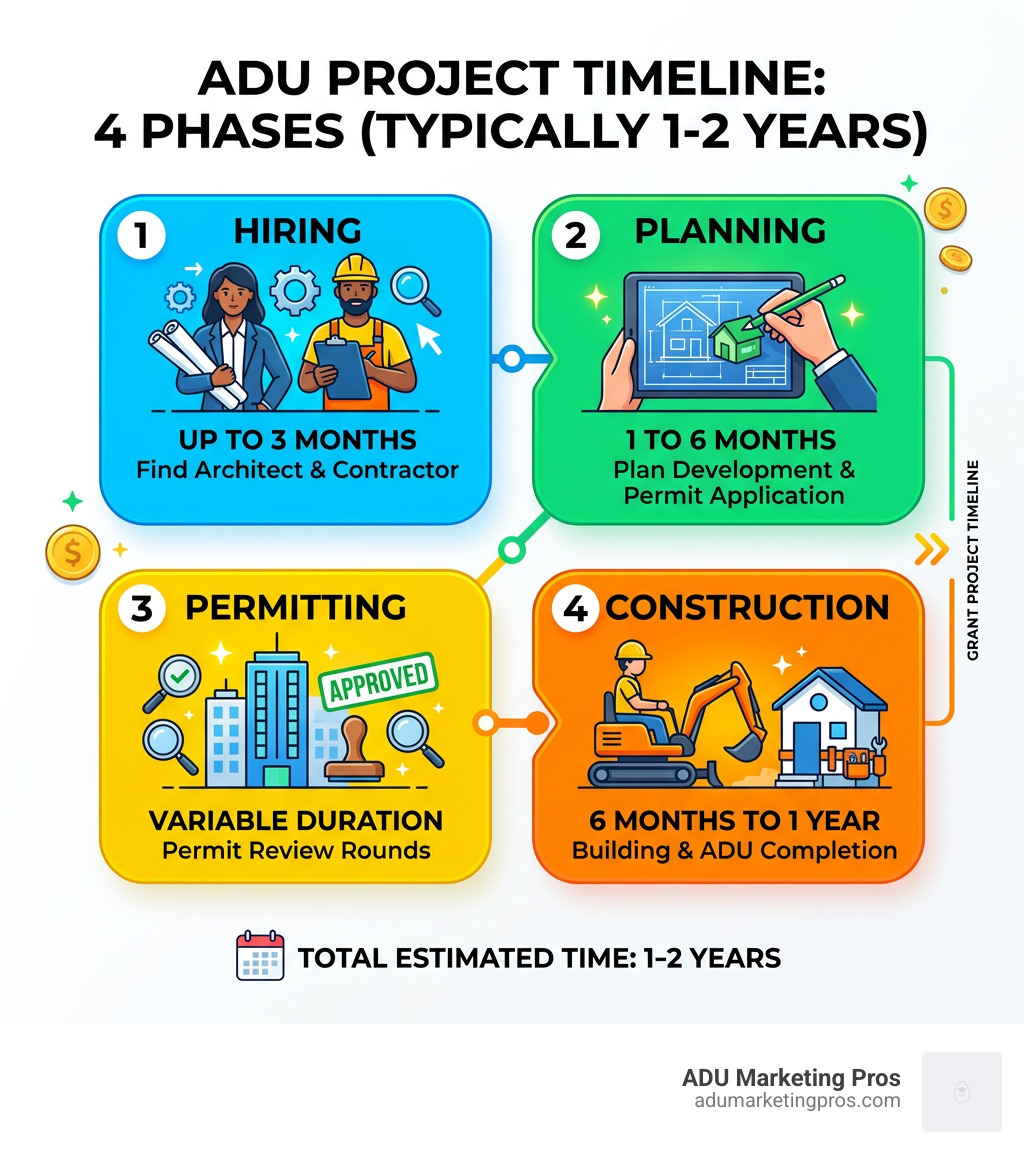
The ADU grant project timeline typically runs 1 to 2 years from start to finish, broken into four key phases. Navigating this timeline requires a blend of patience, strategic planning, and a deep understanding of both local zoning laws and state-level financial incentives. In California, the push for Accessory Dwelling Units (ADUs) has been fueled by legislative changes like SB 9 and SB 10, which have streamlined the approval process but also led to a surge in applications that can occasionally bottleneck local planning departments.
| Phase | Typical Duration | Key Milestones |
|---|---|---|
| Hiring your team (architect, contractor) | Up to 3 months | Contract signing, feasibility study |
| Plan development & permit application | 1 to 6 months | Site survey, Title 24, construction drawings |
| Permitting review | Variable (depends on review rounds) | City comments, revisions, permit issuance |
| Construction | 6 months to 1 year | Foundation, framing, utilities, final inspection |
Grant-specific deadlines layer on top of this. For example, Truckee’s ADU Mini-Grant requires a building permit and Certificate of Occupancy within 12 months of approval. Vermont’s VHIP 2.0 gives homeowners 18 months to finish the entire project. These deadlines are often non-negotiable, meaning that a delay in the permitting phase can directly jeopardize your ability to access thousands of dollars in funding.
California’s CalHFA ADU Grant Program — which offered up to $40,000 for pre-development costs — moved fast when funds were available. Its second phase allocated $25 million that was completely used up in just 17 days (December 11–28, 2023). That kind of speed means homeowners who aren’t ready to move quickly can miss out entirely. To be “ready,” you must have your financing lined up and your design team already working on the preliminary sketches.
Understanding the timeline isn’t just useful for planning — it’s often the difference between securing a grant and losing it. Many homeowners underestimate the “pre-development” phase, which includes everything that happens before you break ground. This is where the grant money is most often applied, covering the high costs of architecture, engineering, and city fees.

When we talk about the ADU grant project timeline, we aren’t just talking about how long it takes to swing a hammer. We’re talking about a multi-layered marathon that involves government bureaucracy, financial planning, and architectural precision. On average, most of our clients in the San Francisco Bay Area and Los Angeles find that their projects take between 12 and 24 months. This duration accounts for the complexities of urban infill development, where utility connections and property line setbacks can trigger unexpected delays.
Why such a wide range? Because “grant projects” have extra hurdles. Unlike a standard cash-funded build, a grant-funded ADU requires you to hit specific milestones to keep your funding. For instance, if you are applying for assistance based on Area Median Income (AMI) limits, your eligibility is often tied to the “pre-development” phase. This includes the costs you incur before you even break ground—things like architectural drawings, soil tests, and permit fees. If your income changes during the 18-month build, or if the program rules shift, you need to have your documentation in order to prove your initial eligibility.
The Accessory Dwelling Unit Grant Program in California has historically been a game-changer, but it operates in cycles. If you miss a funding window because your plans weren’t ready, you might wait six months or more for the next round to open. We’ve seen $100 million in state funds vanish in a matter of weeks. The takeaway? Your timeline starts the moment you decide to build, not the moment you get the money. You must treat the preparation phase as the most critical part of the entire project.
Pre-Development: From Hiring to Permit Submission
Assembling Your Expert Team
The first real step in your ADU grant project timeline is assembling your “A-Team.” We generally recommend budgeting about three months just for the hiring process. You aren’t just looking for a contractor; you’re looking for an architect who understands local zoning in cities like San Jose or Palo Alto, and a builder who has experience with grant-funded disbursements. A builder unfamiliar with grant requirements might fail to provide the specific itemized invoices required by the state, which can stall your funding.
During this 3-month window, you’ll be:
- Interviewing architects and designers: Look for those who specialize in ADUs. They will be more familiar with the specific state exemptions that allow for larger units or smaller setbacks.
- Reviewing portfolios of completed ADUs in your specific city: Every city has its own quirks. A designer who has successfully navigated the San Francisco Planning Department will be more efficient than one who hasn’t.
- Soliciting at least three detailed contractor bids: Ensure these bids are “apples to apples,” meaning they all cover the same scope of work, including site prep and utility hookups.
The Technical Planning Phase
Once your team is in place, the plan development phase begins. This typically takes 1 to 6 months. This is where the ADU Building Process gets technical. Your architect will need to conduct site surveys and potentially order soil tests if you’re building a detached unit. In California, you’ll also need Title 24 energy reports to prove your unit meets the state’s strict efficiency standards. These reports calculate the energy usage of the unit, including insulation, window efficiency, and HVAC systems.
Don’t forget the “soft costs.” The ADU Permit Cost California homeowners face can be substantial—sometimes upwards of $10,000 to $20,000 before a single piece of lumber is purchased. These are the exact costs that grants like CalHFA are designed to cover, but you usually have to pay them upfront or through a construction loan escrow. If you are relying on the grant to reimburse these costs, you must ensure every receipt is saved and every invoice is clearly marked for “pre-development services.”
How Review Rounds Impact Your ADU Grant Project Timeline
The “Permitting Purgatory” phase is where many timelines go to die. Once you submit your plans, the city doesn’t just say “yes” or “no.” They provide “comments”—which is a polite way of saying “fix these thirty things.” These comments can range from minor clerical errors to major structural concerns regarding the foundation or fire safety.
In the ADU Permit Process, the number of review rounds is the biggest variable. A “complete” application might get through in two rounds (about 2-3 months), while an application with errors or zoning issues might take four or five rounds (6 months or more). Every time the city sends comments, your architect has to make corrections and resubmit. If your architect takes three weeks to respond to each city comment, you can see how the weeks turn into months very quickly. This is why hiring a responsive team is vital for staying within grant deadlines.
The Role of Financing in Early Project Stages
Securing your funding is a parallel track that runs alongside your permit submission. If you are using a grant, you almost always need a primary construction loan to go with it. Grants rarely cover 100% of the build; they are “gap fillers.” The grant might cover the $40,000 in soft costs, but you still need a loan for the $250,000 construction cost.
When exploring ADU Financing Options, you’ll want to See Rates for ADU Loans early in the process. Lenders will look at your loan-to-value (LTV) ratio, often considering the “after-renovation value” of your home. This is crucial because if the loan takes 60 days to close, and your grant requires a recorded loan to disburse funds, a delay in financing will directly push back your construction start date. Keep a close eye on ADU Loan Rates as well—locking in a rate can save you thousands, but those locks usually have expiration dates that must align with your permitting timeline. If your permit takes 8 months instead of 4, your rate lock might expire, forcing you to re-qualify at a higher interest rate.
Navigating Grant-Specific Deadlines and Requirements
The “Use It or Lose It” Nature of Grants
This is where the ADU grant project timeline differs from a standard project. Grants come with “use it or lose it” clauses. For example, some local programs in the San Diego area or Northern California have strict windows where the funds must be encumbered (legally committed) within 90 days of approval. If you don’t have a signed contract with a builder by then, the money goes back into the pool for the next person on the waiting list.
The CalHFA ADU Grant Program is a prime example of a program that requires coordination. While the grant provides up to $40,000, the funds are contributed directly to your construction escrow. This means you can’t just take the cash and sit on it; the money is tied to the progress of the loan. The lender acts as the gatekeeper, ensuring that the grant funds are used specifically for the pre-development costs listed in the grant agreement.
Many homeowners are surprised to learn that grant funds are often treated as a “principal reduction.” This means the grant pays down your loan balance rather than giving you a check to spend at the hardware store. Understanding these California ADU Incentives is vital so you don’t run out of cash mid-project. You need to have enough liquidity to cover the day-to-day construction costs while the grant works in the background to lower your overall debt.
Managing Compliance Within Your ADU Grant Project Timeline
Grants aren’t “free money”—they are “monitored money.” Throughout your project, you will likely have reporting requirements. Some state-level programs require quarterly narrative updates where you describe project progress, provide photos of the construction site, and list any changes to the original plan. Failure to provide these updates can result in a “stop-work” order on your funding.
You must stay on top of ADU Building Requirements and keep meticulous records of every cent spent. If you’re following ADU Construction Regulations, you’ll need to prove that the grant covered “eligible” expenses like architectural designs or impact fees. At the end of the project, you’ll often submit a “final informal memo” or a project closeout report to trigger the final disbursement of funds or to satisfy the grant’s audit requirements. This audit can happen up to three years after the project is finished, so keep your files organized.
Local Program Variations: San Diego and Beyond
If you are in San Diego, you have access to one of the best programs in the country: the SDHC ADU Finance Program. This program is a heavy hitter for the ADU grant project timeline because it offers a 1% interest rate during construction. However, it comes with a big caveat: you must commit to a 7-year affordability period where the unit is rented to low-income tenants. This adds a “compliance phase” to your timeline that lasts long after the construction is finished.
Here is how different programs stack up regarding their deadlines:
| Program Location | Completion Deadline | Key Requirement | Post-Build Obligation |
|---|---|---|---|
| San Diego (SDHC) | Project Dependent | 7-year affordability covenant | Annual income certification |
| Truckee, CA | 12 Months | Must secure Certificate of Occupancy | Short-term rental ban |
| Vermont (VHIP) | 18 Months | HUD Fair Market Rent compliance | 5-year rental commitment |
| New York (Plus-One) | 10-Year Regulatory | 10% withheld until completion | Primary residence requirement |
Local programs often provide technical assistance, which can actually shorten your timeline. Having a dedicated consultant to help with vendor selection can shave weeks off the hiring phase. We always tell our clients to check for ADU Funding Grants at the municipal level first, as they often have more flexible timelines than state-wide programs. Municipalities are often more invested in seeing the units actually built to meet local housing quotas.
Construction and Final Occupancy Milestones
The Physical Build Phase
Once the permit is in your hand and the grant funds are in escrow, the physical work begins. Traditional ADU construction usually takes 6 to 12 months, depending on the complexity of the site and the type of unit (attached vs. detached). A garage conversion might take only 4 months, while a two-story detached unit with a full kitchen and two bathrooms will likely take the full year.
The phases of construction generally look like this:
- Site Prep & Foundation (Weeks 1-4): This involves clearing the site, trenching for utilities, and pouring the concrete slab. If you are building in an area with high clay content, you may need deeper footings, which can add time.
- Framing (Weeks 5-10): The “skeleton” of the house goes up. This is the most exciting phase for homeowners because the structure finally takes shape. This is also when you’ll have your first major structural inspection.
- Dry-in & Utilities (Weeks 11-18): This includes the roof, windows, exterior doors, plumbing rough-in, and electrical wiring. “Dry-in” means the house is protected from the elements, allowing interior work to begin regardless of the weather.
- Interior Finishes (Weeks 19-30): Drywall, flooring, cabinets, countertops, and paint. This phase requires the most coordination between different subcontractors (plumbers, electricians, tilers).
- Final Inspections & Landscaping (Weeks 31-40): The city signs off on the electrical, plumbing, and fire safety systems. Once the final building inspection is passed, you receive your Certificate of Occupancy.
The Cost to Build ADU is often spread out across these milestones. If you’re using a grant, your lender will manage “draws.” This means the bank (and the grant) pays the contractor only after certain stages are inspected and approved. Keeping a close eye on your ADU Construction Cost during this phase is critical to ensure you don’t exceed your grant and loan limits. If a contractor asks for 50% upfront, be wary; most grant-aligned lenders only allow for smaller initial deposits.
Factors That Accelerate or Delay Your ADU Grant Project Timeline
No project goes perfectly. We’ve seen 12-month projects turn into 18-month projects because of a single rainy season in San Francisco or a lumber shortage in Los Angeles. In the world of ADU development, “expect the unexpected” is the only rule you can count on.
Common delay factors include:
- Site Conditions: Finding an old septic tank, unmapped utility lines, or unstable soil can add weeks of remediation and thousands in costs.
- Weather: You can’t pour concrete in a downpour, and framing in high winds is dangerous. A particularly wet winter can push a project back by two months.
- Contractor Availability: The best crews are often booked months in advance. If your project is delayed in the permitting phase, you might lose your spot in your contractor’s schedule.
- Inspection Backlogs: In busy cities like San Jose or San Diego, waiting for a city inspector can take a week or more for each phase. If you fail an inspection, you have to fix the issue and wait another week for a re-inspection.
To keep things moving, use an ADU Cost Calculator to plan for contingencies. Having a 10-15% “buffer” in your budget prevents delays caused by waiting for more funding. For a deeper dive into managing these hurdles, check out our guide on From Loans to Investments: Navigating ADU Financing. Strategic planning and a healthy contingency fund are your best defenses against timeline inflation.
Frequently Asked Questions about ADU Timelines
What is the fastest way to complete an ADU project?
The absolute fastest way is to use “pre-approved plans.” Many cities, like San Diego and San Jose, offer a gallery of designs that have already been vetted by the building department. Using these can shave 2 to 4 months off your ADU grant project timeline because the city review is much faster. Also, hiring a contractor who has a “design-build” model keeps everything under one roof, reducing communication delays between the architect and the builder. You can find many of these resources in the San Diego ADU Planning Tool Kit.
Can I get a grant extension if construction is delayed?
It depends on the program, but most allow for “amendment requests” if you have a valid reason (like a natural disaster, a documented contractor default, or unexpected site remediation). However, you usually must request this extension at least 60 days before your original deadline expires. Hardship waivers are available in some programs, but they are never guaranteed. Always communicate with your grant administrator the moment you suspect a delay; transparency is key to maintaining your funding.
How long does it take to receive grant funds?
Most grants operate on a reimbursement basis or an escrow contribution model. For the CalHFA grant, the funds are usually moved into your construction escrow after your loan is finalized and pre-development invoices are submitted. You won’t see the cash in your personal bank account. If you are waiting for a final “closeout” payment, that usually happens only after the Certificate of Occupancy is issued. Be prepared for the tax implications, as you will likely receive a 1099-G form for the grant amount in the year the funds are disbursed.
Does the timeline change for a garage conversion vs. a new build?
Yes, significantly. A garage conversion (JADU or ADU) typically has a shorter timeline because the foundation and primary structure already exist. You can often shave 3 to 5 months off the construction phase. However, the permitting phase can sometimes be just as long, as the city will want to ensure the existing structure meets current seismic and fire codes. If the garage is on the property line, you may also face additional zoning hurdles that can add time to the pre-development phase.
How do interest rates affect the ADU grant timeline?
While interest rates don’t physically slow down construction, they can delay the start of your project. If rates are high, homeowners may wait for a dip before locking in their construction loan. Since many grants require an active loan to disburse funds, this “waiting game” can push back your entire timeline. It is often better to start the permitting process while watching the rates, as you can always wait to pull the actual building permit until the financing is optimal.
Are there specific seasons that are better for starting an ADU?
In California, starting your project in the late spring or early summer is ideal. This allows you to complete the “dirt work” (grading and foundation) and framing during the dry months. If you start in November, you risk having an open trench or an exposed frame during the winter rains, which can lead to significant delays and potential water damage to the materials.
Conclusion
Building an ADU is a journey, and when you add a grant into the mix, it becomes a high-stakes game of “beat the clock.” While the ADU grant project timeline of 1 to 2 years might seem daunting, the financial rewards—from increased property value to monthly rental income—are well worth the wait. The key is to view the timeline not as a rigid schedule, but as a series of manageable milestones that require constant oversight and proactive communication.
At ADU Marketing Pros, we understand that the most successful projects start with a solid plan. Whether you are a homeowner trying to navigate the Accessory Dwelling Unit Grant Program or a builder looking to streamline your operations, strategic planning is the key to success. We specialize in helping ADU professionals stand out in this competitive California market by focusing on expertise and data-driven results. We know that in this industry, time is literally money.
Don’t let the clock run out on your housing dreams. By understanding the milestones, preparing for the review rounds, and securing your financing early, you can turn that “backyard cottage” dream into a reality—on time and on budget. Remember, the most successful ADU owners are those who started their research months before they ever picked up a shovel. Start your journey today by assembling your team and mapping out your specific local requirements.