
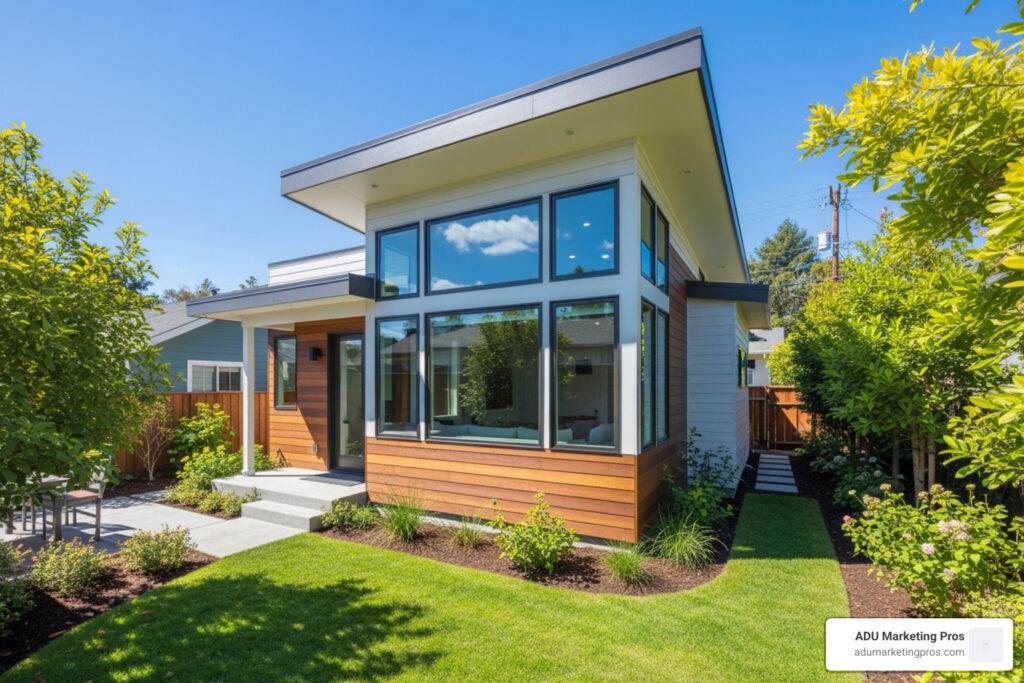
Understanding Custom ADU Designs in Menlo Park
Custom ADU designs in Menlo Park are architect-drawn, site-specific accessory dwelling units built from the ground up to match your property, lifestyle, and local zoning rules — unlike prefab or modular options that arrive in a fixed form. In a city where real estate is valued at a premium, the decision to build an ADU is not just about adding square footage; it is about strategic asset management and enhancing the long-term utility of your primary residence. For many homeowners in the 650 area code, an ADU represents the ultimate flexibility: a guest house today, a rental unit tomorrow, and a retirement cottage in the future.
Here’s a quick snapshot of what you need to know:
| Factor | Key Detail |
|---|---|
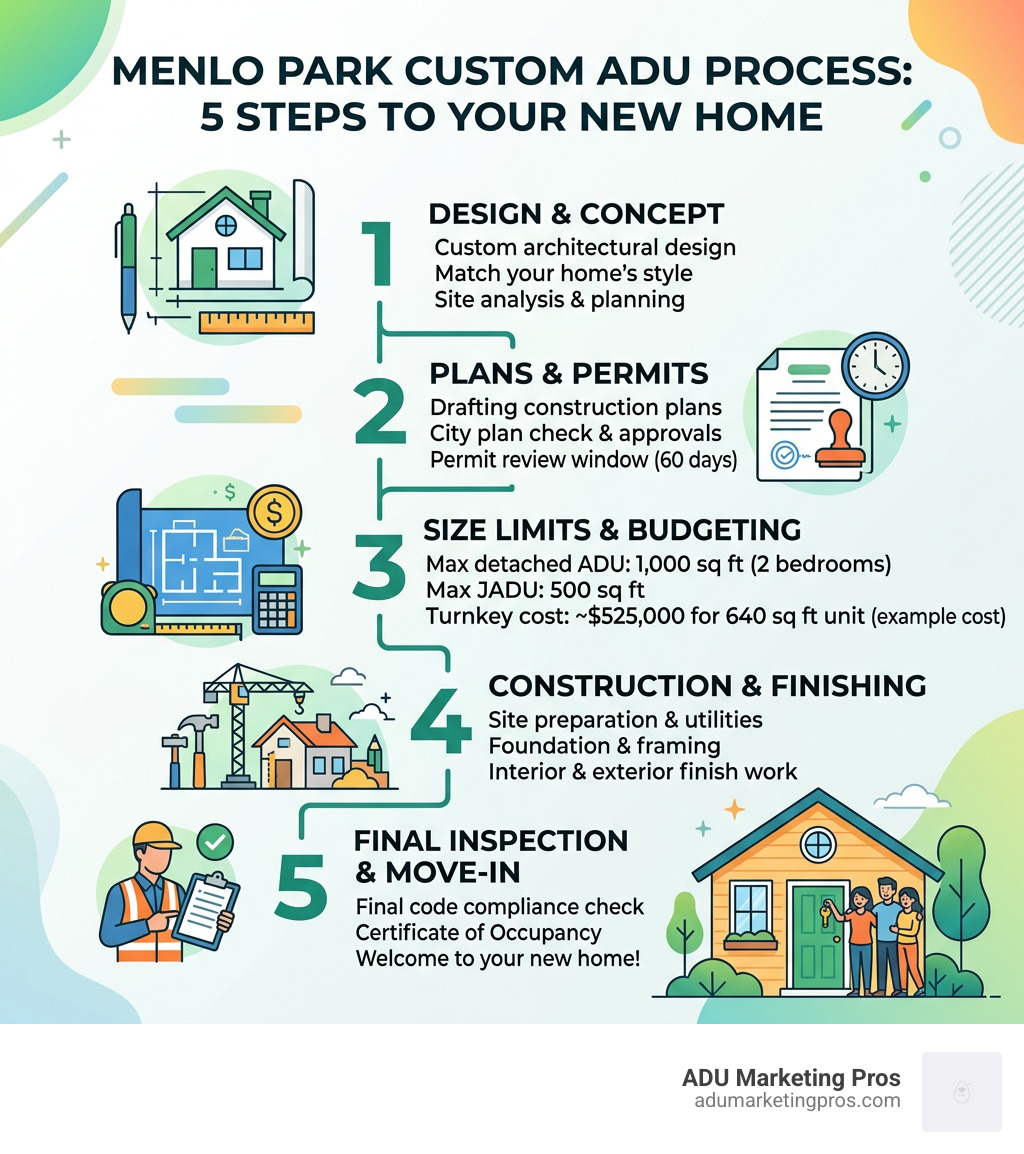
| Max detached ADU size | 1,000 sq ft (2 bedrooms) |
| Max JADU size | 500 sq ft |
| Minimum setbacks | 4 feet (side and rear) |
| Max detached height | 17 feet |
| Typical turnkey cost | ~$525,000 for a 640 sq ft attached ADU |
| Rental income potential | $2,500+ per month |
| Permit review window | 60 days (California law) |
| Property value increase | Up to 30% |
The Menlo Park Housing Landscape
Menlo Park sits at the heart of Silicon Valley — one of the most expensive housing markets in the country. From the tree-lined streets of the Willows to the historic charm of Allied Arts and the modern developments in Belle Haven, the city represents a diverse architectural tapestry. However, common threads unite these neighborhoods: small lots, close neighbors, and a high demand for flexible living spaces. The pressure to maximize every square foot of your property has never been higher, especially as multi-generational living becomes a necessity for many families and the work-from-home culture remains a permanent fixture for tech professionals.
In neighborhoods like Sharon Heights, where larger lots are more common, homeowners are looking for expansive, luxury ADUs that can serve as full-scale secondary residences. Conversely, in the more densely packed areas near downtown, the challenge is often fitting a functional unit into a tight backyard without sacrificing privacy or outdoor living space. This is where the “custom” element becomes non-negotiable. A cookie-cutter solution rarely works when you are dealing with the specific topography, heritage trees, and architectural expectations of a Menlo Park estate.
That’s exactly why custom ADU designs are gaining so much traction here.
Whether you’re thinking about housing an aging parent, generating rental income to offset a high mortgage, or adding a dedicated home office that provides a professional separation from your main living area, a well-designed ADU can solve multiple problems at once. But Menlo Park has its own zoning rules, setback requirements, and design standards — and navigating them without the right guidance can get expensive fast. This guide breaks down everything you need to know: regulations, design options, real costs, and financing — so you can make a confident decision before a single permit is filed.
The Philosophy of Custom vs. Prefab
When we talk about custom adu designs menlo park homeowners often ask: “Why shouldn’t I just buy a box and drop it in the backyard?” While prefab units have their place, Menlo Park’s unique architectural character and often-tight lot configurations frequently demand a more tailored approach.
Custom ADUs, also known as “stick-built” units, are constructed on-site from the ground up. This allows for total architectural harmony with your existing home. If your primary residence is a classic Craftsman or a sleek mid-century modern, a custom design ensures your new addition looks like it was always meant to be there, rather than an afterthought. This is particularly important in neighborhoods with strict aesthetic expectations where a mismatched “box” could potentially detract from the overall property value. Furthermore, stick-built construction allows for modifications during the build process, such as adjusting window heights to capture a specific view or tweaking the interior layout to better accommodate specific furniture pieces.
| Feature | Custom Stick-Built ADU | Prefab Modular Unit |
|---|---|---|
| Design Flexibility | Unlimited; matches main home | Limited to manufacturer models |
| Site Adaptability | High; works with odd lot shapes | Lower; requires crane access |
| Long-Term Value | Generally higher resale appeal | Can be seen as “temporary” |
| Construction Time | 9–12 months | 6–9 months |
| Initial Cost | Higher (often $500k+) | Lower (starts ~$228k) |
Beyond aesthetics, adu designs must account for the long-term impact on the neighborhood. As highlighted in this AARP Article, ADUs are a resounding “YES” for people and places because they provide gentle density and affordable housing options without destroying the character of established communities. In Menlo Park, this “gentle density” is the key to maintaining the city’s suburban feel while addressing the critical housing shortage. It allows for more people to live in high-opportunity areas without the need for massive apartment complexes that can alter the skyline and traffic patterns of a quiet residential street.
Why Homeowners Prefer Custom ADU Designs in Menlo Park
In a city where property values are among the highest in the world, “standard” rarely cuts it. We see a strong preference for custom designs because they allow for specific lifestyle solutions that prefab units simply cannot accommodate. For instance, many Menlo Park residents are looking for adu design trends that prioritize high-end home offices for tech executives or luxurious guest suites for visiting family.
Customization allows you to include:
- Vaulted Ceilings: Making a small footprint feel expansive and airy, which is essential for units under 800 square feet. By utilizing scissor trusses, a custom builder can create 12-foot ceilings that make a 600-square-foot unit feel like 1,000 square feet.
- Specific Storage: Built-in shelving, hidden pantries, and custom cabinetry that maximize every inch of the floor plan. In a small space, every cubic inch counts, and custom millwork can turn a hallway into a library or a closet into a laundry hub.
- Luxury Finishes: Matching the high-end quartz countertops, custom cabinetry, or engineered wood flooring found in the main house to create a cohesive estate feel. This continuity is vital for maintaining the appraisal value of the entire property.
- Privacy Features: Strategic window placement, clerestory windows, and privacy screens to ensure neither you nor your neighbors feel “watched” in a dense backyard setting. Custom designs can orient the ADU’s “public” face toward a private garden while keeping the side facing the neighbor’s yard largely opaque.
Prefab vs. Stick-Built: The Menlo Park Context
While we advocate for the beauty of custom builds, we must acknowledge the rise of prefab. Companies like Abodu offer units starting around $228,000, which can be delivered in as little as nine months. This is an attractive “entry-level” price point. However, in Menlo Park, “entry-level” can sometimes clash with the luxury expectations of the market. Furthermore, the logistics of prefab can be a nightmare in older neighborhoods with narrow streets and low-hanging power lines.
Stick-built ADUs in California often exceed $500,000, but they offer superior durability and site integration. If your backyard has a significant slope, large heritage oaks, or difficult utility access, a adu builders bay area specialist will likely recommend a custom build to navigate these physical constraints that a “one-size-fits-all” prefab unit simply can’t handle. Custom builds also allow for better integration of sustainable technologies, such as solar arrays that match the main house’s system or advanced greywater recycling systems that help maintain the lush landscaping Menlo Park is known for.
Navigating Menlo Park Zoning and Regulations
Building in Menlo Park means following the rules set by both the city and San Mateo County. California has passed several laws to make ADU construction easier, but local “nuances” still exist regarding how those laws are applied. Staying compliant with california adu regulations is the first step toward a successful project. According to the California Department of Housing and Community Development (HCD), state law provides a baseline of protections for homeowners, but cities like Menlo Park still maintain control over certain design elements, particularly those related to safety and aesthetics.
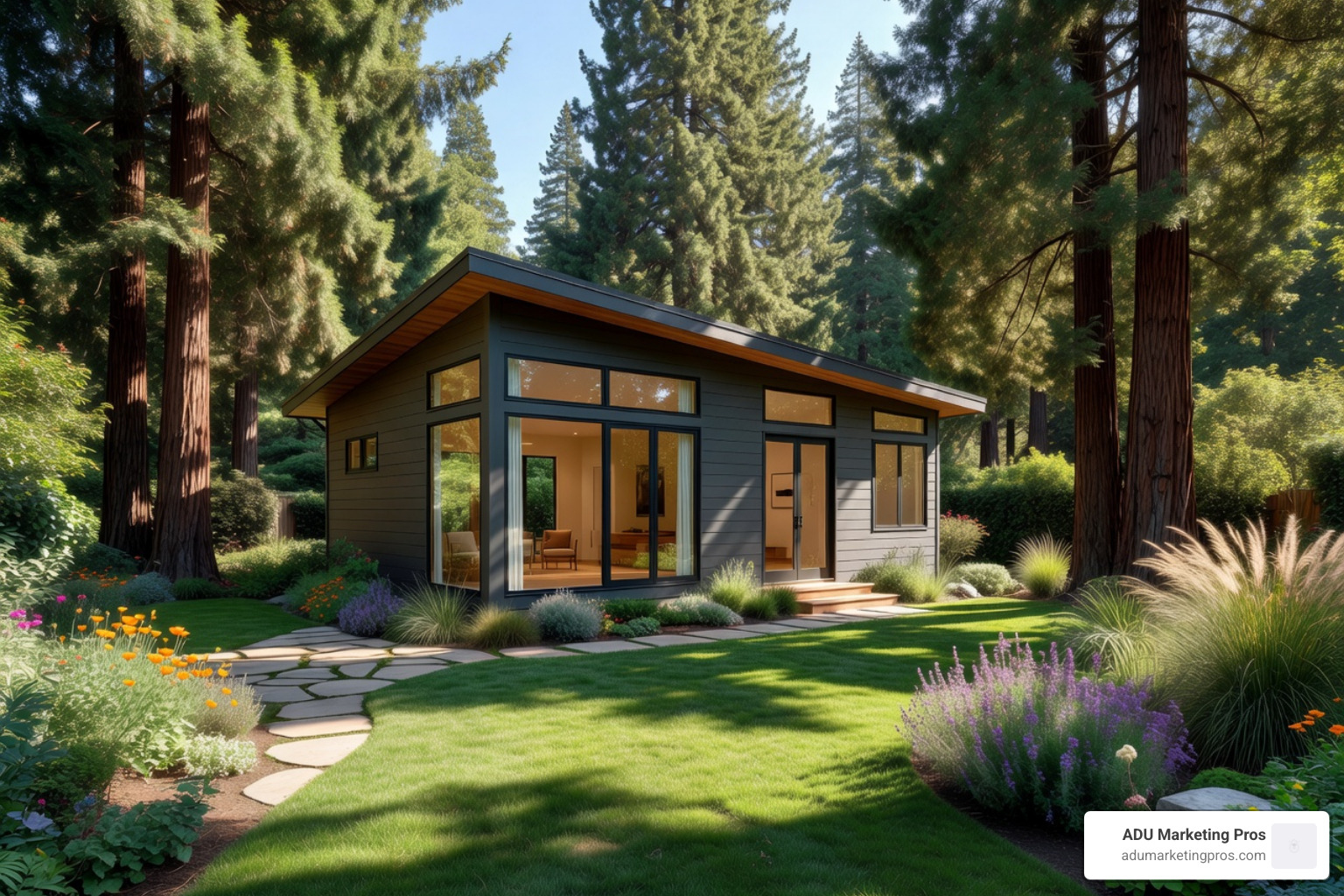
One of the most critical factors in Menlo Park is the Daylight Plane. This is a requirement intended to protect the light and air of neighboring properties. It essentially means that as your building gets taller, it must “lean back” from the property line. Specifically, the daylight plane starts at a certain height (often 8 to 10 feet) at the property line and angles inward at a 45-degree slope. This is why many custom designs feature sloped roofs or unique architectural angles. Navigating the daylight plane requires a skilled architect who can maximize interior volume while adhering to the geometric constraints of the city’s code. Without this expertise, you might end up with a unit that feels cramped or fails to pass the initial plan check.
Size Limits and Setbacks for Menlo Park ADUs
Menlo Park is relatively generous with size compared to some neighboring jurisdictions, but there are hard caps you need to know:
- Detached ADUs: You can build up to 1,000 square feet if the unit has two bedrooms. If it’s a studio or one-bedroom, the limit is 850 square feet. This allows for a true “second home” feel rather than just a guest suite. For many, this extra 150 square feet is the difference between a cramped living room and a spacious open-concept great room.
- Junior ADUs (JADUs): These are limited to 500 square feet and must be contained entirely within the existing walls of your primary residence. They are an excellent option for garage conversions or repurposing a large master suite. JADUs also have the unique requirement of owner-occupancy (you must live in either the main house or the JADU), which does not apply to standard ADUs.
- Setbacks: Generally, you must maintain a 4-foot setback from the side and rear property lines. However, if your ADU is over 800 square feet, Menlo Park may require a 10-foot rear setback depending on your specific zoning district. This is a crucial distinction that can significantly impact where the unit can be placed on your lot.
- Height: Detached units are typically limited to 17 feet. However, if you are doing a garage conversion with a living space above, you might be allowed to go up to 24 feet, provided you meet the daylight plane requirements and the unit is attached to the main dwelling.
When developing custom adu blueprints, your architect must also account for Floor Area Ratio (FAR) and lot coverage. While state law prevents cities from using FAR to block an ADU under 800 square feet, larger custom units may be subject to these local density calculations. This is where the “custom” aspect becomes vital; a designer can find ways to maximize the usable space without triggering restrictive FAR penalties, perhaps by utilizing “exempt” spaces like covered porches or unfinished basements.
The Heritage Tree Ordinance
Menlo Park is famous for its lush canopy, and the city takes its trees very seriously. The Heritage Tree Ordinance protects specific species (like Coast Live Oaks and Valley Oaks) and sizes of trees (typically those with a trunk circumference of 47.1 inches or more). If your proposed ADU footprint interferes with the “drip line” of a heritage tree, you may be required to adjust your design or implement expensive root protection measures.
A custom design allows you to “build around” these natural assets, perhaps incorporating a deck that floats over the roots or shifting the foundation to avoid critical root zones. In some cases, an arborist must be present during excavation to ensure no major roots are severed. This is a level of site-specificity that prefab units simply cannot offer, as they require a flat, clear pad for installation. Ignoring the tree ordinance can lead to massive fines and a complete halt to your construction project.
Parking Requirements and Transit Exemptions
One of the biggest “bank-breaking” costs used to be the requirement to provide off-street parking for an ADU. Thankfully, Menlo Park has modern rules that align with state mandates:
- Transit Proximity: If you are within a half-mile walking distance of public transit (like the Menlo Park Caltrain station or major bus lines), no additional parking is required for the ADU. This covers a significant portion of the city.
- Historic Districts: If your home is in a designated historic district, you are exempt from adding parking to preserve the neighborhood’s aesthetic.
- Garage Conversions: If you convert your existing garage into an ADU, you are no longer required to replace those parking spots on your property, though you must still ensure the driveway remains functional for the main house.
This flexibility allows for more creative adu architectural plans that focus on living space rather than pavement. It also allows homeowners to convert underutilized garages into high-value living spaces without the massive expense of pouring new concrete for replacement parking. However, it is always wise to consider how your tenants or guests will park, as street parking in Menlo Park can be competitive in certain neighborhoods.
Design, Budgeting, and the Permitting Process
Let’s talk numbers. Building a custom adu designs menlo park project is an investment in your property’s future. A recent turnkey project for a 640-square-foot attached ADU in Menlo Park cost approximately $525,000. While that sounds high, consider that this unit can rent for $2,500 or more per month, providing a significant return on investment and potentially paying for itself in less than 15 years while adding immediate equity to the home. In the current market, an ADU can add between $400,000 and $600,000 to the resale value of a Menlo Park home, making it one of the few home improvements that offers a near 1:1 (or better) return on investment.
Cost Factors for Custom ADU Designs in Menlo Park
Why does it cost so much? The bay area adu cost is driven by several factors that are unique to the Silicon Valley ecosystem:
- Site Preparation: In Menlo Park, this often involves dealing with old utility lines, complex drainage systems, or the removal of old structures. Soil stability can also be an issue in certain parts of the city, requiring specialized foundation work like pier-and-beam or deepened footings to prevent settling.
- Utility Connections: Your ADU needs its own plumbing, electricity, and often a separate HVAC system. In Menlo Park, new builds are often required to be “all-electric” under the city’s Reach Codes, which means high-efficiency heat pumps and induction cooktops. Upgrading your main electrical panel to 200 or 400 amps is a common and necessary expense.
- Labor Rates: Silicon Valley has some of the highest skilled labor costs in the country. From master plumbers to specialized finish carpenters, you are paying for expertise that ensures your ADU meets the high standards of the local market. These professionals are in high demand, which also impacts project timelines.
- Luxury Upgrades: Most Menlo Park homeowners opt for high-end materials like stainless steel appliances, modern black hardware, and exposed wood beams to match the neighborhood’s standard. These choices increase the upfront cost but significantly boost the rental and resale value. High-performance windows and doors are also a major cost driver but are essential for meeting California’s strict Title 24 energy requirements.
Working with palo alto adu builders or local Menlo Park specialists ensures that these costs are managed through a “design-permit-build” workflow, which prevents expensive mid-construction changes and ensures that the project stays on schedule. A professional team will provide a detailed line-item budget before construction begins, so there are no surprises when the walls start going up.
Financing Your Menlo Park ADU Project
How do you pay for a half-million-dollar backyard home? Most homeowners use one of three methods:
- HELOC (Home Equity Line of Credit): Leveraging the massive equity built up in Menlo Park homes over the last decade. This is often the most flexible and cost-effective way to fund construction, as you only pay interest on the money you actually draw.
- Cash-Out Refinance: Replacing your current mortgage with a new, larger one and taking the difference in cash. This can be advantageous if current interest rates are lower than your original rate, though in a rising rate environment, this has become less popular.
- Construction Loans: Some lenders offer loans based on the future value of the home once the ADU is completed. This is ideal for homeowners who haven’t yet built up enough equity but have the income to support a larger loan. These loans often convert to a standard mortgage once the certificate of occupancy is issued.
Given that an ADU can increase your property value by up to 30%, many banks view these as low-risk investments. If you are working with custom adu builders, they can often provide the documentation needed to help your appraiser understand the value being added, ensuring your loan reflects the true worth of the completed project. It is also worth checking for local grants or low-interest loan programs offered by San Mateo County for homeowners who agree to rent their ADUs at affordable rates.
Essential Design Features for Small Spaces
To make a 600 or 800-square-foot space feel like a “home” rather than a “hut,” we recommend several design strategies often seen in custom adu san francisco projects where space is at an even higher premium:
- Open-Concept Layouts: Eliminating unnecessary walls to let light flow from the kitchen to the living area. Using a kitchen island as a dining table can also save significant floor space while providing a social hub for the home.
- Dual Lofts: If your height limit allows, adding a loft can provide extra storage or a sleeping area without eating into the main floor’s square footage. This is particularly popular for home offices or guest rooms where the “bedroom” doesn’t need full standing height.
- Indoor-Outdoor Flow: Using sliding glass doors or “NanaWalls” that open onto a private patio or deck. This “tricks” the brain into perceiving the outdoor space as part of the living room, effectively doubling the usable area during the Bay Area’s many sunny days. In Menlo Park, a well-designed patio can serve as a second living room for nine months of the year.
- Strategic Lighting: A mix of recessed lighting, pendant lights, and natural light from skylights or solar tubes can make a compact space feel airy and bright. In custom builds, we often recommend “smart” lighting systems that can be controlled via smartphone, allowing for different “scenes” for working, relaxing, or entertaining.
- Multi-Functional Furniture: Designing the space with specific furniture in mind, such as Murphy beds or built-in desks, ensures that the ADU can transition from a workspace during the day to a guest room at night. Custom cabinetry can hide these elements when they aren’t in use, maintaining a clean and uncluttered aesthetic.
Frequently Asked Questions about Menlo Park ADUs
How long does the permitting process take in Menlo Park?
Under California law, local agencies must act on an ADU application within 60 days of receiving a completed application. However, “completed” is the keyword. If your plans are missing details on utility connections, seismic safety, or heritage tree protection, the clock stops. Generally, from the first meeting with an architect to having a permit in hand takes 4 to 6 months in Menlo Park. This includes the time needed for site surveys, architectural drafting, and responding to city comments. The construction phase typically adds another 6 to 10 months depending on the complexity of the build.
Can I build a two-story ADU in Menlo Park?
It is possible but challenging. Detached ADUs are generally capped at 17 feet, which usually limits you to one story with a loft. However, if you are building an attached ADU or a garage conversion with a second story, you may be able to reach higher (up to 25 feet in some cases), provided you comply with the daylight plane and privacy requirements for your neighbors. Two-story units often require more rigorous structural engineering and may trigger additional fire safety requirements, such as enhanced fire-rated walls between the ADU and the main house.
What is the maximum size for a detached ADU?
In Menlo Park, the maximum size is 1,000 square feet for a unit with two or more bedrooms. If you only need one bedroom or a studio, the limit is 850 square feet. Even if you have a massive lot, you still have to comply with lot coverage and FAR rules if the unit exceeds 800 square feet. It is important to note that these size limits do not include porches, patios, or unfinished attic space, which can be used to expand the “perceived” size of the unit without violating the square footage caps.
Do I need to install fire sprinklers in my ADU?
Fire sprinklers are only required in the ADU if they are required in the primary residence. However, if the ADU is located more than 150 feet from the street (where a fire truck can park), the fire marshal may require additional safety measures, such as a dedicated fire hydrant or a larger water line. This is a common issue in Menlo Park’s deeper lots and should be addressed early in the design phase to avoid massive utility upgrade costs later.
Can I rent out my ADU in Menlo Park?
Yes, you can rent out your ADU. In fact, generating rental income is one of the primary reasons homeowners build them. However, Menlo Park (and California state law) generally prohibits “short-term rentals” (less than 30 days) for ADUs. This means you can have a long-term tenant, but you cannot use the unit as an Airbnb. Additionally, for ADUs permitted between 2020 and 2025, there is no requirement for the owner to live on the property, meaning you could potentially rent out both the main house and the ADU simultaneously.
Will an ADU increase my property taxes?
Yes, but only for the value of the ADU itself. Your primary residence will not be reassessed at current market value. The county tax assessor will perform a “blended assessment,” adding the value of the new construction to your existing tax base. Given the high value of Menlo Park real estate, the increase in property tax is usually a small fraction of the rental income the unit can generate.
Does Menlo Park require solar panels on ADUs?
Yes, under the California Building Standards Code (Title 24), all new detached ADUs are required to have solar panels. The size of the system is based on the square footage of the unit. However, if the ADU is shaded by heritage trees or the main house to the point where solar is not viable, you may be able to apply for an exemption. Attached ADUs and garage conversions generally do not require solar unless the main house is also undergoing a major renovation.
Conclusion
Building a custom adu designs menlo park project is more than just a construction job; it’s a strategic property upgrade that requires a blend of architectural creativity, regulatory knowledge, and financial planning. By choosing a custom design, you ensure that your new unit adds maximum value, provides a beautiful living environment, and respects the unique character of Silicon Valley. The long-term benefits of an ADU — from housing family members to creating a reliable stream of passive income — far outweigh the initial complexities of the planning and building process.
The journey from a backyard dream to a finished home involves several critical steps. It begins with a feasibility study to understand what your specific lot allows, followed by a design phase that balances your needs with the city’s daylight plane and tree ordinances. Once permits are secured, the construction phase requires a team that understands the high standards of Menlo Park building codes and the expectations of the local market. In a city where quality is the standard, cutting corners is never an option.
At ADU Marketing Pros, we understand the complexities of the California ADU market. We specialize in helping construction and architecture firms showcase their expertise and connect with homeowners who value quality over a “quick fix.” If you are a builder looking to dominate the local market, our adu marketing solutions are designed to help you stand out in a crowded field and reach the homeowners who are ready to invest in their property’s future.
Your ADU Success Checklist
Before you break ground, ensure you have checked the following:
- Feasibility: Have you confirmed your lot’s FAR and coverage limits with a professional site survey?
- Trees: Are there any heritage oaks or protected species in the way, and have you consulted an arborist?
- Utilities: Is your electrical panel capable of supporting an all-electric ADU, and have you mapped out the sewer and water connections?
- Budget: Have you accounted for both “hard costs” (construction) and “soft costs” (permits, design, impact fees, and school district fees)?
- Design: Does the ADU complement the architectural style of your main home and respect the privacy of your neighbors?
- Financing: Do you have a pre-approval for a construction loan or a HELOC in place to ensure smooth progress?
Whether you’re building for a parent, a tenant, or yourself, the key to success in Menlo Park is early planning, a clear budget, and a design that makes sense for your specific slice of the Bay Area. The investment you make today will provide housing security, lifestyle flexibility, and financial returns for decades to come. Ready to start your journey? The first step is always a site-specific feasibility study to see exactly what your lot will allow and how you can turn your backyard into a high-value asset.