
Why Tiny Homes Financing is Different from Traditional Home Loans
Tiny homes financing requires navigating a unique set of challenges that don’t apply to traditional houses. Most tiny homes—especially those under 400 square feet or built on wheels—don’t qualify for conventional mortgages because banks require permanent foundations, minimum square footage (typically 400+ square feet), and sufficient loan amounts to justify their underwriting costs.
Quick Answer: Your Main Financing Options
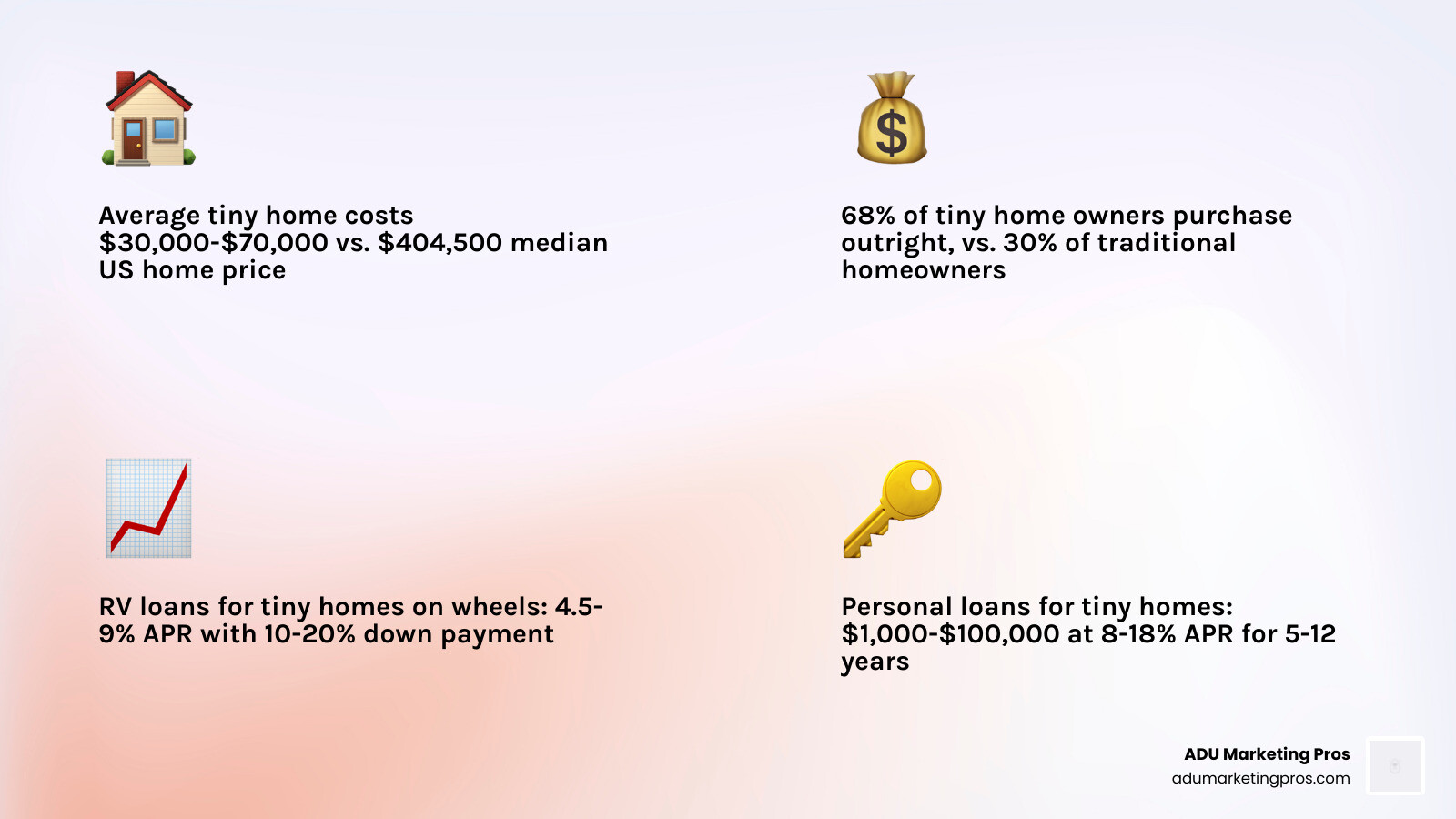
- Personal Loans: Unsecured loans from $1,000-$100,000 with 8-18% APR and 5-12 year terms
- RV Loans: For certified tiny homes on wheels, offering 4.5-9% APR with 10-20% down payment
- Chattel Mortgages: Secured by the home itself, treating it like a vehicle loan
- Home Equity Loans/HELOCs: If you own property, leverage your equity at 6-10% APR
- Builder Financing: Direct programs from manufacturers partnered with specialized lenders
- FHA Title I Loans: For tiny homes built as accessory dwelling units on your property
The average tiny home costs between $30,000 and $70,000 for professional builds, with luxury models reaching $150,000 or more. That’s significantly less than the median existing home price of $404,500 in the U.S. or nearly $200,000 in average mortgage debt carried by traditional homeowners.
Interestingly, 68% of tiny home owners purchase their homes outright, compared to just 30% of traditional homeowners. This reflects both the lower price point and the financing obstacles that push many buyers toward cash purchases.
The path to financing your tiny home depends on several factors: whether it’s on wheels or a permanent foundation, if you own land or have a lease agreement, and whether the home carries certifications like RVIA, NOAH, or CSA standards. These certifications can be the difference between loan approval and rejection, as they prove the home meets safety standards and can be insured.
Credit unions often provide more flexibility than traditional banks for tiny home financing due to their community focus and lenient underwriting. Online lenders like LightStream and SoFi have also entered the market with specialized products for tiny homes and park models.
Beyond the purchase price, you’ll need to budget for land costs (which can reach $200,000+ depending on location), utility hookups, insurance, permits, and ongoing maintenance. In some cases, these hidden costs can double your total investment.
Tiny homes financing helpful reading:
Understanding the Tiny Home Market and Costs
When we talk about “tiny living,” we aren’t just talking about a small bedroom. A tiny home is defined as a fully functioning dwelling, usually under 400 square feet, though some definitions stretch to 600 square feet. According to the International Residential Code (IRC), these structures must include facilities for living, sleeping, eating, cooking, and sanitation.

The market is split into two main categories: Tiny Houses on Wheels (THOWs) and tiny homes on permanent foundations. In areas like San Jose, Sunnyvale, and Mountain View, we often see these structures used as Accessory Dwelling Units (ADUs).
Breaking Down the Price Tag
How much does it actually cost to join the movement? The range is wider than you might think:
- DIY Shells: You can find basic shells or kits for as little as $10,000 to $20,000. These are for the brave souls ready to spend their weekends with a hammer and a level.
- Pre-built Units: Professional builds typically fall between $30,000 and $70,000. These are “turn-key” and ready for move-in.
- Luxury Finishes: For those who want high-end appliances, custom cabinetry, and solar arrays, the price can climb to $150,000 or more.
A striking statistic from our research shows that 68 percent of tiny home owners purchase outright. Because the entry price is so much lower than a $1M bungalow in Palo Alto, many people save up and skip the bank entirely.
However, if you are looking at the price per square foot, tiny homes can actually be more expensive than traditional homes. While the median U.S. home costs about $224 per square foot, tiny homes range from $150 to $450 per square foot. This is because you are packing all the expensive stuff—plumbing, electrical, and kitchen appliances—into a much smaller footprint.
Why Traditional Mortgages Struggle with Tiny Homes Financing
If you walk into a major bank in San Francisco and ask for a mortgage on a 250-square-foot house on a trailer, don’t be surprised if the loan officer looks at you like you’ve asked for a loan to buy a giant block of cheese.
Traditional mortgages are designed for “real property”—land and the permanent structures attached to it. When a home is on wheels, banks view it as personal property, similar to a car or a boat.
The “Small Loan” Problem
Banks have high fixed costs for underwriting any mortgage. Whether the loan is for $50,000 or $500,000, the paperwork and labor are largely the same. This is why many lenders have minimum loan amounts, often starting at $50,000 or $100,000. Considering the average mortgage debt in Canada and the US is nearly $200,000, a $40,000 tiny home loan simply isn’t profitable for them.
Appraisal and Risk
Appraisals are another hurdle. To value a home, appraisers look for “comparables”—similar homes sold nearby in the last six months. In many neighborhoods, there just aren’t enough tiny home sales to create an accurate appraisal. Furthermore, Forbes Magazine on mortgage delinquency notes that lenders are risk-averse; they worry that if they have to foreclose on a tiny home, it will be harder to sell than a standard three-bedroom ranch.
The Impact of Zoning on Tiny Homes Financing
Zoning is the silent dream-killer of the tiny home world. Every municipality has bylaws regarding minimum square footage and what constitutes a “legal” residence. In the San Francisco Bay Area, regulations are shifting to be more ADU-friendly, but you still must steer municipal codes.
If your tiny home is built as an Accessory Dwelling Unit on a permanent foundation on land you own, you have a much better chance of securing financing. We recommend exploring ADU Financing Options if you plan to build in your backyard. If you are leasing land, however, most lenders will view the loan as much higher risk because you don’t own the “dirt” beneath the home.
How Certifications Influence Tiny Homes Financing Approval
Lenders need to know that your home won’t fall apart or catch fire. This is where certifications come in. They are the “gold seal” for tiny homes financing.
- RVIA (Recreational Vehicle Industry Association): This is crucial for THOWs. It proves the unit was built to RV safety standards, making it eligible for RV loans and easier to insure.
- NOAH (National Organization of Alternative Housing): NOAH uses third-party inspectors to verify that the home meets safety, structural, and energy efficiency standards through various stages of the build.
- CSA/Intertek: These are common standards for electrical and safety components.
Without these certifications, finding a lender is nearly impossible. Most insurance companies won’t even talk to you without a professional certification tag on the chassis.
Top Financing Alternatives for Tiny Living
Since traditional mortgages are often off the table, we have to get creative. Here is a breakdown of the most common alternatives:
| Loan Type | Typical Interest Rate | Term Length | Security |
|---|---|---|---|
| Personal Loan | 8% – 18% | 2 – 7 Years | Unsecured |
| RV Loan | 4.5% – 9% | 10 – 15 Years | Secured (the home) |
| Chattel Mortgage | 6% – 15% | 5 – 20 Years | Secured (the home) |
| HELOC / Home Equity | 6% – 10% | 5 – 30 Years | Secured (your primary home) |
Personal Loans and Online Lenders
Unsecured personal loans are the most common path for tiny home buyers. You don’t need to put the home up as collateral, which means the bank doesn’t care as much about square footage or foundations. However, you’ll need a stellar credit score to get a decent rate.
Lenders like LightStream tiny home loans offer specialized programs for tiny homes and park models, with amounts up to $100,000. Another popular option is Lending Club personal loans, which uses peer-to-peer lending to fund amounts up to $40,000. For more specific rates, you can check current ADU Loan Rates to see how they compare to personal loan offers.
RV Loans for Tiny Houses on Wheels
If your tiny home is on a trailer and has that all-important RVIA certification, you can apply for an RV loan. These are fantastic because they offer lower interest rates and longer terms (up to 15 years) compared to personal loans.
We are seeing a massive trend of Millennials and Gen Xers buying RVs and tiny homes as a way to bypass the traditional housing market. Just be aware that some RV lenders require the unit to be for “recreational use” only, so you may need to find a lender that allows for full-time living.
Builder and Manufacturer Financing Programs
Many professional builders know that financing is the biggest hurdle for their customers, so they have partnered with lenders to provide in-house options. This can often be the path of least resistance.
Builders like MitchCraft Tiny Homes, Tiny Heirloom Tiny Homes, and Wind River Tiny Homes have worked with KFG Financial to offer fixed-rate loans. These programs often provide quick credit decisions and terms ranging from 5 to 25 years.
Leveraging Property Equity and Government Incentives
If you already own a home in a place like Menlo Park or San Diego, you are sitting on a gold mine of equity that can fund your tiny home project.
Home Equity Line of Credit (HELOC)
A HELOC allows you to borrow against the value of your existing home. This is often the cheapest way to finance a tiny home because the interest rates are significantly lower than personal loans. It is also perfect for DIY builds because you can draw funds as you need them (buying lumber this month, appliances next month) and only pay interest on what you use.
FHA Title I Loans
The FHA Title I Loan is a hidden gem for tiny home financing. It is specifically designed for property improvements. If you are building a tiny home as an ADU on your property, you may be able to borrow up to $25,000 for the structure and site improvements.
Construction Loans and Refinancing
For larger, permanent tiny home projects, a Construction Loans for ADU might be necessary. This covers the cost of the build and then converts into a traditional mortgage once the structure is complete.
Don’t forget to look for energy efficiency incentives. While programs like the Canada Greener Homes Grant and CMHC Green Home program are specific to our neighbors to the north, many California municipalities offer rebates or expedited permitting for highly efficient, “green” tiny homes.
Steps to Secure Your Tiny Home Loan
Ready to pull the trigger? Here is our recommended checklist to ensure your application doesn’t end up in the “denied” pile.
- Polish Your Credit: You generally need a score between 660 and 900. If you’re below 660, spend six months paying down credit card debt to lower your debt-to-income (DTI) ratio.
- Get a Quote: Most lenders won’t even look at your application without a formal quote or contract from a builder.
- Secure the Land: Lenders want to know where the home is going. Having a land deed or a long-term lease agreement in hand shows you’ve done your homework.
- Prepare for the Down Payment: Even for non-mortgage loans, having 10% to 20% down will significantly improve your interest rate.
- Calculate the “Hidden” Costs: Don’t just finance the house. You need to account for:
- Utility hookups (water, septic/sewer, electrical)
- Property taxes
- Insurance (specialized tiny home insurance is a must)
- Permits and impact fees
For a deeper dive into the financial strategy of these units, read our guide on From Loans to Investments: Navigating ADU Financing.
Frequently Asked Questions about Tiny Homes Financing
Can I get a mortgage for a tiny home on wheels?
Technically, no. A mortgage is for real estate. A home on wheels is considered personal property. You would instead look for an RV loan, a personal loan, or a chattel mortgage.
What is the typical interest rate for a tiny home loan?
It varies wildly based on your credit. RV loans can be as low as 4.5% to 9%, while unsecured personal loans typically range from 8% to 18%. If you have “fair” credit, expect rates on the higher end of those ranges.
Are there grants available for building tiny homes?
While national grants are rare, some local governments in California offer incentives for ADUs to combat the housing crisis. Always check with your local city planning department in cities like San Jose or Los Angeles for any current “backyard cottage” initiatives.
Conclusion
Financing a tiny home isn’t as straightforward as a traditional 30-year mortgage, but for many, the effort is worth the financial freedom that follows. Whether you choose a personal loan, leverage your home equity, or work with a builder’s financing partner, the key is to have a solid plan and all your certifications in order.
At ADU Marketing Pros, we help builders and architects steer this complex market. If you’re a professional looking to attract more high-quality leads for your tiny home or ADU business, we specialize in making your firm the go-to authority. You can Find a Tiny House Builder in California or contact us to learn how we can help grow your revenue through targeted market research and expert digital strategies.
The tiny home movement is about more than just square footage—it’s about making big dreams fit into a smaller, more manageable life. With the right financing, that dream is well within your reach.