

Why Growing Your Architecture Business Requires Strategic Thinking
How to grow architecture business starts with understanding that success in today’s market demands more than exceptional design skills. Thriving firms are built on a foundation of strategic thinking, digital marketing, and operational excellence.
The architecture industry faces unique challenges. With over 113,000 architects in the US, competition has intensified by 10% over the past decade, while future growth prospects remain modest. This means architects can no longer rely solely on design excellence to succeed. As one industry expert notes: “The biggest challenge we have as architects is that we don’t come out of school understanding that to start a practice is to start a small business.”
Successful architects must evolve from pure designers into business leaders who understand marketing, operations, and client acquisition. For ADU construction and architecture firms in California’s competitive market, this challenge is even more pronounced. Regulatory changes and housing trends create opportunities, but capturing them requires strategic business growth rather than hoping for referrals.
This guide provides a step-by-step roadmap for changing your architectural practice into a thriving business that consistently attracts ideal clients and profitable projects.
Laying the Foundation: Strategic Business Planning for Architects
Many talented architects launch their practices without the same careful planning they’d apply to their projects. How to grow architecture business successfully starts with a strategic business plan—your roadmap for turning design talent into sustainable success.
This foundation work covers two critical areas: defining your firm’s identity and establishing a solid financial framework. Get these right, and you’ll have the structure to scale.
Define Your Firm’s Identity and Mission
Before you can attract ideal clients, you need to know who you are and what you stand for. This shapes every interaction with potential clients.
- Firm Description & Mission: Explain what you do and why. Your mission statement acts as an internal compass for decision-making. For example, instead of “creating innovative designs,” try “helping California families add functional, beautiful ADUs that increase property value.”
- Unique Selling Proposition (USP): In a crowded market, what makes clients choose you? Perhaps you specialize in navigating complex zoning laws for ADU projects or are known for sustainable design that reduces energy costs.
- Target Market: Define your ideal client with focus. Will you work with homeowners, developers, or contractors? Are you targeting new construction, renovations, or specific project types like ADUs? The more specific you are, the easier it is to focus your marketing.
- Core Values & Goals: These guide hiring, client relationships, and business development. This identity work creates a roadmap, helping you evaluate opportunities and say no to projects that don’t fit. For more on this, explore our guide on branding for architecture firms.
Establish Your Financial Framework
Mastering the financial side of your business is essential for sustainable growth. Many architects avoid this, but it’s what separates thriving firms from those struggling with cash flow.
- Bookkeeping & Accounting: Use accounting software from day one to track every expense and invoice. This is crucial for managing cash flow and securing loans.
- Pricing Strategy: Move beyond guesswork. Consider different fee structures like billable hours, project-based fees, or retainers to improve profitability and cash flow.
- Startup Costs & Capital: Budget for office space, software, insurance, and marketing. The SBA startup cost calculator can help estimate these expenses. According to the AIA Firm Survey Report 2020, the average business debt for firms was $70,000 in 2019, so plan to manage debt carefully.
- Profitability Targets: Set clear goals and track key performance indicators. The AIA survey shows that 53% of firms view increasing profitability as a top concern. Continuous financial oversight is essential for long-term sustainability.
The Blueprint for Attraction: Marketing Strategies for How to Grow Your Architecture Business

Here’s the reality: how to grow architecture business today has less to do with being the most talented designer and everything to do with being found by the right clients at the right time. The digital marketing industry is projected to hit $786.2 billion by 2026, and a robust strategy can boost brand awareness by up to 86%.
Your potential clients are turning to Google, searching for “ADU architect near me.” If you’re not there to meet them, they’ll find someone who is. Traditional referrals are no longer enough. For a deeper dive into comprehensive strategies, check out More info about Architecture Firm Marketing.
Build a Powerful Digital Presence
Your website is your digital storefront, and 84% of potential clients will visit it before contacting you. It needs to be stellar.
- Website Design: A clean, professional website should have intuitive navigation and a portfolio that showcases not just images but the story behind each project. For specific guidance, explore More info about Architect Website Design.
- Search Engine Optimization (SEO): Only about 25% of architecture firm websites are properly set up for search engines. SEO ensures that when someone searches for “sustainable architect Bay Area,” your firm appears in the results. For firms in California, More info about Local SEO for Architects California provides targeted strategies.
- Content & Social Media: Share your expertise through blog posts and videos that answer common client questions. Instagram, with over 100 million posts tagged #architecture, is a visual playground perfect for architects. Look at how firms like Foster and Partners use it to showcase their work. LinkedIn is ideal for building professional relationships and establishing thought leadership.
Implement Effective Lead Generation Tactics
Waiting for referrals is not a growth strategy. Smart firms focus on attracting clients at all stages of their journey, not just those ready to hire immediately. This is where educational content becomes your secret weapon.
- Educational Content: Offer valuable resources like a guide to local ADU regulations or a checklist for starting a project. This builds trust and positions you as an expert.
- Email Marketing: Build an email list to nurture relationships with potential clients who aren’t ready to hire today. A monthly newsletter keeps you top-of-mind. Learn more about Email Marketing for Architects.
- Paid Advertising: Google Ads puts your firm directly in front of people actively searching for your services, providing immediate visibility. For targeted strategies, check out More info about Google Ads for Architects.
- Networking & Referrals: Build relationships with complementary professionals like contractors and real estate agents. Be proactive about asking past clients for testimonials and making it easy for them to refer you.
Securing the Right Projects: How to Attract and Retain Ideal Clients

Attracting clients isn’t just about volume; it’s about securing the right projects that align with your firm’s vision and profitability. Moving beyond passive referrals to a strategic approach is key for how to grow architecture business.
Building strong relationships is paramount. Did you know that 70% of firm billings are derived from repeating clients? This statistic from the AIA Firm Survey Report underscores the immense value of client retention. A happy client is a source of repeat business and a powerful advocate for your firm.
Identify and Target Your Ideal Client and Projects
To avoid projects that drain resources, be clear about who you want to work with. Analyze your past profitable and fulfilling projects to identify common characteristics of those clients. What were their values, problems, and budget range?
Once you have an ideal client profile, define your “dream project.” Is it a large-scale commercial development, a luxury home, or a series of innovative ADUs? By working backwards from these goals, you can focus your marketing efforts precisely and signal to your network the kind of work you’re seeking.
Craft a Portfolio That Sells Your Vision
Your portfolio is a strategic tool to sell your vision. It should reflect the work you want to do, not just everything you’ve ever done. Curate it carefully, removing projects that don’t align with your current goals.
Invest in high-quality photography and complement visuals with detailed project descriptions that tell a story. Explain the client’s challenge, your design solution, and the positive outcome. Using case studies is particularly effective, as it walks potential clients through your process and highlights your unique value.
A Guide on how to grow architecture business through Referrals and Retention
While proactive marketing is essential, referrals remain a powerful source of new business when cultivated systematically. The goal is to build a consistent, strategic referral process.
Prioritize nurturing client relationships beyond project completion. Implement post-project follow-ups and always ask for testimonials and reviews on platforms like Google Business Profile. Excellent service is the most fundamental way to encourage referrals. Finally, expand your network to include complementary professionals like contractors and real estate agents who can be valuable sources of qualified leads. For more on this, check out More info about Lead Generation for Architects.
Optimizing the Build: Internal Operations and Profitability

Once you’ve secured projects, the next phase of how to grow architecture business focuses on internal efficiency. This involves shifting from working “in the business” (designing) to working “on the business” (managing and optimizing).
The Deltek Clarity Architecture and Engineering Industry Study reveals that only 21% of firms qualify as “High Performing.” What separates them? They deliver 10% more projects on time. Operational efficiency directly impacts profitability, which remains a top concern for 53% of firms. Mastering your internal operations is not optional if you want to thrive.
Streamline Project Management and Operations
Think of project management as the structural engineering of your business. High-performing firms know that running projects on time maximizes billable hours and avoids costly delays. Modern practice operations software is indispensable for growing firms, providing real-time visibility into timelines, budgets, and resource allocation. By focusing on reducing overhead and improving efficiency through technology, you create more capacity for profitable work.
| Performance Area | High Performers | Average Firms |
|---|---|---|
| Net Labor Multiplier | 3.0+ | 2.5-2.8 |
| Operating Profit | 15%+ | 8-12% |
| On-Time Projects | 90%+ | 80% |
| Utilization Rate | 65-75% | 50-60% |
| Repeat Clients | 70%+ | 50-60% |
Build and Empower a High-Performing Team
Your team is your foundation. When hiring, look beyond design skills. Do you need someone with project management abilities or business development experience? The Bureau of Labor Statistics projects modest 4% growth in the profession, meaning competition for top talent will be fierce.
Retaining talent requires more than competitive salaries. Foster a design culture that provides opportunities for growth and professional development. This is essential for staying competitive as codes evolve and new technologies emerge.
A Deep Dive on how to grow architecture business by Maximizing Profitability
Growth without profitability is just expensive busy work. Analyze profitability by project type to understand what drives profit in your practice. The AIA Firm Survey 2020 shows that commercial/industrial specialization generates the highest profitability at 14.8%. For ADU-focused firms, the key often lies in developing efficient, repeatable processes.
Diversifying services also opens new revenue streams. Consider offering pre-design services like site analysis or feasibility studies, which accounted for 9% of gross billings in 2019. Construction management or post-occupancy evaluations can also provide recurring revenue, helping to smooth out the feast-or-famine cycle.
Frequently Asked Questions about Growing an Architecture Firm
How do architects find their first clients?
Landing your first clients requires a proactive approach. Start with your personal network of friends, family, and former colleagues who already trust your capabilities. Subcontracting for larger firms is another excellent strategy to gain experience, build connections, and secure income.
Local networking is crucial. Attend industry events to meet contractors, developers, and other professionals who can provide referrals. Even without a large portfolio, create a strong online presence showcasing speculative projects or competition entries to demonstrate your design thinking. Finally, consider offering smaller-scale services like consultations or feasibility studies to build a track record and gather testimonials.
What is the most profitable niche for an architecture firm?
Profitability varies by market, but some specializations consistently perform well. The AIA Firm Survey 2020 found that commercial and industrial specialization reported the highest profitability at 14.8%. Other lucrative niches include healthcare and sustainable design, which command premium fees due to their complexity and high demand.
For firms in California, Accessory Dwelling Unit (ADU) specialization is a prime opportunity. Strong demand, favorable regulations, and high property values make ADU projects particularly profitable. The key is to become the go-to expert in a specific area rather than a generalist.
How much should an architecture firm spend on marketing?
While there’s no magic number, a common benchmark is 5-10% of your net service revenue. Startups or firms in a high-growth phase may need to invest 10-15% initially to build brand awareness.
The most important factor is not the amount spent, but its effectiveness. Track the return on investment (ROI) for every marketing activity. A modest investment in targeted digital marketing that generates qualified leads is far more valuable than a large spend on general advertising with no measurable results. Focus on strategies that deliver leads, measure what works, and optimize your budget accordingly.
Conclusion
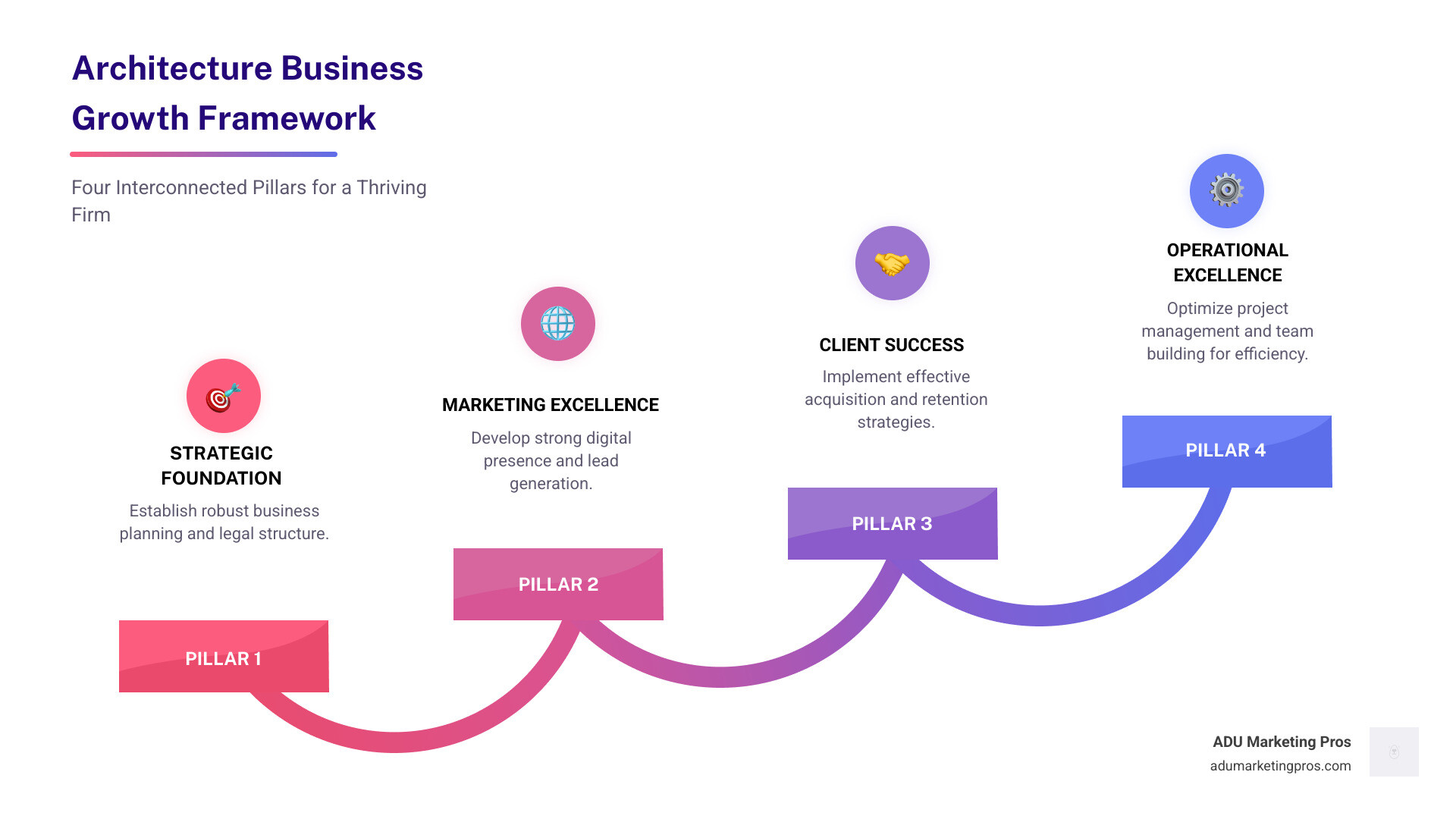
How to grow architecture business is about building a thriving enterprise, not just designing great buildings. The path to success rests on four pillars: a solid Strategic Foundation, smart Marketing Excellence, strategic Client Acquisition, and optimized Internal Operations.
The architecture services market is projected to grow at a 4.8% compound annual growth rate through 2030, but this growth will flow to firms that accept the shift from designer to business leader. This means getting comfortable with digital marketing, nurturing client relationships, and continuously refining your processes.
Growth is a continuous process of adaptation and learning. The firms that thrive are those that stay agile in an evolving market. For ADU construction and architecture firms in California, standing out requires a specialized marketing approach that showcases your unique value and expertise.
At ADU Marketing Pros, we understand these challenges. Based in San Jose and serving the entire Bay Area, we specialize in helping ADU firms attract high-quality leads and grow revenue by emphasizing expertise over price. Our approach is custom to the unique dynamics of the California market.
Ready to take the next step in your firm’s growth journey? We’re here to help you transform your architectural vision into measurable business success. Learn more about generating high-quality construction leads and find out how we can help your firm dominate its niche.