

Navigating the Core California ADU Zoning Laws for Homeowners
California ADU zoning laws govern where, how, and what type of accessory dwelling units can be built on residential properties across the state. For homeowners, understanding these regulations is no longer just a matter of local curiosity; it is a vital component of property management and wealth building in the 21st century. California has undergone a legislative revolution over the last decade, transforming from a state where “granny flats” were nearly impossible to permit into a national leader in housing flexibility. This shift is not merely about adding a room; it is about addressing a systemic housing shortage that has plagued the Golden State for decades.
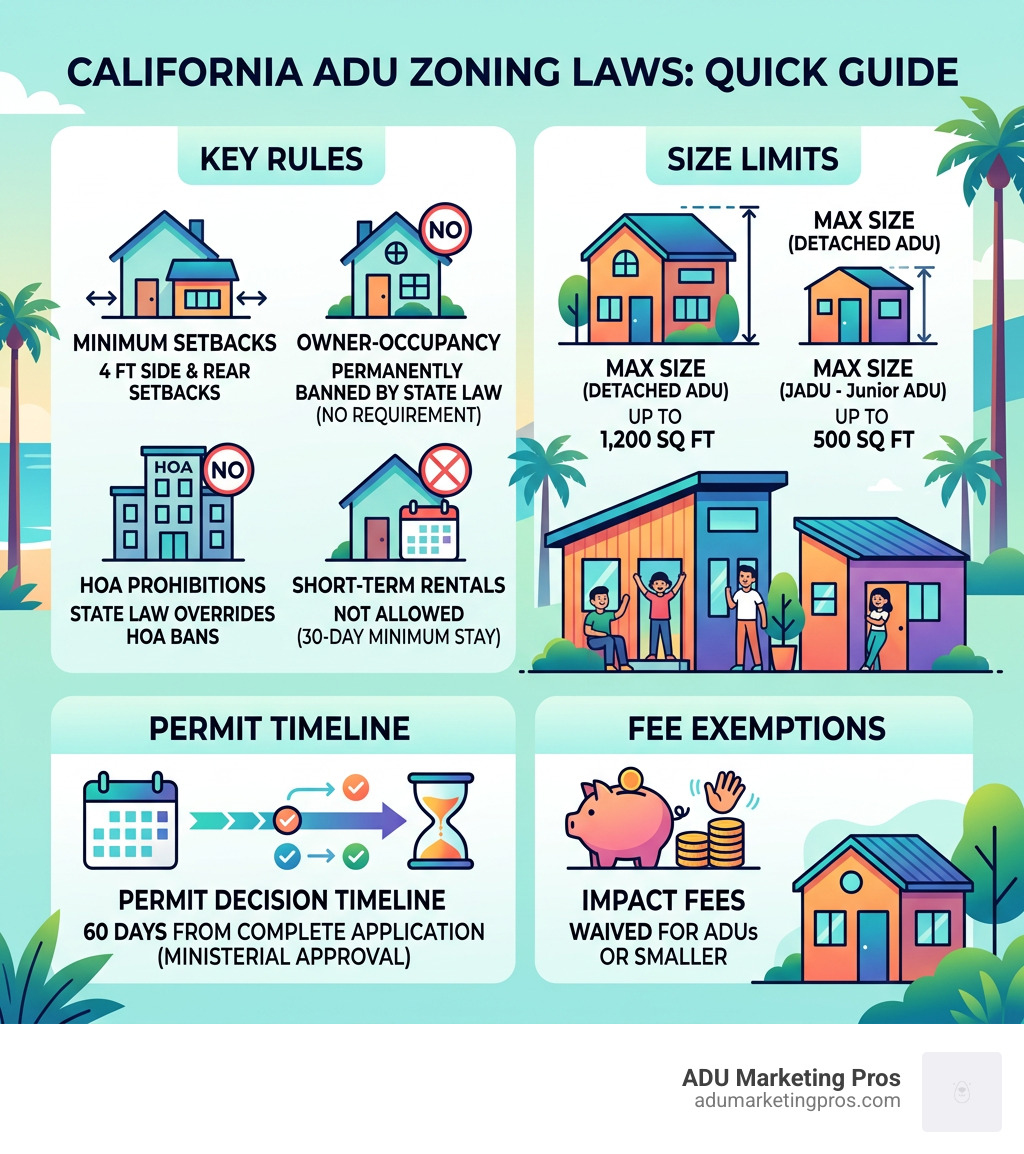
Quick Answer: Key California ADU Rules
| Rule | What It Means |
|---|---|
| Max size (detached ADU) | 1,200 sq ft |
| Max size (JADU) | 500 sq ft |
| Minimum setbacks | 4 ft side and rear |
| Permit decision timeline | 60 days from complete application |
| Impact fees | Waived for ADUs 750 sq ft or smaller |
| Short-term rentals | Not allowed (30-day minimum stay) |
| Owner-occupancy required? | No — permanently banned by state law |
| HOA prohibition allowed? | No — state law overrides it |
The Legislative Context: Why the Rules Changed
California is in the middle of a historic housing crisis, characterized by a severe shortage of affordable units and skyrocketing rents. The state has responded by making it dramatically easier to build ADUs. In fact, the number of ADUs permitted each year grew from just 1,336 in 2016 to 26,924 in 2023 — a 20-fold increase. By 2023, ADUs made up more than 21% of all new homes permitted statewide. This shift was driven by landmark bills like SB 1069 and AB 2299, which stripped local governments of their ability to use “discretionary review” to block projects.
Before these laws, local municipalities could use subjective criteria to deny permits, such as claiming an ADU didn’t match the “character” of a neighborhood. Today, the state has mandated a “Housing First” approach, recognizing that backyard cottages and garage conversions are the fastest way to add density without altering the fundamental footprint of suburban neighborhoods. This legislative momentum continues to build, with new bills passed every year to close loopholes used by cities to slow down production.
The Power of Ministerial Approval
Navigating California ADU Regulations can feel like trying to assemble IKEA furniture without the manual. Fortunately, the state has stepped in to provide a much-needed “cheat sheet.” The most important thing to understand is that california adu zoning laws are now largely dictated by the state, not your local city council.
Under the current framework, ADU applications are subject to ministerial approval. This is a fancy legal term meaning that if your project meets the “objective standards” (like size and setbacks), the city must approve it. They cannot subject you to a public hearing, a neighbor’s whim, or a “discretionary review” based on whether they think the ADU “fits the vibe” of the neighborhood. This removes the political element from the permitting process, ensuring that if you follow the rules, you get your permit. This process is designed to be as predictable as a building code inspection rather than a political debate.

State law takes precedence over local ordinances. If a city’s local ADU Zoning Laws are more restrictive than the state’s, those local rules are often considered null and void. The Official ADU Handbook issued by the Department of Housing and Community Development (HCD) serves as the ultimate authority on these protections, ensuring that homeowners in cities like San Jose, Los Angeles, and San Francisco aren’t blocked by outdated local red tape. The HCD actively monitors local ordinances and has the power to decertify a city’s housing element if they fail to comply with state ADU mandates.
ADU vs. JADU: Understanding the Definitions
Before you start digging, you need to know exactly what you’re building. There are two main flavors: the standard Accessory Dwelling Unit (ADU) and the Junior ADU (JADU).
- Accessory Dwelling Unit (ADU): This is a full, independent living unit. It has its own kitchen, bathroom, and entrance. It can be detached (a backyard cottage), attached to the main house, or a conversion of an existing space like a garage. ADUs can be up to 1,200 square feet and can be built on both single-family and multifamily lots. They are considered independent residences for the purposes of utility and safety codes.
- Junior ADU (JADU): These are smaller, capped at 500 square feet, and must be contained entirely within the walls of a single-family residence. Think of a converted spare bedroom or an attached garage. Crucially, a JADU can share a bathroom with the main house, though it must have its own “efficiency kitchen” (which includes a sink, a cooking appliance, and a food preparation counter). JADUs are often the most cost-effective way to create a rental unit because they utilize existing infrastructure.
| Feature | ADU | JADU |
|---|---|---|
| Max Size | 1,200 sq ft | 500 sq ft |
| Location | Attached, Detached, or Conversion | Internal to Primary Home |
| Bathroom | Must be private | Can be shared with main house |
| Kitchen | Full kitchen | Efficiency kitchen |
| Owner Occupancy | Not required | Required (if sharing sanitation) |
Eligibility and Property Requirements
In the past, you needed a massive lot to build a second home. Today, almost any residentially zoned property in California is eligible. Whether you own a single-family home or a multifamily property (like a duplex or apartment building), you likely have the right to add units. Even properties in “non-residential” zones that allow for residential use are often eligible under the latest state guidance. This includes mixed-use developments where residential units are a permitted use.
If you are unsure of your property’s potential, you can Check here to decide if an ADU is right for you. For those in areas like San Diego, you can use your Assessor’s Parcel Number (APN) to run a Property Summary Report to verify your specific zoning and lot details. Generally, if your lot allows for residential use, the state wants to help you build. This includes properties with existing non-conforming uses or those located in high-density urban centers. Even if your property is located in a fire hazard zone or a flood plain, you still have the right to build an ADU, though you may be subject to specific safety-related construction standards.
Development Standards: Size, Height, and Setbacks
When it comes to the physical footprint of your unit, ADU Size Restrictions are much more generous than they used to be. The state has set “floors” that cities cannot drop below, ensuring you aren’t forced to build a “dwelling unit for ants.” These standards are designed to maximize the utility of the land while maintaining a degree of neighborhood consistency. By standardizing these rules, California has effectively created a statewide building envelope that local planners cannot shrink.
Maximum Size Limits Under California ADU Zoning Laws
Under california adu zoning laws, the maximum size for a detached ADU is 1,200 square feet. However, local cities do have some wiggle room to set their own limits, provided they don’t go below certain thresholds. This is where the “850/1,000 Rule” comes into play, which acts as a safeguard for homeowners.
- The 850/1,000 Rule: A city cannot limit an ADU to less than 850 square feet for a studio or one-bedroom unit. If the ADU has two or more bedrooms, the city must allow at least 1,000 square feet. This prevents cities from effectively banning families from living in ADUs by restricting them to tiny studio sizes. It ensures that ADUs can serve as true multi-generational housing solutions.
- Attached ADUs: If you are attaching the ADU to your main house, the size is typically capped at 50% of the primary dwelling’s square footage, up to that 1,200-square-foot limit. However, the city must still allow at least an 800-square-foot unit regardless of this percentage. This “800-square-foot floor” is a critical protection for owners of smaller primary homes.
- The “State-Exempt” 800: This is the most powerful tool for homeowners. Regardless of lot coverage, floor area ratio (FAR), or open space rules, cities must allow at least one detached ADU of up to 800 square feet with 4-foot setbacks. This means even if your main house already uses up all the “allowed” square footage on your lot, you can still build an 800-square-foot ADU. This rule effectively overrides local zoning density limits.
For a deeper dive into these dimensions, check out our guide on How Big Can an ADU Be in California.
Height and Setback Requirements
Gone are the days of 10-foot rear setbacks that killed backyard projects. Today, the standard is a 4-foot side and rear setback. This allows homeowners to tuck units into the corners of their lots, preserving backyard space for other uses. If you are converting an existing structure (like a garage on the property line), you generally don’t need any new setbacks at all, provided the structure is safe. This makes garage conversions one of the most popular and space-efficient ways to add a unit.
Height limits have also seen a significant boost to accommodate two-story units and ADUs over garages:
- 16 feet: The standard base height for any detached ADU on a lot with a single-family home. This is usually enough for a single-story unit with a standard roof pitch.
- 18 feet: Allowed if the property is within a half-mile of major transit stops or high-quality transit corridors, or if the lot already has a multifamily building that is at least two stories. This extra two feet is crucial for allowing pitched roofs or slightly higher ceilings, which can make a small space feel much larger.
- 25 feet: The limit for attached ADUs (or the height limit of the underlying zone, whichever is lower). This allows the ADU to match the height of the primary residence in many cases, facilitating two-story additions that blend seamlessly with the original architecture.
Lot Coverage and Floor Area Ratio (FAR)
One of the most common ways cities used to block ADUs was through “Lot Coverage” or “Floor Area Ratio” (FAR) limits. For example, if a city said only 40% of a lot could be covered by buildings, and the main house already covered 39%, the homeowner was stuck. Current state law overrides these local limits. As long as the ADU is 800 square feet or smaller and maintains 4-foot setbacks, the city cannot use FAR or lot coverage to deny the permit. This is a massive win for homeowners with smaller lots in dense urban areas like Oakland or Los Angeles, where every square foot of land is at a premium.
Parking, Utilities, and Impact Fee Exemptions
Parking used to be the “poison pill” for ADU projects. If a city required two off-street parking spaces for a new unit, most small backyards simply couldn’t comply without destroying all green space or incurring massive costs for new driveways. Today, ADU Parking Requirements have been largely neutralized by state intervention, recognizing that ADU tenants often rely on transit or shared mobility.
Parking Mandates and Transit Exemptions
While the base rule is one parking space per ADU, you are exempt from providing any parking if your project meets any of the following criteria:
- Transit Proximity: You are within a half-mile walking distance of public transit (including bus stops and train stations). This covers the vast majority of urban and suburban California.
- Historic Districts: The ADU is located within an architecturally or historically significant district where adding parking would mar the aesthetic.
- Existing Space: The ADU is part of the existing primary residence or an existing accessory structure (like a garage conversion).
- Permit Zones: You live in an area where on-street parking permits are required but not offered to the occupant of the ADU.
- Car-Share: There is a car-share vehicle (like Zipcar) located within one block of the ADU.
Furthermore, if you convert your garage into an ADU, the city cannot force you to replace that “lost” parking. This is a massive win for homeowners in dense areas like San Francisco or Los Angeles. You can learn more about these specifics in our summary of ADU Building Requirements.
Navigating Impact Fees and School Fees
Building a home usually comes with heavy “impact fees” to pay for parks, roads, and sewers. These fees can often exceed $20,000, making small projects financially unfeasible. However, California law provides a major financial break for ADU builders to encourage production and lower the barrier to entry:
- Under 750 sq ft: No impact fees allowed. Period. This makes the 749-square-foot ADU one of the most popular sizes in the state, as it maximizes living space while avoiding thousands of dollars in fees.
- 750 sq ft or larger: Impact fees must be charged proportionally to the size of the primary dwelling. For example, if the ADU is 50% of the size of the main house, the impact fees can only be 50% of what a new full-sized home would pay. This prevents cities from overcharging for small units.
- School Fees: Generally, if your ADU is under 500 square feet, you are exempt from school district developer fees. For units larger than 500 square feet, school districts can charge a fee, but it is usually capped at a few dollars per square foot. This is one of the few fees that still applies to mid-sized ADUs.
These exemptions can save you anywhere from $5,000 to $25,000 depending on your location and the size of your unit. For a full breakdown of what you might pay, see our article on ADU Permit Cost California.
Utility Connections and Separate Meters
Utility requirements vary depending on whether the ADU is a conversion or new construction. For JADUs and ADUs converted from existing space, the city cannot require a new or separate utility connection unless the unit was constructed with a new primary dwelling. This significantly reduces plumbing and electrical costs. For detached ADUs, the local utility provider may require a separate connection, but the connection fee must be proportionate to the burden the ADU places on the system. You are not required to pay the same “capacity charge” as a new 3,000-square-foot mansion, ensuring that the infrastructure costs remain fair and manageable for the homeowner.
The Permitting Process and Ministerial Approval
The ADU Permit Process is designed to be fast and predictable. Once you submit a complete application, the city has a 60-day “shot clock” to approve or deny it. If they don’t act within that window, the application is technically “deemed approved” by operation of law. This prevents projects from languishing in bureaucratic limbo for months or years, a common tactic used by anti-growth municipalities in the past.
Streamlining Your Project with California ADU Zoning Laws
To keep things moving, the state has mandated that cities use ministerial review. This means no subjective design hurdles. Cities like San Francisco have even implemented a Permit Review Roundtable review process to ensure applications are handled efficiently. This roundtable brings together different departments (planning, building, fire) to resolve conflicts in real-time rather than passing the application back and forth for months.
By 2028, AB 920 will require larger jurisdictions (populations over 150,000) to provide centralized online portals. This will allow you to submit ADU Permits California and track their status in real-time, much like tracking a pizza delivery. This transparency is intended to hold planning departments accountable to the 60-day timeline and provide homeowners with peace of mind throughout the construction journey.
The Role of the HCD in Enforcement
If a city tries to block your ADU with illegal local rules, you have a powerful ally: the California Department of Housing and Community Development (HCD). The HCD has a dedicated ADU task force that reviews local ordinances for compliance. If a city’s rules are found to be non-compliant, the HCD can issue a notice of violation. If the city fails to correct the issue, the state can refer the matter to the Attorney General. This “top-down” enforcement is why so many cities have suddenly become “ADU-friendly” in the last few years; they simply cannot afford the legal risk of non-compliance.
Legalizing Unpermitted Units (AB 2533)
Do you have an “in-law suite” or a converted garage that was built years ago without a permit? AB 2533 is your new best friend. This law allows owners of unpermitted ADUs built before January 1, 2020, to legalize them without being penalized for minor building code violations, provided the unit meets basic health and safety standards. This is a form of amnesty designed to bring existing housing stock into the legal market.
Cities are prohibited from denying these permits unless there is a legitimate safety risk (like a fire hazard). This amnesty program is a huge opportunity to add value to your property, ensure the safety of your tenants, and bring “bootleg” units into the legal rental market. It also allows these units to be counted toward the state’s housing goals, creating a win-win for homeowners and the government. Legalization also makes it much easier to sell the property later, as unpermitted work can often derail a real estate transaction.
Pre-Approved ADU Plans
To further speed up the process, many cities (including Los Angeles, San Jose, and San Diego) now offer “Pre-Approved ADU Plans.” These are architectural designs that have already been vetted by the building department for safety and code compliance. If you choose one of these designs, your plan check process can be shortened from weeks to just a few days, and you can save thousands of dollars in architectural fees. These plans range from modern studios to traditional two-bedroom cottages, offering something for every aesthetic preference.
2025 and 2026 Legislative Updates: What’s Changing?
The landscape of New ADU Regulations California is constantly shifting. Staying on top of ADU Regulatory Updates is vital because the state is getting even more aggressive about enforcement and expanding the types of properties that can host ADUs. The goal is to remove every remaining friction point in the development process.
SB 543 and the 60-Day “Shot Clock”
One of the most significant updates is SB 543. Effective late 2025/early 2026, this bill tightens the screws on slow-moving planning departments to ensure the 60-day limit isn’t just a suggestion:
- 15-Day Completeness Check: Cities must tell you within 15 business days if your application is “complete.” They can no longer wait until day 59 to tell you that you forgot to sign a form. This forces early engagement from the city.
- Written Deficiency Lists: If an application is incomplete, the city must provide a full, exhaustive list of what’s missing. They are prohibited from coming back with “just one more thing” later in the process. This prevents the “death by a thousand cuts” approach to permitting.
- Private Plan Checkers: Under AB 253, if a city takes longer than 30 business days to review your permit, you may be allowed to hire a certified private plan checker to move the project forward, with the city required to accept their findings. This introduces competition into the permitting process, incentivizing cities to work faster.
Historic Districts and Coastal Zones
For a long time, being in a historic district or the Coastal Zone was an “automatic no” for ADUs due to endless environmental and aesthetic reviews. Not anymore. Under AB 1061, cities can only block ministerial approval if the specific house is individually listed as a landmark on a local, state, or federal register. Simply being inside a historic district is no longer enough to stop a backyard ADU. This opens up thousands of properties in older, established neighborhoods.
In the Coastal Zone, AB 462 now requires the Coastal Commission or local agencies to approve or deny ADU coastal permits within 60 days. This prevents projects from getting stuck in multi-year environmental reviews that were originally intended for large-scale developments, not small backyard cottages. It ensures that coastal residents have the same housing rights as those living further inland.
Multifamily ADU Expansion (SB 1211)
Recent legislation has also expanded the rights of multifamily property owners. Under SB 1211, owners of apartment buildings or duplexes can now build up to eight detached ADUs on a property with an existing multifamily dwelling, provided they meet the setback and height requirements. This is a massive opportunity for real estate investors to increase the density and cash flow of their existing portfolios without the need for a full redevelopment. It also allows for the conversion of underutilized spaces like carports or storage rooms into new housing units.
Separate Sale of ADUs (AB 1033)
Perhaps the most revolutionary change is AB 1033. This law allows local governments to opt-in to a program that lets ADUs be sold separately from the primary residence as condos. While not all cities have adopted this yet, it opens the door for a new type of “starter home” in California, where a homeowner can build an ADU and sell it to a first-time buyer while keeping their original home. This could fundamentally change the homeownership landscape in the state, providing a path to equity for those priced out of traditional single-family homes.
Frequently Asked Questions about California ADU Zoning Laws
Can I use my ADU for short-term rentals or sell it separately?
Generally, no. State law requires a 30-day minimum stay for ADU rentals to prevent them from becoming “de facto hotels” (Airbnbs). The goal of the ADU legislation is to create long-term housing for Californians, not vacation rentals. As for selling, ADUs usually must be sold with the primary house. However, as mentioned above, AB 1033 now allows cities to opt-in to a program that lets ADUs be sold separately as condos. You must check with your local planning department to see if your specific city has adopted this ordinance. If they haven’t, the ADU remains part of the property’s overall title.
Do I need fire sprinklers and separate utility hookups?
Fire sprinkler requirements are tied to the primary residence. If your primary house has fire sprinklers, your ADU must have them too. If your primary house doesn’t have them, the city cannot force you to install them in the ADU, regardless of the ADU’s size. This is a major cost-saving measure for owners of older homes. For utilities, you generally don’t need a separate meter for converted units or JADUs. For detached ADUs, a separate meter may be required by the utility provider, but the fees must be proportionate. For more technical details, see Information Bulletin 25-004.
Can my HOA or CC&Rs prohibit me from building an ADU?
No. Under AB 130, any HOA or CC&R provision that effectively prohibits or unreasonably restricts the construction of an ADU or JADU is void. While HOAs can have “reasonable” design guidelines (such as requiring the ADU to match the color of the main house), they cannot make the project so expensive or difficult that it becomes impossible to build. If your HOA is blocking your project, they are likely in violation of state law and could face legal action.
Are solar panels required on ADUs?
Under California’s Title 24 Building Standards, new detached ADUs are generally required to have solar panels. However, there are exceptions for units built in shaded areas where solar is not cost-effective. Conversion ADUs (like garage conversions) are typically exempt from the solar requirement because they are not considered “new construction” in the same way a detached unit is. This is an important distinction for budgeting, as solar can add $10,000 or more to a project’s cost.
Can I build an ADU if I have a septic system?
Yes, but you must prove that the septic system has the capacity to handle the additional load. If the existing system is too small, you may need to upgrade it as part of the ADU construction process. The city cannot, however, use the mere existence of a septic system as a reason to blanket-ban ADUs in your neighborhood. You will likely need a “septic certification” from a licensed professional during the permitting phase.
What is the “Owner-Occupancy” rule?
For many years, cities required the owner of the property to live in either the main house or the ADU. State law has now permanently banned owner-occupancy requirements for standard ADUs. This means you can rent out both the main house and the ADU to different tenants, making ADUs a powerful tool for real estate investors. Note that JADUs (Junior ADUs) may still have an owner-occupancy requirement if they share sanitation facilities with the main house, as they are considered more “integrated” into the primary residence.
Conclusion
Mastering california adu zoning laws is the first step toward unlocking the massive potential of your property. Whether you’re looking to house an aging family member, provide a home for a returning college graduate, generate consistent rental income, or significantly increase your home’s resale value, the current legal climate has never been more favorable for homeowners. The shift from local control to state-mandated standards has leveled the playing field, ensuring that your right to build is protected from local bureaucracy. This is a unique window of opportunity where the state is actively removing barriers that have existed for generations.
As the state continues to refine these laws through 2025 and 2026, the process will only become more streamlined. The introduction of the 60-day shot clock, the elimination of parking requirements, and the waiving of impact fees for smaller units have removed the most significant barriers to entry. We are witnessing a fundamental change in how California approaches housing, moving toward a more flexible, decentralized model that empowers individual property owners to be part of the solution to the housing crisis.
At ADU Marketing Pros, we specialize in helping the firms that build these units stand out in a crowded market. From our base in San Jose, we track every legislative update to ensure the architects, builders, and developers we work with are always ahead of the curve. If you are a professional in the ADU space, we can help you turn this complex regulatory knowledge into a powerful marketing engine that attracts high-quality leads and builds trust with homeowners.
For more information on the latest ADU California Regulations or to learn More info about ADU marketing services, reach out to us today. The housing future of California is being built in backyards — make sure you’re a part of it and that your business is positioned to lead the way!