
What Makes Junior Accessory Dwelling Units California’s Smartest Housing Solution
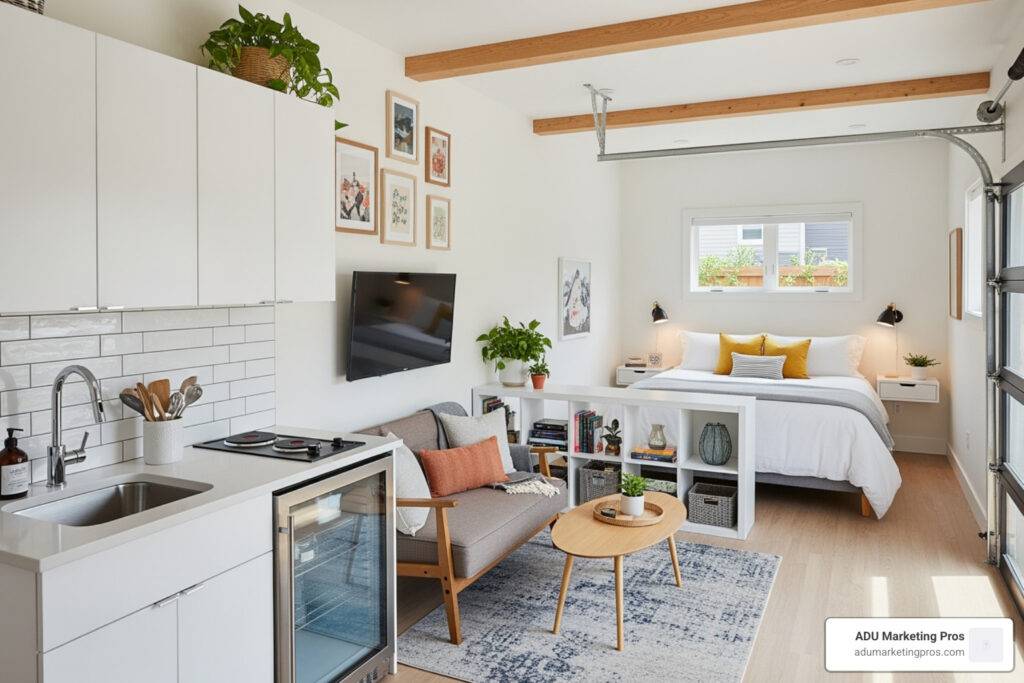
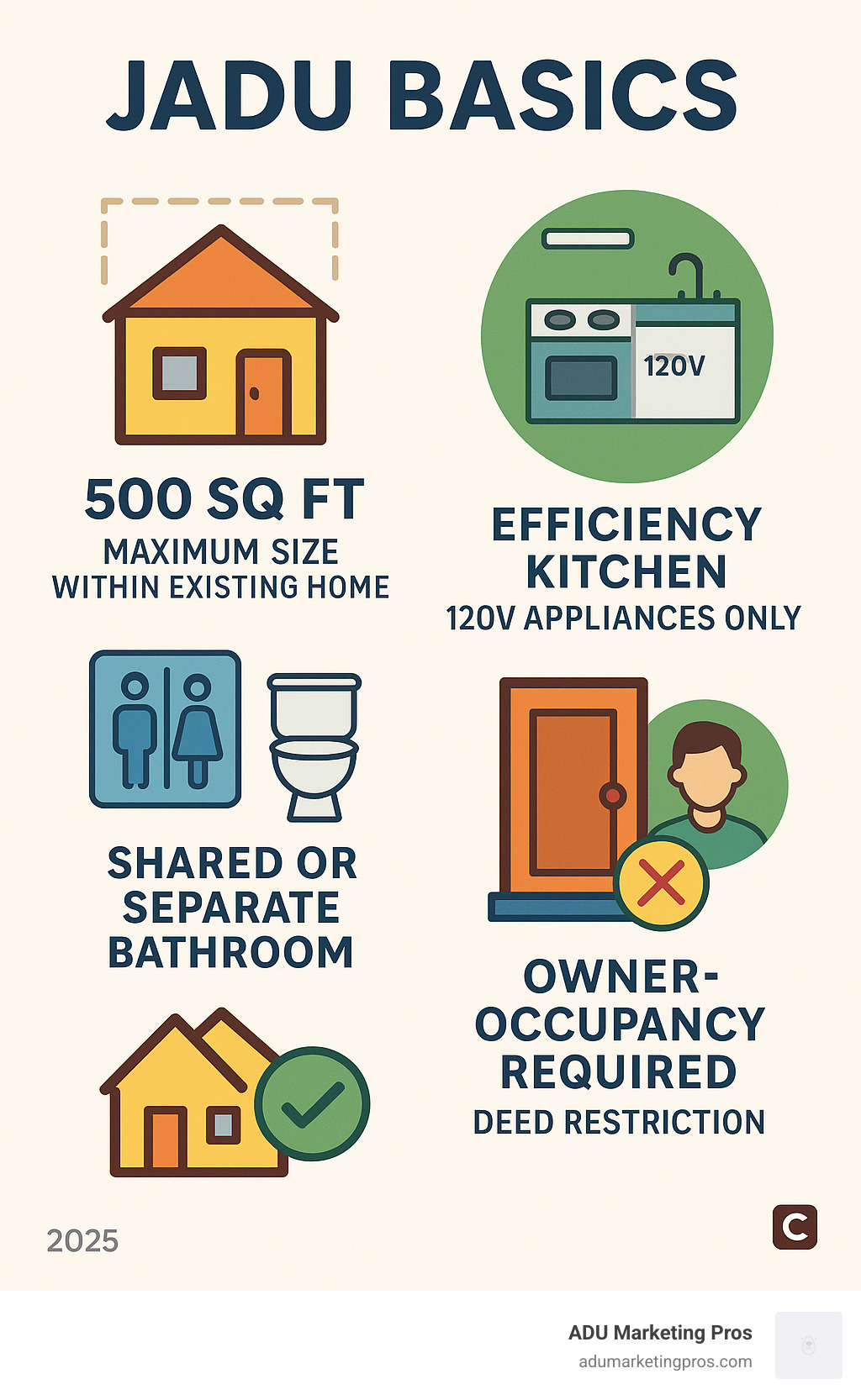
In the ongoing effort to solve California’s housing affordability crisis, a powerful and often overlooked solution has emerged: the junior accessory dwelling unit (JADU). More than just a spare room, a JADU is a legally distinct living space, carefully defined by state law as being up to 500 square feet and created entirely within the existing, fully enclosed footprint of a single-family home or its attached garage. This innovative housing option represents a form of “gentle density,” adding much-needed rental units to established neighborhoods without altering their character or straining infrastructure.
A JADU must have its own separate exterior entrance, a key feature that provides privacy for both the occupant and the main household. While it can share bathroom facilities and utilities with the primary residence to reduce costs, it must contain its own efficiency kitchen. This compact food preparation area is limited to 120V appliances, a small sink, and minimal counter space. Critically, the property owner must live on-site in either the primary residence or the JADU, a requirement enforced by a deed restriction that ensures these units are managed by on-site homeowners rather than absentee landlords.
The JADU’s Role in California’s Housing Ecosystem
California’s housing crisis is a well-documented challenge, with median home prices and rents soaring to levels that are unattainable for a large portion of the population. JADUs directly address this by open uping the hidden potential within millions of single-family homes. They offer homeowners a practical way to generate significant rental income, house family members in an era of multi-generational living, or create flexible living and working space without the prohibitive costs and lengthy timelines of new construction.
A garage conversion into a JADU typically costs between $70,000 to $110,000, a fraction of the cost of a detached ADU, which can easily exceed $200,000 or $300,000. This lower financial barrier makes housing creation accessible to a broader range of homeowners. The construction timeline is also significantly shorter, with most projects completed in a swift 3-6 months. For homeowners, this translates into a faster path to generating $1,200 to $2,500 in monthly rental income, providing a home for adult children struggling with high rents, or creating a safe and independent space for elderly parents. This approach not only provides financial relief to the homeowner but also contributes a new, affordable housing unit to the community, helping cities meet their state-mandated housing goals as defined by the Regional Housing Needs Assessment (RHNA).
The Environmental and Community Benefits
Beyond the financial incentives, the JADU model offers substantial environmental advantages. By repurposing existing structures like garages or spare bedrooms, JADUs minimize the need for new materials, reduce construction waste, and avoid the carbon footprint associated with pouring new foundations and extensive site grading. This form of development is inherently sustainable, making use of existing infrastructure like roads, sewers, and water lines, preventing urban sprawl and preserving open space. It’s a smarter, more resource-efficient way to grow.
From a community perspective, JADUs add housing without the disruptive impact of large-scale apartment complexes. They integrate seamlessly into the fabric of a neighborhood, providing diverse housing options for teachers, students, young professionals, and essential workers who might otherwise be priced out. This fosters more inclusive, economically diverse communities where people can live near where they work.
Simple junior accessory dwelling unit word guide:
JADU vs. ADU: A Head-to-Head Comparison
For California homeowners looking to add a secondary living space to their property, the choice often comes down to a junior accessory dwelling unit (JADU) or a standard Accessory Dwelling Unit (ADU). While both create valuable housing, they are governed by different rules that significantly impact cost, complexity, and use. Understanding these distinctions is the first step in determining the right path for your budget, property, and long-term goals.
For homeowners exploring their options, our comprehensive California ADU Guidelines provide detailed information about regulations affecting both types of units.
Size, Location, and Structure
The fundamental difference lies in how and where each unit can be built. A junior accessory dwelling unit is defined by its efficiency and use of existing space. These units are strictly capped at 500 square feet and must be constructed entirely within the existing, fully enclosed walls of a single-family home or an attached garage. You are essentially repurposing an underused area—a large bedroom, a formal dining room, or the garage—into a self-contained living unit. This constraint is also its greatest cost advantage, as it eliminates the need for new foundations, exterior framing, and roofing.
Traditional ADUs offer far greater flexibility. They can be as large as 1,200 square feet, depending on local ordinances and the size of the primary dwelling. More importantly, they can be built in several configurations: as a detached backyard cottage, as an attached addition to the main house (a “bump-out”), or as a conversion of an existing garage or other accessory structure. While both a JADU and an ADU can be a garage conversion, an ADU conversion allows for more extensive structural changes and is not subject to the 500-square-foot limit.
Kitchen and Bathroom Facilities
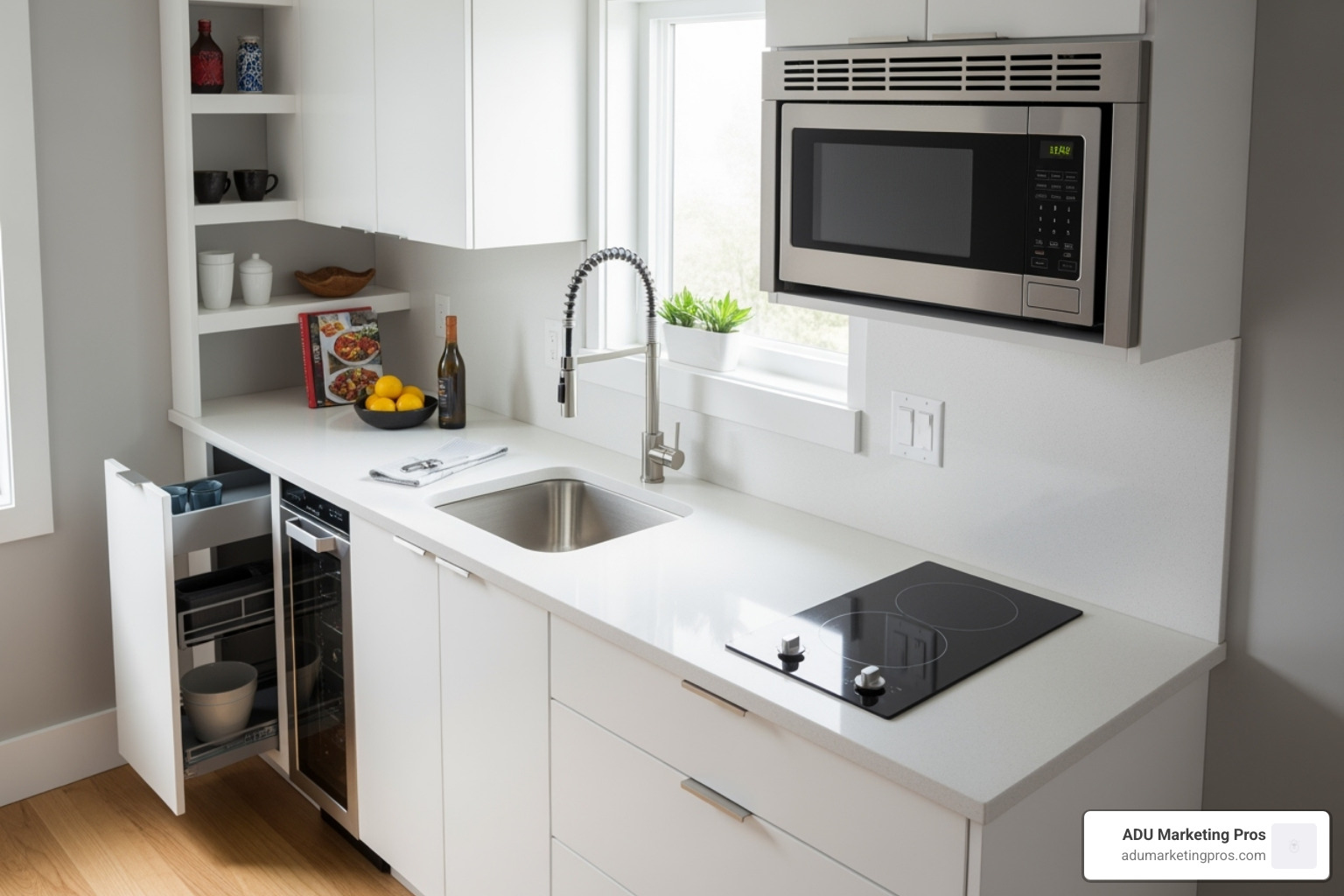
The kitchen is a major point of distinction. A junior accessory dwelling unit is limited to an “efficiency kitchen.” This is a compact setup that must include a small sink (with a maximum waste line diameter of 1.5 inches), a small food preparation counter, storage cabinets, and an electric-only cooking appliance (like a hot plate or microwave) that runs on a standard 120V outlet. No gas lines or 240V outlets for powerful ranges are permitted. This simplifies the electrical work and avoids the need for complex ventilation.
An ADU, by contrast, must have a full, independent kitchen with all the standard amenities, including a sink, cooking appliances, and refrigeration facilities, without the voltage restrictions of a JADU. In terms of bathrooms, a JADU can share a bathroom with the main house, provided there is an interior connection. This option can save tens of thousands of dollars by avoiding new plumbing, fixtures, and ventilation systems. Alternatively, a JADU can have its own bathroom. A traditional ADU, however, must always have its own separate, full bathroom.
Owner-Occupancy and Rental Rules
This is perhaps the most significant legal and lifestyle difference. A property with a junior accessory dwelling unit is subject to an owner-occupancy requirement. The property owner must reside in either the main house or the JADU. This is not a temporary rule; it is enforced through a deed restriction that is recorded with the county and remains with the property title, binding future owners as well. This ensures the JADU is part of an owner-occupied property and prevents it from being used in a purely speculative, absentee-landlord scenario. Furthermore, a JADU can never be sold separately from the primary residence.
For traditional ADUs, the landscape is different. Recent state law (AB 976) has, for the foreseeable future, banned cities from imposing owner-occupancy requirements on ADUs. This gives property owners much more flexibility, allowing them to rent out both the main house and the ADU while living elsewhere. This makes ADUs a more attractive option for pure real estate investors. Both unit types are intended for long-term housing and must be rented for periods of 31 days or more, precluding their use as short-term vacation rentals in most jurisdictions.
Cost, Construction, and Fees
Because a junior accessory dwelling unit is built within an existing structure and can share utilities, its cost is dramatically lower than that of an ADU. A JADU garage conversion typically runs $70,000 to $110,000. Architectural plans usually add $4,000 to $10,000. The timeline is also faster, generally taking 3 to 6 months from design to completion.
Traditional ADUs, especially detached new-construction units, are a much larger undertaking. They require a new foundation, separate utility trenching and connections, and full construction from the ground up. Costs for a detached ADU often range from $150,000 to over $300,000, with a timeline of 6 to 12 months or more. Another key financial difference is impact fees. State law waives impact fees for any accessory unit under 750 square feet. Since JADUs are capped at 500 square feet, they are always exempt from these fees, which can save thousands of dollars.
| Feature | Junior Accessory Dwelling Unit (JADU) | Accessory Dwelling Unit (ADU) |
|---|---|---|
| Max Size | 500 sq ft | Up to 1,200 sq ft (jurisdiction dependent) |
| Location | Within existing single-family home or attached garage | Detached, attached, or within existing structure |
| Kitchen | Efficiency kitchen (120V appliances, no gas/240V) | Full kitchen required |
| Bathroom | Can share with main house or have separate facilities | Must have its own separate, full bathroom |
| Owner-Occupancy | Required (owner must live in main house or JADU) | Not required by state law |
| Separate Sale | Not permitted; tied to primary residence via deed | Not permitted (except under AB 1033 if adopted by city) |
| Utility Meters | Can share with primary residence | Separate meters may be required, especially for new construction |
| Impact Fees | Exempt (under 750 sq ft) | Exempt if under 750 sq ft; otherwise may apply |
| Parking | No additional parking required | No additional parking usually required |
| Typical Cost | $70,000 – $110,000 (garage conversion) | $150,000 – $300,000+ (new construction) |
| Timeline | 3-6 months | 6-12+ months |
The Essential Guide to Building a Junior Accessory Dwelling Unit
Starting on a junior accessory dwelling unit project is one of the most practical and financially rewarding home improvements a California homeowner can undertake. The process is significantly more straightforward and less expensive than larger construction projects because it involves renovating an existing space rather than building from the ground up. Recognizing their potential, the state has actively worked to streamline the approval process, making it easier than ever to add a JADU. Our New ADU Regulations California guide offers the latest updates on these streamlined rules.
Unpacking the Benefits for Homeowners and the Community
These compact, 500-square-foot units deliver an outsized impact, creating a cascade of benefits for the homeowner and the wider community.
- Significant Financial Rewards: A JADU is a powerful engine for generating passive income. With typical rents ranging from $1,200 to $2,500 per month depending on the location and amenities, a JADU can cover its own construction costs in just a few years and provide a steady stream of income thereafter.
- Substantial Property Value Increase: Adding a legal, permitted, and income-generating living unit to your property directly boosts its market value. This is not just about adding square footage; it’s about adding functionality and an income stream, which is highly attractive to future buyers. Our ADU Return on Investment analysis demonstrates how these units build long-term wealth and equity.
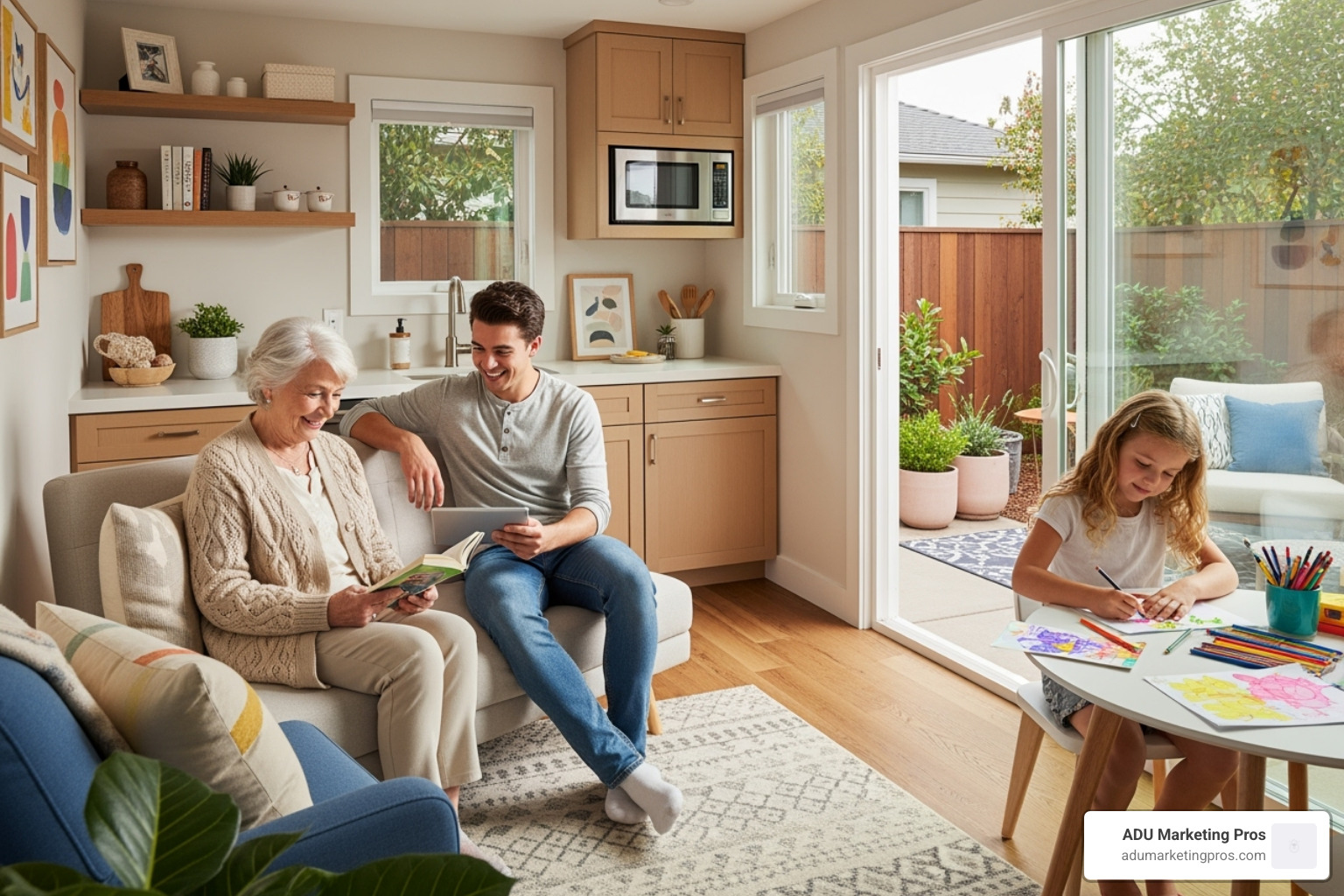
- Enabling Multi-generational Living: JADUs are an ideal solution for modern family dynamics. They provide a safe, private, and affordable home for aging parents who wish to remain close to family, or for adult children saving for their own home. This arrangement offers a perfect balance of togetherness and independence.
- Best Flexibility: The use of a JADU can evolve with your life. Today’s rental unit can become tomorrow’s home office, a dedicated art studio, a private gym, a classroom for homeschooling, or a comfortable guest house for visiting family and friends.
- A Tangible Community Contribution: Every single junior accessory dwelling unit adds a new home to California’s critically low housing supply. It does so in an organic, distributed way that avoids the negative impacts of large-scale development, helping to solve the housing crisis one garage conversion at a time.
What is the Typical Cost to Build a Junior Accessory Dwelling Unit?
Understanding the financial scope of a JADU project is crucial for planning. A junior accessory dwelling unit is remarkably affordable compared to any other form of new housing in California.
Garage conversions, which are the most common type of JADU, typically cost between $70,000 and $110,000. This all-in figure generally covers everything from initial demolition and site preparation to final finishes and appliance installation. A critical component of this budget is architectural plans, which will cost between $4,000 and $10,000. While it may be tempting to cut corners here, professional plans are a vital investment to ensure the design is efficient, compliant with all building and fire codes, and sails smoothly through the permitting process.
Costs can fluctuate based on several factors: the structural condition of the existing space (e.g., does the garage slab need repair?), the quality of finishes and fixtures you select, and regional labor and material costs. Even at the higher end of the range, a JADU remains significantly cheaper than a detached ADU, which often starts at $150,000 and can easily exceed $200,000. Our Garage Conversion to ADU guide provides a more detailed breakdown of costs for this popular option.
Financing Your JADU Project
Multiple financing avenues are available to make your junior accessory dwelling unit project a reality:
- Cash Savings: The most straightforward approach, allowing you to avoid interest payments and loan fees.
- Home Equity Lines of Credit (HELOCs): A popular and flexible option that lets you borrow against your home’s equity. You can draw funds as needed during the construction process and only pay interest on the amount you use.
- Cash-Out Refinance: This involves replacing your current mortgage with a new, larger one, and taking the difference in cash to fund the construction. It can be a good option if you can secure a lower interest rate.
- Construction/Renovation Loans: These are specialized loans like the FHA 203(k) loan, designed specifically for building projects. Funds are typically disbursed in stages (draws) as construction milestones are met and inspected.
- State Grants: The CalHFA ADU Grant Program is a game-changer for many. It provides up to $40,000 for eligible low- and moderate-income homeowners to cover pre-development and non-recurring closing costs, significantly reducing the out-of-pocket expense.
Our ADU Financing Options guide explores each of these financial tools in greater detail.
The Permitting and Construction Timeline
One of the most appealing aspects of a junior accessory dwelling unit is the accelerated timeline from concept to completion.
- Phase 1: Design & Planning (1-3 months): This is where you work with an architect or designer to create a set of construction-ready plans. This involves space planning, material selection, and ensuring the design complies with all state and local codes.
- Phase 2: Permitting (Under 60 days): California state law mandates that local agencies must approve or deny a JADU permit application within 60 days of receiving it. This ministerial, streamlined approval process prevents the long delays often associated with other types of construction.
- Phase 3: Construction (2-3 months): Because JADUs are conversions of existing, structurally sound spaces, the building process is much faster than for new structures. It involves stages like demolition, framing new interior walls, rough-in for plumbing and electrical, insulation, drywall, and finally, the installation of finishes and fixtures.
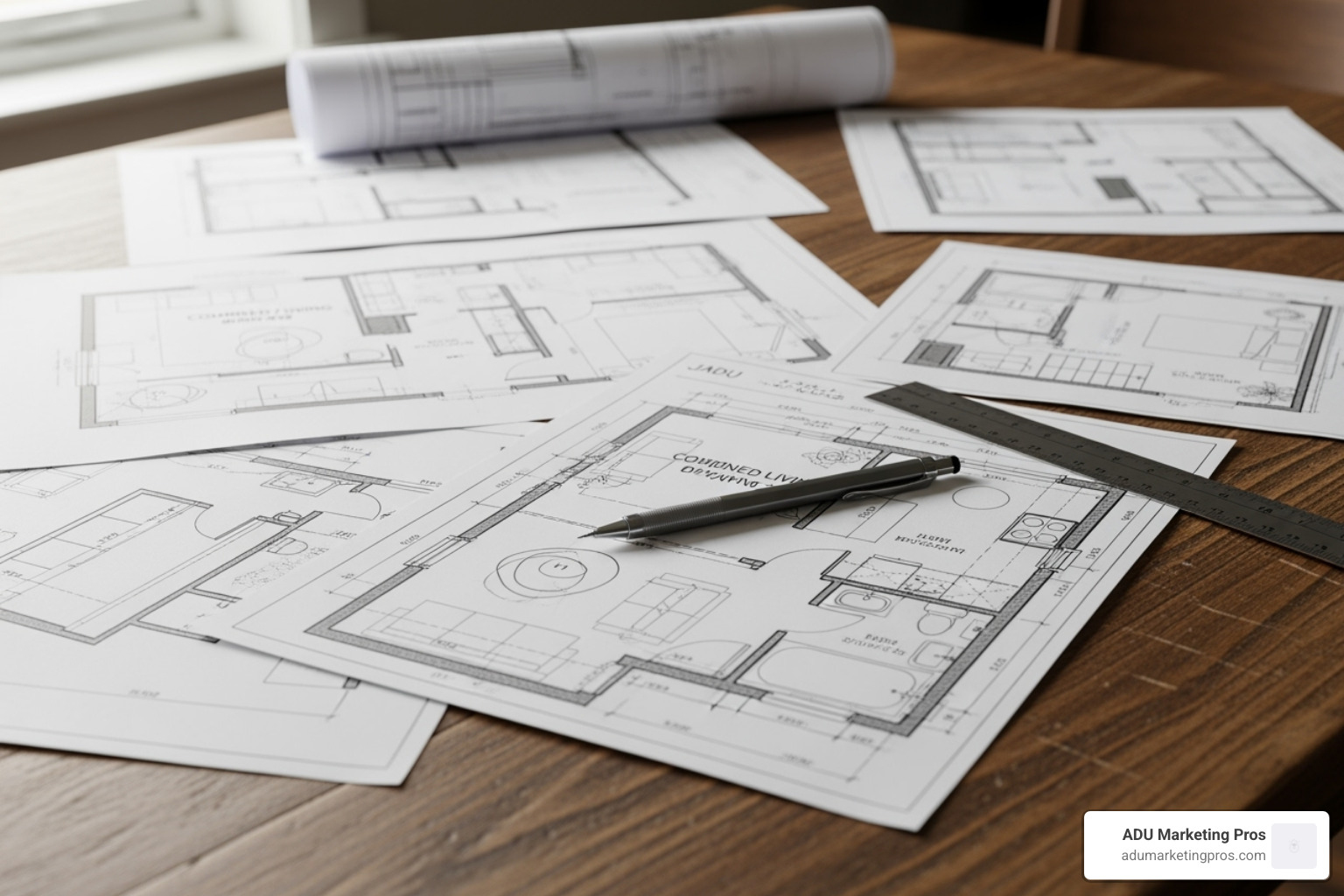
The total timeline from the first design meeting to the final inspection is typically just three to six months. This rapid turnaround means you can start seeing a return on your investment, whether through rental income or family use, in a remarkably short period. For more on navigating this stage, see our ADU Permit Process guide.
Navigating Legal, Financial, and Regulatory Problems
Building a junior accessory dwelling unit is a streamlined process, but it still requires careful navigation of state laws, local ordinances, and financial regulations. While California has laid a clear path for homeowners, understanding the key rules and potential problems upfront can prevent costly delays and ensure a smooth project from start to finish. For a broader look at how regulations affect your project, our ADU Zoning Laws guide provides excellent context.
Can Homeowners Associations (HOAs) Prohibit JADUs?
In short, no. California Civil Code Section 4751 explicitly states that any provision in an HOA’s governing documents (CC&Rs) that “effectively prohibits or unreasonably restricts” the construction or use of an accessory dwelling unit or junior accessory dwelling unit is void and unenforceable. Your HOA cannot legally ban JADUs outright.
However, HOAs can impose reasonable restrictions. These are rules that do not significantly increase the cost or make the project unfeasible. For example, an HOA may require the exterior paint color and roofing material of the JADU’s new entrance to match the primary home, or they may set limits on construction hours to minimize disruption to neighbors. They cannot, however, impose subjective requirements or demand design elements that would add substantial cost. If you encounter resistance, it’s important to know your rights under state law. Legal resources like those at FindHOALaw, a site run by a law firm specializing in HOA matters, can offer valuable insights.
How a Junior Accessory Dwelling Unit Impacts Property Taxes
Many homeowners fear that building a JADU will trigger a full reassessment of their property and lead to a massive tax hike. This is a common misconception. Thanks to California’s Proposition 13, your existing home’s assessed value is protected.
When you complete your JADU, the county assessor will perform a blended or supplemental assessment. This means they will only assess the value of the new construction. Your original property tax bill remains based on your home’s initial assessed value, plus any standard annual increases. A new, separate tax amount is calculated based only on the added value of the JADU. For example, if your home is assessed at $500,000 and the JADU is determined to have added $90,000 in value, your new total assessed value for tax purposes becomes $590,000. You only pay the ~1.1% property tax rate on that incremental $90,000, not on the entire $590,000. This makes the tax increase predictable and manageable. For specific local policies, it is always wise to check with your local assessor’s office, such as the LA County Assessor’s website.
Renting Your JADU and Key California Laws
A JADU can be a reliable source of rental income, typically fetching between $1,200 and $2,500 monthly. However, this comes with important legal obligations:
- Owner-Occupancy: As mentioned, you, the property owner, must live in either the main house or the JADU. This is a permanent requirement tied to the property’s deed.
- Long-Term Rentals Only: JADUs are intended to provide stable housing. State law requires a minimum rental period of more than 30 days. They cannot be used as short-term vacation rentals (like Airbnb or Vrbo).
- Landlord-Tenant Laws: When you rent your JADU, you become a landlord and must comply with all applicable California landlord-tenant laws regarding leases, security deposits, tenant rights, and eviction procedures.
It’s also important to understand how recent housing laws apply. AB 1033, a law that allows cities to opt-in to a program permitting the separate sale of ADUs like condominiums, does not apply to JADUs. They remain legally and financially tied to the primary residence. Other laws, like AB 434, encourage cities to develop pre-approved JADU and ADU plans, which can further streamline the design and permitting process for homeowners. The Official California ADU/JADU FAQ from the Department of Housing and Community Development provides comprehensive answers to detailed legal questions.
Do JADUs Count Towards Regional Housing Needs (RHNA)?
Yes, absolutely. Your junior accessory dwelling unit is more than just a home improvement project; it’s a direct contribution to solving your community’s housing shortage. JADUs meet the official US Census Bureau definition of a housing unit and are therefore counted by the state in official housing production statistics.
This is crucial because every city and county in California is assigned a certain number of new homes it must plan for under the Regional Housing Needs Assessment (RHNA). By building a state-compliant JADU, you are actively helping your city meet its mandated housing goals. This creates a positive feedback loop where cities are incentivized to make the JADU application process as efficient as possible, as each completed unit helps them fulfill their legal obligations. Your small project becomes an integral part of a much larger, statewide solution.
Frequently Asked Questions about JADUs
As homeowners explore the possibility of adding a junior accessory dwelling unit, many practical questions arise. Here are detailed answers to the most common inquiries we receive.
What are the exact requirements for a JADU “efficiency kitchen”?
An efficiency kitchen is specifically defined by state law to ensure it is functional yet limited in scope, which helps control construction costs and complexity. It must include:
- A sink with a maximum waste line diameter of 1.5 inches. This typically corresponds to a small bar-style sink, roughly 16″x16″.
- A cooking appliance that is electric only and does not require electrical service greater than 120 volts. This means you can use plug-in appliances like microwaves, hot plates, or toaster ovens, but not a full-size 240V electric range or cooktop.
- A small refrigerator, typically an under-counter or apartment-sized model.
- A food preparation counter and storage cabinets that are of a “reasonable size” in relation to the unit. The goal is functionality without creating a full-scale kitchen.
Can I build both a standard ADU and a JADU on my property?
Yes. California state law allows a property with a single-family home to have both one standard ADU and one junior accessory dwelling unit. This effectively allows a single-family lot to contain three separate households (the primary home, the ADU, and the JADU), creating a small, multi-unit property. This is a powerful tool for maximizing rental income or creating a family compound. However, the owner-occupancy rule for the JADU still applies. The property owner must reside in one of the three units on the property. This provides immense flexibility for multi-generational living or for homeowners who want to live in one unit while renting out the other two.
Is a separate utility meter required for a JADU?
No, and this is one of the most significant cost-saving advantages of a junior accessory dwelling unit. State law explicitly prohibits local agencies from requiring a separate utility meter for a JADU. It can share all utility connections—electricity, water, sewer, and gas (if applicable to the main house)—with the primary residence. This saves homeowners from the substantial expense of installing new meters and paying for new service connections, which can often cost tens of thousands of dollars. The homeowner can then choose to include the cost of utilities in the rent or use a submeter to bill the tenant for their share of usage.
Do I have to replace parking if I convert my garage to a JADU?
Generally, no. State law prohibits cities from requiring replacement off-street parking when a garage is converted into a JADU (or an ADU). This rule was created to remove a common and costly barrier to building these units. You are allowed to convert your garage into living space without having to build a new carport or parking pad elsewhere on your property. This holds true for nearly all properties, making garage conversions a universally viable option.
How does a JADU affect my homeowner’s insurance?
Once you build a JADU, you must inform your homeowner’s insurance provider. Your existing policy will need to be updated to reflect the new, permitted living space and its increased replacement value. This will likely result in a modest increase in your premium. It’s also highly recommended to require your tenant to obtain their own renter’s insurance policy. This protects their personal belongings and provides them with liability coverage, reducing your overall risk as a landlord.
Can I use a JADU as a short-term rental on a platform like Airbnb?
No. A junior accessory dwelling unit is intended to be part of the long-term housing stock. State law mandates that any rental agreement for a JADU must be for a term longer than 30 days. This restriction is in place to ensure these units help alleviate the housing crisis for residents, rather than serving the tourist market.
Start Your JADU Journey Today
From their remarkable affordability to their incredible flexibility, a junior accessory dwelling unit represents one of the most intelligent, accessible, and impactful housing solutions available to California homeowners. The benefits are tangible and immediate: generating a consistent rental income of $1,200 to $2,500 monthly, creating a safe and private space for multi-generational living, and adding significant, long-term value to your most important asset—your home.
The affordability of a JADU, with garage conversions typically costing between $70,000 and $110,000, places this opportunity within reach for a wide range of homeowners, offering a clear and rapid return on investment. Its inherent flexibility means the space can adapt to your changing needs over time; today’s home office can seamlessly become tomorrow’s rental unit, art studio, or guest suite. The compact 500-square-foot footprint challenges designers to be creative, resulting in highly functional, stylish, and beautiful living spaces that prove good things truly do come in small packages.
At ADU Marketing Pros, we specialize in bridging the gap between homeowners ready to open up their property’s potential and the skilled construction and architecture firms that can make it happen. Based in San Jose, we have a deep understanding of the California housing landscape and recognize that every junior accessory dwelling unit project is a unique reflection of a homeowner’s vision and goals.
Your Actionable Next Steps
The path from idea to a completed JADU is more straightforward than ever, thanks to streamlined state laws and clear regulations. The typical 3-6 month timeline means you can be enjoying your new space or collecting rental income in less than a year. Here’s how to get started:
- Define Your Primary Goal: Are you seeking rental income, a home for a family member, or a flexible workspace? Your goal will shape your design and budget.
- Assess Your Property: Identify the best location within your home’s existing footprint. Is it the attached garage, a large primary suite, or a combination of lesser-used rooms?
- Establish a Preliminary Budget: Research local costs and review your financing options, from HELOCs to the CalHFA grant program.
- Consult with Professionals: Reach out to experienced architects, designers, or design-build firms who specialize in JADUs. Their expertise is invaluable for navigating the process efficiently.
If you’re ready to take the next step, we can help connect you with the right professionals for your project. For those in the San Diego area, a great starting point is to Explore Pre-Approved ADU Plans in San Diego to see what’s possible. Your property’s change is waiting to begin.