
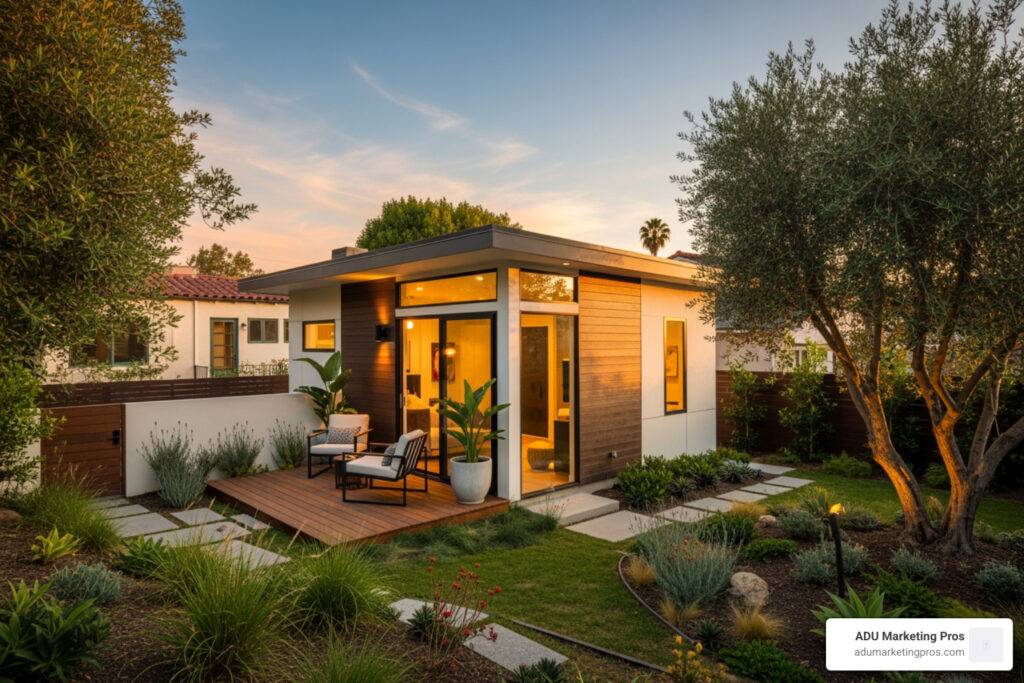
Why Understanding Accessory Dwelling Unit Cost Los Angeles Matters Before You Build
The accessory dwelling unit cost Los Angeles is a critical figure for any homeowner considering this popular addition, with typical all-in investments ranging from $100,000 to over $400,000. This wide spectrum reflects the diversity of options available, from budget-friendly garage conversions ($100k–$150k) to more complex attached ADUs ($175k–$325k) and premium detached new-build units ($200k–$400k+).
In a city grappling with a severe housing shortage, the State of California has streamlined regulations to encourage ADU development, making it a more viable option than ever. However, this accessibility can create a false sense of simplicity. Many homeowners are caught off guard when the initial contractor quote—the “hard cost” of construction—is only part of the story. The true total investment balloons once you account for “soft costs” like architectural plans, structural engineering, soil reports, and city permit fees, which can easily add $20,000 to $40,000 or more to the final bill.
Understanding this distinction between the quoted construction price and the true project cost is the first and most crucial step. Your final cost is a unique equation determined by the ADU type, size, level of finishes, and specific site conditions. A project on a flat, easily accessible lot will be vastly different from one on a challenging hillside property. Whether your goal is to generate rental income to combat the high cost of living, provide a home for aging parents, or simply boost your property’s value, a clear and realistic budget is the foundation of a successful and stress-free ADU project.
Understanding the Total Accessory Dwelling Unit Cost Los Angeles
The accessory dwelling unit cost Los Angeles is a complex calculation with many variables. While you might see headline figures for construction, a comprehensive, stick-built ADU project typically lands between $150,000 and $400,000, with some high-end custom builds exceeding $500,000. A reliable rule of thumb for initial budgeting in Southern California is to estimate an all-in cost of $300-$450 per square foot.
The “true cost” encompasses far more than just labor and materials. It includes essential “soft costs” like architectural design, structural engineering, and a gauntlet of city permits, which can collectively add $20,000 to $40,000+ to your budget before a single nail is hammered. The following table provides a generalized cost comparison to illustrate how these expenses accumulate for different project types:
| Cost Category | Garage Conversion ADU (Estimated Range) | Detached New Build ADU (Estimated Range) |
|---|---|---|
| Design/Plans & Permits | $10,000 – $21,000 | $15,000 – $37,000 |
| Site Preparation | $3,000 – $10,000 | $5,000 – $25,000 |
| Foundation | (Often existing) $0 – $10,000 | $15,000 – $30,000+ |
| Construction & Finishes | $80,000 – $140,000 | $170,000 – $330,000 |
| Utilities/Hookups | $5,000 – $15,000 | $10,000 – $30,000 |
| Contingency (10-15%) | $10,000 – $20,000 | $20,000 – $50,000 |
| Total Estimated Cost | $110,000 – $241,000 | $260,000 – $542,000 |
This table highlights why a simple cost-per-square-foot metric can be misleading. Fixed costs, such as the kitchen, bathroom, and utility connections, are required for any ADU, regardless of size. In a larger unit, these fixed costs are spread over more square footage, leading to a lower average cost per square foot—a principle known as “economies of scale.”
Average Accessory Dwelling Unit Cost Los Angeles by Type
The type of ADU you choose is the single most significant driver of your total project cost.
Garage Conversion ADU: The most budget-friendly path, leveraging an existing structure to keep costs between $100,000 and $150,000. You save on framing and foundation, but the budget must still cover significant structural upgrades (if needed), a new concrete slab (often required), full plumbing and electrical systems, insulation, and all interior finishes.
Attached ADU: Built as an addition to your primary residence, these units typically cost between $175,000 and $325,000. They require a new foundation and frame but can sometimes share utility lines or a wall with the main house, offering moderate savings over a detached unit.
Detached ADU (New Build): A standalone backyard home is the most expensive but also the most flexible and desirable option, especially for generating rental income. These ground-up projects range from $200,000 to $400,000+ and offer complete control over design, layout, and placement.
Junior ADU (JADU): The most affordable ADU type, a JADU is created within the existing footprint of your home and cannot exceed 500 square feet. Costs often range from $75,000 to $150,000. Savings come from minimal structural changes, lower permit fees, and the ability to share a bathroom with the main house (though an efficiency kitchen is required).
Prefab vs. Stick-built ADUs: The advertised price of a prefab ADU module ($50,000-$150,000) is highly deceptive. This price rarely includes crucial expenses like site preparation, foundation work, utility trenching and connection, crane rental for installation, and final assembly. These additional “site costs” can easily add another $50,000 to $100,000+, bringing the total cost into the same territory as a traditional stick-built ADU. While prefab can offer a faster construction timeline, it often comes with less design flexibility.
Cost Breakdown by ADU Size and Layout
Size and complexity are the next major cost drivers. While a larger unit costs more overall, its cost per square foot is often lower.
Studio ADU (400-500 sq ft): Perfect for a single person or as a guest suite, these compact units typically cost between $150,000 and $200,000. They require a full kitchen and bathroom, which are the most expensive rooms to build per square foot, keeping the overall cost relatively high for the small size.
One-bedroom ADU (600-800 sq ft): A popular choice for long-term rentals, a one-bedroom unit provides a more defined living space and may range from $200,000 to $275,000. This size often hits a sweet spot for rental income potential versus construction cost.
Two-bedroom ADU (800-1,200 sq ft): To maximize living space or rental income, a two-bedroom unit can cost between $275,000 and $400,000+. A full 1,200 sq ft ADU with higher-end finishes can easily exceed $400,000, especially if it includes complex design features.
Two-story ADU: Building up instead of out can preserve yard space but adds significant cost and complexity. Due to extra engineering, structural requirements, and construction labor, two-story ADUs often start at $350,000 and can quickly surpass $500,000.
Key Factors That Drive Your ADU Budget
To accurately forecast and manage your accessory dwelling unit cost Los Angeles, it’s essential to understand the specific line items that will shape your budget. These costs are broadly divided into pre-construction (soft costs) and construction (hard costs).
Pre-Construction: Design, Permits, and Fees
Before any ground is broken, you will invest in a series of “soft costs” for planning, engineering, and municipal approvals. These typically account for 10-15% of the total project budget.
- Design and Engineering: This is the blueprint for your project. Expect to pay between $8,000 and $20,000 for a full set of architectural plans and structural engineering. For complex designs, hillside properties, or two-story units, this can exceed $25,000. This phase also includes a Title 24 energy compliance report, which is mandatory in California.
- Permit Costs and City Fees: Navigating the city’s bureaucracy comes with a price. Permit costs in Los Angeles can range from $5,000 to over $15,000. This includes plan check fees, building permit fees, and potentially school and park impact fees. A major cost-saving advantage is that under state law, ADUs under 750 square feet are exempt from impact fees, which can save you thousands. For the most current fee schedules, it’s wise to Check official city guidelines at the LADBS page.
Construction: Labor, Materials, and Site Prep
The bulk of your budget (85-90%) will be allocated to “hard costs”—the physical labor, materials, and site work required to build the unit.
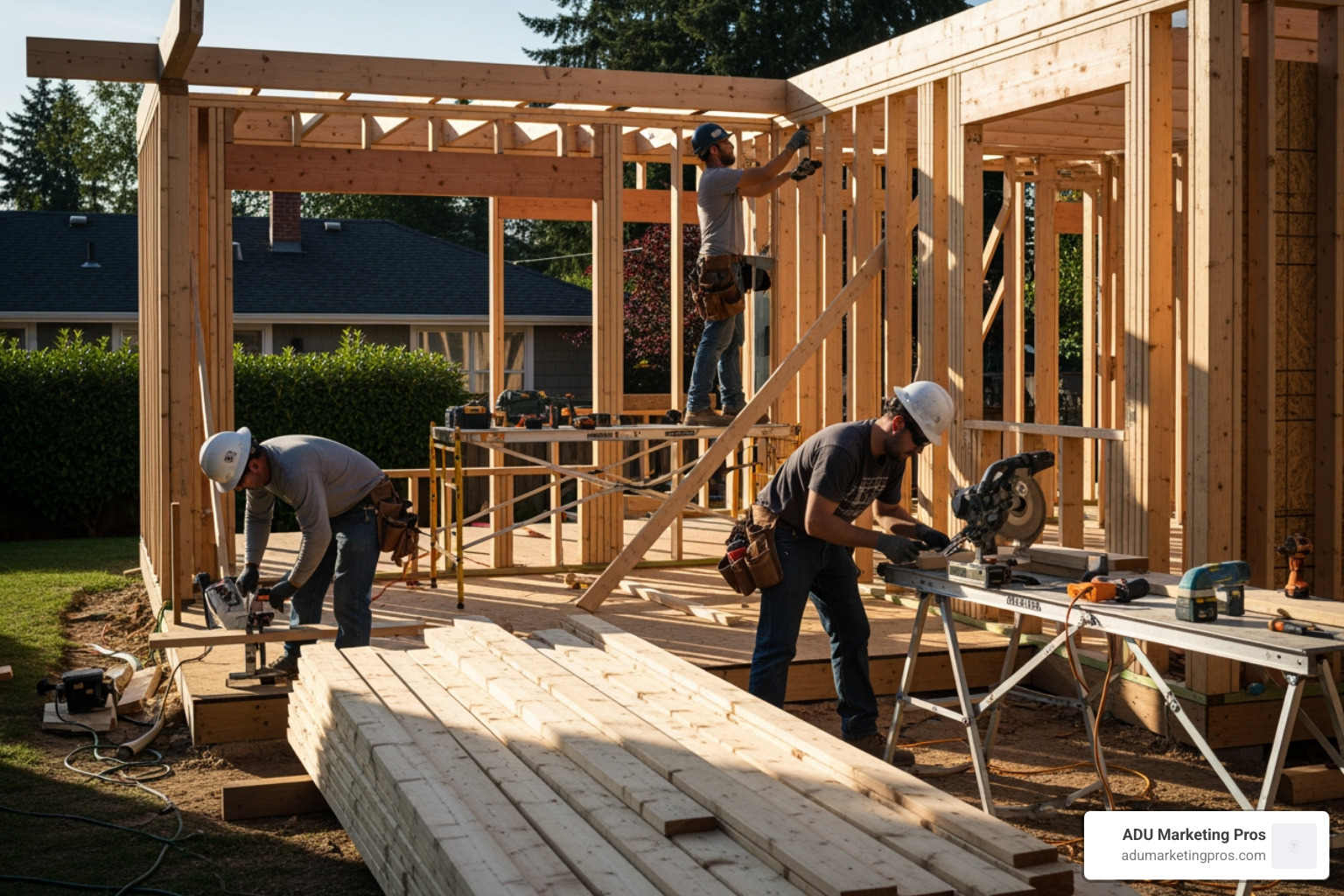
- Labor and Materials: Los Angeles is a high-cost labor market. The price of materials like lumber, concrete, wiring, and drywall can also fluctuate based on supply chain dynamics, directly impacting your budget.
- Site Preparation: This foundational step can cost anywhere from $5,000 to $25,000+. It includes demolition of existing structures, clearing vegetation, grading the land for proper drainage, and excavation for the foundation and utility lines.
- Foundation: A new reinforced concrete slab foundation for a detached ADU typically costs between $15,000 and $30,000. While a garage conversion may use the existing slab, it often requires significant repairs, reinforcement, or a new moisture barrier to meet code.
- Framing and Roofing: The structural skeleton (framing) for an average-sized ADU can cost around $25,000 to $40,000. A new roof will add approximately $10,000 to $15,000, depending on the material chosen (e.g., asphalt shingles vs. standing seam metal).
How Site Conditions Affect Your Accessory Dwelling Unit Cost Los Angeles
Your property’s unique characteristics can introduce significant costs that are not immediately obvious.
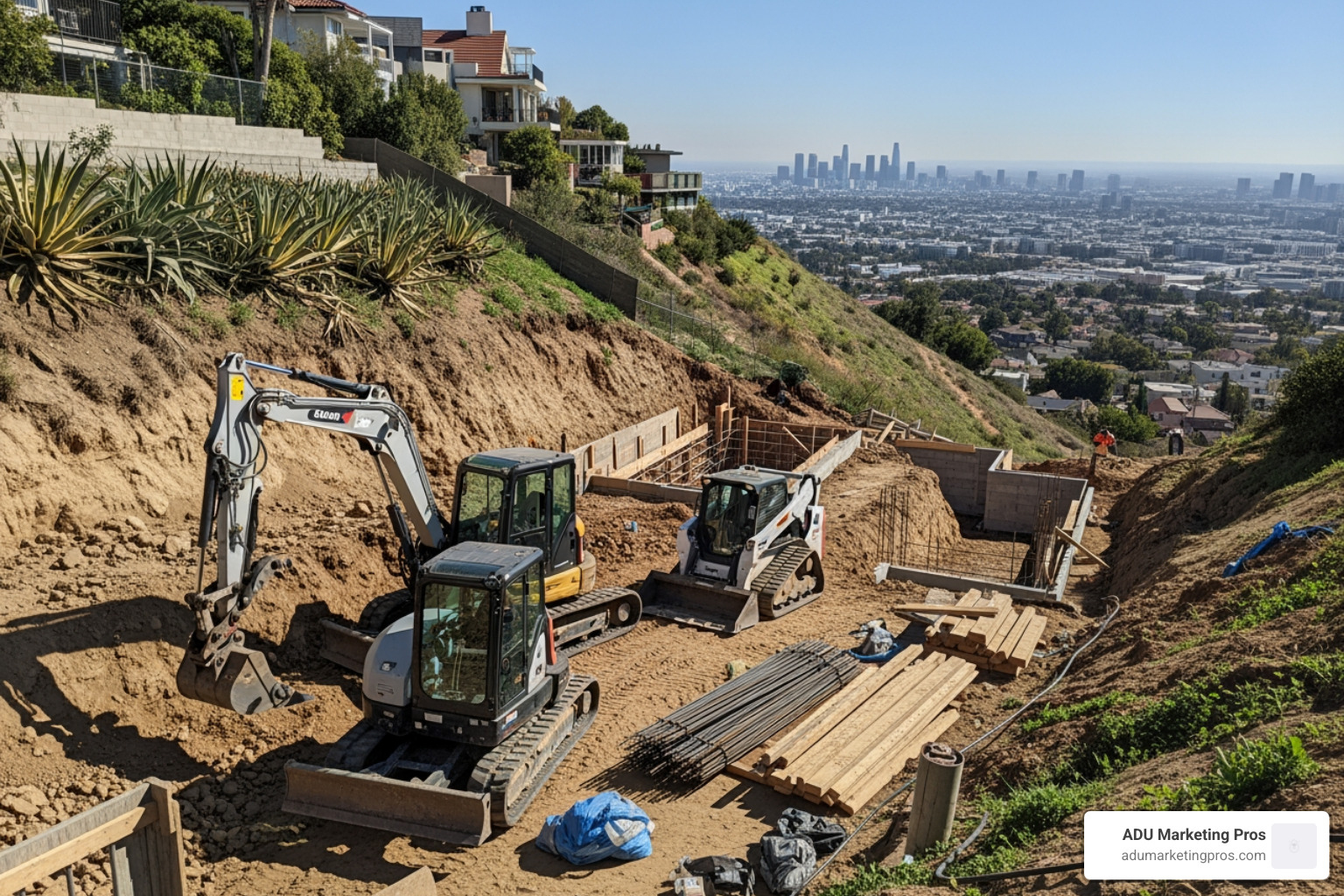
- Hillside Properties: Building on a slope is inherently more expensive. It requires extensive grading, excavation, and potentially costly retaining walls or caissons drilled deep into the bedrock for stability.
- Soil Conditions: Many jurisdictions, including Los Angeles, may require a soil report ($2,000-$4,000). If the soil is found to be unstable or expansive, the engineer will specify a more robust and expensive foundation design.
- Backyard Accessibility: If the build site is difficult to access, costs will rise. If heavy machinery like a mini-excavator cannot reach the site, tasks like excavation and concrete pouring must be done by manual labor, which is slower and more expensive.
- Utility Connections: The distance from the ADU to the main house’s utility hookups is a major cost factor. Longer trenching distances for water, sewer, gas, and electrical lines mean higher labor and material costs. A long or complex sewer line connection can be particularly costly.
Potential Hidden Costs to Budget For
Successful projects anticipate the unexpected. Always plan for these potential additional expenses.
- Utility Upgrades: If your home’s main electrical panel cannot handle the additional load of the ADU, it will need to be upgraded. This can cost $3,000 to $7,000 or more.
- Sewer Line Connections: Connecting to the main sewer line can be complicated. If the line is in the street, it may require traffic control and public works permits, adding thousands to the cost.
- Hazardous Material Abatement: In older garage conversions, there’s a risk of encountering asbestos or lead-based paint, which requires specialized and costly remediation.
- Landscaping and Hardscaping: Your budget should include funds for pathways, patios, fencing, and plants to properly integrate the new ADU into your property. This can range from a few thousand dollars to over $20,000.
- Contingency Fund (10-20%): This is the most critical part of your budget. Set aside at least 10-20% of your total estimated cost to cover unforeseen issues, material price increases, or design changes you decide to make mid-project. A healthy contingency fund prevents financial stress and project delays.
Financing Your ADU and Understanding the ROI
An ADU in Los Angeles is not just an expense; it’s a significant financial investment and a powerful wealth-building asset. A well-executed project can generate a new stream of rental income, often between $1,800 and $3,500+ per month depending on size and location. Furthermore, it can add substantial resale value to your property, often appraised at $200,000 to $400,000 or more. Because you are building on land you already own, an ADU offers a unique opportunity to leverage your existing assets for significant financial gain.
Common ADU Financing Options
Funding a project that can cost six figures requires careful financial planning. Fortunately, several strong options are available to homeowners:
- Home Equity Line of Credit (HELOC): This is one of the most popular methods. It functions like a credit card, allowing you to borrow against your home’s equity as needed. This flexibility is ideal for construction projects where costs are incurred over time. Interest rates are often variable.
- Cash-out Refinance: This involves replacing your current mortgage with a new, larger one and taking the difference in cash. It can be a good option if you can secure a lower interest rate than your current mortgage, but it does reset your loan term.
- Construction or Renovation Loans: These are short-term loans specifically designed for building projects. Funds are typically disbursed in stages (draws) after inspections confirm that work has been completed. They are then often converted into a traditional mortgage.
- Personal Savings: Using cash is the most straightforward method, as it avoids interest payments and loan fees. However, it’s crucial to ensure you retain a separate, healthy emergency fund.
- California ADU Grant Program: To spur development, the California Housing Finance Agency (CalHFA) offers a grant of up to $40,000 to reimburse pre-development and non-recurring closing costs for low- to moderate-income homeowners. Eligibility is tied to income limits and requires owner-occupancy. You can find detailed requirements on the California ADU Grant Program website.
Calculating the Long-Term Financial Benefits
To appreciate the full value of an ADU, you must look beyond the upfront cost to its long-term return on investment (ROI).
- Rental Income & Cash Flow: Research rental rates (on sites like Zillow or Apartments.com) for comparable units in your neighborhood. Let’s run a hypothetical scenario: A $250,000 one-bedroom ADU financed with a loan at 7% interest might have a monthly payment of around $1,660. If it rents for $2,400/month, your gross cash flow is $740. After setting aside 15% for property taxes, insurance, and maintenance ($360), your net positive cash flow is approximately $380 per month, or $4,560 per year—all while the tenant pays down your loan.
- Property Value Increase: An ADU adds permitted, functional square footage to your property, which is a primary driver of real estate value. In many LA neighborhoods, the value added by the ADU can meet or even exceed the cost to build it, resulting in an immediate equity boost.
- Multigenerational Living Savings: The financial benefits aren’t always direct income. Housing an aging parent in an ADU can save your family tens of thousands of dollars per year compared to the staggering cost of assisted living facilities. Similarly, it can provide an affordable home for an adult child saving for their own down payment.
Property Tax and Income Tax Implications
Building an ADU will affect your taxes, and it’s important to understand how.
- Property Taxes: Thanks to California’s Proposition 13, your entire property is not reassessed at its new, higher value. Instead, your property tax bill will be a “blended assessment.” Your original home remains taxed at its old value, and only the value of the new construction (the ADU) is added to the bill. This results in a modest, manageable increase rather than a shocking jump.
- Income Taxes: If you rent out your ADU, the income is taxable. However, you can also claim deductions for a portion of your property taxes, insurance, mortgage interest, and repairs. Most significantly, you can depreciate the value of the ADU structure over 27.5 years, creating a substantial “paper loss” that can offset your rental income and lower your overall tax burden.
Smart Strategies to Reduce Your ADU Cost
While the accessory dwelling unit cost Los Angeles can be high, strategic decisions during the design and construction phases can lead to significant savings without compromising the quality or functionality of your new unit.
Design and Layout Efficiencies
Complexity is expensive. A simpler, smarter design is the most effective way to control costs from the very beginning.
- Use a Simple Footprint: A basic square or rectangular shape is the most cost-effective to build. Complex angles, numerous corners, and curved walls require more materials, intricate framing, and significantly more labor, driving up costs.
- Align Plumbing and Utilities: Design the layout so that the kitchen and bathroom are back-to-back or stacked (in a two-story unit). This minimizes the length and complexity of expensive plumbing and ventilation runs.
- Stick to Standard Dimensions: Avoid high or vaulted ceilings, which increase costs for framing, insulation, and drywall. Likewise, design with standard window and door sizes in mind. Custom-ordered windows and doors are dramatically more expensive than off-the-shelf options.
- Consider Pre-Approved Plans: To save on design fees and potentially speed up the permitting process, investigate your city’s pre-approved ADU plans. While not a perfect fit for every lot, they can provide a cost-effective starting point, but be sure to verify that the plan works with your property’s specific topography and utility locations.
Cost-Effective Material and Finish Choices
High-impact savings can be found by choosing value-oriented materials that are durable, attractive, and budget-friendly.
- Exterior Siding: Stucco is a classic, durable, and one of the most affordable exterior finishes in Southern California. It’s less expensive than wood siding or brick veneer.
- Flooring: Instead of expensive hardwood, consider high-quality laminate flooring or Luxury Vinyl Tile (LVT). These modern alternatives are incredibly durable, water-resistant, and offer a wide range of realistic wood and stone looks at a fraction of the cost.
- Cabinets: Fully custom cabinetry is a major budget item. Opt for builder-grade cabinets or ready-to-assemble (RTA) options from stores like IKEA. They offer excellent value and can be customized with unique hardware for a high-end look.
- Countertops: While granite and quartz are popular, high-quality laminate or butcher block countertops can provide a stylish and functional surface for a much lower price point.
- Bathroom Surfaces: A one-piece Fiberglass tub surround is far more affordable and faster to install than custom tile work, saving on both material and labor costs.
Strategic DIY and Project Management
For homeowners with the time, skill, and willingness to get their hands dirty, “sweat equity” can be a significant cost-saver. However, it’s crucial to be realistic about your abilities.
- Good DIY Projects: Tasks like interior and exterior painting, landscaping, installing flooring, and assembling RTA cabinets are manageable for many handy homeowners.
- Leave it to the Pros: Electrical, plumbing, foundation, and framing work should almost always be left to licensed professionals. Mistakes in these areas can be dangerous, costly to fix, and will not pass city inspections.
- Act as Your Own Project Manager: If you are highly organized and have the time, you could act as your own general contractor, hiring and managing subcontractors directly. This can save you the 15-20% GC fee but is a demanding, full-time job that carries significant risk if you are inexperienced.
Frequently Asked Questions about ADU Costs in Los Angeles
Navigating the world of ADUs can bring up many questions. Here are answers to some of the most common queries about cost and process in Los Angeles.
How much does it cost to convert a garage into an ADU in Los Angeles?
A garage conversion is generally the most cost-effective ADU type, with a typical range of $100,000 to $150,000. The final price depends heavily on the existing garage’s structural condition, size, and your choice of finishes. While you save on building a new foundation and frame, the budget must still account for architectural plans, permits, potentially a new concrete slab, a full kitchen and bathroom, and all new utility systems (plumbing, electrical, HVAC).
How do prefab ADUs compare in cost to traditional stick-built ADUs in Los Angeles?
The initial advertised unit cost for a prefab ADU ($50,000-$150,000) can be misleadingly low. This price almost never includes essential site-specific costs like design, permits, site prep, foundation, utility connections, crane delivery, and final installation. These can add another $50,000 to $100,000+. When all costs are factored in, the total project price is often very similar to a stick-built ADU. The primary advantage of prefab is a potentially faster on-site construction timeline, not necessarily a lower total cost.
What is a realistic cost per square foot for a new ADU in Los Angeles?
A realistic all-in cost per square foot for a new detached ADU in Los Angeles is between $300 and $450. This comprehensive range should account for all hard costs (construction, labor, materials) and soft costs (plans, permits, fees). It’s important to remember that the cost per square foot is often higher for smaller units (under 600 sq ft) and lower for larger ones (over 1,000 sq ft), as expensive fixed costs like kitchens and bathrooms are spread over a larger area.
How long does the entire ADU process take in Los Angeles?
The timeline can vary significantly, but a realistic estimate is 9 to 18 months from start to finish. This can be broken into two main phases:
- Design & Permitting (4-8 months): This involves hiring a designer, completing architectural and engineering plans, and submitting them to the city for review and approval. The plan check process at LADBS can be lengthy.
- Construction (5-10 months): This phase begins after the permit is issued. The duration depends on the ADU type (garage conversions are faster), site complexity, and contractor efficiency.
What are the biggest mistakes homeowners make when building an ADU?
The most common pitfalls include:
- Hiring the Cheapest Contractor: Choosing a bid that is significantly lower than others often leads to poor quality, hidden upcharges, or an unfinished project.
- Not Having a Contingency Fund: Failing to budget 10-20% for unexpected costs is the single biggest cause of financial stress and project delays.
- Underestimating Soft Costs: Focusing only on the construction quote and ignoring the thousands needed for design, engineering, and permits.
- Poor Design: Rushing the design phase can result in an awkward layout that is less functional and has lower rental or resale value.
Conclusion
Embarking on an ADU project is a significant but ultimately rewarding investment for a Los Angeles homeowner. While the total accessory dwelling unit cost Los Angeles can seem daunting, ranging from a modest $100,000 for a simple garage conversion to over $400,000 for a custom detached home, a clear understanding of the financial landscape is the key to success. By recognizing the importance of soft costs, planning for site-specific challenges, and budgeting for a robust contingency fund, you can navigate the process with confidence.
The long-term benefits are compelling and multi-faceted. An ADU can provide a steady stream of rental income, a dramatic increase in your property’s value, and a flexible housing solution for family members in one of the nation’s most expensive housing markets. With careful planning, smart design choices, and the right professional team, your ADU can be a transformative addition to your home and your financial future. For construction and architecture firms aiming to lead in this dynamic market, ADU Marketing Pros offers specialized digital marketing strategies to connect with qualified homeowners. To learn more, explore our complete guide to building an Accessory Dwelling Unit Los Angeles.