
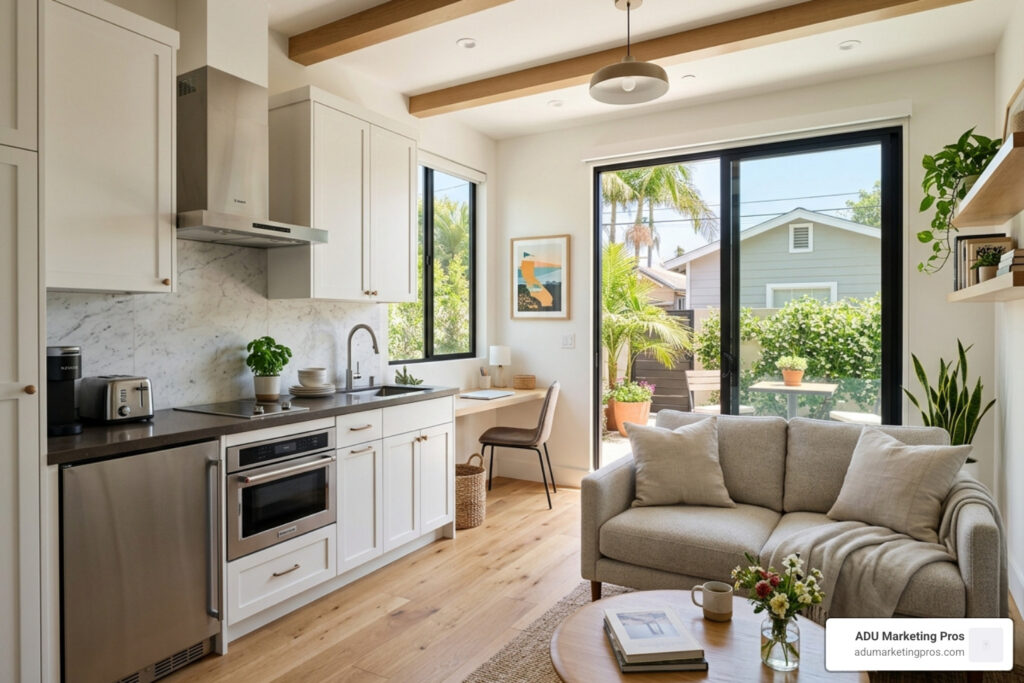
Why Every LA Homeowner Is Talking About the Junior ADU Right Now
The Evolution of the Los Angeles Housing Landscape
For decades, the “American Dream” in Southern California was defined by the single-family home on a sprawling lot. However, as we move through 2026, that dream has evolved. The reality of the Los Angeles housing market is one of scarcity, high demand, and skyrocketing costs. Homeowners are no longer just looking for a place to live; they are looking for ways to make their property work for them. This is where the Los Angeles junior ADU (JADU) has emerged as a revolutionary tool for urban density and financial independence.
A JADU is a secondary living unit of up to 500 square feet created inside an existing single-family home or attached garage. Unlike its larger cousin, the standard ADU, the JADU is designed to be a low-impact, high-efficiency conversion that utilizes the existing “envelope” of your home.
Quick Snapshot: What Makes a JADU Distinct?
| Feature | Junior ADU (JADU) |
|---|---|
| Maximum size | 500 sq ft (plus up to 150 sq ft for entry/hallway) |
| Location | Must be within the existing home or attached structure |
| Separate bathroom | Not required — can share with main home |
| Kitchen | Efficiency kitchenette only (120V, no gas) |
| Owner-occupancy | Required (in JADU or main home) |
| Permit timeline | Must be approved or denied within 60 days |
| Typical cost | $70,000 – $150,000 |
| Parking required | No |
Why the JADU is the “Smart” Choice in 2026
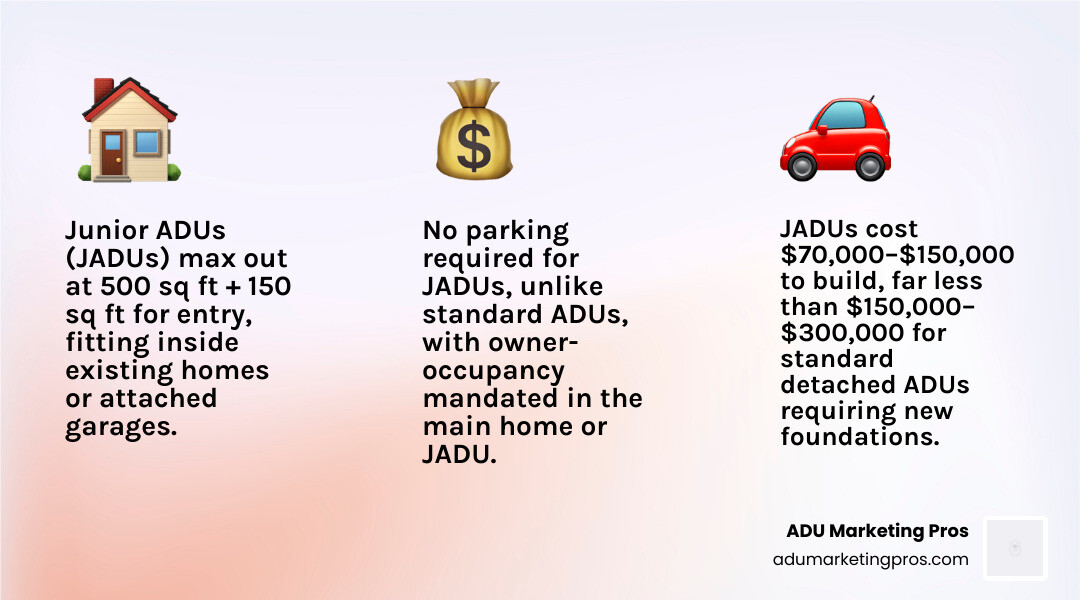
Los Angeles has a housing crisis that isn’t going away. Rents are high, lots are small, and homeowners are looking for ways to add value without breaking the bank. That’s exactly where JADUs come in. Unlike a full detached ADU — which can cost $150,000 to $300,000 and require new foundations, separate utilities, and more complex permits — a JADU works within what you already have.
Whether it is a spare bedroom, an attached garage, or an underused corner of your home, the JADU allows you to create a legal, rentable, livable unit that can bring in $1,200 to $2,500 per month in rental income. This income can be the difference between struggling with a mortgage and living comfortably. Furthermore, as of April 2026, California state law and the Los Angeles Municipal Code have made building a JADU more accessible than ever. But the rules are specific, and getting them wrong can mean costly delays or unpermitted work.
Understanding the Los Angeles junior ADU: Definitions and Legal Framework
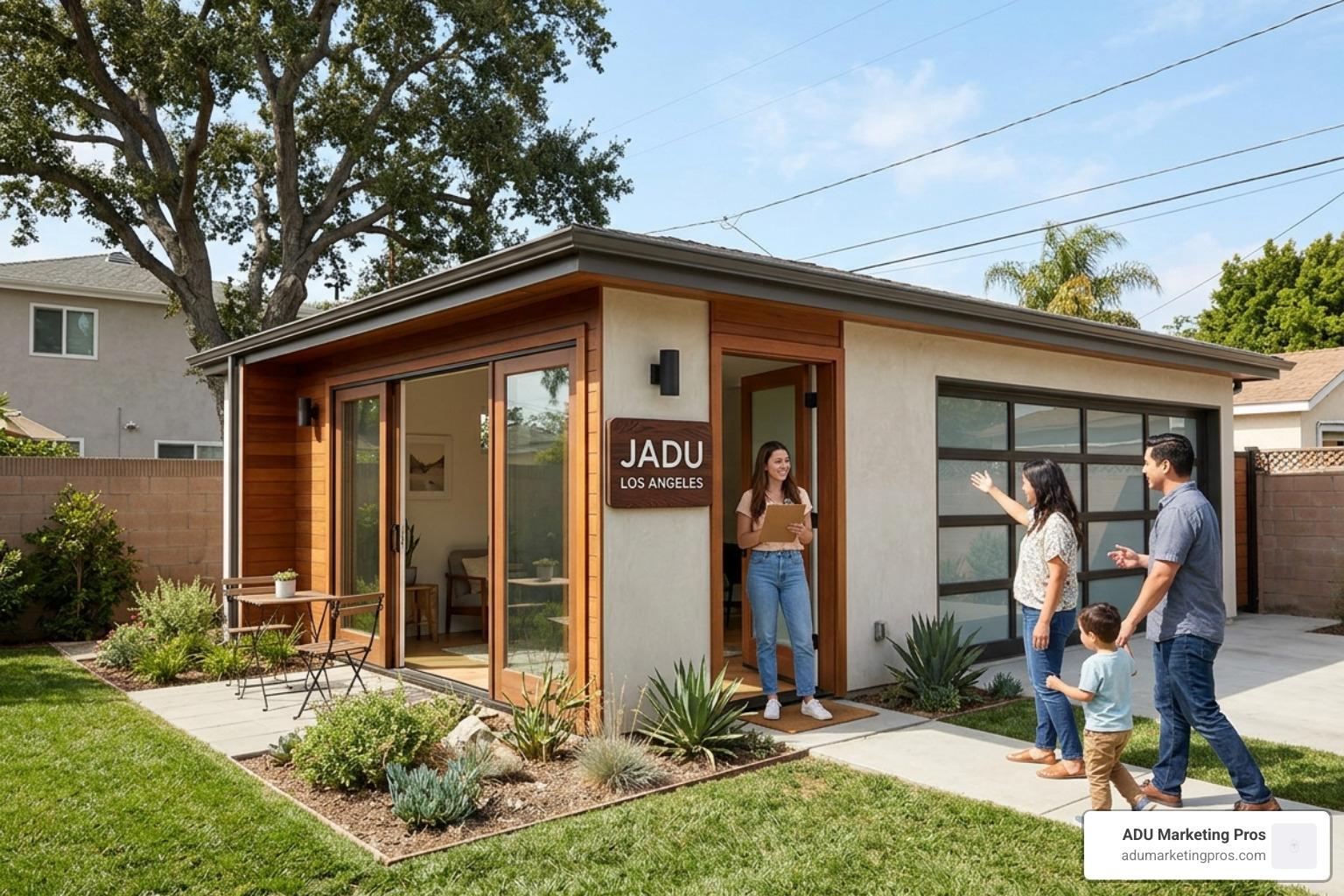
The Legal Backbone: State and Local Mandates
When we talk about a Los Angeles junior ADU, we aren’t just talking about a “guest room” or a “mother-in-law suite” in the casual sense. We are talking about a legally recognized housing unit defined by specific state and local laws. The legal backbone of the JADU movement lies in California Government Code Section 65852.22. Over the last few years, landmark legislation like AB 68 and AB 881 has stripped away the red tape that once made these units nearly impossible to permit.
Locally, the Los Angeles Municipal Code (LAMC) 12.22 A.33 provides the specific “how-to” for homeowners within city limits. Essentially, these laws mandate that if you meet the requirements, the city must allow you to build. This “ministerial” approval process means that as long as your plans meet the code, the city cannot subject you to subjective hearings or neighbor approval. For a deep dive into the broader regulatory landscape, check out Your Guide To Los Angeles Adu Regulations What You Need To Know. If you’re looking for professional help navigating these codes, Junior ADU Los Angeles: Design a Custom JADU With LADU offers specialized design services tailored to these exact standards.
Key Differences Between a JADU and a Standard ADU
The most common question we hear is: “Isn’t a JADU just a small ADU?” Not exactly. While both provide additional housing, the JADU has a much stricter “envelope.”
- Size Constraints: A JADU is capped at exactly 500 square feet. A standard Accessory Dwelling Unit Los Angeles can often go up to 1,200 square feet and can be a completely separate building in your backyard (detached).
- Structural Integration: A JADU must be created within the existing walls of your home or an attached structure, like an attached garage. You cannot build a new detached structure and call it a JADU.
- Sanitation Rules: One of the most significant “perks” of a JADU is shared sanitation. Unlike a standard ADU, which requires its own full bathroom, a JADU is legally allowed to share a bathroom with the main house. This can save you thousands in plumbing costs, though most homeowners still opt for a private bath to maximize rental value.
Size Limits and Location Requirements for a Los Angeles junior ADU
Size is the defining factor here. You are limited to 500 square feet for the living area itself. However, there is a helpful “bonus” rule: you are allowed an additional 150 square feet specifically for ingress and egress (that’s fancy talk for an entrance or a hallway). This allows you to create a proper entryway without eating into your 500-square-foot living limit.
To qualify for a Los Angeles junior ADU, your property must be zoned for single-family residential use. You cannot build a JADU on a multi-family property (like an apartment building), though you can build standard ADUs there. Because the JADU must stay within the “existing footprint” of your home, you aren’t usually building out into the yard; you’re repurposing what’s already there. For inspiration on how to fit a full life into 500 square feet, take a look at these Adu Floor Plans Los Angeles.
Design Standards: Kitchenette, Bathroom, and Parking Rules
The Art of the Efficiency Kitchenette
Designing a Los Angeles junior ADU requires a bit of a “tiny home” mindset. Because you are working with limited space and specific electrical constraints, every inch counts. The centerpiece of a JADU is the “efficiency kitchen.” Unlike a standard kitchen, a JADU kitchenette has specific limitations defined by the state:
- Cooking Appliances: They must be electric and usually cannot exceed 120 volts. This means you’ll likely be looking at high-end induction cooktops and convection microwaves rather than a massive gas range. This is a safety measure intended to keep the utility load manageable for the existing home’s electrical panel.
- Sink Size: The sink is typically limited to a maximum of 16×16 inches with a 1.5-inch drain line. This prevents the unit from being used for heavy-duty commercial purposes and keeps the plumbing simple.
- Counter Space and Storage: You must provide a clear area for food preparation and storage cabinets. The goal is to provide a functional space for a single occupant or a couple to prepare meals without the footprint of a full-sized kitchen.
If you are converting an attached garage, you are essentially performing a Garage Conversion Los Angeles. This is one of the most popular ways to create a JADU because the “shell” of the building already exists, making it much easier to meet the requirement of staying within the existing footprint.
Bathroom Options: Private vs. Shared
While the law allows a JADU to share a bathroom with the primary residence, this is rarely the best choice for those looking to rent the unit to a stranger. A shared bathroom requires an internal door connecting the JADU to the main house, which can compromise privacy. Most modern JADU designs in Los Angeles include a compact, private 3/4 bath (shower, toilet, sink) to ensure the unit is fully self-contained and commands a higher market rent.
Parking Exemptions and Owner-Occupancy Mandates
One of the biggest wins for LA homeowners in 2026 is that you are not required to provide additional parking for a JADU. Even better, if you convert your garage into a JADU, you are not required to replace those two parking spots elsewhere on your lot. In a city where driveway space is at a premium, this is a game-changer. It allows for the conversion of garages that would otherwise be unusable due to parking replacement rules.
However, there is a “catch” called the owner-occupancy mandate. Unlike standard ADUs (where the state has largely banned owner-occupancy requirements), JADUs still require the property owner to live on-site. You can live in the main house and rent out the JADU, or you can move into the JADU and rent out the main house. This rule is recorded as a deed restriction on your property. For more details on these specific legal nuances, see the Adu Guidelines Los Angeles.
The Financial Reality of Building a JADU in 2026
Cost Breakdown: From Bedroom to Garage
Let’s talk numbers. While a JADU is significantly cheaper than a detached backyard home, it’s still a major investment. In the current April 2026 market, we see the total cost to build a Los Angeles junior ADU ranging from $70,000 to $150,000. Why the wide range? It depends on the complexity of the conversion:
- Bedroom Conversion ($70k – $90k): This is the most cost-effective route. If you are simply “walling off” a master suite and adding a kitchenette and separate entrance, your costs stay on the lower end because the walls, roof, and floor are already finished. The primary costs here are plumbing for the kitchenette and the creation of a separate exterior door.
- Garage Conversion ($90k – $120k): Converting an attached garage requires more work. You must insulate the walls to meet Title 24 energy standards, raise the floor to match the house level (to avoid moisture issues), and run new plumbing and electrical lines through the slab or walls.
- High-End Finishes ($120k – $150k): If you’re adding a luxury bathroom, custom cabinetry, separate HVAC zones (like a mini-split system), and high-end flooring, the price climbs quickly.
For a more granular breakdown of what you might spend, check out our guide on Los Angeles Adu Cost or use our Garage Conversion Cost Calculator to get a ballpark figure for your specific project.
Impact on Property Taxes and Insurance
Building a JADU will affect your “carrying costs” in a few ways. First, property taxes. Under California’s Proposition 13, the tax assessor will generally perform a “blended assessment.” They won’t re-assess your entire home at its current market value, but they will add the value of the new JADU construction to your existing tax base. For example, if the JADU adds $100,000 in value, your property tax might increase by roughly $1,000 to $1,250 per year.
Insurance is another factor. You’ll need to notify your provider that you’ve added a rental unit to ensure you have liability coverage for tenants. Some providers may require a “landlord policy” or an endorsement to your existing homeowner’s policy.
Rent Control and the RSO
Finally, there’s the Rent Stabilization Ordinance (RSO). If your primary house was built before 1978, adding a JADU might subject the property to certain rent control rules. Currently, the LA Housing Department (LAHD) charges an RSO registration fee of approximately $38.75 per unit per year. It’s a small price to pay for the legal right to rent out your space. For more on the long-term financial implications, the Further Out Group provides excellent resources on JADU management and the financial benefits of long-term rentals.
Permitting and the 2026 Construction Timeline
The 60-Day Approval Rule
If you’re worried about your project dragging on for years, there’s good news. Under California state law (specifically AB 68), the Los Angeles Department of Building and Safety (LADBS) is required to approve or deny your JADU permit application within 60 days. This is a “ministerial” review, meaning the city cannot deny you based on subjective criteria like “it doesn’t fit the neighborhood character.”
The Typical Construction Journey
The typical journey for a Los Angeles junior ADU looks like this:
- Design and Feasibility (1 month): Working with Adu Architects Los Angeles to create code-compliant plans. This involves measuring your existing space and determining where plumbing and electrical lines can be tapped.
- Permitting and Plan Check (2 months): The “Plan Check” process where the city reviews your blueprints. You may receive “corrections” that your architect must address before the permit is issued.
- Construction (2-4 months): Since you aren’t pouring a new foundation or framing a whole new building, the actual build time is much faster than a detached ADU. The main phases are demolition, rough-in (plumbing/electrical), insulation, drywall, and finishes.
In total, most homeowners can go from “napkin sketch” to a move-in-ready unit in 4 to 7 months. The Adu Architect Los Angeles Cost for these plans usually runs between $4,000 and $10,000, depending on the complexity of your utilities and whether you are converting a garage or an interior room.
The “Triple-Unit” Strategy: JADU + ADU
Can you have your cake and eat it too? Yes! On a single-family lot in Los Angeles, you are legally allowed to have one JADU and one detached ADU. This is a massive opportunity for property owners. Imagine this: You convert your attached garage into a 500 sq ft JADU for your college-aged child, and you build a new 1,200 sq ft detached ADU in the backyard to rent out to a local professional. This “triple-unit” strategy is the ultimate way to maximize density and income on a single lot. To speed this up, many homeowners look into Pre Approved Adu Plans Los Angeles to bypass some of the initial design hurdles for the detached unit.
Strategic Benefits of a Los Angeles junior ADU for Homeowners
Beyond the Rent Check: Long-Term Value
The benefits of a Los Angeles junior ADU extend far beyond just having an extra room. We see homeowners using these spaces in three primary ways:
- The Income Generator: With JADU rents in LA currently hovering between $1,200 and $2,500, these units can often cover a significant portion of a homeowner’s mortgage. In many cases, the JADU pays for itself within 5 to 7 years.
- Multigenerational Living: As the “sandwich generation” grows, many LA residents are using JADUs to provide a private, safe space for aging parents or adult children who are priced out of the local market. It allows for proximity without the friction of sharing a kitchen or living room.
- The Retirement Strategy: Some homeowners are moving into their own JADU upon retirement and renting out their large “main house” to fund their lifestyle. This allows them to stay in their neighborhood while downsizing and generating significant cash flow.
Beyond the immediate cash flow, a JADU adds significant home equity. In a competitive market, a house with a legal, permitted rental unit is often much more attractive to buyers than a standard single-family home. For those in the construction industry looking to reach these homeowners, Adu Seo Los Angeles can help your firm stand out in this crowded market.
Common Pitfalls and How to Avoid Them
Building a JADU isn’t without its “gotchas.” Here are the most common mistakes we see:
- Ignoring the HOA: While state law limits how much an HOA can restrict ADUs, they can still have a say in aesthetics (like the color of the front door or the type of windows). Always check your CC&Rs first.
- Utility Capacity: JADUs usually share the main home’s electrical and water lines. If your main panel is already full (e.g., 100-amp service), you might need a costly service upgrade to 200 amps to handle the new kitchenette and HVAC.
- Sound Control: Since a JADU shares a wall with your main living space, don’t skimp on soundproofing. Use double-layered drywall, resilient channels, or specialized rockwool insulation to ensure privacy for both parties.
- Fire Separation: You must have a 1-hour fire-rated wall between the JADU and the main house. This usually means specific types of drywall and fire-caulking around any penetrations.
Staying on top of Los Angeles Adu Regulations is the best way to avoid these headaches and ensure your project is a success.
Frequently Asked Questions about Los Angeles junior ADU
Can I convert my detached garage into a JADU?
Technically, no. A JADU must be within the walls of a proposed or existing single-family dwelling or an attached accessory structure. If your garage is detached, it would be permitted as a standard ADU, not a JADU. This matters because the rules for kitchens and owner-occupancy differ between the two. A detached garage conversion does not require owner-occupancy, whereas a JADU does.
Is a separate utility meter required for a JADU?
No, a separate meter is not required. JADUs are designed to share central systems with the main house to keep construction costs low. However, you can choose to install sub-meters if you want to track exactly how much electricity or water your tenant is using for billing purposes.
Does building a JADU trigger a full property tax reassessment?
No. Under California’s Proposition 13, your existing home’s assessed value remains the same. Only the new square footage and improvements associated with the JADU will be assessed at current market value and added to your tax bill. This is a major benefit compared to selling and buying a new home, which would trigger a full reassessment.
Can I use my JADU as an Airbnb or short-term rental?
In the City of Los Angeles, short-term rentals (less than 30 days) are heavily regulated. Under the Home-Sharing Ordinance, you can only host short-term rentals in your primary residence. Since a JADU requires owner-occupancy on the property, you may be eligible, but you must register with the city and follow all RSO and home-sharing rules. Most JADU owners find that long-term rentals (30+ days) are simpler and more stable.
What are the ceiling height requirements for a JADU?
Like any habitable space in Los Angeles, a JADU must generally have a minimum ceiling height of 7 feet. If you are converting a garage with a low roof, you may need to modify the structure to meet this requirement, which can add to your construction costs.
Conclusion
Building a Better Los Angeles, One Unit at a Time
The Los Angeles junior ADU is more than just a trend; it is a vital part of the solution to our city’s housing needs. By working within the existing footprint of your home, you can create a flexible, high-value space that serves your family’s needs today while securing your financial future. The JADU represents a unique intersection of affordability, speed, and utility that standard construction simply cannot match.
Whether you are looking to house a loved one, generate passive income to offset the rising cost of living, or simply maximize your property’s potential, the window of opportunity in 2026 has never been wider. The regulations are in your favor, the permitting is faster than ever, and the demand for compact, high-quality housing in LA is at an all-time high.
At ADU Marketing Pros, we are passionate about the ADU movement and the positive impact it has on our communities. We specialize in helping construction and architecture firms connect with homeowners who are ready to build. If you’re a professional in the ADU space looking to grow your brand and reach more clients, get started with professional ADU marketing services today. Let’s build a more densified, affordable, and vibrant Los Angeles together.