
Why ADU Laws California Matter More Than Ever
ADU laws California govern one of the fastest-growing segments of the state’s housing market — and understanding them is now essential for any homeowner, builder, or real estate professional operating in the Golden State. For decades, California’s housing supply has failed to keep pace with its population growth, leading to some of the highest housing costs in the nation. In response, the state legislature has pivoted toward a “Housing First” strategy, identifying Accessory Dwelling Units (ADUs) as a critical tool for increasing density without fundamentally altering the character of existing neighborhoods.
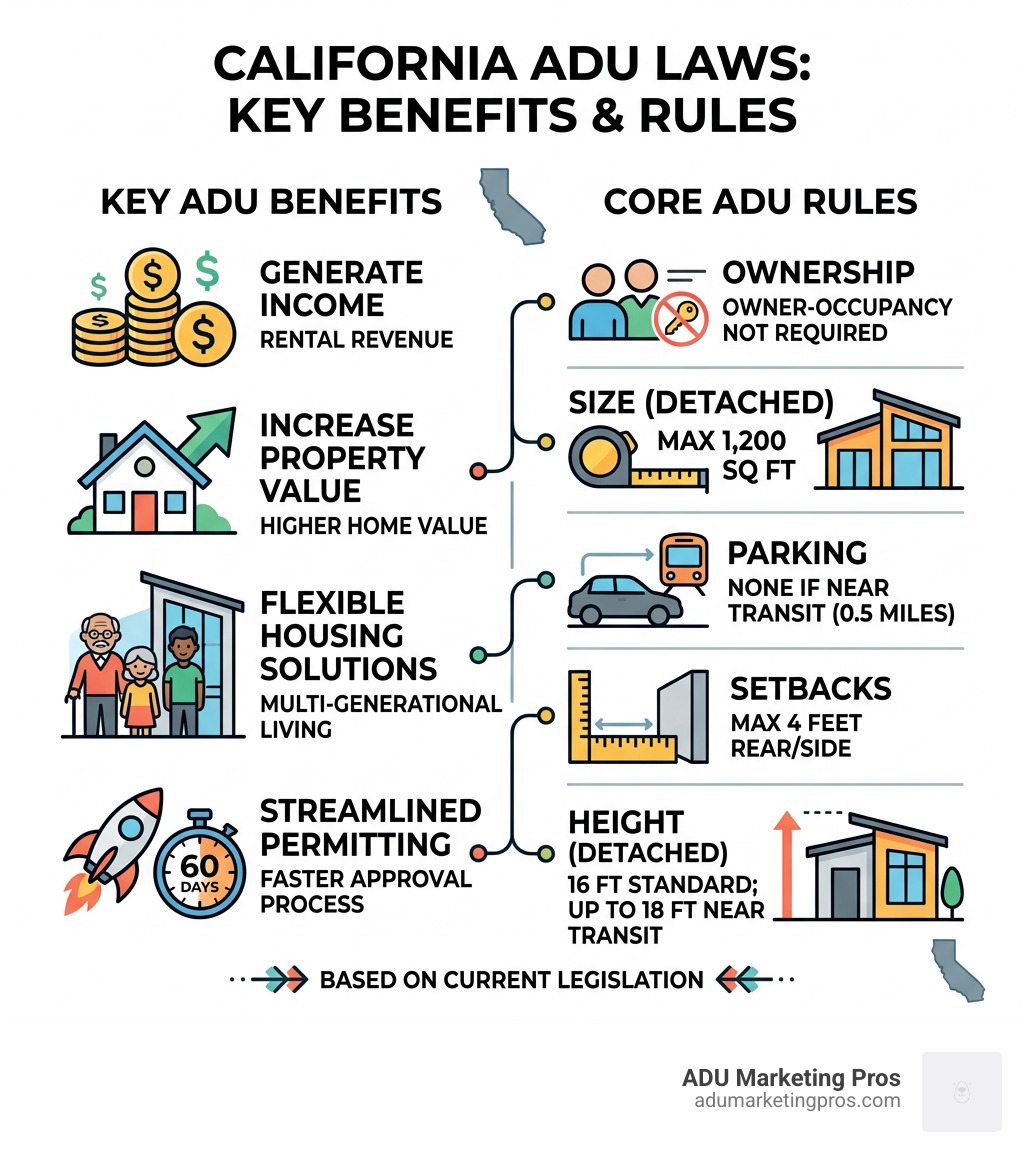
Here’s a quick snapshot of what California law currently allows:
| Topic | Key Rule |
|---|---|
| Who can build | Most residential property owners |
| Max size (detached) | 1,200 sq ft |
| Max size (attached) | 850–1,000 sq ft, or 50% of primary home |
| Min size | 150 sq ft (efficiency unit) |
| Rear/side setbacks | Max 4 feet |
| Height (detached) | 16 ft standard; up to 18 ft near transit |
| Permit timeline | 60 days from complete application |
| Parking required | No, if within 0.5 miles of public transit |
| Owner-occupancy required | No (prohibited for ADUs under AB 976) |
| Separate sale allowed | In participating cities under AB 1033 |
California’s housing crisis has been the driving force behind a wave of ADU-friendly legislation. The results speak for themselves: annual ADU permits grew from just 1,336 in 2016 to 26,924 in 2023 — a 20-fold increase. By 2023, ADUs made up more than 21% of all new homes permitted statewide. This surge is not accidental; it is the direct result of the state stripping away the ability of local NIMBY (“Not In My Backyard”) policies to block these small-scale developments.
However, the legal landscape remains complex. While state law sets a mandatory “floor” for what must be allowed, local jurisdictions still retain some control over aesthetic standards and specific zoning nuances. This creates a layered regulatory environment where a homeowner in San Jose might face different procedural hurdles than one in Los Angeles, even though both are protected by the same overarching state mandates. Keeping track of what applies to your property, in your city, under the latest legislation, is genuinely confusing but vital for avoiding costly construction delays.
This guide cuts through that confusion. Whether you’re a homeowner thinking about a backyard cottage for an aging parent, or a builder trying to advise clients confidently, you’ll find clear, current answers here. We will explore the technical definitions, the latest 2025 legislative updates, and the financial incentives that make these projects more viable than ever.
ADU laws California word roundup:
What is an Accessory Dwelling Unit in California?
At its core, an Accessory Dwelling Unit (ADU) is a secondary house or apartment with its own kitchen, bathroom, and sleeping area, located on the same lot as a primary residence. You might know them as granny flats, in-law suites, or backyard cottages. In the eyes of the law, they are permanent structures designed for independent living. They are not temporary guest houses or “recreation rooms”; they are fully functional residences that can be rented out or used for multi-generational living.

According to the California Department of Housing & Community Development, there are several ways to categorize these units based on how they are built and where they are situated on the property:
The Primary Categories of ADUs
- Detached ADU: A standalone structure that is physically separated from the primary dwelling. These are often the most popular choice for homeowners seeking maximum privacy for both the main house and the tenant.
- Attached ADU: A unit that shares at least one wall with the main house. These are often more cost-effective to build because they can sometimes tap into the existing home’s utility lines more easily.
- Converted ADU: Space within an existing structure (like a garage, basement, or attic) turned into a living unit. Garage conversions are the most common form of ADU in California due to the existing foundation and roof, which can significantly lower construction costs.
- Efficiency Units: Small units that meet minimum habitability standards but can be as small as 150 square feet. These are ideal for high-density urban areas where space is at a premium.
- Manufactured Homes: These are also permitted as ADUs provided they are attached to a permanent foundation and meet ADU California Regulations. This includes “Moveable Tiny Homes” in certain jurisdictions like Los Angeles and San Diego, which have adopted specific ordinances to allow them as valid ADUs.
Defining the JADU (Junior Accessory Dwelling Unit)
A Junior Accessory Dwelling Unit (JADU) is a specific subtype that is even more integrated into the primary home. To qualify as a JADU under ADU Size Restrictions, the unit must:
- Be contained entirely within the walls of a single-family residence (though it can include an addition of up to 150 square feet for ingress/egress).
- Be no larger than 500 square feet.
- Have its own separate entrance from the main house.
- Include an efficiency kitchen (which requires a sink, a cooking appliance, and food preparation counters).
One critical distinction: while standard ADUs no longer require the owner to live on the property (thanks to AB 976), JADUs still carry an owner-occupancy requirement if the unit shares sanitation facilities with the main house. This makes JADUs a unique tool for homeowners who want to stay in their homes while generating income from a spare bedroom or converted garage space.
Prefab vs. Modular ADUs
When we look at construction methods, “prefab” is a broad term, but “modular” has a specific legal meaning. Modular ADUs are built in sections at a factory and then transported to the site. Because they are placed on a permanent foundation and must meet the same California Building Standards Code as site-built homes, they are widely accepted under ADU Building Requirements. This is often a faster route to completion than traditional “stick-built” construction, sometimes cutting the project timeline by 30-50%.
New Legislative Updates: The 2025 ADU Landscape
The California legislature has been remarkably active in refining the rules surrounding ADUs. It seems like every year, new bills are passed to make ADUs easier to build, more flexible to use, and harder for local governments to block. For those of us in the industry, staying on top of ADU Regulatory Updates is a full-time job, as these laws often override local zoning codes that have been in place for decades.
Selling Your Unit: AB 1033 and Condo Conversions
For decades, one of the biggest hurdles to ADU development was that you couldn’t sell an ADU separately from the main house. AB 1033 changed the game by allowing local governments to adopt ordinances that permit ADUs to be “condo-ized.” This means the ADU can be sold as separate entities, much like a traditional condominium.
This is a massive shift for property values and affordable homeownership. It allows a homeowner to build an ADU and sell it to a first-time buyer, providing a more affordable entry point into the California real estate market. However, it isn’t automatic—your city (like San Jose or San Francisco) must opt-in to this law for you to take advantage of it. If they do, you’ll need to follow specific legal steps to create a homeowners association (HOA) and separate the property taxes, which requires careful legal and financial planning.
Multifamily and Amnesty Updates
Recent laws like SB 1211 and AB 2533 have expanded the horizon even further for property owners who aren’t just dealing with single-family homes:
- Multifamily Expansion (SB 1211): Property owners of existing multifamily buildings (like apartments or duplexes) can now build up to eight detached ADUs on their lots, provided they don’t exceed the number of existing units. This is a significant increase from previous limits and allows for much higher density on existing urban lots.
- Amnesty for Unpermitted Units (AB 2533): This law provides a pathway to legalize “bootleg” ADUs built before January 1, 2020. Local agencies generally cannot deny a permit for these older units unless they pose a direct threat to health and safety. This is a huge relief for homeowners who want to bring their property up to New ADU Regulations California without fear of massive fines or demolition orders.
The End of Owner-Occupancy: AB 976
One of the most significant barriers to ADU investment was the requirement that the owner live in either the main house or the ADU. AB 976 made the temporary ban on owner-occupancy requirements permanent. This means you can now build an ADU and rent out both the main house and the ADU simultaneously. This has turned ADUs into a powerful tool for real estate investors and homeowners looking to move but keep their original property as a high-yield rental asset.
Navigating the Permitting Process for ADU Laws California
The “ministerial review” process is your best friend in the world of California development. In plain English, this means that if your ADU meets the “objective standards” (size, height, setbacks), the city must approve it. They cannot hold public hearings, they cannot notify your neighbors for approval, and they cannot use subjective judgment to tell you “no” because they don’t like the color or style. This removes the political element from the permitting process, which was historically used to block housing.
The 60-Day Shot Clock
The state has also put local agencies on a strict “shot clock.” Once you submit a complete application, the agency has only 60 days to approve or deny it. If they miss the deadline, the permit can be “deemed approved” in many cases. Furthermore, they now only have 15 business days to tell you if your application is incomplete. This prevents the endless back-and-forth that used to kill projects by “death by a thousand papercuts.”
To get started, you’ll want to follow the ADU Permit Process carefully:
- Gather Plans: This includes site plans, floor plans, and a Title 24 energy report. You will also need structural calculations if you are building a new detached unit.
- Submit: Turn these into your local building department. Many cities now allow for digital submissions to speed up the process.
- Review: Expect a response within 60 days. If the city takes longer, you may have legal recourse under the Housing Accountability Act.
- Correct: If denied, the city must provide a written list of exactly what needs to be fixed to meet the objective standards.
Understanding Local Variations in ADU Laws California
While state law sets the baseline, cities like San Jose, San Francisco, and Los Angeles have their own nuances that can affect your project’s speed and cost.
- San Jose: Known for being very ADU-friendly, they offer pre-approved plans to speed up the process. Check out the San Jose ADU Guidelines for specifics on their “Tuesdays ADU” program, which offers same-day permit reviews for certain projects.
- San Diego: They have pioneered “bonus” programs that allow for extra ADUs if you commit to making some of them affordable housing. See the latest San Diego ADU Laws for more on how to maximize your lot’s potential.
- Los Angeles: LA has a robust “Standard Plan Program” that features dozens of pre-approved designs from top architects, which can cut weeks off your permitting time and thousands off your design fees.
Common Myths Regarding ADU Laws California
There are a few myths we hear constantly that often discourage homeowners from starting. Let’s clear them up:
- “I have to add a parking spot.” False. If you are within half a mile of public transit (which includes most urban areas in the Bay Area or LA), you are exempt from adding parking. Even if you aren’t near transit, you can often replace a garage with an ADU without adding new parking.
- “My HOA said no.” They likely can’t. Under the Housing Accountability Act, HOAs cannot unreasonably restrict ADUs. They can have reasonable rules about aesthetics, but they cannot make it so expensive or difficult that it effectively prohibits the unit.
- “I can’t build in a historic district.” You can, though there may be more specific “objective” design standards to follow to ensure the unit matches the historic character. Refer to the California ADU Guidelines for how state law protects your right to build even in sensitive zones.
Development Standards: Size, Height, and Setbacks
How big can you go? The answer depends on your lot and the type of unit you are building. Generally, How Big Can an ADU Be in California follows these state-mandated limits that local cities cannot override:
| ADU Type | Maximum Size |
|---|---|
| Detached | 1,200 sq ft |
| Attached | 50% of primary home (or at least 800 sq ft) |
| JADU | 500 sq ft |
The “800 Square Foot Rule”
The “800 Square Foot Rule” is a lifesaver for homeowners with small lots. It states that regardless of local limits on lot coverage, floor area ratio (FAR), or open space requirements, a city must allow you to build at least one detached ADU of up to 800 square feet with 4-foot side and rear setbacks. This ensures that even on a crowded lot, you have a legal right to build a functional two-bedroom unit.
Height Restrictions and Bonuses
Height used to be a major sticking point, as many cities tried to limit ADUs to a single story to “protect privacy.” However, SB 897 raised the roof—literally. The new standards are:
- 16 Feet: The standard base height for detached ADUs on a lot with a single-family home.
- 18 Feet: Allowed if the property is within half a mile of a major transit stop or if the lot already has a multifamily building of at least two stories. This extra two feet is crucial for allowing pitched roofs or loft spaces.
- 25 Feet: The limit for attached ADUs (or the height of the main house, whichever is lower), allowing for seamless two-story additions.
These increases make two-story ADUs much more feasible, which is great for small lots where you need to build “up” instead of “out” to preserve backyard space. We cover these nuances in detail in our guide on ADU Construction Regulations.
The “66323 Units” Category
This is a technical term you might see in legal documents or permit applications. “66323 units” refers to ADUs and JADUs created under Government Code section 66323. These units are entitled to ministerial approval with almost zero local interference regarding lot coverage, open space, or design. If you are looking for the path of least resistance, this is it. Understanding how to use these can simplify getting ADU Permits California. It essentially creates a “safe harbor” for homeowners to build without being subjected to the whims of local planning commissions.
Financial Incentives and Impact Fee Exemptions
Building an ADU is a significant investment, often ranging from $150,000 to $400,000 depending on the size and finishes. However, the state of California has implemented several financial incentives to make these projects more accessible to the average homeowner.
The CalHFA ADU Grant Program
The California Housing Finance Agency (CalHFA) has previously offered an ADU grant program providing up to $40,000 for pre-development costs. These costs include architectural drawings, permits, soil tests, and environmental reviews. While funding for these grants fluctuates based on the state budget, it is always worth checking the current status. For many homeowners, $40,000 covers the entire “soft cost” phase of the project, allowing them to focus their savings or financing on the actual construction.
Impact Fees and Utility Connections
One of the biggest “hidden” costs of construction is impact fees—money the city charges for the “impact” your new unit will have on local infrastructure like parks, schools, and roads. In the past, these fees could exceed $20,000. Current ADU laws California have drastically reduced this burden:
- Under 750 sq ft: These units are completely exempt from all impact fees. This is a massive saving and is a primary reason why many homeowners choose to keep their units just under this threshold.
- 750 sq ft and larger: Fees must be proportional to the size of the primary home. For example, if your ADU is 50% of the size of your main house, the impact fees cannot exceed 50% of what a new full-sized home would pay.
When it comes to utilities, local agencies cannot require a new or separate utility connection (like a separate water meter) for ADUs converted from existing space. For new detached units, they can require a connection, but the fee must be fair and based on the unit’s actual burden on the system. We dive deeper into these costs in our look at ADU Zoning Laws.
Property Tax Implications
A common concern is that building an ADU will trigger a reassessment of the entire property. Fortunately, California law prevents this. Only the new construction (the ADU) is assessed at market value. Your original home maintains its Proposition 13 protected tax base. This makes an ADU one of the most tax-efficient ways to add value to your real estate portfolio.
Frequently Asked Questions about ADU Laws California
Are fire sprinklers required for my ADU?
This is a common worry for homeowners building on older properties. The rule is simple: ADUs only require fire sprinklers if the primary house has them. If your main house was built in the 1950s and doesn’t have sprinklers, you don’t need to add them to your new ADU. However, if you are building a new primary home and an ADU at the same time, both will likely need them. For more on safety and energy compliance, see our section on the Title 24 energy report.
Can my HOA stop me from building an ADU?
In short: No. California law (Civil Code section 4751) voids any provision in HOA covenants (CC&Rs) that prohibits or unreasonably restricts the construction of an ADU or JADU on a lot zoned for single-family residential use. They can have “reasonable” rules about aesthetics (such as requiring the ADU to match the color of the main house), but they cannot make it so expensive or difficult that you give up. Stay updated on these rights through our ADU Regulatory Updates.
What happens if I have an unpermitted structure on my lot?
In the past, cities would refuse to look at an ADU application if you had an unpermitted patio, shed, or fence. ADU laws California now prohibit this. A city cannot deny your ADU permit just because there are other non-conforming conditions on the property, as long as those conditions don’t affect the safety of the new ADU. If you’re worried about existing structures, a property inspection is a great first step before applying for amnesty under AB 2533.
Do I need to install solar panels on my ADU?
Under the current California Building Standards Code (Title 24, Part 6), all new newly constructed detached ADUs are required to have solar panels. However, there are exceptions. If the ADU is a conversion of an existing space (like a garage), solar is generally not required. Additionally, if the ADU is located on a site that doesn’t get enough sun (due to shading from trees or other buildings), you may be able to get an exemption.
Can I use my ADU as a short-term rental (Airbnb)?
This is one area where local cities still have significant control. While state law encourages ADUs for long-term housing, many cities (like Santa Monica or San Francisco) have banned the use of ADUs as short-term rentals (less than 30 days). Always check your local ordinance before planning to use your unit for vacation rentals.
Conclusion
Building an ADU is one of the smartest investments a California homeowner can make in the current economic climate. It provides essential housing for family members, generates significant rental income, and increases property value by an average of 20-30%. But as we’ve seen, the legal landscape is constantly shifting as the state continues to refine its approach to the housing crisis.
At ADU Marketing Pros, we specialize in helping the people who build these homes—the construction firms, architects, and developers—connect with homeowners who are ready to start their projects. Based in San Jose, we understand the local markets from Sunnyvale to San Diego. We focus on helping firms stand out by highlighting their expertise in these complex regulations, ensuring that homeowners find the most qualified professionals for their specific needs.
If you are a homeowner, we hope this guide helps you feel more confident in your journey. The path from blueprint to backyard cottage can be long, but the rewards are permanent. If you are a builder looking to grow your revenue and attract high-quality leads in this competitive space, we are here to help you scale. Don’t forget to check out how ADUs can even help with financing through Fannie Mae ADU Rental Income rules, which allow you to use projected rent to qualify for a larger mortgage.
The housing future of California is in our backyards. By leveraging these friendly ADU laws California, we can all play a part in solving the housing crisis while building long-term wealth for our families. Let’s build it right.