
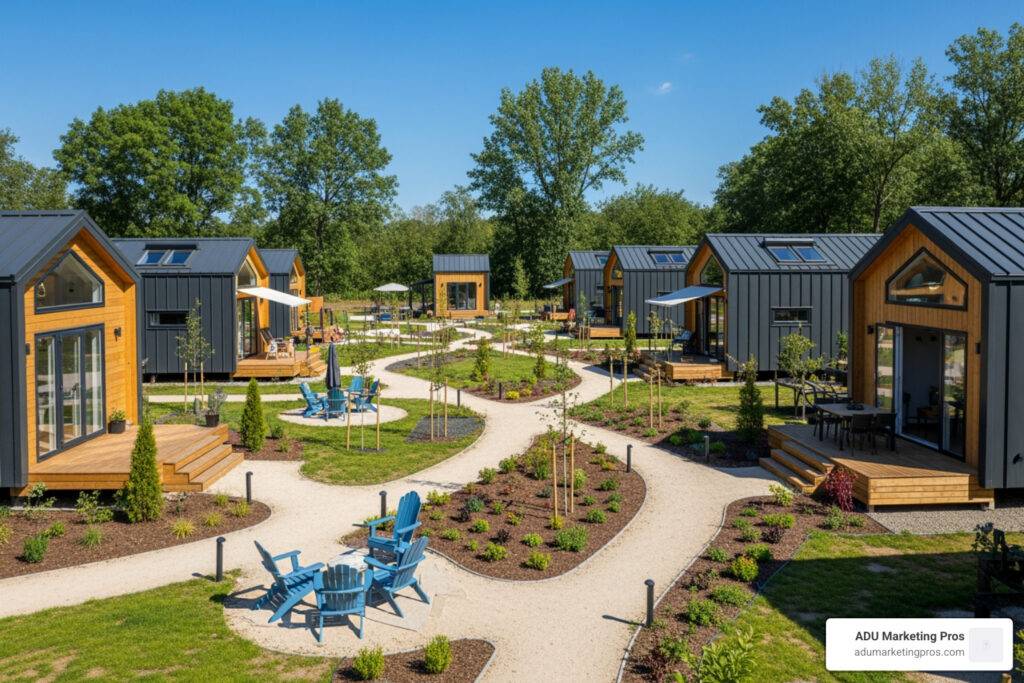
Why Tiny House Parks Are Revolutionizing Affordable Living
A tiny house park is a dedicated community where individuals can legally park and live in their tiny homes on wheels, typically offering full utility hookups, shared amenities, and a supportive neighborhood atmosphere. These communities solve the biggest challenge facing tiny house owners: finding legal, long-term parking with proper infrastructure. As the housing crisis deepens across North America, these parks are no longer just a niche lifestyle choice; they are becoming a critical component of the “missing middle” housing solution.
Quick Guide to Finding Tiny House Parks:
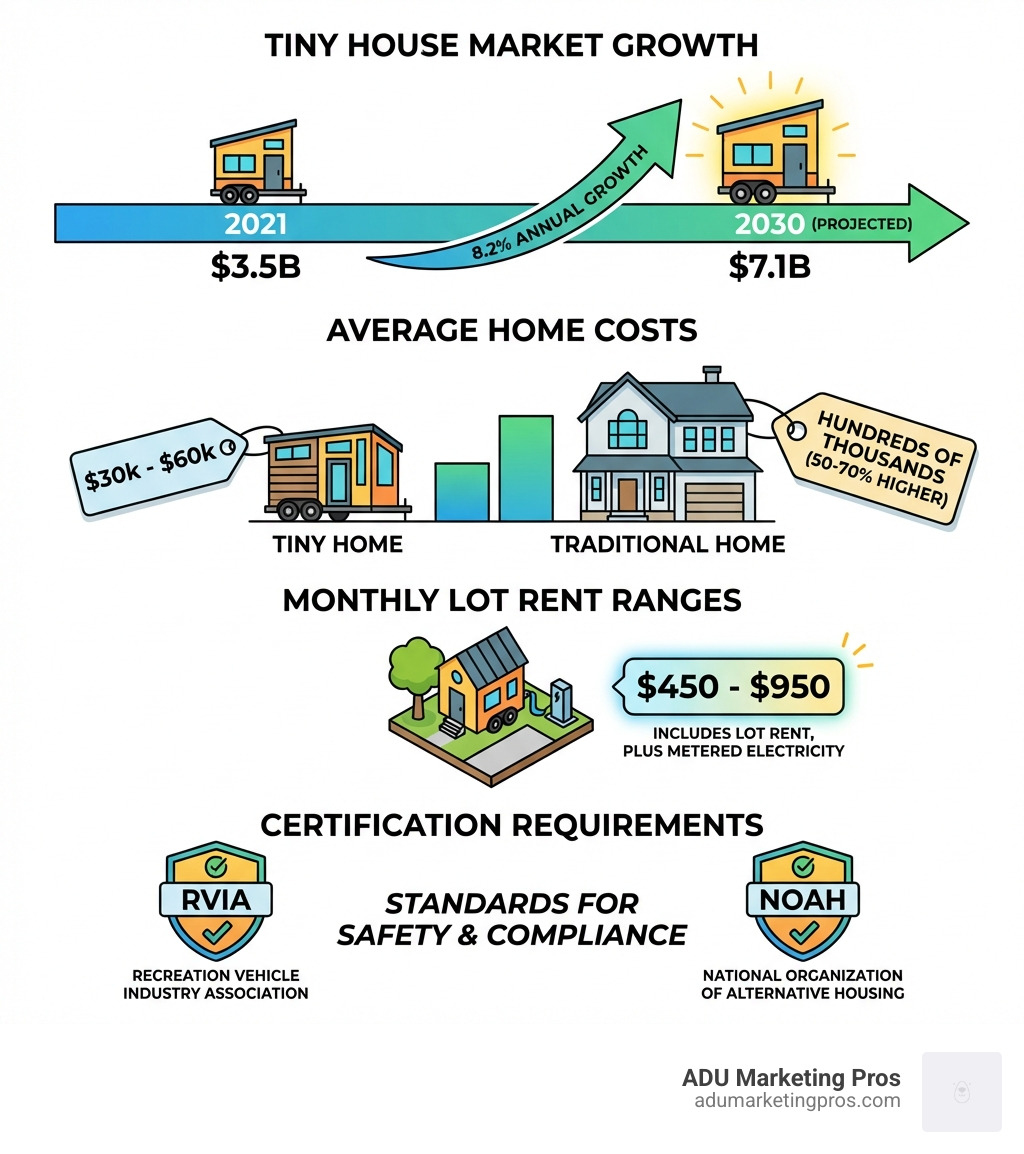
- Monthly Costs: $450–$950 for lot rent, plus metered electricity
- Top Locations: Lake Okeechobee (FL), Nacogdoches (TX), Portland (OR), California ADU villages
- Requirements: RVIA or NOAH certification, 400 sq ft maximum, towable with VIN/title
- Key Amenities: 30/50 amp electric, water/sewer hookups, internet, community spaces
- Finding Resources: Facebook groups (Tiny House Hosting), online maps, local meetups, Craigslist
The tiny house movement isn’t slowing down. The market reached $3.5 billion in 2021 and is projected to hit $7.1 billion by 2030, growing at 8.2% annually. Even more striking: 56% of Americans say they’d consider living in a tiny home. The appeal is clear—tiny homes cost 50-70% less than traditional housing, averaging $30,000 to $60,000 compared to hundreds of thousands for conventional homes. This economic shift is driven by a generation of workers who prioritize mobility and debt-free living over the accumulation of square footage.
But here’s the catch that most tiny house enthusiasts don’t anticipate: finding a legal place to park is one of the biggest, least-talked-about challenges of this lifestyle. Many municipalities treat tiny houses on wheels as recreational vehicles, allowing parking but prohibiting full-time living. Others have outdated zoning codes that don’t account for this housing type at all. That’s where tiny house parks come in. These purpose-built communities are emerging across the country, offering legal residency with proper infrastructure, security features, and—perhaps most importantly—a community of like-minded individuals who’ve chosen to downsize to a bigger life.
From waterfront sites in Florida starting at $500 per month to Texas communities offering seven-year price locks at $450 monthly, these parks provide stability in what can otherwise feel like a legal grey zone. Some parks, like those near Lake Okeechobee, offer gazebos, boat docks, and nature trails. Others focus on urban convenience, placing residents within walking distance of shops and services. The evolution of these parks reflects a broader societal shift toward intentional living, where the quality of one’s environment is measured by community connection rather than property lines.
For ADU construction firms and architects, understanding the tiny house park landscape offers insight into regulatory trends and community housing solutions. As municipalities update building codes through frameworks like the International Code Council’s Appendix Q, the line between tiny houses and accessory dwelling units continues to blur, creating opportunities for innovative housing developments. This convergence is leading to a new era of urban planning where flexibility and density are prioritized to meet the needs of a changing workforce.
Basic Tiny house park glossary:
Navigating the Legal Landscape of Tiny Living
One of the biggest problems for tiny house owners is finding a legal place to call home. In many areas, tiny houses exist in a confusing “legal grey zone.” This is because local zoning regulations and building codes were often written long before the tiny house movement gained momentum. Most existing codes are designed for traditional, permanent homes or recreational vehicles (RVs), leaving little room for tiny houses on wheels (THOWs) or even foundation-built tiny homes. This regulatory lag has historically forced many tiny dwellers into “stealth living,” where they park on private land and hope to avoid code enforcement officers.
Historically, many municipalities treated THOWs as RVs, meaning they could be parked in RV parks but often couldn’t be used for full-time residency. This “parking but no living” rule created a significant challenge for those seeking a permanent minimalist lifestyle. However, this confusing state of affairs is slowly changing. More municipalities, particularly in forward-thinking regions like California, are rewriting regulations to accommodate the growing interest in tiny houses. The International Code Council has even introduced Appendix Q, a set of guidelines specifically for tiny houses, which many local governments are adopting. This appendix provides relief from standard building codes that require minimum room sizes and ceiling heights, which are often impossible to meet in a tiny home.
For tiny homes built on foundations, the legal pathway often falls under Accessory Dwelling Unit (ADU) regulations. This is a crucial distinction, especially here in California, where ADU laws have become increasingly favorable. An ADU is a secondary housing unit on a single-family residential lot. While not always “tiny” in the traditional sense, many ADUs are small, efficient homes that align with the tiny living philosophy. Understanding the nuances between a tiny house and an ADU is key, and we’ve explored this in detail in our guide on ADU vs. Tiny House. The primary difference often lies in the foundation; ADUs are permanent structures, while many tiny houses are designed to be mobile.
This shift in legal recognition is vital for the growth of tiny house park communities. These parks offer a legal and stable solution for tiny house owners, providing dedicated spaces that comply with local regulations for long-term stays. Without these progressive changes, the dream of a permanent tiny home community would remain just that—a dream. As more cities recognize the value of tiny homes in addressing the housing shortage, we expect to see a surge in the development of these specialized parks.
Certification Requirements for Tiny Homes
To legally park a tiny house in many communities, especially RV parks or designated tiny house parks, specific certifications are often required. These certifications ensure the home meets certain safety and construction standards, similar to how traditional homes must adhere to building codes. Without these certifications, obtaining insurance or financing for a tiny home can be nearly impossible.
For tiny houses on wheels (THOWs), the most commonly recognized certifications include:
- RVIA (Recreation Vehicle Industry Association) certification: If your tiny house is built to RVIA standards, it can often be parked anywhere it’s legal to park an RV. This is a common pathway for many THOW owners seeking parking flexibility. RVIA certification involves rigorous inspections of the electrical, plumbing, and structural systems.
- NOAH (National Organization of Alternative Housing) certification: NOAH is another certification body that provides inspection and certification services specifically for tiny homes, ensuring they meet safety and structural requirements. NOAH uses a digital inspection process that allows builders to document every stage of construction.
- CSAZ240RV or NFPA1192: These are Canadian (CSAZ240RV) and US (NFPA1192) standards primarily for recreational vehicles, which some parks and jurisdictions might accept for THOWs.
Beyond these certifications, many parks and jurisdictions will require your tiny home to have a VIN (Vehicle Identification Number) and a title, just like a car or RV. This is particularly true for THOWs, as it confirms their status as a vehicle. For park model tiny homes, which are often larger than typical THOWs but still considered recreational vehicles, these certifications and VIN requirements are equally important. For instance, some communities specify that homes should be 399 sq ft or less (not including porches or lofts) and must be RVIA or NOAH certified. These rigorous inspection processes are in place to protect residents and ensure the safety and longevity of the homes within the community. Furthermore, many parks require proof of liability insurance, which is often only available for certified units.
The Benefits of Living in a Tiny House Park
Imagine waking up each day in a home that perfectly suits your needs, surrounded by nature or a vibrant community, with significantly less financial burden. That’s the promise of living in a tiny house park. These communities offer a unique blend of financial freedom, a simpler lifestyle, and a strong sense of belonging that often eludes conventional housing. In a world where the average mortgage can consume 40% or more of a household’s income, the tiny house park model offers a radical alternative.
One of the most compelling benefits is the drastic reduction in housing costs. Tiny homes themselves are 50-70% cheaper than traditional homes, and monthly lot rent in a tiny house park can range from $450 to $950. This affordability translates directly into financial freedom, allowing residents to save more, work less, or pursue passions without the crushing weight of a mortgage. For many, this means the ability to retire early, start a small business, or travel more frequently. The low overhead of tiny living provides a safety net that traditional homeownership simply cannot match.
Beyond the financial aspect, tiny house parks foster a strong sense of community. We often find that residents are like-minded individuals who value minimalist living, environmental consciousness, and mutual support. This leads to a “neighborly watch” environment, where people look out for each other, share knowledge, and build genuine connections. This community sanctuary is a stark contrast to the often-isolated experience of traditional suburban living. In a tiny house park, the shared outdoor spaces become the “living room” of the community, encouraging spontaneous social interactions and a deeper sense of security.
Living in a tiny house park also means less maintenance. While you’re responsible for your tiny home, the park typically handles common area upkeep, utilities infrastructure, and sometimes even lawn maintenance. This frees up precious time and energy, allowing you to focus on enjoying life, exploring hobbies, or simply relaxing. It’s truly about downsizing to a bigger life, where your home supports your lifestyle, not consumes it. The reduced environmental footprint is another major draw, as tiny homes require significantly less energy to heat and cool, and many parks encourage sustainable practices like composting and rainwater harvesting.
Here in California, where housing costs are notoriously high, tiny house parks and tiny-friendly regulations offer a vital pathway to affordable and sustainable living. We’re seeing more Places in Southern California That Allow Tiny Houses, providing these benefits to our local communities.
| Feature | RV Parks (Traditional) | Dedicated Tiny House Communities |
|---|---|---|
| Purpose | Short-term travel, recreation | Long-term residency, community living |
| Community Focus | Transient, less emphasis on permanent bonds | Stable, strong emphasis on shared values/support |
| Aesthetics | Varied, often utilitarian | Designed for tiny homes, often landscaped |
| Regulations | Primarily RV-focused, short-term stay limits | Custom for tiny homes, long-term residency |
| Amenities | Basic hookups, bathhouses, laundry | Full hookups, community spaces, gardens, internet |
| Home Types | RVs, travel trailers | THOWs, park models, often strict size/style |
| Long-Term Stay | Often restricted, seasonal | Encouraged, permanent residency possible |
| Sense of Belonging | Lower | High, shared lifestyle |
Essential Amenities in a Tiny House Park
What transforms a simple parking spot into a thriving tiny house park community? It’s the thoughtful provision of essential amenities and features that cater to the unique needs of tiny home residents. When we look at successful parks, we see a consistent focus on both practical necessities and quality-of-life improvements. A well-designed park acts as an extension of the home, providing the space and facilities that a tiny house might lack.
At the core, reliable utility hookups are non-negotiable. This includes dedicated 30 or 50 amp electrical service for each lot, ensuring your tiny home has ample power for appliances, heating, and cooling. Robust waste water systems and freshwater supply are also crucial, often with individual hookups at each site. Some parks even offer separate electric meters for each unit, allowing for accurate billing based on individual usage. This transparency is vital for residents who are closely monitoring their monthly expenses.
Beyond the basics, many tiny house parks go the extra mile to create an inviting and convenient environment:
- Connectivity: High-speed internet is increasingly a must-have, allowing residents to work remotely and stay connected. Many parks now offer fiber-optic connections directly to each lot.
- Community Spaces: We often see communal areas like waterfront gazebos, picnic tables, and common patio areas that encourage social interaction. Some parks even feature “common houses” with full kitchens and large dining areas for community potlucks.
- Recreational Features: Some parks, especially those in scenic locations, might offer boat docks, fishing cleaning stations, nature trails, or even community gardens. For example, some parks along waterways provide access to fishing and boating right from the community.
- Convenience Services: Laundry facilities are a common and welcome amenity. Many parks also provide essential services like trash collection and lawn maintenance, taking some of the burden off residents.
- Security: Gated communities, video surveillance, and robust outdoor lighting contribute to a sense of safety and peace of mind. This is particularly important for residents who may travel frequently.
- Pet-Friendly Spaces: Knowing that many tiny home owners have furry companions, many parks are pet-friendly, though they often have rules regarding leashing and waste management. Some even include fenced dog parks or washing stations.
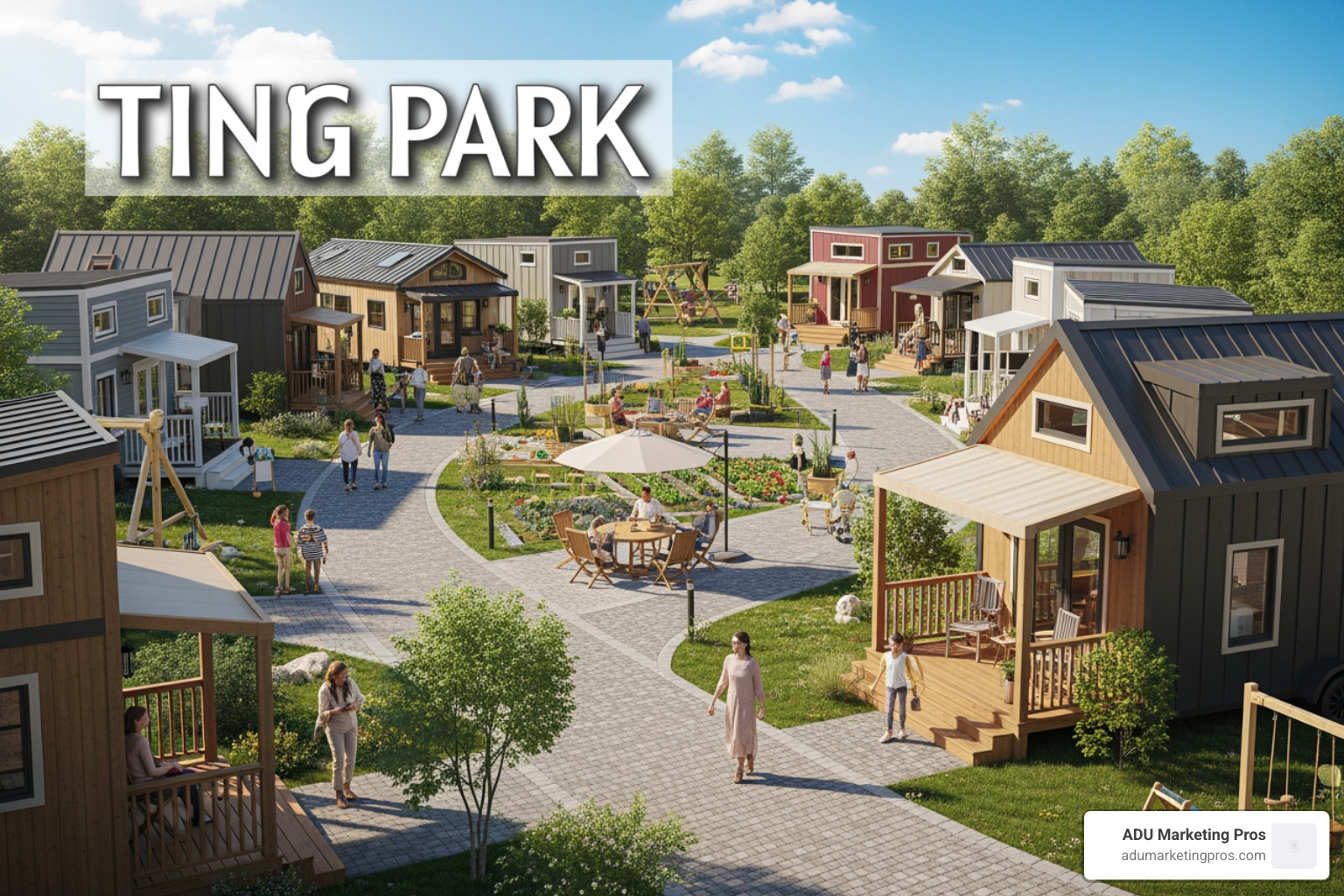
When exploring options for your tiny home, we encourage you to look beyond just the parking spot itself. The amenities offered by a tiny house park significantly impact the quality of life and the overall experience of tiny living. A park that invests in its infrastructure and community spaces is more likely to foster a stable and happy resident base.
Understanding the Costs of a Tiny House Park
One of the primary drivers for embracing tiny living is often financial, and tiny house park communities play a significant role in making this lifestyle affordable. The costs associated with parking a tiny house are generally much lower than traditional homeownership or even apartment rentals, but it’s important to understand the various components. Budgeting for a tiny house park requires looking at both fixed and variable expenses.
The most substantial recurring cost will be your monthly lot rent. Based on our research, this typically ranges from $450 to $950. This fee usually covers the land your tiny home occupies and often includes some basic services. For instance, many parks include standard water and sewer hookups, along with trash pick-up, in their monthly rates. Some communities, like Gracious Tiny House Park, offer waterfront sites starting at $500 per month plus electric, while others, like Dogwood Hills, advertise homesites for $450 per month with an attractive 7-year price lock. These price locks are particularly valuable in an era of rising inflation.
However, it’s rare for all utilities to be included. Electricity is almost always metered separately and billed based on your individual usage. Depending on the climate and your home’s insulation, this could range from $30 to $150 per month. Additional fees might apply for services like washer/dryer access if not included in the base rent, or if you opt for specific premium amenities like extra storage units or covered parking for a secondary vehicle.
Beyond the monthly rent, consider potential move-in or relocation costs. If you’re moving a tiny home, especially a larger park model, there might be significant transportation expenses, often ranging from $5 to $10 per mile. Some communities might offer assistance or recommendations for professional movers. Also, for tiny homes on wheels (THOWs) that are certified as RVs, property taxes are generally not applicable, as they are considered personal property rather than real estate. This can be a substantial saving compared to traditional homeownership, where property taxes can cost thousands of dollars annually.
We always advise potential residents to get a clear breakdown of all costs—base rent, included utilities, separately metered utilities, and any other fees—before committing to a tiny house park. Transparency in pricing ensures you can accurately budget for your tiny living adventure and avoid any unpleasant surprises down the road.
Finding Your Spot: Resources and Platforms
So, you’ve accepted the tiny house dream, perhaps even built your perfect miniature abode. Now comes the crucial step: finding that ideal tiny house park or parking spot. Thankfully, a growing ecosystem of resources and platforms is making this search much more manageable than it used to be. The search for a spot requires a mix of digital savvy and old-fashioned networking.
One of the most traditional, yet still effective, methods involves online classifieds like Craigslist. Here, you might find private landowners offering spots in their backyards or driveways, often for a more personal arrangement. However, be sure to verify local regulations before committing, as “backyard parking” is often the most legally precarious option. Always ask the landowner if they have checked with local code enforcement regarding long-term residency.
For a more specialized approach, several dedicated online platforms have emerged:
- My Tiny House Parking: Part of the Tiny House Network family of websites, this platform offers listings for private parking, spots on farms, or within tiny house communities. It often features an interactive map, making it easy to search geographically and filter by price or amenities.
- Tiny House Hosting: This is a vibrant Facebook group dedicated to connecting tiny house owners with land for rent or sale. It’s also a great place to find opportunities for starting new tiny house communities. The group is highly active, with new listings appearing daily across the country.
- Tiny House Map: Created by tiny house builder Dan Louche of Tiny Home Builders, the Tiny House Map is a searchable, interactive tool that includes communities renting out land, as well as individuals looking to connect. It is one of the oldest and most reliable databases in the movement.
Beyond these, attending tiny house meetups and gatherings can be incredibly valuable. These events are not only great for networking and learning but often lead to word-of-mouth opportunities for parking. You might hear about new tiny house park developments or private land rentals before they’re widely advertised. Many of the best spots are never listed online; they are filled through personal recommendations within the community.
Whether you’re looking for a short-term spot while traveling through Tiny House San Francisco or a long-term home base, these resources are invaluable. Remember to always clarify whether a listing is for short-term or long-term parking, as regulations and availability can differ significantly. Some parks may have a 30-day limit, while others are designed for multi-year stays.
Leveraging Social Media for Parking
In today’s interconnected world, social media plays an increasingly vital role in helping tiny house owners find parking opportunities and connect with communities. It’s not just about scrolling through feeds; it’s about active engagement and leveraging the power of collective knowledge. Social media allows you to “vibe check” a community before you ever visit in person.
Facebook groups, such as the aforementioned Tiny House Hosting, are treasure troves of information. These groups allow members to post about available land, parking spots, and even opportunities to start new communities. They also serve as forums for asking questions, sharing experiences, and getting real-time availability updates from park owners or other residents. We’ve seen countless success stories emerge from these online communities, where a simple post like “Looking for a spot in Oregon” leads to a perfect match within hours.
Beyond Facebook, platforms like Instagram and YouTube can offer visual insights into potential tiny house park communities. Many parks and residents share photos and video tours, giving you a sneak peek into the lifestyle and amenities. You can often connect directly with park owners or residents through direct messaging, allowing for personalized inquiries and community feedback. Searching hashtags like #tinyhouseparking or #tinyhousecommunity can reveal hidden gems that aren’t on the major listing sites.
The beauty of using social media lies in its ability to foster direct connections. You can network with other tiny house enthusiasts, learn about unlisted opportunities, and even find collaborators for co-housing arrangements. However, always exercise caution and verify information. While these platforms are fantastic for discovery, always follow up with official inquiries and site visits before making any financial commitments. Scams do exist, so never send a deposit without verifying the legitimacy of the park and the landowner.
Regional Spotlights: Tiny-Friendly Cities and Regions
While the tiny house movement is global, certain regions and cities have become particularly welcoming, often leading the charge in developing progressive zoning and fostering tiny house park communities. While we acknowledge the strides made in places like Lake Okeechobee, Florida, with its waterfront tiny house communities, or Nacogdoches, Texas, offering established park model options, our focus remains firmly on California, where we’re seeing significant innovation. These regions serve as blueprints for how other states can integrate tiny homes into their housing portfolios.
California, with its high housing costs and progressive outlook, is a natural fit for tiny living. Cities across the state are actively exploring and implementing solutions to make tiny houses a viable housing option. The state’s legislative body has passed several bills in recent years that limit the ability of local governments to ban ADUs and tiny homes, creating a more uniform landscape for developers and homeowners alike.
California’s Evolving Tiny House Regulations
California has been a pioneer in embracing tiny homes, largely driven by the urgent need for affordable housing and innovative urban infill strategies. Our state’s approach has often focused on legalizing tiny houses as Accessory Dwelling Units (ADUs), which can be built on existing residential lots. This has opened up numerous opportunities for tiny homes on foundations to become a permanent part of our communities. We help many clients steer these regulations through our expertise in Tiny House Builders California.
Beyond ADUs, specific cities are creating dedicated tiny house park initiatives:
- San Jose: Our home city of San Jose has been at the forefront, opening tiny home villages on city or county land to address homelessness and provide affordable housing solutions. These villages often feature small, modular units and a strong community support system. San Jose’s “Bridge Housing Communities” have become a national model for using tiny homes as transitional housing.
- Sunnyvale: Similarly, Sunnyvale has seen development in small homes and tiny house options, often through innovative partnerships and zoning adjustments. You can explore options for Small Houses for Sale in areas like Sunnyvale, where the city is encouraging higher density in residential zones.
- Los Angeles and San Diego: These major metropolitan areas have also made significant strides in ADU legalization, making it easier for homeowners to add tiny homes to their properties. This has fueled the growth of Tiny House Builders in Southern California and expanded parking opportunities. San Diego, in particular, has streamlined the permitting process to reduce costs for tiny home builders.
- Fresno: A notable success story, Fresno, California, updated its zoning ordinances to allow tiny homes on wheels as permanent dwellings on residential lots, provided they meet specific criteria and are connected to utilities. This move has been a game-changer for tiny house owners in the region, as it was one of the first major cities to treat THOWs as permanent residences rather than temporary RVs.
Our team at ADU Marketing Pros is deeply engaged with these evolving regulations, helping ADU construction and architecture firms understand and capitalize on these opportunities. We see the integration of tiny homes, whether as ADUs or within dedicated tiny house park communities, as a critical component of California’s housing future. The landscape is constantly changing, but the trend is clear: California is becoming increasingly tiny-friendly, providing a much-needed relief valve for the state’s housing pressure.
Conclusion
The dream of financial freedom and a simpler life, embodied by the tiny house movement, is undeniably powerful. While finding a legal and suitable place to park your tiny home has historically been a significant challenge, the rise of tiny house park communities is revolutionizing this aspect of tiny living. These parks offer not just a parking spot, but a vibrant community, essential amenities, and a legal pathway to a sustainable, minimalist lifestyle. As we move toward a future where housing must be more efficient and affordable, these communities represent a scalable solution for urban and rural areas alike.
From navigating complex legal landscapes and understanding certification requirements to exploring diverse community models and managing costs, we’ve seen that the journey to finding your perfect tiny home park is multifaceted but ultimately rewarding. The growth of online platforms and social media continues to connect tiny house owners with opportunities, while progressive cities, particularly here in California, are actively adapting regulations to accept this innovative housing solution. The success of these parks proves that when you reduce the physical footprint of a home, you often expand the social and financial possibilities for its inhabitants.
For ADU construction and architecture firms, understanding the dynamics of tiny house parks and evolving regulations is key to strategic growth. As the lines between tiny homes and ADUs continue to blur, new opportunities emerge for innovative housing solutions. We are dedicated to helping our clients thrive in this evolving market, connecting them with high-quality leads and positioning them as leaders in sustainable, efficient housing. The demand for tiny living is only going to increase, and those who can provide legal, high-quality parking and housing solutions will be at the forefront of the next real estate revolution.
If you’re considering a tiny home or looking to develop tiny home solutions, we encourage you to explore the myriad possibilities within tiny house park communities. The future of housing is compact, communal, and increasingly accessible. For more insights into specific opportunities in our region, be sure to check out our guide on Places in Southern California That Allow Tiny Houses.
What is the average monthly cost for a tiny house lot?
Monthly lot rent typically ranges from $450 to $950, often including water, sewer, and trash services, while electricity is usually metered separately. Specific costs can vary based on location, amenities, and whether the site is waterfront or interior. In high-demand areas like coastal California, prices may lean toward the higher end of this spectrum.
Can I park my tiny house in any RV park?
Most RV parks require tiny houses on wheels (THOWs) to be RVIA or NOAH certified, treating them as recreational vehicles. They may also have specific age restrictions for residents (such as 55+ communities), aesthetic requirements for the tiny home (no DIY exteriors), or limits on long-term stays. It’s always best to check with individual RV parks about their specific policies for tiny homes before arriving.
Are tiny house parks legal in California?
Yes, many cities in California are increasingly friendly to tiny house living. While traditional “tiny house parks” might be less common than in some other states, California has made significant strides in legalizing tiny houses as Accessory Dwelling Units (ADUs) on residential properties. Cities like San Jose, Sunnyvale, and Fresno have implemented progressive zoning changes that allow for various forms of tiny living, including dedicated tiny home villages and ADU placement. Regulations vary by municipality, so it’s crucial to research local ordinances in specific areas like Los Angeles, San Diego, and the San Francisco Bay Area.
What certifications do I need for a tiny house park?
Most reputable tiny house parks require either RVIA (Recreation Vehicle Industry Association) or NOAH (National Organization of Alternative Housing) certification. These certifications prove that the home was built to safety standards regarding electrical, plumbing, and structural integrity. Additionally, you will likely need a VIN and a title to prove ownership and vehicle status.
Do tiny house parks allow pets?
Most tiny house parks are pet-friendly, recognizing that many tiny dwellers have dogs or cats. However, they usually have specific rules regarding the number of pets, breed restrictions, and requirements for leashing and waste disposal. Some premium parks even offer amenities like dog parks or pet washing stations.
Is internet usually included in the lot rent?
While some parks include basic Wi-Fi in the lot rent, many residents prefer to set up their own high-speed connections. Many modern tiny house parks are pre-wired for fiber-optic or cable internet, allowing residents to contract directly with local providers for reliable, high-speed service suitable for remote work.
Can I finance a tiny home if I plan to live in a park?
Financing can be more challenging than a traditional mortgage, but it is possible. Many lenders offer personal loans or RV loans for certified tiny homes. If the tiny home is built on a foundation as an ADU, traditional construction or renovation loans may be available. Having a certified home (RVIA/NOAH) significantly increases your chances of securing financing.