
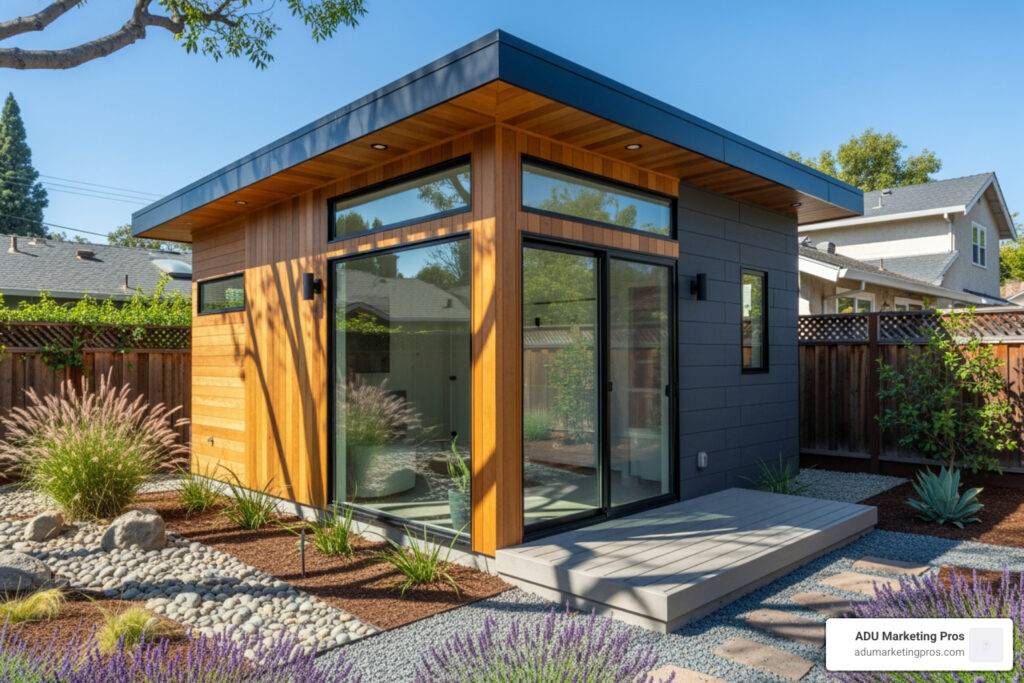
Why Prefab Studio ADUs Are Changing California’s Housing Landscape
In the face of California’s persistent housing shortage and soaring property values, homeowners are discovering a powerful tool right in their own backyards: the prefab studio ADU. These innovative accessory dwelling units are not just a trend; they represent a fundamental shift in how we think about residential space, offering a nimble, cost-effective, and high-quality solution to a complex problem. As cities from San Diego to the Bay Area grapple with the need for more housing, the prefab model has emerged as a clear winner for those looking to add value, generate income, or create flexible living arrangements.
So, what exactly is a prefab studio ADU? Here’s a quick overview of this game-changing housing option:
- What it is: A compact, self-contained living unit, typically ranging from 200 to 500 square feet, that is constructed in a factory and then transported to your property for final assembly and installation.
- All-in Cost: The total investment generally falls between $200,000 and $450,000. This comprehensive figure includes the ADU structure, foundation, utility connections, delivery, installation, and all associated permit fees.
- Timeline: One of the most compelling benefits is the accelerated timeline. A complete project can be finished in just 6 to 12 months, a stark contrast to the 18 months or more often required for a traditional, site-built ADU.
- Key Benefits: Expect build times that are 30-50% faster, a dramatic reduction in construction waste (up to 85%), the security of fixed pricing, and unparalleled quality control thanks to the factory environment.
- Common Uses: The versatility is endless. Homeowners use them for generating rental income, as a dedicated home office, a private guest suite, or as a comfortable home for aging parents or adult children.
For decades, traditional construction has been plagued by unpredictable timelines, budget overruns, and the general chaos of an on-site build. The prefab studio ADU model flips this script. By moving the majority of the construction process off-site into a controlled factory setting, companies like Abodu, Studio Shed, and Wellmade have perfected a system that delivers faster timelines, predictable costs, and superior build quality. This comprehensive guide will walk you through every aspect of the journey, from initial design concepts and financing to navigating permits and selecting the perfect provider for your California property.
Why Choose a Prefab Studio ADU? The Core Advantages
When considering adding an accessory dwelling unit to your property in California, the choice between traditional stick-built construction and a prefab studio ADU often comes down to a few critical factors: speed, cost, quality, and sustainability. While a traditional build has its place, prefabricated solutions offer compelling, modern advantages across the board, making them an increasingly popular choice for savvy homeowners in San Jose, Los Angeles, San Diego, and across the Bay Area.
Best Speed and Efficiency
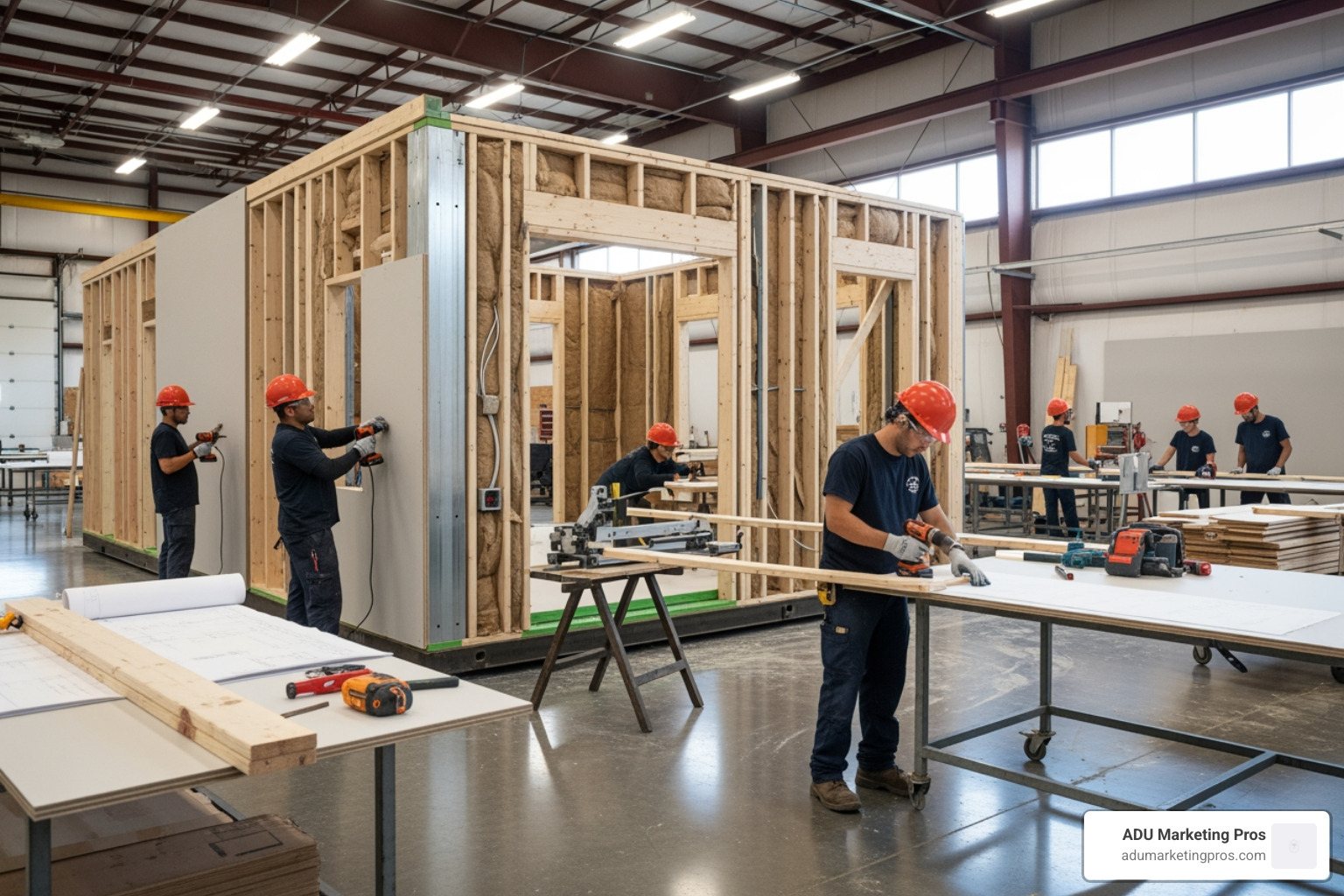
The single most significant advantage of a prefab studio ADU is unparalleled speed. Traditional construction is a linear process; nothing can be built until the foundation is poured, and framing can’t start until the foundation is cured. Prefabrication shatters this model by enabling a parallel workflow. While your property is being graded and the foundation is prepared, your ADU is simultaneously being constructed in a climate-controlled factory. This overlap is the key to dramatically shortening the project timeline. Weather delays, which can halt a traditional project for weeks, are a non-issue for the 90% of construction that happens indoors. Furthermore, factory production lines are optimized for efficiency, with dedicated teams and specialized tools at every station, eliminating the scheduling conflicts and downtime common with coordinating multiple subcontractors on-site. This results in 30-50% fewer framing hours and a total project completion time of as little as 6-9 months, meaning less disruption to your daily life and a much faster path to enjoying your new space or collecting rental income.
Cost Savings and Predictability
Budget uncertainty is a major source of stress in traditional construction. A prefab studio ADU brings welcome cost predictability. Most leading providers operate on a fixed-pricing model, providing you with a detailed, all-in cost upfront. This figure locks in the price of your unit and standard installation, protecting you from the market volatility and surprise overages that can plague site-built projects. The savings are generated through multiple efficiencies. Manufacturers buy materials in bulk, securing better prices than a single-project contractor can. The factory process is a model of efficiency, with streamlined labor and processes that generate up to 85% less material waste—a cost saving that is passed on to you. While the all-in cost for a studio can range from $200K to $450K+ depending on size, site complexity, and finish level, the transparency of the pricing allows you to plan, secure financing, and manage your budget with confidence from day one.
Superior Quality and Durability
Building a home inside a factory leads to a demonstrably higher-quality product. Every component of a prefab studio ADU is built in a controlled environment, protected from rain, wind, and extreme temperatures that can warp wood, compromise seals, and degrade materials on a traditional job site. This allows for precision engineering, tighter tolerances, and a level of quality control that is simply not possible in the field. Prefab units are built to be transported, which means they are often engineered to be stronger and more durable than their site-built counterparts. They must withstand the rigors of a crane lift and highway travel, resulting in a more robust structure. These ADUs are engineered to meet or exceed all California state and local building codes, often utilizing advanced materials like Structural Insulated Panels (SIPs) which provide superior insulation, strength, and air tightness for a high-performance building envelope. This commitment to quality is typically backed by a comprehensive structural warranty, giving you peace of mind in your long-term investment.
A Greener Way to Build
In an era of increasing environmental awareness, prefab construction offers a significantly greener alternative to traditional building methods. The factory process is inherently less wasteful. Materials are measured and cut with precision, and any scraps are often sorted and recycled or repurposed for other projects, minimizing the amount of debris sent to a landfill by up to 85%. This efficiency also reduces the project’s overall ecological footprint. Fewer vehicle trips are needed to transport materials and labor to your property, cutting down on carbon emissions. Beyond the build process, these units are designed for long-term energy efficiency. Standard features often include high-performance windows, robust insulation, cool roofs, heat pump HVAC systems, heat pump water heaters, and all-electric appliances. Many units are delivered solar-ready or with integrated solar panels, aligning perfectly with California’s ambitious energy goals and helping to lower your monthly utility bills for years to come. Choosing a prefab studio ADU is a responsible, sustainable investment in your property and the planet.
Understanding the Costs and Timeline of a Prefab Studio ADU Project
Navigating the financial and temporal aspects of any construction project can feel daunting, but with prefab studio ADUs, the process is defined by clarity and predictability. A core promise of the prefab model is to demystify the complexities of building. Understanding the true “all-in” cost and the distinct phases of the project timeline will empower you to plan with confidence, whether you’re in the competitive markets of the San Francisco Bay Area, the sprawling suburbs of Los Angeles, or the coastal communities of San Diego.
Breaking Down the “All-In” Cost
When a prefab provider gives you an “all-in” cost, it’s crucial to understand what that comprehensive price includes. This figure should go far beyond the price of the unit itself and cover everything required to make your ADU move-in ready. A transparent proposal will itemize these costs clearly:
- Unit Base Price: This is the cost of the factory-built structure. For example, a 340 sq ft studio might start at $228,800. This typically includes standard interior and exterior finishes, windows, doors, roofing, and built-in cabinetry.
- Customization & Upgrades: This category covers any selections beyond the standard package. This could include upgraded flooring (e.g., from LVP to hardwood), premium countertop materials (e.g., quartz), higher-end appliance packages, or architectural additions like a deck or pergola.
- Site Work: This is often the most variable component of the total cost. It includes essential on-site construction such as grading the land, pouring a concrete slab or setting a pier foundation, and trenching for utility connections (sewer, water, electrical, gas). Costs can increase for sloped lots, difficult soil conditions, or long utility runs.
- Delivery & Installation: This fee covers the transportation of the unit from the factory to your property and the labor and equipment (often a crane) required to set it on the foundation. Costs vary based on distance and site accessibility.
- Permitting & Taxes: These are government-mandated fees. They include city plan check fees, building permit fees, and potentially school district or utility impact fees. A reputable provider will pass these costs through to you without a markup, and they can average around $17,000 or more depending on your jurisdiction.
- Soft Costs: These are administrative and design fees that occur before construction begins. They can include geological surveys, site surveys, structural engineering reports, and title reports. A full-service provider will manage these for you.
Always insist on a detailed proposal that breaks down every line item. This transparency is a hallmark of a trustworthy prefab partner and is your best defense against unexpected expenses.
What is the Typical Timeline from Start to Finish?
A key advantage of prefab is the compressed timeline, which is significantly shorter than the 12-18+ months typical for traditional builds. The process is methodical and efficient:
- Feasibility, Design & Consultation (2-4 weeks): This initial phase involves confirming your property is suitable for an ADU, selecting your model, and finalizing all design choices and upgrades.
- Permitting (2-6 months): This is often the longest and most unpredictable phase. Your provider’s permitting team will prepare and submit a full set of construction documents to your local planning department. The timeline depends heavily on the city’s workload. Providers with pre-approved plans (plans that have already been reviewed and accepted by a specific city’s building department) can sometimes accelerate this stage.
- Fabrication & Site Work (2-3 months): This is where the magic of parallel processing happens. As soon as permits are issued, your unit goes into production at the factory. Simultaneously, a local construction crew begins work on your property, preparing the site and foundation.
- Delivery & Installation (1-2 weeks): The completed unit is delivered to your site via flatbed truck. A crane carefully lifts and places it onto the prepared foundation. The final connections for utilities are made, and any finishing touches (like connecting modular sections or completing exterior siding) are completed. On-site work from start to finish can be as fast as 40-60 days.
From signing the contract to receiving the keys, a complete prefab studio ADU project in California typically takes 6 to 12 months.
Financing Your Prefab Studio ADU
Financing an ADU is more accessible than ever, with several common pathways available to homeowners:
- Home Equity Line of Credit (HELOC): A flexible line of credit based on your home’s equity. You can draw funds as needed, which is ideal for paying for project milestones. Interest rates are often variable.
- Cash-Out Refinance: This involves replacing your current mortgage with a new, larger one, allowing you to take out the difference in cash to fund the ADU. It can be a good option if you can secure a lower interest rate than your current mortgage.
- Construction Loan: A short-term, higher-interest loan specifically for the construction phase. Funds are disbursed in stages as work is completed. Once the ADU is finished and receives its certificate of occupancy, the loan is typically refinanced into a traditional mortgage.
- Renovation Loan (like FHA 203k): These government-backed loans allow you to finance the purchase or refinance of a home and include the cost of renovations or an ADU in a single mortgage.
Consulting with a financial advisor and a mortgage broker who is experienced with ADU financing is the best first step to determine the most advantageous path for your financial situation.
Design, Customization, and Functionality
A prefab studio ADU isn’t just about efficiency and speed; it’s about creating a beautiful, highly functional, and personalized living space. The best prefab providers have invested heavily in architectural design, partnering with architects to develop floor plans that maximize every square foot. The result is a compact home that feels spacious, bright, and perfectly suited for modern living.
Key Design Features of a Modern Prefab Studio ADU
Modern prefab studio ADUs are a far cry from the boxy mobile homes of the past. They are characterized by sophisticated design choices that prioritize comfort, style, and a connection to the outdoors, making a compact space feel large and inviting:
- Open-Concept Layouts: By minimizing or eliminating interior walls, designers create a single, fluid space for living, dining, and sleeping. This enhances the sense of volume and allows for flexible furniture arrangements.
- Dramatic Ceilings: High ceilings are a game-changer in small spaces. Many designs feature vaulted or cathedral ceilings, some soaring to over 13 feet, which draw the eye upward and create a feeling of airiness and grandeur.
- Strategic Glazing: Large windows, sliding glass doors, and clerestory windows are used to flood the interior with natural light and provide views of the surrounding landscape. This visual connection to the outdoors helps to dissolve the boundary between inside and out, making the space feel larger.
- Full-Size Amenities: Compromise is not in the vocabulary of modern ADU design. Most units include full-size kitchens with standard appliances (refrigerator, oven, cooktop, dishwasher) and well-appointed bathrooms with spacious showers and quality fixtures. This ensures complete functionality for long-term living.
- Durable and Stylish Flooring: Luxury vinyl plank (LVP) is a popular standard choice for its attractive appearance, durability, and water resistance. Many providers offer upgrades to engineered hardwood or tile for a more custom look.
- Thoughtful Lighting: A layered lighting plan, including recessed ceiling lights, pendant lights over kitchen islands, and options for task lighting, is essential for creating both function and ambiance.
Maximizing Functionality in a Compact Footprint
In a space under 500 square feet, every design choice matters. Smart design ensures that no inch is wasted and that the ADU can adapt to various needs:
- Multi-functional Furniture: This is key to versatility. A classic Murphy bed can instantly transform a living room into a bedroom. Other options include convertible sofa beds, drop-leaf dining tables that can be folded away, and nesting coffee tables that can be expanded when guests arrive.
- Integrated Smart Storage: To maintain a clean, uncluttered look, storage is built directly into the design. This includes floor-to-ceiling cabinetry, built-in shelving in nooks, and closets with efficient organizational systems. Some designs even incorporate storage within stairs or platform beds.
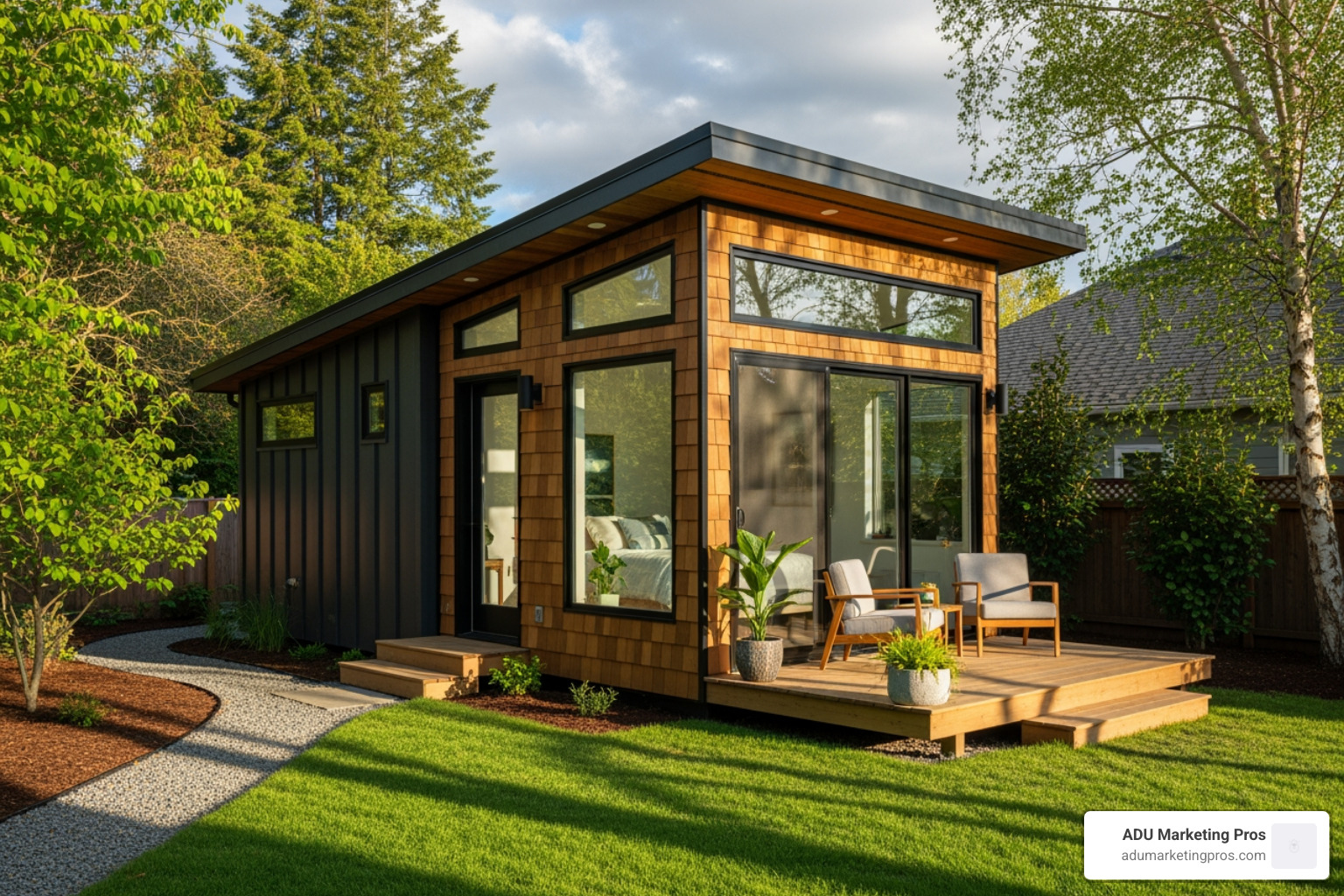
- Seamless Indoor-Outdoor Flow: California living is all about the outdoors. Features like panoramic folding glass doors or large multi-slide doors can open up an entire wall, effectively expanding the living area onto an adjacent deck or patio. This is perfect for entertaining or simply enjoying the pleasant climate.
- Efficient Kitchen and Bath Layouts: Galley kitchens and well-organized bathroom layouts are designed to be ergonomic and easy to navigate, proving that a small footprint doesn’t have to feel cramped.
Customization: Making the Space Your Own
Prefabrication does not mean a one-size-fits-all product. Reputable providers offer a curated menu of customization options, allowing you to tailor the ADU to your personal style and to complement your main home.
- Exterior Finishes: You can typically choose from a variety of siding materials, such as fiber cement, metal, or natural wood (like cedar or redwood), along with a palette of colors.
- Interior Finishes: Personalize your space by selecting from different paint colors, cabinet styles and colors, and countertop materials (e.g., laminate, solid surface, or quartz).
- Flooring and Tile: Choose the flooring that suits your lifestyle and aesthetic, and select from a range of tile options for the bathroom and kitchen backsplash.
- Appliance Packages: While a standard package is included, you can often upgrade to higher-end appliances from brands like Bosch or Miele, or add a washer/dryer combo unit.
Many companies enhance this process with powerful online 3D design tools. For instance, Studio Shed’s configurator, which you can Design your own ADU with this 3D tool, allows you to experiment with different finishes, add features, and see the price update in real-time, providing a transparent and engaging design experience.
The Process: From Permitting to Installation
Embarking on a prefab studio ADU project might seem complex, but leading providers have meticulously refined the process into a clear, manageable, and often turnkey journey. From deciphering local regulations in San Diego to ensuring a smooth crane delivery in a tight Bay Area lot, a good partner acts as your expert guide, handling the complexities so you can focus on the exciting outcome. Here’s a closer look at the critical stages of bringing your ADU to life.
Navigating the Permitting Maze for a Prefab Studio ADU
For many homeowners, the permitting process is the most intimidating part of any construction project. This is where a full-service prefab provider’s expertise becomes invaluable. They streamline this critical phase by:
- Leveraging Deep Local Knowledge: An experienced team understands the nuances of Accessory Dwelling Unit regulations that vary significantly between cities like Los Angeles, San Jose, and San Francisco. They are experts on local requirements for setbacks, height limits, parking, and design standards.
- Utilizing Pre-Approved Plans: To expedite reviews, many providers work with cities to get their standard models pre-approved. This means the city’s building department has already reviewed the structural and architectural plans, which can significantly shorten the plan check period. However, a site-specific plan must still be submitted to show placement, foundation, and utility connections.
- Managing All Submissions: A dedicated in-house or partner permit team handles the preparation and submission of all required documents, including architectural plans, structural engineering calculations, and energy compliance forms (Title 24). Their familiarity with the process helps avoid common errors that can lead to long delays.
- Providing Authoritative Resources: Navigating state law is also key. The California Department of Housing and Community Development provides an excellent Accessory Dwelling Unit Handbook that outlines statewide rules that often supersede stricter local ordinances, a fact that your permit specialist will leverage to your advantage.
Throughout the build, your project will undergo several city inspections (e.g., foundation, framing, final). Your provider will coordinate these inspections to ensure every aspect of the construction meets or exceeds all building codes.
Site Preparation and Foundation
Once the permits are approved, work can begin on your property. This phase runs concurrently with the factory fabrication of your ADU. Proper site preparation is crucial for a seamless installation.
- Comprehensive Site Assessment: Before any dirt is moved, a project manager conducts a thorough assessment of your yard. They confirm the final placement, plan the path for utility lines, and determine the best access route for delivery and installation equipment.
- Utility Connections: This is a significant part of the on-site work. It involves digging trenches to connect the ADU to your home’s main sewer, water, and electrical panels. The complexity and cost depend on the distance and any obstacles (like concrete patios or large tree roots) that must be navigated.
- Foundation Construction: The ADU needs a solid base. Depending on the model, soil conditions, and local codes, your unit will be set on either a monolithic concrete slab foundation or a raised pier foundation. Some innovative designs use helical piles or ground screws, which are screwed into the earth and can minimize excavation and site disruption, making them ideal for sensitive sites or sloped lots.
- Ensuring Site Access: The provider will confirm that there is a clear path for the delivery truck and crane. This may involve temporarily removing a section of fence or trimming tree branches. For extremely tight sites, smaller modules or panelized kits that can be moved with specialized dollies or all-terrain forklifts may be used.
The Installation and Move-In
This is the most exciting and remarkably fast phase of the project. Your prefab studio ADU arrives on a flatbed truck, either as a complete module or in a few large sections. A crane, carefully positioned, then lifts the unit and precisely places it onto the prepared foundation. The setting process itself can take just a few hours. Over the next few days or weeks, the installation crew completes the final steps: securing the unit to the foundation, weatherproofing the seams between modules (if applicable), connecting the utility lines, and completing any final interior and exterior finishing touches. After a final inspection by the city, you’ll receive a Certificate of Occupancy, and your new prefab studio ADU is officially move-in ready!
How to Choose the Right Prefab Studio ADU Provider
Selecting the right partner for your prefab studio ADU project is the single most important decision you will make. A great provider will make the process feel seamless and exciting, while a poor choice can lead to delays, budget issues, and frustration. With a growing number of excellent providers operating in California’s key markets like San Diego, Los Angeles, and the Bay Area, it’s essential to conduct a thorough evaluation to find the perfect fit for your needs and property.
Key Factors to Evaluate in a Builder
As you research potential builders, move beyond the glossy photos and evaluate them on these critical factors:
- Service Model (Turnkey vs. Kit): First, decide on your desired level of involvement. A full-service, turnkey provider manages every single step, from design and permitting to installation and final handover. This is ideal for homeowners who want a hands-off experience. Other companies sell panelized kits or shells, which require you to act as the general contractor or hire one to manage site work, assembly, and finishing. This can sometimes save money but requires significant time and expertise.
- Design, Materials, and Quality: Scrutinize their offerings. Do their architectural styles align with your vision? Review the standard specifications for key components: What type of framing do they use (e.g., light-gauge steel, traditional wood)? What is the R-value of their insulation? What brands of windows and doors do they use? High-quality materials are a direct indicator of a durable, long-lasting product.
- Warranty and Post-Installation Support: A strong warranty is a sign of a company’s confidence in its product. Look for a comprehensive warranty that covers structural components for 10 years and workmanship for at least one year. Ask about their process for handling any issues that may arise after you move in.
- Transparency and Communication: From the very first conversation, gauge their level of transparency. Are they open about their pricing structure? Do they clearly explain the process? A good partner will assign you a dedicated project manager or point of contact who provides regular updates and is readily available to answer your questions.
- Reputation and Track Record: Look for established providers with a proven history of successful projects in your area. Don’t just rely on testimonials on their website. Check third-party review sites like Google, Yelp, and Houzz to get unbiased feedback from past clients. You can Read more customer reviews to gain these valuable insights.
Comparing Quotes: An Apples-to-Apples Approach
When you receive proposals, it’s crucial to compare them accurately. A low-ball quote often means key items are missing. To ensure an apples-to-apples comparison, ask each provider for an itemized breakdown that clearly separates:
- The base price of the ADU model.
- The cost of any selected upgrades or customizations.
- A detailed estimate for all site work, including foundation and utility trenching.
- Fees for delivery and crane service.
- An estimate for all soft costs and government permit fees.
Ask clarifying questions: Is sales tax included? Are the costs for site work a fixed price or an estimate? What are the payment milestones? A fixed-price model for the unit and a clear, well-defined budget for site work will help prevent surprises.
The Importance of Local Expertise
Never underestimate the value of local expertise in California. A provider with extensive experience in your specific city or county brings critical advantages that can save you time and money. They will have deep knowledge of local zoning ordinances, building codes, and design review processes. For example, a builder in Los Angeles will be an expert in navigating hillside ordinances and specific fire zone requirements, while a Bay Area builder will have established relationships with planning departments in San Jose, Oakland, and Palo Alto, which can help smooth the permitting process. They will also be familiar with regional site conditions and have a network of trusted local contractors for site work. Choosing a builder with a strong local presence is one of the best ways to ensure your project runs smoothly from start to finish.
Unlocking Your Property’s Potential: Uses and ROI
A prefab studio ADU is more than just an extra structure; it’s a dynamic and versatile asset that unlocks significant potential for your property, finances, and lifestyle. Homeowners across California are leveraging these flexible spaces to solve a variety of needs, reaping both immediate quality-of-life benefits and substantial long-term financial returns.
Versatile Uses for a Studio ADU
The self-sufficient design of a prefab studio ADU, complete with its own kitchen and bathroom, makes it a highly adaptable space perfect for a wide range of uses:
- Rental Income Generator: This is one of the most popular uses. In a high-demand rental market like California, a studio ADU can generate significant passive income. Whether through a long-term lease to a local professional or student, or as a short-term rental on platforms like Airbnb, it can become a powerful financial engine.
- Dedicated Home Office: In the age of remote work, a separate, quiet workspace is invaluable. An ADU provides a professional environment free from the distractions of the main house, improving focus and work-life balance.
- Private Guest Suite: Offer a luxurious and private space for visiting friends and family. They get their own entrance, kitchen, and bathroom, providing a level of comfort and independence that a spare bedroom cannot match.
- In-Law Suite for Multigenerational Living: Support your family by providing a safe, accessible, and independent home for aging parents. This allows them to maintain their autonomy while being close by for support, a compassionate and practical alternative to assisted living.
- A Stepping Stone for Adult Children: Give young adults a space to build their independence while saving money in an expensive housing market. It’s a perfect solution for recent graduates or young couples starting out.
- Personal Retreat or Creative Studio: The possibilities are limited only by your imagination. Use the space as a tranquil yoga or meditation studio, a fully-equipped home gym, an art or music studio, or simply a quiet personal library and retreat.
Calculating the Long-Term Return on Investment (ROI)
An investment in a prefab studio ADU offers a powerful and multifaceted return. The financial benefits extend far beyond simple rental income.
- Significant Property Value Increase: A high-quality, permitted ADU is a major value-add to your property. In California’s competitive real estate market, appraisers recognize ADUs as a substantial asset, and homes with ADUs often sell for a significant premium.
- Strong Rental Income Stream: The potential for consistent rental income can not only cover the monthly financing payments for the ADU but also provide a new, reliable revenue stream. For example, a $300,000 ADU in San Jose could potentially rent for $2,200/month, generating $26,400 in annual gross income. This represents a strong gross rental yield and can pay back the initial investment over time.
- Tax Benefits: If you use the ADU as a rental property, you may be eligible for significant tax deductions, including the depreciation of the structure’s value over 27.5 years, as well as deductions for property taxes, insurance, and maintenance expenses related to the unit. It is always best to consult a tax professional for personalized advice.
- Unmatched Long-Term Flexibility: Perhaps the greatest return is the flexibility an ADU provides. As your family’s needs change over the decades, the ADU can adapt. It can transition from a home office to a guest suite, then to a rental unit, and later to a home for an aging parent. This adaptability makes it a valuable, lasting asset that serves your family for generations.
Conclusion
Prefab studio ADUs have firmly established themselves as more than just a passing trend; they are a smart, efficient, and powerful solution to California’s diverse housing needs. From the dense urban neighborhoods of Los Angeles to the spacious lots of Sacramento and the tech-centric communities of Palo Alto, homeowners are embracing these innovative structures. They recognize the compelling advantages of the prefab model: its remarkable speed, cost predictability, superior factory-built quality, and sustainable building practices.
By choosing a prefab studio ADU, you are doing more than just adding square footage. You are making a strategic investment in a versatile asset that can generate substantial rental income, provide flexible and compassionate living solutions for your family, and significantly increase your property’s long-term value. The modern prefab process, defined by its transparency, turnkey service, and streamlined installation, demystifies construction and makes adding a new living space more accessible and manageable than ever before.
At ADU Marketing Pros, we are passionate about this housing revolution. We understand the nuances of this booming sector and are dedicated to connecting homeowners with the industry’s best providers and resources. Whether you envision a tranquil backyard home office, a welcoming private guest suite, or a profitable rental unit that accelerates your financial goals, a prefab studio ADU offers a modern, high-quality, and intelligent path forward.
Ready to explore the possibilities for your own backyard? Explore our comprehensive guide to studio ADU floor plans to start designing your perfect space!