
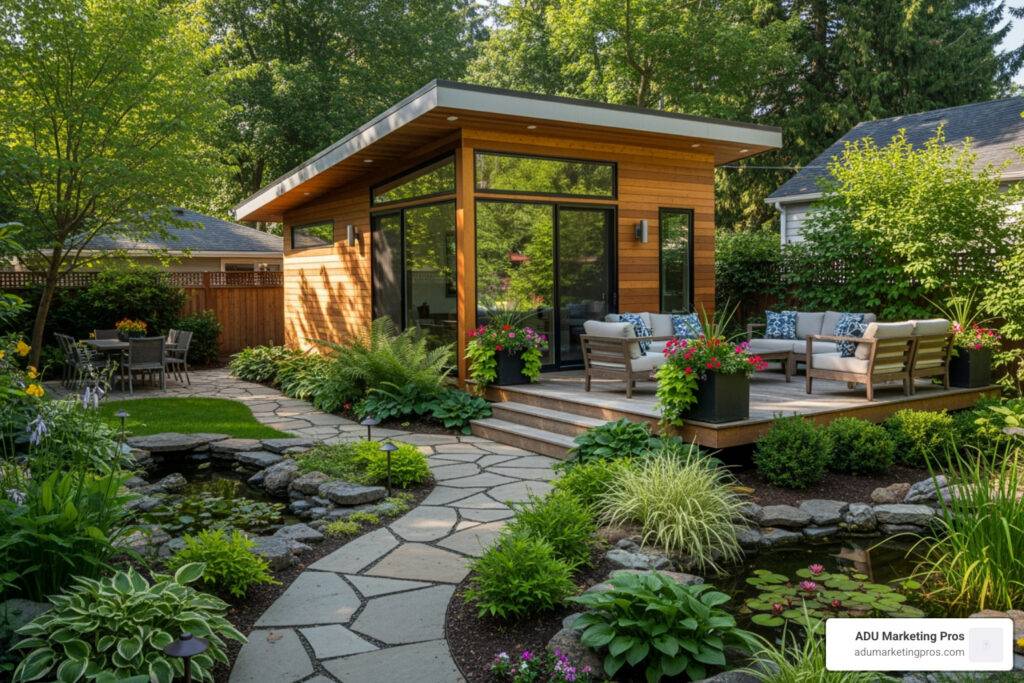
The Rise of the Backyard Home
A premade adu is a factory-built accessory dwelling unit delivered to your property for quick installation. These structures, also known as prefab ADUs, are emerging as a powerful solution to California’s housing challenges. Here’s the quick rundown:
Quick Answer: What is a Premade ADU?
- Definition: A secondary home built to state and local building codes in a controlled factory environment. It is then transported to your property, often in one or more complete sections, for final assembly and installation.
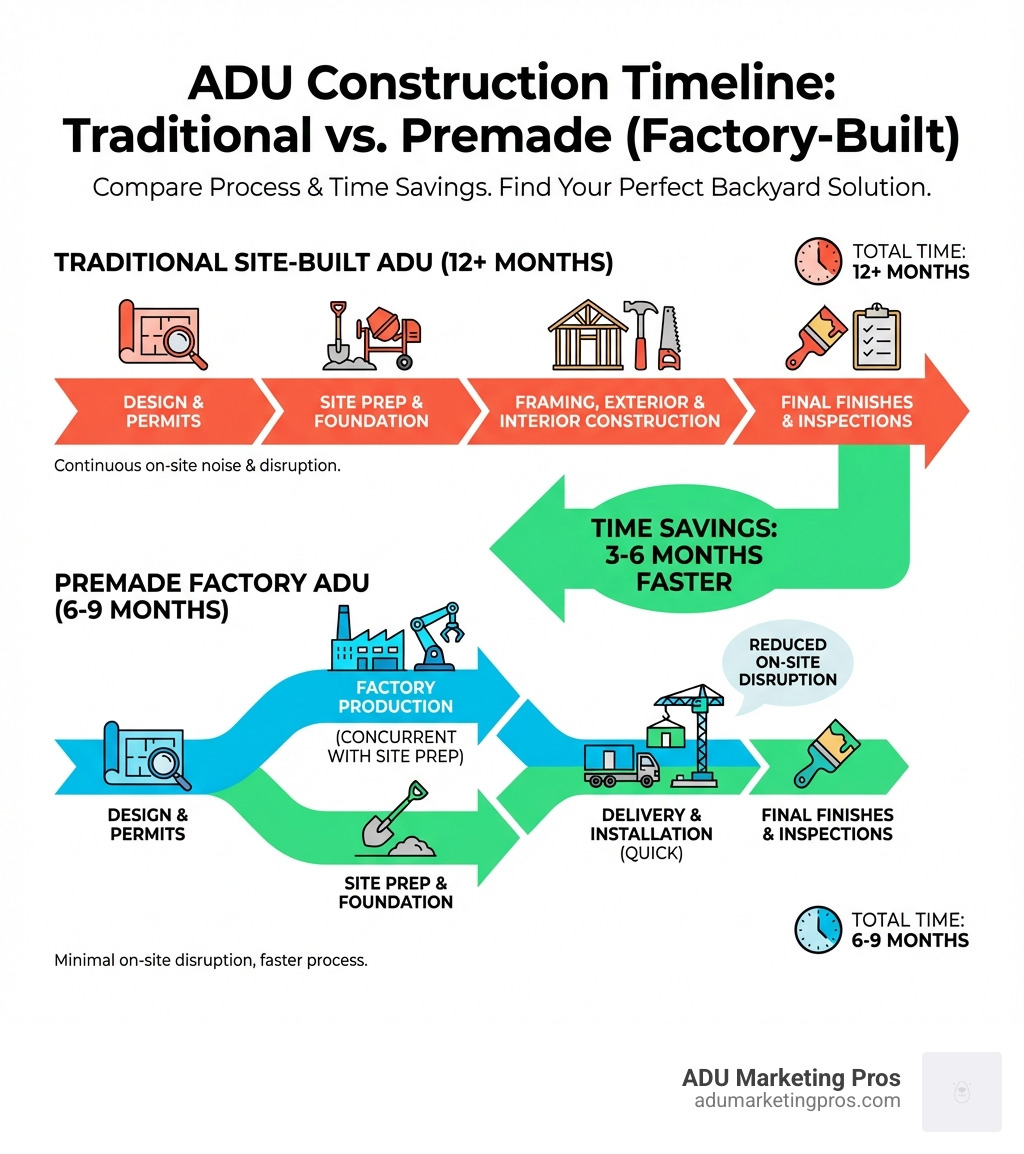
- Timeline: A significantly condensed 4-9 months from permit approval to move-in. This is possible because site preparation (foundation, utilities) occurs simultaneously while the home is being built in the factory, a stark contrast to the linear 12-24 month timeline for traditional builds.
- Cost Range: The all-in cost typically falls between $80,000 and $250,000+, but can go higher. This price is highly dependent on size, level of customization, site complexity (e.g., slope, access), and utility connection distances.
- Types: The main categories are Modular (arrives 95% complete), Panelized (wall and roof panels assembled on-site), or Kit (a pre-cut package of materials for on-site construction), each offering a different balance of speed and hands-on involvement.
- Best For: Homeowners seeking a faster, more predictable, and less disruptive building process. It’s ideal for generating rental income quickly, housing family members, or adding a dedicated workspace with minimal interruption to daily life.
California’s persistent housing crisis, fueled by decades of under-building and population growth, has sparked a backyard revolution. Homeowners from the tech hubs of Silicon Valley to the sprawling neighborhoods of San Diego are discovering that the most efficient path to more living space is going prefab. Prefab ADUs are frequently more cost-effective and significantly faster than traditional construction, thanks to standardized designs, bulk material purchasing, and the sheer efficiency of off-site manufacturing. A conventional stick-built ADU can easily consume a year or more of your time and property, whereas a prefabricated unit can be designed, permitted, built, and installed in as little as six to nine months.
Beyond speed, factory construction offers unparalleled quality control. Materials are protected from the elements, and every stage of the build is subject to rigorous inspections, eliminating the weather delays and inconsistencies common on an open construction site. Imagine avoiding months of relentless construction noise, daily crew traffic, and a yard filled with debris. With prefab, the on-site process is compressed into a few weeks of foundation work followed by a crane delivery and a few days of final installation.
These units are incredibly versatile. Whether you need a reliable source of rental income to offset a mortgage, a private and comfortable home office, an independent suite for aging parents (an alternative to costly senior living), or a vibrant creative studio, premade ADUs can boost home value and generate rental income while solving pressing housing needs.
The industry has matured rapidly, with reputable companies like Abodu, Villa, and Studio Shed offering comprehensive turnkey services. These providers manage everything from initial design and feasibility studies to navigating the complex permitting process and coordinating final installation. Concurrently, California’s state regulations have adapted, now requiring cities to approve ADU applications within 60 days and waiving substantial impact fees for units under 750 square feet, effectively cutting the red tape that once hindered these essential projects.
Premade adu terms simplified:
Why Go Prefab? The Unbeatable Advantages of Factory-Built ADUs
When adding an Accessory Dwelling Unit (ADU) in California, the choice often comes down to traditional site-built versus a prefabricated, or premade ADU. While both add valuable living space, premade options offer a suite of compelling advantages for homeowners in high-demand regions like the Bay Area, Los Angeles, and San Diego.
Faster Build Times
A primary benefit of a premade ADU is the dramatically reduced project timeline. Traditional on-site ADU construction is a linear process that can take 9-12 months or even longer, subject to weather delays, subcontractor scheduling conflicts, and lengthy inspection sequences. In stark contrast, prefab construction operates on a parallel path: the ADU is built in a factory at the same time your property is being prepared (grading, foundation, utilities). This concurrent workflow can shave months off the project. Many prefab ADUs in Southern California are completed in just 4 to 9 months from permit issuance to move-in day. This speed is a significant game-changer for homeowners eager to use their new space or, crucially, start generating rental income months earlier than they otherwise could.
Lower and More Predictable Costs
Factory efficiency almost always translates to cost savings and, just as importantly, cost predictability. Prefab ADUs can be more affordable than traditional construction by leveraging several key factors: standardized, optimized designs that reduce architectural and engineering costs; bulk purchasing of materials at a discount; and a highly efficient, specialized labor force in a streamlined factory setting. This controlled process drastically reduces material waste and eliminates unforeseen labor costs associated with on-site construction. Furthermore, California’s progressive ADU laws provide a financial boost by waiving expensive impact fees for units under 750 square feet, making smaller prefab units an even more attainable investment.
Superior Quality Control
Building a home inside a climate-controlled facility ensures a level of craftsmanship and consistent quality that is difficult to replicate on an exposed job site. Materials are protected from rain, sun, and humidity, preventing warping, mold, and degradation. Factories adhere to stringent, multi-point quality checks at every stage of construction, from framing to finishing. This results in higher precision, tighter seals, and superior structural integrity. For example, many modern prefab builders use advanced materials like cold-formed steel (CFS), which offers an exceptional strength-to-weight ratio and can better withstand the high winds and seismic activity common in California. The end product is a stronger, more durable, and longer-lasting structure.
Predictable Timelines and Less Stress
With a premade ADU, the factory-built process offers a high degree of predictability that is a welcome relief for homeowners. Once the design is finalized and permits are secured, manufacturing proceeds on a fixed schedule, immune to the vast majority of on-site delays like bad weather, subcontractor no-shows, or material delivery problems. This reliability removes a massive layer of stress and uncertainty from the building process. You get a clear completion date, allowing you to plan your finances, tenant search, or family move-in with confidence, avoiding the frustrating and costly delays that often plague traditional projects.
Reduced Site Disruption
A traditional build can turn your backyard into a noisy, messy, and intrusive construction zone for the better part of a year. Prefabricated construction minimizes this disruption profoundly. Since the bulk of the work—framing, insulation, drywall, plumbing, electrical—happens miles away at a factory, the on-site activity is drastically reduced in both duration and intensity. The on-site phase is typically limited to foundation prep, utility trenching, and the final delivery and setting of the unit, which can take just a few days. This means less noise, less debris, less traffic, and far fewer disturbances for you, your family, and your neighbors.
Sustainable and Energy Efficient Design
Many premade ADU manufacturers are leaders in sustainable building practices. The factory setting is inherently less wasteful; materials can be measured and cut with precision, and excess can be recycled or repurposed for other projects. Beyond reduced waste, these units are often designed from the ground up for high energy efficiency, potentially saving homeowners up to 60% on utility bills compared to older structures. Common features include high-R-value Structural Insulated Panels (SIPs) that create a super-tight building envelope, dual-pane windows, cool roofs, high-efficiency HVAC systems, and water-saving fixtures. Materials like CFS are also 100% recyclable, reducing the home’s end-of-life environmental impact. To learn more, you can read a Keep Truckee Green article about modular construction and sustainability. For more insights, explore our resources on Sustainable ADU Designs.
Decoding Prefab: Modular, Panelized, and Kit ADUs Explained
Not all premade ADUs are created equal. The umbrella term “prefab” covers several distinct construction methods, each with its own unique process, advantages, and ideal use case. Understanding these differences is the key to choosing the right option for your California property, budget, and timeline.
Modular ADUs: The Turnkey Solution
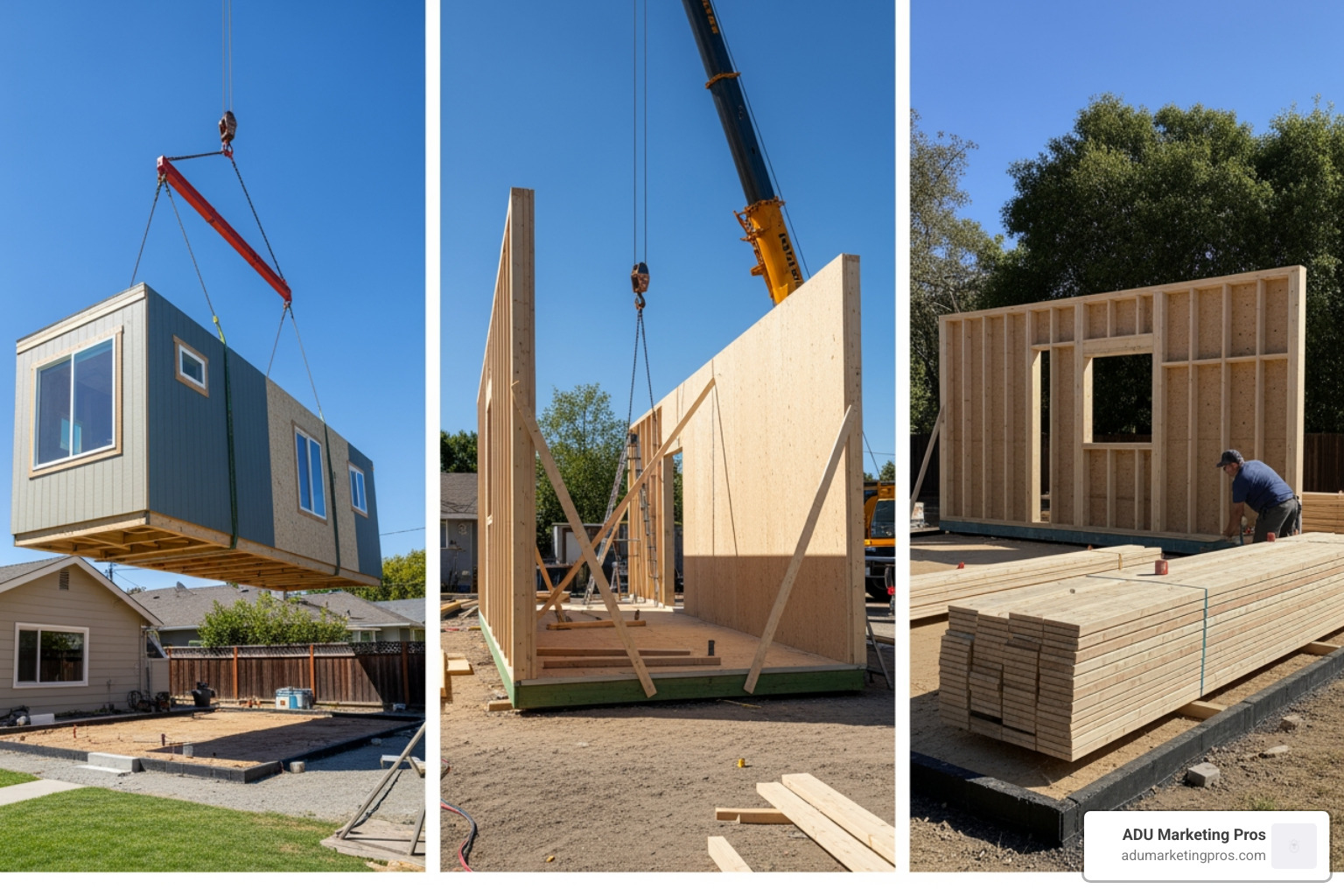
Modular ADUs are what most people picture when they hear “prefab.” These units are constructed as nearly complete, three-dimensional “modules” in a factory. They are typically 90-95% finished upon departure, with everything from framing and insulation to drywall, flooring, cabinetry, plumbing fixtures, and even appliances already installed. The finished modules are carefully wrapped, transported to your property on a truck, and then lifted by a crane onto a pre-poured foundation. The final on-site work involves “stitching” the modules together (if there are multiple), sealing the seams, and connecting the utilities. The primary advantage is unparalleled speed and minimal on-site disruption, making it a true turnkey solution. Companies like Abodu and Villa specialize in this approach, which is ideal for homeowners in busy areas like San Jose and Los Angeles who want the fastest, most hands-off experience. For more on this method, see our guide on ADU Modular Homes.
Panelized ADUs: The Hybrid Approach
Panelized ADUs represent a middle ground between fully modular and traditional building. In this method, the structural components of the home—such as walls, floor systems, and roof trusses—are manufactured as flat panels in a factory. These panels, which may include sheathing, insulation, and even windows, are then shipped to your property. On-site, a construction crew assembles these panels on the foundation, almost like a life-sized building set. While this process requires more on-site labor and time for assembly and interior finishing compared to modular, it is still significantly faster than building from scratch. The precision of factory-made panels ensures a tight, energy-efficient structure. This hybrid approach offers a great balance of speed and quality, and it can be an excellent choice for lots with difficult access where delivering a large, complete module isn’t feasible.
Kit ADUs: The DIY-Friendly Option
Kit ADUs involve the most on-site labor but can be the most cost-effective option for hands-on homeowners or those who have a trusted general contractor. With an ADU kit, all the necessary materials—pre-cut lumber, panels, trusses, windows, doors, and hardware—are pre-engineered and delivered to the site as a comprehensive package. This method eliminates the guesswork of material takeoffs and reduces waste from on-site cutting. However, the entire structure must be assembled, finished, and connected on your property. It is essentially a highly organized, streamlined building package that simplifies the construction process. This is a great option for experienced DIYers or those in areas like Palo Alto or Mountain View who want maximum control over the building process and finish details, provided they have the skills or the right team to manage the project from foundation to occupancy.
Your Journey to a Premade ADU: A Step-by-Step Guide
Embarking on a premade ADU project is a more streamlined and manageable process than many homeowners realize, especially with the rise of turnkey providers in California’s active market. Here’s a more detailed, step-by-step look at the journey from initial idea to finished backyard home.
Step 1: Design, Customization, and Feasibility
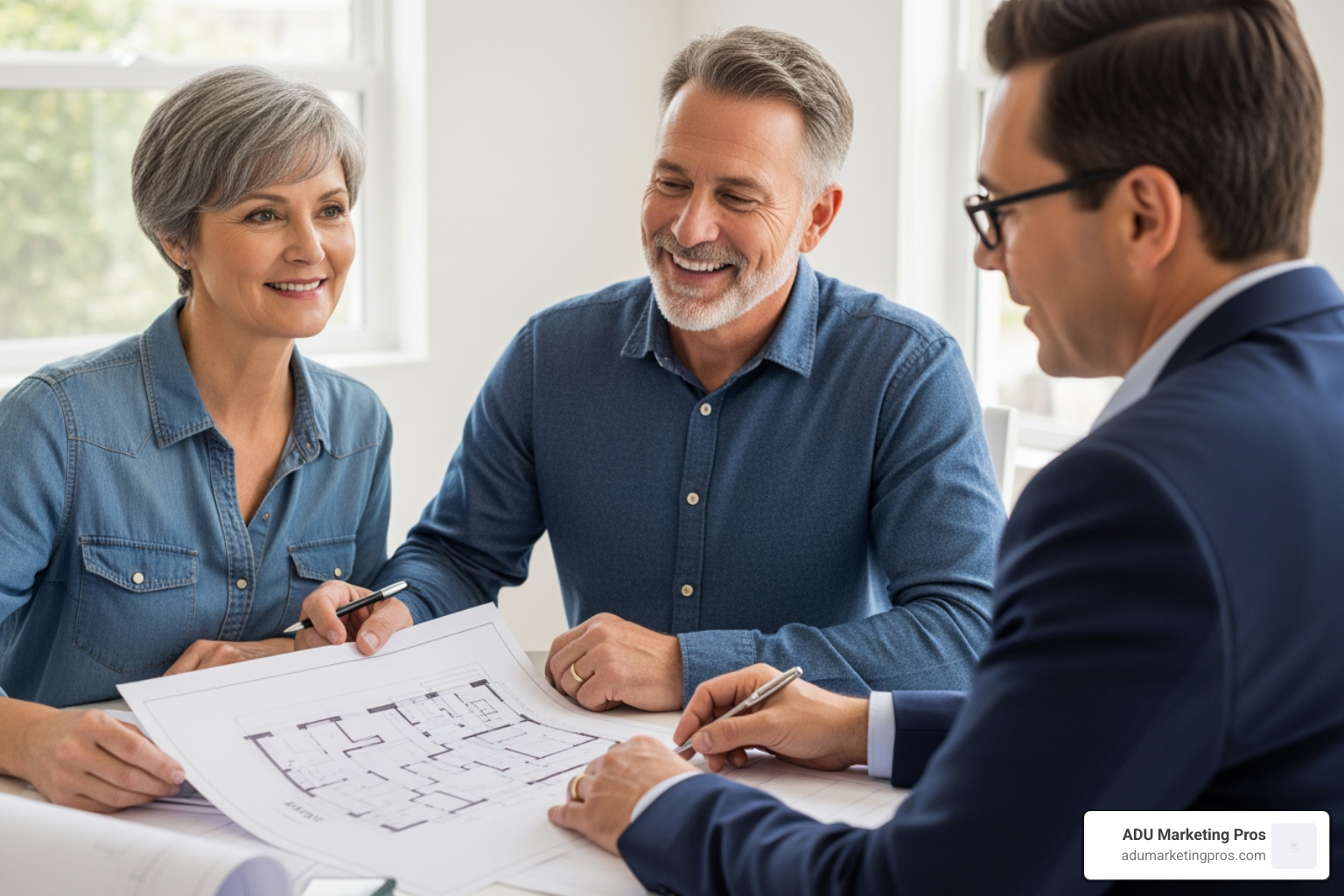
Your journey begins with a vision. How will you use this new space? Most premade ADU providers offer a curated catalog of pre-designed models, ranging from compact studios to spacious two-bedroom units, to serve as a starting point. From there, you can often customize a wide array of finishes, including exterior siding, roofing materials, flooring, paint colors, cabinetry, and countertops. Some forward-thinking companies like Studio Shed even provide interactive 3D design tools that allow you to visualize and tailor your unit in real time.
This initial phase also includes a critical feasibility study to assess your property. A reputable provider will conduct a thorough site analysis to confirm your yard can accommodate the ADU, identify the optimal placement, determine how and where utilities can be connected, and verify compliance with local setback rules and fire codes. This crucial upfront check ensures your chosen design is not only beautiful but also viable, preventing costly surprises down the road. For design inspiration, explore our ADU Design Ideas California. Using a city’s list of Pre-Approved ADU Plans can also significantly accelerate the permitting phase.
Step 2: Navigating Permits for Your Premade ADU
Permitting can be one of the most intimidating aspects of any construction project, but California’s state laws have dramatically simplified the process for premade ADUs. State law now mandates that cities and counties must approve or deny ADU applications within 60 days of the application being deemed complete, and their review must be based on objective standards, not subjective aesthetic judgments. This has largely eliminated the endless delays and arbitrary denials of the past. Many leading prefab ADU companies offer turnkey services that include managing the entire permitting process on your behalf. Their deep familiarity with the specific codes and submission portals in cities like San Jose, San Francisco, and Los Angeles is invaluable, streamlining approvals and ensuring all paperwork is filed correctly. This expert handling means less hassle for you and a much smoother, faster path to breaking ground. For more details, consult our comprehensive guides on the ADU Permit Process and California ADU Regulations.
Step 3: Site Prep, Factory Construction, and Installation
Once your permits are approved, the project springs to life on two parallel tracks:
- Site Preparation: While your ADU is being built, crews arrive at your property to prepare the site. This is a critical phase that involves grading the land to ensure proper drainage, pouring a foundation (typically a concrete slab or a raised pier system), and trenching to run the necessary utility lines for water, sewer, electricity, and gas from the main house or street to the ADU’s location.
- Off-site Manufacturing: Simultaneously, your premade ADU is constructed with precision in a controlled factory environment. This indoor process ensures the highest quality standards and eliminates the risk of weather-related delays that plague traditional construction.
- Delivery and Installation: This is the most exciting day of the project. The finished unit or panels are transported to your site. For modular ADUs, a large crane will carefully lift the unit(s) into place onto the foundation, often in a single day. After the unit is secured, the final phase involves connecting the utilities, completing any minor interior and exterior finishing touches (like seam work and trim), and conducting final inspections.
The entire process, from the day permits are issued to a move-in ready premade ADU, typically takes just 4 to 9 months—a testament to the efficiency of prefabricated construction.
The Financials: Cost, Financing, and ROI
Investing in a premade ADU is a significant financial decision, but it is one that can yield substantial and lasting returns. A clear understanding of the complete costs, available financing options, and potential return on investment (ROI) is crucial for any California homeowner considering this addition.
Breaking Down the Cost of a Premade ADU
The all-in, turnkey cost for a premade ADU in California typically ranges from $80,000 to $250,000+, but it’s essential to understand what drives this price. The final number is influenced by a combination of factors:
- Unit Cost: This is the price of the factory-built structure itself, which varies based on size (studio vs. two-bedroom), design complexity, and the level of interior and exterior finishes you select (e.g., standard vs. luxury packages).
- Soft Costs: These are the non-physical costs, including architectural and engineering fees, soil reports, surveys, and city/county permit and plan check fees. While some impact fees are waived for ADUs under 750 sq. ft., these other fees can still amount to several thousand dollars.
- Site Preparation Costs: This is the biggest variable and can significantly impact the total budget. Costs include grading, excavation, and the foundation. A flat, easily accessible lot will be far less expensive than a sloped property requiring retaining walls or extensive earthwork.
- Utility Hookups: The cost to trench and connect to water, sewer, and electrical lines is determined by the distance from the main house’s connections to the ADU site. Longer distances mean higher costs for labor and materials.
- Transportation and Installation: Delivering the unit from the factory and hiring a crane for placement are significant expenses that must be factored in. Crane costs vary based on the size of the crane needed and the complexity of the lift.
It is vital to get a transparent, itemized quote that clearly distinguishes between the cost of the prefab unit and the estimated site-specific costs. For more details, see our guides on ADU Construction Cost and Prefab ADU California Cost.
Securing Financing for Your ADU Project
Fortunately, as ADUs have become more mainstream, financing options have expanded. Several avenues are available for your premade ADU:
- Home Equity Loans/Lines of Credit (HELOCs): One of the most popular methods, this allows you to borrow against the equity you’ve built in your primary home. HELOCs offer flexibility and often have competitive interest rates.
- Construction Loans: These are short-term loans specifically for building projects. Funds are typically disbursed in stages (draws) as construction milestones are met. Lenders will want to see detailed plans and a contract with your prefab builder.
- Cash-out Refinance: This involves refinancing your existing mortgage for a larger amount than you currently owe and taking the difference in cash to pay for the ADU. This consolidates your debt into a single monthly payment.
- Personal Loans: For smaller ADU projects or to cover a portion of the costs, an unsecured personal loan can be an option, though they generally come with higher interest rates.
- Lender Partnerships: Many established prefab companies have cultivated relationships with lenders who are experienced in financing ADUs and understand the prefab process, which can greatly simplify the loan application and approval process.
Consult with a financial advisor to determine the best strategy for your situation. Our resource on ADU Financing Options offers more in-depth guidance.
Maximizing Your Return on Investment
An ADU is a powerful financial tool that boosts property value and can create a new income stream.
- Increased Property Value: A fully permitted ADU is a significant asset. Studies have shown it can increase your home’s market value by 18-35%, especially in competitive markets like the Bay Area or Los Angeles.
- Rental Income: Renting out your premade ADU can generate substantial passive income. In many California cities, monthly rent from an ADU can cover the financing cost and still provide positive cash flow. For example, a $200,000 ADU in San Jose renting for $3,000/month generates $36,000 in annual gross income, offering a strong long-term return. Learn more about the potential in our article on ADU Rental Income.
- Multi-Generational Living: An ADU provides an invaluable, independent living space for aging parents or adult children, potentially saving thousands of dollars annually compared to the cost of senior care facilities or market-rate rent.
- Flexibility: An ADU is an adaptable asset. It can serve as a rental unit today, a home office tomorrow, and a guest house in the future, changing to meet your family’s evolving needs.
A premade ADU offers a strong ADU Return on Investment through a combination of immediate financial gains and long-term lifestyle benefits.
Final Considerations: Uses, Challenges, and Choosing a Builder
While the benefits of a premade ADU are compelling, a successful project requires thoughtful planning. It’s wise to consider all angles, from the specific use of the space to potential challenges and, most importantly, how to select the right building partner.
Common Uses for Your New Backyard Space
The remarkable versatility of a premade ADU is a major part of its appeal. Homeowners from the quiet suburbs of Sunnyvale to the dense urban landscape of San Diego are using these flexible spaces for a wide range of purposes:
- Rental Income: This remains the most popular use, creating a steady stream of revenue to offset mortgage payments, build wealth, or simply provide extra financial cushion in California’s high-cost housing market.
- Guest House: A private, comfortable, and fully-equipped space for visiting friends and family, offering them (and you) more comfort and privacy than a spare bedroom.
- Home Office: A dedicated, quiet workspace completely separate from the main house. This physical separation helps create a healthy work-life balance and may offer tax advantages for small business owners and remote workers. See more ideas for your ADU Home Office.
- In-Law Suite: An ideal solution for multi-generational living, allowing aging parents or other family members to live close by while maintaining their independence and dignity. This can be a far more desirable and affordable alternative to assisted living.
- Creative Studio: A dedicated space for artists, musicians, writers, or hobbyists to work without interruption and keep messy projects out of the main home.
- Starter Home for Adult Children: In high-cost areas like Menlo Park or Santa Monica, an ADU can serve as an affordable and supportive stepping stone for adult children saving to buy their own home.
Potential Challenges and How to Overcome Them
Even a streamlined premade ADU project can encounter hurdles. Being aware of them upfront is the best way to mitigate them:
- Site Access Issues: This is a primary logistical challenge. Delivering large modular sections requires clear access for trucks and a crane. Narrow driveways, tight corners, overhead power lines, or large trees can complicate or prevent delivery. A thorough site assessment by your builder is crucial to identify these issues early and determine if a modular, panelized, or kit approach is most feasible.
- Limited Customization: While finish options are plentiful, the fundamental floor plans of prefab ADUs are less flexible than a fully custom, site-built home. You are typically working within the builder’s established designs. However, the industry is constantly expanding its offerings to meet diverse tastes and needs.
- Unforeseen Site Work Costs: The cost of preparing your site can sometimes be higher than anticipated. As some have noted, the “big cost of small dwellings” often lies in site-specific expenses like extensive grading, soil remediation, or long, complex utility trenches. It is critical to get a detailed site work estimate and build a contingency fund (typically 10-15%) into your budget.
- Navigating Local Regulations: While state laws provide a favorable framework, local jurisdictions still have specific rules for setbacks, height limits, parking, and fire safety (especially in high-risk zones). The key is to work with an experienced builder who knows the specific codes and processes in your city, whether it’s San Jose, Oakland, or Los Angeles.
How to Choose the Right Prefab ADU Builder
Selecting the right partner is the single most important decision you will make. Your builder will guide you through every step, so diligence is paramount. Here’s what to look for:
- Experience and Portfolio: Choose builders with a proven, verifiable track record of completing ADU projects in California. Ask to see a portfolio of their work and, if possible, visit a completed project or a showroom.
- Turnkey Services: For the most stress-free experience, look for a builder who offers comprehensive, turnkey services. This means they handle everything from the initial design and feasibility study to permits, site work, installation, and final inspections.
- Transparency in Pricing: Demand a clear, itemized quote that details all included costs (the unit, delivery, installation) and provides a thorough estimate for variable site costs. Be wary of vague or overly optimistic pricing.
- Client Testimonials and References: Look for recent reviews and ask for a list of past clients you can speak with. Ask them about the builder’s communication, reliability, and quality, and whether they stayed on budget and on schedule.
- Warranty: A reputable builder will stand behind their work. Understand the warranty offered on the structure itself, as well as the pass-through warranties on appliances and components.
- Local Code Expertise: Ensure the builder is an expert on both California’s state ADU laws and your specific city’s regulations. This expertise is invaluable for a smooth permitting process.
- Construction Quality and Materials: Inquire about their construction methods and the quality of materials they use. Ask about framing (e.g., wood vs. durable cold-formed steel), insulation R-values, window specifications, and siding options.
For more guidance, explore our resources on Custom ADU Builders.
Conclusion: Is a Premade ADU Right for You?
The housing landscape in California is in a state of constant evolution, and premade ADUs are at the forefront of this transformative change. They represent a smart, modern, and highly effective solution for homeowners looking to add living space, generate rental income, or house family members with far greater speed, cost-predictability, and quality control than traditional construction can offer. From the dense urban cores of San Francisco and Los Angeles to the suburban backyards of San Diego, these factory-built homes are proving their immense value every day.
Throughout this guide, we’ve covered the key advantages that make prefab a compelling choice—dramatically faster build times, predictable budgets with fewer surprises, and superior, factory-assured quality. We’ve explored the different types of prefab construction, from all-in-one turnkey modular units to flexible panelized systems and hands-on kit homes. We’ve also walked through the streamlined step-by-step process, demystified the financials of cost and ROI, and examined the versatile uses and potential challenges to consider.
Ultimately, the decision is a personal one. But if you value efficiency, predictability, and a high-quality, sustainable product with minimal disruption to your life and property, then a premade ADU is very likely the perfect solution for your backyard. It is more than just an addition; it’s a strategic investment that not only enhances your property and financial standing but also contributes a vital piece to solving California’s broader housing puzzle.
Ready to explore the exciting possibilities for your own property? The journey to your new backyard home starts with a single step. We’re here to help you navigate the options and make an informed decision. Explore ADU costs in your area to begin planning your project today.