
The Best States for Tiny Homes in 2026: A Quick Answer
As we move into 2026, the tiny house movement has transitioned from a minimalist trend into a cornerstone of the modern housing market. With traditional real estate prices continuing to challenge first-time buyers and retirees alike, the search for the best states for tiny homes has become more critical than ever. Finding a location that balances affordability with legal permissiveness is the key to a successful transition to small-scale living. In the current economic climate, where interest rates remain volatile and the supply of starter homes is at historic lows, tiny homes offer a viable, sustainable, and financially responsible alternative.
The rankings below are based on a comprehensive analysis of 2026 data, including average construction costs, zoning friendliness, climate stability, and overall livability. We have factored in the latest legislative changes that occurred throughout 2024 and 2025, which saw several states overhaul their zoning codes to accommodate the growing demand for Accessory Dwelling Units (ADUs) and Tiny Homes on Wheels (THOWs).
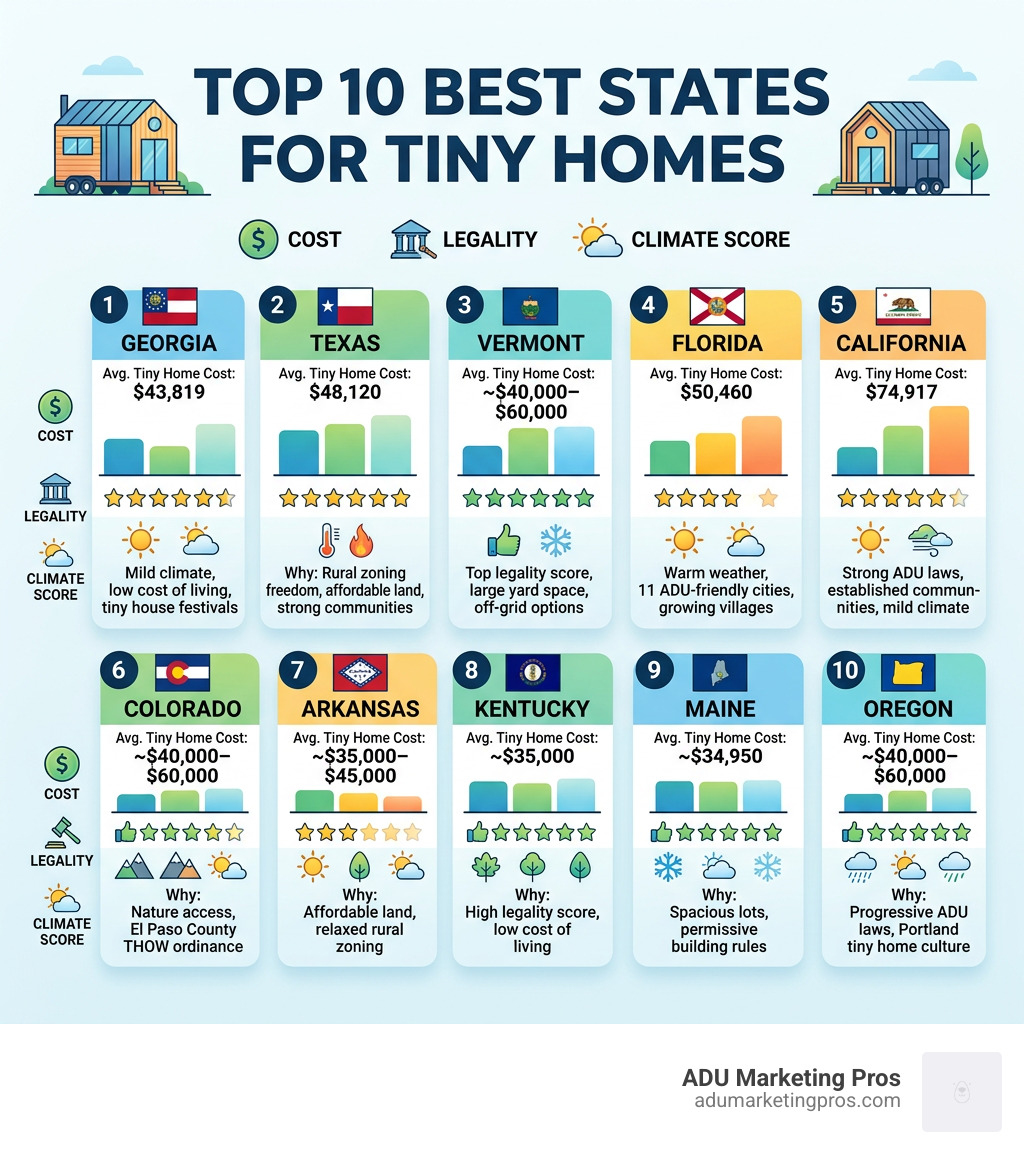
| Rank | State | Avg. Tiny Home Cost | Why It Stands Out |
|---|---|---|---|
| 1 | Georgia | $45,200 | Mild climate, low cost of living, tiny house festivals |
| 2 | Texas | $49,500 | Rural zoning freedom, affordable land, strong communities |
| 3 | Vermont | ~$42,000–$62,000 | Top legality score, large yard space, off-grid options |
| 4 | Florida | $52,100 | Warm weather, 11 ADU-friendly cities, growing villages |
| 5 | California | $77,300 | Strong ADU laws, established communities, mild climate |
| 6 | Colorado | ~$42,000–$62,000 | Nature access, El Paso County THOW ordinance |
| 7 | Arkansas | ~$36,000–$47,000 | Affordable land, relaxed rural zoning |
| 8 | Kentucky | ~$36,500 | High legality score, low cost of living |
| 9 | Maine | ~$36,200 | Spacious lots, permissive building rules |
| 10 | Oregon | ~$42,000–$62,000 | Progressive ADU laws, Portland tiny home culture |
The financial appeal of this lifestyle is undeniable. While the median starter home in many US markets now exceeds $250,000, a well-crafted tiny home typically ranges from $35,000 to $70,000. This price gap represents more than just savings; it represents financial freedom, reduced debt, and the ability to invest in experiences rather than square footage. Furthermore, the environmental footprint of a tiny home is significantly smaller, requiring less energy for heating and cooling and fewer materials for construction.
However, the “where” is just as important as the “what.” Zoning laws, building codes, and local county ordinances vary so significantly that a home deemed perfectly legal in one jurisdiction might be cited for violations just a few miles away. This guide is designed to navigate those complexities, highlighting the states that have embraced the movement and those that are still catching up. We will explore the nuances of land ownership, the difference between foundation-built and mobile units, and the specific regions where you can live your tiny house dream without the constant fear of code enforcement.
What Makes a State Tiny House Friendly?
When evaluating the best states for tiny homes, we look beyond the aesthetic appeal of the landscape. A truly “friendly” state is one where the legal framework supports permanent residency in small structures. This involves a combination of state-level mandates and local flexibility. In the past, the biggest hurdle for tiny home enthusiasts was the lack of a clear legal definition for these structures. Today, progressive states have adopted specific language that distinguishes tiny homes from temporary campers or substandard housing.
Zoning Laws and Building Codes
Zoning laws dictate land use, while building codes ensure safety and structural integrity. Historically, many US cities enforced minimum square footage requirements—often between 600 and 1,000 square feet—which effectively banned tiny homes. Friendly states have actively worked to lower or eliminate these minimums to address the housing shortage. This shift is often driven by the “YIMBY” (Yes In My Backyard) movement, which advocates for higher density and more diverse housing options to combat rising costs.
In 2026, the gold standard for tiny home construction is the International Residential Code (IRC), specifically Appendix Q. This appendix was created to provide a set of standards specifically for dwellings under 400 square feet. It addresses unique tiny home features such as:
- Relaxed requirements for loft stairs and ladders: Allowing for steeper inclines and smaller treads that save valuable floor space.
- Reduced ceiling heights in loft areas: Recognizing that sleeping lofts do not require the same 7-foot clearance as primary living areas.
- Specific emergency escape and rescue opening requirements: Tailored for smaller spaces to ensure safety without compromising the structural integrity of a small build.
Accessory Dwelling Units (ADUs)
An ADU is a secondary housing unit located on the same lot as a primary residence. For many, the easiest way to live tiny is to place a unit in a backyard. Understanding what states allow ADUs is essential for urban and suburban tiny dwellers. States like California and Oregon have passed legislation that prevents local municipalities from banning ADUs, provided they meet certain safety and size criteria. This has led to a boom in “backyard cottages” that serve as housing for aging parents, adult children, or as rental income properties.
Local Ordinances and Utilities
Even in the most progressive states, the local county or city council often has the final say. Prospective owners must investigate:
- Property Tax Classification: Is the home taxed as real estate (permanent foundation) or personal property (on wheels)? This distinction can affect your long-term costs and your ability to secure financing.
- Utility Requirements: Many jurisdictions require a permanent connection to the municipal sewer and electrical grid, which can be a hurdle for those seeking an off-grid lifestyle. Some areas are beginning to allow composting toilets and solar arrays, but these are still the exception rather than the rule.
- Community Acceptance: The “NIMBY” (Not In My Backyard) sentiment is still a factor. States with high community acceptance often have established tiny home villages or “agrihoods” that provide a supportive social environment and shared resources like community gardens and tool sheds.

Top 10 Best States for Tiny Homes in 2026
Selecting a location for your tiny home requires a strategic balance of budget, climate, and legal ease. While some states offer incredibly cheap land, they may lack the infrastructure or legal protections needed for long-term security. The following states have been selected for their proactive approach to small-scale housing. For those focusing on the West Coast, it is helpful to learn more about California’s varying guidelines to understand how local control impacts the broader state mandates.
1. Georgia: The Southern Leader
Georgia remains a top contender in 2026 due to its combination of affordability and a welcoming culture. With an average tiny home price of $45,200 and a mild climate that averages 62.3 degrees Fahrenheit, it is ideal for year-round living. The state has become a hub for the movement, hosting major festivals and supporting several dedicated tiny house communities in the Blue Ridge mountains. Its low cost of living and diverse geography—from coastal plains to mountain peaks—make it a versatile choice for all ages. Cities like Decatur have been pioneers in changing zoning to allow for smaller footprints.
2. Texas: The Land of Rural Freedom
Texas is synonymous with “rural freedom.” In many Texas counties, there are no zoning regulations outside of city limits, which provides a level of autonomy rarely found elsewhere. This has led to the rise of innovative projects like Village Farm Austin, an “agrihood” where residents live in tiny homes centered around a working organic farm. Spur, Texas, continues to be a landmark as the first tiny-house-friendly town in the country. Whether you are looking for the lakeside luxury of WatersEdge at Lake Conroe or a quiet plot in the Hill Country, Texas offers a robust market for small-scale living. It is important to note that while Texas counties do not enforce zoning regulations in many areas, you must still adhere to state-level health and safety standards regarding septic and water.
3. Vermont: The Legality Champion
Vermont consistently ranks high for its progressive stance on housing. The state has made significant strides in simplifying the permitting process for small dwellings. With a focus on sustainability and environmental stewardship, Vermont is perfect for those looking to build high-efficiency, foundation-built tiny homes. The state’s “Act 250” provides a framework for land use that, while rigorous, often favors clustered, small-scale developments over sprawling suburban tracts.
4. Florida: The Sunshine State’s Tiny Boom
Florida offers more than just warm weather; it offers a rapidly growing network of tiny home villages. Cities like Rockledge and Sarasota have created specific zoning categories for tiny homes, allowing them to be placed on smaller lots than traditional houses. The state’s ADU-friendly policies in urban centers like Orlando and Miami make it a prime location for those who want to live tiny while staying close to city amenities. The average cost of $52,100 is balanced by the lack of state income tax.
5. California: The ADU Innovator
California is the leader in ADU legislation. Despite having a higher average cost of $77,300, the state has made it legally easier to build a tiny home than almost anywhere else. Recent updates have streamlined the permitting process, requiring cities to act on applications within 60 days. Cities like Fresno and San Diego have led the way by legalizing Tiny Homes on Wheels (THOWs) as habitable ADUs. This has opened the door for many tiny house builders in California to create high-end, compliant units that serve as primary residences or rental properties. From the creative enclaves of Sonoma County to the Delta Bay Tiny House Resort, California offers a sophisticated infrastructure for the tiny life.
6. Colorado: Nature and Progress
Colorado is a magnet for outdoor enthusiasts, and its tiny home scene reflects that. El Paso County has been a leader in creating ordinances that specifically allow for THOWs. The state’s mix of rugged mountains and progressive urban centers like Boulder and Denver provides a variety of settings for tiny living. Colorado’s adoption of Appendix Q has made it much easier for builders to create safe, legal structures that can withstand the state’s snowy winters.
7. Arkansas: The Budget Choice
For those looking for the lowest entry price, Arkansas is hard to beat. With land prices significantly lower than the national average and relaxed rural zoning, it is a haven for DIY builders and those looking to live off-grid. The Ozark region, in particular, has seen a rise in small-scale homesteads where tiny homes serve as the primary residence for those seeking a simpler, more self-sufficient lifestyle.
8. Kentucky: High Legality, Low Cost
Kentucky often flies under the radar, but it offers some of the most permissive building rules in the country. The state’s low cost of living and high legality score make it an attractive option for retirees on a fixed income. Several communities in Kentucky have embraced tiny homes as a way to revitalize rural areas and provide affordable housing for young professionals.
9. Maine: Spacious and Permissive
Maine’s “LD 2003” legislation has been a game-changer, requiring municipalities to allow for higher density and ADUs. Maine offers the unique combination of vast, affordable acreage and a legal system that is increasingly supportive of small-scale housing. It is an ideal state for those who want a tiny home with a large “backyard” of forest or coastline.
10. Oregon: The Cultural Hub
Oregon, particularly Portland, has long been the heart of the tiny house movement. The state’s progressive ADU laws and the presence of numerous tiny home builders and designers make it a great place to start your journey. Oregon’s “Residential Outbuildings” code allows for a variety of small structures, and the state’s commitment to urban growth boundaries encourages the kind of high-density, small-footprint living that tiny homes provide.
Navigating Regulations: THOWs vs. Foundation-Built Homes
One of the most common points of confusion for newcomers is the distinction between a Tiny Home on Wheels (THOW) and a foundation-built structure. This distinction determines everything from your taxes to where you can legally park. As the movement matures, the legal lines are becoming clearer, but they still require careful navigation.
- Tiny Homes on Wheels (THOWs): These are often built to RVIA (Recreational Vehicle Industry Association) standards. While they offer mobility, many cities still classify them as RVs, meaning you cannot live in them full-time on a standard residential lot. However, progressive cities are increasingly allowing them as ADUs if they are hooked up to permanent utilities. The advantage of a THOW is that it is often classified as personal property, which can lead to lower taxes, though it may depreciate like a vehicle rather than appreciate like real estate.
- Foundation-Built Homes: These are constructed on-site or delivered as a modular unit to a permanent slab or crawlspace. They are governed by local building codes and the IRC. While they lack mobility, they are generally easier to finance with traditional loans and are more likely to appreciate in value as real estate. They are also more widely accepted by local zoning boards, as they look and function more like traditional “small houses.”
In Florida, for instance, the Florida Housing Coalition ADU Guidebook provides a roadmap for how different municipalities handle these structures. Before committing to a build, it is vital to understand the ADU vs tiny house nuances in your specific city to avoid costly compliance issues. Some cities may allow a foundation-built tiny home but ban a THOW, or vice versa, depending on their specific goals for neighborhood character and density.
Living Off-Grid: Best States for Tiny Homes and Self-Sufficiency
For many, the tiny house movement is inseparable from the desire for self-sufficiency. If your goal is to live off the grid with solar power and rainwater collection, certain states are much more accommodating. This lifestyle requires a shift in mindset, moving away from the convenience of municipal services toward a more hands-on approach to resource management.
- Iowa: Consistently ranked as a top state for off-grid living due to its permissive rural land-use policies and high potential for wind and solar energy. Iowa’s agricultural heritage means that many counties are comfortable with non-traditional structures and self-managed utilities.
- Alaska: The ultimate frontier for tiny living. Many boroughs in Alaska have no building codes or permit requirements for small structures, though the extreme climate requires specialized construction techniques. Living tiny in Alaska is a test of endurance and ingenuity, but it offers unparalleled privacy and natural beauty.
- Arkansas: Known for having some of the most affordable unrestricted land in the Southeast. It is a popular destination for those building eco-friendly small homes on a budget. The state’s climate is conducive to gardening and small-scale farming, which often goes hand-in-hand with the tiny house lifestyle.
- New Mexico: Offers a combination of cheap land and high solar gain, making it a prime location for earth-sheltered or solar-powered tiny homes. The state has a long history of alternative architecture, from traditional adobes to modern “Earthships,” making it culturally receptive to tiny homes.
Living off-grid requires a deep understanding of local environmental regulations, particularly regarding greywater disposal and composting toilets, which are still restricted in some “friendly” states. Always check with the local health department before assuming your off-grid sanitation plan is legal.
Challenges and Pitfalls of the Tiny House Journey
While the benefits of tiny living are numerous, the path is not without its obstacles. Being prepared for these challenges is what separates successful transitions from abandoned projects. It is important to approach the process with a realistic understanding of the logistical and emotional hurdles involved.
- Financing: Because tiny homes (especially THOWs) do not fit the traditional definition of real estate, getting a standard mortgage is difficult. Most owners rely on personal loans, RV loans, or manufacturer financing, which often carry higher interest rates and shorter terms. For foundation-built homes, you may be able to secure a construction-to-permanent loan, but you will need to meet strict appraisal requirements.
- Insurance: Insuring a DIY tiny home can be a significant hurdle. Many traditional carriers will only insure homes built by certified manufacturers (such as those with NOAH or RVIA certification). You may need to seek out specialized “inland marine” policies or RV-specific coverage, which can be more expensive and offer less comprehensive protection than a standard homeowner’s policy.
- Climate Adaptations: A tiny home in Maine requires significantly more insulation and moisture control than one in Southern California. In small, airtight spaces, proper ventilation is critical to prevent mold and maintain air quality. You must also consider the “thermal bridge” of a steel trailer frame if you are building on wheels, as this can lead to cold floors and condensation issues.
- Hidden Costs: The cost of the “shell” is only the beginning. Site preparation, including clearing land, drilling a well, installing a septic system, and running electrical lines, can often cost as much as the home itself. Impact fees—charges levied by local governments to fund infrastructure—can also add thousands of dollars to your budget.
- The Psychology of Downsizing: Moving from 2,000 square feet to 200 is a massive shift. It requires a rigorous culling of possessions and a change in daily habits. Many people find the transition liberating, but it can also lead to “tiny house blues” if the space feels too restrictive or if the lack of privacy becomes an issue for couples or families.
If you are looking to bypass some of these hurdles, searching for existing small houses for sale that already have utility connections and established zoning can be a smart financial move. This allows you to focus on the lifestyle rather than the bureaucracy of land development.
Frequently Asked Questions about Tiny Home Living
Are tiny homes legal in all 50 states?
There is no federal or state-wide ban on tiny homes in any of the 50 states. However, legality is determined at the local level. Many cities use minimum square footage requirements in their zoning codes to prevent tiny homes from being built in certain residential areas. The trend, however, is toward more inclusion as the housing crisis worsens.
How much does the average tiny home cost in 2026?
In 2026, the average cost for a professionally built tiny home ranges from $40,000 to $80,000. DIY builds can still be completed for under $25,000 if you use reclaimed materials and do the labor yourself, while luxury models with high-end finishes, smart home technology, and off-grid systems can exceed $120,000.
Can I park a tiny home on my own land without a permit?
Generally, no. Even if you own the land, most jurisdictions require permits for any structure used as a permanent residence. This includes permits for sanitation (septic or sewer) and electrical work. Parking a THOW on your land without these permits often results in code enforcement citations and potential eviction from your own property.
Can a family of four live in a tiny home?
Yes, but it requires careful design. Many families utilize “gooseneck” trailers or larger foundation-built tiny homes (up to 600 square feet) with multiple lofts or separate bedrooms. The key is having dedicated spaces for children and plenty of outdoor living area to expand the footprint of the home.
Do tiny homes hold their value?
Foundation-built tiny homes tend to appreciate similarly to traditional real estate, especially if they are located in desirable areas. Tiny Homes on Wheels (THOWs) are more like high-end RVs; they may depreciate over time, though well-maintained units from reputable builders have shown surprisingly strong resale value due to high demand.
Conclusion
The journey to tiny living is a path toward intentionality, sustainability, and financial freedom. As we look at the best states for tiny homes in 2026, it is clear that the movement is no longer just about the size of the house, but about the quality of the life lived within it. Whether you are drawn to the rugged independence of Alaska, the rural freedom of Texas, or the legislative progress of California, there is a place for your vision. The key to success lies in thorough research, understanding the local legal landscape, and choosing a location that aligns with your long-term goals.
At ADU Marketing Pros, we are dedicated to supporting the architects and builders who make these dreams a reality. Based in San Jose, CA, we provide specialized digital marketing solutions for the ADU and tiny home industry. We help firms navigate the competitive landscape by connecting them with high-quality leads and establishing them as market authorities in this rapidly evolving sector. Our expertise allows builders to focus on what they do best—creating beautiful, functional homes—while we handle the complexities of digital growth.
If you are a builder or architect looking to scale your operations in the booming ADU sector, we invite you to explore our ADU Marketing Pros services. Together, we can continue to innovate and expand the reach of sustainable, affordable housing across the nation, helping more people find their perfect place in the tiny house movement.