
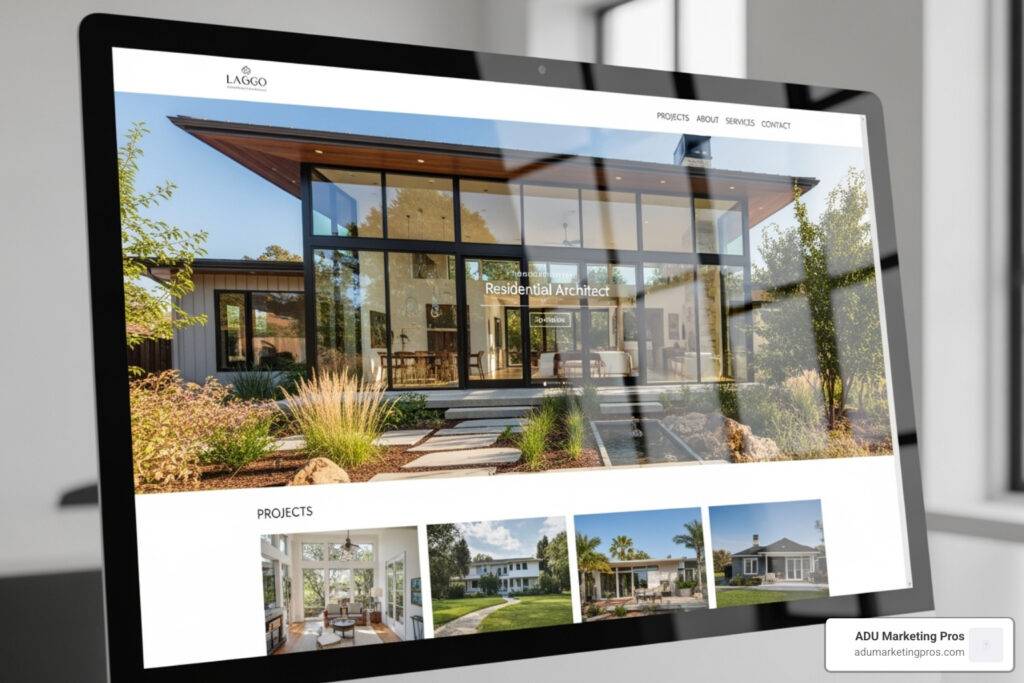
Why Your Residential Architecture Firm Needs a Strategic Web Presence
Residential architect web design is far more than a digital brochure; it is your firm’s most critical business and marketing asset. In today’s competitive market, a high-end client’s journey almost always begins online. Your website serves as your virtual studio, your curated portfolio, and the first handshake with discerning homeowners looking to make a significant investment. A generic, slow, or poorly designed site doesn’t just fail to impress—it actively erodes credibility.
Research consistently shows that 75% of consumers judge a company’s credibility based on its website design. For architects, this statistic is even more potent. Your digital presence must be a direct reflection of the precision, creativity, and quality that define your built work. An effective residential architect website is a seamless fusion of art and strategy, designed to attract, engage, and convert your ideal clients.
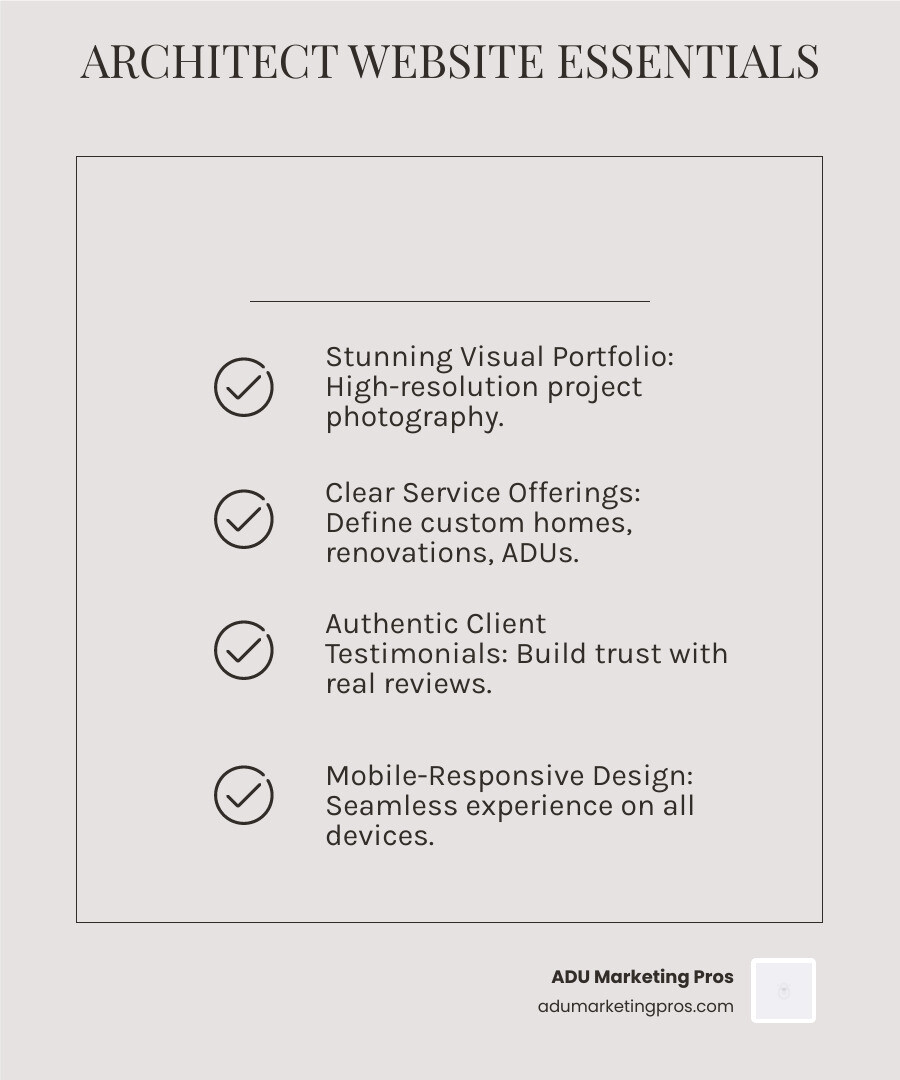
Essential Elements for a High-Performing Architect Website:
- A stunning, immersive visual portfolio with professional, high-resolution photography and video.
- A clear articulation of your firm’s unique design philosophy and value proposition.
- Detailed service offerings (e.g., custom homes, historic renovations, sustainable design, ADUs).
- Authentic client testimonials and in-depth case studies that build trust.
- A flawless, mobile-responsive design for an exceptional user experience on any device.
- Strategic calls-to-action (CTAs) that guide visitors toward a consultation.
- Blazing-fast loading speeds and intuitive, logical navigation.
Whether you specialize in sprawling luxury estates, minimalist modern homes, or innovative ADU designs, your website must communicate your expertise with clarity and elegance. It must tell a compelling story and make it effortless for a potential client to take the next step in their journey with you.
Terms related to residential architect web design:
The Foundation: Essential Website Elements for Architects
A successful architect website is more than a collection of images; it’s a carefully constructed digital experience designed to guide high-value clients from initial curiosity to a confident decision to engage your firm. With users forming a lasting impression in mere seconds, these foundational elements must work in perfect harmony to create an effective and compelling online presence.
Key pillars include non-negotiable high-quality imagery, user-centric navigation, and flawless mobile responsiveness, as over half of all website traffic now originates from mobile devices. Fast loading speed is equally critical; a delay of even a few seconds can cause a potential lead to abandon your site. Above all, the site must powerfully convey your firm’s unique brand identity and design philosophy. This is the soul of your website—the narrative that explains what makes your architectural approach distinct and why a client should choose you over any other firm.
Your Digital Portfolio: The Heart of Your Site
Your portfolio is the undeniable centerpiece of your website, a curated gallery designed to showcase the breadth and depth of your talent. To create a truly immersive and persuasive portfolio, we recommend including:
- Stunning, high-resolution photography: Professional images are paramount. Invest in an architectural photographer who can capture the light, materials, and emotional essence of your designs.
- Immersive video content: Video walkthroughs and drone footage can convey the spatial experience of a home in a way that static images cannot, offering a powerful and engaging perspective.
- 3D renderings and detailed case studies: Showcase your process. Renderings can visualize unbuilt projects, while case studies can walk clients through the entire project journey, highlighting challenges, creative solutions, and the final, successful outcome.
- Before-and-after galleries: For renovation and addition projects, these are incredibly powerful. They provide a tangible, dramatic demonstration of your work’s transformative impact.
- Strategic categorization: Organize projects to help visitors find what’s relevant to them. Go beyond simple type (e.g., modern, traditional, ADU) and consider organizing by client goal (e.g., “Sustainable Living,” “Homes for Entertaining”) or location.
- Dedicated project pages: Each project deserves its own page with a gallery of strong visuals, a concise narrative description, and key details.
About Us: Telling Your Firm’s Story
People hire architects they connect with and trust. The “About Us” page is your opportunity to build that connection by sharing the human story behind your firm. This section should articulate your:
- Firm’s mission and values: What is the driving force behind your work? Share your core beliefs, whether it’s a commitment to creating “healthy, adaptable homes” or practicing “architecture that serves the greater good.”
- The firm’s origin story: What inspired you to become an architect? Sharing your passion and journey can create a powerful personal connection.
- Detailed team bios: Introduce your principal architect and key team members. Go beyond a simple resume; share their experience, unique expertise, and what they love about architecture.
- Unique design philosophy: Clearly articulate your approach. Do you focus on the interplay of light and shadow, the seamless integration of landscape and structure, or a particular material palette? This is a key differentiator.
- Awards and publications: Prominently list accolades and features in respected publications like Dwell or New England Home to build third-party credibility.
Services & Process: Defining What You Do and How You Do It
Clarity is crucial for converting interest into qualified leads. Your services page must clearly define what you offer and explain your process for potential clients. This manages expectations and builds confidence. Include:
- A detailed list of services: Be specific about your offerings, such as custom new homes, large-scale renovations, historic preservation, interior design, and Accessory Dwelling Units (ADUs).
- A step-by-step process breakdown: Guide clients through your architectural process. Consider detailing phases like Pre-Design & Feasibility, Schematic Design, Design Development, Construction Documents, Bidding & Negotiation, and Construction Administration. This shows professionalism and transparency.
- Emphasis on client collaboration: Reassure potential clients that their vision is central to the process. Explain how you integrate their needs, desires, and feedback at each stage.
- Fee structure overview: Briefly and clearly explain your fee structure (e.g., percentage of construction cost, hourly rates, or a hybrid model) to help pre-qualify leads and start the conversation on a transparent footing.
Contact & Lead Capture
Your website’s ultimate goal is to generate leads. Make it exceptionally easy for potential clients to get in touch. This section should be prominent, simple, and user-friendly.
- Visible contact information: Display your phone number, email, and studio address in the website’s header and footer for immediate access on every page.
- A simple, streamlined inquiry form: Only ask for essential information: name, email, phone, and a brief message about their project. Long, complicated forms are a major deterrent.
- Strong, compelling calls-to-action (CTAs): Use clear, action-oriented language on buttons like “Schedule a Consultation” or “Discuss Your Project” to guide users and significantly boost conversions.
- Embedded location map: An embedded Google Map not only helps clients find you but also improves your local SEO, which is critical if you serve a specific geographic area like the San Francisco Bay Area or the Hamptons.
- Social media links: Provide links to your professional social profiles (especially visually-driven platforms like Instagram and Pinterest) to engage with clients and showcase your work in a different context.
The Blueprint: UX, Visuals, and Modern Design Trends
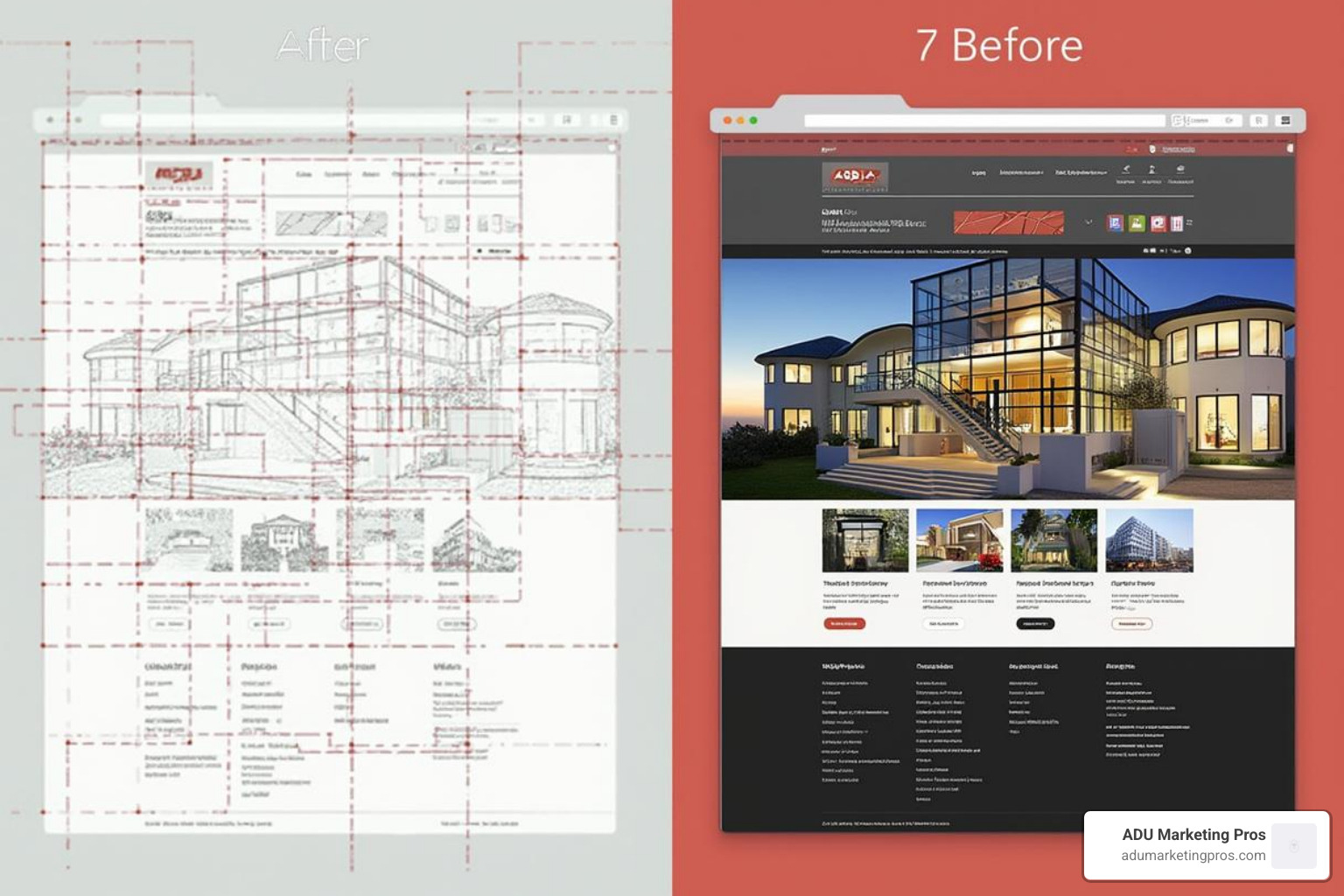
Your website is more than a digital portfolio; it’s a functional machine designed to guide visitors on a specific journey. User Experience (UX) and visual storytelling are the twin pillars of effective residential architect web design, balancing aesthetic creativity with intuitive usability. Think of it as designing a breathtakingly beautiful home that is also effortless and comfortable to live in.
Best Practices for User Experience (UX)
Poor UX is the digital equivalent of a stunning home with a confusing floor plan where you can’t find the light switches. A great user experience is essential to keep visitors engaged, build trust, and encourage them to explore your work deeply.
- Intuitive navigation is paramount. A visitor should be able to find your portfolio, services, and contact information within seconds via a clear, logical main menu.
- A fast page load speed is non-negotiable. Google recommends pages load in under 2.5 seconds; any longer, and you risk visitors leaving before they even see your work.
- Use readable typography and ample white space. Choose clean, legible fonts (at least 16px for body text) and use generous spacing to create a calm, uncluttered layout that allows your project photos to be the heroes.
- Your site must be mobile-friendly and responsive. With over 50% of web traffic coming from mobile devices, your site must provide a seamless experience on everything from a smartphone to a large desktop monitor.
- A simple, logical user flow guides potential clients smoothly from a landing page to a project gallery and, finally, to your contact form. For a deeper dive into creating user-centric digital products, explore the resources on user experience research from Smashing Magazine.
Using Visual Storytelling to Engage Clients
As an architect, you are a master storyteller who uses space, light, and materials. Your website must do the same with pixels and code. Narrate your projects, don’t just display them.
- Share the story behind each design. Create compelling project narratives that detail the client’s vision, the unique challenges of the site, and the creative breakthroughs that led to the final design. This creates a far deeper connection than a simple photo gallery.
- High-quality video tours and drone footage can immerse visitors in the finished space, conveying its flow, atmosphere, and relationship to its surroundings in a way static images cannot.
- Bring your site to life with interactive elements. Allow users to engage with 3D models, view process sketches, or click on hotspots in a floor plan to see photos of that specific space. This highlights your meticulous process and technical skill.
- Use immersive visuals to spark emotion. A full-screen “hero” image of your best work on the homepage can make an immediate, powerful first impression and bring your architectural vision to life.
Current Trends in Architect Web Design
Staying current with web design trends signals that your firm is as forward-thinking in its digital presence as it is in its architecture.
- Minimalist layouts with full-screen, high-impact imagery continue to dominate, as they let the architectural work speak for itself without digital clutter.
- Asymmetrical grids and bold, neat typography can create a dynamic, memorable, and sophisticated visual experience that breaks from cookie-cutter templates.
- Micro-interactions and subtle animations—like a button that changes color on hover or a project image that gently fades in—add a layer of polish and make your site feel alive and modern.
- A dark mode theme is an increasingly popular choice for architects, as it can make vibrant project photography pop, reduce eye strain, and lend your site a sophisticated, contemporary feel.
Building Credibility: Showcasing Your Work and Building Trust
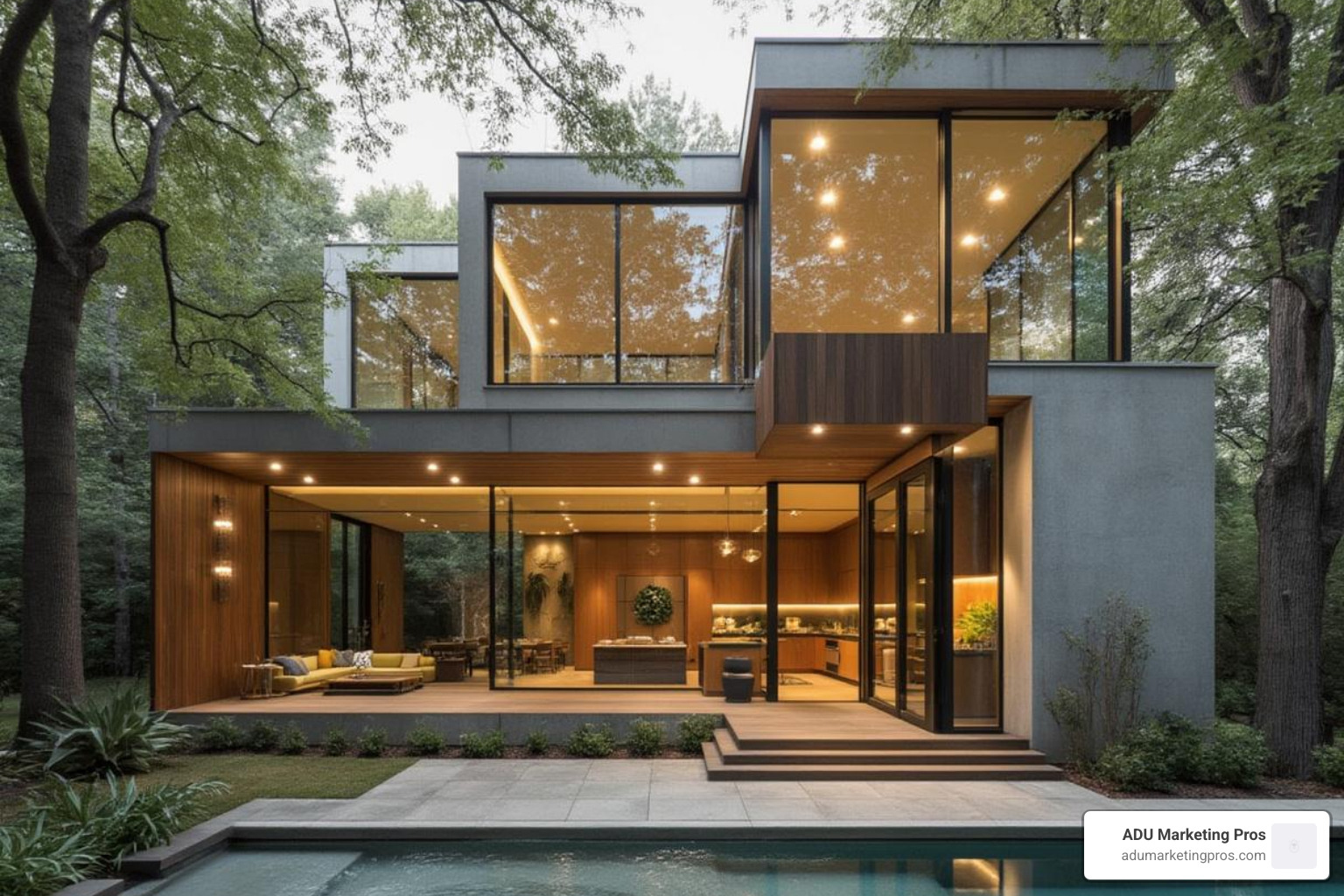
High-end residential projects are built on a foundation of trust. Clients need to feel deeply confident that you can not only realize their vision but also steward their significant investment with expertise and care. Your website is the primary stage for building that confidence by highlighting your proven expertise, celebrating your happy clients, and clearly communicating your firm’s unique value.
Crafting Your Portfolio for Maximum Impact
A compelling portfolio does more than showcase beautiful images—it tells a persuasive story that draws visitors into each project, demonstrating your problem-solving skills and design intelligence.
- Provide detailed project descriptions that go beyond the obvious. Explain the client’s initial goals, the core design concept, and how the final space serves their lifestyle.
- Highlight challenges and solutions. Don’t be afraid to discuss constraints. Explaining how you steerd tricky zoning laws, a difficult site, or a tight budget demonstrates your real-world problem-solving expertise and builds immense credibility.
- Showcase materials and craftsmanship. Detail the key materials used and why they were chosen. This underscores your commitment to quality, durability, and longevity.
- Include architectural drawings, sketches, or diagrams to offer a window into your technical skills and the creative evolution of the project. For more best practices, see ArchDaily’s guide to creating a compelling architect portfolio.
The Power of Client Testimonials and Case Studies
Authentic social proof is one of your most powerful marketing tools. Prospects trust the experiences of other homeowners far more than your own marketing copy. Websites that effectively use testimonials can see conversion rates increase by over 30%.
- Feature video testimonials or pair high-quality written quotes with professional photos of the client in their completed home for maximum impact and credibility.
- Link to third-party review sites like Houzz or your Google Business Profile. This proves your reviews are genuine and allows prospects to see a wider range of unbiased feedback.
- Develop in-depth case studies for your signature projects. A strong case study follows a narrative arc: 1) The Client & Their Vision, 2) The Site & Its Challenges, 3) The Architectural Solution, 4) The Collaborative Process, and 5) The Stunning Outcome, complete with a glowing testimonial.
Communicating Your Brand and Thought Leadership
Every element on your site should reinforce your firm’s unique personality, professional standards, and position as an industry leader.
- Maintain a consistent visual identity—your logo, color palette, and typography—across all pages for a polished, cohesive, and professional feel.
- Articulate your values with conviction. Whether you focus on sustainable, net-zero design, historic preservation, or community-centric solutions, stating your philosophy clearly and passionately will attract like-minded clients.
- Showcase thought leadership. Dedicate a section of your site to a blog, articles, or news. Featuring your insights on design trends, white papers on building science, or announcements about speaking engagements positions you not just as a service provider, but as an expert authority in your field. Referencing your affiliation with respected organizations like the American Institute of Architects (AIA) further solidifies this authority.
The Framework for Growth: Strategic Residential Architect Web Design
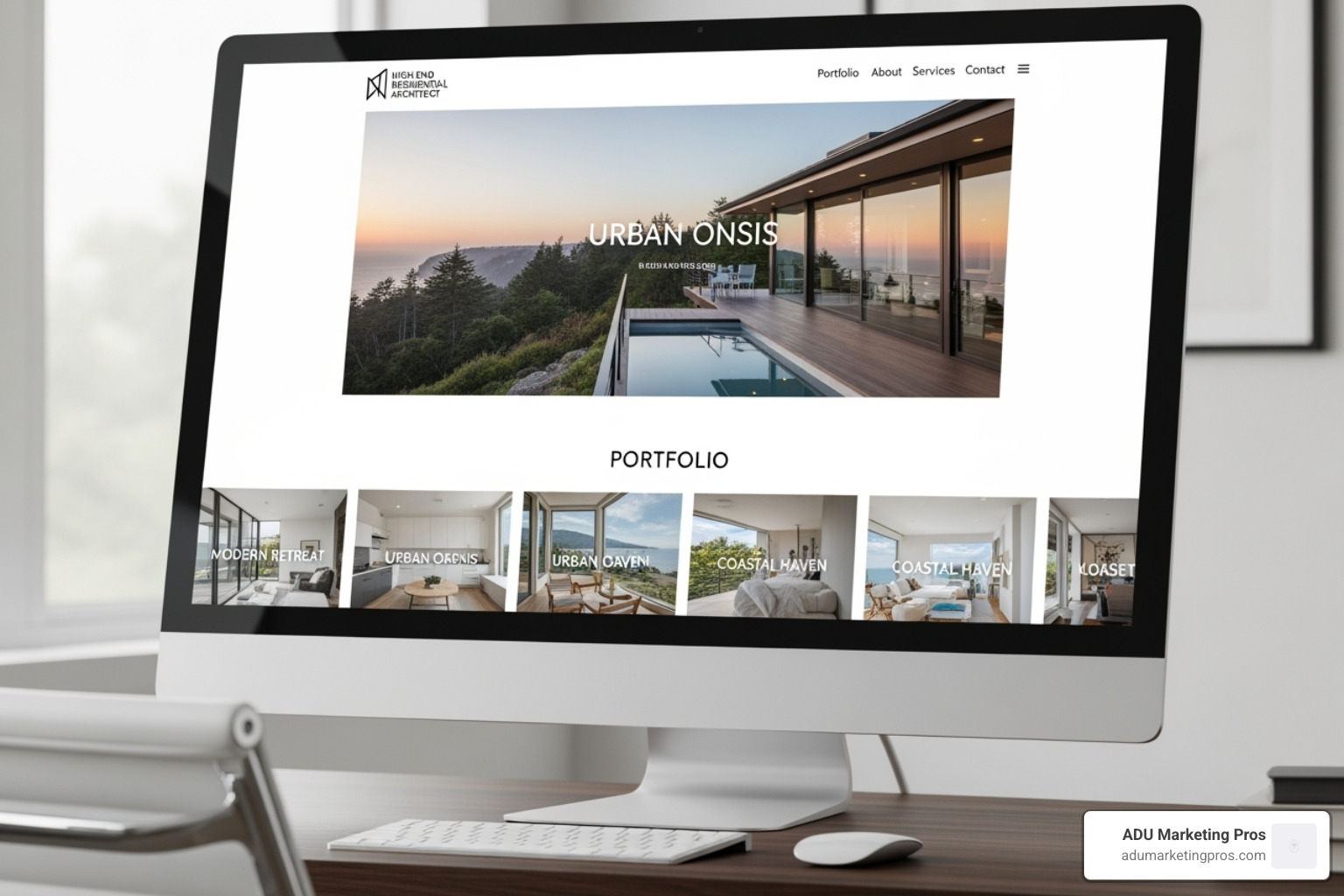
Your website should not be a passive digital object. It must be an active, strategic growth engine—an always-on marketing system that consistently attracts and qualifies your ideal clients, producing a steady stream of high-quality project inquiries so you can stay focused on design, not business development.
### The Role of a Blog in Your Content Strategy
A regularly updated blog is one of the most effective tools for demonstrating expertise and driving organic traffic. It transforms your website from a static portfolio into a dynamic resource.
- Showcase expertise with articles on topics like passive house principles, the benefits of biophilic design, or navigating local building regulations.
- Answer common client questions in detail. Posts like “How Much Does It Cost to Build a Custom Home in [Your City]?” or “Our Architectural Process, Explained” build trust and pre-qualify leads.
- Boost Search Engine Optimization (SEO) by consistently publishing valuable content optimized for keywords your potential clients are searching for.
- Share firm news such as project milestones, new awards, or team member spotlights to demonstrate momentum and personality.
- Drive targeted traffic by promoting your articles on social media platforms like LinkedIn and in your email newsletter.
### Mastering SEO for Architects
A beautiful website is useless if your ideal clients can’t find it. SEO is the practice of optimizing your site to rank higher in search engine results for relevant queries.
- Local SEO is Critical: Most architects serve a specific geographic region. Optimizing your Google Business Profile is the first step. Ensure it’s complete with photos, services, and positive reviews. Consistently use location-specific keywords throughout your site (e.g., “Boston residential architect,” “custom home designer in Marin County”).
- Keyword Research: Identify the terms your target audience uses. These might include long-tail keywords like “architect for modern kitchen renovation” or “sustainable ADU designer Los Angeles,” which indicate high intent.
- On-Page SEO for Projects: Every project page is an SEO opportunity. Use the project type and location in the page title, URL, and image alt-text (e.g.,
alt="Modern farmhouse in Napa Valley designed by [Your Firm Name]").
### Website Navigation and Calls-to-Action (CTAs)
Strategic navigation and clear CTAs guide visitors through your site and toward the desired action: contacting you.
- Keep the main menu simple and intuitive. Use clear, standard labels like “Work,” “Services,” “About,” and “Contact.” Avoid vague or overly clever terms.
- Use strong, action-oriented CTA buttons (e.g., “Schedule a Consultation,” “View Our Portfolio”) and place them prominently on every key page. Don’t make visitors hunt for the next step.
### Leveraging Technology and Interactive Elements
Modern residential architect web design accepts technology to deepen engagement and differentiate your firm.
- Offer integrated 3D viewers or virtual tours using platforms like Matterport so prospects can explore projects in an immersive, self-guided way.
- Provide a secure client portal for sharing drawings, documents, project schedules, and progress photos. This demonstrates transparency and improves the client experience.
- Include interactive floor plans or filterable project galleries that let users personalize their browsing experience based on style, size, or location.
- Highlight your use of innovative technology in your practice, such as designing to LEED or Passive House standards or leveraging advanced energy-modeling software, to underscore your technical prowess.
The Construction Process: Building Your Website

Building a high-performance website is much like designing a custom home: it’s a significant project that requires a skilled team, a clear blueprint, and meticulous attention to detail. It is an investment in your firm’s future that, when planned carefully, will pay dividends for years to come.
How to Choose the Right Web Designer or Agency
Choosing the right web design partner is the most critical decision you’ll make in this process. You need a partner who understands not only cutting-edge web design and SEO but also the unique marketing needs and client psychology of a high-end architecture firm.
- Look for designers with direct industry expertise and a relevant portfolio. Ask to see examples of other architect websites they have built and, more importantly, ask for the results they generated.
- Ensure they have a deep understanding of SEO and digital marketing for architects. They should be able to speak fluently about local SEO, content strategy, and lead generation.
- Ask these key questions: “What is your process for understanding our firm’s unique brand and ideal client?” “How do you measure the success of a website post-launch?” “What kind of post-launch support, maintenance, and security do you offer?”
- Check their own client testimonials and case studies. A great agency will have plenty of happy clients who can attest to their process and results.
- Demand transparent pricing and a clear scope of work that outlines all deliverables and a projected timeline.
How Much Does a Professional Architect Website Cost?
The cost of residential architect web design is an investment in your brand reputation and lead generation pipeline. The price varies based on the level of customization, complexity, and features required.
| Tier | Price Range | Pros | Cons |
|---|---|---|---|
| Entry-Level Template | $500–$2,000 | Very low cost, extremely quick to set up. | Looks generic, limited customization, poor for SEO, lacks brand story. |
| Mid-Range Professional | $3,000–$8,000 | Custom design, strong brand alignment, good SEO foundation, professional. | Higher initial cost, requires significant collaboration and time. |
| High-End Custom Agency | $10,000+ | Fully bespoke, advanced features (portals, VR), top-tier SEO, ongoing strategy. | Highest cost, longest timeline, may be overkill for smaller firms. |
Most established architecture firms find the best value in the mid-range, as it offers the ideal balance of custom design, strategic thinking, and manageable cost. While cheap templates are tempting, they often cost more in the long run due to poor performance and the need for a redesign.
Key Steps in the Residential Architect Web Design Process
A structured, collaborative process ensures a smooth journey from initial concept to a successful launch.
- 1. Strategy and Sitemap: Define business goals, identify ideal client personas, analyze competitors, and create a logical sitemap (the blueprint of your site’s structure).
- 2. Wireframing: Create low-fidelity, basic page layouts to map out content hierarchy, key features, and user flow without the distraction of visual design.
- 3. Visual Design (UI): Develop high-fidelity mockups that bring the site to life with your brand’s colors, typography, imagery, and overall aesthetic.
- 4. Development: Write the code to build the functional site and integrate it with a Content Management System (CMS) like WordPress, which allows you to easily update content yourself.
- 5. Content Integration: Populate the developed site with your final, polished project images, compelling text, team bios, and client testimonials.
- 6. Testing, Launch, and Optimization: Thoroughly test the site’s functionality, links, forms, and responsiveness on all major devices and browsers before going live. The launch isn’t the end; it’s the beginning of ongoing optimization.
Common Mistakes to Avoid
Avoid these common pitfalls to ensure your website is an effective, professional asset from day one.
- Poor Quality Imagery: Using low-resolution, poorly lit, or non-professional photos is the fastest way to undermine your credibility.
- Slow Loading Times: Impatient users will abandon a site that takes more than a few seconds to load, and search engines penalize slow sites.
- Confusing Navigation: If a potential client can’t easily find your portfolio or contact information, they will leave in frustration.
- No Clear Call-to-Action: You must explicitly tell visitors what to do next (e.g., “Schedule a Consultation”).
- Neglecting Mobile Users: A site that is not perfectly responsive on a smartphone is alienating more than half of your potential audience.
- Forgetting Accessibility (A11y): Your website should be usable by people with disabilities. This includes using proper color contrast, adding alt text to all images, and ensuring keyboard navigation. This is not only ethical but also benefits your SEO.
Conclusion: Your Digital Foundation for Growth
Your website is the digital centerpiece of your architecture firm. From the immersive quality of your visuals to the invisible logic of its user experience, every element is a critical reflection of your brand. It is your most valuable marketing asset, a 24/7 testament to the quality, creativity, and professionalism of your architectural work. More than just a portfolio, a strategic website is a dynamic tool engineered to build trust, communicate your unique design philosophy, and generate a consistent flow of high-quality, pre-qualified leads.
To build a website that truly performs, you must prioritize stunning, professional visuals, ensure a flawless user experience on all devices, build deep credibility with authentic testimonials and detailed case studies, and implement a strategic framework for growth through content marketing and SEO. A well-executed website attracts the right clients—those who value your specific expertise and vision—and powers your firm’s long-term success.
At ADU Marketing Pros, we understand the unique challenges and opportunities for residential architects, especially those in California’s booming ADU sector. We specialize in building beautiful, high-performance websites that generate qualified leads, so you can focus on what you do best: designing incredible spaces, not chasing down your next project.
Ready to build a digital presence that perfectly showcases your vision and drives measurable growth?