
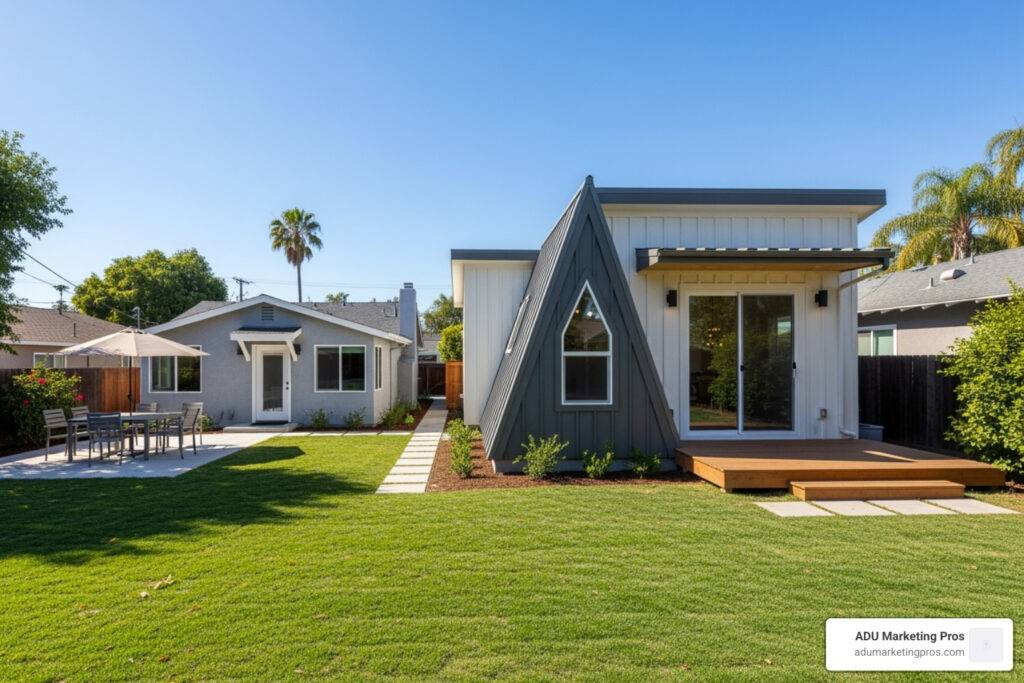
Why Understanding San Diego ADU Laws Is Critical for Your Success
San Diego’s housing market is notoriously competitive, with median home prices pushing the dream of homeownership out of reach for many. In response, San Diego ADU laws have transformed dramatically, creating unprecedented opportunities for homeowners and developers. These reforms aren’t just about adding units; they’re about creating flexible, affordable housing solutions that can help homeowners generate rental income, house family members, or downsize while staying in their communities. With thousands of ADUs permitted recently and major reforms approved by the San Diego City Council, the landscape is evolving faster than ever, offering a tangible path forward in a challenging market.
Quick Reference: San Diego ADU Laws Overview
- Maximum ADU Size: 1,200 square feet
- Number Allowed: 1 ADU + 1 JADU on single-family lots
- Setbacks: 0-4 feet depending on height and location
- Parking: Generally waived
- Owner Occupancy: Required for JADUs only
- Building Permit: Always required
- Key Change: ADUs can now be sold separately in the City (AB 1033)
As a solution to San Diego’s housing crisis, ADUs offer a more affordable path to homeownership, often selling for a fraction of a traditional home’s price. However, success hinges on navigating the complex regulations that differ between the City of San Diego and unincorporated San Diego County. Each jurisdiction has distinct rules for setbacks, bonus programs, and permitting, with state law adding another layer of complexity.
Understanding these nuances is critical to keeping your project on time and on budget. This guide breaks down everything you need to know about San Diego’s ADU laws, from eligibility requirements to the groundbreaking reforms that now allow ADUs to be sold as individual condominiums.
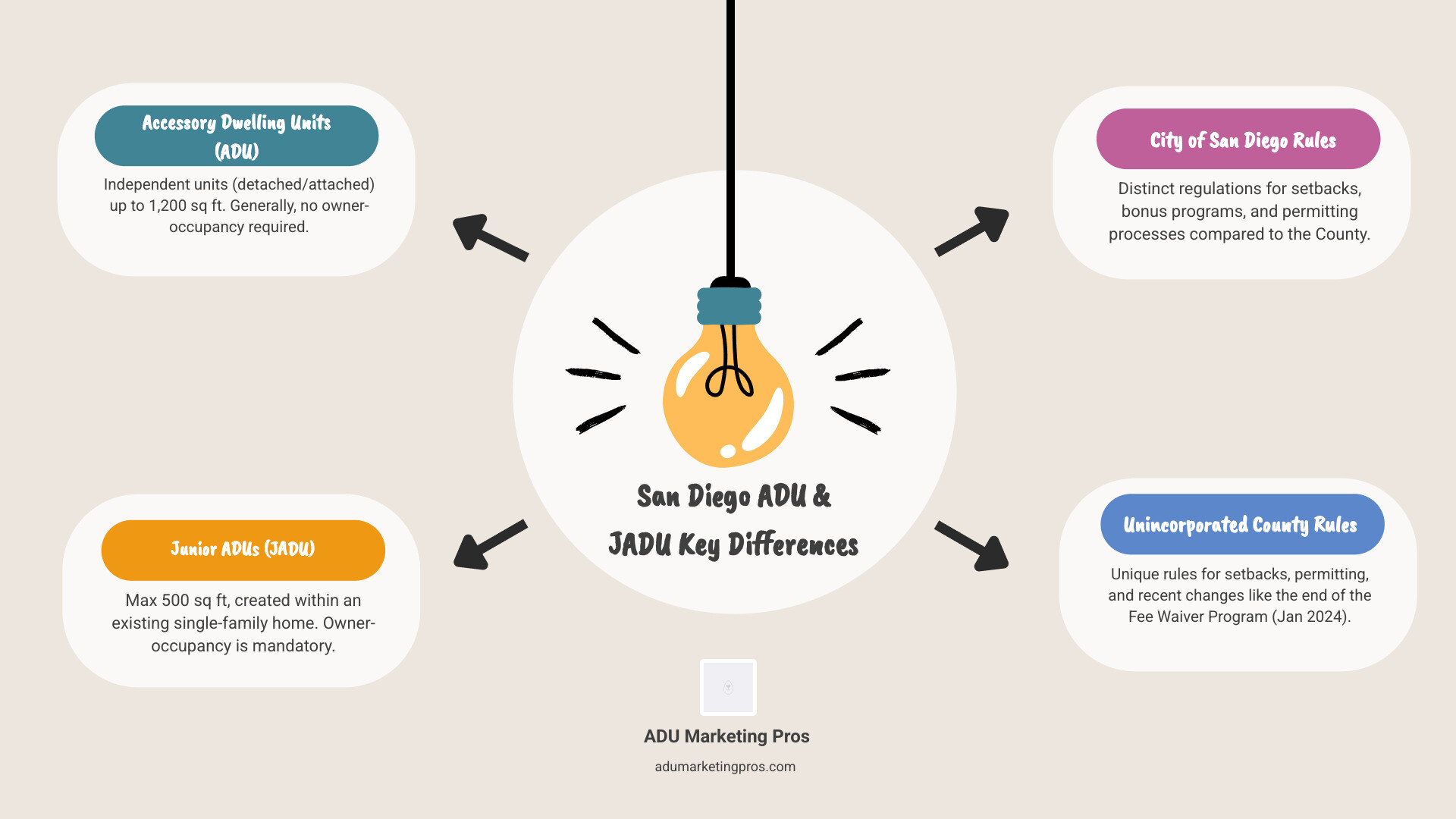
ADU vs. JADU: Understanding the Core Differences
When exploring San Diego ADU laws, you’ll encounter two types of units: Accessory Dwelling Units (ADUs) and Junior Accessory Dwelling Units (JADUs). While similar, they have distinct requirements that impact your project. An ADU is a complete, separate home on your property, while a JADU is a smaller unit created within your existing home. Understanding their differences is key to choosing the right option for your goals.
What is an Accessory Dwelling Unit (ADU)?
An Accessory Dwelling Unit is a fully independent home on your property, complete with its own kitchen, bathroom, living area, and separate entrance. This self-sufficiency means a resident can live comfortably without needing to enter the main house.
ADUs offer great flexibility. They can be built as a detached unit in a backyard, an attached unit connected to the main home, or as a garage conversion. Their versatility makes them ideal for housing family members, generating rental income, or creating a private retreat. For detailed guidance, see our guide on ADU Building Requirements.
What is a Junior Accessory Dwelling Unit (JADU)?
A Junior Accessory Dwelling Unit is created within the existing footprint of a single-family home. With a maximum size of 500 square feet, a JADU is a compact and efficient living space.
Instead of a full kitchen, a JADU has an efficiency kitchen with a sink, cooking appliance, counter, and storage. It can either share a bathroom with the main house or have its own. The most significant rule for JADUs is the owner-occupancy requirement: the property owner must live in either the main residence or the JADU. This makes them well-suited for multi-generational living or for homeowners who want to rent out a space while remaining on-site. To learn more about size limits, read our article on ADU Size Restrictions.
The key differences between ADUs and JADUs under San Diego ADU laws are summarized below:
| Feature | Accessory Dwelling Unit (ADU) | Junior Accessory Dwelling Unit (JADU) |
|---|---|---|
| Size | City & County: Minimum 150 sq ft, Maximum 1,200 sq ft. Attached ADUs in County: up to 50% of SFD area, max 1,200 sq ft. | City & County: Minimum 150 sq ft, Maximum 500 sq ft. |
| Location | City & County: Can be detached, attached, or converted from existing space (garage, accessory structure, portion of main home). Must be on a lot with an existing or proposed primary dwelling. | City & County: Must be entirely contained within an existing or proposed single-family residence (or attached garage). |
| Kitchen | City & County: Requires complete independent living facilities, including a full kitchen (sink, permanent cooking facilities, refrigeration). | City & County: Requires an efficiency kitchen (sink, cooking appliance, food preparation counter, storage cabinets). |
| Bathroom | City & County: Requires its own bathroom. | City & County: Can have its own bathroom or share with the main house if there’s direct interior access. |
| Parking | City: Generally waived, with specific exceptions in Coastal Overlay Zone/Beach Impact Area. County: Generally waived, with exceptions for transit proximity/historic districts. | City & County: Generally waived. |
| Owner-Occupancy | City & County: Not required for ADUs. | City & County: Required for the owner to live in either the primary dwelling or the JADU. |
| Number Allowed | Single-Family: 1 ADU + 1 JADU. Multi-Family: Up to 2 detached ADUs, or conversion of existing habitable space (25% of units), or unlimited conversion of non-habitable space. (City and County rules vary slightly on multi-family, especially post-SB1211 for County). | Single-Family: 1 JADU per lot. Multi-Family: JADUs are generally not permitted in multi-dwelling unit zones (City). County rules may vary, but typically focused on single-family. |
| Separate Sale | City: Now permitted under AB 1033 (condominium model). County: Not permitted. | City & County: Not permitted to be sold separately. |
Understanding these distinctions helps you make informed decisions about which option best fits your property, budget, and long-term goals.
Navigating San Diego ADU Laws: City vs. County Regulations

San Diego ADU laws vary significantly depending on whether your property is in the City of San Diego or unincorporated San Diego County. While California state law provides a foundation, local jurisdictions add their own rules. A property in Mission Valley (City) follows different regulations than one in Ramona (County), impacting setbacks, bonus programs, and permitting. For a deeper look at how zoning affects development, see our guide on ADU Zoning Laws.
Eligibility and Number of Units Allowed
Both the City and County are generous with ADU allowances.
- Single-Family Properties: In both jurisdictions, you can typically build one ADU plus one JADU, creating a total of three units on the lot.
- Multi-Family Properties (City): You can add up to two detached ADUs. You can also convert existing habitable space to ADUs equal to 25% of your total units, with no limit on converting non-habitable space like garages, boiler rooms, or storage areas. This particular rule has open uped significant potential for apartment building owners to add value and units without expanding the building’s footprint.
- Multi-Family Properties (County): Owners can now build as many ADUs as there are existing units, up to a maximum of eight detached ADUs.
Before planning, verify your property’s jurisdiction. The City offers the Zoning and Parcel Information Portal (ZAPP), and the County provides a Property Summary Report.
Size and Height Limitations
Size and height rules are similar across jurisdictions but have key differences.
- Minimum Size: All ADUs and JADUs must be at least 150 square feet.
- Maximum Size: Standard ADUs are capped at 1,200 square feet in both the City and County. JADUs are limited to 500 square feet.
- Attached ADUs (County): Limited to 50% of the primary home’s area, up to the 1,200 sq ft maximum.
- Conversions: Converting an existing space like a garage is generally not bound by the 1,200 sq ft limit.
- Height Limits: Detached ADUs in the City can be 16 feet high with reduced setbacks, but may go up to 24-35 feet depending on the zone. The County allows detached ADUs up to 24 feet. Both jurisdictions permit two-story ADUs.
For more on size regulations, see our guide on How Big Can an ADU Be in California?.
Zoning and Setback Requirements
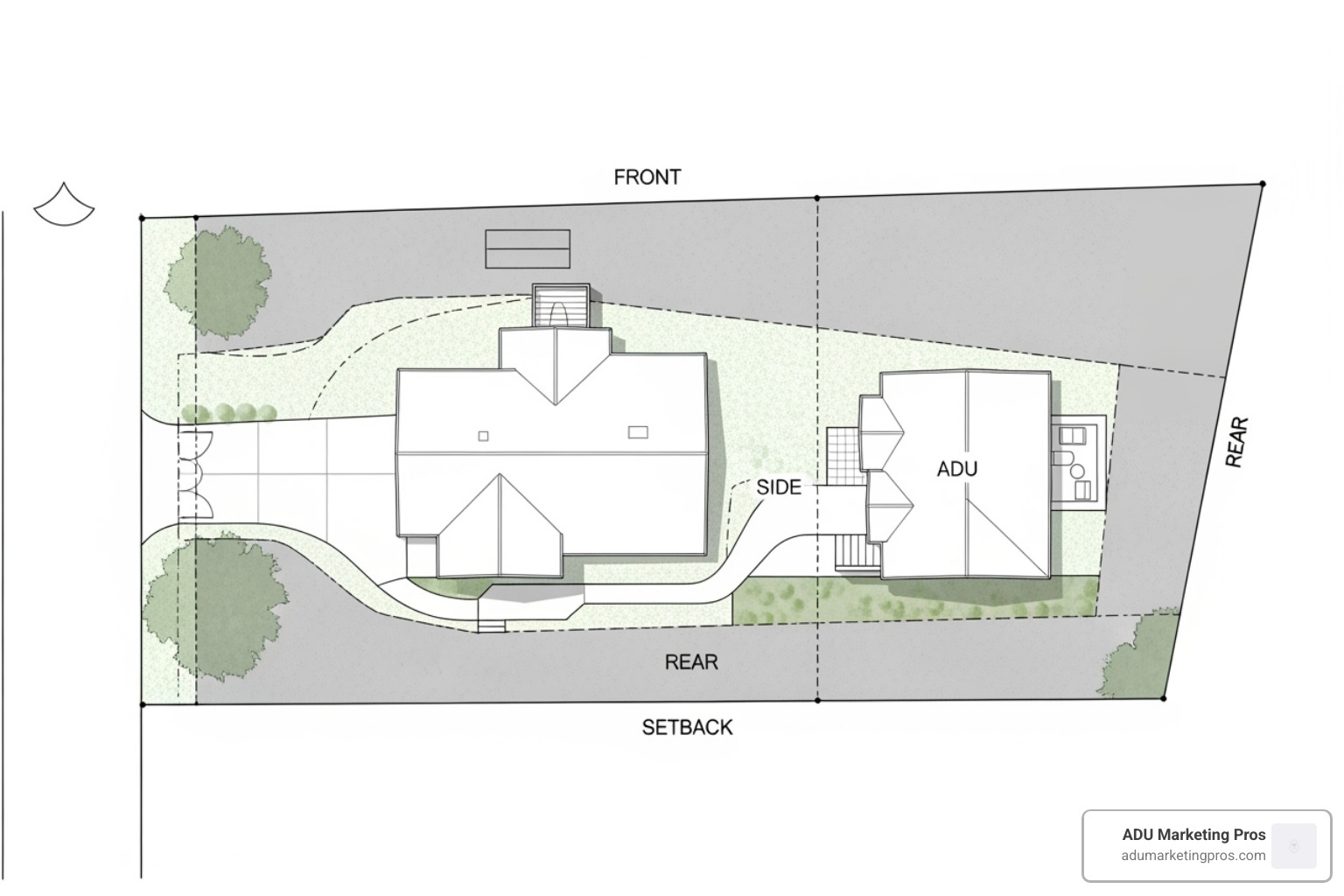
Setbacks determine how close your ADU can be to property lines.
- City of San Diego: Allows zero-foot side and rear setbacks for single-story structures up to 16 feet high. Taller or two-story units require 4-foot setbacks. ADUs up to 800 square feet may encroach into front setbacks.
- San Diego County: Requires 4-foot minimum side and rear setbacks. ADUs of 800 square feet or less may be built in the front setback if the backyard is not feasible, subject to County approval.
- Special Zones: Properties in the Coastal Overlay Zone face extra scrutiny to protect coastal resources, which often translates to additional design reviews and the need for a Coastal Development Permit. In High Fire Hazard Severity Zones, which cover many of San Diego’s inland and canyon communities, the minimum 4-foot setbacks are non-negotiable. This is to create “defensible space”—a buffer that helps firefighters protect structures from wildfires. These requirements are not meant to be prohibitive but are essential for safety and environmental protection.
You can check your property’s specific zone using ZAPP to see which rules apply.
Parking Rules: What You Need to Know
One of the biggest changes to San Diego ADU laws is the widespread elimination of parking requirements, making projects more feasible.
The general rule is that parking is not required for new ADUs. When you convert a garage, you generally do not need to replace the lost parking.
- City Exception: In the Coastal Overlay Zone’s Beach Impact Area, one off-street parking space is required. However, this is waived if the ADU is 500 sq ft or smaller, in a historic district, attached to the main house, or near a car-share vehicle.
- County Rules: Parking is not required if the ADU is within a half-mile of public transit, in a historic district, or is a conversion of existing space.
For more details, our guide on ADU Parking Requirements covers various scenarios.
The Permit and Building Process for San Diego ADUs
Navigating the permit process is a critical step. While it may seem daunting, San Diego has streamlined systems and pre-approved plans to simplify the journey. Every ADU or JADU project requires a building permit to ensure it meets all safety, structural, and environmental standards. For a complete overview, our guide on the ADU Permit Process California is an excellent resource.
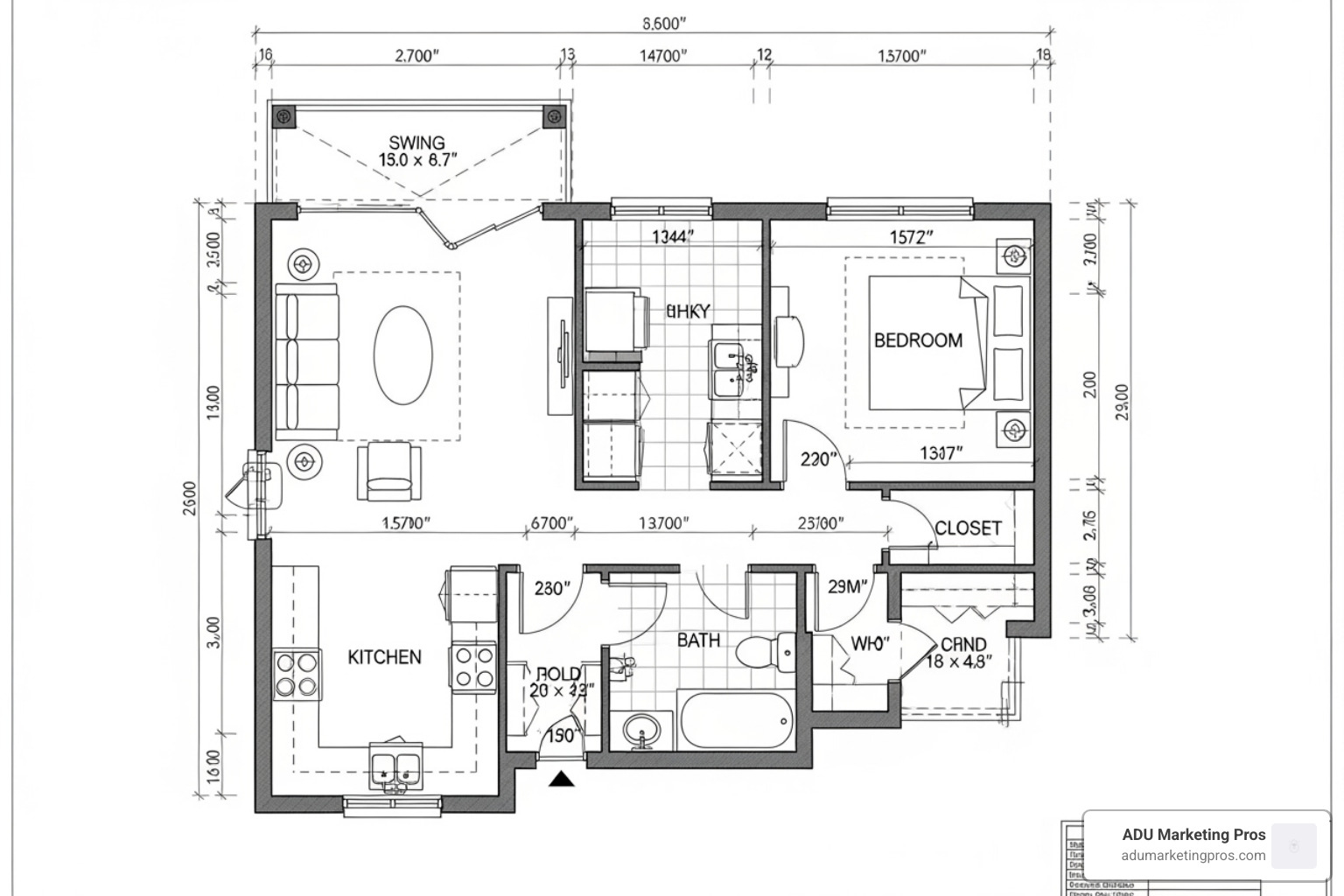
The Application and Permitting Journey
Your building permit is the foundation of your project. The City of San Diego’s Digital Application Portal has modernized the submission process. If your property is in the Coastal Overlay Zone, you will also need a Coastal Development Permit (CDP).
Your application must include detailed site plans, floor plans, elevations, and structural calculations, typically prepared by a qualified architect or designer. You may also need input from a structural engineer, especially for two-story units or properties on a slope, and a surveyor to create an accurate site plan. A traditional plan review can take 90-100 days, which is why many are turning to pre-approved plans to shorten this timeline. For more on securing permits, see our resource on ADU Permits California.
Understanding the San Diego ADU laws for building and safety
San Diego ADU laws include specific safety and energy requirements.
- Fire Sprinklers: Detached ADUs are generally exempt if the primary home lacks sprinklers. However, an attached ADU must have sprinklers if the main house does.
- Fire Separation: Structures built less than 5 feet from a property line in the City require fire-rated exterior walls. The County generally requires a 6-foot distance between structures.
- Defensible Space: In High Fire Hazard Severity Zones, you must maintain 100 feet of clear space around structures.
- Solar Panels: Per Title 24, newly constructed detached ADUs must include solar panels. Conversions, additions, and JADUs are generally exempt. Beyond solar panels, Title 24 also mandates other energy-efficiency features, such as high-performance windows, quality insulation, and efficient heating and cooling systems, ensuring your new ADU has a minimal environmental footprint and lower utility bills.
These rules ensure your ADU is safe and meets modern standards. For more construction details, check our guide on ADU Construction Regulations.
Speeding Up the Process with Pre-Approved Plans
Using pre-approved ADU plans can save months of waiting and thousands in design fees. Several jurisdictions, including the County of San Diego, Chula Vista, and Encinitas, offer plans with a streamlined 30-day review process.
You typically license these plans from the original architect for a fee that is much lower than custom design. California Assembly Bill (AB) 1332 further supports this by requiring agencies to review these plans within 30 business days, protecting you from unnecessary delays. Pre-approved plans save time, money, and stress, making your ADU journey much smoother.
Groundbreaking Reforms and Financial Incentives
The landscape of San Diego ADU laws is rapidly changing, creating exciting new opportunities. Recent reforms are reshaping how ADUs are used—not just as rentals, but as pathways to homeownership.
A New Era: Buying and Selling ADUs in the City of San Diego
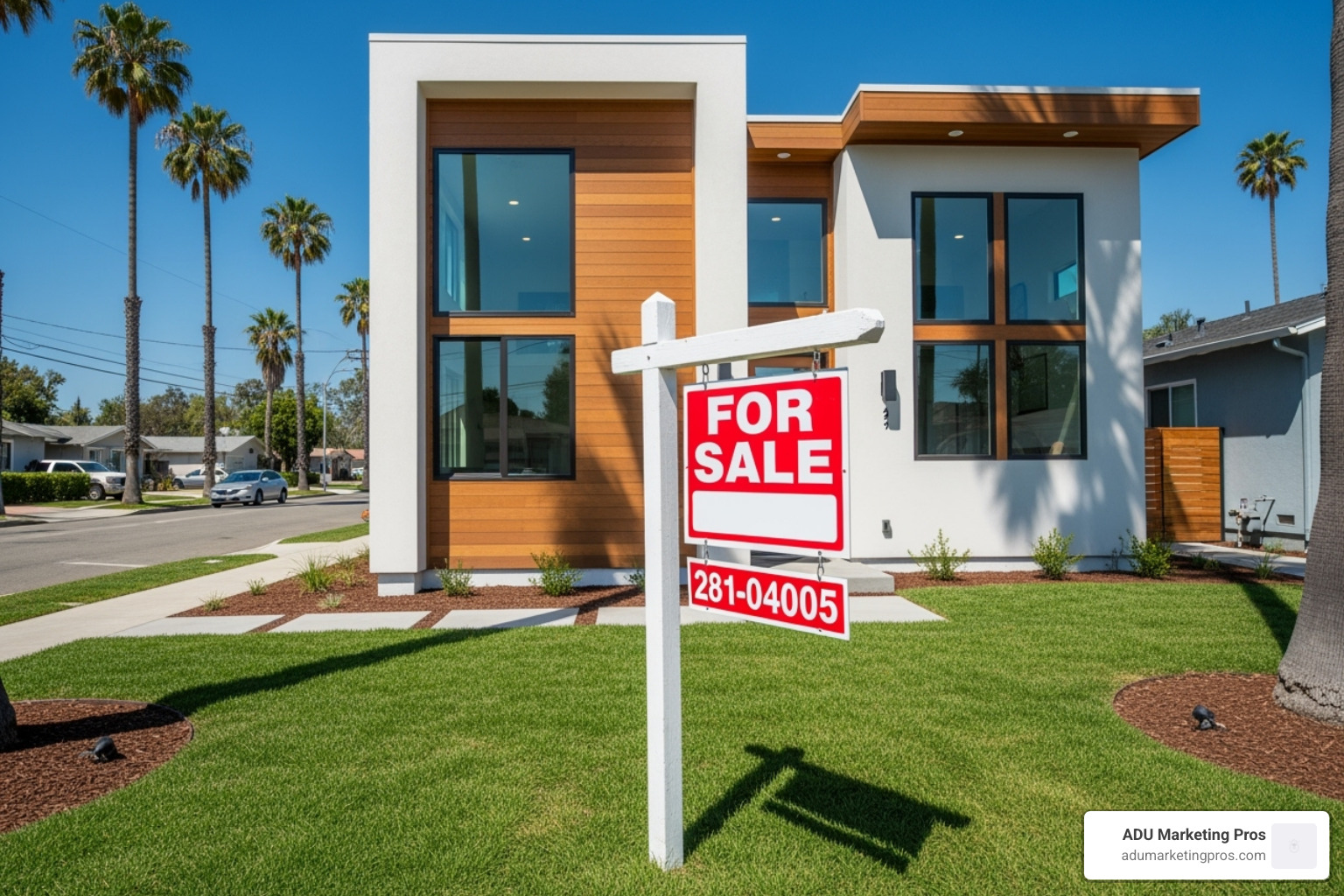
In a game-changing move, you can now buy or sell an ADU as a standalone home in the City of San Diego. Following the passage of Assembly Bill 1033, the City Council updated its ordinances to allow ADUs to be sold separately from the primary residence using a condominium model. This process involves legally separating the ADU from the main home by creating a condominium map and establishing a homeowners association (HOA) to manage shared spaces and responsibilities, such as a common driveway or yard. While this adds a layer of legal complexity, it open ups the ability to sell the ADU to a new owner, providing a much-needed source of smaller, more affordable starter homes.
This creates a more affordable entry point into one of California’s most expensive housing markets, with some ADUs potentially selling for 40-60% of a traditional home’s price. This reform directly addresses the need for “missing middle” housing, bridging the gap between apartments and single-family homes. These changes are part of a package of 25 proposed amendments aimed at boosting housing production. For more on these changes, see our guide on ADU Regulatory Updates.
The City of San Diego’s ADU Bonus Program
The City’s ADU Bonus Program incentivizes the creation of affordable housing. If you build ADUs that are deed-restricted as affordable for 15 years, the city may allow you to build additional market-rate bonus ADUs.
In Sustainable Development Areas (typically areas near public transit), one bonus ADU may be permitted for each affordable ADU, with no limit on the total number. While the program has great potential, only a fraction of recently permitted ADUs have used it, suggesting a need for greater awareness or stronger incentives. For builders, this program represents a significant opportunity to maximize development potential. Explore more funding options on our page about ADU Funding Grants.
Financial Resources and the End of County Fee Waivers
Understanding the financial landscape is crucial. For homeowners in the City, the San Diego Housing Commission’s (SDHC) ADU Finance Program offers construction loans and technical assistance to qualifying low-income homeowners. You can learn more about the SDHC program on their website.
However, a major change has occurred in unincorporated San Diego County. The County’s Fee Waiver Program officially ended on January 9, 2024. This program had saved homeowners an average of $15,000-$20,000 in impact fees (for things like parks, traffic, and drainage) and school fees. Projects that had not received a permit by this date now face the full cost of these charges. This change makes careful financial planning and obtaining accurate cost estimates from your builder more important than ever for projects in the County. Our guide on ADU Building Costs can help you create a realistic budget.
Frequently Asked Questions about San Diego ADU Laws
Here are answers to some of the most common questions about San Diego ADU laws.
Will building an ADU increase my property taxes?
Yes, but likely not as much as you fear. The county assessor will only reassess the value of the new construction, not your entire property. Your existing home keeps its current assessed value, and you’ll only pay additional taxes on the value added by the ADU. For most homeowners, the potential rental income far outweighs this modest tax increase.
Can I use my ADU as a short-term rental like an Airbnb?
No. Both the City and County of San Diego require that ADUs be rented for periods longer than 30 days. This rule ensures that ADUs contribute to the long-term housing supply, as intended by state law, rather than serving as tourist accommodations. Long-term rentals remain a lucrative option in San Diego’s market. For more on this, see our guide on ADU Rental Income.
How long does it take to get an ADU permit in San Diego?
The timeline can vary significantly. If you use a pre-approved plan from the City or County, the review process is streamlined and can take as little as 30-60 days. For a custom ADU design, the plan check process typically takes longer, often between 90 and 120 days, depending on the complexity of the project and the jurisdiction’s workload. It’s crucial to submit a complete and accurate application to avoid delays caused by corrections and resubmissions.
What is the difference between the City and County ADU regulations?
This is a critical distinction. The City of San Diego covers incorporated areas (e.g., downtown, Hillcrest), while unincorporated San Diego County includes areas like Fallbrook and Bonita. Always verify your jurisdiction before planning.
Key differences include:
- Setbacks: The City allows zero-foot setbacks in some cases, while the County generally requires four feet.
- Incentives: The City has a Bonus Program for affordable ADUs and now allows ADUs to be sold separately.
- Fees: The County’s fee waiver program ended in January 2024, increasing upfront costs for projects there.
Conclusion
Navigating San Diego ADU laws is the key to open uping your property’s potential. ADUs and JADUs are vital solutions to the region’s housing shortage, offering new paths to homeownership and flexible living spaces.
Key takeaways from this guide include:
- ADUs vs. JADUs: ADUs are independent 1,200 sq ft units, while JADUs are smaller (500 sq ft) integrated units with an owner-occupancy rule.
- City vs. County: Regulations for setbacks, incentives, and fees differ significantly depending on your property’s jurisdiction. Always verify your location first.
- Simplified Rules: Parking requirements have been broadly waived, and streamlined permitting with pre-approved plans makes development more accessible.
- Groundbreaking Reforms: The City of San Diego now allows ADUs to be sold separately like condominiums, creating new homeownership opportunities.
- Financial Planning: The end of the County’s fee waiver program and the availability of programs like the SDHC’s finance initiative highlight the need for careful budgeting.
San Diego is committed to ADU development, but regulations are constantly adapting. Staying informed and conducting thorough due diligence is paramount for success.
At ADU Marketing Pros, we understand that construction and architecture firms must stay ahead of these regulatory changes. We help our clients steer this complex market with confidence, focusing on expertise to help them stand out. Whether you’re a homeowner or a professional, understanding these laws is your foundation for success.
Let us help you steer the complexities of San Diego ADU Laws with expert guidance and transform your property’s potential into reality.