
Why San Diego ADU Parking Requirements Matter
San Diego ADU parking requirements are a frequent source of anxiety for homeowners, but the reality is far simpler and more encouraging than you might think. In a decisive move to combat the housing crisis, both state and city lawmakers have systematically dismantled the parking mandates that once stalled countless projects. The result? Most Accessory Dwelling Units (ADUs) in San Diego do not require any dedicated parking at all.
This shift has profound implications for your project’s feasibility, cost, and timeline. Understanding these updated rules is not just helpful; it’s the critical first step that can save you tens of thousands of dollars in unnecessary construction costs and prevent frustrating, time-consuming permitting delays. The regulations are nuanced, hinging on your property’s specific location, the type of ADU you plan to build, and whether you’re participating in the city’s affordable housing programs. For most, the news is overwhelmingly positive.
Here’s a quick overview of the current landscape:
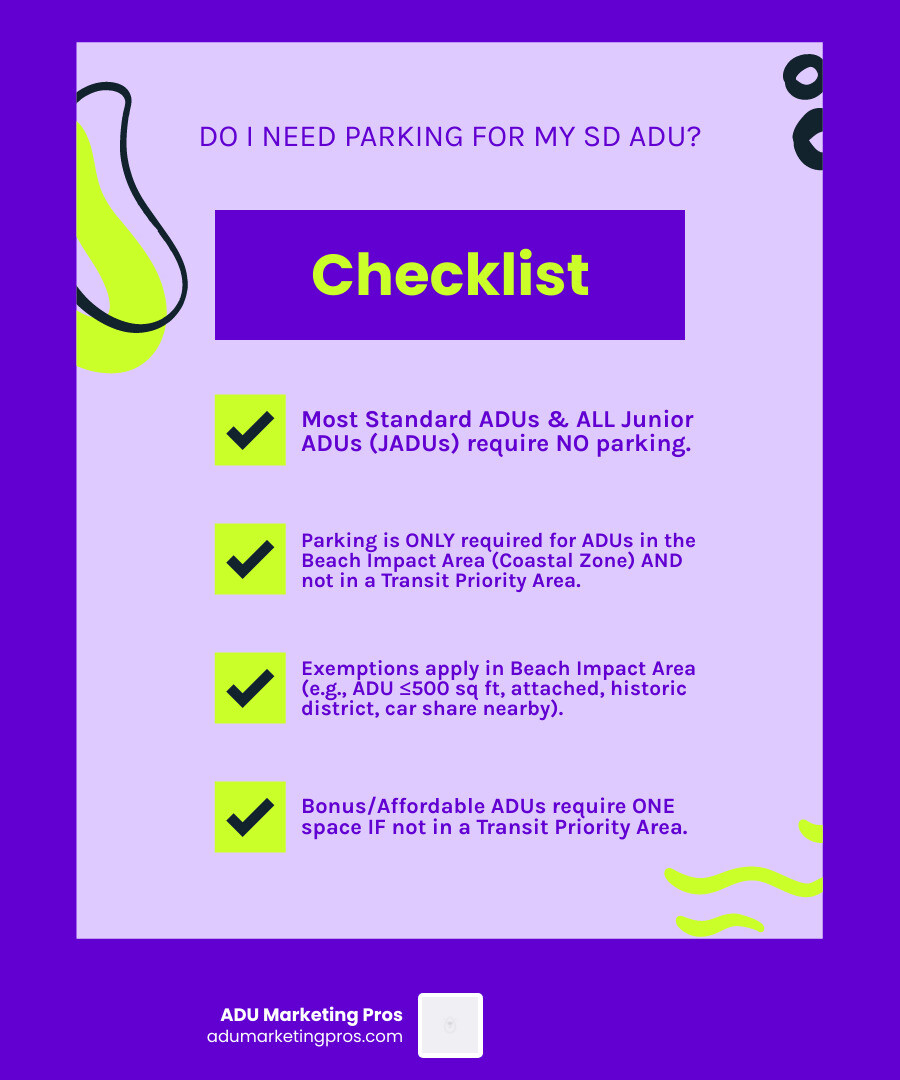
- No parking is required for the vast majority of standard ADUs, whether they are attached, detached, or converted from an existing space like a garage.
- Junior ADUs (JADUs), which are created within the primary home’s footprint, are always exempt from parking requirements, everywhere in the city.
- A single parking space is only mandated in a very specific scenario: when your property is located in the Beach Impact Area of the Coastal Overlay Zone AND is also outside a Transit Priority Area.
- One space per unit is also required for Bonus or Affordable ADUs built under the city’s density bonus program, but only if the property is outside a Transit Priority Area.
- Crucially, even within the restrictive Beach Impact Area, powerful exemptions can still eliminate the parking requirement if your ADU is 500 square feet or less, attached to the main house, or if your property is near a car-share pod, among other conditions.
For builders, designers, and architects, mastering these details is a significant competitive advantage. It enables you to provide immediate, accurate guidance to clients, design code-compliant projects from the outset, and establish your firm as a true expert in the field. While navigating San Diego’s unique zoning overlays, particularly the Coastal Zone, can seem daunting, a clear understanding of your property’s specific rules transforms the process from confusing to confidently predictable.
The General Rule: No Parking Required for Most San Diego ADUs
The most significant and welcome surprise for homeowners exploring an ADU project is that San Diego ADU parking requirements are effectively nonexistent for the majority of properties. This isn’t a loophole or an oversight; it’s a deliberate and strategic policy shift enacted by the State of California and embraced by the City of San Diego. The core mission is to dismantle long-standing barriers to housing development and address the region’s severe housing shortage.
For your project, this translates into immediate, tangible benefits. You likely won’t need to construct a new, costly parking space, redesign your driveway, or sacrifice valuable yard space that could be used for a garden, patio, or a larger ADU. This simplifies the architectural design process, dramatically lowers construction costs, and grants you far greater flexibility in the placement and layout of your new unit. This broad exemption covers detached backyard cottages, garage conversions, and attached ADUs. For a complete picture of the entire approval journey, our comprehensive guide on the ADU Permit Process details every step from design to final inspection.
Why Most ADUs Are Exempt from Parking Rules
The elimination of parking minimums for ADUs was a calculated response to California’s housing crisis. For decades, rigid parking requirements were a primary obstacle, driving up project costs, consuming precious urban land, and rendering many potential ADU projects financially unfeasible for the average homeowner. By removing these barriers, the state and city aim to achieve several critical goals:
- Drastically Reduces Costs: Constructing a single new parking space—whether a concrete pad or a carport—can easily add $5,000 to $15,000 or more to a project’s budget. Eliminating this expense makes ADUs a more accessible and affordable housing solution for more people.
- Spurs Housing Creation: With fewer regulatory hurdles and lower costs, more homeowners are empowered to build ADUs. Each new unit contributes to alleviating San Diego’s tight housing supply and provides more rental options for the community.
- Promotes Sustainable Transit: The policy is designed to encourage residents to utilize walking, biking, and public transportation. This aligns with broader city and state goals to reduce traffic congestion, lower carbon emissions, and build more sustainable, walkable neighborhoods.
- Accelerates Project Approvals: Simpler rules mean less complexity for city planners to review. By removing the need to analyze parking plans, the city can process permit applications more quickly, getting projects off the ground faster.
These changes are rooted in the California Government Code, which explicitly identifies ADUs as a vital and affordable component of the state’s housing solution. For a deeper understanding of the statewide framework that governs local ordinances, you can review our overview of California ADU Requirements.
Key Statewide Exemptions Applied in San Diego
State law provides several powerful exemptions that San Diego has fully adopted. Your ADU project is exempt from any parking requirements if it meets any one of the following conditions:
- It is located within a half-mile walking distance of public transit. This includes any bus stop, trolley station, or other major transit hub. The half-mile is measured as the actual walking path, not as a straight line.
- The property is situated within an architecturally and historically significant historic district.
- The ADU is part of the existing primary residence or an existing accessory structure. This is a crucial exemption that explicitly covers garage conversions, basement ADUs, and additions to the main house.
- The property is within a residential permit parking district, but the city does not offer permits to the occupants of the ADU.
- A car share vehicle is located within one block of the property. This refers to a vehicle available for short-term rental from a registered car-sharing service like Zipcar or Getaround.
Location, Location, Location: How Your Zone Affects Parking
While the general rule is a liberating “no parking required,” your property’s specific location is the ultimate determining factor. San Diego employs a system of zoning overlays, which are special zones that add another layer of regulations on top of the base zoning. These overlays are designed to balance citywide housing needs with unique neighborhood characteristics, environmental protection, and coastal access.
Identifying your property’s exact zoning is the essential first step in confirming your parking obligations. The rules become crystal clear once you know if your property falls within a Transit Priority Area or the Coastal Overlay Zone. For a detailed exploration of how zoning shapes every aspect of your project, from size to height, see our guide on ADU Zoning Laws.
Transit Priority Areas (TPAs): The Ultimate Parking-Free Zone
If your property is located within a Transit Priority Area (TPA), state law is absolute and supersedes any local preference: no parking can be required for any type of ADU. A TPA is officially defined as any area within a one-half mile radius of a major transit stop. In San Diego, this includes trolley stations, bus rapid transit stops, and bus stops served by routes with frequent service (typically headways of 15 minutes or less during peak hours).
This powerful exemption is the cornerstone of transit-oriented development, encouraging housing density where residents have viable alternatives to driving. For homeowners, it provides maximum design freedom. Space that might have been allocated for a parking pad can now become a private patio, a lush garden, or simply a larger, more comfortable ADU. To definitively check if your property is in a TPA, use the City of San Diego’s official Zoning and Parcel Information Portal (ZAPP). Simply enter your address and review the “Zoning” and “Transit Oriented Development” sections.
The Coastal Overlay Zone: San Diego’s Most Specific ADU Parking Requirements
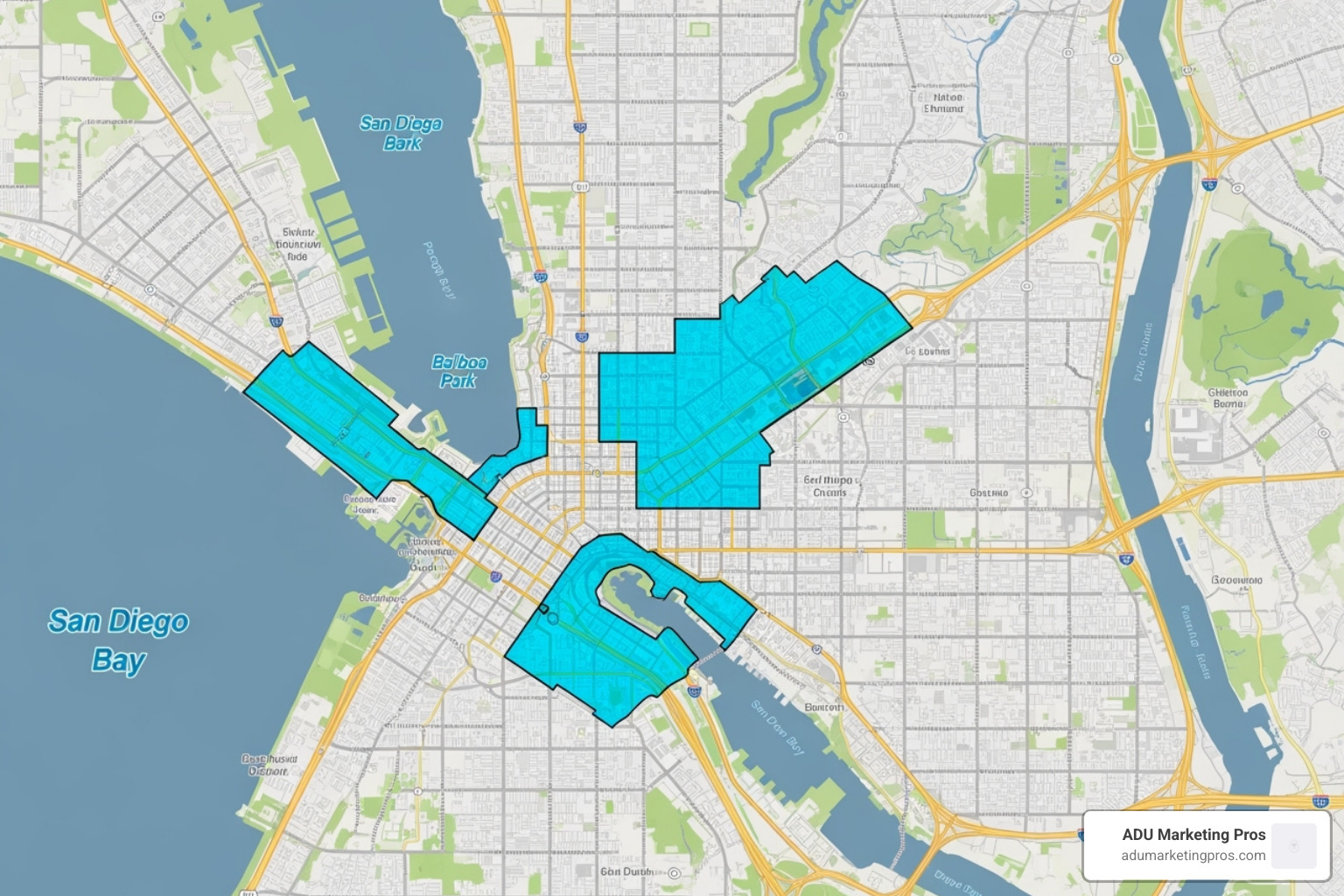
The Coastal Overlay Zone is the primary area where the general “no parking” rule has a significant exception. This zone is regulated not just by the city, but also by the California Coastal Commission, which has a state mandate to protect public access to the coast and manage the impacts of development. This dual jurisdiction leads to a very specific and narrowly defined scenario where parking is required.
A parking space becomes mandatory only if your property meets all of the following conditions: it is located within the Beach Impact Area of the Parking Impact Overlay Zone AND it is outside of a Transit Priority Area. Neighborhoods like parts of Ocean Beach, Pacific Beach, Mission Beach, and La Jolla fall into this category. In this specific case, you must provide one off-street parking space for your ADU.
The rationale for this rule is the intense, year-round parking demand near San Diego’s popular beaches. The Coastal Commission and the city are concerned that new ADUs could exacerbate parking congestion for both residents and visitors trying to access the coastline. Because the boundaries are precise and can run down the middle of a street, you must always verify your property’s exact zoning. Our guide to San Diego ADU Laws provides more detail on these coastal nuances.
Exemptions Within the Beach Impact Area
Even if your property falls squarely into the small slice of the city that requires ADU parking, you may still be exempt. Demonstrating the city’s commitment to balancing coastal access with housing production, several key exemptions are available:
- The ADU is 500 square feet or less.
- The property is located in a designated historical district.
- The ADU is attached to the primary dwelling or an existing accessory structure (this includes converting part of the main house).
- The property is in a residential permit parking district where ADU occupants are ineligible for permits.
- A car share vehicle is located within one block.
For example, if you plan to build a 490-square-foot detached ADU in Mission Beach (outside a TPA), you would be exempt from the parking requirement due to its size. Checking if you qualify for one of these exemptions is a critical step that could save you significant time and money.
San Diego ADU Parking Requirements by Unit and Project Type
The type of ADU you choose to build—whether a detached backyard home, an attached addition, a garage conversion, or a Junior ADU (JADU)—also intersects with San Diego ADU parking requirements. However, in most cases, the property’s location (in or out of a TPA or the Beach Impact Area) remains the primary deciding factor. Let’s break down the specific rules for each project type to provide complete clarity.
Standard ADUs (Attached & Detached) and Garage Conversions
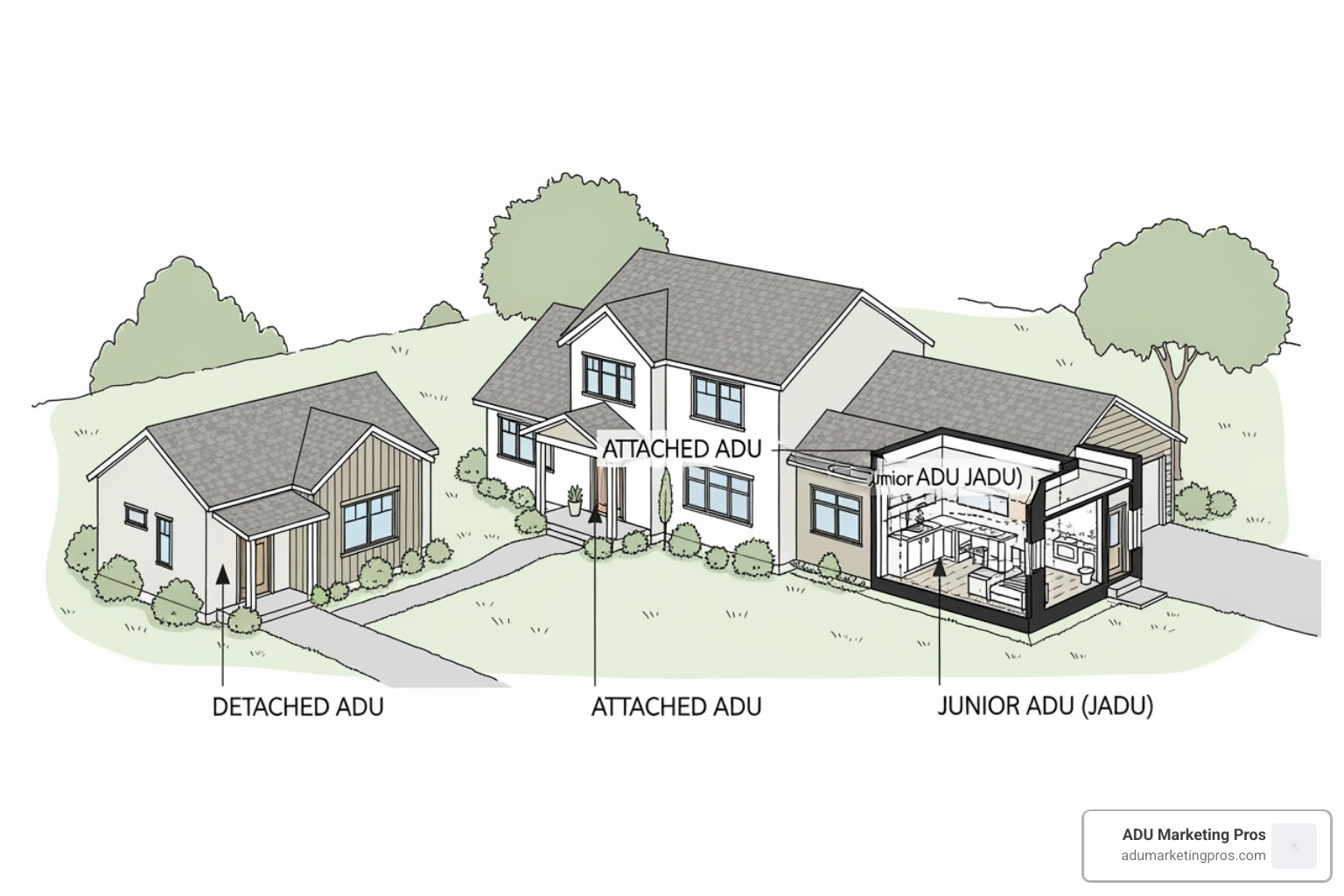
For the vast majority of standard ADUs, both attached and detached, the general rule holds true: no parking is required. As long as your property is not located in that specific sliver of the Coastal Overlay Zone’s Beach Impact Area (and is also outside a TPA), you are exempt. This applies whether you are building a brand-new unit in your backyard or adding one onto your existing home.
This exemption explicitly includes garage conversions. State law is unequivocal on this point: when an existing garage, carport, or other covered parking structure is converted into an ADU or demolished to make way for an ADU, you are not required to build replacement parking spaces. This powerful provision makes converting an underutilized garage one of the most popular and cost-effective ways to add an ADU, as you are not penalized for repurposing the structure.
The only major exception to this garage conversion rule is, once again, in the Coastal Overlay Zone’s Beach Impact Area (when outside a TPA). In this specific zone, if you convert your garage to an ADU, you are required to replace the lost parking spaces, in addition to providing a space for the ADU itself (unless an exemption applies). This rule is designed to prevent a net loss of parking in beach-adjacent neighborhoods.
Junior Accessory Dwelling Units (JADUs)
The regulations for JADUs are the simplest and most straightforward of all. A JADU is a specialized type of ADU that must be 500 square feet or less and created entirely within the existing, conditioned footprint of a single-family home. This could involve converting a spare bedroom, a formal dining room, or an attached garage.
For all JADUs, no additional off-street parking spaces are ever required. This is a universal rule that applies everywhere in the City of San Diego, regardless of zone, including the Coastal Zone and TPAs. This absolute exemption makes JADUs an excellent, low-impact, and highly accessible option for homeowners looking to add a small rental unit or a space for a family member. The official rules are codified in the San Diego Municipal Code §141.0302.
Bonus & Affordable ADU Parking Requirements
San Diego’s innovative ADU Density Bonus Program allows property owners to build more ADUs than would normally be permitted, on the condition that at least one of the units is designated as affordable for low-income residents. These additional units, known as “Bonus” or “Affordable” ADUs, have a unique parking rule designed to balance housing incentives with neighborhood concerns.
One off-street parking space is required for each Affordable ADU and each Bonus ADU that is located outside of a Transit Priority Area. This requirement was added as part of recent housing policy updates to address community feedback about the potential parking impacts of increased density in neighborhoods with limited public transit options.
However, if your property is located within a TPA, the state-level exemption still applies. In that case, even Bonus and Affordable ADUs are exempt from parking requirements, consistent with the goal of promoting dense, transit-rich communities. This policy carefully balances the primary goal of creating more affordable housing with managing on-street parking in different neighborhood contexts.
Practical Parking Solutions (If You Need a Space)
Although most ADU projects in San Diego are exempt from parking rules, you might find yourself in a situation where a space is required. This typically occurs if you’re building in the Beach Impact Area or developing a Bonus ADU outside of a TPA. If this applies to you, don’t despair. San Diego ADU parking requirements are designed with flexibility in mind, offering several practical and cost-effective solutions that won’t necessarily derail your project or break your budget.
The city’s regulations allow for creative approaches that can often utilize existing features of your property. The key is to understand the options and work with an experienced professional who can design the most efficient solution. Working with knowledgeable experts, like those in our network of vetted ADU contractors, can help you navigate these requirements seamlessly.
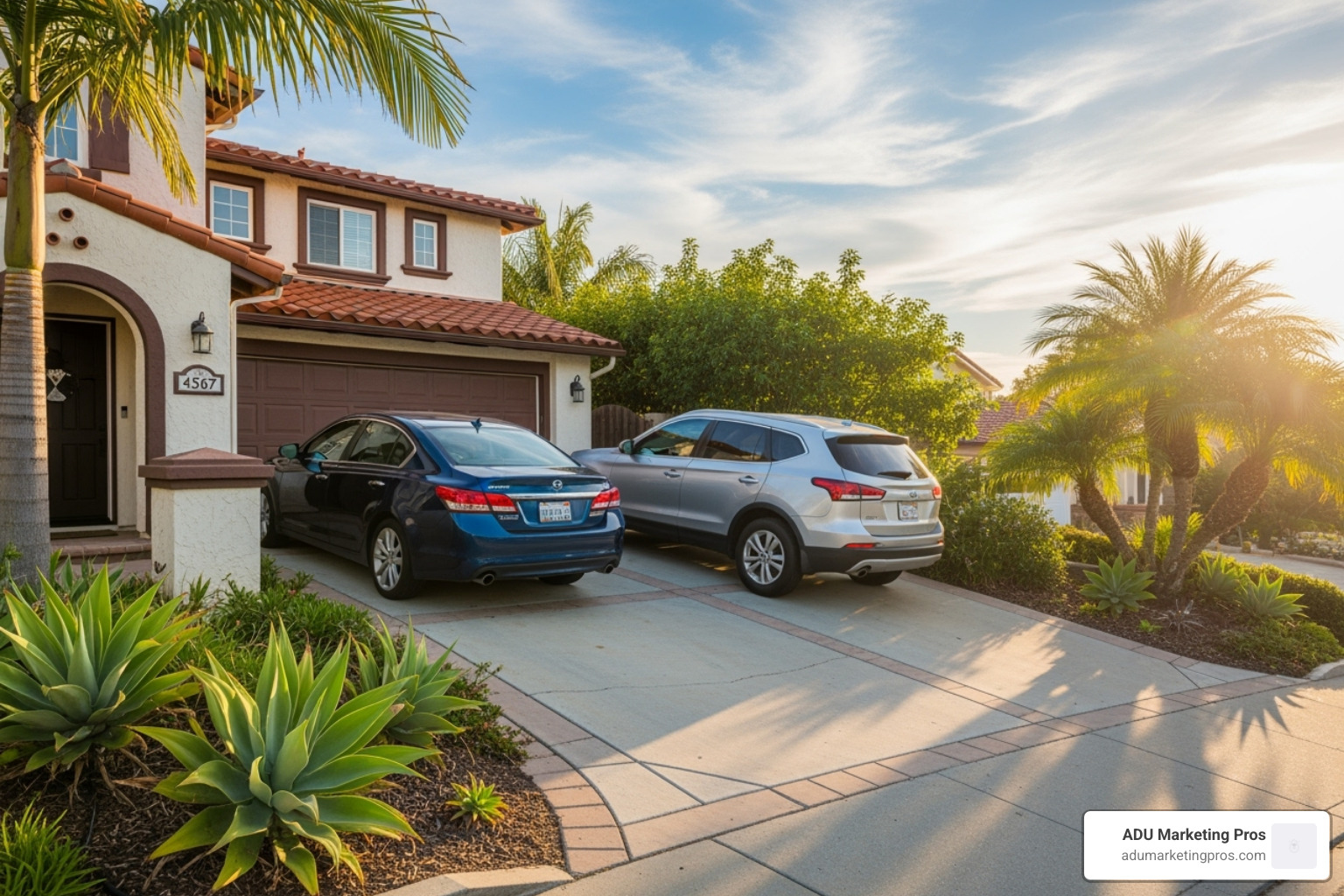
Tandem Parking, Setbacks, and Mechanical Lifts
Any required parking space must meet the city’s minimum dimension standards, which are typically 8.5 feet wide by 18 feet long for a standard space. The space must be located on your property, but the city allows for several accommodating configurations:
- Tandem Parking: This is the most common and efficient solution. It allows one car to be parked directly behind another in a single-lane driveway. This configuration is explicitly permitted for ADUs and often requires no new construction, as it simply utilizes the existing driveway.
- Parking in Setback Areas: The city allows uncovered parking spaces to be located within the required front and side yard property setbacks. This is a huge advantage, as it frees up the prime, buildable area of your lot for the ADU itself, landscaping, or outdoor living space. Paving for the space must adhere to city standards.
- Utilizing Existing Driveways: If you are converting a garage that requires replacement parking, the driveway that once led to the garage can often be designated as the required parking space. This is another common-sense solution that avoids the need for new pavement.
- Mechanical Car Lifts: For properties with very tight space constraints, mechanical lifts are a viable, though more expensive, option. These systems stack vehicles vertically, allowing you to meet a two-car requirement in the footprint of a single space. While they represent a larger upfront investment ($15,000 – $25,000+), they can be the key to making a project feasible on a small lot.
- Permeable Pavers: When creating a new parking pad, using permeable pavers or turf blocks can be a smart strategy. These materials allow for stormwater to percolate into the ground, which can help you meet the city’s separate landscaping and stormwater management requirements while also providing a durable parking surface.
These flexible options ensure that even when a parking space is required, it doesn’t have to become a major obstacle. For the complete technical details on parking dimensions and materials, you can consult the San Diego Municipal Code, Chapter 14, Article 2, Division 5.
Staying Current: Recent and Upcoming Changes to San Diego’s ADU Regulations
ADU regulations, including the nuanced San Diego ADU parking requirements, are in a constant state of evolution. As the housing crisis persists, state and local governments are continually refining the rules to streamline development, encourage affordability, and respond to community feedback. What is true today might be slightly different six months from now, making it essential for homeowners and professionals to stay informed.
Changes can impact everything from where you can place your ADU to whether you need that parking space. Relying on outdated information from a blog post written two years ago can lead to costly redesigns and significant permitting delays. For a broader perspective on how regulations are shifting across the state, our article on new ADU regulations in California offers valuable context.
Housing Action Packages (HAP 1.0 & 2.0)
San Diego has been at the forefront of municipal ADU reform, proactively updating its policies through a series of comprehensive amendments known as “Housing Action Packages” (HAPs). These packages bundle numerous changes designed to optimize housing production.
- HAP 1.0 (2020-2021): This package introduced significant changes, particularly in the Coastal Overlay Zone. It established new, more permissive setback and landscape requirements that indirectly affect how and where a required parking space can be integrated into a site plan. It also clarified rules around owner-occupancy and short-term rentals.
- HAP 2.0 (2022-2023): This next wave of updates continued the evolution. It included the creation of the parking requirement for Bonus/Affordable ADUs outside of TPAs, a direct response to neighborhood parking concerns. It also closed a loophole that some developers were using to attach a JADU to a detached ADU, clarifying the intent of the law. It’s important to note that ordinances affecting the Coastal Zone (like O-21618 and O-21758) only become effective after they are certified by the California Coastal Commission, which can create a lag time that professionals must track.
These packages demonstrate the city’s commitment to an iterative process, refining its housing policies based on real-world data and community input.
Proposed Future Amendments and Ongoing Discussions
San Diego’s ADU program will undoubtedly continue to evolve. City planners and elected officials are constantly engaged in discussions about how to balance rapid housing development with other important community values.
One of the most significant recent topics has been the parking rule for Bonus ADUs, which was a compromise between housing advocates and residents concerned about parking. Future discussions may revisit this rule, potentially expanding or contracting it based on its observed impact.
Fire safety is another critical area of focus. The city is considering amendments that would increase setback requirements for ADUs in Very High Fire Hazard Severity Zones. While not a parking rule itself, this directly impacts overall site planning and can severely limit the available space for an ADU and any associated parking, making efficient design even more critical.
Because the regulatory environment is so dynamic, the single most important step before finalizing your ADU plans is to verify the latest regulations directly with the San Diego Development Services Department or consult with a design professional who specializes in local ADU projects. This ensures your project is compliant from day one.
Conclusion
Navigating San Diego ADU parking requirements is ultimately a task of verification, not a major construction hurdle. The city and state have deliberately and effectively removed parking mandates for the vast majority of projects to make it easier, faster, and more affordable for homeowners to contribute to the housing supply.
By understanding the current framework, you can approach your project with confidence and a realistic budget. Here are the key takeaways to remember:
- The Default is Zero Parking: For most standard ADUs, garage conversions, and all JADUs, you will not need to provide any additional parking. Start your project with this assumption.
- Location is Everything: The primary exceptions are tied to specific geographic zones. You must verify if your property is in a Transit Priority Area (where no parking is ever required) or the Coastal Zone’s Beach Impact Area (where it might be).
- Exemptions Are Powerful: Even if your property is in the one area that requires parking, a robust set of exemptions for smaller units (≤500 sq ft), attached ADUs, and other conditions can still eliminate the requirement.
- Bonus ADUs Have a Special Rule: If you’re using the ADU Density Bonus Program, remember the one-space-per-unit rule applies, but only outside of Transit Priority Areas.
- Flexible Solutions Exist: If you are one of the few who must provide a parking space, the city allows for practical, low-cost solutions like tandem parking in your existing driveway.
Before you invest in design, always verify your property’s specific zoning requirements using the city’s official online tools or by consulting with the Development Services Department. Regulations evolve, and this single step is your best insurance against costly surprises.
For ADU builders, architects, and designers, a deep mastery of these rules is a cornerstone of your value proposition. When you can confidently and accurately explain parking regulations, you save your clients time and money, immediately building the trust that separates your firm from the competition. At ADU Marketing Pros, we specialize in helping construction and architecture firms leverage this exact type of expertise to attract high-value clients and dominate their local market.
San Diego has laid out a clear path for ADU development. With the right knowledge and preparation, that path is more accessible than ever.
Ready to take the next step? Begin by understanding the full scope of ADU Parking Requirements and how they apply to your specific property.