

Why Understanding San Diego County Laws Matters for Property Owners and Developers
San Diego County laws dictate how property is used and developed across more than 4,000 square miles of unincorporated land. For property owners, developers, and contractors, a misunderstanding of these regulations isn’t just an inconvenience—it can lead to catastrophic financial and legal consequences. Imagine investing hundreds of thousands of dollars into a new structure, only to receive a stop-work order followed by a notice of violation, hefty fines, and potentially a mandate to demolish the unpermitted construction. This is the reality for those who neglect their due diligence. Whether you plan to build an accessory dwelling unit (ADU), start a home-based business, subdivide a lot, or simply modify your property, you must know which regulations apply.
The most critical distinction is whether your property lies within an incorporated city (like San Diego, Chula Vista, or Escondido) or the unincorporated county. The rules are entirely different. A project that is perfectly legal in the City of San Diego might be strictly prohibited on a parcel just a few hundred feet away in a county-governed area. This jurisdictional puzzle is the first and most important piece to solve.
Quick Answer: Where to Find San Diego County Laws
To navigate this landscape, you must familiarize yourself with the county’s primary legal documents. Here’s a breakdown of what they are and what they contain:
- San Diego County Code of Regulatory Ordinances: This is the main body of law affecting the public. It contains rules for public health (like food facility permits), safety (like fire codes), environmental regulations, animal control, and business licensing.
- San Diego County Administrative Code: This document governs the internal machinery of county government. It outlines the powers, duties, and procedures for county departments, officials, and employees. While less relevant for a typical project, it dictates how the government itself operates.
- San Diego County Zoning Ordinance: For any construction or land use project, this is the bible. It dictates what you can build, how large it can be, where it can be placed on your property, and what activities are permitted in different geographical zones (e.g., residential, commercial, agricultural).
- Board of Supervisors Policy Manual: This manual contains policies that guide the actions of county staff. While not laws themselves, they represent the Board’s official stance and heavily influence how ordinances are interpreted and enforced.
- Ordinance Library: This is a comprehensive, searchable database of all individual laws (ordinances) adopted by the Board of Supervisors. It’s the best place to find the most recent changes to the codes listed above.
The legal framework is notoriously complex. The Board of Supervisors constantly adopts new ordinances that amend, add, or repeal sections of these codes. To make matters more confusing, the County explicitly warns that online versions of the codes may not reflect the most recent legislation and should not be relied upon as the definitive legal authority.
This guide cuts through the complexity. We’ll explain the core legal framework, break down the critical Zoning Ordinance, and clarify the crucial difference between county and city regulations. Whether you’re an ADU professional or a property owner embarking on a new project, you’ll learn where to find the rules that matter and how to ensure your project is compliant from day one.
Common san diego county laws vocab:
Understanding the Core Legal Framework of San Diego County
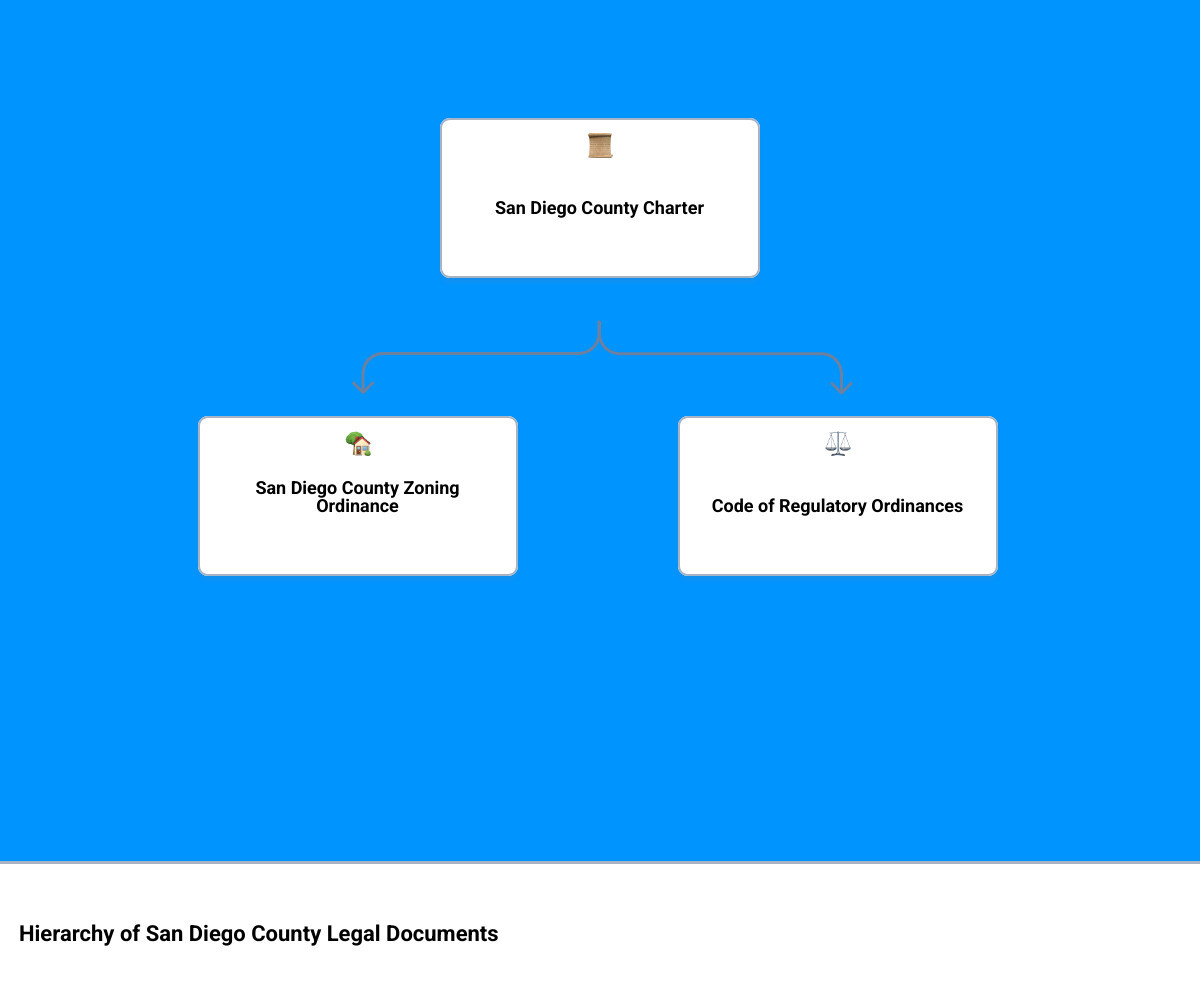
The foundation of San Diego County laws is a clear hierarchical framework designed to organize its governance and guide its functions. At the very top is the San Diego County Charter, which acts as the county’s constitution. It establishes the structure of the government, defines its powers, and outlines the duties of its elected and appointed officials. All other laws, codes, and policies flow from the authority granted by this charter. The county’s legislative body, the Board of Supervisors, is responsible for adopting laws (called ordinances) that shape everything from land use and public health to business regulation and environmental protection. Understanding this hierarchy is the first and most critical step to successfully navigating local regulations.

The San Diego County Charter: The County’s Constitution
The County Charter is the foundational document that empowers and limits the county government. Approved by voters, it establishes the five-member Board of Supervisors as the governing body and outlines the responsibilities of other key offices like the Sheriff, District Attorney, and Assessor. For property owners and developers, the Charter is important because it grants the Board of Supervisors the specific authority to control land use, protect public welfare, and create the very departments—like Planning & Development Services—that will review and approve project applications. Any ordinance or policy created by the county must be consistent with the powers laid out in the Charter.
What are Ordinances and How Do They Shape County Law?
Ordinances are simply laws adopted by the Board of Supervisors. They are the primary legislative tool for creating and changing county law. The process typically involves a public hearing where a proposed ordinance is introduced (a “first reading”), followed by a subsequent meeting for a final vote (a “second reading”). This process allows for public comment and debate. Once adopted, an ordinance can amend, repeal, or add to the county’s existing codes. For example, an ordinance might update ADU setback requirements in the Zoning Ordinance, increase fees for certain permits in the Administrative Code, or ban a particular activity for public safety reasons in the Regulatory Code. The county maintains a comprehensive, searchable list of these laws online, which is an invaluable resource for staying current.
You can Access the Ordinance Library to find specific legislation.
The County’s Main Legal Documents: Administrative and Regulatory Codes
The county organizes its thousands of ordinances into two primary codes for easier navigation:
- The Administrative Code governs the internal workings of county government. It’s the rulebook for the bureaucracy, outlining the duties and procedures for departments, setting salary scales for employees, and establishing the processes for county contracts and purchasing. It’s less relevant for the average property owner but essential for understanding how the county operates internally.
- The San Diego County Code of Regulatory Ordinances is the public-facing document containing rules that directly affect residents, businesses, and property owners. It is a vast collection of laws covering public health and sanitation (e.g., restaurant inspections), safety (e.g., fire hazard abatement), environmental protection (e.g., stormwater runoff), and business regulations (e.g., licenses for street vendors). This is a crucial document for understanding the daily legal landscape. You can access it here: San Diego County Code of Regulatory Ordinances.
The Role of the Board of Supervisors Policy Manual
In addition to formal laws, the Board of Supervisors uses a Policy Manual to provide direction to county staff and guide decision-making. This manual contains policies that don’t carry the force of law but are vital for ensuring consistent operations. For example, a policy might direct the planning department to prioritize the review of affordable housing projects or establish guidelines for how code enforcement officers should handle minor violations. While not “law” in the strictest sense, these policies reflect the Board’s intentions and can significantly influence how San Diego County laws are interpreted and applied by the staff you’ll interact with during a permit process.
A Deep Dive into the San Diego County Zoning Ordinance
For anyone involved in property development, construction, or land use, the San Diego County Zoning Ordinance is the single most critical legal document. It is the master rulebook that manages land use across all of the county’s unincorporated areas, dictating what you can build, where you can build it, and under what specific conditions. Originally adopted in 1978, this ordinance is a living document, continuously updated through amendments to meet the county’s evolving needs for housing, economic development, and environmental protection. Whether you’re planning a single-family home, a large commercial center, an agricultural operation, or an ADU, the Zoning Ordinance is your primary guide for ensuring orderly, safe, and compliant development.

Purpose, Applicability, and Structure
The ordinance’s core purpose is to protect public health, safety, and general welfare by implementing the county’s General Plan—its long-range blueprint for physical growth and resource conservation. It applies exclusively to all unincorporated areas of San Diego County, a key distinction from the separate laws of the 18 incorporated cities. The document is comprehensively structured into eight parts to cover every aspect of land use:
- Part One: General Provisions and Definitions: Establishes the rules for interpreting the ordinance’s language and provides precise legal definitions for critical terms.
- Part Two: Use Regulations: Specifies permitted activities, conditional uses, and prohibited uses within each zone (e.g., residential, commercial, agricultural). It also includes detailed regulations for keeping animals.
- Part Three: Animal Regulations: Contains specific standards for the number and type of animals allowed based on zone and lot size.
- Part Four: Development Regulations: Sets the physical standards for development, including density, lot size, building height, setbacks, floor area ratio, and lot coverage.
- Part Five: General Regulations: Lays out broad rules that apply across many zones, covering topics like parking, signage, lighting, and noise.
- Part Six: Special Area Regulations: Addresses unique conditions in sensitive or distinct areas like coastal zones, floodplains, historic districts, and specific community planning areas like Fallbrook and Ramona.
- Part Seven: Administration and Procedures: Outlines the processes for obtaining permits, variances, and other administrative approvals.
- Part Eight: Maps: Contains the official zoning maps that show which zone applies to every parcel in the unincorporated county.
The San Diego County website provides excellent resources and more Zoning Ordinance information.
Key Definitions and How to Interpret the Law
Understanding the specific language of the Zoning Ordinance is crucial, as common words can have very specific legal meanings. Part One includes a detailed section of definitions that are essential for compliance. For example, terms like ‘dwelling unit,’ ‘accessory use,’ ‘floor area ratio,’ ‘lot coverage,’ and ‘commercial vehicle’ are carefully defined. The definition of ‘kitchen’ can determine whether a space is considered a full dwelling unit. The ordinance also provides rules for interpretation, such as stating that its provisions control if they impose a greater restriction than other regulations. Mastering these definitions is a prerequisite for any successful construction project, especially for a nuanced build like an ADU San Diego.
Navigating Specific Regulations in San Diego County
The Zoning Ordinance contains granular detail on what is and isn’t allowed. Understanding these is essential for compliance.
- Use Regulations: These define what you can do on your property based on its zone (e.g., R-1 for single-family residential, C-36 for general commercial, A-70 for limited agriculture). Each zone has a matrix of permitted uses (allowed by right), conditional uses (requiring a Use Permit), and prohibited uses.
- Development Standards: These are the core construction rules. For a typical residential lot, they dictate minimum lot size, maximum building height (e.g., 35 feet), minimum setbacks from front, side, and rear property lines (e.g., 20 feet front, 5 feet side), and maximum lot coverage (the percentage of the lot that can be covered by buildings).
- General Regulations: These are broad rules that apply across zones. They cover requirements for off-street parking (e.g., two covered spaces per single-family home), limitations on the size and height of fences, standards for outdoor lighting to reduce light pollution, and noise limits.
- Special Area Regulations: San Diego County has unique environmental and community features, leading to specific overlay rules. For example, properties in the Coastal Zone are subject to the ‘C’ Designator, which requires a Coastal Development Permit and review for consistency with the California Coastal Act. Properties in designated village centers like Alpine and Fallbrook have design review standards to preserve the area’s unique architectural character.
Navigating these rules can be complex, especially for an ADU project. For more on the financial side, our resources on ADU Rentals San Diego can offer further guidance.
The Practical Guide to Permits, Variances, and Staying Current with San Diego County Laws
Understanding the rules is the first step, but successfully navigating the application and approval process is where projects succeed or fail. For property owners and developers, staying informed about the latest San Diego County laws and following the correct procedures for permits and variances is essential to save time, avoid costly redesigns, and prevent project-killing delays.
The Process for Obtaining Permits and Variances
The Zoning Ordinance outlines several distinct approval paths, or “procedures,” depending on your project’s scope, location, and potential impact on the community. Each has a different process, timeline, and level of review.
- Administrative Permit: This is the simplest process, designed for minor projects that meet clear, objective criteria defined in the ordinance. These are approved at the staff level by the Director of Planning & Development Services without a public hearing. Examples include certain home occupations or minor deviations from development standards.
- Use Permit: This is required for uses that are generally appropriate for a zone but could have a greater impact on the surrounding community. This process is more intensive, requiring a public hearing before a Zoning Administrator, Planning Commission, or even the Board of Supervisors. The approving body must make specific findings that the proposed use will not be detrimental to public health, safety, or welfare. Examples include schools, churches, or gas stations in certain zones.
- Site Plan Review: This process focuses specifically on a project’s layout, design, architecture, and landscaping to ensure it meets the county’s development standards and design guidelines. It is often required for commercial, industrial, and multi-family residential projects. Like an Administrative Permit, it is typically approved by staff, but it requires a more detailed review of the project’s physical characteristics.
- Variance: A Variance is a request for relief from a specific zoning rule, such as a setback or height limit. It is not a way to change the property’s allowed use. To be granted a Variance, an applicant must prove that due to special circumstances unique to their property (like an unusual shape, size, or topography), the strict application of the ordinance deprives them of privileges enjoyed by other properties in the same zone. This is a high legal bar to clear; personal convenience or economic advantage are not valid reasons for a Variance.
Streamlining the process with compliant designs is a smart move for any construction project. Using Pre-Approved ADU Plans San Diego can simplify the permitting journey significantly by using designs that are already known to meet county standards.
How Zoning Ordinances are Updated and Where to Find the Latest Information
San Diego County laws are not static; the Board of Supervisors regularly amends the Zoning Ordinance to respond to new state laws, changing community needs, and evolving planning principles. For property owners, staying current is non-negotiable. The best way to track changes is to monitor the agendas for the Board of Supervisors’ meetings, which are posted online. Proposed ordinance changes are discussed in public hearings before being adopted. For definitive information, the county makes up-to-date regulations available at the Zoning Information Counter at the Planning & Development Services office in San Diego. We strongly advise directing all questions about zoning changes to this counter to ensure you are working with the most current regulations.
A Critical Disclaimer on Online Legal Codes
Here is a crucial warning that cannot be overstated: online versions of San Diego County laws and codes may not reflect the most current legislation. These online documents are provided for convenience but should never be relied upon as the definitive legal authority. There is often a significant time lag between when the Board of Supervisors passes a new ordinance and when the online code is updated to include it. Basing a multi-thousand-dollar project on outdated online information is a recipe for disaster. A developer might design a project based on a 15-foot setback found online, only to discover during permit submission that the law was changed to 20 feet two months prior, forcing a complete and costly redesign.
For accurate and definitive information, you must:
- Contact the county directly: Reach out to the Zoning Information Counter at Planning & Development Services for the official version and interpretation of any ordinance.
- Consult the official printed copy: In legal terms, the official, certified printed copy of an ordinance held by the Clerk of the Board of Supervisors is the definitive authority.
Distinguishing County Laws from City of San Diego Regulations
One of the most common and costly sources of confusion when navigating local regulations is failing to understand the difference between county laws and city laws. The San Diego region includes vast unincorporated areas governed by San Diego County laws, as well as 18 incorporated cities—like the City of San Diego, Chula Vista, and Oceanside—each with its own independent government and municipal code.
This jurisdictional difference is absolute and critical. A property in an unincorporated community like Ramona, Fallbrook, or Alpine follows the County of San Diego’s Zoning Ordinance. A property located within the boundaries of an incorporated city follows that city’s unique zoning and municipal code. The rules for setbacks, density, parking, business licenses, and ADUs can vary dramatically between jurisdictions, even for properties on opposite sides of the same street. Applying the wrong set of regulations is a guaranteed path to project delays, fines, or outright permit denial. Before you do anything else, you must confirm your property’s jurisdiction.
How to Verify Your Jurisdiction
Fortunately, determining whether your property is in an incorporated city or the unincorporated county is straightforward. The County of San Diego provides a powerful online tool that allows you to look up any parcel by address or Assessor’s Parcel Number (APN). This map-based browser will clearly state the jurisdiction and provide a wealth of other information, including zoning, general plan designation, and any special area regulations that apply. This should always be your first step.
A Tale of Two Jurisdictions: ADU Regulations Compared
To illustrate the importance of this distinction, let’s compare a few key regulations for Accessory Dwelling Units (ADUs) between the County of San Diego (unincorporated) and the City of San Diego (incorporated) as of a recent review. Note: These rules change frequently and must be verified.
- Maximum Size:
- County: For lots under one acre, the maximum ADU size is often 1,200 sq. ft. For lots over one acre, it can be larger under certain conditions.
- City: The maximum size for a detached ADU is 1,200 sq. ft., regardless of lot size.
- Setbacks:
- County: Generally requires 4-foot side and rear setbacks for new detached ADUs.
- City: Also requires 4-foot side and rear setbacks, but has different rules for how eaves and other architectural features can project into that setback.
- Parking:
- County: One parking space is required per ADU, unless the property is located within a half-mile walking distance of a public transit stop.
- City: No parking is required for an ADU if the property is within a designated Transit Priority Area, which covers a large portion of the city.
This simple comparison shows how two properties, just miles apart, can face entirely different development standards for the exact same type of project.
What is the San Diego Municipal Code?
The City of San Diego has its own comprehensive legal document: the San Diego Municipal Code. This code contains all the ordinances adopted by the San Diego City Council and is the primary source of law for all properties within the city’s limits. It is structured similarly to the county’s codes, with different chapters covering everything from business licensing and public safety to land development, building, and zoning regulations. Its Land Development Code (Chapters 11-15) serves the same function as the County’s Zoning Ordinance.
How to Access the City’s Municipal Code and Stay Updated
The City of San Diego provides its Municipal Code online, which can be navigated using the Table of Contents for the Municipal Code. Just like the county’s laws, the city’s code is regularly updated by the City Council. To stay informed of changes, it is highly recommended that you Sign up for notifications today. This proactive step is essential for anyone developing property or doing business within the City of San Diego.
Conclusion
Navigating San Diego County laws can seem like a formidable challenge, but it is entirely manageable with a structured and diligent approach. The key to success lies in understanding the core legal framework, from the foundational County Charter and the legislative power of the Board of Supervisors down to the specific codes that govern your property and project.
Throughout this guide, we’ve emphasized the critical importance of the San Diego County Zoning Ordinance, which is the master rulebook for any development in the unincorporated areas. We’ve detailed the procedural steps for obtaining permits and variances, highlighting the different levels of scrutiny each requires. We’ve also drawn a bright line between county and city regulations—a fundamental distinction that must be the starting point for any project analysis. Most importantly, we’ve stressed that laws are dynamic and that online codes can be dangerously out of date. The golden rule is to always verify information with official county sources before committing time and resources.
For property owners and developers looking to build, especially by adding an ADU, mastering these local regulations is not just a bureaucratic hurdle; it is the foundation of a successful, profitable, and stress-free project. By taking the time to understand the rules of the road, you protect your investment and set yourself up for a smooth journey from concept to completion. At ADU Marketing Pros, we specialize in helping construction and design firms steer this complex landscape to connect with clients. To learn more about specific rules affecting ADU development, read our comprehensive guide on San Diego ADU Laws.