
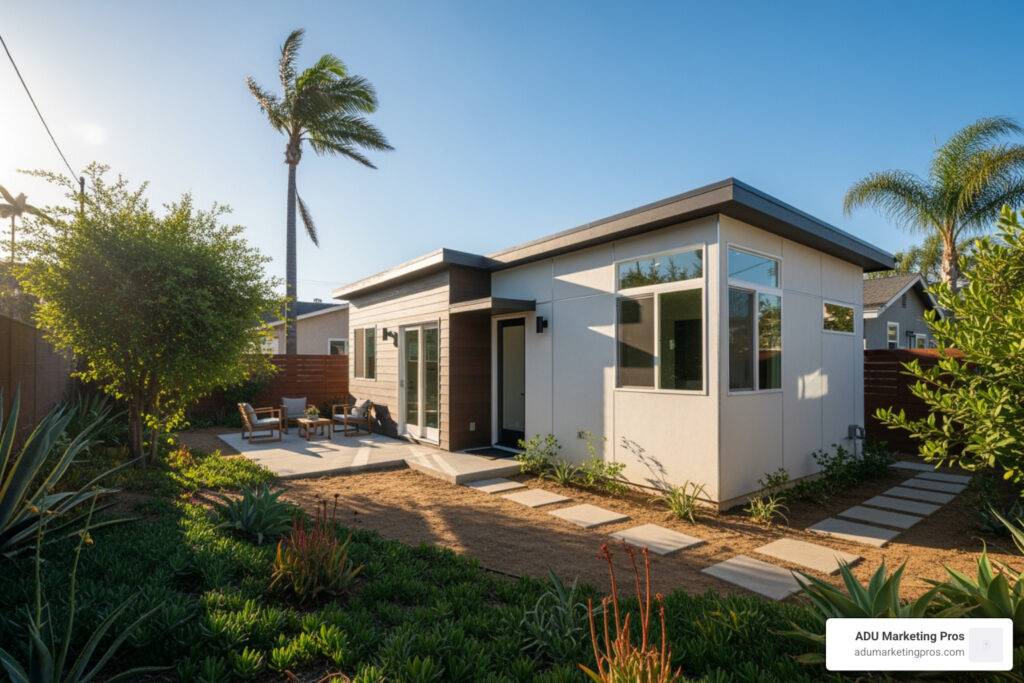
Los Angeles Homeowners Are Sitting on a Goldmine — If They Know Where to Look
Affordable ADU construction Los Angeles is one of the most searched topics among local homeowners right now — and for good reason. As the city grapples with an unprecedented housing shortage, the backyard has become the new frontier for financial stability and urban development. For decades, restrictive zoning laws made it nearly impossible for the average homeowner to build a secondary unit. However, a series of legislative shifts at the state level, starting with SB 1069 in 2017 and continuing through recent updates in 2023 and 2024, has effectively dismantled these barriers, turning thousands of underutilized backyards into potential sources of significant wealth.
Quick answer: Here’s what you need to know about affordable ADU construction in Los Angeles:
| Topic | Key Facts |
|---|---|
| What is an ADU? | A secondary dwelling unit on your existing residential lot (300–1,200 sq ft) |
| Typical cost range | Varies widely based on type; garage conversions are the most budget-friendly |
| Fastest path to affordability | Grants up to $40,000 from CalHFA for qualifying low-income homeowners |
| Payback period | Most ADUs pay for themselves in under 10 years through rental income |
| Key programs | Backyard Homes Project, NHS of LA County, CalHFA ADU Grant Program |
| First step | Check your zoning using the City of LA’s ZIMAS property lookup tool |
The Context of the Los Angeles Housing Crisis
Los Angeles is currently navigating a complex housing landscape. Rents in neighborhoods from Silver Lake to the San Fernando Valley have reached historic highs, while the inventory of available homes remains at a record low. This “missing middle” housing gap has left millions of residents struggling to find affordable options. For homeowners, this crisis presents a unique opportunity. By investing in an accessory dwelling unit — also called a granny flat, backyard cottage, or in-law suite — you are not just adding a room; you are creating a self-contained home that can generate consistent rental income or house a family member in a city where space is the ultimate luxury.
Historically, the “American Dream” in Los Angeles was defined by the single-family home on a large lot. However, as the population surged and land became scarce, this model became unsustainable. The state’s intervention to mandate ADU approval was a direct response to this scarcity. Today, the City of Los Angeles is one of the most ADU-friendly jurisdictions in the country, having processed tens of thousands of applications in the last five years alone. This shift represents a fundamental change in how we view urban density and property rights.
Why Affordability is Finally Within Reach
The challenge for many has always been the perceived cost. Many homeowners assume building an ADU requires a massive liquid cash reserve or a complex commercial loan. It doesn’t have to be. Recent policy changes have streamlined the permitting process, reduced development impact fees, and introduced specialized grant programs. These initiatives are designed specifically to help middle-class and low-income homeowners participate in the housing solution. This guide breaks down exactly how to make affordable ADU construction in Los Angeles work for your property and your budget — from your first site check to collecting your first month’s rent.
Why Affordable ADU Construction in Los Angeles is a Smart Investment
When we talk about affordable ADU construction Los Angeles, we aren’t just talking about building a shed in the backyard. We’re talking about creating a high-quality, permanent residence that serves as a powerful financial engine. Building an accessory dwelling unit Los Angeles is arguably the fastest way to add massive equity to your home. In a city where land is the most expensive commodity, utilizing your existing lot is a stroke of genius. You aren’t buying more land; you’re just using yours more efficiently.
Passive Income and Property Equity
The most immediate benefit is the potential for passive rental income. With LA’s high demand for housing, a well-built ADU can often pay for itself in less than 10 years through rent alone. In high-demand areas like Santa Monica, Venice, or West Hollywood, a one-bedroom ADU can command rents upwards of $2,500 to $3,500 per month. Even in more suburban areas of the San Fernando Valley, rental rates remain strong enough to cover most, if not all, of the monthly financing costs of the build.
Beyond the monthly checks, the “forced appreciation” — the value added to your property — often exceeds the cost of construction the moment the project is finished. Real estate experts in Southern California have noted that properties with permitted ADUs often sell for significantly more than comparable homes without them, as buyers recognize the value of a built-in income stream or a flexible living space. This is particularly true for multi-generational buyers who are looking for a way to house extended family without the expense of buying two separate properties.
Housing Flexibility and Urban Infill
Whether you need a “granny flat” for aging parents or a starter home for adult children, ADUs provide housing flexibility that traditional homes can’t match. As the “Silver Tsunami” approaches, many families are looking for ways to keep aging relatives close while maintaining privacy. An ADU offers the perfect balance. By following the latest adu-guidelines-los-angeles, you contribute to “urban infill,” helping solve the housing crisis without destroying the character of your neighborhood. This method of development is environmentally superior to suburban sprawl, as it utilizes existing infrastructure and reduces the need for long commutes.
Environmental and Social Benefits
Beyond the personal financial gains, there is a broader social impact. Programs like the California Housing Finance Agency ADU Grant Program are making it easier than ever for low-to-moderate-income homeowners to jump into the game. By building an ADU, you are providing a safe, modern home for a fellow Angeleno, contributing to the stabilization of your local community. Furthermore, smaller living units naturally have a lower carbon footprint. They require fewer materials to build and less energy for heating and cooling, which aligns with California’s aggressive climate goals and the Title 24 energy standards that mandate solar panels on most new detached ADUs.
Breaking Down the Cost of affordable ADU construction Los Angeles
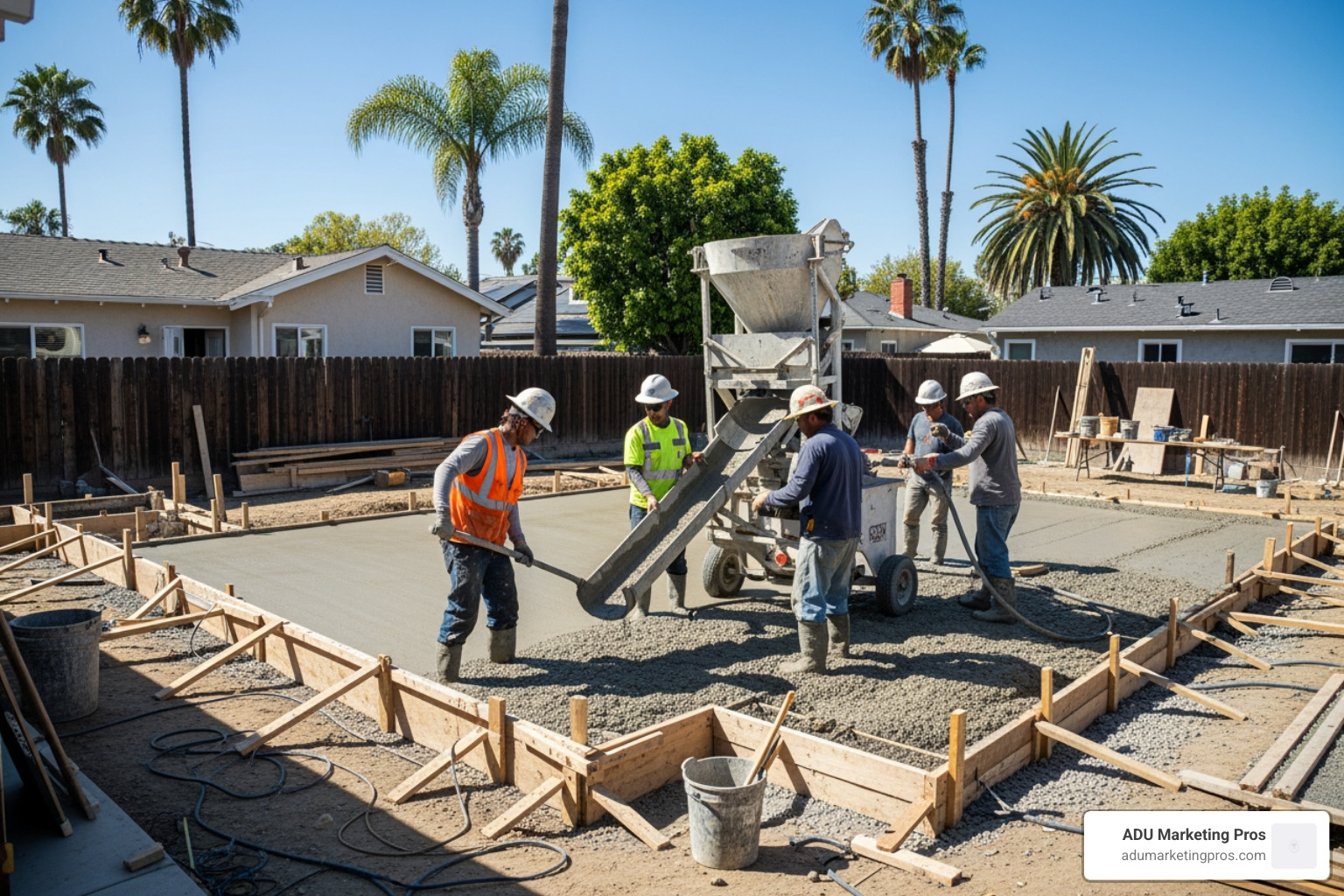
One of the first questions we hear is: “What’s the bottom line?” While every backyard is different, understanding the components of affordable ADU construction Los Angeles helps you budget effectively. Generally, the adu-cost-per-square-foot can range from $250 to $450+, depending on whether you are converting an existing space or building from the ground up. New detached units usually cost more because they require a new foundation, framing, and utility trenching.
Comparing Construction Types
To give you a better idea of how to save, here is a quick comparison of the two most common paths:
| Feature | Garage Conversion | Detached New Construction |
|---|---|---|
| Foundation | Existing (may need retrofitting) | New |
| Framing | Existing walls used | All new materials |
| Permitting | Often faster | Standard timeline |
| Typical Cost | $90,000 – $150,000 | $200,000 – $350,000+ |
| Privacy | Attached or close to main house | Completely separate |
For a deeper dive into these numbers, check our guide on adu-building-costs.
Understanding Soft Costs vs. Hard Costs
When budgeting for affordable ADU construction Los Angeles, it is vital to distinguish between “hard costs” (the actual labor and materials) and “soft costs” (the fees and services required before construction begins).
- Hard Costs: These include the concrete for the foundation, lumber for framing, roofing materials, plumbing fixtures, and electrical wiring. In Los Angeles, labor costs are a significant portion of this category, often accounting for 40-50% of the total hard cost budget. Material costs can fluctuate based on global supply chains, so it is always wise to include a 10-15% contingency fund in your hard cost budget.
- Soft Costs: These are often overlooked but can add up quickly. They include architectural design fees, structural engineering reports, Title 24 energy calculations, and city permit fees. Using tools like ZIMAS (the City of Los Angeles property lookup) helps identify if you are in a “Hillside” zone or a “Historic Preservation” zone, both of which can increase soft costs due to additional required reviews and specialized engineering.
Factors Influencing Pricing
Several variables can swing your budget by tens of thousands of dollars.
- Site Conditions: Is your backyard sloped? Is access for heavy machinery blocked by your main house? These “soft” site issues can increase labor costs significantly. If a contractor has to carry materials by hand to the back of the lot because a Bobcat can’t fit through the side gate, your labor costs will rise.
- Utility Hookups: Connecting water, sewer, and electricity to the main line is a significant part of adu-construction-cost. If your existing sewer line is old or undersized, you may face unexpected expenses to upgrade it. Additionally, the Los Angeles Department of Water and Power (LADWP) may require a transformer upgrade if your total property load exceeds certain thresholds.
- Design Fees: While custom designs are beautiful, the adu-architect-los-angeles-cost can add 10-15% to your budget. Opting for pre-approved plans can cut these costs significantly and speed up your timeline.
Financing Options and Grants for LA Homeowners
The biggest hurdle is often the upfront cash. Fortunately, Los Angeles has some of the most robust support systems in the country for ADU builders. The CalHFA ADU Grant Program is a game-changer, offering up to $40,000 to qualified low-to-moderate-income homeowners. This money covers pre-construction costs like architecture, engineering, and permit fees. While the initial $100 million was exhausted quickly, the state recently injected another $25 million into the fund, signaling a long-term commitment to this housing model. To qualify, homeowners must meet specific income limits based on their county, making this a vital tool for middle-class families.
Specialized Lending and Traditional Loans
For those looking for traditional or specialized lending, organizations like Genesis LA Economic Growth Corporation and Self-Help Federal Credit Union provide financing products tailored to ADU projects. These lenders often understand the unique value proposition of an ADU better than traditional big-box banks. Even major institutions like JP Morgan Chase & Co. have recognized the value of ADUs in stabilizing community housing and have begun offering more flexible home equity products.
If you’re wondering which loan fits your situation, we’ve mapped out the journey from-loans-to-investments-navigating-adu-financing and provided a list of adu-funding-grants to explore. Common options include:
- HELOC (Home Equity Line of Credit): A flexible line of credit that allows you to draw funds as needed during construction. This is often the most cost-effective way to finance a build if you have significant equity in your primary home.
- Cash-Out Refinance: Replacing your current mortgage with a larger one and taking the difference in cash to fund the build. This can be advantageous if current interest rates are lower than your original mortgage rate.
- Construction Loans: Specialized loans that pay out in “draws” as construction milestones are met. These are ideal for homeowners who do not have enough equity for a HELOC but have a strong income and credit score.
Leveraging Programs for affordable ADU construction Los Angeles
Innovative programs like the Backyard Homes Project (led by LA Más and partners) offer a unique “win-win.” Homeowners receive design and construction support in exchange for committing to rent the unit to a Section 8 voucher holder for a minimum of five years. This program is supported by entities like Restore Neighborhoods LA, the Housing Authority of the City of Los Angeles, and the Housing Rights Center.
Participants often receive landlord training and support from the St. Joseph Center, ensuring that their journey into property management is smooth and successful. This approach not only makes affordable ADU construction Los Angeles possible for the homeowner but also directly addresses the homelessness crisis by providing stable housing for vulnerable populations. You can find more about these affordable-adu-california initiatives on our dedicated resource pages. By participating in these programs, homeowners can often bypass the most stressful parts of the development process while serving a greater social good.
Navigating the ADU Construction Process in Los Angeles
Building an ADU is a marathon, not a sprint. Knowing the milestones helps you avoid the common “permit purgatory” that many DIYers fall into. The process in Los Angeles has been significantly improved by the Department of Building and Safety (LADBS), but it still requires careful coordination and a clear understanding of the local bureaucracy.
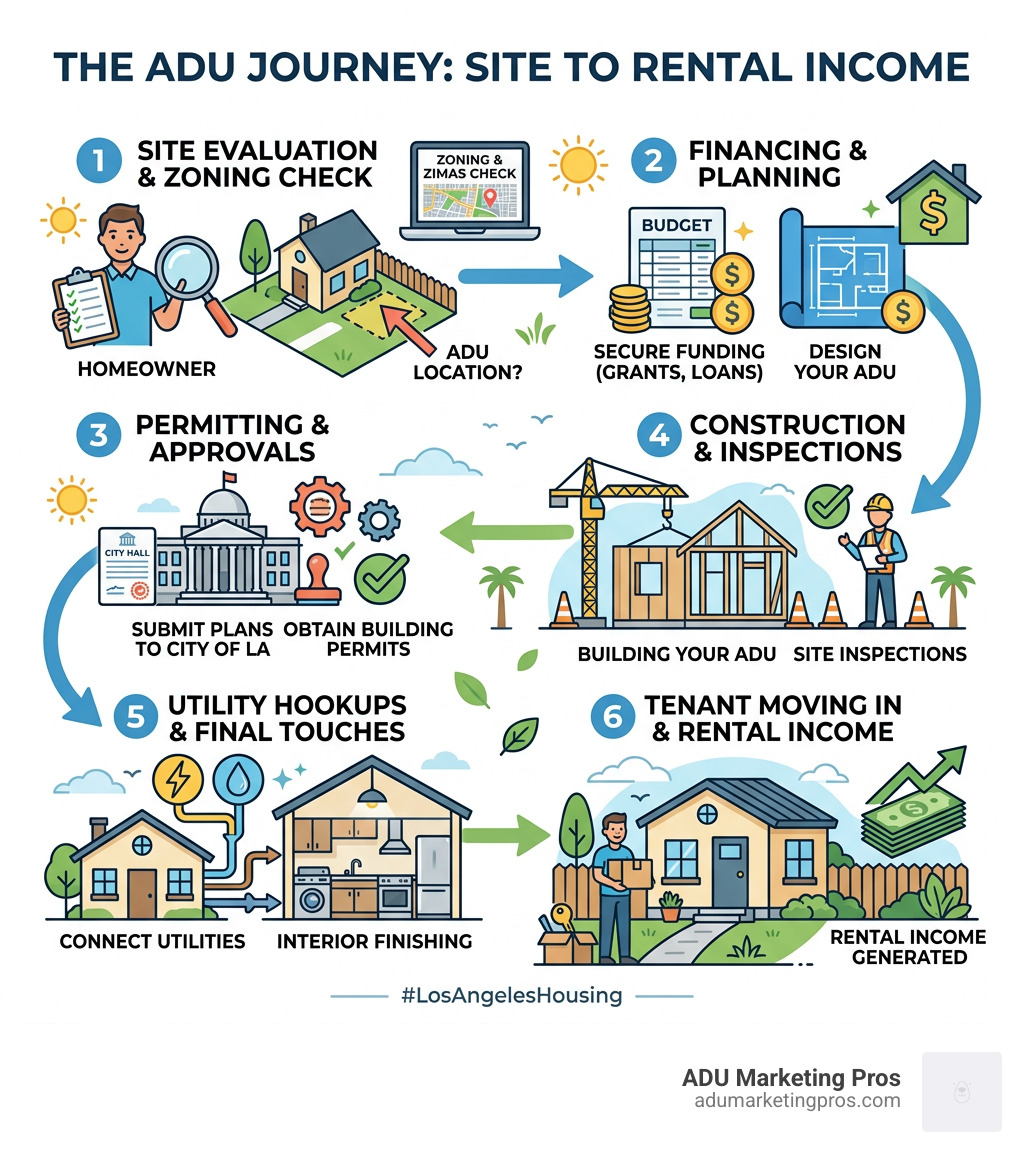
- Site Evaluation: Before you fall in love with a floor plan, you must know what your lot allows. This includes checking setbacks (usually 4 feet from side and rear property lines) and utility locations. You must also ensure that your ADU doesn’t interfere with existing easements or protected trees, such as Coast Live Oaks or Western Sycamores, which have strict removal and pruning regulations in LA.
- Design and Architecture: Working with experienced adu-architects-los-angeles is vital. They understand the nuances of LA’s building codes, Title 24 energy requirements, and the specific fire safety standards required for units built close to property lines. For example, if your ADU is within 5 feet of a property line, you may need fire-rated walls and specialized windows.
- Permitting: You will submit your plans to the Los Angeles Department of Building and Safety (LADBS). We’ve created a guide to Los Angeles ADU regulations to help you understand what the city looks for. Expect a few rounds of “corrections” where the city asks for minor adjustments to the plans. This phase can take anywhere from 8 to 16 weeks depending on the complexity of the project.
- Construction: Once permits are in hand, your adu-builder-los-angeles will break ground. Key milestones include foundation, framing, “rough-in” (plumbing/electrical), insulation, drywall, and final finishes. Each stage requires a city inspection before you can move to the next. The final inspection results in a Certificate of Occupancy, which officially makes the unit legal for habitation.
Choosing Between Prefab, Custom, and Pre-Approved Plans
The “how” of your build significantly impacts the “how much.”
- Prefab ADUs: These are built off-site in a factory and craned onto your property. While they can be faster and offer more predictable pricing, you still need to handle site prep, foundations, and utility hookups. Explore prefab-adu-los-angeles options to see if they fit your lot’s access constraints. Prefab is often a great choice for flat lots with wide street access.
- Custom Builds: These allow for maximum creativity and can be designed to perfectly match the architecture of your main home. However, they come with higher design costs. You can browse adu-floor-plans-los-angeles to get inspiration for your custom project. Custom builds are often necessary for irregular lots or hillside properties.
- Pre-Approved Plans: The City of Los Angeles offers a “Standard Plan Program.” Using pre-approved-adu-plans-los-angeles can shave weeks or even months off the permitting process because the structural designs have already been vetted by the city. This is one of the most effective ways to achieve affordable ADU construction Los Angeles because it reduces both architectural fees and city review time.
For the most official state-wide rules, the HCD ADU Guidelines provide the baseline for all California cities, ensuring that local municipalities cannot impose overly restrictive requirements that would thwart your project.
Legalizing Unpermitted Units and Neighborhood Zoning
Do you already have a “recreation room” or a converted garage that was built without permits? You aren’t alone. Thousands of Angelenos have unpermitted units that they are afraid to talk about. For years, these units existed in a legal gray area, often providing housing but leaving the homeowner vulnerable to fines, forced demolition, or liability in the event of an accident.
The Path to Legalization (AB 2533)
Thanks to laws like AB 2533, there is now a clearer path to legalizing these units. The state has instructed local governments to prioritize health and safety over minor zoning infractions for existing units. This means you can often bring an older garage-conversion-los-angeles up to code without having to tear it down and start over. The focus is on ensuring the unit has proper egress (exits), smoke detectors, and safe electrical wiring, rather than worrying about whether the ceiling is an inch too low or if the setback is slightly off.
Turning Liabilities into Assets
Legalizing these units is one of the most cost-effective forms of affordable ADU construction Los Angeles. It turns a “liability” into a legal, rent-producing asset. Once permitted, the unit can be legally insured, and the income can be counted toward your total earnings when applying for loans. Programs like LA Family Housing often work with homeowners in areas like Northeast Los Angeles to stabilize these units and provide safe housing for those in need.
If you’re looking to turn a storage space into a home, check out our resources on adu-garage-conversions and garage-to-adu-conversion. Legalization not only protects you from city citations but also significantly increases your property’s market value, as a permitted ADU is a much more attractive feature to future buyers than an unpermitted “bonus room.” Furthermore, it provides peace of mind, knowing that your tenants are living in a space that meets modern safety standards.
Frequently Asked Questions about Affordable ADUs
How long does it typically take to complete an ADU project in LA?
From the first sketch to the final walkthrough, expect a timeline of 9 to 14 months. Permitting usually takes 3-5 months, and construction takes another 6-9 months. Working with specialized adu-architects-los-angeles-2 who know the LADBS system can help you avoid common delays like “corrections” that send your plans back to the bottom of the pile. Factors like weather, material availability, and contractor scheduling can also influence the final timeline. It is important to remember that the “pre-construction” phase (design and permitting) is often just as long as the actual building phase.
Can I build an ADU on a multi-family property in Los Angeles?
Yes! Recent changes to los-angeles-adu-regulations allow owners of multi-family buildings (duplexes, triplexes, etc.) to add ADUs. You can often build up to two detached ADUs on a multi-family lot, or convert existing non-livable space (like basements, attics, or storage rooms) into units. This is a massive opportunity for landlords to increase their ROI without buying new property, effectively densifying their existing portfolio and providing more housing in high-density areas.
What is the most cost-effective way to build an ADU?
The “Gold Medal” for affordability goes to the garage-conversion-to-adu. By using the existing foundation, walls, and roof of a garage, you save roughly 30-40% compared to a new build. To keep costs low, stick to “standard” finishes (like luxury vinyl plank flooring and off-the-shelf cabinetry) rather than custom imports. A garage-conversion-adu is the fastest way to start seeing a return on your investment. Another tip is to keep the plumbing “wet wall” (kitchen and bathroom) on the same side of the unit to minimize piping costs.
Will building an ADU increase my property taxes?
Yes, but not as much as you might fear. In California, building an ADU triggers a “blended assessment.” Your primary home’s tax basis remains the same (thanks to Proposition 13), and only the new construction is assessed at its current market value. This means your property taxes will go up based on the value of the ADU, but your entire property will not be reassessed at current market rates. This is a significant protection for long-term homeowners who have a low tax basis.
Are there parking requirements for ADUs in Los Angeles?
In most cases, no. Under current state law, if your ADU is located within a half-mile of public transit (which includes most of Los Angeles), you are not required to provide additional parking for the unit. Furthermore, if you convert a garage into an ADU, you are no longer required to replace the parking spaces that were lost. This has been a major factor in making affordable ADU construction Los Angeles a reality for homeowners with small lots or those who live in parking-impacted neighborhoods.
Can I sell my ADU separately from my main house?
Generally, no. In most of Los Angeles, the ADU and the primary home must be sold together as a single property. However, new legislation (AB 1033) allows cities to opt-in to a program that would permit ADUs to be sold as condominiums. As of now, Los Angeles is still evaluating how to implement this, but it could represent a massive shift in the future, allowing for more affordable homeownership opportunities.
Conclusion: Building Your Future, One Unit at a Time
Affordable ADU construction Los Angeles is more than just a home improvement project; it’s a comprehensive wealth-building strategy. By adding a secondary unit, you are creating a source of income that can fund your retirement, pay off your primary mortgage, or provide a safety net for your family in an increasingly expensive city. The transition from being a single-family homeowner to a multi-unit property owner is a significant milestone that offers long-term financial security and a hedge against inflation.
Beyond the personal financial gains, you are playing a vital role in the community. Every ADU built helps ease the housing shortage, reduces the pressure on our infrastructure, and makes Los Angeles a more livable, inclusive city for everyone. Whether you are legalizing an old garage or building a modern custom cottage, the long-term benefits far outweigh the initial hurdles of permitting and construction. You are contributing to a more sustainable urban model that prioritizes density and efficiency over sprawl, helping to preserve the natural beauty of Southern California by reducing the need for outward expansion.
At ADU Marketing Pros, we specialize in helping the firms that build these incredible homes reach more people. We know that the ADU market is competitive, and we help architects and builders stand out by highlighting their expertise and successful projects. If you’re a professional in the space looking to grow, explore more info about ADU marketing solutions to see how we can help you lead the charge in LA’s housing revolution.
Your backyard is waiting. With the right planning, the right team, and a clear understanding of the available grants and financing, your dream of an affordable ADU is closer than you think. The path to becoming a landlord and increasing your property’s value is well-trodden, and the resources available today are better than ever. Are you ready to build?