
Why Mountain View ADU Financing Is One of the Smartest Moves You Can Make Right Now
Mountain View ADU financing is something more homeowners are actively pursuing — and for good reason. As the heart of Silicon Valley continues to face a chronic housing shortage, the value of residential land has skyrocketed, making the addition of an Accessory Dwelling Unit (ADU) one of the most lucrative investments available to property owners today.
Here are the most common ways to fund an ADU build in Mountain View:
- HELOC (Home Equity Line of Credit) – Borrow against your home’s equity without touching your primary mortgage
- Cash-out refinance – Replace your mortgage with a larger one and pocket the difference
- Construction loan – A short-term loan that funds building in stages, then converts to a permanent loan
- CalHFA ADU Grant – Up to $40,000 in reimbursements for pre-development costs for qualifying low- to moderate-income homeowners
- Housing Trust Silicon Valley loan – Local program offering ADU-specific loans with a 2-year affordability requirement
- ADU-specific lender products – Specialized loans from banks and credit unions designed for accessory dwelling unit projects
The Silicon Valley Housing Context
Mountain View sits at the heart of Silicon Valley, where the median property value hovers around $1.87 million and the median rent reaches $4,488 per month. That combination creates a powerful case for adding an ADU to your property. In a city where tech giants like Google and LinkedIn drive a constant influx of high-earning professionals, the demand for high-quality, modern housing far outstrips the supply. This “Missing Middle” housing gap is exactly what ADUs are designed to fill.
Yet for most homeowners, the biggest question isn’t whether to build — it’s how to pay for it. The financial landscape of the San Francisco Bay Area is unique; while property values are high, so are construction costs and living expenses. Navigating the intersection of high-interest rates and high-equity positions requires a nuanced approach to financing.
The Evolution of ADU Legislation
Construction costs in California average around $150,000, and complex custom builds in high-cost areas like Mountain View can push well past $300,000. That’s a serious financial commitment, and navigating the landscape of loans, grants, equity products, and local programs can feel overwhelming before you’ve even pulled a permit. However, recent legislative shifts, including SB 9 and SB 10, have significantly streamlined the approval process, making it easier for lenders to justify these loans.
The good news? The options have never been more varied or accessible. From state-level grants to equity-backed loans to specialized ADU lenders, there’s likely a financing path that fits your situation — whether you’re a homeowner looking to generate rental income, house a family member, or simply grow your property’s long-term value. This guide breaks down every major financing option available for Mountain View ADU projects, what each costs, who qualifies, and how to avoid the most common mistakes along the way.
Understanding the Costs of Mountain View ADU Financing
Before we dive into the “how” of borrowing, we need to talk about the “how much.” In Mountain View, building an ADU is a significant capital expenditure. While the statewide median cost was estimated at $150,000 back in 2018, the reality of the 2024 Silicon Valley market is often higher. According to Terner Center research on ADU construction costs, about 13% of California ADUs now exceed $300,000 in total costs. In Mountain View, where labor is at a premium and site conditions can be complex, budgeting for the higher end of the spectrum is a prudent move.
When planning your mountain view adu financing, you have to account for more than just lumber and labor. Your budget should be split into “hard costs” (the actual construction) and “soft costs” (everything else).
Breaking Down Soft Costs vs. Hard Costs
- Soft Costs: These include architectural designs, structural engineering, environmental surveys, and the city’s permit fees. In Mountain View, design fees typically range from 5% to 15% of your total construction budget. You must also account for Title 24 energy compliance reports and potentially soils reports if you are building a detached unit on a slope.
- Hard Costs: This covers site preparation, foundation, framing, roofing, and interior finishes. In the Bay Area, the cost of materials has stabilized, but the cost of skilled labor remains among the highest in the nation.
- Utility Connections: Don’t overlook these. You may need a sewer lateral inspection or electrical panel upgrades to handle the new unit’s load. Mountain View often requires separate metering for certain utilities if the ADU is to be used as a rental, which adds to the upfront cost but simplifies long-term management.
To help you visualize the difference in scale, here is a comparison of typical costs in the current Mountain View market:
| ADU Type | Typical Size | Est. Cost Range (Mountain View) | Best For |
|---|---|---|---|
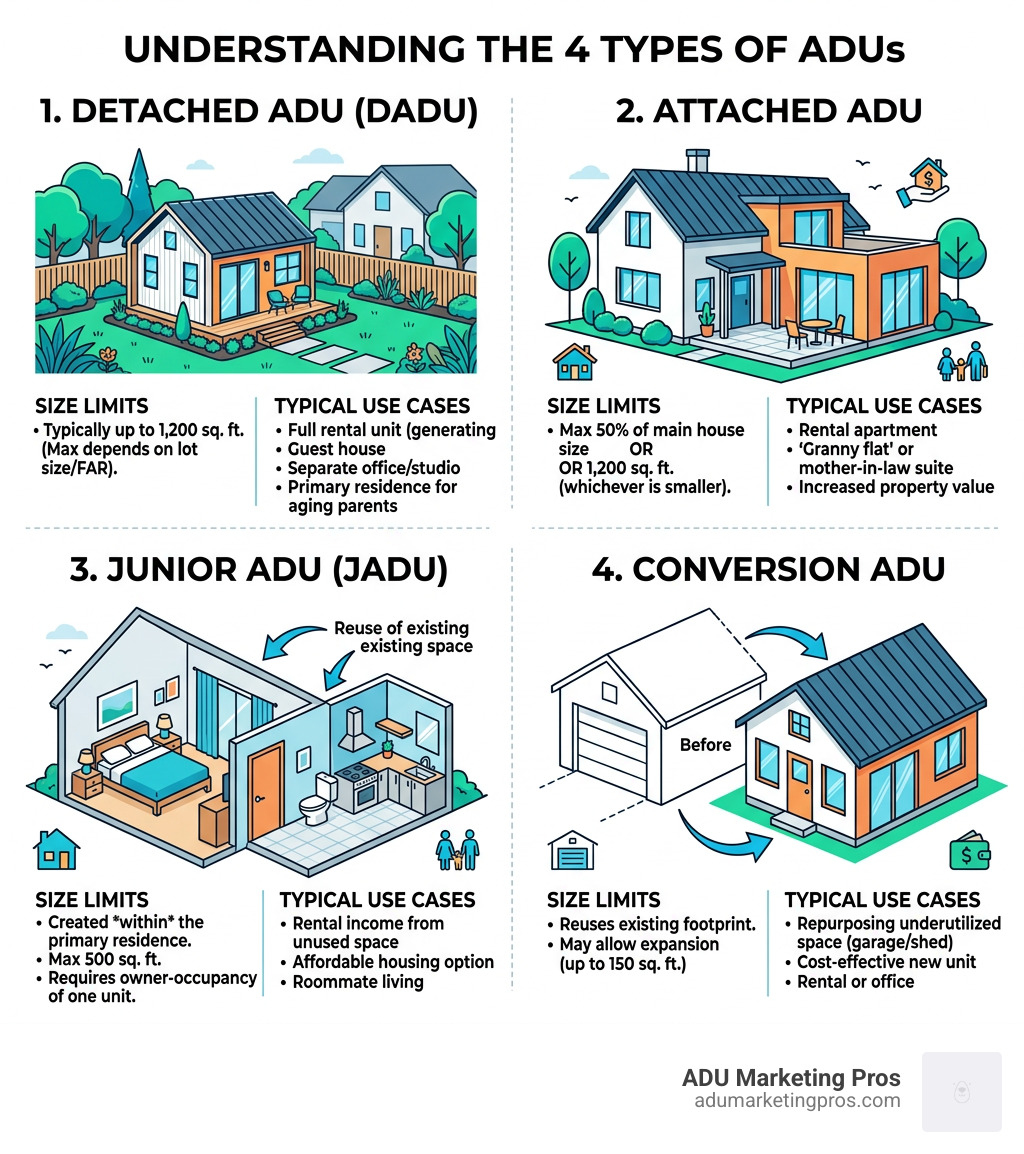
| Junior ADU (JADU) | < 500 sq ft | $80,000 – $150,000 | Budget-conscious, internal conversions |
| Garage Conversion | 300 – 500 sq ft | $120,000 – $200,000 | Utilizing existing footprint |
| Detached ADU | 600 – 1,200 sq ft | $250,000 – $450,000+ | Maximum privacy and rental ROI |
For a deeper dive into current market pricing, you can check more info about ADU loan rates to see how interest impacts these totals over time. Understanding the debt-to-income ratio requirements is also critical when planning these larger builds.
Impact Fee Exemptions and Reductions
One of the biggest wins for homeowners in recent years is the reduction of “impact fees.” These are fees the city charges to offset the “impact” of new residents on parks, schools, and traffic. Historically, these fees could add $30,000 or more to a project, often acting as a deterrent for middle-class homeowners.
Under California state laws like SB 1069 and AB 2299, ADUs under 750 square feet are completely exempt from local impact fees. If you build a unit larger than 750 square feet, the fees are required to be proportional to the size of the primary dwelling, often capped at 50% of what a full-sized house would pay. This exemption alone can save you between $10,000 and $25,000 in Mountain View. You can learn more about these legislative perks in our guide on California ADU incentives.
Pre-approved Plans and Cost Certainty
If you want to speed up the process and potentially lower your design costs, look into “pre-approved” plans. The City of Mountain View has moved toward ministerial approval for compliant ADUs, meaning if your plan meets objective standards, the city must approve it within 60 days. This removes the “discretionary review” process that used to plague Bay Area construction.
Using a pre-approved plan can shorten your permit review time to just 1 to 3 months, compared to the 6 to 15 months often required for fully custom designs. These plans offer a “guaranteed” path through the building department, which can make lenders more comfortable with your Mountain View ADU Investing with Pre-Approved Options. Lenders love certainty, and a pre-approved plan reduces the risk of costly design changes mid-construction.
Top Loan Strategies for Your Mountain View ADU
Choosing the right loan is like choosing the right foundation — if it’s not solid, the whole project feels shaky. Most Mountain View homeowners utilize their home’s existing equity to fund their backyard dreams, but the strategy you choose depends heavily on your current mortgage rate and long-term financial goals.
Leveraging Home Equity for Mountain View ADU Financing
If you’ve owned your home in Mountain View for a few years, you likely have a “gold mine” of equity. Even with market fluctuations, the long-term trend in Santa Clara County has been aggressively upward. There are two primary ways to tap into this:
- HELOC (Home Equity Line of Credit): This works like a credit card backed by your house. You only pay interest on what you draw. This is perfect for ADU projects because you can pay your contractor in stages (draws) as milestones are met. This prevents you from paying interest on the full loan amount from day one.
- Cash-Out Refinance: This involves replacing your current mortgage with a new, larger one. You take the difference in cash to pay for the ADU. This is often best if current interest rates are lower than your original mortgage rate. However, many Mountain View residents locked in sub-3% rates in 2020-2021. In these cases, a HELOC or a second mortgage is almost always the better financial move to preserve that low primary rate.
When applying, lenders look closely at your Loan-to-Value (LTV) ratio. Typically, they want your total debt to be less than 80-90% of your home’s value. Because Mountain View property values are so high, even a small percentage of equity can cover a full ADU build. Explore all your ADU Financing Options to see which fits your tax strategy.
Specialized Construction Loans for Mountain View ADU Financing
What if you don’t have enough equity yet? Perhaps you recently purchased your home and haven’t seen significant appreciation. That’s where Construction loans for ADU come in. Unlike a standard mortgage, these loans are based on the future value of the property after the ADU is built.
- FHA 203k Renovation Loans: These allow you to bundle the purchase (or refinance) of a home with the costs of construction into a single loan. They have lower credit score requirements but come with mortgage insurance premiums.
- Renovation Loans (Fannie Mae/Freddie Mac): These are conventional options that allow for ADU construction. A major benefit here is that some lenders now allow you to count a portion of the future rental income from the ADU to help you qualify for the loan. This is a game-changer for homeowners who might otherwise have a high debt-to-income ratio. See how this works with Fannie Mae ADU rental income rules.
The Appraisal Gap Challenge
One hurdle in Mountain View is the “appraisal gap.” Sometimes, an appraiser might not give full value to an ADU because there aren’t enough “comparable sales” in the immediate neighborhood. Working with a lender who specializes in ADUs is vital because they use appraisers who understand how to value these units based on both square footage and potential rental income. This ensures your mountain view adu financing covers the actual cost of construction.
Grants and Local Incentives in Santa Clara County
Free money? It exists, but it usually comes with specific requirements and strict timelines. For Mountain View residents, the combination of state and local programs can significantly offset the initial “soft costs” of a project.
The CalHFA ADU Grant
The California Housing Finance Authority (CalHFA) offers an ADU Grant that provides up to $40,000 to qualifying homeowners. This isn’t a loan; it’s a reimbursement for “pre-development” costs. This includes:
- Architectural drawings and design iterations
- Permit fees and city processing charges
- Soil tests and structural engineering reports
- Site preparation and utility hookup planning
To qualify, you generally need to fall within “low to moderate” income limits for Santa Clara County. Given the high income ceilings in our area (often exceeding $200,000 for a household), more people qualify than you might think. You can find the Official CalHFA ADU Grant details on their website or browse our summary of ADU funding grants.
Housing Trust Silicon Valley Programs
Local organizations are also stepping up to combat the housing crisis. The Housing Trust Silicon Valley has a dedicated ADU program designed to encourage more housing in Santa Clara County. They offer technical assistance, educational workshops, and specialized loan products that traditional banks might not offer.
One unique aspect of their program is the affordability restriction. In exchange for favorable loan terms or lower interest rates, you may be required to rent the unit to a low-income tenant for a set period (often 2 years). This is a great way to align your investment with a social mission while securing funding. For many, this is a small price to pay for the financial assistance provided. Check out the Accessory Dwelling Unit Grant Program for local updates.
Financing for Low-Income and Multi-Family Properties
The push for equity in housing means there are more resources for BIPOC homeowners and those in historically underserved neighborhoods. Furthermore, if you own a multi-family property (like a duplex or apartment building) in Mountain View, you may be eligible to add multiple ADUs. Recent changes like SB9 even allow for lot splits in some cases, creating entirely new financing opportunities. If you’re looking at a multi-family project, review the Freddie Mac ADU rental income guidelines to see how it affects your borrowing power. Multi-family ADU financing often follows commercial lending rules, which can offer different leverage options than residential loans.
Maximizing ROI and Rental Potential in Mountain View
Is mountain view adu financing worth it? Let’s look at the numbers. In a market where a one-bedroom apartment can easily rent for over $3,500, the return on investment for an ADU is often superior to the stock market or other real estate ventures.
The Cash Flow Analysis
With a median rent of $4,488, a well-built ADU can pay for its own financing in a matter of years. Let’s look at a hypothetical scenario:
- Construction Cost: $300,000
- Loan Payment (at 7%): ~$2,000/month
- Expected Rent: $4,000/month
- Net Monthly Cash Flow: $2,000/month
In this scenario, the ADU isn’t just paying for itself; it’s providing a significant monthly profit that can be used to pay down your primary mortgage or reinvest. Even if your loan payment is higher, the long-term appreciation of the structure adds to your net worth every single month.
Property Tax Implications and Market Value
A common fear is that an ADU will cause a massive jump in property taxes. In California, thanks to specific protections, your primary home is not reassessed. Only the new construction (the ADU) is assessed for its value. If your ADU costs $200,000 to build, your property taxes might increase by roughly 1% of that value (about $2,000 per year), which is easily covered by a month or two of rent. This is a critical distinction that makes ADUs much more tax-efficient than selling and buying a larger home.
Beyond the monthly income, an ADU can increase your property’s market value by 25% to 35%. In a market like Mountain View, that could mean adding $500,000 or more in resale value to a $1.8M home. For more on the long-term math, read From Loans to Investments: Navigating ADU Financing.
Short-Term vs. Long-Term Rentals
While Airbnb is popular, Mountain View has specific regulations regarding short-term rentals. The city generally requires the host to live on-site, and there are limits on the number of days a unit can be rented out. Most ADUs are best suited for long-term tenants (30 days or more), which provides more stable income and is often viewed more favorably by lenders when calculating FHA ADU rental income. Long-term tenants also result in less wear and tear on the unit and lower turnover costs.
Frequently Asked Questions about Mountain View ADU Financing
Can I finance an ADU without refinancing my current mortgage?
Yes! This is a very common goal for homeowners who locked in 3% interest rates a few years ago. You can use a HELOC or a Home Equity Loan (a “second mortgage”). These sit behind your primary mortgage, leaving your original low rate untouched. Personal loans or the Housing Trust Silicon Valley loan program are also options that don’t require a full refinance. Some homeowners also use 401k loans or private lending if they have a clear path to repayment.
Are ADUs under 750 square feet exempt from impact fees?
Yes. Per California state law, any ADU under 750 square feet is exempt from impact fees. This is a statewide mandate that Mountain View follows. For units larger than that, the fees must be proportional. This is one of the most effective ways the state has encouraged the construction of smaller, more affordable housing units.
How long does the financing and approval process take?
Securing financing usually takes 30 to 60 days, depending on the complexity of the loan and the speed of the appraisal. Once you have the funds, the Mountain View permitting process typically takes 4 to 6 months for custom builds, though pre-approved plans can be much faster. Construction usually adds another 6 to 12 months. If you’re feeling stuck on the rules, it’s often helpful to Talk to a zoning expert to get a clear timeline for your specific lot.
Does an ADU require a separate solar system?
Under California’s Title 24 building standards, newly constructed detached ADUs are generally required to have solar panels. However, if you are doing a conversion (like a garage conversion), you may be exempt. The cost of solar can often be rolled into your mountain view adu financing package, and the energy savings help offset the loan costs.
Can I use the projected rent to qualify for the loan?
Yes, many modern loan products, including those from Fannie Mae and Freddie Mac, allow lenders to consider up to 75% of the projected rental income from the ADU to help you meet debt-to-income requirements. You will typically need a market rent analysis from a qualified appraiser to verify the potential income.
What happens to my property taxes?
Only the new square footage is assessed. Your original home maintains its Prop 13 base year value. The ADU will be assessed at its current market value (usually based on construction cost), and that amount will be added to your total tax bill. It is a “blended” assessment rather than a full property reassessment.
Are there parking requirements for ADUs in Mountain View?
In most cases, no. California law prohibits local jurisdictions from requiring replacement parking when a garage is converted to an ADU, or requiring new parking for an ADU if it is located within a half-mile of public transit. Given Mountain View’s robust transit network, most properties qualify for this exemption.
Conclusion
Building an ADU in Mountain View is more than just adding a room; it’s a strategic financial move that addresses the Silicon Valley housing crisis while building personal wealth. Whether you’re leveraging $40,000 in state grants, tapping into your home’s equity, or using specialized construction loans, the path to a successful build starts with the right financing strategy. The complexity of the Bay Area market means that a one-size-fits-all approach rarely works, but the rewards for those who navigate the process are substantial.
At ADU Marketing Pros, we’ve seen how the right information can transform a “maybe one day” project into a “breaking ground tomorrow” reality. By focusing on expertise and the unique regulations of the San Francisco Bay Area, we help homeowners and builders navigate this booming sector with confidence. The transition from a single-family lot to a multi-unit property is a powerful way to secure your financial future while providing much-needed housing for the community.
Ready to take the next step in your ADU journey? Explore our ADU Marketing Solutions to see how we help the best builders in the industry connect with homeowners like you, or contact us today to learn more about the evolving landscape of Silicon Valley housing. Your backyard has the potential to be your most productive asset — let’s help you unlock it.