
Why Small Dwelling Units Are Reshaping Housing as We Know It
Small dwelling units are compact, self-contained residential spaces built on the same property as a primary home — or sometimes as standalone structures — designed for year-round living. For decades, the American housing model focused on suburban sprawl and large single-family estates. However, as urban centers become more crowded and the cost of living skyrockets, the “Missing Middle” housing movement has brought small dwelling units to the forefront of urban planning.
Here’s a quick breakdown of what they are and why they matter:
| Term | What It Means |
|---|---|
| Accessory Dwelling Unit (ADU) | A secondary unit on the same lot as a main home — attached, detached, or interior |
| Tiny Home | A very small dwelling, typically under 400 sq ft, either on a foundation or on wheels |
| Junior ADU (JADU) | A unit carved out of existing space inside a home, up to 500 sq ft |
| Secondary Suite | A self-contained apartment within or beside a primary residence |
| Micro Dwelling | An urban rental unit, often under 320 sq ft, designed for single occupancy |
All of these fall under the broad umbrella of small dwelling units — and all of them are growing fast. This shift represents a move toward “gentle density,” where cities increase housing capacity without destroying the architectural character of established neighborhoods.
Housing costs have surged in cities across North America. Families are squeezed. Renters are priced out. And traditional construction isn’t keeping up. Small dwelling units have emerged as one of the most practical, flexible responses to this crisis. They allow for multi-generational living, provide a source of passive income for homeowners, and offer a lower-cost entry point for renters in high-demand areas.
The numbers tell the story clearly. In California alone, ADU permitting jumped from fewer than 10,000 in 2017 to over 83,000 in 2022 — now accounting for nearly 1 in 5 new housing units built statewide. In Vancouver, roughly one-third of single-family homes have a legally permitted secondary suite. In the UK, 5% of households already have a granny flat, with another 7% planning to build one. This isn’t a niche trend; it’s a fundamental shift in how people think about property, housing, and community.
Whether you’re a homeowner looking to generate rental income, a builder trying to capture a growing market, or a city planner trying to solve an affordability crisis — small dwelling units are part of the conversation. This guide covers everything: definitions, types, costs, regulations, benefits, and the step-by-step process for building one.
Simple Small dwelling units word guide:
Defining Small Dwelling Units and Their Many Names
When we talk about Small dwelling units, we often find ourselves swimming in a sea of terminology. Depending on who you ask—a city planner in San Francisco, a real estate agent in San Diego, or your neighbor in Palo Alto—you might hear a dozen different names for the exact same thing. This linguistic diversity reflects the long history of these structures, which have evolved from simple servant quarters and carriage houses into modern, high-tech living spaces.
In fact, research has identified over 64 synonyms for ADUs and similar structures. While “Accessory Dwelling Unit” is the formal term used by architects and government officials, the public often uses more colorful language that reflects the unit’s intended use or its location on the property.

Common names you’ll encounter include:
- Granny Flats: Traditionally used for aging parents, this term is common in the UK, Australia, and the US.
- In-law Suites: A classic term for guest or family quarters, often located in a basement or attic.
- Laneway Houses: Popular in the Bay Area and Vancouver, these sit along the back alley or lane, often replacing a garage.
- Carriage Houses: A nod to the days of horse-drawn transport, often referring to units over a garage or standalone structures.
- Fonzie Flats: A reference to the garage apartment from Happy Days, popular in Australia and parts of the US.
- Secondary Suites: A broad term often used in Canada and parts of the US for basement or attic apartments.
- Garden Cottages: A more poetic term for detached units nestled in a backyard landscape.
Despite the naming confusion, the core concept remains the same: these are Small Houses that provide a private, self-contained living space. They are architecturally diminutive compared to the primary residence but offer full functionality, including a kitchen, bathroom, and sleeping area. Whether you are looking for Small Houses for Sale or building your own, understanding these terms helps navigate the local zoning codes in places like San Jose or Sunnyvale, where specific terms might be used in the municipal code.
Types of Small Dwelling Units: From ADUs to Tiny Homes
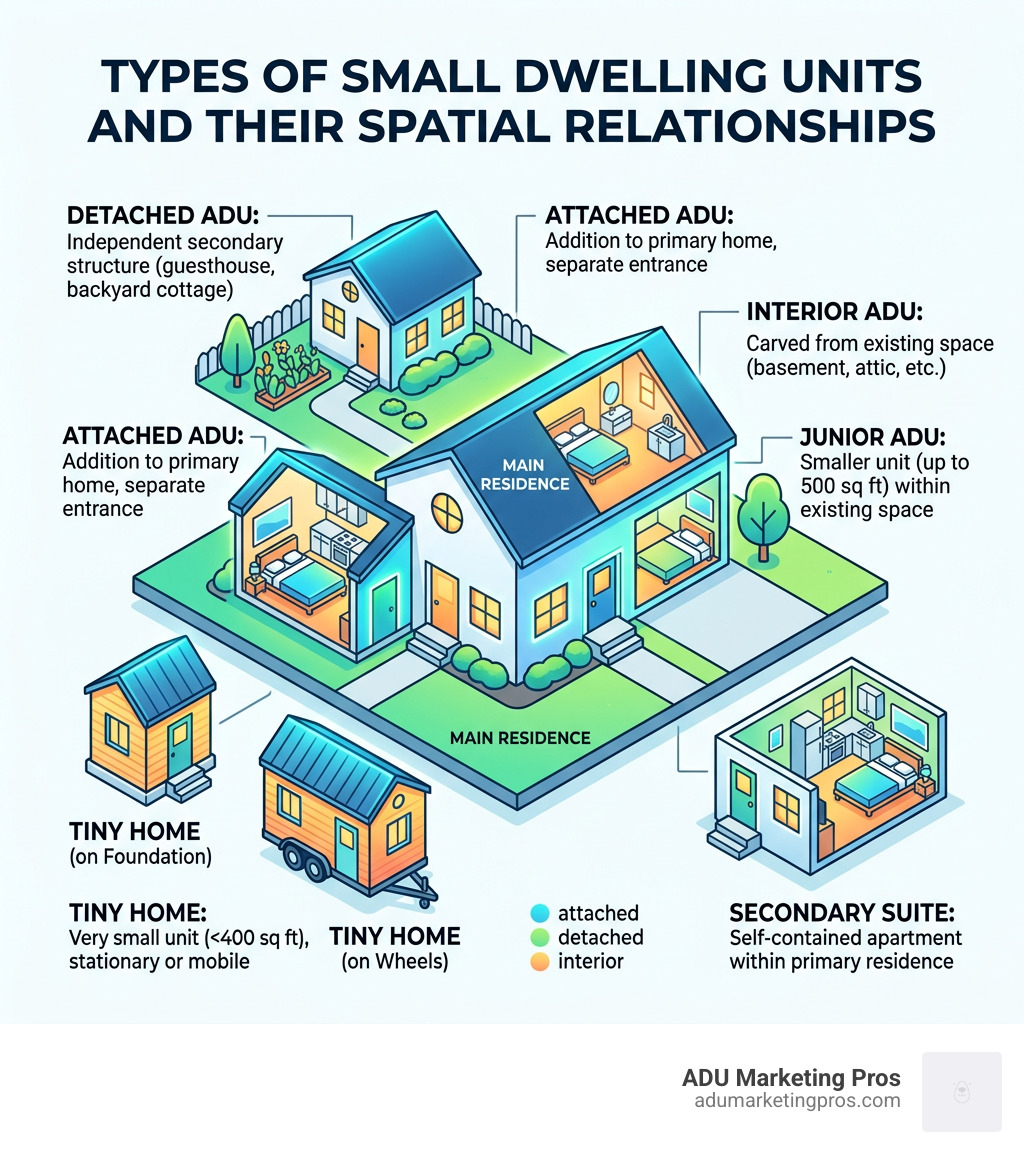
Not all Small dwelling units are created equal. They vary significantly in how they are attached to your property and how they are built. At ADU Marketing Pros, we see a wide range of designs that cater to different needs, from rental income to multi-generational living. Understanding the physical configuration of these units is the first step in determining what is feasible for your specific lot.
Attached ADUs
These units share at least one wall with the primary residence. They can be additions built onto the side of the house or conversions of existing space, such as an attic or a basement. They are often the most cost-effective way to add square footage because they can leverage existing utility lines and structural elements. However, they do require careful design to ensure soundproofing and privacy between the two living spaces.
Detached ADUs
A detached ADU is a standalone structure located on the same lot as the main house. These are frequently backyard cottages or converted detached garages. They offer the highest level of privacy for both the homeowner and the tenant, as there are no shared walls. In many California cities, detached units can be larger than attached ones, sometimes reaching up to 1,200 square feet depending on local ordinances.
Junior ADUs (JADUs)
Specific to California law, JADUs are units no larger than 500 square feet that are contained entirely within the walls of an existing single-family home. They must have an efficiency kitchen (which includes a sink, a cooking appliance, and a food preparation counter) and may share a bathroom with the main house, though most homeowners prefer to install a private one. JADUs are an excellent option for homeowners who have an extra bedroom or a large master suite they aren’t using.
Basement Apartments and Garage Conversions
These are “interior” units. Converting a garage is one of the most popular trends in Southern California and the Bay Area because the structure is already there, which can significantly reduce construction costs. However, we must ensure these conversions meet modern building codes for insulation, fire safety, and ceiling height. Basement apartments are more common in older East Coast cities but are gaining traction in the West as homeowners look for ways to maximize their existing footprint.
Modular vs. Site-Built
- Site-Built: Constructed from scratch on your property. This allows for total customization and seamless architectural integration with the main house but can take longer and cause more disruption to your daily life.
- Modular/Prefab: Built in a factory and transported to your site. This method is gaining traction because it’s faster, often results in less waste, and offers more predictable pricing. Companies now offer beautiful Studio ADU Floor Plans and 400 Square Foot ADU Plans that look incredibly modern and sleek.
When deciding between these options, the ADU vs Tiny House debate often comes up. While they may look similar, the legal distinctions are vital for compliance in cities like Los Angeles and Mountain View.
Distinguishing a Tiny Home on Wheels from Permanent Small Dwelling Units
This is a point of confusion for many. A “Tiny House on Wheels” (THOW) is exactly what it sounds like—it’s built on a chassis with wheels. In many jurisdictions, including Seattle and parts of Northern California, these are treated more like RVs or camper trailers than permanent residences.
For a tiny home to be considered a legal Small dwelling unit in most of our service areas:
- It must have a foundation: In San Francisco, for example, a tiny house must be attached to a permanent foundation to be classified as a DADU (Detached Accessory Dwelling Unit).
- Zoning Restrictions: Mobile units often face stricter “stay” limits. You generally cannot live in a THOW year-round in a residential backyard unless the city has specific “move-in ready” tiny home ordinances.
- Building Codes: Permanent ADUs must follow the California Building Code, whereas mobile units are often built to RV standards (ANSI).
If you’re looking for San Francisco Tiny House Builders or Tiny House San Francisco options, always verify if the unit will be on a permanent foundation to ensure long-term legality.
Interior vs. Detached Small Dwelling Units
Choosing between an interior conversion and a detached unit often comes down to two things: space and budget. Interior units (like a 1000 Sq Ft ADU carved out of a large basement) are excellent for space optimization. They don’t eat up your backyard footprint, which is crucial in densely packed areas like Menlo Park. Detached units (which can go up to a 1200 Sq Ft ADU in some California cities) offer superior privacy. They are essentially a separate house in your backyard, making them ideal for high-end rentals or for family members who want their own “front door.”
The Strategic Benefits of Building Small Dwelling Units
Building Small dwelling units isn’t just about adding more rooms; it’s a strategic real estate move. We’ve seen homeowners in San Diego and San Jose transform their financial futures through these projects. By leveraging the land you already own, you can create a multi-functional asset that serves your family for decades.
Passive Income and Property Value
One of the most immediate benefits is rental income. In the Bay Area, a well-designed ADU can command significant monthly rent, often covering the mortgage of the entire property. Furthermore, while “contributory value” can be hard to measure universally, there is no doubt that adding a legal, permitted dwelling increases the overall market appeal and value of your home. Appraisers are increasingly recognizing the value of ADUs, especially in markets where housing is scarce.
Aging-in-Place and Caregiver Housing
The “granny flat” namesake exists for a reason. As our population ages, many families are looking for ways to keep parents close while maintaining independence. An ADU allows seniors to “downsize” into their own backyard, staying in a familiar neighborhood while being steps away from family. It also provides a perfect space for a live-in caregiver, which can be significantly more affordable than a traditional assisted living facility.
Environmental Impact
Eco-Friendly Small Homes are inherently more sustainable. They require fewer materials to build, less energy to heat and cool, and promote “gentle density.” By using existing land and infrastructure, we reduce the need for urban sprawl and the carbon emissions associated with long commutes. Many Architects in Southern California Who Design Tiny Houses now specialize in net-zero or highly efficient ADU designs that utilize solar power and greywater systems.
How Small Dwelling Units Solve the Housing Affordability Crisis
We are currently facing a massive inventory shortage. Traditional apartment complexes take years to approve and build. In contrast, Small dwelling units offer a flexible free-market housing solution. By allowing “gentle density”—adding one or two units to existing residential lots—cities can increase housing supply without changing the fundamental character of the neighborhood.
This creates more workforce housing for teachers, nurses, and young professionals who might otherwise be priced out of cities like Sunnyvale or Palo Alto. It also opens doors for entry-level homeownership; in San Francisco and Berkeley, new laws even allow for some ADUs to be sold as condominiums, providing a more affordable path to owning property. If you are looking for Places in Southern California That Allow Tiny Houses, you’ll find that many municipalities are aggressively updating their codes to encourage this type of development.
Financial Incentives and Government Programs for Small Dwelling Units
The high cost of construction can be a barrier, but California has introduced several programs to help. These programs are designed to lower the barrier to entry for middle- and low-income homeowners who want to contribute to the housing supply.
| Program | Benefit | Eligibility |
|---|---|---|
| CalHFA ADU Grant | Up to $40,000 for pre-construction costs | Low-income homeowners in CA |
| San Diego Bonus Program | Additional density/units allowed | If units are deed-restricted affordable |
| Pasadena ADU Loan | Low-interest financing | Residents building affordable ADUs |
The CalHFA ADU Grant Program has been incredibly popular, providing up to $40,000 to cover soft costs like architecture, engineering, and permit fees. While funding is often limited and moves fast, it’s a game-changer for low-income Californians. Additionally, programs like the Residential Rehabilitation Assistance Program (RRAP) have historically shown how government-backed forgivable loans can spur the creation of secondary suites for seniors and people with disabilities. Finding Land for Sale in Southern California for Tiny Houses can be tough, but leveraging these financial programs makes the dream of building much more attainable.
Navigating the Regulatory Landscape: Permits and Zoning
This is where the rubber meets the road. You can’t just drop a shed in your backyard and call it a house. Small dwelling units must comply with a complex web of building codes and zoning laws. Understanding these regulations is crucial to ensuring your project is legal, safe, and insurable.
California State Laws (AB 68 and beyond)
California has passed sweeping legislation to make ADUs easier to build, overriding many restrictive local ordinances. Key highlights include:
- By-Right Development: If your ADU meets basic state requirements, the city must approve it. They cannot require a “special permit” or a public hearing, which used to be a major roadblock.
- Parking Exemptions: In many cases, if you are within a half-mile of public transit, you are not required to provide a new parking space for the ADU. This is a huge win for small lots where space is at a premium.
- Setback Requirements: State law generally allows for side and rear setbacks as small as 4 feet, allowing units to be tucked into corners of the yard.
- Owner Occupancy: For units permitted between 2020 and 2025, many cities cannot require the owner to live on the property, making ADUs more attractive to investors.
Local Variations and Impact Fees
While state law provides a floor, cities like Los Angeles, San Diego, and San Francisco have their own nuances. For instance, San Diego has a “Bonus Program” that allows for additional units if you agree to rent them at affordable rates. One critical detail is that in California, ADUs under 750 square feet are exempt from “impact fees,” which can save homeowners tens of thousands of dollars in development costs.
Essential Standards for Safety
Every unit must meet Building Code compliance for:
- Fire Safety: This includes smoke detectors, carbon monoxide alarms, and proper egress (exit) windows in every sleeping area.
- Utility Connections: You’ll need to trench for water, sewer, and electricity. Some cities allow ADUs to share the main house’s connections, while others require separate meters.
- Height and Size: Most detached ADUs are limited to 16-18 feet in height, though some cities allow more for two-story units or units built over a garage.
Working with Tiny House Builders in Southern California who understand these specific local codes is the best way to avoid expensive mistakes and ensure your project moves through the planning department smoothly.
The Step-by-Step Process: Planning to Construction
Building an ADU is a marathon, not a sprint. It requires careful coordination between architects, engineers, contractors, and city officials. Here is how the process typically unfolds:
- Feasibility Study: Before spending a dime, check your zoning. Use tools like Seattle’s ADUniverse or Los Angeles’s ZIMAS to see what’s allowed on your lot. Consider things like easements, power lines, and tree protection zones.
- Design Phase: Work with an architect to create your floor plans. You can also take a Building an ADU course to understand the design principles that maximize small spaces, such as using high ceilings and multi-functional furniture.
- Permitting: This is often the longest phase. In Los Angeles, you can use the LADBS ePlanLA system to submit your plans digitally. Expect this to take anywhere from 2 to 6 months depending on the city’s backlog and the complexity of your project.
- Site Preparation and Foundation: Once you have the permit, the construction crew will clear the site, trench for utilities, and pour the foundation. This is the “messy” phase where your backyard will look like a construction zone.
- Framing and Shell: The “bones” of the house go up. This is when it starts to look like a home. If you chose a modular unit, this phase happens in a factory and the unit is delivered to the site nearly complete.
- Utility Hookups: Electrical, plumbing, and HVAC systems are installed. This is a critical step that requires inspections before the walls are closed up.
- Interior Finishing: Drywall, flooring, cabinetry, and appliances are added. This is where your design vision truly comes to life.
- Final Inspection: A city inspector will visit to ensure everything is up to code. Once they sign off, you receive your Certificate of Occupancy, and you are officially ready to move in or find a tenant!
Frequently Asked Questions about Small Dwelling Units
What is the minimum and maximum size for a small dwelling unit?
Size limits vary by location. In California, state law generally allows ADUs up to 800 square feet regardless of lot size, and many cities allow up to 1,200 square feet for detached units. JADUs are capped at 500 square feet. For comparison, in Ontario, the minimum size for a tiny home is about 188 square feet (17.5 m²). Always check your local “Gross Floor Area” ratios, as some cities limit the ADU to 50% of the size of the main house.
Does a small dwelling unit require a full kitchen and bathroom?
Yes. To be considered a legal “dwelling unit” (and not just a guest room or “hobby room”), it must have permanent provisions for living, sleeping, eating, cooking, and sanitation. This means a full kitchen (stove, sink, fridge) and a bathroom (toilet, sink, shower/tub). It also requires its own separate entrance (egress) to ensure the safety and privacy of the occupants.
How much does it cost to build a small dwelling unit?
Pricing varies wildly based on whether you choose a modular shell or a custom site-built home.
- Modular Shells: Can start as low as $45,000 to $60,000 for the unit itself, but site prep and utilities can double that.
- Full Custom Builds: In the San Francisco Bay Area or Los Angeles, a fully finished, high-end ADU typically ranges from $150,000 to $350,000 once you include permits, utility trenching, and site work.
- Soft Costs: Don’t forget to budget for architecture, engineering, and city impact fees, which can add $10,000 to $30,000 to the total.
Will an ADU increase my property taxes?
Yes, but only for the value of the new construction. In California, adding an ADU triggers a “blended assessment.” Your main house’s tax basis remains the same, but the value of the ADU is added to your total property value. This is generally a small price to pay for the significant increase in property value and potential rental income.
Conclusion
The evolution of housing is leaning toward smaller, smarter, and more efficient spaces. Small dwelling units represent a path forward that benefits homeowners, tenants, and the environment alike. They offer a rare “win-win-win” in the real estate world: homeowners gain financial security, renters gain access to high-quality housing in desirable neighborhoods, and cities gain much-needed density without the need for massive infrastructure overhauls.
Whether you are looking to house a family member or build a high-performing rental property, the opportunities in the California market are unprecedented. As laws continue to evolve in favor of small-scale development, the barriers to entry are falling. At ADU Marketing Pros, we specialize in helping the firms that build these homes reach their target audience. By focusing on expertise and data-driven insights, we help ADU construction and architecture firms stand out in a competitive market. If you are a builder looking to scale, or a homeowner searching for Tiny House Builders California, the future of housing is small—and it is very bright.