
ADU Grant Programs in Washington State: What Homeowners Need to Know
The ADU grant program Washington State landscape looks different from what many homeowners expect — and knowing that upfront can save you a lot of frustration. While many residents look toward the “Evergreen State” for direct financial subsidies similar to those found in California, the reality is that Washington has taken a more systemic, legislative approach to solving its housing shortage. This approach focuses on removing the bureaucratic red tape that has historically made building an Accessory Dwelling Unit (ADU) or Detached Accessory Dwelling Unit (DADU) prohibitively expensive and legally complex.
At ADU Marketing Pros, we specialize in helping construction and architecture firms navigate these complex regulatory environments. While our primary offices are located in California hubs like San Jose, San Francisco, and Los Angeles, we have expanded our expertise to the Washington market because the legislative shifts in the Pacific Northwest are currently mirroring the massive reforms we’ve seen in the Silicon Valley and Bay Area markets. Understanding these shifts is the first step toward a successful build. The state is currently facing a deficit of over 1.1 million homes, and the legislature has identified ADUs as a primary tool for creating “missing middle” housing.
Here’s the quick answer for homeowners:
Washington State does not currently offer a single, statewide ADU construction grant program that provides direct cash to homeowners. However, homeowners can access a range of financial incentives, including property tax exemptions, reduced impact fees, and local assistance programs that can save tens of thousands of dollars. These incentives function as “indirect grants” by lowering the total cost of development and increasing the long-term return on investment.
Key Financial Incentives Available Right Now
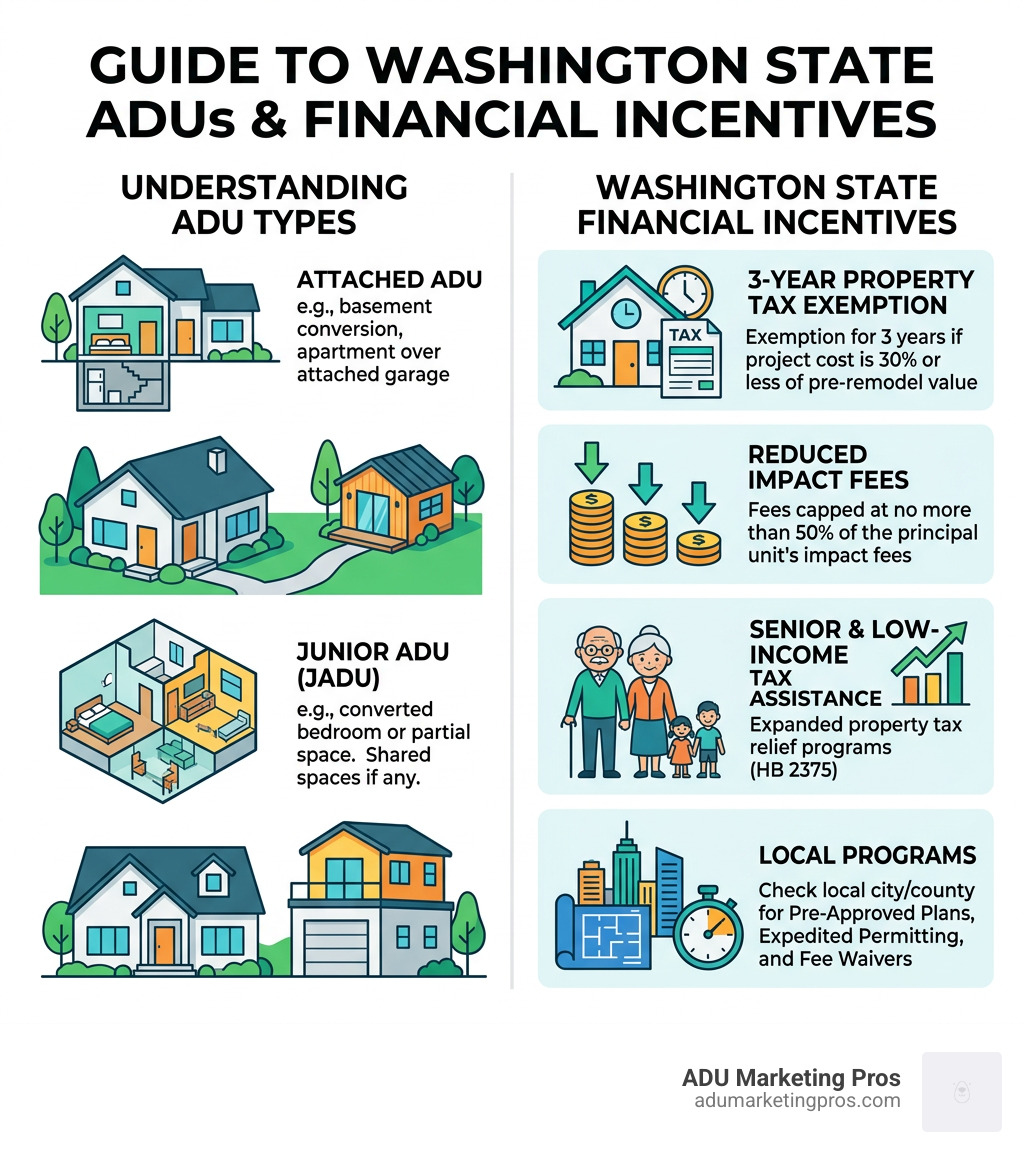
- Three-year property tax exemption: If your ADU project costs 30% or less of your home’s pre-remodel assessed value, you can avoid tax increases on the improvement for three years.
- Impact fee reductions: Capped at no more than 50% of what’s charged for the principal unit, with many cities waiving them entirely for affordable units.
- Property tax assistance programs: For seniors and low-income households, expanded under HB 2375 (effective June 6, 2024), allowing the ADU to be included in tax-frozen valuations.
- Local city and county programs: Offering pre-approved plans, expedited permitting, and fee waivers that significantly reduce pre-development costs.
Washington is in the middle of a genuine housing shift. Laws like HB 1337 (2023) have torn down many of the old barriers to building ADUs — eliminating owner-occupancy requirements, mandating that cities allow at least two ADUs per lot in urban growth areas, and capping excessive fees. Then HB 2375 expanded property tax relief to include ADU structures for the first time. The result? Building an ADU in Washington is more financially accessible than it’s ever been — even without a traditional grant program. By focusing on reducing the “soft costs” of development, the state is making it easier for middle-class homeowners to become part of the housing solution.
Is There a Statewide ADU Grant Program in Washington State?
As we mentioned in the opening, if you are looking for a direct “check in the mail” from the state to build your backyard cottage, you won’t find a universal adu grant program washington state homeowners can apply for today. Unlike California’s previous $40,000 grant or New York’s Plus One program, Washington has focused its efforts on legislative reform and tax relief rather than direct cash subsidies for construction. This is a strategic choice by the state legislature to ensure long-term sustainability rather than short-term, budget-dependent payouts that often run out of funding within months.

Distinguishing Between Grants and Incentives
However, it is vital to distinguish between a “grant” and an “incentive.” While a grant is direct funding, an incentive—like a property tax exemption or a fee waiver—keeps money in your pocket that you would otherwise have to spend. When you look at the adu-funding-grants available in other regions, you’ll notice they often come with heavy strings attached, such as strict rent control for ten years or requirements to house specific demographics. Washington’s incentive-based model offers more freedom for the homeowner to use the unit as they see fit, whether for family, long-term rental, or a home office.
The Role of the Department of Commerce
The Washington State Department of Commerce ADU guidance emphasizes that the state’s strategy is to lower the “barrier to entry.” By reducing permit costs and eliminating the requirement that a homeowner must live on-site, the state is making it easier for banks to lend on these projects. The “funding gap” is often most painful during the pre-development phase—architectural drawings, soil tests, and permit fees. In Washington, the current focus is on making these specific steps faster and cheaper through local government mandates.
For homeowners, this means that while you might need to secure your own construction loan, the total amount you need to borrow is significantly lower than it was five years ago. Furthermore, the state has provided grants to cities (not individuals) to help them update their codes and create pre-approved ADU plans. This indirect support saves homeowners thousands in architectural and engineering fees, which functions as a “hidden grant” for those who use these resources. By standardizing the process, the state is effectively subsidizing the design phase for every resident.
Legislative Breakthroughs: How HB 1337 and HB 2375 Change the Game
The landscape of ADU development in Washington was fundamentally altered by two massive pieces of legislation: House Bill 1337 and House Bill 2375. These bills did more for the average homeowner than any small-scale grant could have by removing the legal hurdles that previously made ADUs a risky or impossible investment. They have created a predictable environment where homeowners can plan their projects with confidence.
HB 1337: Density and Flexibility
Passed in 2023, HB 1337 is the “Gold Standard” for ADU reform. It requires all local governments planning under the Growth Management Act (GMA) to allow at least two ADUs per lot in urban growth areas. This can be two detached units, two attached units, or one of each. Crucially, RCW 36.70A.680 now prohibits cities from requiring owner-occupancy.
This is a massive shift. Previously, many cities required the homeowner to live in either the main house or the ADU. By removing this, the state has turned ADUs into viable investment properties. You can live in the main house and rent the ADU, live in the ADU and rent the main house, or rent both out as an investment. This flexibility significantly increases the “After-Repair Value” (ARV) of your property, making it easier to secure financing from traditional lenders who now see the ADU as a reliable income-generating asset. Furthermore, HB 1337 mandates that cities cannot require more than 1,000 square feet for an ADU, and they must allow heights of at least 24 feet, ensuring that two-story units are feasible on most lots.
HB 2375: The Property Tax Revolution
While HB 1337 fixed the zoning, House Bill 2375 fixed the tax bill. Effective June 6, 2024, this bill amended the definition of “residence” to include one ADU. This is a game-changer for homeowners currently enrolled in property tax assistance programs.
Previously, adding an ADU might have disqualified a senior or a person with a disability from their tax exemption because the property was no longer considered a “single-family residence” under strict legal definitions. Now, the ADU’s value is included in the reduced valuation, leading to a much larger overall tax saving. This bill ensures that the most vulnerable homeowners can increase their property value and potential income without being penalized by the tax assessor. It effectively protects the “equity” of the homeowner while encouraging the creation of new housing.
Impact of HB 2375 on the ADU Grant Program Washington State Landscape
For those seeking an adu grant program washington state alternative, the expansion of RCW 84.36.381 is the closest thing to it. Senior citizens and people with disabilities can now have the value of their ADU “frozen” along with their primary residence. If you build an ADU for a family member or a caregiver, the added value to your property won’t necessarily result in a massive spike in your annual tax bill. This “tax grant” can save a homeowner thousands of dollars every year, which, over the life of a 30-year mortgage, far exceeds the value of a one-time $40,000 construction grant. It provides a permanent reduction in the cost of ownership rather than a one-time infusion of cash.
Financial Incentives and Property Tax Exemptions for Homeowners
In Washington, the “grant” is often hidden in the tax code. There are several ways to reduce the long-term cost of your unit, making the return on investment (ROI) much more attractive for middle-income families. Understanding these nuances is essential for any homeowner looking to maximize their budget.
| Incentive Type | Benefit | Qualification Requirement |
|---|---|---|
| 3-Year Property Tax Exemption | No tax on the value of the ADU for 3 years | ADU cost must be ≤ 30% of home’s pre-remodel value |
| Impact Fee Reduction | Fees capped at 50% of principal unit | Must be a legal ADU in a GMA-planning city |
| Low-Income Rental Exemption | Expanded property tax relief | Must rent to households < 80% AMI |
| Utility Fee Waivers | Reduced SDCs for water/sewer | Varies by municipality (e.g., Seattle, Tacoma) |
The 30% Rule Explained
The “30% rule” is a hidden gem in Washington’s tax code. If your ADU construction represents 30% or less of your home’s pre-remodel assessed value, you may qualify for a three-year property tax exemption on that improvement. This allows you to stabilize your finances during the first few years of being a landlord without the immediate pressure of increased property taxes. For a $200,000 ADU on a $700,000 home, this could mean saving $2,000 to $3,000 annually in the initial years. This exemption is designed to encourage homeowners to invest in their properties without fear of immediate tax penalties.
Targeting High-Growth Counties
Furthermore, RCW 84.36.400 has expanded eligibility for property tax exemptions to include ADUs rented to low-income households in counties with populations between 900,000 and 1.5 million. This specifically targets high-growth areas like King, Pierce, and Snohomish Counties, where the housing crisis is most acute. By providing housing for those earning less than 80% of the Area Median Income (AMI), homeowners can unlock significant long-term tax breaks. This aligns the homeowner’s financial interests with the state’s goal of providing affordable housing options.
Qualifying for an ADU Grant Program Washington State Incentive
To qualify for these incentives, you generally need to meet specific eligibility criteria. Most of these programs require the property to be your primary residence (though, as noted, you don’t necessarily have to live in the main house anymore). For the low-income exemptions, you will need to provide proof of the tenant’s income to ensure it falls below the AMI thresholds. You can find more about these specific requirements in our accessory-dwelling-unit-grant-program guide, which breaks down the application process for various state-level incentives. It is also important to note that many of these exemptions require an application before construction begins or immediately upon completion, so timing is critical.
Local ADU Grant and Incentive Programs by City and County
While the state provides the framework, many cities have gone above and beyond to create their own versions of an adu grant program washington state homeowners can utilize. These local programs are often where the most immediate financial relief is found, as they address the specific needs of their local communities.
Seattle and King County: The ADU Universe
Seattle has been a leader in ADU reform. While they don’t offer a direct construction grant, they provide an “ADU Universe” of resources, including pre-approved plans that can save you $5,000 to $15,000 in design and engineering fees. These plans are already vetted for the city’s building codes, which also speeds up the permitting process significantly. For those in more rural parts of the county, the King County OSS memo for septic systems is essential reading. It clarifies how you can add an ADU to a lot with an existing septic system—a process that used to be a deal-breaker for many rural homeowners. This memo provides a clear path for expansion that was previously shrouded in regulatory uncertainty.
Spokane and the “Building Opportunity and Choices Act”
Spokane has become a national model for housing reform. Their local ordinances often go further than state law, allowing for even more flexibility in ADU size and placement. They have streamlined their permitting process to the point where some ADU permits can be issued in a fraction of the time it takes in other major cities. This speed reduces “carrying costs”—the interest you pay on a loan while waiting for permission to build. Spokane’s approach has been so successful that it served as a blueprint for much of the statewide legislation passed in 2023.
Tacoma, Lacey, and Auburn
Cities like Lacey and Auburn have implemented expedited review processes. In Auburn, ADUs can even be sold as condominium units, allowing homeowners to recoup their entire investment quickly by selling the unit separately from the main house. Tacoma has introduced an “Infill Pilot Program” that provides additional support for homeowners building in specific neighborhoods. Bellingham and Port Townsend have also updated their codes to allow for more flexible designs, including duplex-style detached ADUs and even tiny homes on wheels in certain zones. If you are looking for adu-financing-options to cover these costs, local credit unions in these areas often have specific products tailored to these cities’ regulations.
Navigating Local Requirements and SDCs
One of the most significant financial wins for Washington homeowners is the cap on impact fees. State law now mandates that impact fees for ADUs cannot exceed 50% of the fees for the principal housing unit. Some cities, like Tacoma, have gone further, waiving these fees entirely for ADUs that meet certain size or affordability requirements. We recommend checking for “System Development Charges” (SDCs) early in your planning. These are the fees for connecting to city water and sewer. Transparency in these fees is now required by state law, meaning no more “surprise” $20,000 bills halfway through construction. More tips on managing these costs can be found in our guide on navigating adu financing.
Beyond Grants: Financing Your Washington ADU Project
If you can’t find a direct grant, how do you pay for a $200,000 to $400,000 project? The good news is that financing is becoming much more sophisticated as lenders begin to understand the value of these units. At ADU Marketing Pros, we see this shift daily; as more homeowners seek out builders, the financial sector is responding with better loan products that recognize the income-generating potential of ADUs.
Leveraging Home Equity and ARV Loans
Most homeowners start with a Home Equity Line of Credit (HELOC) or a cash-out refinance. However, these depend on your current home equity. If you just bought your home in a high-priced market like Bellevue or Seattle, you might not have enough equity to build a DADU. This is where products like RenoFi loans come in. They allow you to borrow based on the After-Renovation Value (ARV) of your home. Since an ADU can increase property value by up to 35% in some Washington neighborhoods, this unlocks a massive amount of capital that was previously inaccessible. This type of financing is ideal for homeowners who want to build but haven’t lived in their homes long enough to build significant equity.
Rental Income Offset
While we often look at california-adu-incentives for inspiration, Washington’s market is unique because of the rental income potential. In Seattle, a well-built DADU can rent for $1,500 to $2,500 per month. This income can be used by many lenders to help you qualify for the loan in the first place. This is known as “rental income offset,” and it can be the difference between a loan denial and an approval. By turning your backyard into a self-funding asset, you are essentially creating your own grant through future cash flow. Lenders are increasingly willing to count 75% of the projected rental income toward your debt-to-income ratio.
Cost-Effective Conversion Options
For those looking for the most affordable path, “Internal ADUs” (basement or garage conversions) remain the most cost-effective option. These projects typically cost 40-60% less than a detached unit because the foundation and shell are already in place. Financing these is often simpler, as the loan amounts are smaller and the construction timelines are shorter. A basement conversion in a city like Tacoma might only cost $120,000 but could generate $1,800 in monthly rent, providing an incredible return on investment compared to other financial assets.
Frequently Asked Questions about ADUs in Washington
How much does it cost to build an ADU in Washington?
Construction costs vary wildly depending on whether you are doing a conversion or a new build. In the current market, you should expect the following ranges:
- Detached ADU (DADU): $250,000 – $450,000 (includes site prep and utilities)
- Garage/Basement Conversion: $100,000 – $225,000
- Design & Permits: $10,000 – $30,000 (unless using pre-approved plans)
Can I rent out my ADU as a short-term rental?
It depends on your city. While the state has loosened long-term rental rules, cities like Bellingham, Seattle, and Poulsbo have strict Short-Term Rental (STR) regulations. For example, Poulsbo requires a minimum 90-day stay for certain units, effectively banning Airbnb-style rentals in ADUs. Seattle requires an STR permit and limits the number of units you can rent. Always check your local municipal code before planning your ROI around short-term guests, as these rules can change annually.
Do I need to live on the property to build an ADU?
Thanks to HB 1337, if you live in an Urban Growth Area (UGA), the answer is generally no. Local governments are now prohibited from requiring owner-occupancy for ADUs. This has opened the door for “mom and pop” investors to build housing on their rental properties, significantly increasing the state’s housing supply. However, some very small towns or rural areas outside of UGAs may still have older restrictions in place, so it is always worth a quick call to the local planning department.
What is the maximum size for an ADU in Washington?
Under HB 1337, cities must allow ADUs of at least 1,000 square feet. Some cities allow more, but 1,000 sq ft is the new state-mandated floor. This is large enough for a comfortable two-bedroom, one-bath unit, making it suitable for small families or roommates. Some jurisdictions may allow up to 1,200 square feet if the lot size is large enough, but 1,000 is the standard you can rely on.
Are there any low-interest loans specifically for ADUs?
While there isn’t a state-run loan program, some local credit unions (like BECU or Salal) offer home improvement loans that are frequently used for ADUs. Additionally, some non-profits in the King County area are exploring “revolving loan funds” for low-income homeowners to build ADUs, though these are often limited in scope. It is also worth checking with the Washington State Housing Finance Commission (WSHFC) for any new programs that may be launched in response to the housing crisis.
How long does the permitting process take?
Permitting timelines vary by city. In streamlined cities like Spokane or Lacey, you might receive a permit in 4-8 weeks. In more complex jurisdictions like Seattle or Bellevue, it can take 4-8 months. Using pre-approved plans can often shave 2-3 months off this timeline, as the structural and life-safety reviews are already completed.
Conclusion
The search for an adu grant program washington state might not lead to a direct check from the government, but it leads to something much more sustainable: a robust system of tax exemptions, fee caps, and legislative protections. Washington has made it clear that ADUs are a vital part of the solution to the housing shortage, and the state has paved the way for homeowners to succeed. By removing the most significant barriers to entry, the state has empowered residents to take control of their property’s potential.
By leveraging the three-year property tax exemption, taking advantage of capped impact fees, and utilizing modern financing like after-renovation value loans, you can make your ADU project a reality. The financial landscape is more favorable now than at any point in the last decade. At ADU Marketing Pros, we help firms in this space connect with homeowners who are ready to build. Whether you are an architect in Seattle or a builder in Spokane, we understand the unique marketing needs of the Pacific Northwest market and how to communicate these complex benefits to your clients.
Our team, though based in California, brings a wealth of experience from the nation’s most mature ADU market to help Washington firms stand out. We have seen how these legislative shifts transform neighborhoods and create new opportunities for both homeowners and contractors. If you’re a builder or architect looking to grow your business in this booming market, we’re here to help you attract the right clients and navigate the changing landscape. Ready to dive deeper into funding? Check out more info about accessory dwelling unit grant programs and start your journey toward building an evergreen asset in the Evergreen State. The future of Washington housing is in the backyard, and there has never been a better time to start building.