
California ADU Grants: What Homeowners Need to Know Before Applying
California ADU grants are real — but the most well-known program, the CalHFA ADU Grant, has already exhausted its latest round of funding as of December 28, 2023. This program represented a significant shift in how the state approaches the housing crisis, moving from mere regulatory changes to direct financial assistance for middle- and low-income residents.
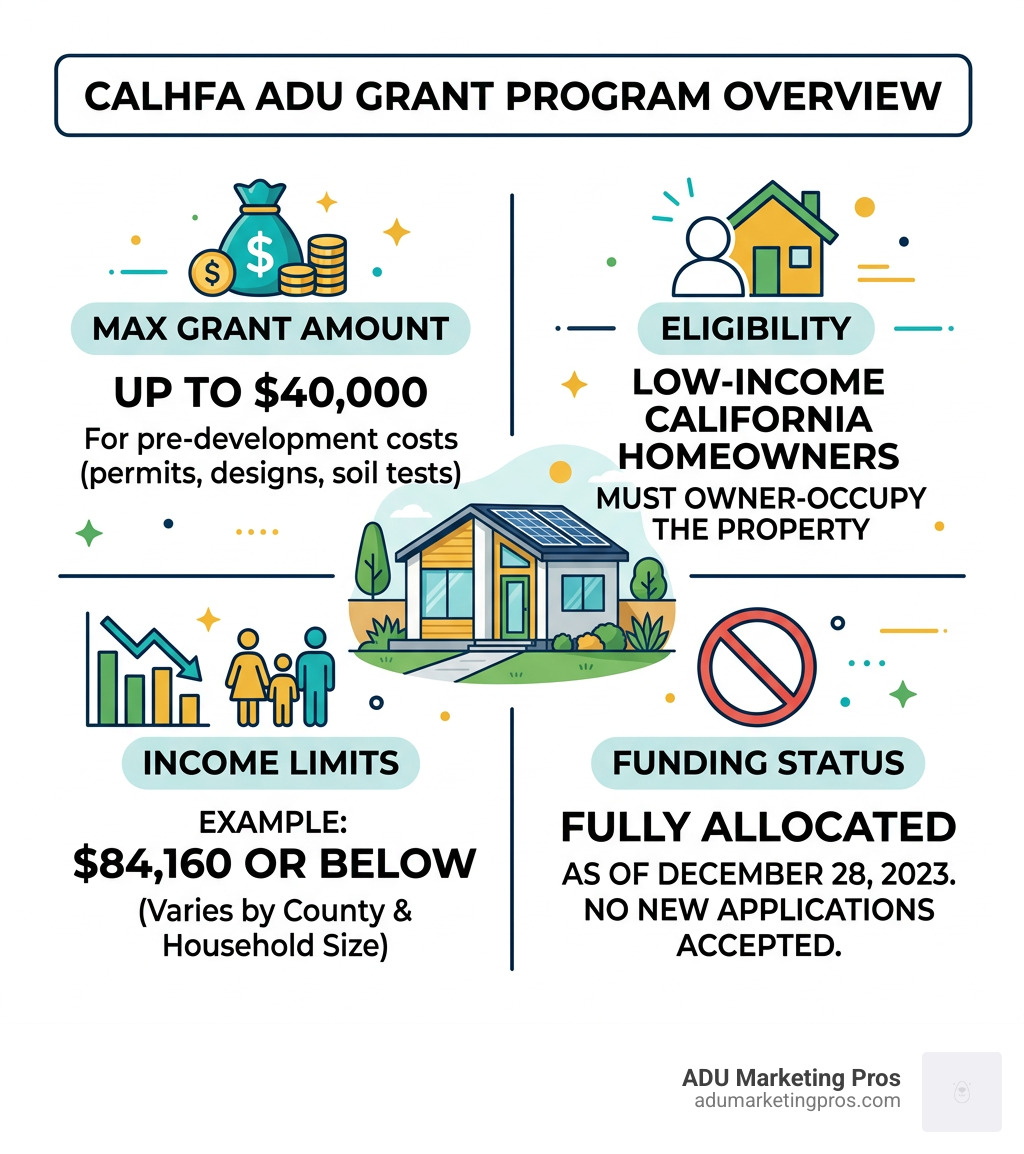
Here’s a quick snapshot of what you need to know:
| Key Detail | Summary |
|---|---|
| Program name | CalHFA ADU Grant Program |
| Max grant amount | Up to $40,000 |
| What it covers | Pre-development costs (permits, architectural designs, soil tests, etc.) |
| Who qualifies | Low-income California homeowners who owner-occupy the property |
| Income threshold example | $84,160 or below (varies by county and household size) |
| Current status | Fully allocated as of December 28, 2023 — no new applications accepted |
| Repayment required? | No — it’s a grant, not a loan |
The Context of California’s Housing Crisis
California’s housing shortage is well documented and has reached a critical tipping point. For decades, housing construction has not kept pace with the state’s population growth and economic expansion. This imbalance has pushed home prices and rents to record highs, forcing many families into long commutes or out of the state entirely. In response, the California legislature has passed a series of laws (such as SB 9 and SB 10) designed to streamline the production of Accessory Dwelling Units (ADUs).
ADUs — also called granny flats, backyard cottages, or in-law suites — have emerged as one of the most practical and affordable solutions to this crisis. Unlike large-scale apartment complexes, ADUs can be integrated into existing neighborhoods without changing the fundamental character of the community. They provide flexible housing for aging parents, adult children, or rental income for the primary homeowner.
The Rise of the ADU Movement
The state currently has an estimated 240,000 ADUs, with roughly 25,000 building permit applications filed in 2019 and 2020 alone. This surge is the result of “ADU-friendly” legislation that removed many of the barriers homeowners previously faced, such as restrictive parking requirements and excessive impact fees. To accelerate that growth even further, the California Housing Finance Agency (CalHFA) launched the ADU Grant Program to help lower-income homeowners cover the upfront costs that often stop a project before it starts.
The program proved enormously popular. An initial $100 million in funding was exhausted within months, financing up to 2,500 potential ADUs. A second round of $25 million followed — and that too has since been fully allocated. The demand is clearly there, reflecting a massive appetite among Californians to contribute to the housing solution while building equity in their own backyards.
The demand is clearly there. The funding, for now, is not.
But that doesn’t mean options have dried up entirely. Understanding how the CalHFA program worked — and what alternatives exist — puts homeowners and ADU professionals in a much stronger position when new funding opens up. By analyzing the mechanics of these grants, we can better prepare for the next wave of state or local incentives.
Understanding the CalHFA California ADU grants Program

The Accessory Dwelling Unit Grant Program was designed by the California Housing Finance Agency (CalHFA) to tackle the “soft costs” of building. While many homeowners can secure a loan for the actual hammers-and-nails construction, the thousands of dollars required before a single shovel hits the dirt can be a major roadblock. These pre-development costs are often the most difficult to finance because they occur before the project has tangible value that a bank can use as collateral.
This program offered a maximum of $40,000 per homeowner. Unlike a traditional loan, this was a true grant—meaning it did not have to be repaid if the recipient followed the program’s guidelines. The primary goal was to incentivize the creation of more housing units across the state by offsetting the expensive pre-development phase, which can easily consume 10% to 20% of a total ADU budget.
Current Funding Status of California ADU grants
It is vital to stay informed about the current availability of these funds. As of December 28, 2023, CalHFA announced that the latest round of funding for California ADU grants has been fully allocated. This announcement came as a disappointment to many who were in the planning stages, but it also highlighted the program’s success in reaching its target demographic.
The program’s history is one of rapid consumption. After the initial $100 million was used to finance approximately 2,500 units, the state legislature recognized the program’s success and provided an additional $25 million revival fund. However, due to the high volume of applications from homeowners in high-cost areas like San Jose and San Francisco, these funds were spoken for in record time. We recommend that interested homeowners sign up for CalHFA ADU eNews updates to be the first to know if the state legislature approves a new round of funding for 2024 or 2025. You can also Read Full Article at LA Times to see how the revival impacted local families and the broader housing market.
Eligible Expenses for California ADU grants
If funding returns, what can you actually spend it on? The grant is strictly for pre-development and non-recurring closing costs. According to California ADU Incentives guidelines, eligible expenses include:
- Architectural Designs: Hiring a professional to draft your plans is often the first major expense. These plans must meet local building codes and state safety standards.
- Permit Fees: The often-hefty costs charged by cities like Los Angeles or Palo Alto can range from $5,000 to over $15,000 depending on the size and complexity of the unit.
- Impact Fees: Development fees required by local jurisdictions to offset the impact on local infrastructure. Recent state laws have limited these for smaller ADUs, but they can still be significant for larger units.
- Soil Tests and Surveys: Essential site preparation work to ensure the ground can support the new structure and to define property boundaries accurately.
- Energy Reports: Title 24 compliance and other environmental assessments are mandatory in California to ensure the unit meets strict energy efficiency standards.
- Utility Hookups: The costs associated with connecting water, sewer, and electricity. This often involves trenching and upgrading existing panels.
- Interest Rate Buy-downs: Using funds to lower the interest rate on your primary construction loan, which can save tens of thousands of dollars over the life of the loan.
Why Pre-Development Costs Matter
Many homeowners underestimate the “soft costs” of building. While the cost per square foot for construction is a common metric, the administrative and design costs are fixed regardless of the unit’s size. For a low-income homeowner, coming up with $30,000 for permits and plans before a bank will even consider a construction loan is often impossible. The CalHFA grant bridged this gap, allowing the homeowner to reach the “shovel-ready” stage where traditional financing becomes accessible.
Navigating California ADU Grant Income Limits and Eligibility
Not every homeowner is eligible for these grants. The program specifically targets those who need the most help: low-to-moderate income households. To qualify, you must be an owner-occupant of the property where the ADU is being built. This means you cannot use the grant for an investment property where you do not reside. This residency requirement ensures that the state’s investment directly benefits families rather than corporate landlords.
Eligibility is largely determined by the Area Median Income (AMI) of the county where the property is located. Because the cost of living varies wildly between, say, Mountain View and more rural areas, the income limits are adjusted geographically. This ensures that a family in a high-cost area isn’t unfairly disqualified simply because their nominal income is higher than the state average.
Qualifying for California ADU grants through Income Verification
The income limit is a hard cap. For example, in previous rounds, a common threshold for “low income” was around $84,160, but this fluctuates based on household size and specific county data. In some Bay Area counties, the “moderate income” limit for a family of four can exceed $150,000, yet they still qualify for assistance due to the extreme cost of housing in that region.
To verify your status, you must work with a CalHFA-approved lender who will review:
- Recent paystubs and W2s: To establish current earning levels.
- The last two years of federal tax returns: To ensure income stability and check for other financial assets.
- Your overall debt-to-income (DTI) ratio: While the grant itself isn’t a loan, the lender must ensure you can afford the primary construction loan that the grant will supplement.
We’ve seen many homeowners get a head start by attending an ADU 101 online workshop to understand these financial nuances. For more details on the math behind these numbers, check out our guide on ADU Funding Grants.
Property and Residency Requirements
The property itself must meet certain criteria to be eligible for state-funded grants. These requirements are designed to prevent the misuse of funds and ensure the long-term viability of the housing unit.
- Single-family residences: The traditional backyard cottage setup is the most common use case for these grants.
- Multi-unit buildings: Properties with 1 to 4 existing units are also eligible, allowing for the conversion of garages or basements into additional housing.
Interestingly, the program is flexible regarding ownership structures. Properties held in a Trust or a non-corporate LLC are generally eligible, as are Tenancy in Common (TIC) arrangements, provided all ownership documentation is clear. This flexibility is crucial in California, where many families use trusts for estate planning. For those looking for deep-dive resources on these requirements, ADU 101 Materials and Education provides excellent specialized worksheets and checklists.
The Role of Household Size in Eligibility
It is important to note that income limits are often scaled based on the number of people living in the home. A single person earning $80,000 might be considered “moderate income,” while a family of five earning the same amount would be classified as “low income.” When applying for future rounds of California ADU grants, homeowners should be prepared to provide documentation for all adult members of the household to ensure an accurate AMI calculation.
Step-by-Step Guide: How to Apply for ADU Funding
While the CalHFA portal is currently closed for new applications, the process remains the blueprint for how state-level California ADU grants are administered. You don’t apply directly to the state; you apply through an approved participant. This decentralized model allows the state to leverage the expertise of private lenders and non-profit organizations to vet applications.
- Find an Approved Lender: You must work with a lender who has signed a “Lender Participation Agreement” with CalHFA. Not all banks participate, so it’s essential to check the official list of approved partners.
- Apply for a Loan: Most homeowners use a construction or renovation loan to fund the actual build. The grant is then layered on top of this loan. The lender will evaluate your credit score, equity, and income just like a standard mortgage application.
- Submit the Grant Application: Your lender handles the submission of the grant package to CalHFA. This happens concurrently with your loan processing to ensure the funds are available when the project starts.
- Fund Disbursement: CalHFA does not send a check to your mailbox. Instead, they wire the funds directly into the construction escrow account. These funds are used as a principal reduction on your loan, effectively “paying off” the first $40,000 of your debt. This reduces your monthly payments and the total interest paid over the life of the loan.
For a broader look at how these pieces fit together, explore our ADU Financing Options page.
Required Documentation for Grant Submission
Accuracy is everything when dealing with state agencies. A missing signature or an outdated document can delay or disqualify an application, potentially costing you the grant if funds run out while you are correcting errors. The standard submission package includes:
- Deed of Trust: Proof of ownership and a clear title are mandatory.
- Loan Approval Documents: Showing you have the means to finish the project. The state won’t provide a grant for a project that is likely to stall due to lack of construction funds.
- Itemized Pre-development Costs: A clear list of what the $40,000 will cover, backed by quotes from architects, engineers, and the city’s fee schedule.
- Applicant Affidavits: Confirming owner-occupancy and income levels under penalty of perjury.
- Certificate of Occupancy: This is required after completion to finalize the grant terms. It proves that the unit was actually built and is safe for habitation.
Navigating this paperwork can be daunting, which is why we’ve created a resource on From Loans to Investments: Navigating ADU Financing to help you stay organized throughout the process.
Avoiding Scams and Fraudulent Offers
Whenever “free money” is mentioned, scammers follow. We have seen reports of fraudulent websites claiming to be “official” grant portals or offering to “guarantee” a grant for a fee. Remember: CalHFA will never ask for your credit card over the phone or via email to “reserve” a grant.
Always verify your lender through the official CalHFA website. If you encounter a suspicious offer, report it to marketing@calhfa.ca.gov. You can also use the official Ask Us portal to search for verified information directly from the state. Legitimate grants are always processed through established financial institutions or government-vetted non-profits.
Alternative Financing and Local California ADU grants
With state funds currently paused, where else can you turn? There is a patchwork of federal, local, and private options available for homeowners in our service areas like Los Angeles, San Jose, and the Bay Area. While no single program currently matches the $40,000 CalHFA grant in scale, combining multiple smaller incentives can still make a project viable.
Local Programs in Los Angeles and the Bay Area
In Southern California, organizations like NHS Los Angeles offer the “Don’t Move, Improve!” workshop, which helps low-income families navigate local subsidies and property tax exemptions. Some cities in LA County have also experimented with “forgivable loans” where the debt is wiped clean if the homeowner agrees to rent the ADU to a Section 8 voucher holder for a set number of years.
In the Bay Area, cities like East Palo Alto and San Jose have utilized CalHome loans to provide low-interest financing for ADUs and JADUs (Junior ADUs). These programs are often hyper-local, sometimes restricted to specific zip codes or neighborhoods that have been historically underserved.
Veterans should also look into the Veterans Housing and Homelessness Prevention Program (VHHP), which occasionally offers specialized funding for housing projects that benefit those who served. If you’re looking for a traditional path, check our guide on Construction Loans for ADU.
Private and Nonprofit Funding Sources
Some private nonprofits offer grants for specific types of ADUs—particularly those that prioritize sustainability or serve specific populations like the formerly homeless. If you are installing solar panels, graywater systems, or high-efficiency heat pumps, you may qualify for “green” incentives that can be stacked with other funding. These are often administered through utility companies or environmental non-profits.
The CA Statewide Housing Plan is a great place to start looking for long-term state initiatives that might offer local rebates. This plan outlines the state’s 10-year strategy for housing and often contains clues about which regions will receive the next round of infrastructure and housing grants.
Federal Options: FHA and Fannie Mae
On the federal level, the FHA 203(k) loan and Fannie Mae’s HomeStyle Renovation mortgage allow homeowners to borrow against the future value of the home (including the ADU). While these are loans and not grants, they offer much higher borrowing limits and lower interest rates than personal loans or credit cards. Recently, the FHA updated its guidelines to allow 75% of the projected rental income from a future ADU to be counted toward the homeowner’s qualifying income, making it much easier for low-income families to get approved for the necessary construction capital.
Frequently Asked Questions about California ADU grants
Do I have to repay the CalHFA ADU grant?
No. This is a grant, not a loan. As long as you use the funds for eligible pre-development costs and complete the ADU according to the agreed-upon timeline, the money does not need to be paid back. However, if you fail to complete the project, provide a Certificate of Occupancy, or if it is discovered that you provided false information regarding your income or residency, you may be required to return the funds in full.
What is the maximum income to qualify for the $40,000 grant?
The limits are based on the Area Median Income (AMI) of your specific county. In high-cost counties like Santa Clara, San Mateo, or San Francisco, the “moderate-income” limit can be significantly higher than in the Central Valley. Generally, the $40,000 grant was targeted at “low-income” earners, which is defined as 80% or less of the AMI. You should check the current CalHFA income limit tables for your specific county and household size.
Can I use the grant for actual construction labor and materials?
No. The CalHFA grant is strictly for pre-development costs. You cannot use it to buy lumber, pay a framing crew, or purchase kitchen appliances. Its purpose is to get you through the “paperwork” phase—architectural plans, engineering, permits, and environmental reports—so that your construction loan can cover the physical build. This distinction is important for budgeting purposes.
Can I build a JADU with this grant?
Yes, Junior Accessory Dwelling Units (JADUs) were generally eligible under the CalHFA program. JADUs are units created within the walls of an existing residence (like a converted bedroom) and are limited to 500 square feet. They are often a more cost-effective way to add housing, and the grant can cover the necessary permits and design changes required for the conversion.
Will building an ADU increase my property taxes?
While the ADU will trigger a “blended assessment”—meaning the value of the new construction is added to your existing property value—it does not trigger a full reassessment of your entire property under Proposition 13. This means your primary home’s tax basis remains the same, and you only pay additional taxes on the value added by the ADU itself. Some local grants also offer tax abatement programs for a limited number of years.
How long does the application process take?
When funding is available, the grant approval process typically mirrors the timeline of your construction loan, which can take 30 to 60 days. However, the pre-development phase (design and permitting) can take anywhere from 3 to 9 months depending on your local building department’s backlog. It is best to start the process as early as possible.
Conclusion
Building an ADU is more than just a construction project; it’s a way to build intergenerational wealth and provide a tangible solution to California’s housing crisis. While the current round of California ADU grants is fully allocated, the landscape is always shifting. New legislation and budget cycles often bring fresh opportunities for homeowners who are ready to act.
At ADU Marketing Pros, we specialize in helping the firms that build these homes reach the right audience. If you are an architect or builder in San Jose, Sunnyvale, or Los Angeles, you know that educating your clients is the first step toward a successful project. By staying informed on grants and financing, you position yourself as a trusted expert in a competitive market.
For more information on how we help ADU professionals grow, visit our Accessory Dwelling Unit Grant Program resources or reach out to us in San Jose. Together, we can help more Californians find the funding they need to turn their backyards into homes and contribute to a more sustainable housing future for the entire state.