
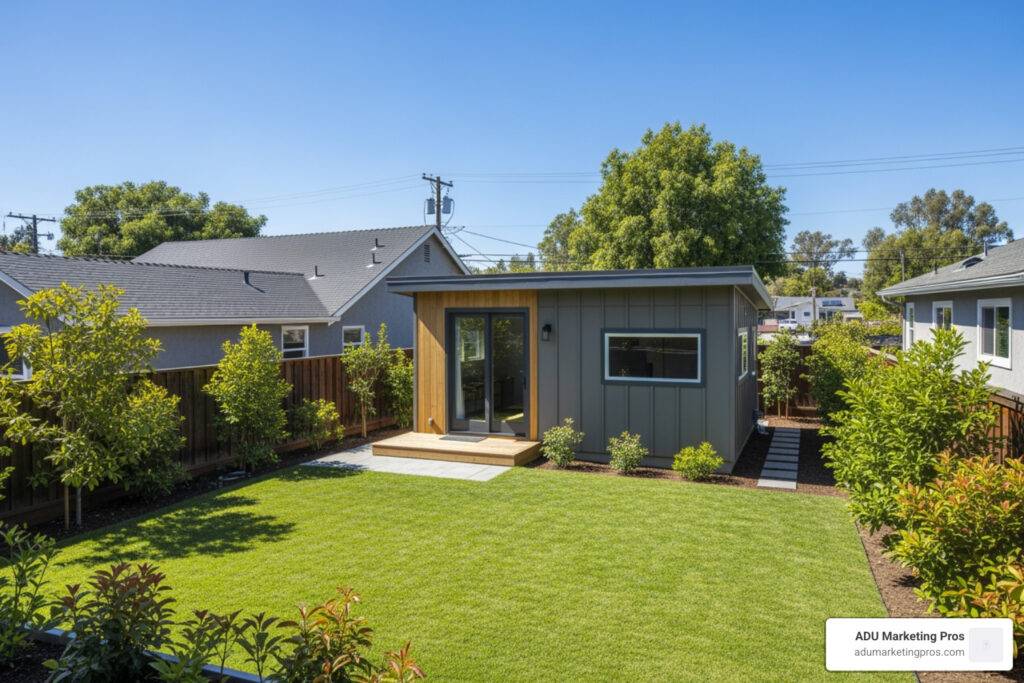
Why Small Prefab ADUs Are Changing California Backyards
Small prefab ADU units are factory-built accessory dwelling units typically ranging from 150 to 800 square feet. Manufactured off-site and installed in weeks, they offer a streamlined alternative to traditional construction. In the context of California’s evolving real estate landscape, these units represent more than just extra space; they are a strategic response to a chronic housing shortage and skyrocketing urban density. By shifting the construction process from a chaotic backyard site to a precision-controlled factory floor, homeowners can bypass many of the traditional headaches associated with home improvement.
The Evolution of the Backyard Cottage
Historically, adding a secondary unit meant months of noise, dust, and unpredictable contractors. Today, the “small prefab ADU” has evolved into a high-tech, architecturally significant structure. These units are engineered to maximize every square inch, utilizing vertical space and natural light to make a 400-square-foot studio feel like a spacious home.
Key Benefits of the Prefab Approach:
- Cost-effective: Generally 10-20% cheaper than site-built homes, with base prices starting around $140 per square foot. This predictability is crucial for budgeting.
- Fast installation: Projects often finish in 6-12 months, compared to 18-24 months for traditional builds. The actual on-site assembly can sometimes happen in a single day.
- High quality: Factory precision ensures building code compliance and superior insulation. Because the units are built indoors, materials are never exposed to rain or moisture during the framing process.
- Versatile uses: Ideal for rental income, in-law suites, or home offices. As remote work becomes a permanent fixture, the demand for detached, quiet workspaces has surged.
Popular Models and Price Ranges:
- Studio Shed: Starting at $21,829 (120 sq ft) – Ideal for home offices.
- Aux Box: Starting at $28,000 (97-588 sq ft) – Known for minimalist, modern aesthetics.
- Abodu Studio: Starting at $228,800 (340 sq ft, turnkey) – A premium, all-inclusive option.
- Nestron Cube Two: Starting at $59,000 (328 sq ft) – Futuristic, smart-home integrated units.
California’s housing crisis has pushed accessory dwelling units into the spotlight. With rising home prices, homeowners are finding that small prefab ADUs offer a practical solution for generating rental income or housing aging parents without the stress of a major construction site. The state has paved the way with legislation that limits the ability of local municipalities to block these projects, making it the “Golden Age” for backyard development.
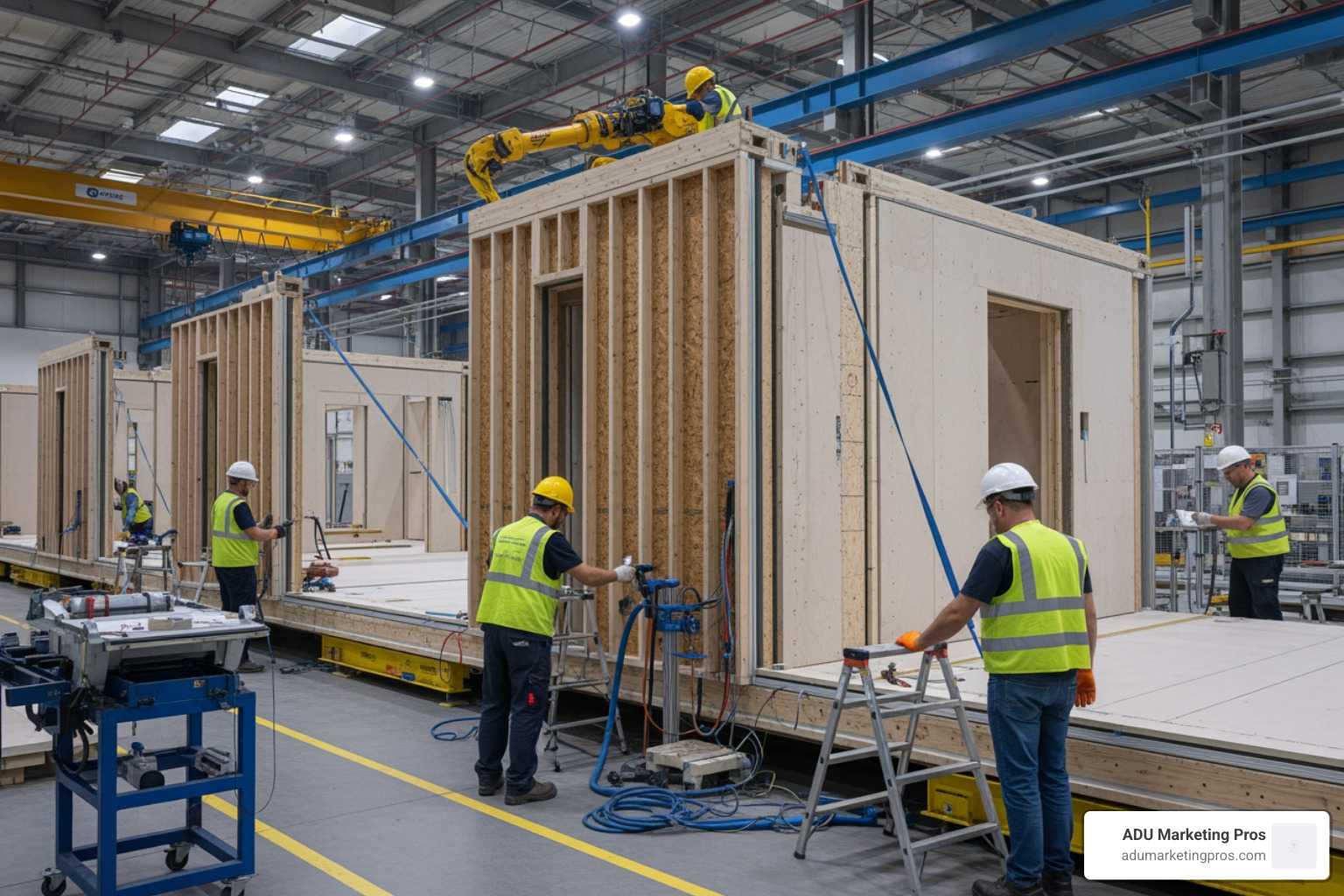
The prefab advantage is simple: most work happens in a controlled factory environment. This eliminates weather delays and material theft. As one customer noted, the process felt like “instant gratification” compared to typical home projects. When the unit arrives on a trailer and is craned into place, the transformation of the property is immediate and profound.
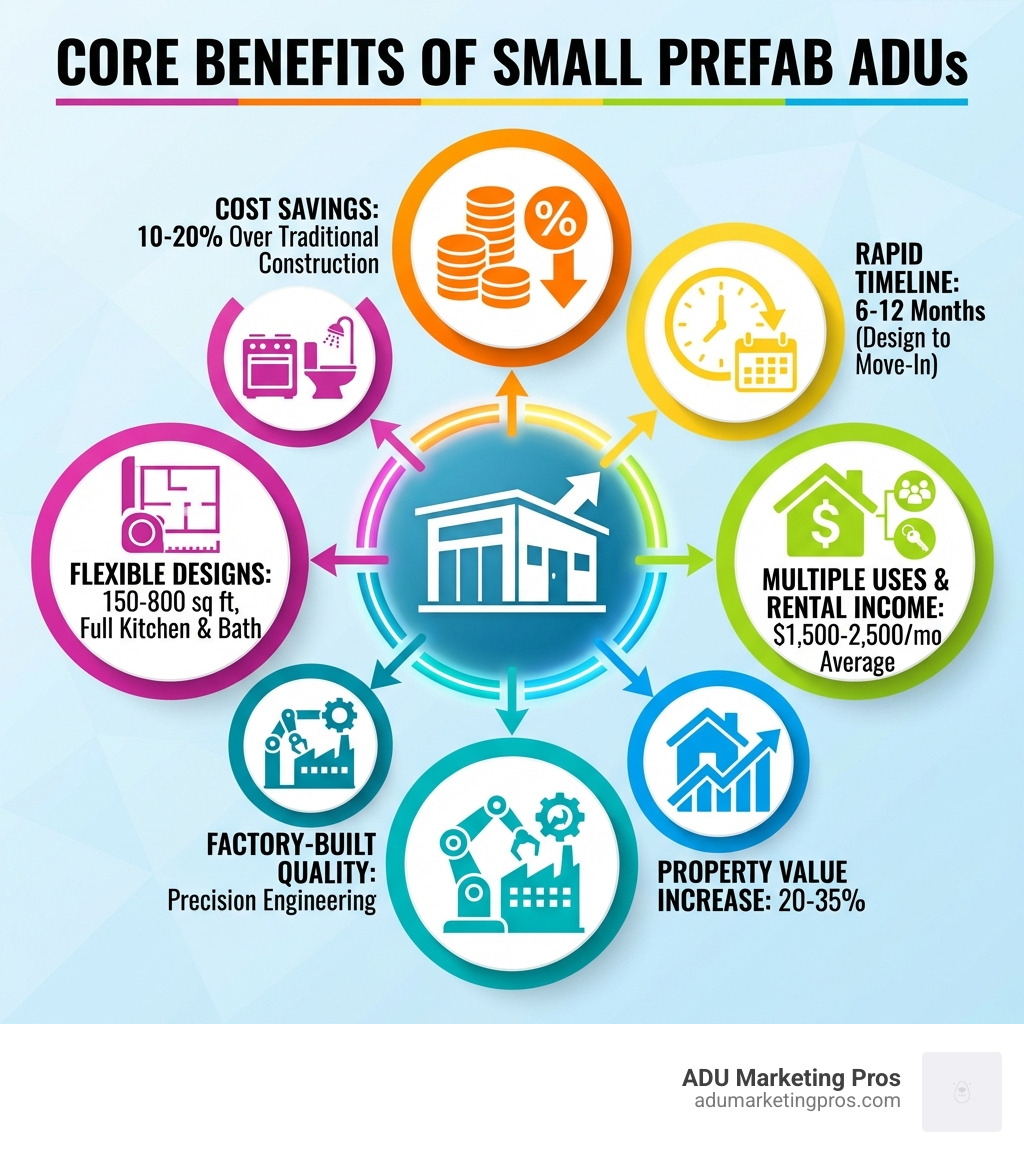
Essential Small prefab ADU terms:
Why Homeowners are Choosing a Small Prefab ADU
For homeowners in Los Angeles, San Diego, and the San Francisco Bay Area, the small prefab ADU has become a preferred choice over site-built construction. The primary drivers are efficiency, cost, and quality, but there is also a growing appreciation for the “productized” nature of prefab. Buying an ADU is becoming more like buying a high-end vehicle—you know exactly what you are getting, what it will cost, and when it will arrive.
Unmatched Construction Efficiency
Efficiency is a major factor. Prefab ADUs are constructed in factories, reducing variables like weather delays and subcontractor scheduling conflicts. In a traditional build, a single week of heavy rain can set a project back by a month due to mud and scheduling ripples. In a factory, the work continues 24/7 regardless of the weather. This allows some models to be assembled on-site in just weeks, minimizing the time your backyard looks like a war zone.
Predictable Cost Savings
Cost savings are equally significant. Prefab designs are typically 10-20% cheaper than traditional builds. By leveraging modular panel systems, companies like Studio Shed avoid the labor overruns and material waste common in on-site projects. Because the designs are standardized, the engineering costs are spread across hundreds of units rather than being absorbed by a single homeowner. This economy of scale is passed directly to the consumer.
Superior Quality Control
Quality control is improved in a factory setting. Every component of a small prefab ADU undergoes rigorous inspection at multiple stages of the build. Precision engineering ensures walls are square to within a fraction of an inch, and insulation is installed with a level of perfection rarely seen in the field. Steel-framed modular units, for example, offer superior termite and seismic resistance—essential for California properties located near fault lines. Furthermore, the materials are stored in climate-controlled environments, preventing the warping or mold growth that can occur when lumber is left out on a construction site.
Minimal Disruption to Daily Life
Finally, minimal site disruption is a massive benefit. Instead of a year-long construction zone in your backyard with workers arriving at 7 AM every day, prefab units involve a short installation window. Some panelized systems from Wellmade can even be hand-carried through standard gates, making them perfect for tight urban lots where a crane might not be feasible. This means your pets, children, and neighbors are spared the prolonged stress of a major build.
For a deeper dive into why ADUs are becoming the go-to solution, you can Read full article — Your Questions About ADUs Answered.
Cost and Financial Benefits of Prefabricated Units
Understanding the financial landscape of a small prefab ADU is vital. While the initial investment is notable, the total cost of ownership and ROI often outperform traditional construction. Homeowners must look beyond the “sticker price” of the unit and consider the all-in costs, including site preparation, utility trenching, and local impact fees.
Breaking Down the Investment
Base prices for a Studio Shed ‘shell’ kit start around $140 per square foot. However, “turnkey” pricing—which includes permitting, utilities, and finishes—is a more realistic metric for most homeowners. For example, the Abodu Studio starts at $228,800 for 340 sq ft, while the Wellmade Ashbury 440 is approximately $333,200, including installation and taxes. While these numbers may seem high, they often include everything from the foundation to the kitchen appliances.
| Cost Factor | Prefab ADU (General) | Site-Built ADU (General) |
|---|---|---|
| Base Price (Shell) | Starts at ~$140/sq ft | Varies, often higher |
| All-in Cost | ~$350 – $700/sq ft | Can exceed $500-$800/sq ft |
| Speed | Weeks to months | 12-24 months |
| Permitting | Often streamlined/concierge | Complex and manual |
| Waste/Overruns | Minimal (Fixed Price) | Common (10-20% buffer needed) |
Transparency and Fixed Pricing
Site preparation and utility hookups are often bundled into turnkey packages by providers like Abodu, providing fixed-price guarantees. This transparency prevents the “budget creep” common in custom builds, where unexpected soil issues or plumbing complications can add tens of thousands of dollars to the final bill. With prefab, the manufacturer has usually seen it all before and can provide a much more accurate estimate upfront.
Long-Term ROI and Rental Income
Beyond costs, small prefab ADUs offer substantial returns. They can increase property value by 20-35% depending on the local market. In high-demand areas like Silicon Valley or Santa Monica, the value add can be even higher. Furthermore, they generate significant rental income. In California, many homeowners see rental rates between $1,500 and $2,500 per month for a well-designed studio or one-bedroom ADU.
Financing Your ADU
Financing options have expanded significantly in recent years. Homeowners can utilize Home Equity Lines of Credit (HELOCs), cash-out refinances, or specialized ADU loans that consider the future rental income of the unit when qualifying the borrower. Some California programs, like the CalHFA ADU Grant, have previously offered up to $40,000 to cover pre-development costs, making these units accessible to a wider range of homeowners in San Jose and beyond.
Legal Requirements and the Permitting Process
Navigating permits for a small prefab ADU in California has become much easier due to recent state legislation. Laws like SB 9 and AB 68 have effectively “unlocked” backyards across the state, stripping away many of the bureaucratic hurdles that once made secondary housing nearly impossible to build.
State-Wide Protections for Homeowners
Key Legal Considerations:
- Zoning: ADUs are generally permitted in any single-family or multi-family residential zone. The state has mandated that cities cannot prohibit ADUs if they meet basic requirements.
- Size: State law allows units up to 800 square feet by right, with some cities allowing up to 1,200 square feet. Small prefab ADUs typically fall within the 150-800 sq ft range, making them easy to approve.
- Setbacks: You can often build with just 4-foot rear and side setbacks. In some cases, if you are converting an existing structure, the setbacks can be zero.
- Height: Detached ADUs are generally limited to 16 feet in height, though recent laws have increased this to 18-25 feet in certain transit-rich areas to allow for two-story units.
- Ministerial Approval: In many cities, ADUs under 800 square feet receive “ministerial” approval. This means the city must approve the permit within 60 days if it meets objective standards, without a lengthy public hearing or discretionary review.
- Impact Fees: Development impact fees are often waived for units under 750 square feet, which can save homeowners between $5,000 and $20,000 depending on the jurisdiction.
The “Concierge” Permitting Advantage
Many prefab providers offer “concierge permitting.” This is a game-changer for homeowners who don’t want to spend their afternoons at the city planning desk. Abodu, for instance, maintains a high approval rate across 90+ California cities, including Palo Alto and Menlo Park, by using pre-approved plans. These plans have already been vetted for structural and energy compliance, meaning the local building department only needs to review the site-specific details (like the foundation and utility connections). While homeowners pay the city fees, the manufacturer handles the paperwork and coordination. For more on the financial complexities and the history of these regulations, Read full article — The big cost of small dwellings.
Design Trends and Customization Options
Modern small prefab ADU designs are far from the “cookie-cutter” mobile homes of the past. They often feature high-end architecture that complements the main home while establishing its own unique character. Designers are now focusing on “biophilic” elements—connecting the occupant to the outdoors—to make small spaces feel expansive.
Current Design Trends
- Open-concept layouts: By removing interior walls, designers create a sense of flow and space even in footprints as small as 300 square feet.
- Vaulted ceilings: High ceilings (up to 11 or 12 feet) expand the interior volume significantly. A small room with a high ceiling feels much larger than a large room with a low ceiling.
- Natural Light: Clerestory windows, skylights, and folding glass walls (like those in the Dwell House) blur the lines between indoor and outdoor living. This is particularly effective in California’s temperate climate.
- Space-saving features: Built-in storage, Murphy beds, and “pocket doors” are common in models like the Abodu Studio. Every inch is utilized, from under-cabinet drawers to lofted sleeping areas.
Customization Options
Homeowners can personalize their small prefab ADU through various choices to ensure it doesn’t look like a “box in the backyard”:
- Finishes: A wide range of flooring (from engineered hardwood to polished concrete), paint colors, and high-end cabinetry.
- Exterior Cladding: Options for fiber-cement (James Hardie), natural cedar, or modern metal panels. This allows the ADU to match the architectural style of the primary residence, whether it’s a 1920s Craftsman or a 2020s Modern.
- Smart Home Integration: Many units come standard with smart thermostats, integrated lighting systems, and even solar-ready electrical panels.
Common Uses for Small Units
- Rental Income: A steady revenue stream from long-term or short-term tenants. In many cases, the rent covers the entire mortgage of the ADU and then some.
- Guest House: A private, high-end space for visiting family and friends that offers more dignity than a pull-out couch.
- Home Office: A dedicated, quiet workspace separate from the main house, which is essential for productivity in the era of Zoom calls.
- In-law Suite: Supporting multi-generational living while maintaining privacy for both the parents and the adult children.
- Aging-in-place: A smaller, accessible home for homeowners who wish to downsize and rent out their primary residence to fund their retirement.
The Timeline from Factory to Backyard
The compressed timeline is perhaps the most compelling reason to choose a small prefab ADU. While site-built units take 12-24 months from the first meeting to move-in, prefab projects often reach completion in 6-9 months. This is made possible through “parallel processing.”
Step-by-Step Process
- Design & Feasibility (1 month): Selecting and customizing your model using 3D design tools. A site feasibility study is conducted to ensure a crane can reach the backyard and utilities can be connected.
- Permitting (2-4 months): Variable by city, but often streamlined by manufacturers using pre-approved plans. Because the unit itself is already “certified” by the state, the local city only reviews the site plan.
- Manufacturing (2 months): The unit is built in the factory. This happens simultaneously with the next step, which is impossible in traditional construction.
- Site Prep (1 month): While the house is being built in the factory, crews are in your backyard doing grading, pouring the foundation (usually a slab or pier system), and digging trenches for water, sewer, and power.
- Installation (1 day to 1 week): Modular units are often craned in during a single day. It is a spectacular event where a fully finished house flies over your roof and lands on its foundation. Panelized systems may take a week or two for assembly.
- Connections & Finishes (2-4 weeks): Final utility hookups (plumbing, electrical) and minor interior touches like baseboards or appliance installation are completed.
- Final Inspection: Local authorities verify the build meets all codes. Once the “Certificate of Occupancy” is issued, you are ready to move in.
This efficiency is why prefab is the fastest way to add living space to a California property. You aren’t just buying a building; you are buying time.
Sustainability and Long-Term Property Value
A small prefab ADU is a sustainable investment that improves long-term property value while reducing your environmental footprint. Modern prefab factories are leaders in green building practices, often exceeding the requirements of California’s strict Title 24 energy standards.
Sustainability Features
- Reduced Material Waste: In a factory, off-cuts of lumber or drywall can be used for the next unit rather than being thrown into a dumpster. Prefab construction generates up to 80% less waste than site-built projects.
- Energy Efficiency: Units often feature high-performance R-23 wall and R-38 roof insulation. Because they are built with precision, there are fewer air leaks, meaning the HVAC system doesn’t have to work as hard.
- Electrification: Many units are all-electric, utilizing induction cooktops and heat-pump water heaters. This aligns with California’s goal to phase out natural gas in new residential construction.
- Solar Integration: Some manufacturers, like Samara, include integrated solar panels and battery storage, allowing the ADU to be net-zero or even contribute power back to the main house.
- Durable Materials: Steel frames are common in prefab because they are recyclable, termite-resistant, and offer better seismic stability during earthquakes.
Property Value Impact
Adding an ADU can boost home value by 20-35%. In a market where a single-family home costs $1 million, adding a high-quality ADU can instantly add $250,000 to $350,000 in equity. Beyond the immediate equity gain, the flexibility of the space—as an office, rental, or suite—makes the property much more attractive to future buyers. In dense markets like the Bay Area or San Diego, an ADU provides a much-needed housing solution while securing the homeowner’s financial future. It is one of the few home improvements that actually pays for itself through increased equity and monthly cash flow.
Frequently Asked Questions about Small Prefab ADUs
How does the quality of a prefab ADU compare to a site-built home?
Quality often exceeds site-built homes due to factory precision. Controlled environments eliminate weather damage during construction, such as wood rot or mold. Units are engineered to meet rigorous California Building Codes and Title 24 energy standards. Materials like steel framing and high-density insulation provide superior durability and seismic resistance compared to standard “stick-built” construction.
Can I build a small prefab ADU on a sloped or hard-to-reach lot?
Yes. While modular units require crane access (which can be limited by power lines or narrow streets), panelized systems (like Wellmade) use components that can be hand-carried through standard side gates. Sloped lots require specialized foundation engineering, such as caissons or grade beams, but experienced prefab providers can manage these complexities through initial site feasibility studies.
What is the difference between an ADU and a tiny home on wheels?
A small prefab ADU is a permanent structure on a fixed foundation, built to the California Residential Code (CRC). It adds to property value and is legal for full-time residency. A tiny home on wheels (THOW) is typically classified as a Park Model RV; while some cities like Los Angeles now allow them as ADUs, they do not add permanent property value in the same way and often face stricter financing and insurance hurdles.
Will an ADU increase my property taxes?
In California, adding an ADU will trigger a “blended assessment.” Your primary home’s tax basis will remain the same (thanks to Proposition 13), but the value of the ADU will be added to your total assessment. For example, if the ADU adds $200,000 in value, your property taxes will increase by approximately 1% of that amount ($2,000 per year), which is usually a small fraction of the rental income the unit can generate.
Can I rent out my ADU on Airbnb?
This depends on your local city ordinances. While state law allows ADUs for long-term rentals (30 days or more), many cities have banned short-term rentals (STRs) in ADUs to preserve housing stock for permanent residents. Always check with your local planning department before planning an STR strategy.
Conclusion
The small prefab ADU is a transformative solution for California homeowners looking to maximize their property’s potential. From San Diego to San Jose, these units offer a faster, more predictable, and often more stylish path to expanding living space. By choosing prefab, you benefit from factory-controlled quality, fixed pricing models, and modern architectural designs that can adapt to any lifestyle—whether you need a quiet home office, a place for aging parents, or a reliable source of rental income.
As the state continues to ease regulations and the technology behind modular construction advances, the backyard cottage is no longer a luxury—it is a smart, sustainable, and accessible housing strategy. The ability to add a fully functional home to your property in a matter of months is a powerful tool for building wealth and supporting your family’s changing needs.
At ADU Marketing Pros, we help ADU construction and architecture firms thrive in this rapidly growing market. We provide specialized digital marketing—including SEO, content strategy, and lead generation—to help firms stand out in a competitive landscape. If you are looking to grow your ADU business in California, our data-driven strategies are designed for your success.