
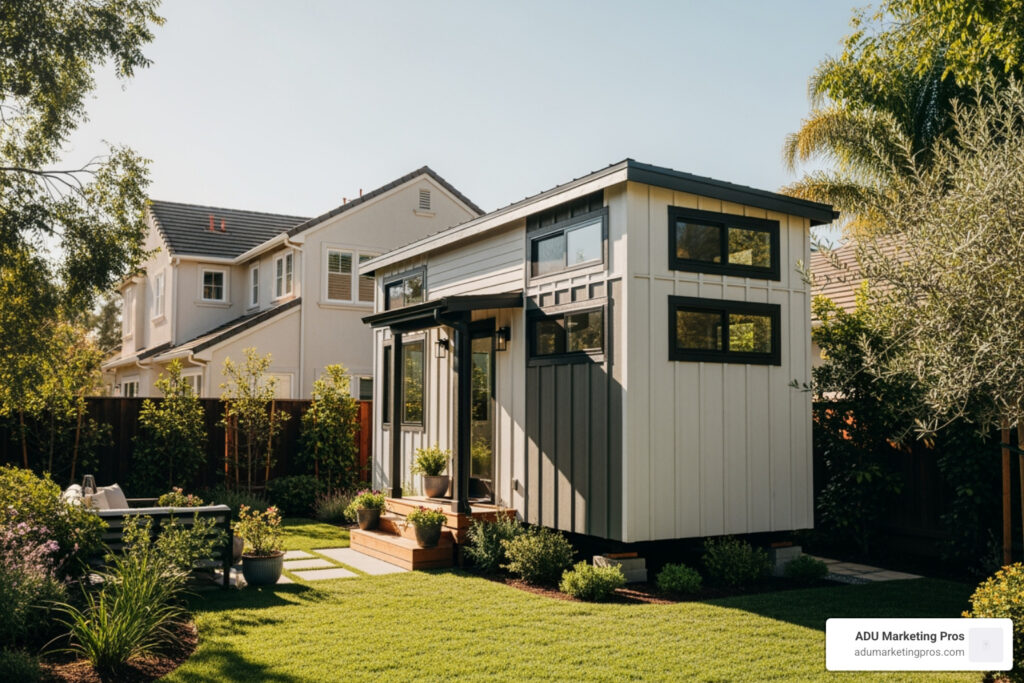
Why Tiny House ADUs Are Redefining the California Dream
In the heart of California, a quiet revolution is taking place in backyards from San Diego to Sacramento. Faced with a historic housing crisis and ever-increasing living costs, homeowners are discovering a powerful solution: the tiny house ADU. This innovative housing option merges the minimalist ethos of the tiny home movement with the legal and financial power of an Accessory Dwelling Unit (ADU), creating a path to greater financial freedom, flexible living arrangements, and a significant boost in property value.
A tiny house ADU is a small, self-contained home built on a permanent foundation on the same property as a primary residence. Here’s a quick overview of what makes them a game-changer:
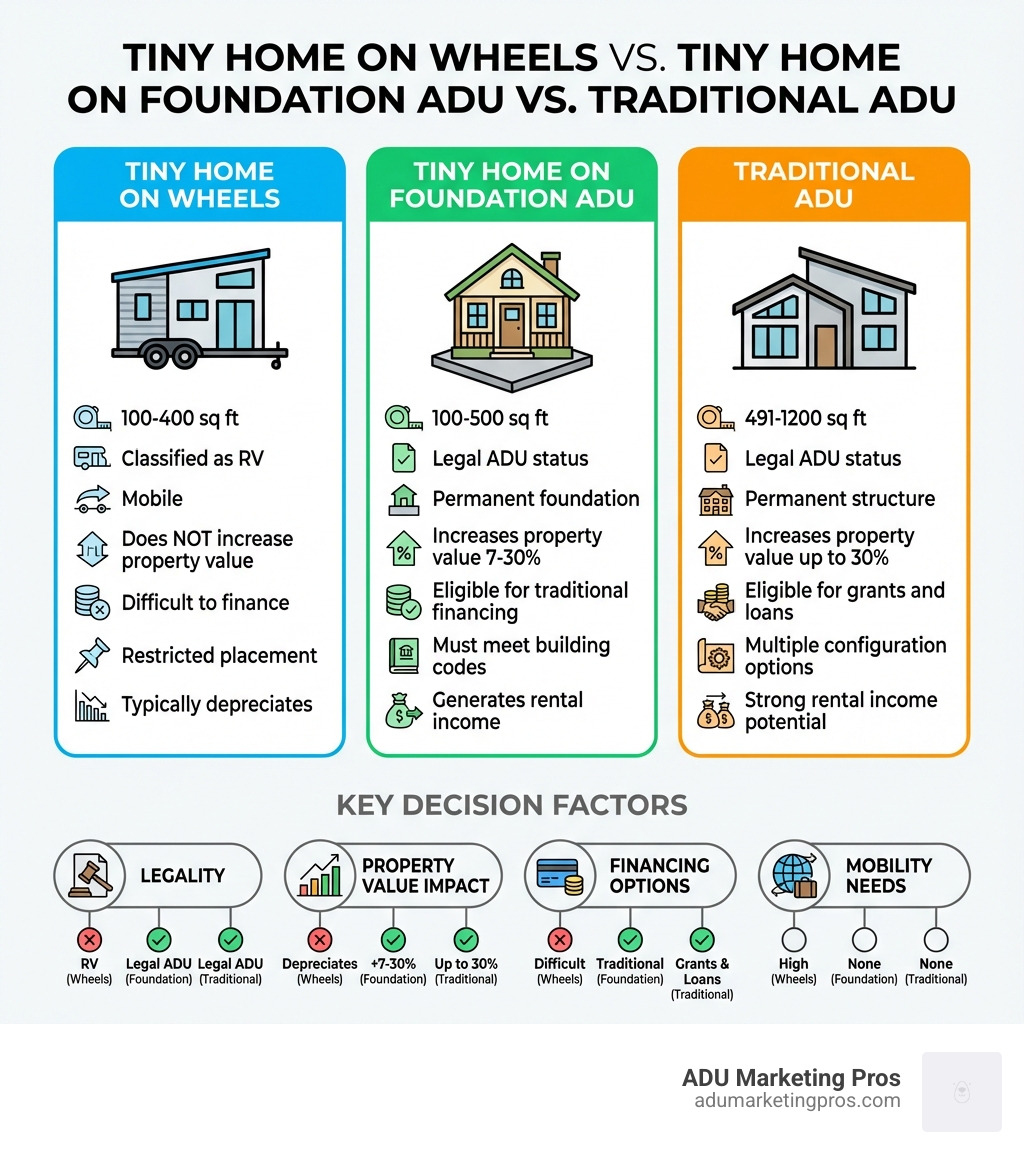
- Legal Status: To be a legal ADU, a tiny home must be permanently affixed to the ground and comply with state and local building codes, just like a traditional house. Tiny homes on wheels (THOWs) are typically classified as RVs and face heavy restrictions for full-time residential use.
- Size Flexibility: While the tiny home movement champions spaces under 400 sq ft, California law allows ADUs to be up to 1,200 sq ft, offering a wide spectrum of possibilities from a compact studio to a two-bedroom family unit.
- Investment Power: A permitted, foundation-built tiny house ADU is a real estate asset that can increase property value by an estimated 7-30%. A mobile tiny home, considered personal property, typically depreciates and adds no value to your real estate.
- Streamlined Approval: Thanks to a wave of pro-housing legislation, California mandates a ministerial, streamlined approval process for ADUs, making it faster and more predictable to get permits than ever before.
- Core Benefits: The advantages are compelling: generating substantial rental income, providing housing for aging parents or adult children (multigenerational living), increasing your property’s net worth, and contributing a much-needed housing unit to your community.
The numbers tell a dramatic story. Between 2016 and 2023, the number of ADUs permitted annually in California skyrocketed from just 1,336 to an incredible 26,924—a 20-fold increase. This boom isn’t just a trend; it’s a direct response to state-level incentives and the urgent need for affordable, flexible housing solutions.
However, the terms “tiny home” and “ADU” are often used interchangeably, leading to costly confusion. An ADU is a legal zoning classification for a secondary home, while a tiny home is a design philosophy focused on simplicity and small-footprint living. The magic happens when these two concepts merge correctly: the tiny house ADU. This guide is designed to cut through the noise, clarify the critical distinctions, and provide a comprehensive roadmap for California homeowners considering this powerful investment.
Find more about Tiny house ADU:
Defining the Terms: What’s an ADU vs. a Tiny Home?
While the terms are often used interchangeably in casual conversation, an Accessory Dwelling Unit (ADU) and a tiny home are fundamentally different concepts. Understanding this distinction is the first and most important step for any homeowner looking to add a small living space to their property. An ADU is a legal and zoning term, while a tiny home is a design movement. One is a classification; the other is a philosophy.
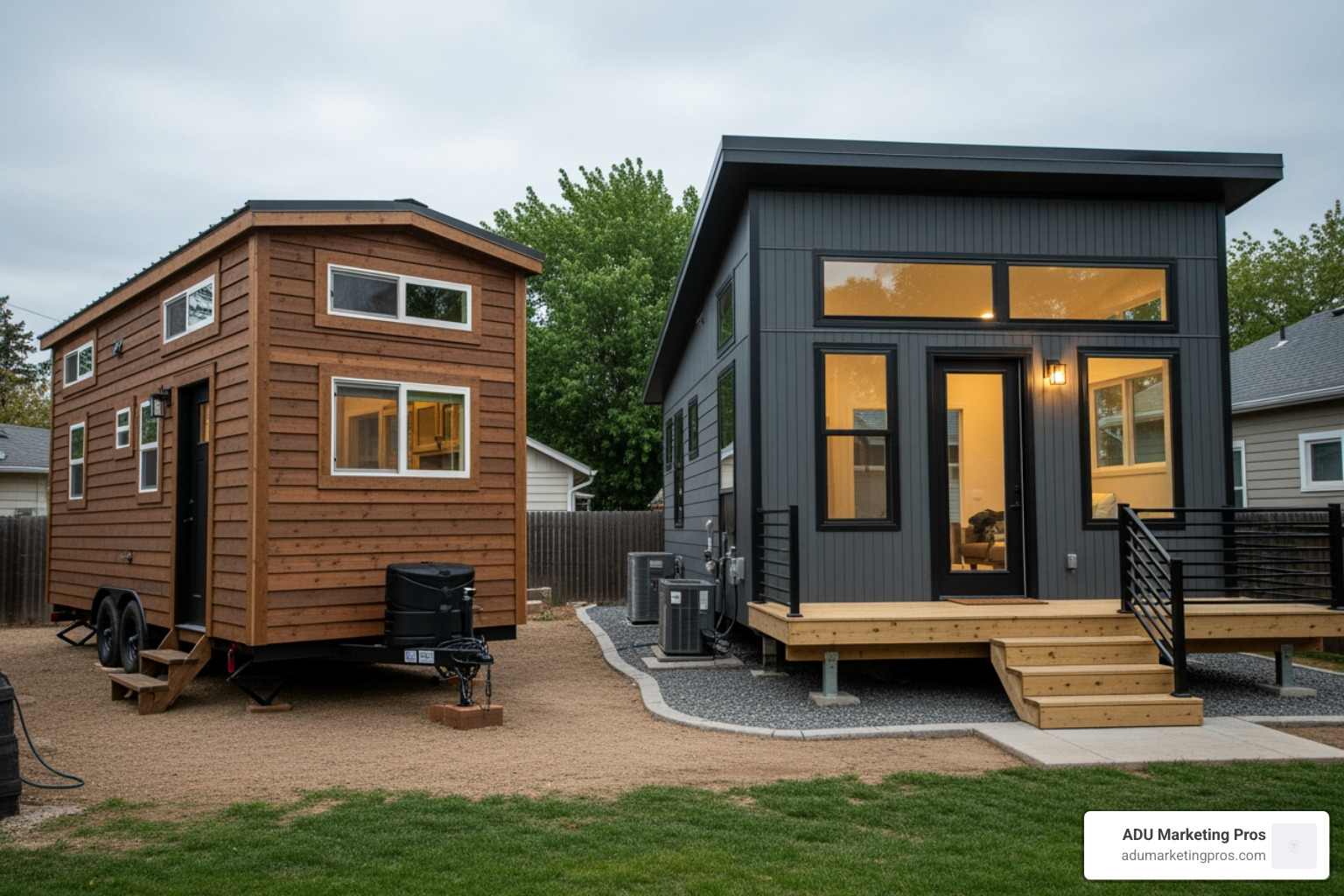
The Core Differences: Foundation, Building Codes, and Legality
The key distinctions that every homeowner must grasp are permanence, governing codes, and legal status.
- Foundation and Permanence: This is the brightest dividing line. ADUs are required by law to be built on a permanent foundation (e.g., a concrete slab or crawl space). This makes them a permanent part of the real estate. In contrast, many iconic tiny homes are built on a chassis with wheels (Tiny Homes on Wheels, or THOWs), designed for mobility.
- Governing Building Codes: A permanent tiny house ADU must comply with the same state and local building codes as a full-sized house. This typically means adhering to the California Residential Code (CRC), which governs everything from structural integrity and fire safety to energy efficiency. A THOW, on the other hand, is often built to RV standards (like ANSI 119.5) or, in some cases, has no official certification, putting it in a legal gray area.
- Legal Classification and Use: In California, a permitted ADU is a legal, rentable dwelling unit. A THOW is legally classified as a Recreational Vehicle (RV). This classification comes with significant restrictions. Most cities prohibit living in an RV full-time on a residential property, making a THOW an illegal long-term housing solution in a backyard setting.
Types of Accessory Dwelling Units (ADUs)
ADUs are not one-size-fits-all. California law defines several types, each offering unique advantages:
- Detached ADU: A standalone structure, often called a backyard cottage or granny flat. It is built separately from the main home, offering the highest degree of privacy for both the primary residents and the ADU occupants. This makes it ideal for generating rental income.
- Attached ADU: A unit that shares at least one wall with the primary residence. It is essentially a home addition designed as a self-contained living space. This can be a cost-effective option as it may leverage existing structural elements and utility connections.
- Conversion ADU: This involves transforming existing, non-livable space within a property into a legal dwelling unit. The most popular options in California are garage conversions, but basements, attics, or large master suites can also be converted. These are often the fastest and most affordable ADUs to build.
- Junior ADU (JADU): A specialized type of conversion ADU, a JADU is a small unit (no more than 500 sq ft) created within the existing walls of the primary home. It must have its own separate entrance and an efficiency kitchen. It can share a bathroom with the main house and must maintain an interior connection, making it a flexible space for a family member or a home office.
Typical Size and Scale: Tiny Home vs. ADU
While both concepts embrace efficient living, their size ranges are dictated by different factors: philosophy versus regulation.
- Tiny Home Size Range: The tiny home movement generally defines its structures as being between 100 and 400 square feet. The small size is a core tenet of the minimalist lifestyle it promotes.
- ADU Size Regulations: ADUs offer much more flexibility. California state law allows ADUs to be up to 1,200 square feet (or larger if local ordinances permit). More importantly, state law mandates that cities must allow an ADU of at least 850 sq ft for a one-bedroom unit and 1,000 sq ft for a two-bedroom unit, regardless of other local rules like floor-area ratio. This means a tiny house ADU can be a truly tiny 200 sq ft studio or a spacious 1,000 sq ft family home, all while falling under the same legal framework.
The Big Question: Can a Tiny Home Legally Be a Tiny House ADU?
Yes, absolutely—but with a critical condition. A tiny home can be a legal tiny house ADU in California only if it is built on a permanent foundation and complies with all state and local residential building codes. This is the non-negotiable requirement that separates a valuable real estate asset from a restricted-use vehicle.
A tiny home on wheels (THOW) is not a legal permanent dwelling in a backyard. It is treated as an RV, and its placement and use are heavily restricted by municipal codes. To transform the “tiny home” concept into a legal ADU, you must remove the wheels and affix it to the ground as a permanent structure, fully permitted and inspected like any other home.
Navigating California’s Groundbreaking ADU Laws
California has become the nation’s leader in ADU development, thanks to a series of landmark laws designed to dismantle barriers to construction. Bills like AB 68, AB 881, and SB 9 have fundamentally reshaped the housing landscape. In 2023, ADUs comprised over 21% of all new homes permitted statewide, a testament to the success of these policies.
Key provisions from this legislation include:
- Ministerial Approval: If an ADU project meets all objective local standards, the city or county must approve it within 60 days. Discretionary reviews and public hearings are eliminated.
- Parking Waivers: No off-street parking is required for an ADU if the property is within a half-mile of public transit, in a historic district, or if it’s a conversion ADU.
- Elimination of Owner-Occupancy: Cities cannot require the property owner to live in either the main house or the ADU, opening up significant investment opportunities.
- Fee Reductions: Impact fees are reduced or eliminated for smaller ADUs (under 750 sq ft).
- Separate Sale Potential: The recent AB 1033 allows cities to opt-in to a program where ADUs can be sold separately from the primary home, similar to a condominium.
For a complete, official overview of all regulations, the California ADU Handbook from the Department of Housing and Community Development is an essential, authoritative resource.
Understanding Your Local Tiny House ADU Regulations
While state law creates a powerful framework, all construction is local. Your city or county planning department has the final say on the specific rules for your property. Regulations for zoning, setbacks (the required distance from property lines), height limits, and architectural styles can vary significantly between jurisdictions like Los Angeles, San Diego, San Jose, and smaller cities like Palo Alto or Menlo Park.
For example:
- The City of Los Angeles has a robust Standard Plan Program with pre-approved ADU designs to expedite permitting.
- San Diego refers to ADUs as “Companion Units” and has its own specific technical manual and fee structures.
- San Jose is known for its clear guidelines and pre-approved ADU plans, encouraging development in the heart of Silicon Valley.
Before investing in design or plans, your first call should always be to your local planning and building departments. They can provide the definitive requirements for your specific address and save you from costly mistakes down the road.
Investment & Lifestyle: A Head-to-Head Comparison
Choosing between a mobile tiny home and a permanent tiny house ADU is a major decision that impacts your finances, property, and lifestyle for years to come. This comparison breaks down the critical factors to help you determine which path aligns with your long-term goals.
| Feature | Tiny Home on Wheels (Mobile) | Tiny House ADU (Permanent Foundation) |
|---|---|---|
| Initial Cost | $50,000 – $100,000+ (for the unit only) | $150,000 – $400,000+ (all-in, including site work and permits) |
| Impact on Property Value | None. Depreciates over time like a vehicle. | Significant increase of 7-30%; a direct addition to your real estate equity. |
| Legal Status | Classified as an RV. Illegal for full-time backyard living in most cities. | Fully legal dwelling unit, permitted for long-term rental and occupancy. |
| Rental Income Potential | Limited to short-term rentals in specific RV parks or zoned areas. | Excellent for stable, long-term rental income. High demand in California. |
| Financing Options | Difficult. Requires RV loans or personal loans with higher interest rates. | Accessible. Eligible for traditional mortgages, HELOCs, construction loans. |
| Mobility | Highly mobile; can be moved to different locations. | Permanent fixture; cannot be moved. |
Cost Analysis: Upfront Price vs. Long-Term Investment
It is crucial to look beyond the sticker price. A tiny home on wheels (THOW) may seem cheaper upfront, with costs often ranging from $50,000 to $100,000. However, this price is for the unit alone. It does not include the cost of a truck to move it, a place to legally park it, or utility hookups. Most importantly, as personal property, a THOW depreciates over time, much like a car or boat. It adds zero value to your property’s assessment.
A tiny house ADU, while a larger initial investment, is a powerful financial tool. Total project costs can range from $150,000 for a simple conversion to over $400,000 for a high-end custom build. These costs are broken down into:
- Soft Costs (10-20%): Architectural design, engineering, surveys, and permit fees.
- Hard Costs (80-90%): Site preparation (grading, trenching), foundation, utility connections (sewer, water, electric), materials, and labor for construction.
Despite the higher cost, the return on investment (ROI) is substantial. A completed ADU can increase your property’s value by 7-30%. For a home valued at $800,000, adding an ADU could increase its market value to $960,000 or more—instantly adding equity that far exceeds the construction cost. Because it is real estate, an ADU can be financed with traditional, lower-interest financial products like a cash-out refinance, a home equity line of credit (HELOC), or a construction loan.
Rental Income Potential and Market Reality
For most California homeowners, the primary driver for building an ADU is rental income. Here, the permanent ADU is the undisputed winner.
- Long-Term Rentals (LTR): A legal tiny house ADU is a highly desirable rental unit. It offers privacy and modern amenities, attracting high-quality, stable tenants. In markets like Los Angeles or the Bay Area, even a small studio ADU can generate $2,000-$3,000+ per month in rental income. This consistent cash flow can often cover the entire monthly mortgage payment for the ADU’s financing, making it a self-sustaining investment.
- Short-Term Rentals (STR): While a THOW might seem suited for Airbnb, this is a legal minefield. Most cities heavily regulate or outright ban the use of RVs as short-term rentals on residential lots. A permanent ADU can be used for STRs, but this is also subject to local ordinances, which are becoming increasingly strict.
The Pros and Cons for Homeowners
Here’s a summary to help you weigh your options:
Tiny House ADU (Permanent)
- Pros:
- Dramatically increases property value and equity.
- Generates strong, stable long-term rental income.
- Clear legal status as a permanent dwelling.
- Eligible for traditional home financing and grants.
- Provides flexible housing for family, caregivers, or tenants.
- Contributes to solving the local housing shortage.
- Cons:
- Higher upfront investment and construction costs.
- Permanent structure reduces backyard space.
- Requires navigating a complex design and permit process.
- Longer timeline from conception to completion.
Tiny Home on Wheels (Mobile)
- Pros:
- Lower initial purchase price for the unit.
- Mobility to relocate if your circumstances change.
- Can be designed for off-grid living.
- Simpler to purchase than building a permanent structure.
- Cons:
- Depreciates in value and does not build equity.
- Severe legal restrictions on where it can be parked and occupied full-time.
- Difficult to finance; requires high-interest personal or RV loans.
- Uncertain resale market and value.
- Does not count as a legal housing unit.
Getting Started: Your 5-Step Roadmap to Building a Tiny House ADU
Building a tiny house ADU is a rewarding but complex project. Breaking it down into a clear, step-by-step process can make it far more manageable. This roadmap outlines the key phases from initial idea to final occupancy.
Step 1: Feasibility and Financial Planning
This foundational phase is about due diligence. Rushing this step is the most common and costly mistake.
- Define Your Goals: First, clarify the ADU’s primary purpose. Is it for rental income, housing for aging parents (requiring accessibility features), a workspace, or a guest house? Your goal dictates the design, size, and budget.
- Check Local Zoning Codes: Go directly to the source: your local city or county planning department’s website. Look for their ADU ordinance or speak with a planner. Key questions to answer: What are the setback requirements? What is the maximum size and height allowed? Are there specific design or parking rules for your property’s zone?
- Conduct a Site Assessment: Analyze your property for practical constraints. Where are the existing utility lines (sewer, water, power)? Is the proposed site on a slope? Are there any large trees or easements that could interfere with construction?
- Create a Realistic Budget: Develop a comprehensive budget that includes all potential costs: soft costs (design, engineering, permits), hard costs (site prep, foundation, utilities, construction), and finishing costs (appliances, landscaping, fixtures). It’s wise to add a 10-15% contingency fund for unexpected expenses.
Step 2: Design and Professional Team Assembly
With a clear understanding of the rules and budget, you can move into the creative phase.
- Choose Your Build Type: Custom vs. Prefab: A custom (or site-built) ADU is designed from scratch by an architect, offering complete personalization but often at a higher cost and longer timeline. A prefabricated ADU is built in a factory and delivered to your site, which can save time and offer cost certainty. Many companies, like Studio Shed, offer modular kits with extensive customizations. You can use online tools to Design & Price ADU Tiny Homes to explore layouts.
- Consider Pre-Approved Plans: To save time and money on design and permitting, check if your city offers pre-approved or “standard” ADU plans. Cities like Los Angeles and San Jose have programs featuring ready-to-go designs from licensed professionals that have already been vetted by the building department.
- Hire Your Team: You will need a team of professionals. This could be a design-build firm that handles everything from architecture to construction, or you might hire an architect/designer and a separate general contractor.
Step 3: Permitting and Approvals
This is the bureaucratic phase that requires patience and attention to detail.
- Prepare Your Submission Package: Your designer or architect will compile a full set of construction documents. This typically includes a site plan, floor plans, elevations, structural calculations, electrical/plumbing/mechanical plans, and California’s Title 24 energy compliance report.
- Submit to the Building Department: Most cities now use online portals for plan submission, such as Los Angeles’ ePlanLA. Once submitted, your plans enter the plan check process.
- Navigate Plan Check: A city plan checker will review your documents for compliance with all relevant codes. It is common to receive comments or requests for revisions. Your design professional will address these comments and resubmit the plans until they are approved.
Step 4: Construction and Inspections
Once you have an approved permit in hand, construction can begin.
- Site Preparation: The first physical work involves clearing and grading the site, trenching for new utility lines, and preparing the ground for the foundation.
- Foundation: A licensed contractor will pour the permanent concrete foundation (either a slab-on-grade or a raised foundation with a crawlspace).
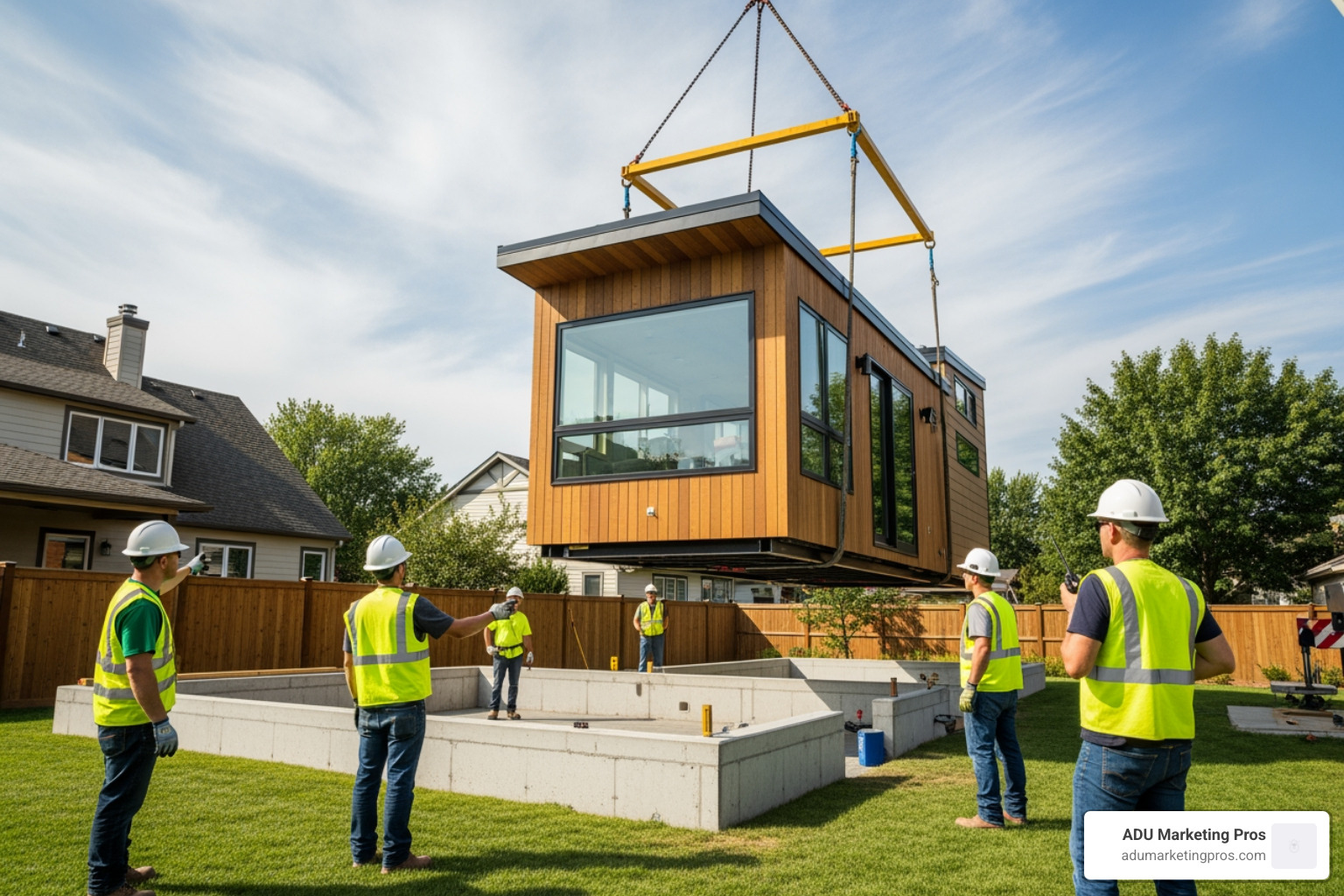
- Framing and Building: For a site-built ADU, the structure will be framed on-site. For a prefab unit, it will be delivered and craned into place on the foundation.
- Municipal Inspections: Throughout the construction process, a city inspector will visit at key milestones (e.g., foundation, framing, rough electrical/plumbing, insulation) to ensure the work matches the approved plans and meets code. Do not cover any work until it has been inspected and approved.
Step 5: Final Touches and Certificate of Occupancy
The final step is preparing the ADU for its new resident.
- Finishes and Fixtures: This includes installing flooring, painting, cabinetry, countertops, light fixtures, and appliances.
- Landscaping and Exterior Work: Complete any pathways, patios, and landscaping around the new unit.
- Final Inspection: Once all work is complete, you will schedule a final inspection. After passing, the city will issue a Certificate of Occupancy, the official document that declares the tiny house ADU a legal, habitable dwelling. Your new unit is now ready for use!
The Future of Compact Living: Trends and Outlook
The movement toward smaller, more efficient housing is not a fleeting trend; it’s a fundamental shift in how Californians live. In 2023, ADUs accounted for over 21% of all new homes permitted in the state, cementing their role as a primary solution to the housing crisis. Several key trends are accelerating this transformation and shaping the future of the tiny house ADU.
The “Condo-ization” of ADUs: AB 1033 Explained
Perhaps the most significant recent development is Assembly Bill 1033. This groundbreaking legislation, enacted in 2023, gives local cities and counties the option to allow ADUs to be sold separately from the primary residence as a condominium. This could unlock a new, more affordable form of homeownership, allowing a first-time buyer to purchase a small home without the cost of the land. While adoption is up to individual cities, it has the potential to create thousands of new starter homes and dramatically increase the financial incentive for homeowners to build ADUs.
The Rise of Eco-Friendly and Prefab Solutions
As environmental awareness grows, so does the demand for sustainable housing. The prefab ADU industry is leading this charge. Factory-based construction inherently reduces material waste compared to on-site building. Many prefab companies now specialize in eco-friendly models that feature:
- High-performance insulation and windows
- All-electric appliances and heat pumps
- Solar panel readiness and net-zero energy capabilities
- Use of recycled and sustainable materials
This focus on sustainability not only lowers the home’s carbon footprint but also results in lower utility bills for the occupant.
Designing for Multi-Generational Family Compounds
ADUs are increasingly being used to keep families together. As Baby Boomers age and Millennials start families, the tiny house ADU provides a perfect solution for multi-generational living. It allows aging parents to live independently on the same property as their adult children, providing proximity for care and support while maintaining privacy. Similarly, it offers a stepping stone for young adults who are not yet able to afford their own home in California’s expensive market. Architects and builders are now focusing on designs that incorporate universal design principles, such as zero-threshold entries and wider doorways, to accommodate residents of all ages and abilities.
Smart Homes and Tech Integration
Modern ADUs are becoming increasingly sophisticated. Smart home technology is no longer a luxury but an expected feature. New units are being equipped with integrated systems for lighting, climate control, security, and entertainment, all controllable from a smartphone. This tech integration enhances convenience, improves energy efficiency, and increases the rental appeal and overall value of the ADU.
Conclusion: Is a Tiny House ADU the Right Investment for You?
A tiny house ADU represents the powerful intersection of a minimalist lifestyle philosophy and a savvy real estate investment strategy. The journey begins with a single, crucial understanding: to become a legal ADU, a tiny home must be built on a permanent foundation and fully comply with residential building codes. This distinction is the key to unlocking immense financial and personal value from your property.
The choice between a mobile tiny home and a permanent ADU is a choice between a depreciating vehicle and an appreciating asset. The mobility and lower entry price of a wheeled tiny home are tempting, but they come at the cost of legal uncertainty and zero contribution to your property’s equity. For the vast majority of California homeowners seeking to generate rental income, house family members, or build long-term wealth, the permanent tiny house ADU is the clear and superior path.
It is an investment not just in a structure, but in your property’s future value, your family’s well-being, and your financial security. By navigating the process of design, permitting, and construction, you are creating a new, legal home that addresses California’s housing needs while significantly enhancing your own financial position.
For ADU builders, designers, and architects aiming to succeed in this booming market, effectively communicating this value proposition is paramount. Your clients are not just buying a small house; they are making a strategic investment. At ADU Marketing Pros, we specialize in crafting marketing strategies that cut through the noise, highlight your expertise in navigating this complex landscape, and connect you with high-quality leads ready to build.
Find out more about marketing for California tiny home builders and learn how to position your firm as a leader in this transformative industry.