
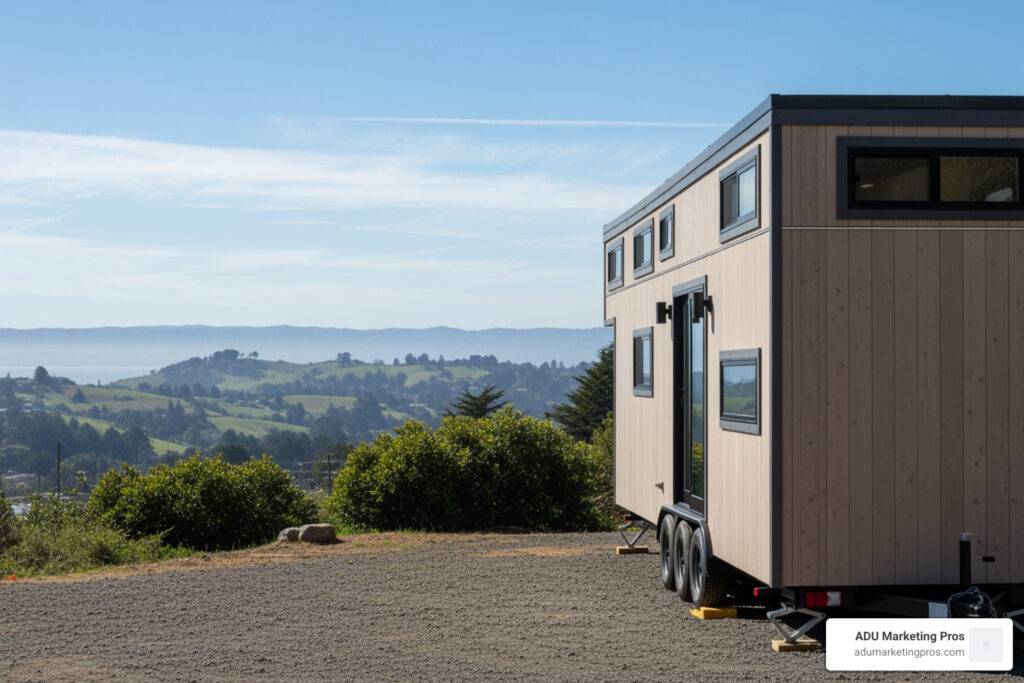
Why Tiny Homes Are Changing Bay Area Housing
Tiny homes san francisco bay area are no longer just a niche lifestyle choice; they are a practical response to the region’s housing crisis. Whether you are looking to downsize, create a backyard rental, or explore affordable alternatives to traditional real estate, the Bay Area offers a growing range of tiny home options.
From the hills of Mill Valley to the urban core of Oakland, tiny homes are appearing in backyards, RV communities, and purpose-built villages. Some serve as permanent supportive housing, such as the 70 private rooms at 33 Gough Street or the micro-homes at Hope Village in Walnut Creek. Others are chosen by residents trading square footage for financial freedom and sustainability. Park Delta Bay, Northern California’s first tiny-home community, currently houses approximately 80 full-time residents.
The median home price in the San Francisco Bay Area continues to push beyond what most residents can afford, sparking serious interest in tiny living as a legitimate housing strategy. However, navigating the complex web of zoning laws, building codes, and permitting requirements remains a challenge. Some municipalities welcome tiny homes as Accessory Dwelling Units (ADUs), while others restrict them to RV parks.
This guide explores the different types of tiny homes available, their actual costs, legal placement options, and the communities leading the movement.
Related content about tiny homes san francisco bay area:
Navigating the Market for tiny homes san francisco bay area
The San Francisco Bay Area’s housing market is notoriously competitive, creating a unique opportunity for tiny homes to thrive as affordable and sustainable options. The market includes everything from custom luxury models to budget-friendly repurposed units, focusing on smart urban infill in cities like San Jose, Oakland, and Berkeley. As the region grapples with some of the highest real estate prices in the nation, the shift toward compact living represents a fundamental change in how residents view homeownership and land use.
For more information on navigating these choices, you can explore More info about tiny house San Francisco options.
| Model | Square Footage | Starting Price |
|---|---|---|
| Life Pod | 100 sq ft | $10,000 |
| A-Frame Solo | 120 sq ft | $29,700 |
| Firefly Backyard Office | 154 sq ft | $44,500 |
| Pinnacle | 153 sq ft | $61,200 |
| A-Frame United | 160 sq ft | $37,200 |
| Trailblazer | 213 sq ft | $74,900 |
| The Cub | 260 sq ft | $55,900 |
| Minimalist | 300 sq ft | $15,000 |
| Aspen | 312 sq ft | $74,400 |
| Grizzly | 388 sq ft | $97,400 |
| Firefly | 396 sq ft | $89,400 |
| Mini Mansion | 400+ sq ft | $20,000 |
| The Resort 3/2 | 792 sq ft | $170,000 |
Popular Models of tiny homes san francisco bay area
- A-frame cabins: Iconic structures like the A-Frame Solo and A-Frame United are popular for glamping or backyard offices. Their steep rooflines are not just aesthetic; they are structurally sound and offer a unique sense of volume in a small footprint.
- Life Pods & Mini Mansions: Repurposed units from companies like BARC offer minimalist spaces starting at $10,000. These are often converted shipping containers or modular steel frames, providing a rugged, industrial look that is highly durable.
- THOWs (Tiny Homes on Wheels): These offer portability and are designed for RV-friendly communities. Models like the Trailblazer or Firefly are prime examples, featuring high-end finishes and the ability to move if your job or lifestyle changes.
- Park Models: Larger units built to RV standards but intended for permanent placement, such as The Resort 3/2. These often feel like traditional cottages and are popular in more rural parts of the Bay Area like Sonoma or Isleton.
- Modular Units & Studio Cottages: Often functioning as ADUs, these pre-fabricated or stick-built units provide additional living space or rental income. They are built to the same standards as traditional homes but on a much smaller scale.
To find professionals who can bring your vision to life, you can Learn about tiny house builders in California.
The True Cost of tiny homes san francisco bay area
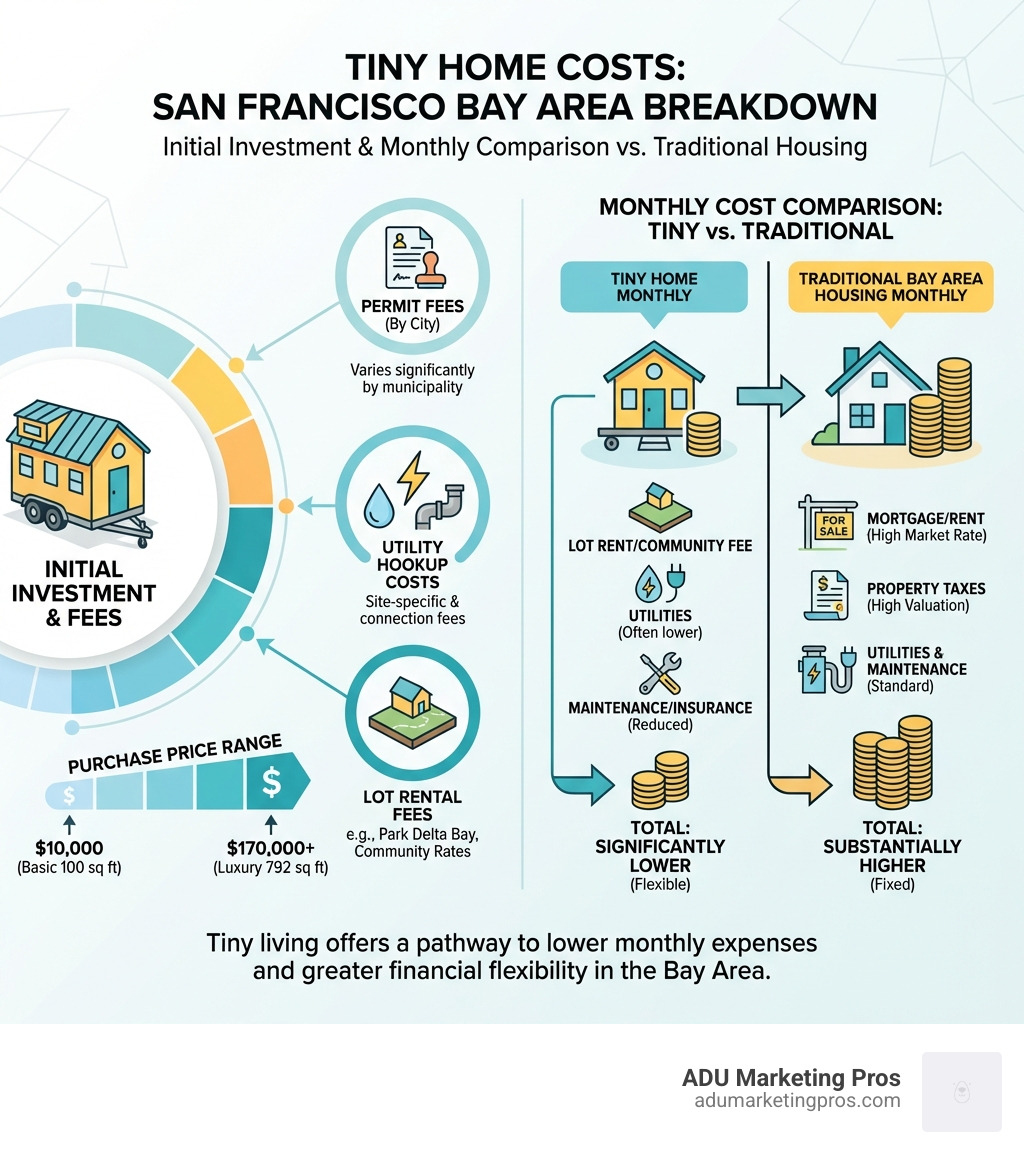
While the sticker price is attractive, the “true cost” includes several factors that can significantly impact your budget:
- Purchase Price: Ranges from $10,000 for basic pods to $170,000 for luxury park models. Customization, such as high-end appliances or off-grid solar packages, can add $20,000 or more.
- Lot Fees/Land Costs: Finding a legal spot is the biggest hurdle. If you don’t own land, expect lot rental fees in communities like Park Delta Bay to range from $600 to $1,200 per month, depending on amenities.
- Utility Hookups: Connecting to water, sewer, and power can add $5,000 to $15,000, especially on undeveloped land. In urban backyards, this involves trenching and upgrading the main electrical panel.
- Permit Costs: Fees vary based on whether the unit is classified as an ADU or an RV. ADU permits in cities like San Francisco can cost several thousand dollars in administrative and impact fees.
- Maintenance & Insurance: While lower than traditional homes, these remain ongoing expenses. Specialized tiny home insurance is necessary to cover both the structure and its contents, especially for THOWs.
As the Sacramento Bee notes, tiny homes yield a bigger problem: Where to put them?. This location factor directly impacts the overall feasibility and cost, making it the most critical part of your planning process.
Legalities and Zoning: Where Can You Actually Live?
Zoning is often the most complex part of the tiny home journey in the Bay Area. Regulations are a patchwork of city ordinances and state laws that are constantly evolving to meet the housing demand. Understanding the nuances of local code is the difference between a successful project and a costly legal headache.
Generally, tiny homes fall into two categories:
- Tiny Homes on Wheels (THOWs): Often classified as Recreational Vehicles (RVs). They usually require RVIA certification and DMV registration. Communities like Park Delta Bay require these for year-round residency. In some jurisdictions, they are now being recognized as “Movable Tiny Houses” (MTHs), a new legal category that allows them to serve as permanent ADUs.
- Tiny Homes on Foundations: Treated as Accessory Dwelling Units (ADUs). They must comply with local building codes, including Title 24 energy requirements and permanent foundation standards. These are the most widely accepted form of tiny living in residential neighborhoods.
Understanding the distinction is vital for compliance. You can learn more about Understanding ADU vs. tiny house regulations to clarify these differences.
Navigating Bay Area City Ordinances
- ADU-Friendly Policies: Cities like San Jose, Oakland, and Berkeley have become more accommodating due to state mandates like SB 9 and AB 68. These laws limit the ability of local governments to deny ADU applications, making it easier to place foundation-based tiny homes in backyards.
- Challenges for THOWs: Many cities still restrict THOWs in residential zones due to sanitation and building code concerns. However, San Jose was a pioneer in allowing Movable Tiny Houses as legal ADUs, a trend that other Bay Area cities are beginning to follow.
- Homelessness Initiatives: Some cities use tiny homes for humanitarian efforts. Projects like Dignity Village in Alameda bypass typical zoning to provide private housing. As KPIX5 reports, Tiny Homes Fill A Need For Many Californians Who Can’t Buy Big Homes, highlighting their role in the housing crisis.
The Permitting Process and State Law
Permitting typically involves site plans, utility mapping, and safety inspections. For THOWs, RVIA certification often serves as proof of safety, ensuring the electrical and plumbing systems meet national standards. For foundation units, you must navigate city planning departments and fire safety standards, especially in high-risk Wildland-Urban Interface (WUI) zones common in the North Bay.
California state law has recently shifted to favor density. SB 9, for instance, allows homeowners to split their lots and build up to four units in some residential zones. This has opened the door for “tiny home clusters” on single-family lots, though local implementation varies. For more general ideas, you might Discover small house options.
Tiny Home Communities and Innovative Developments
Several developments in the Bay Area are making tiny living a reality, offering a glimpse into community-focused housing. These spaces provide not just a place to park or build, but a social network of like-minded individuals committed to a smaller footprint.
Park Delta Bay, Isleton
Park Delta Bay is Northern California’s first tiny-home community. Located on the scenic San Joaquin River, it offers a legal environment for year-round living in a relaxed country setting. It has become a blueprint for how tiny home villages can operate successfully within existing RV park frameworks.
- Community Life: Hosts thirteen tiny homes and sixty RV spaces. Residents have access to a community room, tennis courts, and a pool. The atmosphere is one of mutual support, with shared gardens and community events.
- Legality: Zoned for RVs, requiring homes to be on wheels and RVIA certified. This allows the community to operate under state-regulated mobile home park laws.
- Process: Interested residents must complete a rental application and background check. The community is selective to ensure that all homes meet aesthetic and safety standards.
To learn more, read What’s It Like to Live in Northern California’s First Tiny-Home Community? and check out Delta Bay Tiny House Village: A Legal Place to Live.
Supportive Housing Initiatives
Tiny homes are also addressing the homelessness crisis by providing dignity and privacy that traditional shelters cannot match:
- 33 Gough Street, San Francisco: This “triage” site provides 70 private rooms with essential amenities and on-site support services. It serves as a transitional space for individuals moving toward permanent housing.
- Dignity Village, Alameda: Offers 47 private rooms with ensuite bathrooms and healthcare connections. This project focuses on the “Housing First” model, providing stability before addressing other life challenges.
- Hope Village, Walnut Creek: A collaborative project providing permanent supportive housing for seniors, a demographic increasingly affected by the Bay Area’s rising rents.
Rural vs. Urban Tiny Living
- Urban Backyards: Popular in Oakland and San Jose as ADUs for rental income or family housing. These units help increase density without changing the character of the neighborhood.
- Coastal & Forest Retreats: High demand for tiny homes in Mill Valley or Gualala as vacation rentals. These often feature high-end design to attract tourists looking for a unique experience.
- Mountain Cabins: Foothill areas offer opportunities for farm stays and disconnected living, where tiny homes can serve as worker housing or guest quarters.
For those interested in sustainable options, Explore eco-friendly small homes for further insights into how these communities are leading the way in green building.
The Environmental and Economic Benefits of Going Small
Choosing a tiny home is often a conscious decision toward financial liberation and environmental sustainability. In a region where the average mortgage can consume more than 50% of a household’s income, the economic argument for tiny living is compelling.
Financial Freedom and Downsizing
- Debt reduction: Lower purchase prices can help buyers avoid (or shorten) long-term mortgage debt. Many tiny home owners are able to pay for their homes in cash or through short-term personal loans.
- Lower utilities: Smaller spaces generally require less energy for heating and cooling. A 200-square-foot home can often be heated for a fraction of the cost of a standard 2,000-square-foot house.
- Minimalist mindset: Tiny living encourages focusing on experiences and essentials over excess possessions. This shift often leads to reduced spending on consumer goods.
- Wealth building: Reduced housing costs can free up cash for saving, investing, and emergency funds, allowing residents to build wealth in ways other than home equity.
For additional context on sustainability and housing, see the U.S. Department of Energy’s overview of energy-efficient homes: https://www.energy.gov/energysaver/energy-efficient-home-design.
Environmental Benefits
- Smaller footprint: Less square footage typically means fewer materials used during construction and less ongoing energy demand. The carbon footprint of a tiny home is estimated to be about 7% of that of a traditional home.
- Efficient systems: Many tiny homes use high-efficiency appliances, LED lighting, and compact HVAC systems like mini-splits, which provide targeted climate control.
- Potential for electrification: All-electric setups can pair well with solar (where feasible) and reduce onsite combustion. Many Bay Area tiny homes are designed to be “solar-ready.”
Innovative Design Features
Tiny homes use efficient design to maximize comfort and functionality:
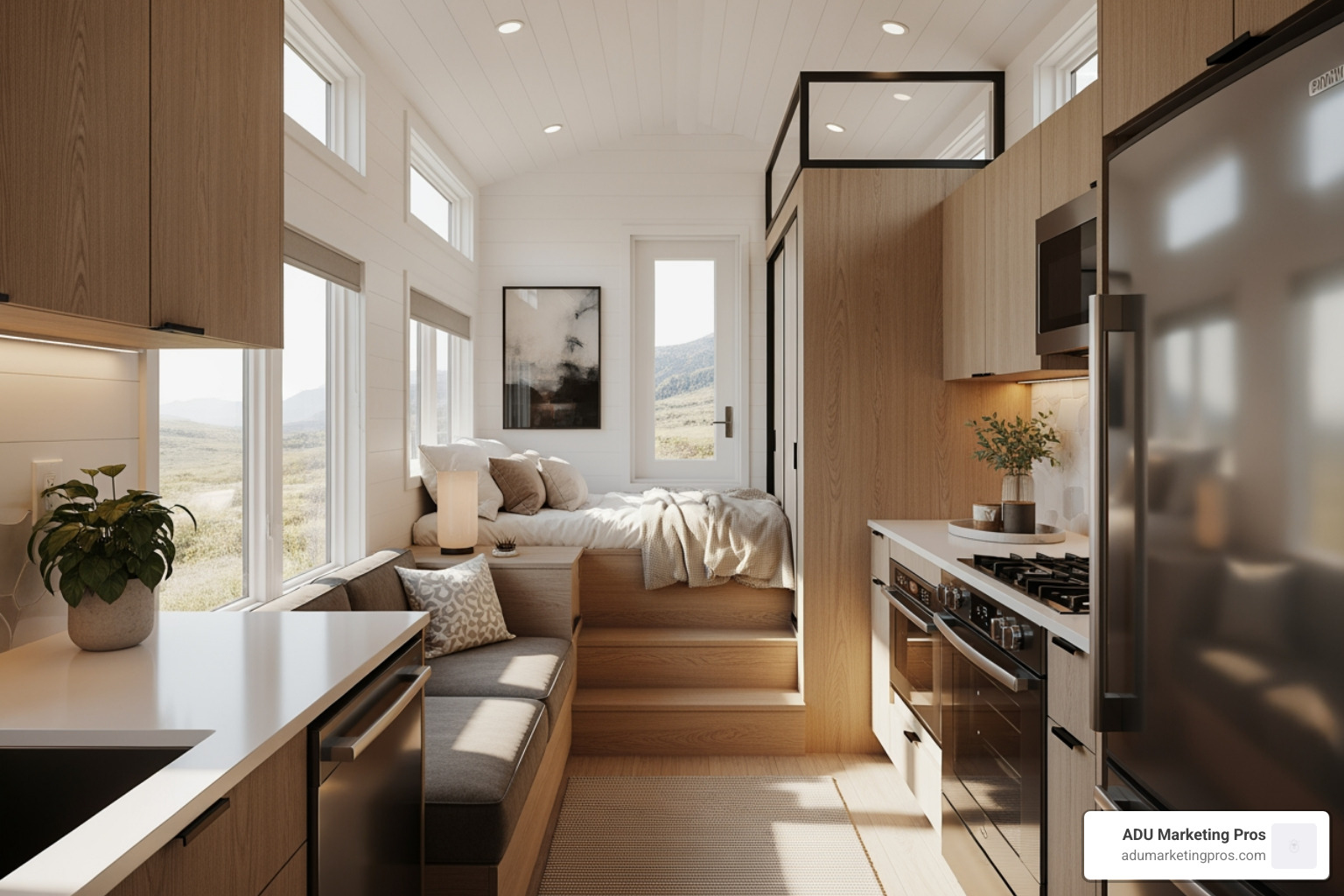
- Loft beds & multi-functional furniture: Maximizing vertical space and using pieces like Murphy beds or storage stairs that serve multiple purposes.
- Mini-split systems: Efficient heating and cooling tailored for small footprints, often controlled via smart thermostats.
- Smart technology & skylights: Optimizing energy use and enhancing the sense of space with natural light, which makes small interiors feel much larger.
- Outdoor integration: Decks and patios that extend the living area into the environment, a crucial feature in the Bay Area’s temperate climate.
- Custom storage: Built-in shelving and under-floor compartments to maintain organization and reduce clutter.
Cost Reality Check (Bay Area)
Even when the home itself is affordable, the Bay Area’s total cost of ownership often hinges on siting and compliance. Site work, including grading and utility trenching, can sometimes cost as much as the tiny home itself if the land is difficult to access. Furthermore, local impact fees—charges levied by cities to fund infrastructure—can add thousands to the project cost for foundation-based units.
For a California-specific policy overview that often influences local rules on backyard housing, the California Department of Housing and Community Development (HCD) ADU page is a helpful starting point: https://www.hcd.ca.gov/policy-and-research/accessory-dwelling-units.
Frequently Asked Questions about Tiny Living in the Bay Area
Can I legally park a tiny home in my San Francisco backyard?
If the tiny home is on a permanent foundation and permitted as an Accessory Dwelling Unit (ADU), it is generally legal in San Francisco. However, if it is on wheels (a THOW), it is typically classified as an RV. Most residential zones in San Francisco do not allow long-term RV occupancy as a primary residence. You would likely need to find a designated RV park or move to a city like San Jose that specifically allows Movable Tiny Houses.
What is the average cost of a tiny home in the Bay Area?
Costs vary by size and features:
- Basic units (100-300 sq ft): $10,000 to $37,000.
- Mid-range units (300-400 sq ft): $44,000 to $97,000.
- Luxury/Park models (400+ sq ft): $100,000 to $170,000+.
Remember to factor in land, permits, and utility hookups, which can add $20,000 to $50,000 to the total project cost.
Do tiny homes in California need to be RVIA certified?
Certification is not universally required by state law but is highly recommended for THOWs. Most legal RV parks and communities like Park Delta Bay require RVIA certification to ensure the unit meets safety standards for recreational vehicles. For tiny homes on foundations (ADUs), the unit must meet the California Building Code (CBC) instead of RVIA standards.
How do tiny homes handle earthquakes in the Bay Area?
Tiny homes on wheels are actually quite resilient in earthquakes because they are not rigidly attached to the ground; the tires and suspension act as shock absorbers. For tiny homes on foundations, they must meet the same seismic codes as traditional homes, which include specific anchoring and bracing requirements to ensure safety during a tremor.
Can I get a mortgage for a tiny home?
Traditional mortgages are difficult to obtain for tiny homes, especially THOWs, because they are not considered real property. Most owners use personal loans, RV loans (if certified), or HELOCs (Home Equity Lines of Credit) from a primary residence to fund their tiny home project. Some specialized lenders are beginning to offer tiny-home-specific financing as the market grows.
What about property taxes on tiny homes?
If your tiny home is on a foundation (ADU), it will likely increase the assessed value of your property, leading to a slight increase in property taxes. If it is on wheels and registered as an RV, you will pay annual DMV registration fees instead of property taxes on the structure itself.
Conclusion
The landscape of tiny homes san francisco bay area is dynamic, offering a viable solution to the region’s housing challenges. From urban ADUs to rural tiny home communities, the movement emphasizes financial freedom, sustainability, and intentional living.
Navigating the legalities of THOWs versus ADUs is complex, but the growth of supportive housing and private communities shows that tiny living is becoming an integral part of the Bay Area’s future. As affordability remains a top priority, these compact dwellings offer a path to homeownership that traditional real estate often cannot.
If you are considering adding a tiny home as an ADU or exploring compact living solutions, professional guidance is essential. Contact professional ADU builders in the Bay Area to learn how to steer the market and bring your project to life.