
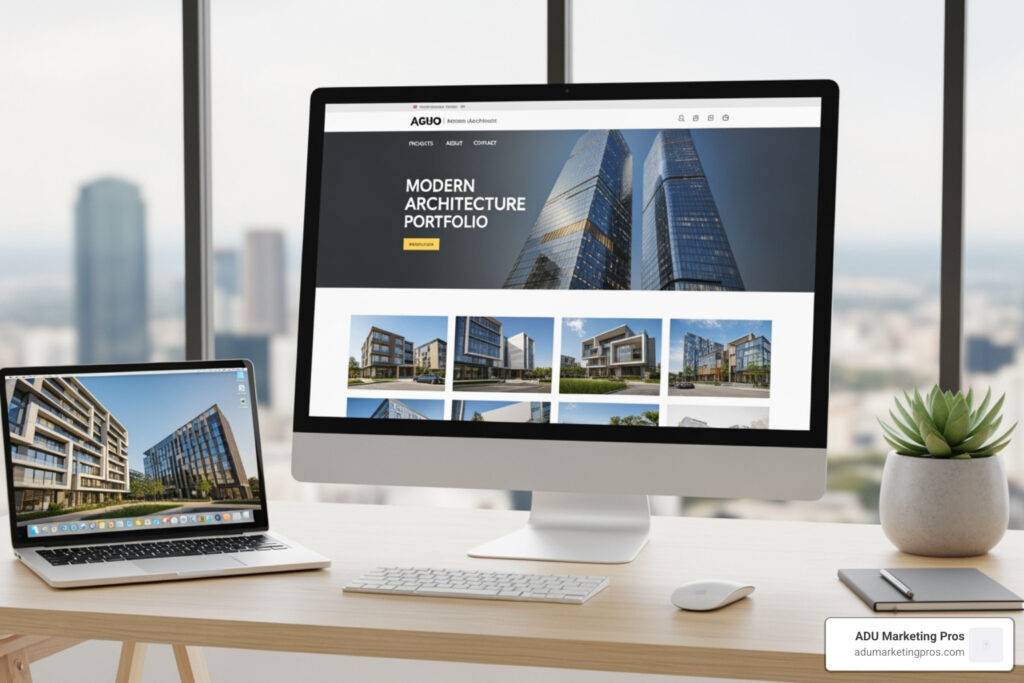
Why Professional Web Design for Architects Is No Longer Optional
In today’s hyper-competitive market, web design for architects has transformed from a digital portfolio into your firm’s most critical lead generation and brand-building asset. The first interaction a potential client has with your practice is no longer a phone call or a handshake; it’s the seconds they spend judging your website. A poorly designed site doesn’t just fail to impress—it actively undermines your credibility and costs you projects.
Quick Answer for Busy Architects:
- Best platforms: WordPress for its unparalleled customization, Squarespace for user-friendly elegance, or fully custom development for a truly bespoke digital experience.
- Essential features: A visually stunning, high-resolution portfolio, flawless mobile optimization, lightning-fast loading speeds, and strategically placed calls-to-action (CTAs).
- DIY vs. Professional: DIY templates offer a basic online presence, but a specialized agency delivers a high-performance, lead-generating website with measurable ROI.
- Investment range: Expect to invest between $5,000 and $25,000+ for a professional website, depending on the complexity, custom features, and strategic depth.
- Timeline: A professionally designed and developed website typically takes 8 to 16 weeks, ensuring a thorough process from strategy to launch.
Consider this: studies consistently show that 94% of first impressions are design-related. For an architect, whose entire profession is built on the principles of superior design, a subpar website is a critical failure. Firms with strategically designed, high-performance websites report a consistent flow of qualified project inquiries, significantly reducing their dependence on inconsistent referrals and traditional networking.
Your website is your 24/7 business development engine. It’s where you articulate your design philosophy, build foundational trust, and clearly differentiate your practice from the competition. This guide provides a comprehensive blueprint for making the key decisions that will transform your website from a static online brochure into a powerful client magnet.
Why Your Firm’s Digital Blueprint Starts with a Professional Website
Think of your website as your firm’s digital flagship showroom—the primary, and often first, destination for potential clients to explore your work, understand your process, and gauge your credibility. In architecture, an industry where trust, precision, and vision are paramount, your online presence must be as carefully planned and executed as your physical designs. A professional website is the cornerstone of modern lead generation and client acquisition, representing your firm around the clock and possessing the power to land your next signature project.
It functions as a tireless business development tool, working to build brand credibility and communicate your unique design philosophy with clarity and impact. This is crucial for attracting clients who are not just looking for an architect, but for your specific approach, effectively differentiating your practice in a crowded marketplace. When every competitor claims to be innovative and client-focused, your website provides tangible proof, creating the trust-building moments that convert passive browsers into engaged prospects. To build a brand that resonates, explore our complete guide on branding for architecture firms.
The Modern Client Journey: From Search to Consultation
Today’s high-value clients follow a predictable digital path before ever making contact. This journey almost always begins with an online search for specific terms like “modern residential architect in Austin” or “sustainable commercial design firm.” Even when a potential client receives a strong personal referral, their immediate next step is to visit your website for validation. An outdated, slow, or difficult-to-steer site can instantly erode the trust established by that referral. During the subsequent portfolio review and service evaluation phases, your site must visually captivate them with your work while clearly answering their key questions about your process, expertise, and project types. A seamless and informative user experience is what facilitates the final step: contact initiation, turning a curious visitor into a qualified, high-potential lead.
Communicating Your Unique Design Philosophy
Your website is the most effective medium for articulating your firm’s distinct vision. This is achieved through a combination of powerful visual storytelling and compelling narrative. Stunning, high-resolution photography, immersive video walkthroughs, and detailed 3D renderings must work in concert to communicate your creativity, precision, and attention to detail. However, visuals alone are not enough. Accompany them with insightful project narratives that detail the client’s initial problem, the unique challenges of the project, your innovative solutions, and the ultimate impact of your design.
Your firm’s values—whether centered on biophilic design, historical preservation, or cutting-edge sustainability—should be woven into the fabric of your site’s content and design. This clarity acts as a filter, helping you attract ideal clients who are already aligned with your vision. Finally, use your website as a platform for an expertise showcase. If you specialize in complex projects like ADUs in California, dedicate content to explaining your deep knowledge of local regulations, material sourcing, and innovative solutions for small-space living. This positions you not just as a service provider, but as an indispensable authority, justifying premium fees.
Essential Features: Building a Website as Meticulous as Your Designs
Just as every line in your architectural drawings serves a distinct purpose, every feature on your website must contribute to a cohesive user experience and drive the ultimate goal of client acquisition. A truly great architect’s website is a masterclass in functional harmony, balancing breathtaking aesthetics with intuitive functionality and robust technical performance.
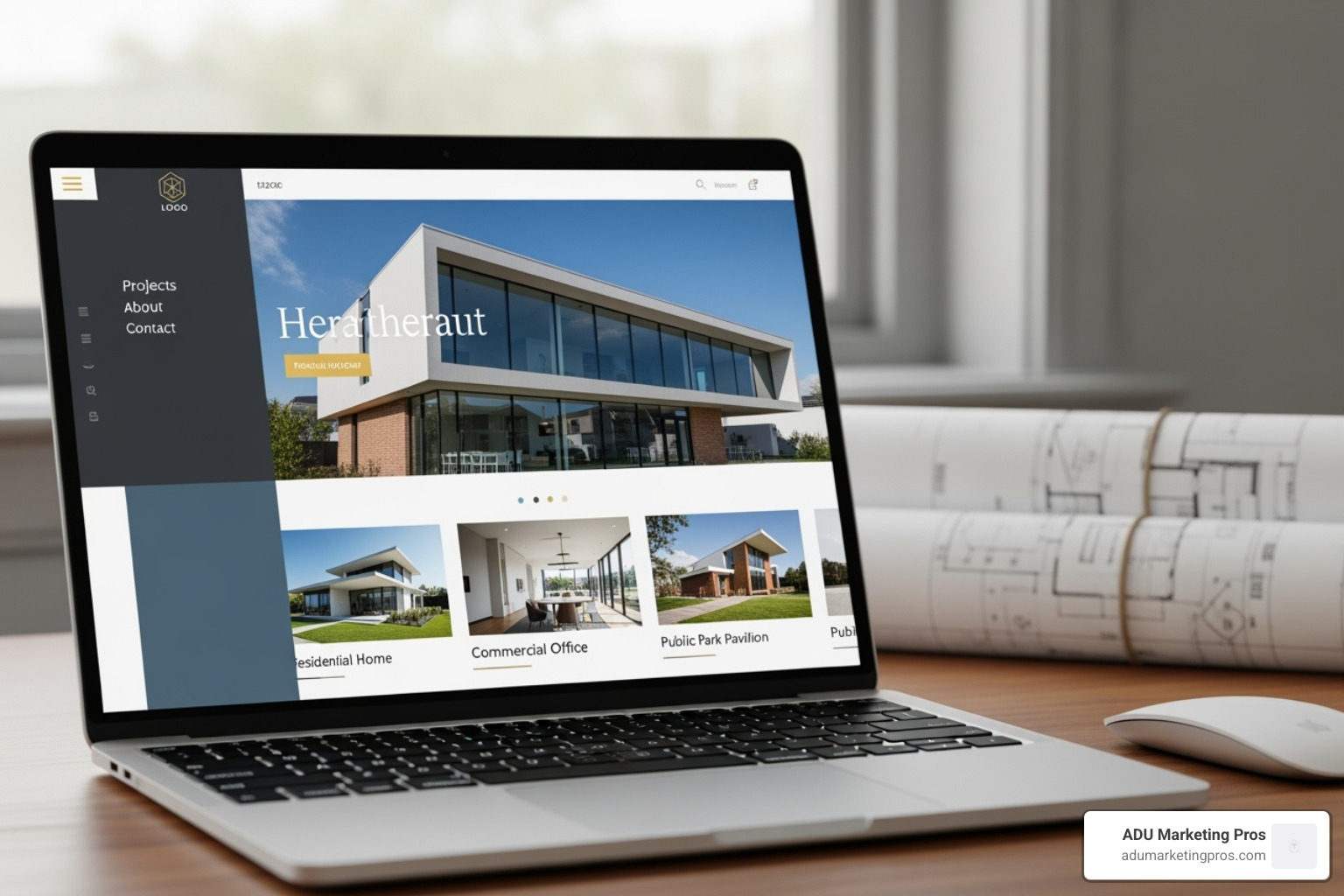
Certain features are non-negotiable for a high-performing site that converts visitors into clients. A high-resolution portfolio is the centerpiece, your digital gallery to showcase your best work with crystal-clear imagery and immersive detail. Lift it with in-depth project case studies that tell the story behind the design, outlining challenges, your process, and the final outcome. Intuitive navigation is the invisible framework that guides users effortlessly; visitors must be able to find your portfolio, services, and contact information within seconds.
Technical excellence is just as critical as visual appeal. Fast loading speeds are essential, as research from Google shows that the probability of a user bouncing increases by 32% as page load time goes from 1 to 3 seconds. Since mobile internet use has long surpassed desktop, a mobile-first design is mandatory, ensuring your site is flawless on any screen size. Finally, you must guide visitors toward the next step with clear calls-to-action (CTAs) like “Schedule a Consultation” or “View Our Process.” For a deeper look at these features, see our guide on architect website design.
The Power of a Visual Portfolio
In architecture, seeing is believing. Your portfolio is the heart of your website, offering tangible, compelling proof of your expertise and design sensibility.
- Professional Architectural Photography: This is the foundation. Invest in a professional photographer who specializes in architecture to capture your projects in the best light, emphasizing form, texture, and space.
- Video Walkthroughs & Drone Footage: These dynamic elements bring designs to life, allowing potential clients to experience the flow and context of a space in a way static images cannot.
- Project Filters: Implement intuitive filters that allow visitors to sort your work by project type (e.g., residential, commercial, institutional), style, or location, helping them find relevant examples quickly.
- Before-and-After Galleries: For renovation, restoration, or ADU projects, these galleries are powerful storytelling tools that visually demonstrate the transformative impact of your work.
Building Trust and Enhancing Usability
Beyond stunning visuals, your site must be fundamentally trustworthy and easy to use. A positive user experience (UX), as defined by usability experts like the Nielsen Norman Group, is paramount. This starts with simple, logical navigation menus that prevent user frustration. Your About Us page is a critical trust-building tool; it should tell your firm’s story, introduce your key team members with their credentials, and articulate your core design philosophy. Make it easy for prospects to take the next step with prominent, straightforward contact forms and clear contact information. Lastly, dedicate a space to showcase client testimonials, awards, and publications. This third-party validation provides powerful social proof, reassuring potential clients that they are choosing a respected and accomplished firm.
DIY vs. Hiring a Specialist: Choosing Your Web Design for Architects Partner
Once you’ve committed to creating a powerful online presence, the pivotal decision is how to build it: Do you take a hands-on DIY approach, or do you partner with a specialized web design for architects agency? While modern DIY platforms have made website creation more accessible than ever, there is a profound difference between a simple online brochure and a strategic, high-performance asset engineered to generate a steady stream of qualified leads.
| Feature | DIY Approach (Squarespace, Wix, WordPress) | Specialized Web Design Partner (like ADU Marketing Pros) |
|---|---|---|
| Cost | Lower initial outlay (platform fees, themes, plugins) | Higher initial investment with a clear, measurable ROI |
| Time Commitment | Extremely high (learning, designing, writing, troubleshooting) | Minimal time from your team (focused on strategy & feedback) |
| Expertise | Requires you to become a designer, developer, SEO, and copywriter | Access to a dedicated team of proven experts |
| Strategic Depth | Typically surface-level, focused on aesthetics | Deeply strategic, aligned with business goals and KPIs |
| Outcome | Often generic, template-driven, poor performance | Custom, unique, high-performance, and lead-generating |
| SEO & Lead Gen | Basic at best, often an afterthought | Integrated from day one for maximum visibility and conversion |
| Maintenance & Security | Your full responsibility (updates, security patches) | Professionally managed for optimal uptime and protection |
| Scalability | Limited by platform constraints and your skills | Built on a flexible foundation for future growth |
| Industry Nuance | General knowledge of web design | Deep understanding of the architectural client journey |
The DIY Approach: Platforms for the Hands-On Architect
Given that architects are master builders, the DIY route can seem tempting. Website builders like Squarespace and Wix offer intuitive drag-and-drop interfaces and aesthetically pleasing templates. However, these platforms often come with significant template limitations that can stifle true brand expression, making your firm look indistinguishable from others. Customization is often superficial, preventing the creation of a truly bespoke digital experience that reflects the quality of your work.
WordPress, while more powerful, presents a steep learning curve and can become a technical minefield of plugins, updates, and security vulnerabilities. The single greatest drawback of any DIY approach is the immense time commitment. A task that seems simple can quickly spiral into hundreds of hours spent learning design principles, SEO best practices, and persuasive copywriting—time taken away from your core business of architecture. This path often leads to a finished product that fails to meet the high standards of your own professional work.
The Specialist Advantage: Why a Professional Partner Delivers Superior Results
For architecture firms serious about growth and market leadership, partnering with a specialized agency is an investment that yields exponential returns. A specialist doesn’t just build websites; they build business growth engines. A partner like ADU Marketing Pros offers:
- Deep Industry Expertise: We live and breathe the architecture and construction markets. We understand the long sales cycles, the importance of a high-end portfolio, and the specific motivations of clients seeking architectural services, from residential homeowners to commercial developers.
- A Truly Strategic Approach: Our process begins with your business goals. We conduct competitor analysis, define your ideal client profile, and map out a website strategy designed to attract those clients and guide them toward a consultation.
- Integrated SEO for Dominance: Search Engine Optimization isn’t a bolt-on service; it’s woven into the fabric of your website from the initial wireframe. We focus on technical SEO, local search dominance, and a content strategy that positions you as an authority.
- Bespoke Custom Design: Your firm is unique, and your website should be too. We create a custom design from the ground up that captures your brand’s essence and differentiates you in a crowded market.
- Time Savings & Guaranteed Professionalism: By entrusting your digital presence to experts, you reclaim your most valuable asset—time. You can focus on designing and managing projects, confident that your website is being built to the highest standards of performance, aesthetics, and conversion, resulting in a clear lead generation focus.
The Architect’s SEO Playbook: Attracting High-Value Clients Online
Building a visually stunning website is a critical first step, but it’s only half the equation. If high-value clients can’t find it, its potential is wasted. This is where search engine optimization (SEO) becomes your firm’s most powerful tool for client acquisition, moving you from a passive reliance on referrals to a proactive strategy that attracts ideal clients who are actively searching for your exact services.
SEO is the art and science of making your website appear prominently in search engine results for relevant queries. Unlike paid advertising, which stops working the moment you stop paying, a well-executed SEO strategy builds long-term digital equity, delivering a sustainable stream of organic traffic and leads for years to come. Niche marketing through SEO allows you to dominate specific search terms related to your unique expertise. If you specialize in Passive House design, you can strategically target searches like “certified Passive House architect Seattle” or “net-zero energy home designers.” This targeted approach attracts higher-quality leads who are already educated and looking for your specific skills, leading to better projects and higher margins.
Foundational SEO: The Structural Engineering of Your Website
Just as a building requires a solid foundation, your website needs strong foundational SEO to perform in search rankings. These are the non-negotiable technical and on-page elements.
- Strategic Keyword Research: Identify the precise terms your ideal clients use. Go beyond broad terms like “architect” and focus on specific, high-intent phrases like “modern farmhouse design plans” or “ADU construction permits Los Angeles.”
- On-Page Optimization: Carefully optimize every page. Craft compelling title tags and meta descriptions that act as mini-advertisements in search results. Structure content logically with header tags (H1, H2, H3) and implement a smart internal linking strategy to guide users and search engines through your site.
- Image Optimization: Architects’ websites are image-heavy. Use descriptive file names and alt tags for all visuals (e.g., “custom-built-ipe-wood-deck-on-modern-austin-home”). Compress images using tools like TinyJPG to ensure fast loading times without sacrificing quality.
- Technical SEO & Mobile-First Design: Ensure your site is technically sound with a clean URL structure, an XML sitemap, and structured data (Schema markup) to help Google understand your content. With Google’s mobile-first indexing, a flawless experience on smartphones is mandatory for ranking well.
Local SEO: Winning Your Geographic Market
For most architectural firms, clients are local. Dominating your geographic area is critical.
- Google Business Profile (GBP): Your GBP listing is your most important local SEO asset. Fully optimize it with your services, service areas, high-quality photos, and posts. It’s the key to appearing in the valuable Google Map Pack.
- Local Citations: Ensure your firm’s name, address, and phone number (NAP) are consistent across all online directories, from Yelp to industry-specific sites like Houzz and the AIA Firm Directory.
- Gathering Reviews: Actively solicit reviews from satisfied clients on Google, Houzz, and other relevant platforms. Positive reviews are a powerful ranking factor and a major trust signal for prospective clients.
Advanced Content Strategies to Establish Authority
Once your foundation is solid, strategic content creation becomes your primary competitive advantage. This transforms your website from a static portfolio into a dynamic resource that attracts, educates, and converts.
- Blogging with Purpose: Go beyond project announcements. Write project deep-dives that detail your problem-solving process. Answer common client questions in dedicated posts (e.g., “The 5 Phases of the Architectural Design Process,” “How Much Does an Architect Cost for a Custom Home?”). This builds trust and captures valuable search traffic.
- Develop Pillar Pages: For your core services (e.g., “Residential Architecture,” “Commercial Interiors,” “ADU Design”), create comprehensive, in-depth pillar pages that cover the topic exhaustively. These pages act as authoritative hubs that rank for broad terms and link out to more specific blog posts.
- Showcase Expertise and Thought Leadership: By consistently publishing insightful content that helps potential clients steer their journey, you position your firm as the go-to expert. This thought leadership attracts clients who value specialized knowledge over a low bid, leading to more rewarding and profitable projects.
The Design & Launch Process: From Concept to a Client-Generating Website
Building a website that serves as a powerful business asset requires a disciplined, strategic process that mirrors the rigor of an architectural project. At ADU Marketing Pros, we’ve refined our approach to be collaborative, transparent, and laser-focused on delivering measurable results for architecture firms. The journey from initial concept to a live, lead-generating website unfolds in four distinct phases.
Phase 1: Findy and Strategy
This foundational phase is the most critical. Before a single line of code is written or a pixel is placed, we immerse ourselves in your business. We conduct in-depth stakeholder interviews to understand your firm’s history, unique value proposition, target clientele, and long-term business goals. We perform a comprehensive analysis of your competitors and the broader market landscape. The key deliverable from this phase is a detailed Website Strategy Document, which outlines the project’s objectives, defines key performance indicators (KPIs), establishes the target audience personas, and maps out the core messaging and content strategy.
Phase 2: UX/UI Design and Architecture
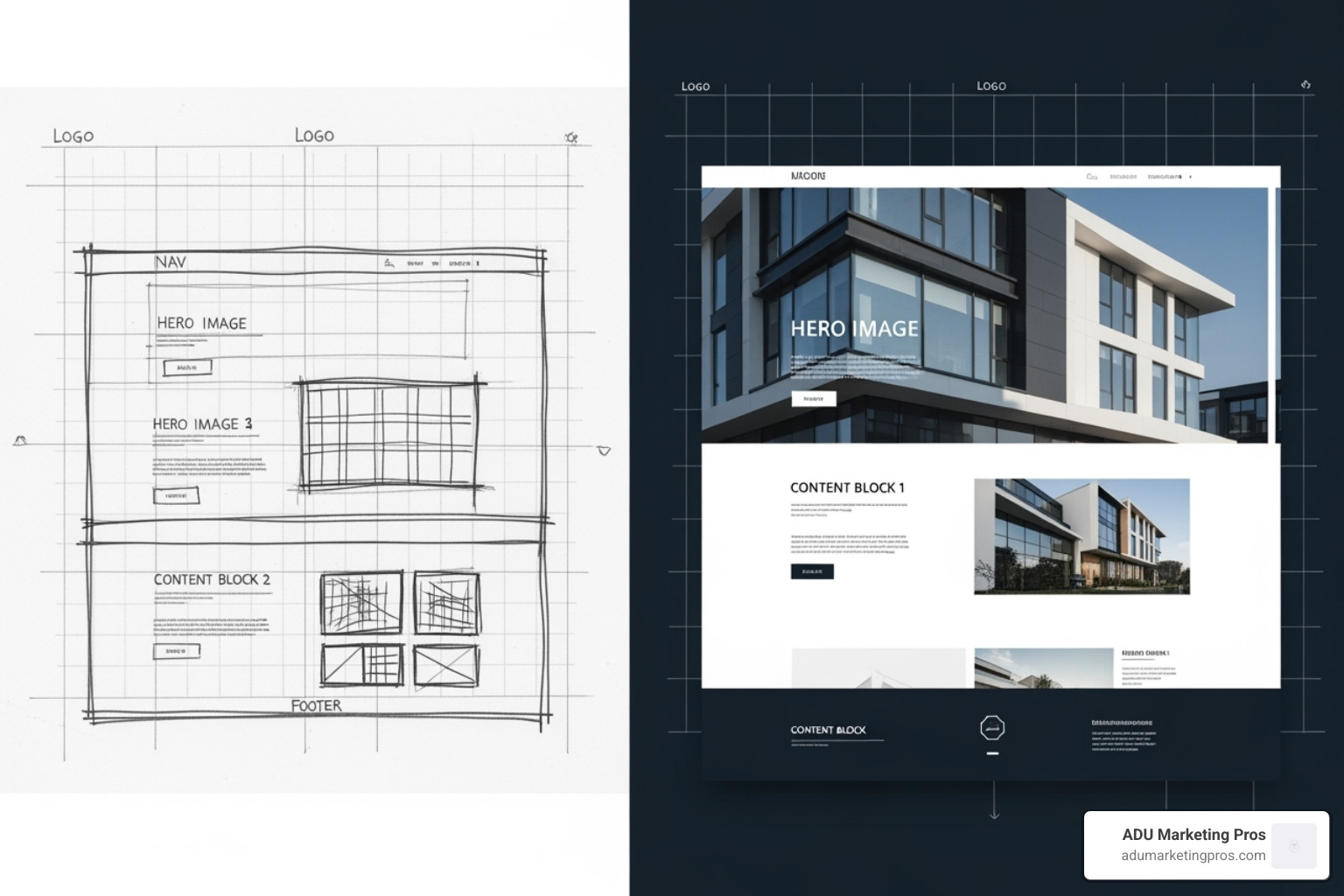
With a clear strategy in place, we move to the architectural blueprint of the website. We begin by developing a sitemap and user flows to establish the site’s structure (information architecture) and map out the ideal user journey. Next, we create wireframes—low-fidelity schematic layouts—to define the placement of content and functional elements on each key page, focusing purely on usability and conversion pathways. Once the wireframes are approved, our UI designers craft a custom visual design that brings your brand to life. This is where we translate your architectural style and brand personality into a unique, compelling, and modern digital interface.
Phase 3: Development and Content Integration
In the development phase, our expert developers transform the approved designs into a fully functional, responsive, and high-performance website. We build on a flexible and scalable Content Management System (CMS), typically WordPress, which allows your team to easily manage content in the future. We write clean, efficient code and rigorously optimize for fast loading speeds and technical SEO. During this phase, we also work with you to integrate all the content—from compelling project case studies and high-resolution imagery to team bios and service descriptions—ensuring it’s perfectly formatted and optimized for search engines.
Phase 4: Testing, Launch, and Ongoing Support
Before the website goes live, it undergoes a meticulous quality assurance and testing process. We test across a wide range of browsers, devices, and screen sizes to ensure a flawless user experience for everyone. We check every link, form, and interactive element. After a seamless website launch, our partnership continues. We provide comprehensive training on how to use your new website and offer post-launch support and maintenance plans to handle security, updates, and performance monitoring, ensuring your investment remains a powerful and effective lead-generation tool for years to come. Learn how this process translates into tangible results in our guide on lead generation for architects.
Conclusion: Your Digital Foundation for Future Growth
In the sophisticated and demanding world of architecture, a professional website is no longer a passive digital business card; it is the active, essential cornerstone of your firm’s brand and business development strategy. It serves as your round-the-clock ambassador, working tirelessly to articulate your unique design philosophy, build profound trust with discerning clients, and consistently attract the high-value, creatively fulfilling projects that define a successful practice.
The decision between a DIY approach and hiring a specialized partner is not merely a question of budget—it is a strategic calculation of value. It’s about recognizing what your time, focus, and expertise are truly worth. Every hour you spend wrestling with a generic template, troubleshooting a broken plugin, or attempting to decipher the complexities of SEO is an hour you are not spending on your craft: designing exceptional spaces.
At ADU Marketing Pros, we specialize in creating digital marketing solutions for architecture and ADU construction firms because we possess a deep and genuine understanding of your industry. We know this is a booming sector filled with unique challenges and extraordinary opportunities. From navigating the intricacies of local zoning regulations to capturing the imagination of homeowners, firms like yours require a partner who not only speaks your language but also understands how to translate your architectural vision into digital success.
Your website must be as thoughtfully designed, carefully crafted, and functionally neat as the buildings you create. It should be a direct reflection of your commitment to excellence. Most importantly, it must work as hard as you do to secure your firm’s future.
Are you ready to build a digital foundation as strong as your architectural ones? Start crafting your firm’s digital future with expert architect website design and find how the right online presence can transform your practice.