
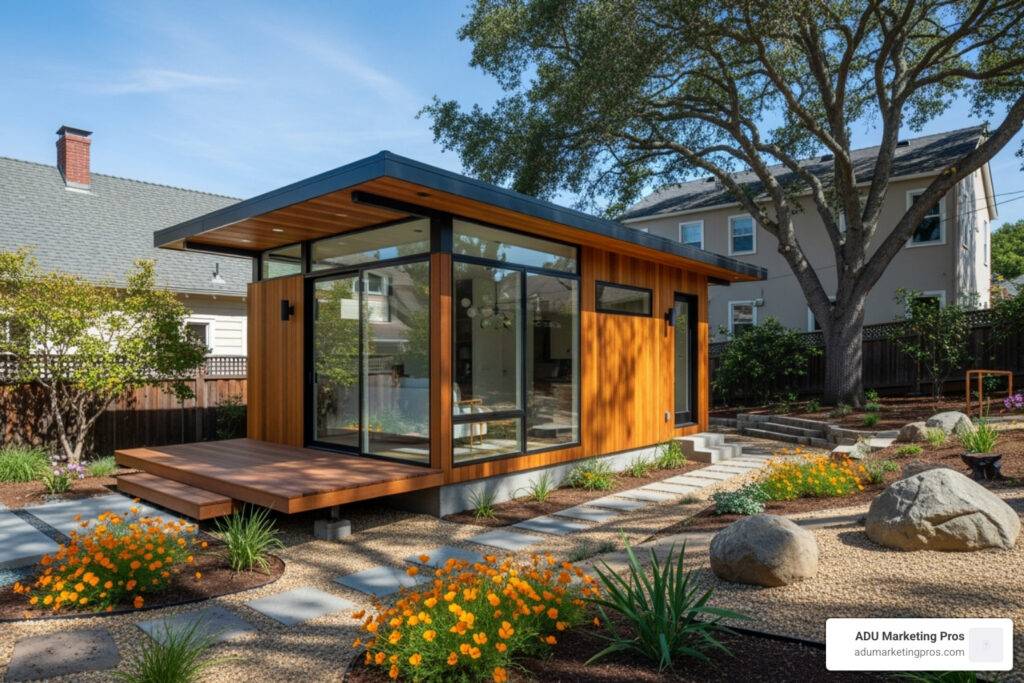
The Big Picture: Understanding Bay Area Prefab ADU Costs
For homeowners navigating the complex housing market, the prefab adu bay area cost for a complete, turnkey project typically ranges from $190,000 to over $500,000. This all-encompassing figure is influenced by the unit’s size, the quality of finishes selected, and the specific conditions of your property. In the heart of the Bay Area’s persistent housing crisis, prefab Accessory Dwelling Units (ADUs) have emerged as a powerful and popular solution for adding space. This trend is undeniable, with ADU permits accounting for a staggering 21% of all building permits issued in California in 2023, a testament to their growing role in the state’s housing strategy.
Beyond simply adding living space, an ADU is a significant financial asset. In the Bay Area, adding an ADU can increase a property’s value by an estimated 20-30%. For a median-priced home, this translates to an immediate equity gain of $200,000 to $500,000. Furthermore, the potential for rental income is substantial, with studios generating $2,000-$2,500 monthly and larger two-bedroom units fetching over $3,000, providing a steady cash flow that can offset mortgage payments or build wealth.
Quick Cost Overview (All-In Averages with Common Upgrades):
- Studio (340 sq ft): $265,500
- 1-bedroom (500 sq ft): $310,200
- 2-bedroom (610 sq ft): $352,500
- Large 2-bedroom (800 sq ft): $447,800
It is absolutely critical for prospective buyers to distinguish between a manufacturer’s “base price” and the total “all-in” project cost. The advertised base price almost exclusively covers the factory-built unit itself, often with standard-grade finishes. Your true total investment must account for a host of other essential expenses. These include site preparation (grading, excavation), foundation work, utility connections (water, sewer, electrical), city permits and fees, delivery, and installation. These site-specific costs frequently add $40,000-$60,000 to the budget, and on complex sites, can easily exceed $100,000.
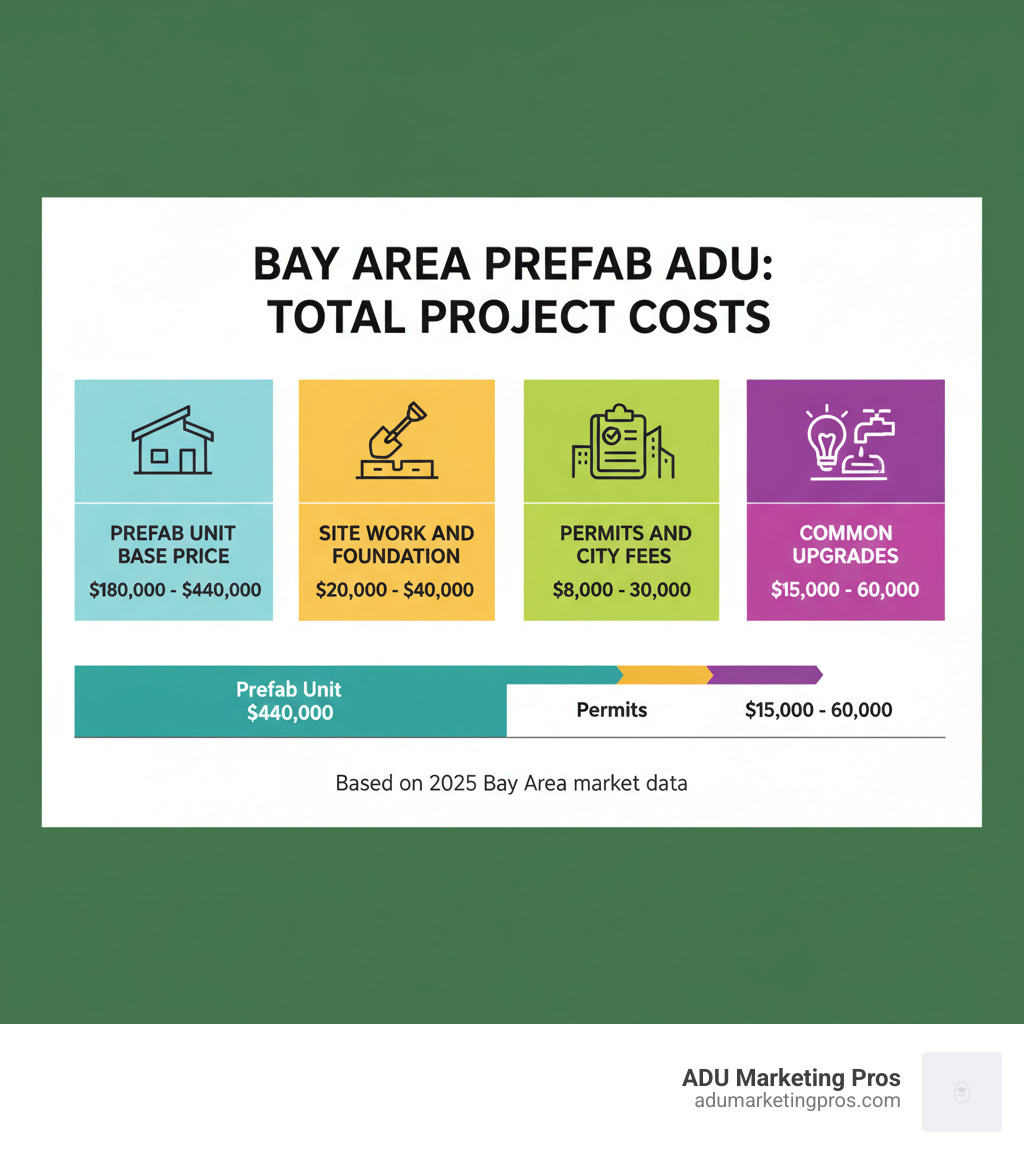
Average Prefab ADU Costs by Size
Size is the most significant driver of your prefab adu bay area cost. As square footage increases, so do the costs for materials, labor, and, in some cases, city fees. Here’s a more detailed look at what to expect for all-in price ranges:
- Studio Prefab ADUs (approx. 350 sq ft): These compact yet efficient units are perfect for a single occupant, a dedicated home office, or a guest suite. Total project costs typically range from $190,000 to $304,000. The final cost depends on site complexity and the level of interior finishes.
- 1-Bedroom Prefab ADUs (320-600 sq ft): Offering more privacy and space for a couple or a single renter, these are one of the most popular ADU sizes. Expect the all-in cost to fall between $219,000 and $320,000. This size often benefits from waived city impact fees, making it a cost-effective choice.
- 2-Bedroom Prefab ADUs (567-1,000 sq ft): Designed for small families, roommates, or as a high-income rental unit, these larger ADUs offer significant living space. Prices for these projects can range from $290,000 to over $440,000, with the upper end reflecting larger square footage, premium finishes, and more complex site work.
What’s Included in a “Base Price” vs. an “All-In” Cost?
This distinction is the most common point of confusion and budget failure for homeowners. Understanding it is crucial for accurately planning your prefab adu bay area cost. A “base price” is a marketing number that typically includes only the factory-built structure with standard finishes and basic delivery to the curb. The comprehensive “all-in” cost, which reflects the true total investment, adds a long list of necessary expenses:
- Site Work: Grading your yard for proper drainage, excavating for the foundation and utility trenches.
- Foundation: The concrete slab or alternative system (like a raised perimeter or helical piles) that the unit is secured to.
- Utility Hook-ups: Trenching and connecting water, sewer/septic, electrical, and gas lines from the main house or street to the ADU. This often includes a main electrical panel upgrade.
- Permits and City Fees: A significant variable, these can include plan check fees, building permits, and school or park impact fees, often averaging $17,000 or more.
- Crane Fees: Essential for properties with limited backyard access, costing anywhere from $5,000 to $15,000+ for the day.
- Specialized Engineering: Required for properties on hillsides, in liquefaction zones, or with poor soil conditions. This can include reports from geotechnical and structural engineers.
- Demolition/Tree Removal: Clearing the build site of old structures, concrete patios, or large trees.
- Sales Tax and Upgrades: Sales tax on the manufactured unit and the cost of any upgrades beyond the standard package (e.g., premium appliances, custom tile, solar panels).
To avoid any surprises, always insist on a detailed, itemized quote from any potential builder that clearly separates the unit cost from all other site and soft costs.
Deconstructing the Budget: A Line-by-Line Prefab ADU Bay Area Cost Breakdown
To prevent budget shock and ensure a smooth project, it’s essential to understand where every dollar goes. Your total prefab adu bay area cost is divided into two main categories: hard costs (the physical building and site materials) and soft costs (the services, permits, and fees required to design and approve the project). For any Bay Area homeowner embarking on this journey, the most crucial piece of advice is to establish a contingency fund of 10-20% of your total estimated budget. On a $300,000 project, this means setting aside $30,000 to $60,000. This fund isn’t for upgrades; it’s a safety net for unexpected but common issues like discovering rocky soil that requires extra excavation, or a city inspector mandating an unforeseen electrical upgrade.
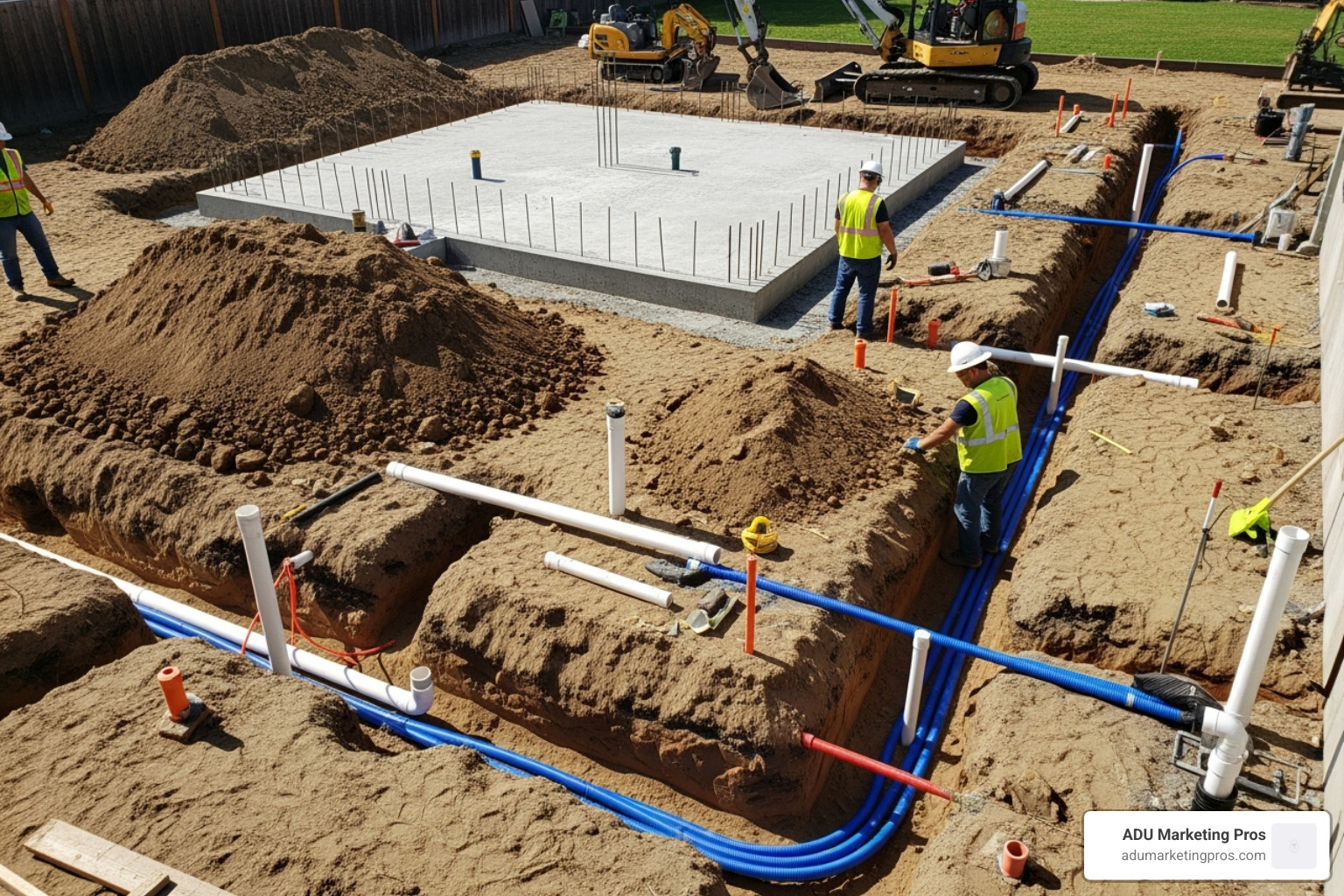
Hard Costs: The Unit, Foundation, and Site Work
Hard costs represent the tangible, physical components of your ADU project. These are typically the largest expenses and form the bulk of your budget.
- Prefab Module: This is your single largest line item. The factory cost of the unit itself (before any site work or fees) can start around $182,400 for a compact 320 sq ft studio and climb to $367,800 or more for a spacious 640 sq ft two-bedroom model. The price is driven by size, complexity of design, and the level of interior and exterior finishes.
- Foundation: A standard concrete slab-on-grade foundation typically costs $20-$40 per square foot in the Bay Area. For a 600 sq ft ADU, this translates to $12,000-$24,000. This cost can increase significantly if soil conditions are poor or if a more complex foundation, like a raised perimeter with a crawl space or a system of helical piles for unstable soil, is required.
- Site Preparation: This involves preparing the land for construction. Basic grading and excavation on a flat lot can range from $2,000-$6,000. However, properties on a slope or with difficult soil can see these costs double or triple, especially if retaining walls are needed to create a level building pad.
- Utility Connections: Bringing power, water, and sewer to your ADU is a major cost. Electrical hookups, including trenching and connection, can run $3,000-$5,000, but this can easily jump to $10,000+ if your home’s main electrical panel needs an upgrade to handle the additional load. Plumbing for water and sewer lines costs around $2,000-$4,000, assuming standard connection distances. HVAC systems (like a ductless mini-split) add about $6,000. Many cities also mandate solar panels, which adds another $2,500-$3,500 to the budget.
- Installation and Crane Rental: The process of getting the module from the street to the foundation is a significant cost. The combined expense for delivery, crane rental (if needed), setting the unit, and weatherproofing the seams (stitching) typically ranges from $40,000-$60,000 for full-service prefab companies.
- Landscaping: While sometimes overlooked, budgeting for landscaping is key to integrating the ADU with your property. Basic landscaping, including irrigation, sod or mulch, and simple plantings, costs around $5-$15 per square foot. Decks, patios, and walkways will be additional costs.
Soft Costs: Permits, Fees, and Design
Soft costs are the essential but less visible expenses required to get your project designed, approved, and legally compliant.
- Permitting Fees: These vary dramatically by city and are a major wild card in the prefab adu bay area cost. The regional average is around $17,000, but the range is vast. For example, San Jose charges over $17,000 in permit and impact fees for larger ADUs. In contrast, Redwood City’s fees are tiered by size, ranging from $2,973 to $3,966, and San Mateo has a flat building permit fee of around $2,671. Money-saving tip: State law requires cities to waive impact fees (fees for parks, traffic, etc.) for ADUs under 750 sq ft, which can save you over $10,000 in some municipalities.
- Plan Review and Inspection Fees: Beyond the permit itself, cities charge for their time. San Jose, for instance, charges hourly rates for plan review ($308/hr) and inspections ($315/hr). Submitting a complete, accurate, and well-organized set of plans is crucial to minimize these costs and avoid delays.
- Architectural and Engineering Design: While prefab companies include standard plans, any customization requires architectural work. If you hire an independent architect for a custom design, fees can range from $5,000 to $40,000+. More commonly, you will need engineering fees for site-specific plans (foundation design, structural calculations, grading plans), which typically cost $3,000-$8,000.
- Technical Reports: These are mandatory reports to ensure your ADU is safe and compliant. A soil report from a geotechnical engineer ($2,000-$4,000) is often the first step. A Title 24 energy calculation report ($500-$1,000) is required to prove compliance with California’s energy standards. On sloped lots, a topographical survey may also be needed.
Prefab vs. Traditional Construction: Bay Area Cost and Timeline Comparison
One of the first major decisions a homeowner faces is choosing between prefab and traditional stick-built construction. While the total all-in project costs can end up being surprisingly similar, prefab construction offers two transformative advantages: superior budget predictability and a dramatically accelerated timeline.
For a complete project, traditional custom-built ADUs in the Bay Area typically range from $200,000 to $550,000+, while all-in prefab ADU projects fall between $190,000 and $500,000+. The key difference isn’t the final price tag, but how you get there. The primary advantage of prefab lies in its controlled factory environment. This manufacturing process minimizes the unforeseen issues—weather delays, material shortages, subcontractor scheduling conflicts—that commonly inflate traditional construction budgets and timelines. Another critical distinction is the level of on-site disruption. A traditional build transforms your backyard into a noisy, dusty construction zone for many months. In contrast, a prefab installation is a surgical process, with the majority of the disruption condensed into just a few days or weeks.
| Comparison Factor | Prefab ADUs | Traditional ADUs |
|---|---|---|
| Estimated Total Cost Range | $190,000 – $500,000+ | $200,000 – $550,000+ |
| Cost Predictability | High (Fixed unit cost) | Low (Prone to overruns) |
| Total Project Timeline | 4-6 months | 9-18 months |
| On-Site Construction Time | 2-4 weeks | 4-8 months |
| On-Site Disruption | Minimal (days/weeks) | Extensive (months) |
| Design Customization | Limited to pre-designed models/finishes | Fully customizable |
| Quality Control | High (Factory-controlled environment) | Variable (Depends on contractor/subs) |
The Speed Advantage: How Prefab Saves You Time
In a market where time is money, the accelerated timeline of prefab construction is a significant financial benefit. The efficiency comes from simultaneous construction. While your ADU unit is being precisely built in a climate-controlled factory, your local contractor is simultaneously preparing the site. This parallel process—foundation being poured, utilities being trenched—slashes the total project timeline in half compared to the linear sequence of a traditional build. Factory construction is immune to rain, wind, or heat, eliminating costly weather delays. Furthermore, the inspection process is often streamlined. The unit itself is inspected in the factory under a state-level program, meaning local inspectors only need to approve the foundation and the final utility connections. The result is a remarkably fast on-site phase: installation, connection, and finishing often take just 2-4 weeks, compared to the 4-8 months of continuous on-site work required for a traditional build.
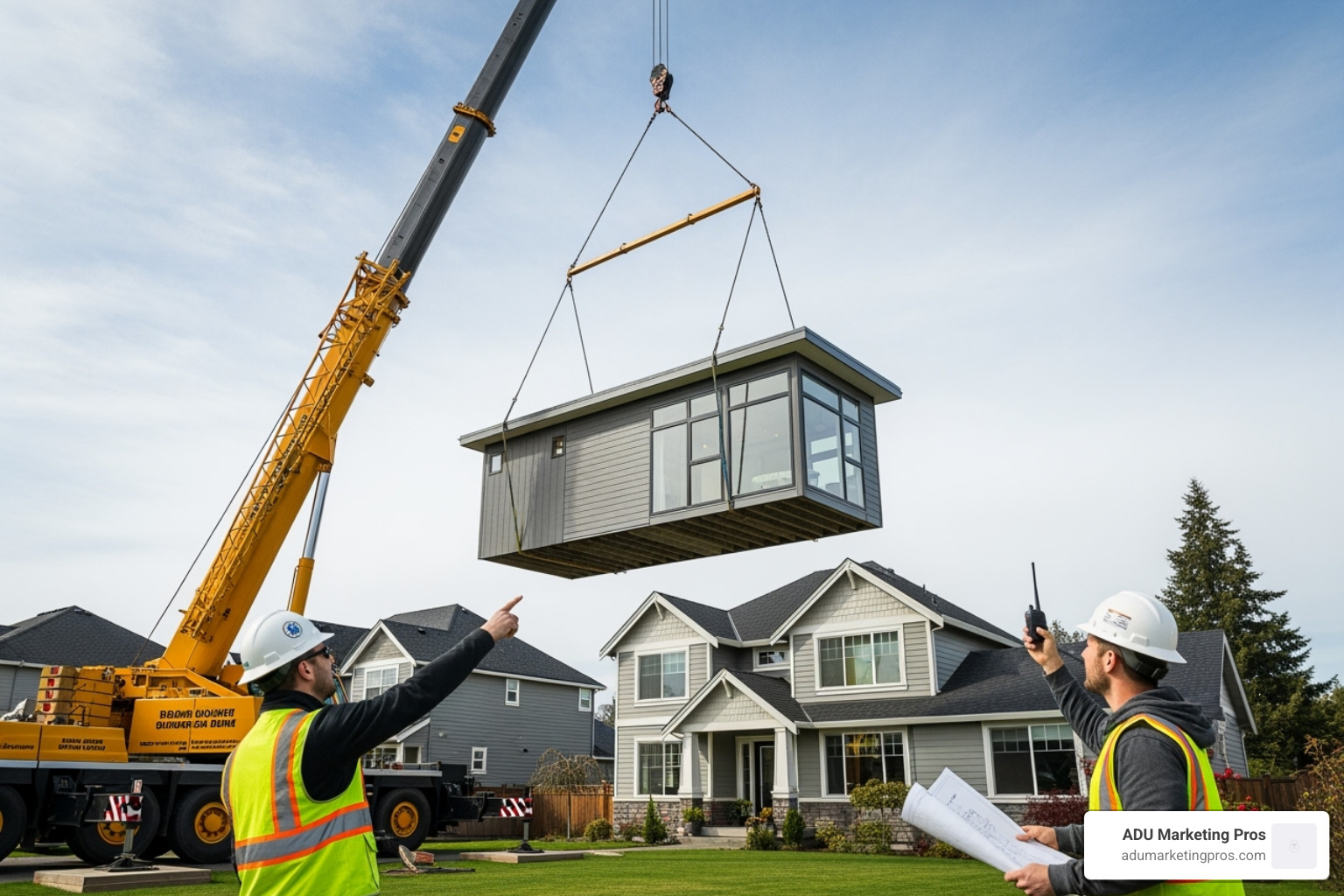
Analyzing the Financial Bottom Line
When comparing the prefab adu bay area cost to a traditional build, it’s crucial to look beyond the initial sticker price and consider the total value proposition. Prefab’s financial strength is rooted in factory efficiency. Manufacturers leverage bulk purchasing of materials at discounted rates and use assembly-line techniques that reduce labor hours and minimize material waste. While prefab projects have unique costs, such as transportation and crane rental (a significant line item that can range from $5,000 to $15,000 or more), its greatest financial advantage is cost predictability. Traditional construction is notoriously prone to budget overruns, often cited at 20-30% above the initial estimate. With prefab, the cost of the unit itself is fixed the day you sign the contract, dramatically reducing your financial risk. The only variables are the site-specific costs, which are easier to manage. Moreover, the rigorous quality control of a factory setting—precise jigs, consistent conditions, and multi-stage inspections—results in a higher quality build with better energy efficiency and fewer expensive repairs or callbacks down the road.
Key Factors That Influence Your Final Price Tag
No two ADU projects are ever identical, even if the units themselves are. Your final prefab adu bay area cost is ultimately determined by a unique combination of your property’s physical characteristics and the specific rules and fees of your local city. A deep understanding of these variables is the key to creating an accurate budget and navigating the process without costly surprises.
How Site Conditions Affect Your Prefab ADU Bay Area Cost
Your backyard is the biggest variable in the entire project. A seemingly simple installation can become complex and expensive due to site-specific challenges that are often hidden until a thorough site assessment is performed.
- Accessibility: This is the first and most critical question. Can a large delivery truck access your backyard to place the unit? If the answer is no due to a narrow driveway, overhead power lines, or large trees, a crane will be required. For example, imagine your property is at the end of a long, narrow driveway. This necessitates renting a 100-ton crane for a full day at a cost of $8,000-$12,000 to lift the modules over your main house into the backyard.
- Slopes and Topography: A flat lot is straightforward. However, many Bay Area properties are on hills. Even a gentle slope can increase excavation and foundation costs by 10-20%. A steeper lot with a 15-degree slope might require a complex stepped foundation and engineered retaining walls, potentially adding $20,000-$40,000 to the site work budget.
- Soil Conditions: What lies beneath the surface matters immensely. Rocky soil is harder and more expensive to excavate. Expansive clay soil or uncompacted fill requires a more robust, specially engineered foundation to prevent shifting, which can add significant cost compared to a standard slab.
- Utilities and Demolition: The distance from your ADU to the main house’s utility connection points directly impacts cost. Trenching for water, sewer, and electrical lines can cost $60-$120 per linear foot. If your ADU is 100 feet from the main connections, that’s an extra $6,000-$12,000 in trenching costs alone. Additionally, the cost of demolishing and hauling away an old shed, concrete patio, or removing large trees must be factored into the site prep budget.
How City Regulations Affect Your Prefab ADU Bay Area Cost
In the Bay Area, your prefab adu bay area cost can fluctuate dramatically from one city to the next. Each of the 101 municipalities has its own unique set of rules, interpretations, and fee schedules that can significantly impact your budget.
- Permit and Impact Fees: This is a major variable. As mentioned, San Jose can charge over $17,000 for permits and fees on a larger ADU. Meanwhile, Redwood City uses a tiered system ($2,973-$3,966), and San Mateo has flat fees around $2,671. Many Bay Area cities waive development impact fees for ADUs under 750 square feet, a state-mandated incentive that can save you $10,000-$20,000. However, if your ADU is 751 square feet, you may be subject to the full fee.
- Local Requirements: Cities often have their own specific mandates. For example, many cities now require solar panel installations on all new construction, including ADUs, adding $2,500-$3,500. Cities in high-risk fire zones (Wildland-Urban Interface areas) like the Oakland Hills or parts of Marin may require expensive upgrades like Class A fire-rated siding, exterior sprinkler systems, and special venting, which can add thousands to the cost. Some cities also have strict setback, height, or parking rules that can influence the ADU’s size and placement.
For the most current statewide rules that provide the framework for local ordinances, it is essential to consult the California Department of Housing & Community Development – ADU Regulations. A thorough understanding of both state and local requirements is crucial for accurate budgeting and a successful project.
Financing Your ADU and Calculating the ROI
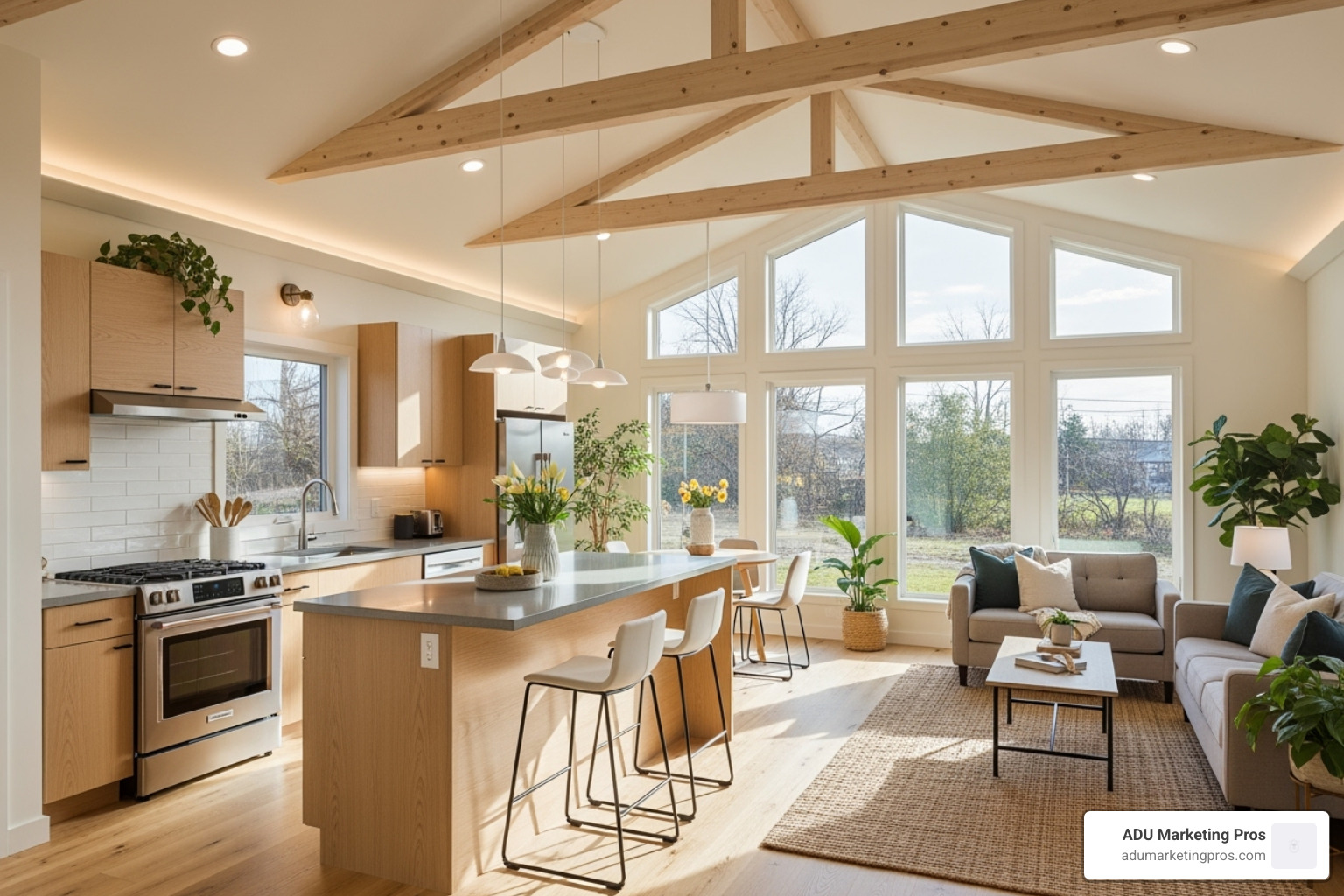
Building a prefab ADU in the Bay Area is one of the smartest financial decisions a homeowner can make. It’s crucial to view this not as a simple expense, but as a strategic investment in a high-performing asset. This asset not only generates significant long-term income but also adds immediate, substantial value to your property, making the initial prefab adu bay area cost a calculated move towards financial growth.
Common ADU Financing Options
Funding a $200,000 to $500,000 project doesn’t require having all the cash on hand. Several excellent financing options are available to help you fund your ADU.
- Home Equity Line of Credit (HELOC): This is a popular choice that functions like a credit card, allowing you to draw funds as needed up to a certain limit based on your home’s equity. Pros: You only pay interest on what you use, making it flexible for construction. Cons: Interest rates are typically variable and can rise over time.
- Home Equity Loan: This provides a lump-sum payment with a fixed interest rate and predictable monthly payments. Pros: Stability and fixed payments make budgeting easy. Cons: You start paying interest on the full loan amount immediately, even if you haven’t spent it all.
- Cash-Out Refinancing: This involves replacing your current mortgage with a new, larger one, and taking the difference in cash to fund the ADU. Pros: Can result in a lower overall interest rate and a single monthly payment. Cons: You are resetting your mortgage term, and closing costs can be significant.
- Construction Loans: These short-term loans are specifically for building projects. The lender releases funds in stages (draws) as construction milestones are met. Pros: Tailored for construction. Cons: Can be more complex to manage, with higher interest rates and more paperwork than other options.
- Grants and Incentives: Always investigate government programs. The California Housing Finance Agency (CalHFA) offers a grant of up to $40,000 to reimburse pre-development and non-recurring closing costs for low- to moderate-income homeowners. Check your eligibility at the CalHFA ADU Grant Program page. Some cities, like East Palo Alto, have also offered local low-interest loan programs.
For more details on how lenders are adapting to the ADU boom, review the guidelines from Fannie Mae’s Accessory Dwelling Units resource.
The Long-Term Value: Rental Income and Property Appreciation
This is where the ADU transforms from a cost into a powerful investment engine. The Bay Area’s robust rental market provides a reliable and substantial income stream.
- Rental Income: A studio or one-bedroom ADU in a desirable location can generate $2,000-$2,500 per month, while a two-bedroom unit can easily command $3,000 or more. This income can often cover the monthly loan payment for the ADU and then some.
- Property Value Increase: On average, adding an ADU boosts a property’s value by 20-30% in the Bay Area. On a $1.5 million home, that’s an immediate equity increase of $300,000-$450,000, often exceeding the entire cost of the project.
- Return on Investment (ROI) Example:
- Total Project Cost: $350,000
- Annual Gross Rental Income: $2,800/month x 12 = $33,600
- Annual Expenses (Est. 15% for taxes, insurance, maintenance): -$5,040
- Net Annual Income: $28,560
- Annual Cash-on-Cash ROI: $28,560 / $350,000 = 8.2%
This 8.2% annual return is a strong performance for any investment, and it doesn’t even account for the massive upfront equity gain. Beyond the numbers, an ADU provides priceless flexibility. It can house aging parents (saving an average of $6,000-$10,000 per month compared to assisted living costs), give adult children a head start, or serve as a private home office. In the unique Bay Area market, an ADU is an unparalleled investment that delivers both powerful financial returns and invaluable lifestyle benefits.
Frequently Asked Questions about Prefab ADU Costs in the Bay Area
Is it cheaper to build a prefab or traditional ADU in the Bay Area?
While the final all-in project costs can be very similar, prefab ADUs generally offer superior financial value due to cost predictability and a significantly faster construction timeline. The factory-controlled process reduces labor costs through efficiency and minimizes material waste. While you will have unique costs like transportation and crane fees ($5,000-$15,000+), you largely avoid the risk of 20-30% budget overruns common in traditional on-site construction. The single biggest advantage of prefab is that the cost of your unit is a fixed, known number from the start, removing the largest source of financial uncertainty from your project. This makes managing your total prefab adu bay area cost much more reliable.
What are the biggest hidden costs to watch out for?
The most common and costly surprise expenses often arise from site conditions and utility requirements. Homeowners should be prepared for:
- Electrical Panel Upgrades: Many older homes lack the electrical capacity to power a new ADU. Upgrading your main service panel is a common requirement and can cost anywhere from $4,000 to $12,000.
- Difficult Soil or Site Conditions: Discovering expansive clay soil or a high water table during excavation can necessitate a more expensive, specially engineered foundation, adding $10,000 or more to your budget.
- Extensive Utility Trenching: The farther your ADU is from the main house’s utility connections, the more expensive it is to run new lines. Trenching costs can add up quickly, especially if it involves cutting through concrete or asphalt.
- Sewer Connection Fees: If your project requires a new sewer connection to the street rather than tying into the existing house line, cities can charge significant capacity and connection fees, sometimes exceeding $10,000.
- Permit Fee Variations & “Customization Creep”: Fees can change, and what you were quoted six months ago may not be the final number. Also, small upgrades in finishes, appliances, and fixtures can quickly add $20,000-$40,000 to your final bill if not carefully managed.
This is precisely why budgeting a 10-20% contingency fund is not optional; it is an essential component of responsible project planning.
How much does a 500 sq ft prefab ADU cost in the Bay Area?
A 500 sq ft prefab ADU, which is typically a well-laid-out one-bedroom unit, has a total all-in project cost ranging from $219,000 to $320,000 in the Bay Area. An average turnkey cost for a unit of this size with common upgrades is approximately $310,200. The final price within this range is determined by three main factors: the level of finishes you choose (e.g., standard vs. luxury appliances and flooring), the complexity of your site work (a flat, accessible lot will be on the lower end), and your specific city’s permit and fee schedule. A key advantage of this size is that, at under 750 sq ft, it qualifies for mandatory impact fee waivers in all California cities, which helps control your total prefab adu bay area cost.
How does building an ADU affect my property taxes?
This is a common concern, but the impact is less than most people fear. Thanks to Proposition 13, your existing home’s assessed value is not re-evaluated. Instead, your property tax bill will be adjusted using a “blended assessment.” The county assessor will determine the value of the newly constructed ADU and add that value to your existing assessment. For example, if your home is assessed at $400,000 and you build an ADU that adds $300,000 in value, your new total assessed value will be $700,000. Your property taxes will only increase based on that $300,000 addition, not on the current market value of your entire property.
Your Next Steps in Building a Bay Area ADU
Embarking on a prefab ADU project in the Bay Area is a strategic investment that enhances your property, provides valuable space, and secures your financial future. With the potential to generate $2,000-$3,000+ in monthly rent and boost your property value by 20-30%, the initial prefab adu bay area cost is often rapidly offset by substantial and lasting returns.
The inherent speed, quality control, and cost predictability of prefab construction make it an exceptionally smart choice in the Bay Area’s dynamic and expensive market. However, a successful outcome hinges on diligent preparation and research. Every property is unique and every city has its own rules. To ensure a smooth process, it is vital to get detailed, all-in quotes from reputable companies and, most importantly, maintain a 10-20% contingency fund for unforeseen site costs.
To move forward with confidence, follow this step-by-step guide:
- Define Your Goals: First, clarify the primary purpose of your ADU. Is it for rental income, housing a family member, or a home office? Your answer will dictate the ideal size, layout, and level of finishes.
- Conduct Initial Research: Visit your local city’s planning department website. Look for their specific ADU ordinance or informational handouts. Many cities have online tools to help you determine if your property is eligible and what size ADU you can build.
- Establish Your Budget and Financing: Before you get too far, understand your financial capacity. Speak with a mortgage broker or your bank to get pre-qualified for a home equity loan, HELOC, or construction loan. This will establish your all-in budget.
- Vet Potential Partners: Research full-service prefab companies that operate in the Bay Area. Do not focus on the advertised “base price.” Instead, request detailed “all-in” proposals that itemize every expected cost, from permits to crane fees. Ask for references and, if possible, visit a completed project.
- Commission a Feasibility Study: Once you’ve selected a promising partner, the first real step is to pay for a feasibility study. This involves a detailed site inspection to uncover any potential challenges (access, slope, utilities) and allows the company to provide a much more accurate, site-specific budget.
Begin your due diligence today by reviewing the official California ADU regulations and guidelines. The ADU boom is not slowing down. Whether for family, finance, or flexibility, a well-planned prefab ADU delivers exceptional value. Your next step is to take this knowledge, define your goals, and connect with qualified professionals who can guide you through the process with transparency and expertise.