

Understanding Tiny Home Regulations in California: Your Starting Point
Tiny home regulations California can feel like navigating a maze without a map. The Golden State offers incredible opportunities for tiny living—from coastal communities to mountain retreats—but the legal landscape is surprisingly complex. Whether you’re dreaming of a minimalist lifestyle, seeking affordable housing solutions, or exploring ways to address California’s housing crisis, understanding the rules is your critical first step.
Here’s what you need to know right away:
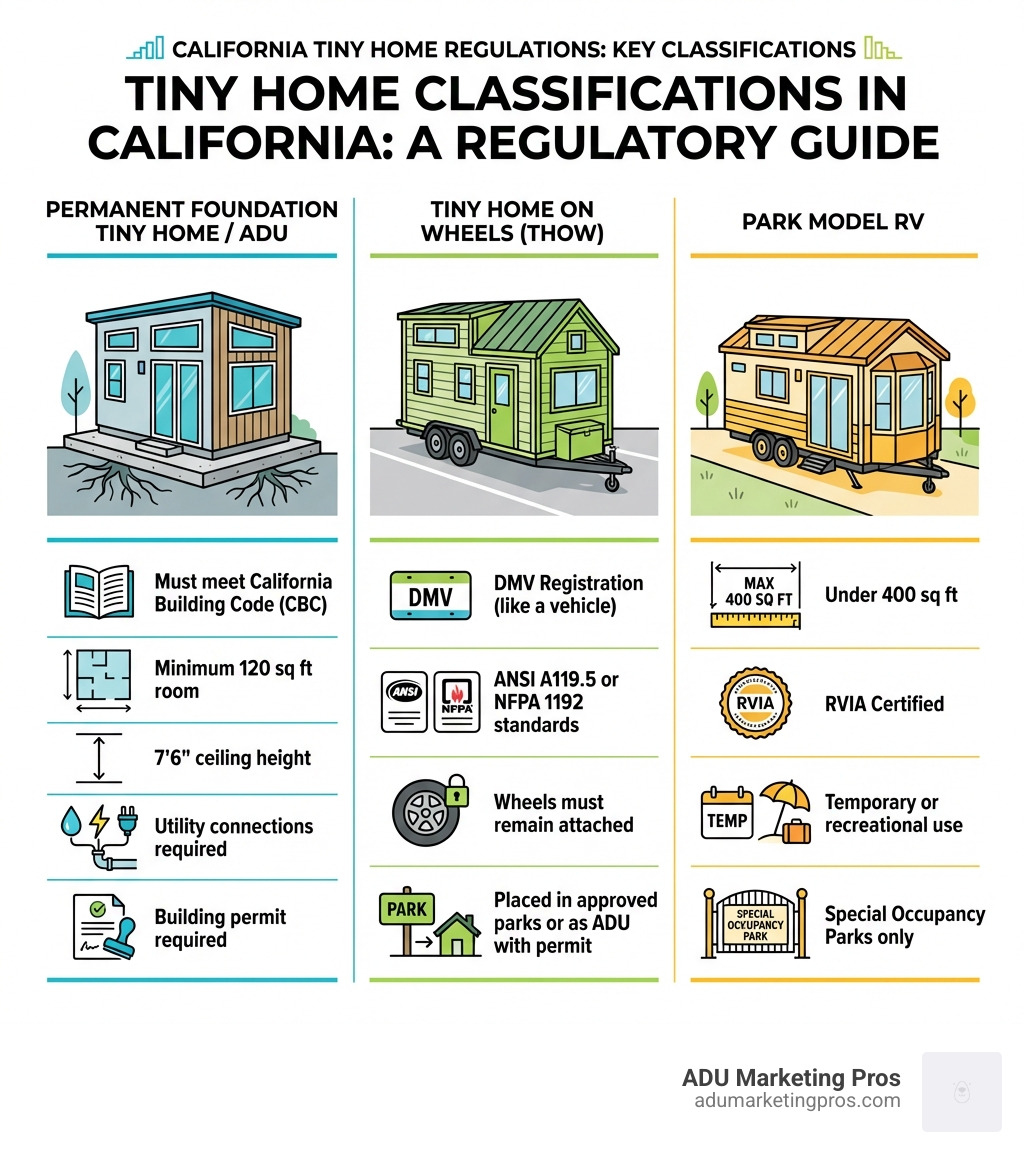
- Classification matters most: Your tiny home falls into one of three categories—permanent foundation dwelling (often an ADU), Tiny Home on Wheels (THOW), or Park Model RV. Each has completely different rules.
- State codes set minimums: California Building Code requires habitable rooms to have 7’6″ ceilings and at least one room with 120 sq ft (other rooms need 70 sq ft minimum).
- Local rules trump state law: Cities and counties can impose stricter requirements. What’s legal in Fresno might be prohibited in San Francisco.
- Permits are non-negotiable: Whether on a foundation or wheels, you’ll need proper approvals. Skipping permits leads to fines, removal orders, or inability to legally occupy your home.
- Tiny homes ≠ always legal: There’s no specific “tiny home” designation in California law. Your structure must fit an existing legal category (RV, manufactured home, factory-built housing, or site-built dwelling) to be occupied legally.
The confusion is understandable. As the California Department of Housing and Community Development notes in their official bulletins, there is no single statutory definition for “tiny homes” in California. The term describes structures ranging from 80 to 400 square feet, built with varying standards, sometimes on wheels, sometimes not. This lack of a unified definition means your tiny home must conform to existing building codes and housing classifications—and those vary dramatically by location.
California’s approach reflects a tension between innovation and safety. The state wants to encourage affordable housing solutions while ensuring structures meet basic habitability standards. Recent changes, like the 2025 adoption of Appendix BB to the California Residential Code, show progress toward tiny-home-friendly regulations. But local governments still wield significant power, and what’s allowed in one county may be completely prohibited in the next.
This guide will decode the regulatory landscape, helping you understand what’s required for legal tiny home living in California. We’ll cover definitions, building codes, permitting processes, county-by-county variations, and the critical financial and legal considerations you can’t afford to overlook.
Find more about tiny home regulations California:
What is a “Tiny Home” in California? Key Definitions and Classifications
The first step in understanding tiny home regulations California is to grasp what we’re actually talking about. The term “tiny home” is more of a cultural phenomenon than a strict legal definition. In California, for a small dwelling to be legal for occupancy, it must fit into one of the state’s existing housing classifications. This distinction is crucial, as it dictates everything from building standards to where you can place your home.
Generally, a tiny home in California is considered a dwelling that is 400 square feet or less in floor area, excluding lofts. This definition is often found in code appendices like Appendix Q of the International Residential Code (IRC) and the forthcoming Appendix BB of the California Residential Code. However, the lack of a specific “tiny home” classification means these structures are regulated based on their construction method and whether they are permanently affixed to the ground or remain mobile.
Tiny Homes on a Permanent Foundation
A tiny home built on a permanent foundation is treated much like any other traditional house, albeit a smaller one. These are typically site-built or factory-built units that are permanently attached to a foundation and connected to utilities.
As a permanent dwelling, it must comply with the full spectrum of California Building Codes (CBC) and California Residential Codes (CRC) applicable to residential structures. This means meeting stringent requirements for structural integrity, fire safety, plumbing, electrical systems, and energy efficiency. Foundation requirements are a key component, ensuring the structure is stable and secure for long-term habitation. These types of tiny homes are often classified as Accessory Dwelling Units (ADUs) or Junior Accessory Dwelling Units (JADUs) when placed on a property with an existing primary residence.
For a deeper dive into how these structures compare to other small dwellings, explore our guide on ADU vs Tiny House. Understanding the specific construction standards is vital; you can learn more about these in our article on ADU Building Requirements.
Tiny Homes on Wheels (THOWs)
Tiny Homes on Wheels, or THOWs, present a different set of regulatory challenges and opportunities. Because they are mobile, they are often classified as Recreational Vehicles (RVs) or Movable Tiny Houses (MTHs). This classification means they are typically subject to different standards than permanent structures.
To be considered a legal THOW in California, your home must generally be licensed and registered with the California Department of Motor Vehicles (DMV), much like any other vehicle. Furthermore, it must meet specific construction standards, such as the American National Standards Institute (ANSI) 119.5 requirements or the National Fire Protection Association (NFPA) 1192 standards, and be certified for compliance by a third-party inspection agency.
A critical distinction for THOWs is that their wheels and leveling/support jacks must remain on, and they need to sit on a concrete, paved, or compacted gravel surface sufficient to support their weight. If the wheels are removed and the structure is placed on a foundation, it is then re-defined as a Dwelling Unit or Accessory Dwelling Unit (ADU) and becomes subject to additional California Building Code requirements.
While some cities, like San Jose and Los Angeles, have adopted ordinances that allow THOWs to be used as ADUs under specific conditions, many areas still restrict their full-time occupancy to designated RV parks or special occupancy parks. For example, San Luis Obispo has clear guidelines for THOWs, emphasizing that they are not considered permanent dwellings unless converted. You can find more specific information on their approach at San Luis Obispo.

Differentiating Tiny Homes from ADUs and JADUs
The lines between “tiny homes,” ADUs, and JADUs can sometimes blur, but understanding their legal distinctions is key to navigating tiny home regulations California.
An Accessory Dwelling Unit (ADU) is a secondary housing unit on a property with a primary single-family home. JADUs are smaller ADUs (less than 500 square feet) that must be contained within the existing footprint of a single-family home. While many tiny homes built on foundations can function as ADUs, and some THOWs are now permitted as ADUs in progressive municipalities, the fundamental difference lies in their regulatory framework.
ADUs and JADUs are governed by comprehensive state laws designed to encourage their development to address California’s housing crisis. These laws often preempt stricter local zoning ordinances, making it easier to build ADUs. In contrast, “tiny homes” (especially THOWs) often fall into a regulatory gray area, requiring local jurisdictions to specifically adopt ordinances to permit them as permanent dwellings or ADUs.
The state’s progressive ADU laws, particularly those enacted in 2020 and further updated for 2023-2025, have significantly streamlined the process for homeowners. These legislative changes aim to reduce barriers such as parking requirements, impact fees, and minimum lot size requirements for ADUs. This has opened up new avenues for tiny homes built on foundations to be legally permitted as ADUs.
To fully grasp the nuances, we recommend reviewing our guides on California ADU Regulations and staying informed about New ADU Regulations California. This evolving legal landscape means that your tiny home dream might be best realized by ensuring it meets the criteria for an ADU or JADU.
Navigating the Labyrinth of Tiny Home Regulations California
The journey to building or placing a tiny home in California requires navigating a complex interplay of state and local rules. While state laws provide a foundational framework, local jurisdictions often add their own layers of requirements, making due diligence paramount.
The California Department of Housing and Community Development (HCD) plays a significant role in overseeing housing standards across the state. However, as we’ve seen, they primarily categorize tiny homes within existing classifications like RVs, manufactured homes, or site-built dwellings, rather than having a standalone “tiny home” category. This means you must check with your specific local planning department to understand how they interpret and apply state guidelines. This is not just a suggestion; it’s a non-negotiable step to avoid costly mistakes.
You can find more general information from the state at the California Department of Housing and Community Development (HCD) website.
Statewide Building Codes and Standards
At the state level, the California Building Standards Code (CBSC), which includes the California Building Code (CBC) and California Residential Code (CRC), sets the baseline for all residential construction. For tiny homes, these codes establish crucial minimums for habitability and safety.
Key requirements from the 2022 California Building Code often stipulate:
- A minimum ceiling height of 7 feet 6 inches in habitable spaces.
- At least one room with a minimum of 120 square feet of gross floor area.
- Other habitable rooms must have a net floor area of no less than 70 square feet.
However, recognizing the unique nature of tiny homes, California has made strides in adapting these codes. Appendix Q of the International Residential Code (IRC), adopted by many California jurisdictions, specifically addresses tiny houses (defined as 400 square feet or less, excluding lofts) and relaxes certain requirements, such as those for compact stairs, loft ceiling heights, and emergency escape openings.
Looking ahead, the 2025 California Residential Code will introduce Appendix BB, further refining these provisions. This amendment allows for even more flexibility, such as minimum ceiling heights of 6 feet 8 inches for habitable spaces and hallways, and 6 feet 4 inches for bathrooms, toilet rooms, and kitchens within tiny houses. This progressive adaptation of codes demonstrates California’s commitment to accommodating smaller dwellings while maintaining safety. You can explore the details of these specific provisions at Appendix Q Tiny Houses and the forthcoming Appendix BB.
The Role of Local Zoning Ordinances
While state building codes set minimum standards, local zoning ordinances often dictate where and how tiny homes can be placed. This is where the phrase “local rules trump state law” really comes into play. Cities and counties in our service areas—such as Los Angeles, San Diego, San Francisco Bay Area, San Jose, Sunnyvale, Palo Alto, Mountain View, and Menlo Park—will have specific zoning districts, setback requirements (how far your structure must be from property lines), lot coverage limits, and even parking requirements.
These local ordinances can be more restrictive than state-mandated building codes. For instance, a city might have a minimum square footage for a dwelling that exceeds the state’s functional minimums, or strict aesthetic guidelines that your tiny home must adhere to. The good news is that recent state ADU laws have significantly limited the ability of local jurisdictions to impose overly restrictive requirements on ADUs, including those that might be tiny homes on a permanent foundation.
Understanding these local nuances is paramount. We specialize in helping steer these complexities, ensuring your project complies with both state and local mandates. For comprehensive information on how zoning impacts your project, see our articles on ADU Zoning Laws and ADU Minimum Lot Size.
Utility Connections and Foundation Requirements
For any tiny home intended for permanent residency, proper utility connections and a suitable foundation are non-negotiable. This applies whether your tiny home is a standalone dwelling or serving as an ADU.
Foundation Requirements:
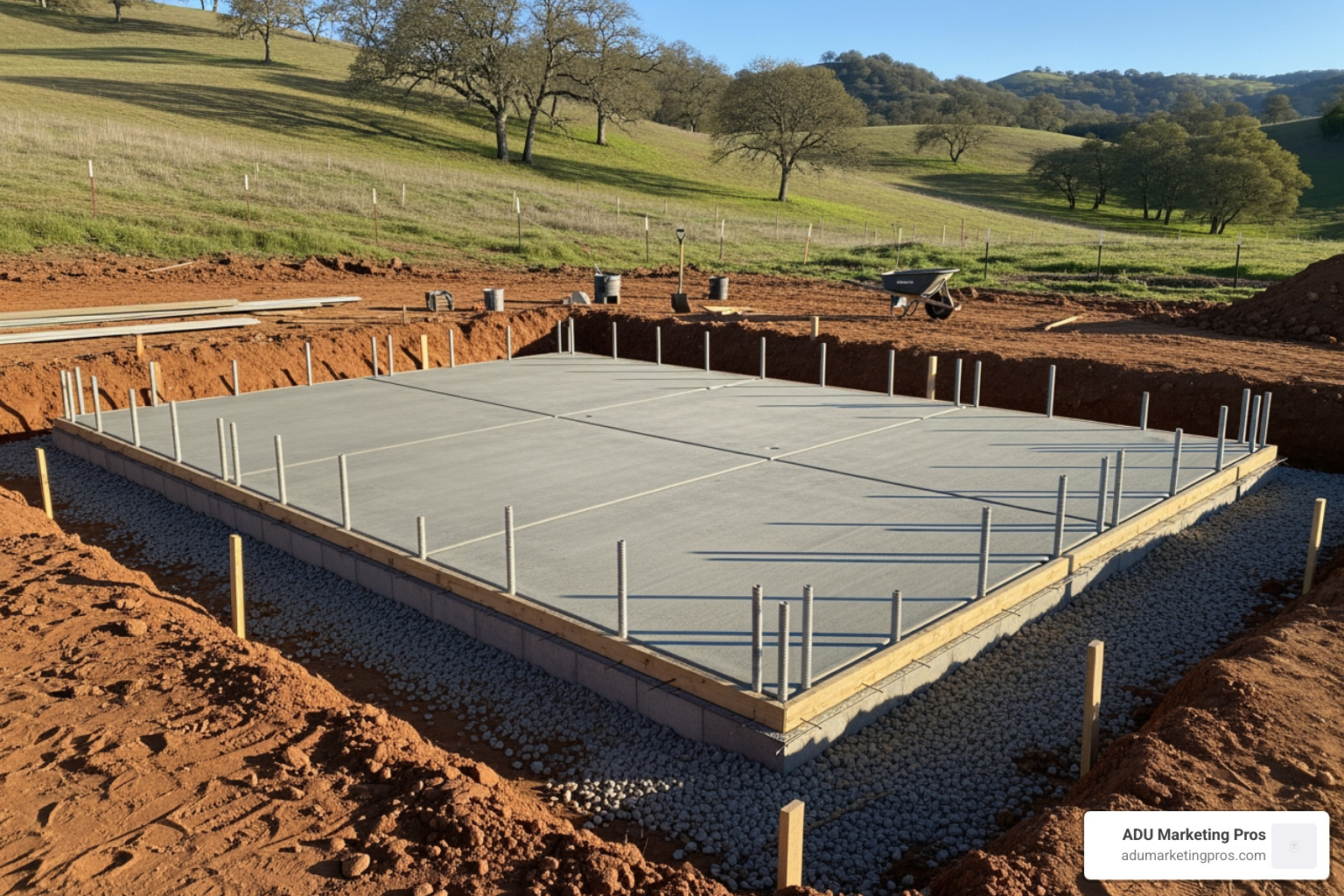
Permanent tiny homes must be built on an approved foundation system that meets local engineering and seismic requirements. This means they are permanently affixed to the ground, unlike THOWs. The foundation provides stability, prevents movement, and ensures the structure’s longevity. Removing the wheels from a THOW and placing it on a foundation effectively converts it into a permanent structure, subjecting it to these same foundation codes.
Utility Connections:
Connection to essential utilities is a must for permanent residences. This includes:
- Water: Potable water supply, typically connected to the municipal water system or a private well.
- Sewer or Septic: Connection to the public sewer system or an approved private septic system.
- Electrical Systems: Connection to the electrical grid, ensuring safe and adequate power for lighting, appliances, and heating/cooling.
- Gas (optional): Connection to natural gas lines if desired for cooking or heating.
These connections must be installed by licensed professionals and undergo inspections to ensure safety and compliance. For those prioritizing sustainability, exploring options for efficient utility use is also a smart move. Our guide on Energy Efficient ADU offers valuable insights into sustainable practices for your tiny dwelling.
The Permitting and Building Process: From Blueprint to Reality
Once you’ve wrapped your head around the definitions and regulations, the next big hurdle is the permitting and building process. This is where your tiny home dream starts to take physical shape, but it’s also where many hopeful homeowners encounter their biggest challenges. Our goal is to simplify this for you.
The process typically involves several key stages: initial planning and design, submitting detailed plans for review, obtaining necessary permits, and undergoing a series of inspections during construction. Each step is designed to ensure your tiny home is safe, compliant, and integrated properly into your property and community.
Securing Permits and Passing Inspections
Securing the right permits is the bedrock of a legal tiny home. This isn’t just bureaucracy; it’s about ensuring your home meets safety standards and can be legally occupied. The process generally includes:
- Planning Phase: This involves conceptualizing your tiny home, determining its classification (permanent, THOW as ADU, etc.), and developing detailed floor plans and site plans.
- Plan Review: You’ll submit your plans to the local building department (e.g., in San Jose, Los Angeles, San Diego) for review. They’ll check for compliance with state and local building codes, zoning ordinances, and environmental regulations. This can involve multiple rounds of revisions.
- Permit Issuance: Once plans are approved, you’ll be issued a building permit. This permit is your green light to begin construction.
- Inspection Stages: Throughout construction, various inspections will occur, including:
- Foundation Inspection: Before pouring concrete.
- Framing Inspection: After the structural shell is complete but before interior walls are closed.
- Rough-in Inspections: For plumbing, electrical, and mechanical systems before they are covered.
- Insulation Inspection: Before drywall.
- Final Inspection: Upon completion of the entire project, ensuring everything meets code and is ready for occupancy.
Skipping permits or inspections is a recipe for disaster, leading to potential fines, orders to remove the structure, or the inability to sell your property down the line. For a more detailed look at the process and associated costs, check out our resources on the ADU Permit Process California and ADU Permit Cost California.
Certified Builders vs. the DIY Approach
When it comes to constructing your tiny home, you generally have two paths: hiring a certified builder or tackling it yourself. While the DIY approach might seem appealing for its cost-saving potential, we often caution our clients that it carries significantly higher risks and unpredictable outcomes, especially when navigating complex tiny home regulations California.
Benefits of Certified Builders:
- Expertise in Regulations: Certified builders are well-versed in the latest state and local codes, including Appendix Q and Appendix BB, ensuring your tiny home is compliant from day one.
- Quality Assurance: Builders certified by organizations like the RV Industry Association (RVIA) or NOAH (National Organization of Alternative Housing) adhere to strict standards, often exceeding basic code requirements. This ensures safety and livability.
- Permitting Navigation: An experienced builder can streamline the permitting process, reducing delays and headaches.
- Access to Finance & Insurance: Homes built by certified professionals are generally easier to finance and insure.
- Resale Value: A professionally built and certified tiny home typically holds higher resale value.
The California Department of Housing and Community Development (HCD) maintains a List of approved 3rd party Design Approval Agencies (DAA) and Quality Assurance Agencies (QAA) that can certify these specialized structures.
Risks of the DIY Approach:
- Code Violations: Without deep knowledge of codes, you risk costly mistakes that require rework or lead to penalties.
- Safety Concerns: Improper construction can lead to structural failures, electrical hazards, or plumbing issues.
- Insurance & Financing Difficulties: Many insurers won’t cover uncertified DIY homes, and lenders are hesitant to finance them.
- Legal Occupancy Issues: An unpermitted or non-compliant home cannot be legally occupied, potentially leading to fines or orders for removal.
Choosing a reputable builder, especially one with experience in tiny homes or ADUs in California, is an investment in peace of mind and the long-term legality of your dwelling. To connect with qualified professionals, explore our network of Tiny House Builders California.
Financial and Legal Considerations for your tiny home regulations California
Beyond the physical build, understanding the financial and legal implications is vital for any prospective tiny homeowner in California. This includes property taxes, insurance, and financing options, all of which vary significantly based on your tiny home’s classification.
Property Taxes:
- Permanent Tiny Homes (on foundations): If your tiny home is built on a permanent foundation and classified as a dwelling unit or ADU, it will be assessed as real property. This means it will contribute to your overall property value and you will pay annual property taxes based on that assessment. For more details on this, see our article on ADU Property Taxes.
- Tiny Homes on Wheels (THOWs): For THOWs that remain on wheels and are registered with the DMV as vehicles, you typically do not pay property taxes. Instead, you pay an annual vehicle license fee. However, if a THOW is placed on a property for an extended period and connected to utilities, some local jurisdictions may attempt to reclassify it as real property, leading to property tax assessment. It’s a nuanced area, so local verification is key.
Insurance Challenges and Solutions:
Insuring a tiny home can be tricky.
- Permanent Tiny Homes/ADUs: These are generally easier to insure as they fall under standard homeowner’s insurance policies, often as an extension of the primary residence’s policy.
- THOWs: Traditional homeowner’s policies usually don’t cover THOWs. You’ll likely need specialized RV insurance (if it meets RVIA standards) or a custom policy designed for mobile dwellings. Some insurers may require the home to be certified by a third party.
Financing Options:
Financing for tiny homes is still evolving.
- Permanent Tiny Homes/ADUs: These can often be financed through traditional mortgages, ADU loans, home equity loans, or construction loans, especially if they add value to an existing property. Explore various avenues in our guide to ADU Financing Options.
- THOWs: Financing for THOWs is more akin to RV loans, personal loans, or specialized chattel mortgages. Interest rates might be higher, and terms shorter, than traditional mortgages.
Navigating these financial and legal waters successfully requires careful planning and often the advice of professionals experienced in both real estate and alternative housing.
Where in California Can You Place a Tiny Home? A Region-by-Region Look
The question of “where” is perhaps the most critical for any aspiring tiny homeowner in California. While the state has made significant strides in supporting ADUs, the specific rules for tiny homes (especially THOWs) can vary dramatically from one city or county to the next. The landscape is a patchwork of progressive cities, cautious counties, and jurisdictions that haven’t yet formally addressed the tiny home movement.
It is absolutely essential to remember that while this guide provides an overview, local verification is non-negotiable. You must consult with the planning and building departments of your specific city and county before purchasing land, a tiny home, or starting any construction. What is celebrated in one city may be prohibited just a few miles away.
Here’s a closer look at how some key regions in California are approaching tiny home regulations.
Los Angeles County: A Pioneer in THOW Acceptance
Los Angeles has emerged as one of the most progressive cities in the nation for tiny homes on wheels. In 2019, the city of Los Angeles amended its zoning code to allow THOWs to be used as Accessory Dwelling Units (ADUs). This was a landmark decision that provided a legal pathway for full-time residency in a THOW outside of a traditional RV park.
Key requirements for a THOW as an ADU in Los Angeles include:
- Certification: The unit must be certified by a recognized third-party agency, such as the RV Industry Association (RVIA) or NOAH. If not, it must have an insignia of approval from the California Department of Housing and Community Development (HCD).
- Registration: The THOW must be licensed and registered with the California DMV.
- Placement: It must be located on a lot with a legally permitted single-family or multi-family dwelling and be connected to utilities.
- No Permanent Foundation: The wheels and chassis must remain attached, distinguishing it from a permanent structure.
This ordinance has made Los Angeles a focal point for the tiny living movement. However, it’s important to note that these rules apply to the City of Los Angeles, not necessarily all 88 incorporated cities within Los Angeles County. You must verify the rules for your specific municipality (e.g., Long Beach, Pasadena, Santa Monica).
San Diego County: Embracing “Movable Tiny Houses”
Following Los Angeles’s lead, the City of San Diego also updated its land development code to permit “Movable Tiny Houses” (MTHs) as ADUs. This move was explicitly designed to increase the supply of affordable and flexible housing options in the city.
San Diego’s regulations are similar to L.A.’s, requiring:
- Third-Party Certification: The MTH must meet ANSI 119.5 or NFPA 1192 standards and be certified.
- State Registration: It must be registered with the California DMV or HCD.
- Utility Connections: The MTH must be connected to water, sewer, and electrical utilities.
- Health and Safety: The unit must meet basic health and safety standards for occupancy.
San Diego’s proactive stance provides another major metropolitan area where tiny home enthusiasts can find legal footing. For detailed information, prospective builders should consult the City of San Diego’s Development Services Department.
San Francisco Bay Area: A Complex and Varied Landscape
The Bay Area presents a more fragmented regulatory environment, reflecting the diverse priorities of its many cities and counties. High property values and dense urban development create unique challenges and opportunities.
- San Jose: As a leader in Silicon Valley, San Jose has a specific ordinance allowing for tiny homes on wheels in the backyards of single-family properties. The program is designed to create more housing options, and the city provides clear checklists and guidelines for residents.
- Alameda County: The county has shown significant interest in tiny homes, particularly as a solution for housing insecurity. The City of Alameda even launched a pilot program for “tiny homes on wheels” to test their viability as long-term housing.
- Other Bay Area Cities (Palo Alto, Mountain View, Menlo Park): In many affluent Silicon Valley communities, the focus remains heavily on traditional, foundation-built ADUs. While state ADU laws make it easier to build small backyard cottages (which can be “tiny”), specific ordinances allowing for THOWs as permanent residences are less common. In these areas, pursuing a tiny home on a permanent foundation classified as an ADU is often the most viable path.
Other Notable Tiny-Home-Friendly Cities
Beyond the major coastal hubs, several other California cities have become known for their welcoming stance:
- Fresno: The City of Fresno was one of the first in California to pass an ordinance allowing THOWs as secondary dwellings in residential zones. Their regulations are often cited as a model for other cities.
- San Luis Obispo: The county has clear guidelines distinguishing between THOWs for recreational use and those intended for permanent occupancy, providing a clear (though strict) path for residents.
- Nevada County: This rural county has also adopted ordinances friendly to tiny homes, reflecting a desire to provide flexible housing options for its residents.
The Future of Tiny Living in California: Trends to Watch
The regulatory and cultural landscape for tiny homes in California is far from static. It’s a dynamic field driven by the state’s housing crisis, a growing desire for sustainable living, and persistent advocacy. As you plan your tiny home journey, it’s crucial to keep an eye on the trends that will shape the future of tiny living in the Golden State.
The Impact of Appendix BB (2025)
Perhaps the most significant upcoming change is the formal adoption of Appendix BB (Tiny Houses) into the 2025 California Residential Code (CRC). While many jurisdictions have already adopted the similar Appendix Q from the International Residential Code, Appendix BB’s inclusion in the statewide code is a major step toward standardization and legitimacy for tiny homes on permanent foundations.
Key provisions of Appendix BB include:
- Reduced Ceiling Heights: Allowing minimum ceiling heights of 6 feet 8 inches in habitable spaces and 6 feet 4 inches in bathrooms, a crucial concession for loft designs.
- Flexible Stair Designs: Permitting ladders, ship’s ladders, and alternating tread devices to access lofts, saving valuable floor space.
- Loft Specifications: Providing clear safety and size requirements for sleeping lofts, a hallmark of tiny home design.
This official recognition will make it easier for builders to design compliant homes and for building departments to approve them, reducing ambiguity and streamlining the permitting process for foundation-built tiny homes across the state.
The Rise of Tiny Home Communities
While much of the focus has been on individual tiny homes in backyards, there is a growing movement toward developing entire tiny home communities or “pocket neighborhoods.” These communities offer a sense of shared resources, social connection, and a lower-impact lifestyle. We are seeing two primary models emerge:
- Lifestyle-Oriented Communities: These are planned developments where residents own their tiny homes and lease a small plot of land. They often feature shared amenities like community gardens, workshops, and gathering spaces. They face significant zoning hurdles, often requiring special permits for a Planned Unit Development (PUD).
- Transitional Housing Communities: Cities like Los Angeles and Oakland are increasingly using tiny homes (often prefabricated cabins) as a rapid-response tool to provide safe, private, and dignified transitional housing for people experiencing homelessness. These projects, like the Hope of the Valley communities in L.A., demonstrate the viability and efficiency of small-scale housing solutions.
Advocacy and Legislative Momentum
The progress seen in cities like Los Angeles and San Diego did not happen in a vacuum. It was the result of years of dedicated work by advocacy groups like the American Tiny House Association and local grassroots organizations. These groups continue to lobby at both the state and local levels for more inclusive zoning, clearer regulations, and recognition of tiny homes as a valid housing solution.
Future legislative efforts may focus on creating a statewide framework for THOWs used as ADUs, which would prevent individuals from having to navigate a confusing patchwork of city-by-city ordinances. As the housing crisis persists, the political will to support innovative and affordable housing types like tiny homes is likely to grow.
Sustainability and Off-Grid Innovation
The tiny home movement is intrinsically linked to sustainability. A smaller footprint means lower energy consumption, fewer building materials, and less waste. This alignment with California’s environmental goals is a powerful driver of its acceptance.
We are seeing a surge in innovation around off-grid and semi-off-grid tiny homes. This includes:
- Advanced Solar Power Systems: Making it possible for tiny homes to be fully or partially powered by the sun.
- Composting Toilets and Greywater Systems: Reducing reliance on municipal sewer systems and conserving water.
- Use of Reclaimed and Sustainable Materials: Further minimizing the environmental impact of construction.
As this technology becomes more reliable and affordable, it will open up new possibilities for placing tiny homes in more remote or rural locations, provided zoning allows for it.
Your Path to Legal Tiny Living: A Final Checklist
Navigating the world of tiny home regulations California is a journey that demands diligence, research, and a clear understanding of the law. While the path can be complex, thousands have successfully built or placed legal, compliant tiny homes in the Golden State. By following a structured approach, you can turn your dream of minimalist living into a safe and legal reality.
Here is a final checklist to guide your process from concept to completion:
-
Define Your Tiny Home Type: First, decide which legal classification your home will fit into. Is it a Tiny Home on a Permanent Foundation (likely an ADU), a Tiny Home on Wheels (THOW), or a Park Model RV? This decision dictates every subsequent step.
-
Master Your Local Jurisdiction: This is the most critical step. Before you do anything else, contact the planning and building departments for your specific city and county. Ask them directly about their ordinances for your chosen tiny home type. Do not rely on information from a neighboring town or general online forums.
-
Design for Compliance: Whether you are designing the home yourself or working with a professional, the plans must adhere to the correct codes. For foundation homes, this means the California Residential Code (including Appendix BB starting in 2025). For THOWs, this means ANSI or NFPA standards and DMV requirements.
-
Choose Your Builder Wisely: The risks of a non-compliant DIY build are immense, from safety hazards to legal trouble. We strongly recommend working with a certified builder who has proven experience with tiny homes or ADUs in California. A professional will ensure quality, compliance, and a smoother permitting process.
-
Secure Permits Before Building: Do not start construction without an approved building permit in hand. The permit and inspection process is your assurance that the home is safe, legal, and habitable. Skipping this step can lead to fines, demolition orders, and an inability to insure or sell your property.
-
Plan Your Finances: Understand the full financial picture. This includes not just the build cost, but also permit fees, utility connection costs, property taxes (for permanent homes) or DMV fees (for THOWs), and insurance. Explore financing options early, as they differ significantly between permanent homes and THOWs.
The tiny home movement represents a powerful shift toward more sustainable, affordable, and intentional living. California, despite its complex regulatory environment, is increasingly at the forefront of this shift. With careful planning, professional guidance, and a thorough understanding of the rules, your vision for a tiny home in California is well within reach.