
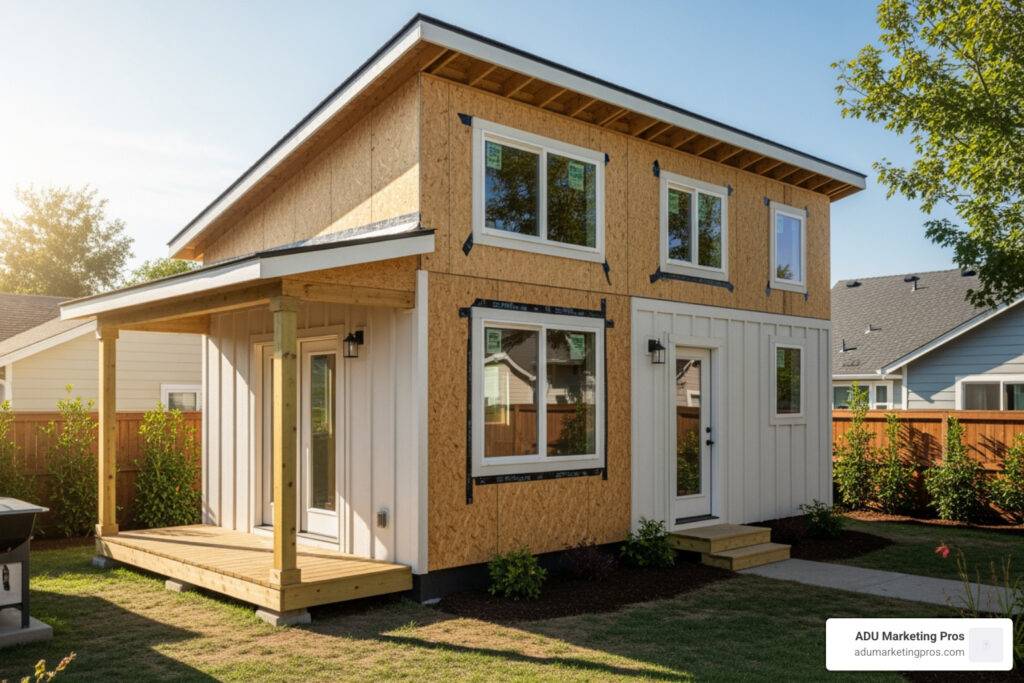
Granny Flat Kits: Your Fastest Path to Backyard Living
Granny flat kits are prefabricated building packages that include everything you need to construct a self-contained secondary dwelling on your property — from pre-engineered wall panels and roof trusses to windows, doors, and fastener hardware. These kits offer a streamlined alternative to the traditional stick-built construction process, which has historically been plagued by delays, budget overruns, and labor shortages. By shifting the bulk of the construction work from a chaotic outdoor job site to a controlled factory environment, granny flat kits provide a level of precision and predictability that was previously unavailable to the average homeowner.
The Snapshot of Modern Backyard Living
Before diving into the technical specifications, here’s a quick snapshot of what you need to know about the current market for these units:
| Feature | Typical Range |
|---|---|
| Kit price | $19,200 – $60,000+ |
| Size range | 24 m² – 111 m² (600 – 1,200 sq ft) |
| Bedrooms | 1–3 bedrooms |
| Delivery time | Under 6 weeks (factory to site) |
| Permit exemption | Often applies to units ≤60 m² on lots >300 m² (varies by jurisdiction) |
| Assembly | DIY-friendly or professional installation available |
Addressing the Housing Crisis with Infill Development
The housing crunch is real, particularly in high-demand regions like the San Francisco Bay Area, Los Angeles, and San Diego. As urban centers become increasingly crowded and expensive, homeowners are turning to backyard secondary dwellings—formally known as Accessory Dwelling Units (ADUs)—as a practical way to house aging parents, generate rental income, or add much-needed livable space for remote work. The problem? Traditional construction is slow, expensive, and unpredictable. In many California markets, builder delays can stretch up to two years, leaving homeowners in a state of perpetual limbo.
That’s where granny flat kits come in. They compress the timeline dramatically. Instead of waiting on a builder’s schedule and dealing with the daily disruption of a construction crew in your backyard for six months, you receive a factory-prefabricated package and get building within weeks. By utilizing precision-engineered components, these kits ensure every piece fits perfectly, reducing material waste and significantly improving the structural integrity of the final build. This “infill development” strategy is now widely recognized by urban planners as a key solution to the “Missing Middle” housing gap.
This comprehensive guide covers kit types, real-world pricing data, complex permit requirements, aging-in-place design principles, and how to choose the right provider for your specific property needs.
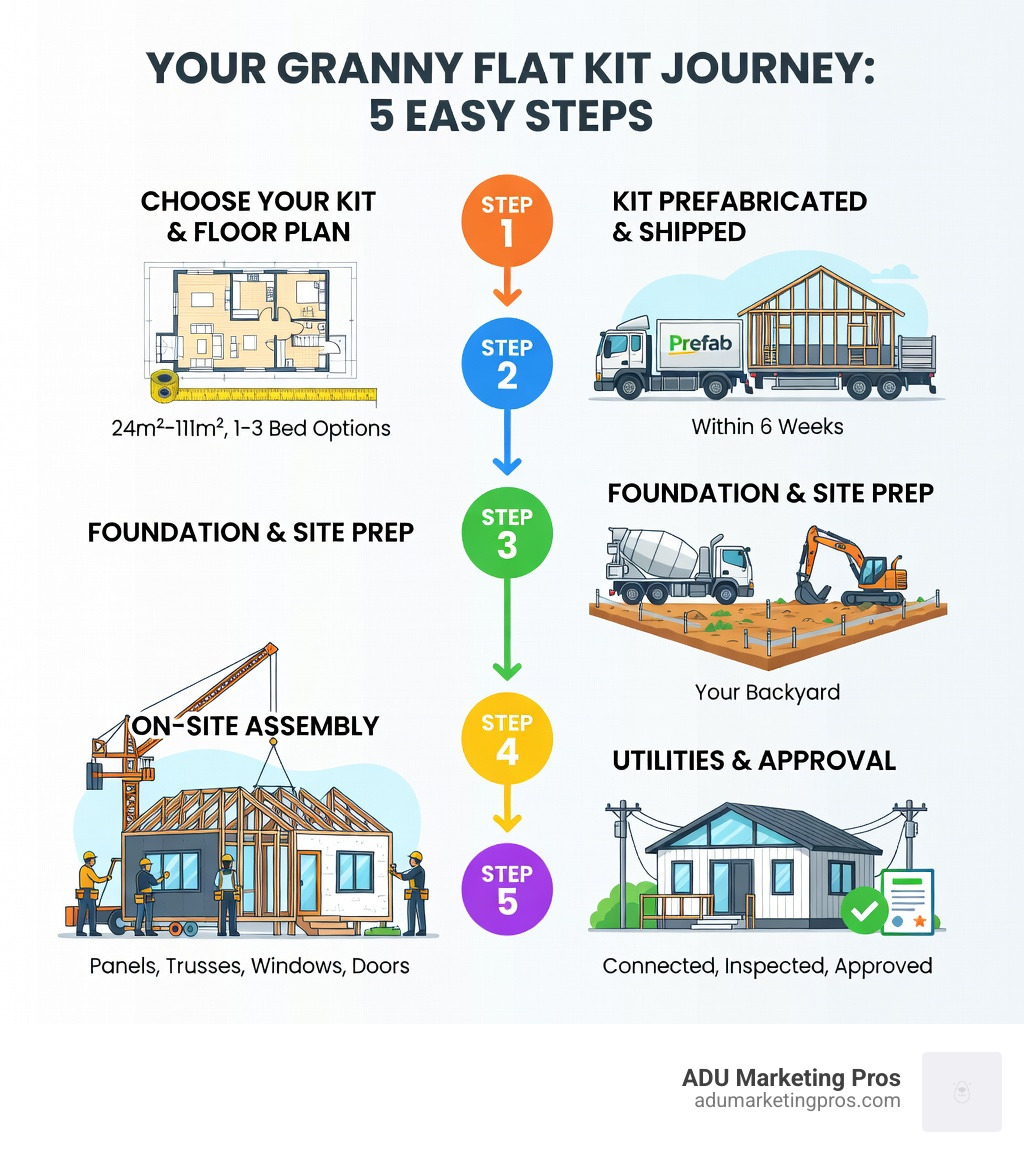
Granny flat kits terms to know:
Understanding Granny Flat Kits and Prefab Alternatives
When adding a unit to your backyard, the terminology can get confusing. The distinction between kit types lies primarily in the level of completion upon delivery and the method of assembly. Understanding these nuances is critical for budgeting and project management.

A granny flat kit is typically a “panelized” system. This means the walls are built in a factory but shipped as flat panels. Unlike a Prefab Granny Flat California, which might arrive as a fully completed “box” (modular) that must be craned over your house onto a foundation, a kit requires assembly on-site. This approach is ideal for homeowners with backyards that are difficult to access with heavy machinery, such as those with narrow side yards or low-hanging power lines.
Material Science in Kit Construction
Common materials used in high-quality kits include sustainable Nordic spruce and high-tensile steel frames. Nordic spruce is prized for its density and natural insulation properties, making it an excellent choice for energy-efficient living. On the other hand, steel frames offer unmatched resistance to termites, rot, and fire—a critical consideration for homeowners in California’s Wildland-Urban Interface (WUI) zones. For a contemporary look, Modern Prefab Granny Flats often utilize these panelized systems to achieve clean lines and large window spans that are difficult to execute with traditional framing.
Key Differences in Construction Methods
We see three main paths to building a backyard unit, each with its own set of logistical requirements:
- Panelized Kits: Pre-engineered wall frames and roof trusses shipped as a “flat-pack.” This is the most flexible option for sites with limited access. It offers high quality control with homeowner-managed assembly. According to the U.S. Department of Energy, panelized homes can be built more quickly and with less waste than traditional homes because they are constructed in a climate-controlled environment.
- Modular Homes: Modular Granny Flats California style units are built entirely in a factory, including interior finishes, cabinetry, and appliances. While they offer the fastest on-site “build” time, they are limited by transport widths (usually 8 to 12 feet) and require heavy machinery for placement, which can add $10,000 to $20,000 in crane costs alone.
- Custom Stick-Built: This is traditional on-site construction where every piece of lumber is cut and nailed in your backyard. It is the most flexible in terms of design but often the most expensive and time-consuming, especially in high-labor-cost areas like Mountain View, Palo Alto, or Santa Monica.
By choosing granny flat kits, we get factory-built consistency with flat-pack transport convenience — minimizing the unknowns that typically plague construction projects while maintaining the ability to customize the interior finishes to match the primary residence.
The Pros and Cons of Choosing Granny Flat Kits
Choosing a kit impacts your finances, timeline, and stress levels. It is a significant undertaking that requires a clear understanding of the trade-offs involved. Here’s what you need to weigh before signing a contract.
The Advantages: Why Kits are Winning
- Significant Cost Savings: By acting as an owner-builder or hiring a local carpenter rather than a full-service ADU firm, you can save the 20-30% margin traditional builders add on labor and materials. This can equate to $40,000 or more on a standard 600 sq ft build.
- Unmatched Speed: Many providers deliver kits in under 6 weeks. Once the kit arrives, it can be “dried-in” (made weather-tight) in a matter of days. This prevents the structural components from being exposed to the elements for months, which is a common issue with stick-built projects.
- Design Certainty: With Granny Flat Designs, you know exactly what the finished product looks like before the first nail is driven. The engineering is already done, meaning you won’t run into “structural surprises” that require expensive change orders mid-construction.
- DIY Potential: Kits come with detailed manuals and numbered components for straightforward assembly. For the handy homeowner, this is the ultimate weekend project that adds massive value to the property.
The Challenges: What to Watch Out For
- Permit Hurdles: You’re still responsible for local site approvals, soil tests, and energy calculations. A kit that is legal in one county might need structural modifications to meet the seismic or wind requirements of another.
- Site Prep Complexity: Foundation work, utility trenching (sewer, water, power), and landscaping are almost never included in the kit price. These “below-ground” costs can often surprise homeowners who only look at the sticker price of the kit.
- Customization Limits: Structural footprints are usually fixed to ensure engineering integrity. If you want to move a load-bearing wall, you might void the warranty or require a complete re-engineering of the kit.
Essential Inclusions in a Standard Granny Flat Kit
To avoid hidden costs, ensure your granny flat kit includes the following components at a minimum:
- Pre-assembled 70mm steel or wood wall frames and roof trusses.
- External wall cladding (CGI sheets, stucco-ready panels, or high-grade timber logs).
- Complete roofing materials including sheets, fascia, flashing, and gutters.
- High-performance, double-glazed sliding glass windows and doors for energy efficiency.
- A comprehensive fastener kit with all necessary hardware, brackets, and adhesives.
- Pre-engineered plans and support documentation required for building permits.
- Internal wall framing (Note: internal linings like drywall are often sourced locally to prevent shipping damage and reduce costs).
Cost Breakdown and Popular Configurations
One of the biggest questions homeowners ask is: “What does it actually cost to go from a kit to a move-in ready home?” It’s important to distinguish between the “kit-only” price and the “all-in” project cost. Transparency in pricing is the only way to ensure your project stays on track.
The Real Math: Kit vs. Total Project
For a standard 600 sq ft model, the building kit cost is approximately $37,417. However, the kit is just one piece of the puzzle. Once we factor in the foundation ($15,000), labor for assembly ($25,000), plumbing and electrical rough-ins ($15,000), interior finishes like flooring and cabinets ($20,000), and utility connections/permits ($15,000), the total project cost often lands between $120,000 and $150,000. While this sounds high, it is still significantly lower than the $250,000 to $350,000 often quoted for custom-built ADUs in California’s major metros.
Smaller 24 m² (250 sq ft) studios can start as low as $19,200 for the kit — perfect for home offices, art studios, or guest suites. Luxury 1,200 sq ft units can see kit prices exceeding $60,000. For California-specific pricing and a deeper dive into the economics of ADUs, check out Prefab Granny Flats in California Grannys Got a Brand New Pad.
Popular Configurations and Floor Plans
When choosing a floor plan, think about the long-term use of the space. A design that works for a college student might not work for an elderly parent. Here are the most popular configurations:
- The 600 sq ft One-Bedroom: This is the “sweet spot” for many homeowners. It usually features vaulted ceilings and an open-concept living/kitchen area. It is the most popular size for rental units because it offers a full kitchen and separate bedroom without taking up the entire backyard.
- The 900 sq ft Two-Bedroom: Ideal for small families or those who need a dedicated home office. These plans usually include a laundry nook and a full-sized bathroom.
- The 1,200 sq ft Suite: Often the maximum allowable ADU size in California. These units feature 2 or 3 bedrooms, 2 bathrooms, and sometimes a small porch or deck. They function as a full-sized second home on the property.
When selecting a plan, consider window orientation. A well-placed kit takes advantage of natural light (passive solar heating), which reduces energy costs and makes a small interior feel much larger and more inviting.
Navigating Permits and Regulations for Granny Flat Kits
In our core service areas like San Jose, Los Angeles, and the San Francisco Bay Area, ADU regulations have become much more favorable over the last five years. California has passed landmark bills (like SB 9 and SB 10) to strip away local red tape and high impact fees. However, “favorable” does not mean “automatic.” Navigating the bureaucracy is often the most time-consuming part of the process.
Compliance with the California Building Code
We must ensure our kit meets the rigorous standards of the California Building Code. For the latest state-wide mandates, homeowners should consult the California Department of Housing and Community Development (HCD) and review standards through the California Building Standards Commission. These agencies provide the framework that local cities must follow.
Key technical requirements for kits in California include:
- Seismic Zone D: Appropriate tie-downs, shear walls, and structural bracing for earthquake stability. Most kits from reputable manufacturers are already engineered for these loads.
- Wind Exposure C: Roof and wall ratings for high-pressure wind events, especially in coastal or canyon areas.
- Fire Hazard Zones: Fire-resistance standards often requiring non-combustible fiber-cement siding (like James Hardie) or metal roofing. This is mandatory in many parts of Southern California.
- Title 24 Compliance: This is California’s energy efficiency standard. It requires specific insulation R-values, high-efficiency windows, and often solar panels for new detached ADUs. Many kit providers offer “Title 24 packages” to help you pass this hurdle.
In many jurisdictions, units under 60 m² (approx 645 sq ft) on lots larger than 300 m² face fewer regulatory hurdles and lower impact fees. However, we always recommend a preliminary meeting with your local planning department to identify any site-specific issues like easements or heritage trees.
Designing Granny Flat Kits for Aging-in-Place
If the primary goal is to house an aging parent, the design must go beyond basic code compliance. You should look for kits that incorporate Universal Design principles. The AARP ADU Design Gallery provides excellent visual examples of accessible layouts that don’t sacrifice style for functionality.
Key features for granny flat kits for seniors include:
- Step-less entry: A ramp or flush threshold that eliminates tripping hazards for those using walkers or wheelchairs.
- 36-inch wide doors: Ensuring accessibility throughout the entire unit, including the bathroom and bedroom.
- Walk-in showers: Featuring built-in benches, non-slip flooring, and reinforced walls for future grab bar installation.
- Automated features: Smart lighting, voice-activated climate control, and leak detection sensors that can be managed via a smartphone by both the resident and their family members.
Financing and Assembly: From Purchase to Completion
Financing a kit home differs from a traditional mortgage because the “asset” arrives in pieces rather than as a finished structure. Many traditional banks are still catching up to the prefab revolution. However, many kit providers now offer owner-builder programs or partner with specialized lenders who understand the prefab process. This often involves construction financing that converts into a standard 30-year mortgage once the certificate of occupancy is issued.
The Construction Timeline: What to Expect
The process generally follows this six-step timeline, which usually spans 4 to 6 months:
- Site Staking and Foundation: While the kit is being manufactured in the factory, you prepare the site. This involves clearing debris, leveling the ground, and pouring a concrete slab or installing a pier-and-beam foundation. This is the most critical stage for ensuring the kit fits correctly.
- Utility Trenching: This is the “dirty work” of running water, sewer, and electricity from the primary residence to the granny flat site. It often requires digging 2-3 foot deep trenches across your yard.
- Delivery and Inventory: The kit arrives on a flatbed truck. It is vital to conduct a thorough inventory check against the packing list to ensure every component is present and undamaged. Most manufacturers give you a 48-hour window to report missing parts.
- Assembly: This is where the magic happens. Wall panels go up, roof trusses are placed, and the structure is “dried-in” with windows and doors. A professional crew of three can often reach this stage in 5 to 7 days for a 600 sq ft kit.
- Interior Finishing: Once the shell is weather-tight, you move to plumbing and electrical rough-ins, followed by insulation, drywall, flooring, and cabinetry. This stage takes the longest and requires the most coordination between trades.
- Final Inspection: Local building officials will visit the site to verify the build matches the approved plans and meets all safety, fire, and energy codes. Once they sign off, you receive your Certificate of Occupancy.
Tips for Integrating a Kit into Your Property
- Aesthetic Matching: To maintain your property’s curb appeal and resale value, choose siding colors and roof pitches that mirror your main house’s architectural style. Many kits allow for custom exterior finishes.
- Landscape Design: Use privacy screening, such as tall hedges or decorative fencing, and strategic plantings to create a sense of separation and “private zones” between the two dwellings.
- Utility Metering: While separate meters cost more upfront, they simplify the management of rental units and allow tenants to be responsible for their own energy consumption.
- Drainage Planning: Don’t forget about water runoff. Integrated gutter systems and French drains are essential to prevent your new unit from causing drainage issues for your neighbors or your own basement.
Frequently Asked Questions about Granny Flat Kits
How much do granny flat kits cost on average?
Base kits start as low as $19,200 for small studios. Most California homeowners should budget between $35,000 and $55,000 for a high-quality 1 or 2-bedroom kit. When you include the foundation, labor, permits, and interior finishes, total project costs typically range from $120,000 to $180,000. This is still a 30-50% savings compared to traditional custom construction.
Can I assemble a granny flat kit myself?
Yes, many granny flat kits are specifically designed for the owner-builder. If you are comfortable with basic power tools, can read architectural plans, and have a few strong friends to help with the heavy lifting, you can save significantly on labor costs. However, we always recommend hiring licensed professionals for the electrical, plumbing, and HVAC work to ensure safety and code compliance.
Do I need a permit for a 600 sq ft kit?
In California, the answer is almost always yes. While state laws have streamlined the process and eliminated many of the old barriers, you still need to submit plans to your local building department. They will review the plans for structural safety, fire resistance, and energy standards (Title 24). Building without a permit can lead to heavy fines, legal issues, and significant difficulties when you eventually try to sell your property.
How long does the entire process take from start to finish?
From the moment you place your order to the day you move in, you should expect a timeline of 4 to 6 months. This includes approximately 6 weeks for manufacturing and delivery, plus 3 to 4 months for site preparation, assembly, and interior finishing. This is significantly faster than the 12 to 18 months typically required for traditional custom construction in today’s market.
Will a granny flat kit increase my property taxes?
In most cases, yes. Under California law (specifically Proposition 13), only the value of the new construction is added to the tax roll. Your primary residence is not reassessed. The increase in property value and the potential for monthly rental income usually far outweigh the additional tax burden. Many homeowners find that the ADU pays for itself within 5 to 7 years through rental income alone.
Are these kits suitable for extreme weather?
Yes, provided you choose a kit engineered for your specific climate. High-quality kits use materials like steel or slow-grown Nordic spruce that handle temperature fluctuations well. You must ensure your kit is rated for the specific wind and snow loads of your region, as well as the seismic requirements if you are in a high-risk earthquake zone like the San Francisco Bay Area.
Conclusion
At ADU Marketing Pros, we understand that building a backyard home is about more than just adding square footage—it’s about creating a space for family, a source of reliable income, or a private retreat for your creative pursuits. By choosing granny flat kits, we can bypass the frustrating “two-year wait” of traditional builders and take immediate control of our property’s potential. The efficiency of factory-built components, combined with the flexibility of on-site assembly, offers a modern, scalable solution to the age-old problem of housing scarcity.
Whether you are located in San Jose, Los Angeles, or the broader Bay Area, the demand for smart, efficient housing is only going to grow. The regulatory environment in California has never been more supportive of ADUs, making this the ideal time to invest in your property. By focusing on high-quality kits and professional project management, you can ensure that your new backyard home is a source of pride, comfort, and profit for decades to come.
If you are ready to take the next step in your backyard journey, now is the time to explore the designs that fit your lifestyle and your budget. Start your backyard project today and see how easy it is to turn a kit into a home. Our team is here to help you navigate the marketing and growth of your ADU business, ensuring you stand out in this rapidly evolving and highly competitive market. The future of housing is in the backyard, and it starts with a kit.