
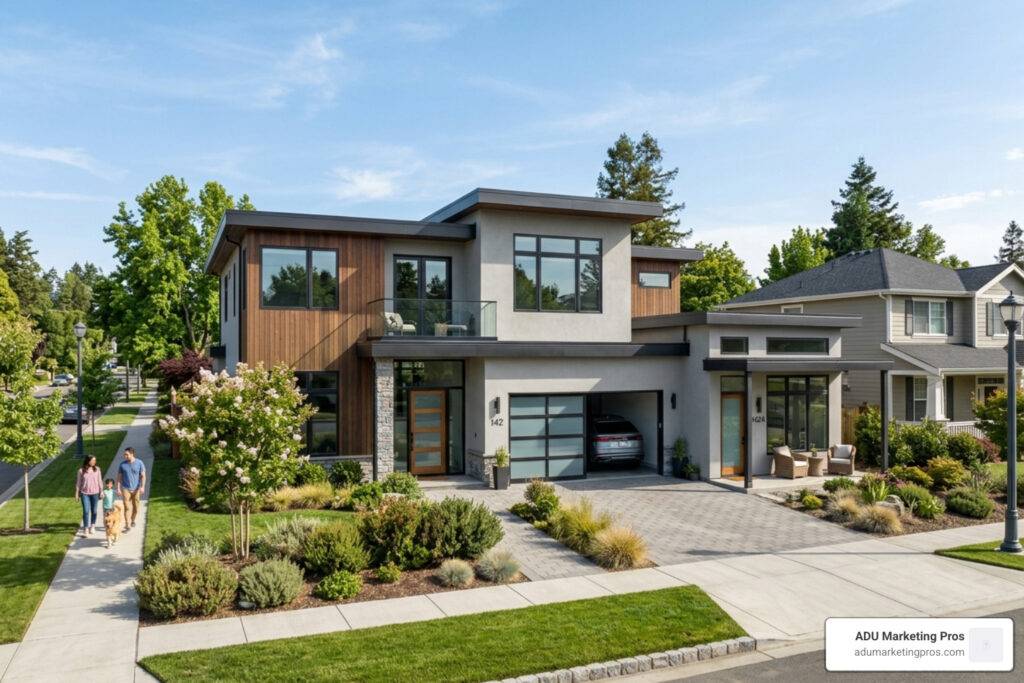
Why a 3 Bedroom House Plus Granny Flat Is One of the Smartest Property Moves in 2026
As we navigate the complexities of the 2026 real estate market, the concept of the 3 bedroom house plus granny flat has transitioned from a niche architectural trend to a mainstream financial powerhouse. In an era defined by high interest rates, a persistent housing shortage, and the rise of multi-generational living, homeowners are looking for ways to make their land work harder. This dual-occupancy configuration is the ultimate answer, offering a unique blend of residential flexibility and investment security that single-dwelling properties simply cannot match.
At its core, this setup involves a primary three-bedroom residence paired with a secondary, self-contained dwelling on the same title. While the term “granny flat” often evokes images of a small backyard shed, the modern reality is far more sophisticated. Today’s secondary dwellings are high-spec, architecturally designed homes that can rival the main house in quality and comfort. Whether you are looking to house aging parents, provide a launchpad for adult children, or generate a significant secondary income stream, the 3-bedroom house plus granny flat model is the gold standard for urban infill development.
Here’s what you need to know at a glance:
| Feature | Details |
|---|---|
| What it is | A primary 3-bedroom home with a self-contained secondary dwelling on the same block |
| Common uses | Rental income, multi-generational living, Airbnb, guest housing, home office |
| Typical granny flat size | 40m² minimum up to 60m² maximum (NSW); up to 1,200 sq ft (California) |
| Average build cost | $145,000–$160,000 for a standalone granny flat (turnkey, NSW); $300k+ (CA) |
| Build timeline | 12–16 weeks once approvals are in place |
| Key configurations | Attached, detached, single-storey, or double-storey |
| Narrow lot friendly? | Yes — designs as slim as 17 feet wide are available |
The appeal is straightforward. You get two independent living spaces on one title. The main house stays yours, providing the stability of a family home. The granny flat works hard — as a rental, an in-law suite, or a flexible space that adapts as your life changes. This is particularly relevant in 2026, where the “Missing Middle” housing crisis has forced many families to rethink their living arrangements. By adding a secondary unit, you are effectively creating a private apartment in your own backyard, bypassing the need for expensive land acquisitions.
Demand for this kind of setup is growing fast. In cities like Los Angeles, ADUs are now officially recognized as a key tool for addressing housing shortages, with the city actively streamlining approvals to make them easier to build. Meanwhile in Australia, builders are reporting strong interest in 3-bedroom configurations specifically — because they’re big enough for a full family, yet still compact enough to fit within standard block sizes. This shift is driven by a change in mindset: homeowners no longer see their backyards as just grass to be mowed, but as valuable real estate that can be unlocked to provide financial freedom.
The design challenge is real, though. Fitting three bedrooms, a kitchen, a bathroom, and a living area into a space that might be capped at 60 square metres in some jurisdictions requires smart planning. That’s exactly what this guide walks you through. We will explore the architectural nuances, the financial implications, and the regulatory hurdles you need to clear to make your 3-bedroom house plus granny flat dream a reality.
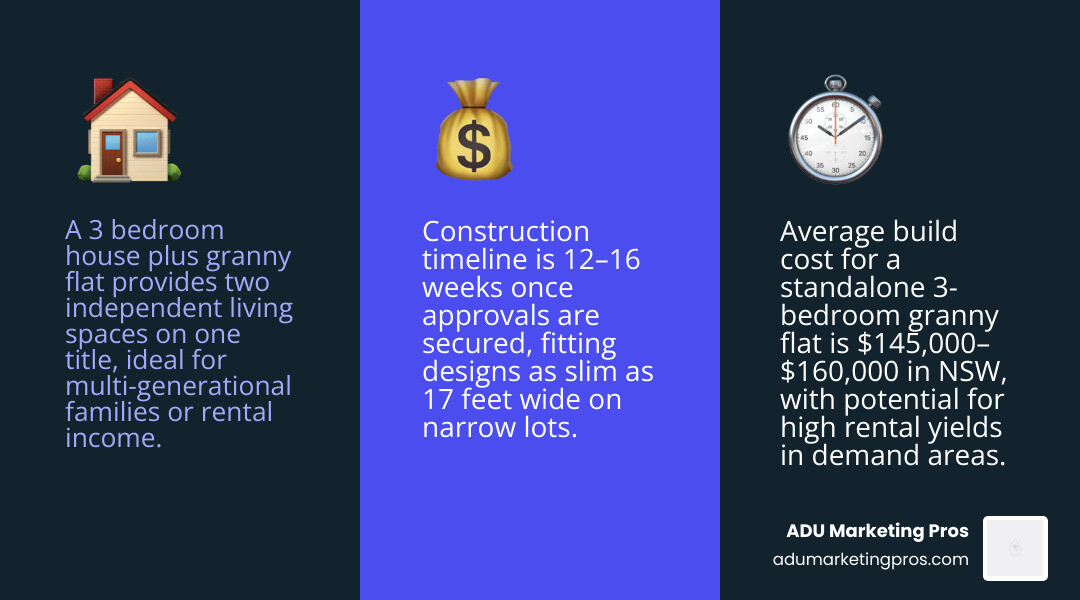
3 bedroom house plus granny flat terms at a glance:
Defining the 3 Bedroom House Plus Granny Flat Concept
When we talk about a 3 bedroom house plus granny flat, we are describing a property that features a primary residence (usually with three bedrooms) and a secondary, self-contained dwelling on the same lot. This secondary unit, often called an Accessory Dwelling Unit (ADU) in California or a granny flat in Australia, functions as a completely independent home. It is not just a guest room or a pool house; it is a fully realized residence with its own address, utility meters (in many cases), and private access.
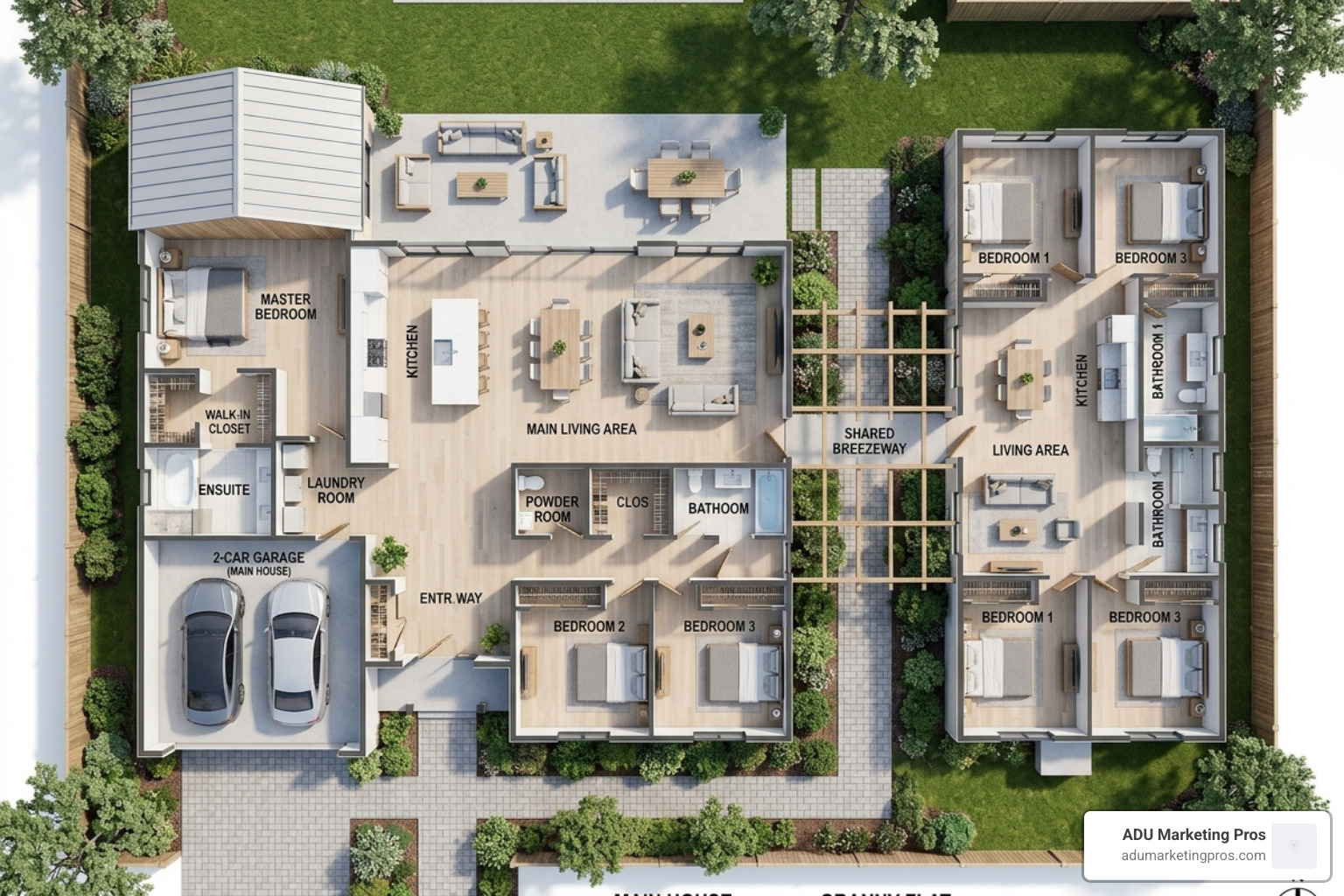
To be truly “self-contained,” the granny flat must have its own private entrance, a fully functional kitchen, at least one bathroom, and dedicated living and sleeping areas. While many people think of granny flats as tiny one-bedroom “pods,” modern Granny Flat Designs have evolved. We are seeing a massive surge in Modern Prefab Granny Flats that offer three full bedrooms, allowing them to function as a legitimate second family home rather than just a guest suite. This evolution is critical because it allows for a higher density of living without the need for high-rise apartment blocks, preserving the character of suburban neighborhoods while increasing housing supply.
According to industry specialists like Backyard Grannys, the 3-bedroom configuration is becoming the gold standard for those looking to maximize the “yield” of their land—whether that yield is measured in rental dollars or family comfort. In the past, a granny flat was often an afterthought, but in 2026, it is frequently the centerpiece of a property development strategy. The ability to house a family of four in the backyard while the main house is rented out to another family is a game-changer for property investors.
Primary Purposes and Modern Use Cases
In April 2026, the reasons for building a 3 bedroom house plus granny flat have expanded beyond just housing “granny.” The economic landscape has shifted, and the way we use our homes has shifted with it. Here are the most common ways our clients are using these spaces:
- High-Yield Rental Income: A 3-bedroom unit can command significantly higher rent than a studio or a 1-bedroom unit. In high-demand areas, these units are perfect for small families or groups of roommates who want the privacy of a house without the price tag of a full-sized suburban lot. This “mortgage buster” strategy is helping many first-time buyers enter the market.
- The Ultimate In-Law Unit: For those looking for an In-Law Unit San Francisco style, a 3-bedroom design provides enough space for aging parents to bring their hobbies, a home office, or even a live-in caregiver. It allows for dignity and independence while keeping the family unit close together.
- Multi-Generational Support: It’s an ideal ADU for Aging Parents, but it also works for adult children who are saving for their own homes but need more space than a single bedroom provides. With the cost of living rising, many families are pooling their resources to build a dual-occupancy property that serves everyone.
- Home Business Headquarters: With three rooms, you can have a professional office, a meeting room, and a storage area, all separate from your main living quarters. This is a tax-efficient way to run a business while maintaining a clear boundary between work and home life.
Common Configurations: Attached vs. Detached
The way you “pair” your house and flat depends on your lot size, local zoning laws, and privacy needs. Each configuration has its own set of pros and cons that must be weighed carefully during the planning phase.
Detached Granny Flats: These are standalone backyard cottages. They offer the most privacy and are the preferred choice for rental units because they feel like a separate home. In California, Modular Granny Flats California are often detached to take advantage of separate yard space and to minimize the noise transfer between the two dwellings. Detached units also offer more flexibility in terms of architectural style, as they don’t necessarily have to be a perfect match for the main house’s structure.
Attached Granny Flats: These are built as an extension or a “wing” of the main house. Designs like the Brooklyn with granny flat show how a double-storey home can integrate a self-contained unit under the same roofline. This is often more cost-effective as it can share certain structural elements, such as the foundation and roof, though it requires careful acoustic engineering to ensure privacy for both dwellings. Attached units are often favored by those who want to keep family members very close, or where lot size constraints make a detached unit impossible.
Key Benefits of a 3 Bedroom House Plus Granny Flat
The most obvious benefit of a 3 bedroom house plus granny flat is the “double-up” effect. You are essentially creating two homes on one piece of land, which is a powerful hedge against rising property prices. In a market where land is the most expensive component of real estate, maximizing the utility of every square foot is the smartest move a homeowner can make. This configuration doesn’t just add space; it adds a new dimension of financial and social utility to your property.
For families, a Multi-Generational ADU setup allows for a “close but not too close” lifestyle. You can share Sunday dinners in a central courtyard while maintaining completely separate morning routines. Large-scale designs like the Bannaby Dual 40 MKI take this to the extreme, offering a massive main house with an attached 3-bedroom flat, totaling up to 8 or even 10 bedrooms on a single block. This is the ultimate solution for large, extended families who want to stay together without sacrificing their individual privacy.
Maximizing Rental Income with a 3 Bedroom House Plus Granny Flat
If you are looking at this from an investment perspective, the 3-bedroom flat is a clear winner. While a studio might attract a single person or a couple, a 3-bedroom unit attracts families or professional roommates. This demographic tends to be more stable, staying in the property for longer periods, which reduces turnover costs and vacancy rates. In markets like Los Angeles, where housing is at a premium, a 3-bedroom ADU can generate “thousands every month” in rental yield.
Furthermore, the rental income from a granny flat is often treated favorably by lenders. Many banks will consider a percentage of the potential rental income when assessing your ability to service a loan, which can help you secure financing for the build itself. This creates a virtuous cycle where the asset pays for its own creation while simultaneously increasing the overall value of the property. In many cases, the increase in property value exceeds the cost of the build from day one.
Long-Term Value for Multi-Generational Families
We often hear from clients who want to “age in place.” Building a Prefab Granny Flat allows parents to downsize into a modern, accessible home in the backyard while their children move into the larger 3-bedroom main house. This is a strategic move that avoids the high costs of retirement villages and keeps the family’s wealth within the family.
This creates a circular economy of care: grandparents provide childcare support, which saves the younger generation thousands in daycare fees, while the younger generation is nearby to help with maintenance or medical needs. Designs like the Oakleigh 355 are specifically built with this flow in mind, connecting the two units through shared spaces like garages or breezeways to make transition easy. It’s a holistic approach to living that addresses the emotional, physical, and financial needs of the entire family tree.
Design Considerations for 3 Bedroom Granny Flats
Designing a 3-bedroom unit within a restricted footprint is an exercise in architectural puzzle-solving. When you are working with a 1000 sq ft ADU or even a 1200 sq ft ADU, every inch counts. The goal is to create a space that feels like a full-sized home, not a cramped apartment. This requires a departure from traditional design thinking and an embrace of modern, space-saving techniques.
One of the most efficient shapes for a backyard is the narrow rectangle. Some designs manage to fit three bedrooms into a footprint just 17 feet wide and 52 feet long. By keeping the width narrow, you leave more usable yard space and meet strict setback requirements (often 4 feet from property lines and 6 feet from the main home). This “long and lean” approach allows for a natural flow of light and air, which is essential for making small spaces feel comfortable.
Space-Saving Floor Plans for a 3 Bedroom House Plus Granny Flat
To make a 3-bedroom flat feel like a home rather than a hallway, we recommend several strategies that focus on efficiency and ergonomics:
- Open-Concept “Great Rooms”: Combining the kitchen, dining, and living areas into one large space makes the unit feel much bigger than its square footage suggests. By removing unnecessary internal walls, you allow light to penetrate deeper into the home and create a social hub that feels expansive.
- Vaulted Ceilings: Adding vertical space can compensate for a smaller floor area. High ceilings or clerestory windows can make a 600-square-foot room feel like it has double the volume. This is a common feature in high-end Modern Prefab Granny Flats.
- L-Shaped Designs: These are excellent for corner lots or creating a private “nook” for an outdoor patio. An L-shape can also help separate the “public” living areas from the “private” bedroom wings, providing a better sense of zoning within the small footprint.
- Integrated Storage: Built-in robes in every bedroom and a dedicated laundry cupboard (rather than a full laundry room) are essential. Designs like the Double Bay 38 Dual excel at including these “hidden” storage solutions, ensuring that the living areas remain clutter-free.
Customization Options for Specific Property Types
No two backyards are the same, and your 3 bedroom house plus granny flat should reflect the unique characteristics of your land. In the San Francisco Bay Area, you might be dealing with a sloping lot or a very narrow “shoebox” yard, which requires a custom approach.
- Sloping Lots: Consider a “pole home” style or a split-level design. This can actually be an advantage, allowing for a garage or storage area to be tucked underneath the living space, or providing the granny flat with a better view than the main house.
- Narrow Lots: Stick to the 17-foot wide rectangular models. These are designed to slide into side yards or long backyards without violating local setback laws. They often feature side-entry doors to maximize the internal layout.
- Aesthetic Matching: To maintain your property’s resale value, it is vital to match the facade of the granny flat to the main house. The Bannaby Dual 38 offers multiple facade options, from modern to Hamptons style, to ensure the two buildings look like they belong together. Using the same roofing materials, paint colors, and window styles creates a cohesive look that appeals to future buyers.
Cost Implications and Building Factors
Building a 3 bedroom house plus granny flat is a significant investment that requires careful financial planning. While a basic 1-bedroom kit might start low, a full-sized 3-bedroom secondary dwelling requires more substantial budgeting because it involves more plumbing, more electrical work, and a larger structural footprint. However, the return on investment (ROI) is typically much higher for a 3-bedroom unit due to its versatility and higher rental potential.
Comparing Costs: Granny Flat vs. Home Extension
| Factor | 3-Bedroom Granny Flat | 3-Bedroom Home Extension |
|---|---|---|
| Average Cost | $145k – $400k+ | $100k – $250k |
| Privacy | High (Separate unit) | Low (Shared walls/entry) |
| Rental Potential | High (Self-contained) | Low (Usually just rooms) |
| Property Value | Significant increase | Moderate increase |
| Complexity | High (New foundations/utilities) | Medium (Tie-in to existing) |
In general, an extension is cheaper because you are leveraging existing walls and rooflines. However, a self-contained granny flat almost always offers a better ROI because it can be rented out as a completely separate home. An extension usually just adds more space to your existing home, which might increase the value but doesn’t provide the same income-generating potential or the same level of privacy for multi-generational living.
Kit Homes vs. Custom Builds
For those looking to save money, prefabricated kits are a popular option. A high-quality 3-bedroom granny flat kit can cost around $310,000 (including roughly $280k for the vertical build and $30k for finishes). When you add in permits, site preparation, and utility connections, the total “all-in” price often lands around $400,000 for a standard property in California. Custom builds, on the other hand, can go much higher but allow for total control over the design and materials.
Companies like PMHI offer panelized kits ranging from 600 to 1,200 sq ft. These kits include pre-engineered plans, panelized walls, and roof trusses, which can significantly speed up the construction timeline. This is a major advantage in 2026, where labor shortages can often delay traditional “stick-built” projects for months. By using a kit, you can have the structure dried-in within days, reducing the risk of weather damage and theft on-site.
Is it More Cost-Effective to Build or Extend?
If your goal is simply more space for your own family, an extension might win. But if you want a “mortgage buster” or a place for parents to live with total independence, the granny flat is the way to go. In areas like Menlo Park, where 3-bedroom rents are astronomical, the granny flat will pay for itself much faster than an extension ever could. You also have to consider the “exit strategy.” A property with a legal, 3-bedroom secondary dwelling is a highly sought-after asset for investors, which can lead to a much higher sale price down the road.
Navigating Regulations and Size Limits
Regulations are the biggest hurdle in any 3 bedroom house plus granny flat project. The rules vary wildly depending on your location, and they are constantly changing as governments try to address the housing crisis. In New South Wales, the legal maximum for a granny flat is often capped at 60m², which makes a 3-bedroom layout very tight. In California, however, state laws have become much more permissive, often allowing ADUs up to 1,200 square feet regardless of local city caps.
Key rules to keep in mind in 2026:
- Setbacks: Most jurisdictions require the unit to be at least 4 feet from the side and rear property lines. This is to ensure fire safety and to maintain a level of privacy for neighbors. Some areas may have even stricter requirements if you are building a two-story unit.
- Separation: You typically need at least 6 feet of space between the main house and the detached granny flat. This is a building code requirement that ensures both structures have adequate light and ventilation, and it also helps with fire separation.
- Parking: Many California cities have waived parking requirements for ADUs if they are near public transit, but you must check your local San Diego County or Bay Area specific codes. In Australia, parking requirements are often tied to the number of bedrooms, so a 3-bedroom unit might require an additional off-street parking spot.
- Utility Connections: You will need to decide whether to “sub-meter” the granny flat or have it share the main house’s utilities. Sub-metering is more expensive upfront but makes it much easier to manage if you are renting the unit to a third party.
Understanding these regulations is the first step in any project. We always recommend a preliminary site assessment by a professional who understands the local planning codes. This can save you thousands in redesign fees and prevent your project from being stalled at the council or city planning desk.
Frequently Asked Questions about 3 Bedroom Granny Flats
What is the minimum size for a 3-bedroom granny flat?
While you can technically squeeze three bedrooms into 40 square metres (approx. 430 sq ft), it isn’t recommended for long-term living. Most functional 3-bedroom designs start at around 60 square metres (645 sq ft) and become truly comfortable at 800–1,000 square feet. If you are limited to 60m², you will need to use clever design tricks like built-in furniture and open-plan living to make it work.
How long does the building process typically take?
Once you have your permits in hand, the actual construction usually takes 12 to 16 weeks. However, the “pre-construction” phase—which includes design, engineering, and permitting—can take anywhere from 3 to 9 months depending on your local jurisdiction. Prefabricated or modular options can be even faster, with some units being erected on-site in just a few weeks after the foundation is poured.
Can I build a 3-bedroom granny flat on a narrow lot?
Yes. We have seen successful designs that are only 17 feet wide. As long as your total lot width allows for the unit plus the required 4-foot setbacks on either side (totaling about 25–27 feet of width), a 3-bedroom flat is feasible. You may need to go for a longer, thinner design or even a two-story configuration to get the necessary square footage.
Does a 3-bedroom granny flat add more value than a 1-bedroom?
In almost all cases, yes. A 3-bedroom unit is much more versatile. It can house a family, a group of students, or a professional couple who both need home offices. This versatility makes the property more attractive to a wider range of buyers and renters, which translates directly into higher property value and higher rental yields.
What are the tax implications of building a granny flat?
This varies by country and state, but generally, adding a rental unit to your property will have tax implications. You may be able to depreciate the cost of the build and the appliances, which can offset the rental income. However, it may also affect your primary residence capital gains tax exemption when you sell the property. Always consult with a tax professional before proceeding.
Conclusion
Building a 3 bedroom house plus granny flat is more than just a construction project; it’s a strategic investment in your family’s future and your property’s value. By choosing the right layout—whether it’s a narrow rectangular detached unit or a grand integrated dual-occupancy home—you can create a flexible living environment that adapts to your needs for decades to come. The ability to generate income, house loved ones, and increase your net worth all on a single piece of land is a rare opportunity in today’s market.
At ADU Marketing Pros, we understand the complexities of the ADU market. Based in San Jose, we specialize in helping construction and architecture firms showcase these sophisticated designs to the right homeowners. If you are a builder looking to dominate the California ADU sector, our ADU Marketing Solutions are designed to help you attract high-quality leads and grow your revenue by highlighting your expertise in these complex, high-value builds.
The housing landscape is changing, and the “two-homes-on-one-block” model is leading the way. Whether you are in Los Angeles, San Diego, or the San Francisco Bay Area, the time to explore a 3-bedroom granny flat is now. By taking action today, you are securing a more flexible and financially stable tomorrow for yourself and your family.