
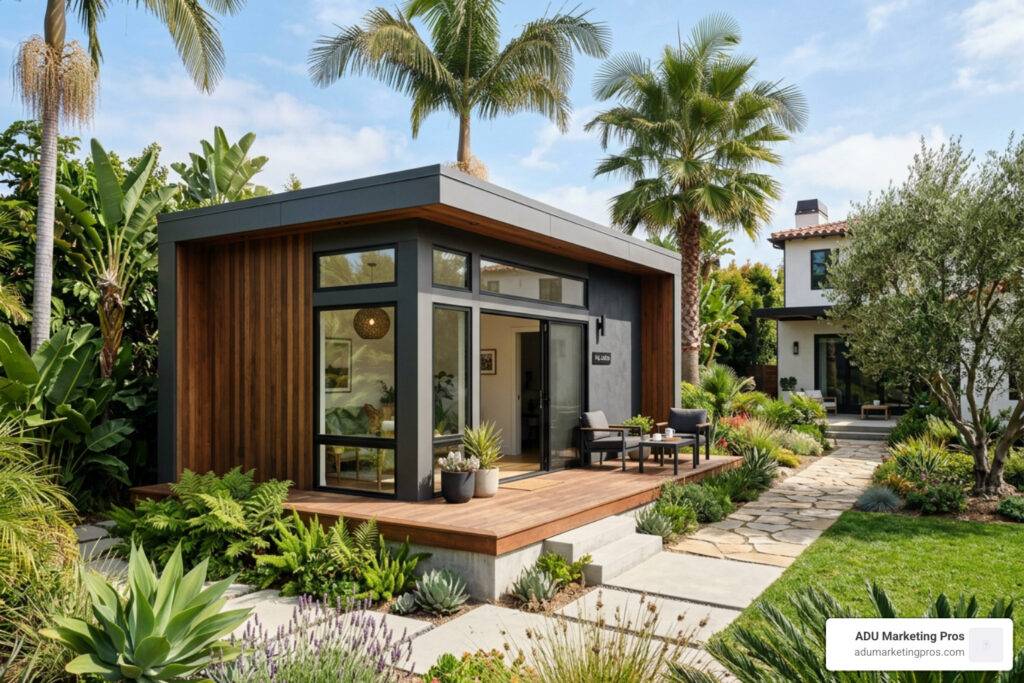
Why Prefab ADU Kits Are Transforming the California Housing Market
Prefab ADU kits are one of the fastest-growing solutions for homeowners who want to add livable space to their property — without the cost, delays, and headaches of traditional construction. In the context of California’s ongoing housing crisis, these units represent more than just a backyard addition; they are a vital tool for increasing density, providing affordable housing for family members, and generating passive income for property owners.
Here’s a quick look at the top options available right now:
| Kit / Brand | Size | Starting Price | Key Feature |
|---|---|---|---|
| ThermoBuilt Craftsman | 368 sq. ft. | $23,900 | Zero Energy Ready, R50 roof |
| Sitka ADU Kit | 405 sq. ft. | $24,582 | Scalable up to 864 sq. ft. |
| prefabADU Micro 150 | 150 sq. ft. | Under $45,000 | Ultra-affordable DIY |
| Wellmade Fillmore 250 | 250 sq. ft. | $184,600 | Turnkey, crane-free install |
| Prefab1 Two-Story | 800 sq. ft. | $239,999 | Permits + install included |
| Abodu Two | 610 sq. ft. | $312,800 | 2 bed, premium finishes |
The Shift Toward Backyard Density
California’s housing crunch has made ADUs more popular than ever. Recent legislative changes, such as SB 9 and SB 10, have effectively ended single-family zoning in many areas, allowing homeowners to maximize the utility of their land. Short-term rental platforms like Airbnb and Vrbo have added another incentive — a backyard unit can pay for itself faster than most homeowners expect, often yielding a 10-15% annual return on investment in high-demand markets like Los Angeles or the Bay Area.
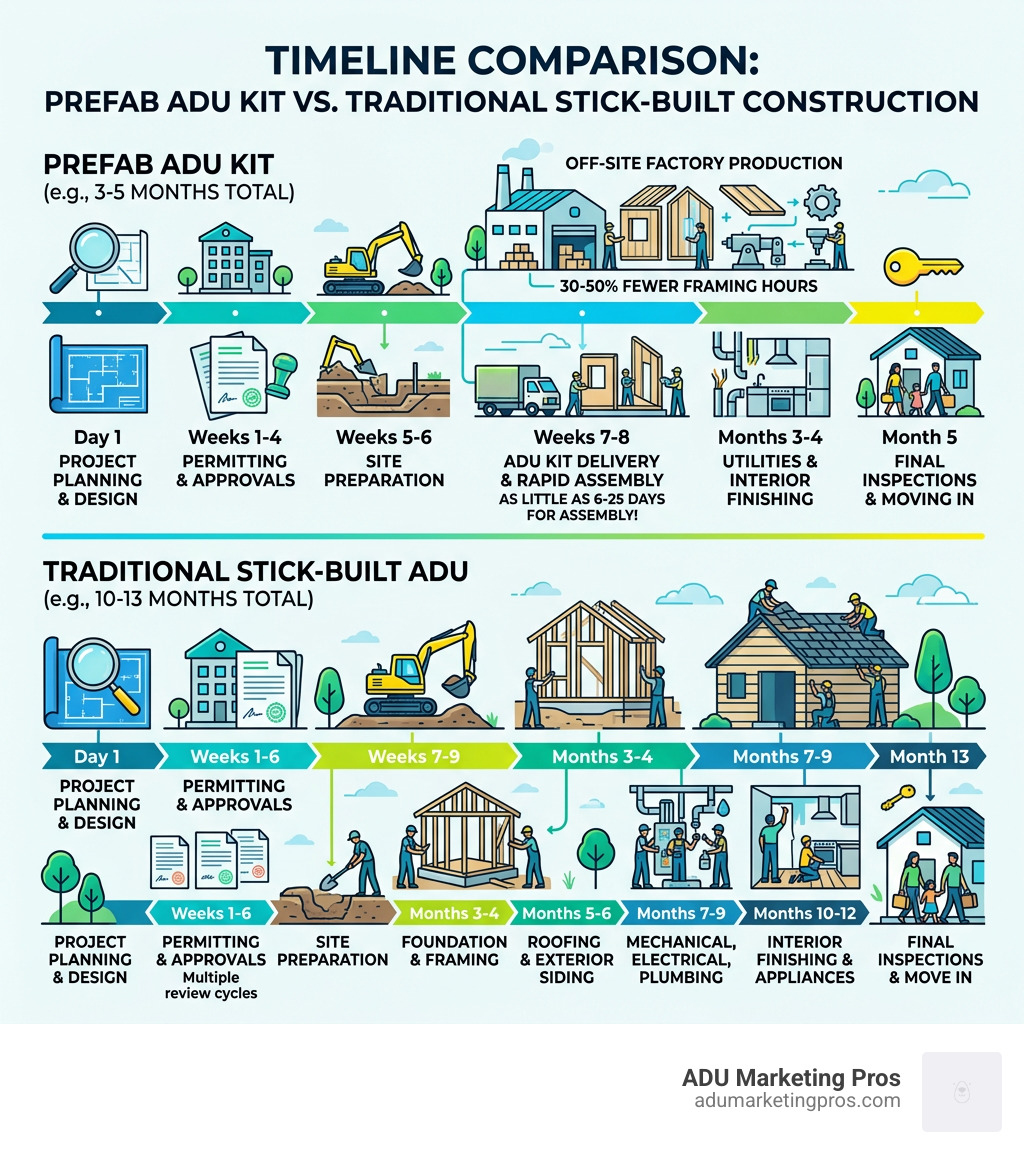
But traditional stick-built ADUs are slow and expensive. They can take 10 to 13 months to complete and require heavy coordination between contractors, designers, and inspectors. The noise, dust, and constant presence of work crews can turn a backyard into a war zone for nearly a year.
Why Prefab is the Future of ADUs
Prefab kits change that equation. Assembly of a modular ADU shell takes as little as 6 to 25 days. Total project time, including finishing, typically runs 3 to 5 months — less than half the time of a conventional build. And because components are precision-cut off-site in a controlled factory environment, prefab builds require 30% to 50% fewer framing hours than conventional construction. This efficiency doesn’t just save time; it reduces the margin for human error and material waste.
The result? A faster, leaner path from empty backyard to finished living space. This guide compares the best prefab ADU kits on the market — covering price, size, construction method, what’s included, and what to watch out for — so you can make a confident, informed decision.
Prefab ADU kits terms explained:
The Ultimate Guide to Choosing Prefab ADU Kits
When we talk about Prefab ADU kits, we are referring to structures where the major components are manufactured in a factory setting before being shipped to your backyard for assembly. This is fundamentally different from “stick-built” construction, where every piece of lumber is cut and nailed on-site, exposed to the elements and potential human error. Factory construction allows for tighter tolerances, better quality control, and a significantly more sustainable building process.
Understanding Prefab Technology Types
There are several types of prefab technology you should know, each with its own set of logistical requirements and benefits:
- Modular ADUs: These are 90% complete when they leave the factory. They arrive as finished “boxes” with flooring, cabinets, and plumbing already installed. They are craned onto a foundation, often in a single day. While fast, they require significant clearance for the crane and delivery truck.
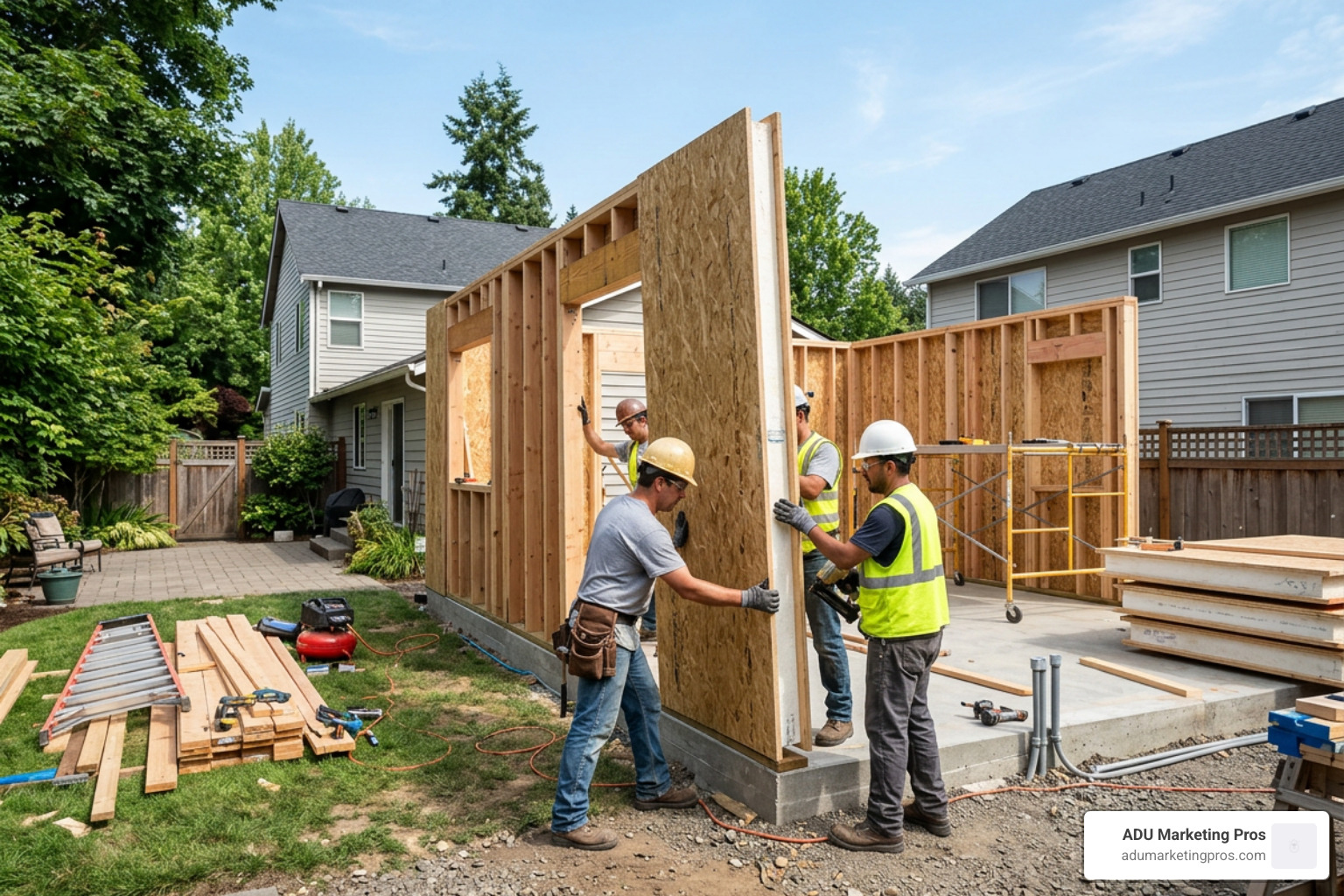
- Panelized Kits: These consist of pre-built wall, floor, and roof panels. They offer a middle ground, allowing for easier transport into tight backyards without the need for massive cranes. The panels are assembled on-site, which takes longer than modular but offers more flexibility for sites with limited access.
- SIPs (Structural Insulated Panels): These kits use high-performance foam cores sandwiched between structural facings (usually OSB). They are incredibly strong and offer superior insulation. SIPs act as both the structure and the insulation, creating a highly airtight building envelope.
Choosing a prefab kit means opting for precision engineering. Many manufacturers use CNC machinery to ensure every joint fits perfectly, often utilizing high-quality materials like Douglas fir or light-gauge steel. This level of accuracy is hard to replicate with traditional site-built methods. As noted in Your Questions About ADUs Answered, choosing the right housing option for your market depends on balancing cost and speed. For many in California, adu-modular-homes-california represent the gold standard for quality control.
Sustainability and Efficiency in Prefab Design
Furthermore, prefab construction is inherently more sustainable. By building in a controlled environment, factories can reduce waste and optimize material use, which is a significant win for eco-conscious homeowners in San Jose or the Bay Area. Traditional construction sites often see 20-30% of materials end up in a landfill; in a prefab factory, that number is often less than 5%.
Key Benefits of Modern Prefab ADU Kits
The most immediate draw of Prefab ADU kits is the bottom line. Because these units require 30% to 50% fewer framing hours, you save significantly on labor costs—often the most expensive part of a California build. In cities where skilled labor is scarce and expensive, this efficiency is a game-changer.
But the savings don’t stop at construction. Modern kits are designed for long-term efficiency:
- Energy Savings: High-performance kits, particularly those using SIPs, can offer up to 60% energy savings compared to standard builds. This is achieved through superior insulation and reduced air infiltration.
- Sustainability: Many manufacturers now offer “carbon-positive” designs. This includes the use of S-SIPs (straw-structural insulated panels) and non-toxic finishes that improve indoor air quality and reduce the carbon footprint of the build.
- All-Electric Design: To stay ahead of California regulations (like Title 24), most top-tier kits are all-electric, utilizing high-efficiency heat pumps for HVAC and water heating, and induction cooktops.
Whether you are looking for modern-prefab-granny-flats for aging parents or a sleek rental unit, the durability and weather resistance of factory-built components ensure your investment lasts for decades.
Construction Methods: SIPs vs. Stick-Built
If you’ve spent any time researching adu-modular-homes, you’ve likely encountered SIPs. Unlike traditional stick-framing, which relies on individual studs spaced 16 inches apart, SIPs provide both the structural frame and the insulation in one cohesive panel.
This eliminates “thermal bridging”—the process where heat escapes through the wooden studs in a wall. The result is impressive insulation values, such as R32 walls and R50 roofs found in premium kits like those from ThermoBuilt.
Beyond energy, SIPs offer:
- Structural Integrity: These panels are significantly stronger than traditional framing, offering better resistance to extreme events like high winds or seismic activity, which is critical in California’s earthquake zones.
- Reduced Pollution: Building off-site reduces air and noise pollution in your neighborhood, keeping your neighbors happy during the short assembly phase. There is no constant sawing or hammering for months on end.
- Less Skilled Labor: Because the panels fit together like a puzzle, they require less specialized (and expensive) labor to dry-in the structure. A small crew can often have the shell of a panelized ADU up in less than a week.
Top Prefab ADU Kit Models and Manufacturers
The market for Prefab ADU kits is diverse, ranging from ultra-affordable DIY shells to high-end, fully finished luxury suites. In California, we are lucky to have some of the industry’s pioneers right in our backyard, pushing the boundaries of what is possible with small-scale architecture.
| Manufacturer | Standout Model | Starting Price | Best For |
|---|---|---|---|
| Abodu | Abodu Two | $312,800 | Premium, turnkey luxury |
| prefabADU | Micro 150 | < $45,000 | Ultra-affordable DIY |
| Wellmade | Fillmore 250 | $184,600 | Tight backyards (No cranes) |
| ThermoBuilt | Craftsman 368 | $23,900 | Energy-efficient shell |
| Prefab1 | Modern 800 | $239,999 | Two-story, 2-bedroom space |
Whether you’re looking for a prefab-granny-flats-in-california-grannys-got-a-brand-new-pad or a modern home office, there is a model designed for your specific needs.
Abodu: The Turnkey Premium Option
For homeowners in Los Angeles or Palo Alto who want a “hands-off” experience, Abodu is a top contender. Their Abodu Two model is a 610 sq. ft., 2-bedroom, 1-bathroom unit that feels remarkably spacious thanks to cathedral ceilings and optional folding panoramic doors. Abodu focuses on a “concierge” service, handling everything from the initial site survey to the final permit sign-off.
What sets them apart is their pricing guarantee. They offer a transparent breakdown, with a base price of $312,800. While upgrades and taxes/fees can add to the total, they ensure no profit is made from permitting fees or project changes. Their units are all-electric and delivered fully finished, making them a popular choice for prefab-adu-los-angeles projects where homeowners value time and design over the lowest possible cost.
prefabADU: Affordable DIY Solutions
Based in the Bay Area, prefabADU focuses on making housing truly affordable. They offer a “You Pick Pricing” model across 12 different plans, ranging from the Micro 150 (150 sq. ft.) to the Barbara (1,000 sq. ft.). This flexibility allows homeowners to choose the level of involvement they want, from a basic shell to a fully managed build.
With starting prices for some kits under $45,000, they are a favorite for the DIY-inclined. They provide comprehensive plans for submittal and in-depth installation guides. Having completed over 170 units, they are experts at navigating California building codes. If you’re searching for a prefab-granny-flat-california, their range of Micro and Villa units offers something for every budget, focusing on functional layouts that maximize every square inch.
Wellmade: The Panelized Specialist
Wellmade (located in San Leandro) solves one of the biggest headaches in ADU construction: backyard access. Many California homes have narrow side yards or overhead power lines that make modular delivery impossible. Their Fillmore 250 starts at $184,600 and utilizes a “prefab panelized” system.
Instead of needing a massive crane to lift a modular box over your house, Wellmade’s panels are hand-carried through standard doorways or side gates. This makes them ideal for modular-granny-flats-california in dense urban areas like San Francisco or Sunnyvale. They offer a full turnkey service, including a virtual site visit and a detailed feasibility study to ensure there are no surprises once construction begins. Their focus on “crane-free” installation opens up ADU possibilities for thousands of properties that were previously considered “unbuildable.”
How to Customize Your Prefab ADU Kits for Maximum ROI
One of the biggest myths about Prefab ADU kits is that they are “cookie-cutter.” In reality, modern 3D modeling and modular manufacturing allow for significant customization. You can flip orientations, add mezzanine spaces, or choose premium finishes like Douglas fir siding and Andersen windows. Customization should be strategic, focusing on features that add the most value to the property.
To maximize your Return on Investment (ROI), consider the primary use:
- Rental Income: Focus on durable finishes (like LVP flooring) and a layout that maximizes privacy for both the main house and the ADU. Soundproofing between units is also a high-value upgrade.
- Home Office: Prioritize natural light with skylights or larger windows and ensure the unit is wired for high-speed internet and multiple power outlets.
- Guest House: Add a deck or a Zen Garden to create an inviting “vacation” feel. Small luxuries like a walk-in shower or a high-end kitchenette can significantly increase the “wow” factor for guests.
In regions like Truckee or high-slope areas in the Bay Area, kits can be engineered for high snow loads or WUI (Wildland-Urban Interface) codes. Understanding the prefab-adu-california-cost is essential for calculating your potential rental yield, especially if you plan to list the unit on Airbnb. A well-designed ADU can often command premium rental rates, rivaling luxury apartments in the same neighborhood.
Cost Analysis and Inclusions for Backyard Kits
Understanding the true cost of an ADU requires looking past the “starting at” price. While a kit like the ThermoBuilt Craftsman starts at $23,900, that price reflects the structural shell, not a finished home. Homeowners must be prepared for the “all-in” cost, which includes everything from the first permit application to the final coat of paint.
Breaking Down the Total Investment
When budgeting, you must account for several distinct categories of expense:
- The Kit Price: The physical components (walls, roof, windows, and doors). This is the most predictable cost.
- Shipping: Can range from a few thousand dollars to significantly more depending on distance and the size of the unit. Modular units are more expensive to ship than flat-packed panelized kits.
- Site Prep: Clearing land, removing trees, leveling the ground, and soil testing. This can vary wildly depending on your backyard’s condition.
- Foundation: Whether it’s a slab-on-grade, a raised foundation, or helical piles. The foundation type is often dictated by soil conditions and local building codes.
- Utility Hookups: Running water, sewer, and power lines from the main house. This is often the most underestimated cost. Wellmade, for example, includes up to 50 feet in their turnkey price, but longer runs or the need for a new electrical panel can add thousands.
Market volatility, particularly in lumber and steel prices, can also impact final costs. It is always wise to check the latest prefab-adu-california-cost data before signing a contract. A 10-15% contingency fund is highly recommended for any construction project.
What’s Typically Included in the Package?
A standard Prefab ADU kit package usually includes the “shell” of the building. This typically encompasses:
- Pre-cut wall and roof panels (often SIPs or steel-framed).
- Insulated framing materials and structural connectors.
- Exterior windows and doors (often dual-pane for energy efficiency).
- Roofing materials and exterior siding.
- Detailed installation plans and sometimes the original plan set for permitting.
Higher-end options like adu-modular-homes-california may also include interior finishes, cabinetry, appliances, and HVAC systems like mini-split heat pumps. It is crucial to get a detailed “Bill of Materials” from your manufacturer so you know exactly what you are buying.
Hidden Costs and Client Responsibilities
Unless you are buying a 100% turnkey solution, you will likely be responsible for several “soft costs” that can add up quickly. According to The big cost of small dwellings, these hurdles are often what surprise homeowners the most.
Common hidden costs include:
- Permit Fees: Paid directly to the city or county. These can range from $2,000 to $15,000 depending on the jurisdiction.
- Structural Engineering Stamps: Required by most California jurisdictions to prove the kit meets local seismic and wind codes. Some manufacturers include this, others do not.
- Energy Calculations (Title 24): California’s strict energy efficiency documentation. This requires a specialized consultant to verify the design meets state standards.
- Impact Fees: Though many small ADUs (under 750 sq. ft.) are exempt from school and park impact fees in California, larger units may trigger these, adding significant cost.
- Property Tax Reassessment: Adding an ADU will increase your property value. While it won’t trigger a full reassessment of your main home, the ADU itself will be taxed based on its value, increasing your annual tax bill.
Navigating Permits and Installation in California
California has become much more ADU-friendly in recent years, with state laws often overriding restrictive local zoning. In cities like San Jose, Los Angeles, and San Diego, the process has been “ministerial,” meaning if you meet the building codes and setback requirements (usually 4 feet from the side and rear property lines), the city must approve your permit. They cannot deny you based on subjective “neighborhood character” arguments.
However, as the San Francisco Chronicle has reported, the “odyssey” to create a modular home can still be arduous if you don’t have the right support. Local planning departments are often overwhelmed, and the technical requirements for utility connections can be complex. This is why many homeowners opt for manufacturers who provide feasibility reports and handle the permit processing on their behalf.
The Importance of a Feasibility Study
Before you buy a kit, you must know if it can actually be built on your lot. A feasibility study looks at:
- Easements: Are there utility lines running through your backyard that you can’t build over?
- Setbacks: Can you fit the unit while maintaining the required distance from property lines?
- Utility Capacity: Can your current electrical panel handle the load of an additional dwelling unit?
- Access: Can a truck or crane get the materials to the site?
The Installation Timeline: From Kit to Keys
One of the greatest joys of a prefab project is the speed. While a traditional build might leave your backyard a muddy construction zone for a year, the on-site “friction” of a prefab kit is minimal. The process is generally broken down into three distinct phases:
- Phase 1: Permitting and Site Prep (2–4 months): While your kit is being manufactured in the factory, your site is being prepared. This includes trenching for utilities and pouring the foundation. This parallel processing is what makes prefab so much faster.
- Phase 2: Shell Assembly (6–25 days): The kit arrives and the structure is dried-in. This is the most exciting phase, as the building seemingly appears overnight.
- Phase 3: Finishing (3–5 months): Electrical, plumbing, and interior finishes are completed. If you bought a modular unit, this phase is much shorter, often just a few weeks for utility hookups and minor trim work.
As many owners of modern-prefab-granny-flats have noted, the process feels like “instant gratification” compared to the slow crawl of traditional remodeling. The predictability of the timeline also makes it much easier to plan for tenants or family members moving in.
Frequently Asked Questions about Backyard ADUs
Are prefab ADU kits considered “Tiny Homes”?
Not usually. In the eyes of the law, “Tiny Homes” are often built to RV codes (ANSI 119.5) and are meant to be mobile. Prefab ADU kits are built to the same California Building Standards Code (Title 24) as a traditional house. They sit on a permanent foundation, are connected to permanent utilities, and are considered permanent real estate improvements that add to your home’s appraised value.
Can I assemble a prefab ADU kit myself?
If you are handy and have a few weeks to spare, yes! Kits from companies like prefabADU are designed to be DIY-friendly, with detailed manuals and pre-cut pieces. However, for adu-modular-homes, we generally recommend professional installation for the foundation and utility connections. Messing up a sewer line or an electrical panel can be a very expensive mistake.
How do I finance a prefab ADU project?
Financing has become much more accessible as banks recognize the value of ADUs. Options include:
- HELOC or Cash-Out Refinance: Leveraging your primary home’s equity is the most common method.
- Renofi Loans: These are innovative loans that allow you to borrow based on the future value of your home with the ADU included, rather than just the current equity.
- Specialized Credit Union Programs: For example, Stanford Federal Credit Union and others offer specific ADU financing for California residents with competitive rates.
Will an ADU increase my property taxes?
Yes, but not as much as you might fear. In California, the addition of an ADU triggers a “blended assessment.” Your main house keeps its Proposition 13 protected value, and only the new construction (the ADU) is assessed at current market value. This results in a much lower tax increase than if the entire property were reassessed.
Do I need solar panels on my prefab ADU?
Under current California building codes, most new detached ADUs are required to have solar panels. However, there are exceptions for units that are heavily shaded or for very small units. Many prefab manufacturers now offer integrated solar packages to make compliance easy and help you reach “Net Zero” energy goals.
Conclusion
Investing in Prefab ADU kits is about more than just adding square footage; it’s about adding flexibility, value, and sustainability to your life. Whether you need an in-law suite in Menlo Park to keep your family close, a quiet home office in Sacramento, or a high-yield rental unit in San Diego, the speed and cost-effectiveness of prefab technology make it the clear winner for the modern backyard.
The transition from traditional construction to factory-built precision is not just a trend; it is a necessary evolution in how we address housing needs in high-density areas. By choosing a prefab kit, you are opting for a process that respects your time, your budget, and the environment.
At ADU Marketing Pros, we understand the unique landscape of the California ADU market. Based in San Jose, we specialize in helping ADU construction and architecture firms stand out by highlighting their expertise and the incredible benefits of these modern building methods. If you are a homeowner ready to transform your backyard, these kits offer the fastest, most reliable path to your dream space. The future of housing is being built in factories today, and it’s ready to be delivered to your backyard.