
The Truth About Whether Are Tiny Houses Legal in California (Quick Answer First)
Are tiny houses legal in California? Yes — but with conditions that vary by location, structure type, and intended use.
Here’s the fast answer most people need:
| Tiny Home Type | Legal in California? | Key Requirement |
|---|---|---|
| Foundation-based (as ADU) | Yes, statewide | Must meet 2022 California Building Code Appendix AQ |
| Tiny Home on Wheels (THOW) | Yes, in many areas | DMV registration + ANSI 119.5 certification |
| Park Model / RV | Yes, in RV parks and many counties | RVIA standards; some counties allow as permanent ADU |
| Standalone primary residence | Depends on local zoning | Must comply with local ordinances and state building codes |
The bottom line: Nearly all of California’s 58 counties allow tiny homes in some form. The state’s ADU-friendly laws have made it easier than ever to build or place one legally. But local rules — not just state law — determine what you can actually do on a specific lot.
California recognized tiny houses statewide under the 2018 International Residential Code (IRC) Appendix Q starting January 1, 2020. Since then, over 60 new housing bills have passed, further streamlining the process. The state also ranks among the top ADU-friendly states in the country.
That said, “legal” doesn’t mean “simple.” Zoning layers, permit requirements, and classification rules still create real complexity — especially for tiny homes on wheels.
This guide breaks it all down clearly so you know exactly where you stand before you build, buy, or invest.
Are tiny houses legal in california vocabulary:
Are Tiny Houses Legal in California? The 2025 Verdict
As of 2025, the short answer is a resounding “yes.” However, we need to look at how the legal landscape has shifted. California is currently grappling with a massive housing shortage, and the state government has responded by passing over 60 new housing bills designed to cut through local red tape. The evolution of these laws has transformed the state from one of the most restrictive to one of the most progressive regarding small-scale living.
One of the most significant updates is SB 477, which works to lower impact fees and streamline the permitting process for smaller dwellings. In the past, a local city council could simply say “no” to a tiny house based on subjective aesthetic tastes. Today, state law mandates a ministerial approval process. This means if your tiny home meets the objective health and safety requirements laid out in the building code, the local government must approve it. They no longer have the “discretionary” power to deny a permit based on personal preference or neighborhood “character.”
The Impact of Recent Legislation (SB 9 and AB 1033)
Beyond basic ADU laws, recent legislation like SB 9 (the California Housing Opportunity and More Efficiency Act) allows for lot splits and up to four units on a single-family lot in many areas. Furthermore, AB 1033 is a game-changer for 2024 and 2025; it allows local municipalities to opt-in to a program that lets homeowners sell their ADUs (including tiny houses on foundations) as separate condominiums. This effectively creates a path for affordable homeownership that didn’t exist five years ago.
We’ve seen a massive surge in interest across our service areas, from the tech hubs of Palo Alto and Mountain View to the bustling streets of Los Angeles. The primary vehicle for this legality is the classification of tiny homes as Accessory Dwelling Units (ADUs). By framing tiny living within the California ADU Regulations, homeowners have gained a powerful legal shield against restrictive local zoning.
Understanding Why Are Tiny Houses Legal in California as ADUs
To understand the legal “why,” we have to look at the statutory definition of a dwelling. Under California law, a tiny house is legally recognized as a “dwelling unit” if it provides permanent provisions for living, sleeping, eating, and cooking.
When you build a tiny house on a permanent foundation on a lot that already has a primary residence, it is regulated as an ADU. This is a game-changer because state law now allows ADUs on almost all single-family lots. Whether you are looking at custom adu designs menlo park or a pre-fab unit in Sunnyvale, the state’s framework ensures that local agencies cannot block these units without a very specific, health-based reason.
Local Ordinances: Where Are Tiny Houses Legal in California?
While state law provides the broad “green light,” local zoning layers still matter. Cities like San Jose and Los Angeles have been pioneers in adopting “Moveable Tiny Home” ordinances. These local rules specify exactly where on a lot a tiny home can sit (setbacks) and how it must be connected to utilities.
Even though state law often “trumps” local zoning, we always advise checking the specific municipal codes for your city. For example, while the state allows ADUs up to 1,200 square feet, some local California ADU Guidelines might have stricter requirements for height or exterior materials to match the main house. The good news? The New ADU Regulations California has implemented recently continue to strip away the ability for cities to impose “owner-occupancy” requirements, making these units even more attractive for investors and multi-generational families alike.
Building Codes, Size, and Foundation Requirements
If you’re building a permanent tiny home, you aren’t just building a shed; you’re building a house. That means you must follow the 2022 California Building Code. The most important section for us is Appendix AQ, which was specifically created to address the unique challenges of tiny houses. This appendix provides relief from standard residential codes that were never intended for 200-square-foot spaces.
Before Appendix AQ, tiny home builders struggled with rules designed for mansions—like requiring massive staircases that would take up half the living room. Now, the code allows for ladders, steeper stairs, and reduced ceiling heights in lofts, provided they meet safety standards. This has opened the door for creative architectural solutions that maximize every cubic inch of space.
Minimum Size Requirements for Habitable Spaces
How small is “too small” in the eyes of the law? According to the 2022 standards, there are specific thresholds that must be met to ensure the health and safety of the occupants:
- One Room: At least one habitable room in the house must have a minimum of 120 square feet of gross floor area.
- Other Rooms: Other habitable rooms (excluding kitchens and bathrooms) must have at least 70 square feet.
- Ceiling Height: Habitable spaces and hallways must generally have a ceiling height of at least 7 feet 6 inches, though lofts have more flexibility. In lofts, the ceiling height can be as low as 6 feet 8 inches in the path of travel.
For those looking at “Efficiency Dwelling Units,” the rules are slightly different, requiring a living room of at least 220 square feet, but the goal remains the same: ensuring the space is actually livable and safe.
Safety Standards and Energy Compliance
California is famous (or perhaps infamous) for its strict building standards, and tiny homes are no exception. Compliance is not optional and is checked during the inspection process.
- Title 24 Energy Standards: Every permanent tiny home must comply with Title 24. This covers insulation, window efficiency (U-factor), and water heating. Many builders now use mini-split HVAC systems and tankless water heaters to meet these goals efficiently.
- Seismic Requirements: Given our location in places like San Francisco and San Jose, your foundation must be engineered to withstand earthquakes. This usually involves specific anchor bolts and shear wall requirements.
- Fire Safety: This is critical. You will need smoke detectors, carbon monoxide alarms, and in many jurisdictions, residential fire sprinklers—even in a 300-square-foot space. If your tiny home is in a Wildland-Urban Interface (WUI) zone, you may also need fire-resistant siding and roofing.
- Egress (Emergency Exit): You must have at least one “emergency escape and rescue opening” (usually a large window) in every sleeping room. The opening must be large enough for a firefighter in full gear to enter and for an occupant to exit safely.
Loft and Stairway Specifications
Appendix AQ specifically addresses lofts, which are common in tiny homes. Lofts must have a floor area of at least 35 square feet and a horizontal dimension of at least 5 feet. Stairways to lofts can be narrower than standard stairs (20 inches wide) and can have steeper risers. Alternating tread devices and ships ladders are also permitted, which is a massive win for space-saving design.
Tiny Houses on Foundations vs. Wheels (THOWs)
This is the “Great Divide” in the tiny house world. Is your home a building or a vehicle? The answer changes everything regarding are tiny houses legal in california. The legal pathway for a structure on a foundation is very different from one on a chassis.
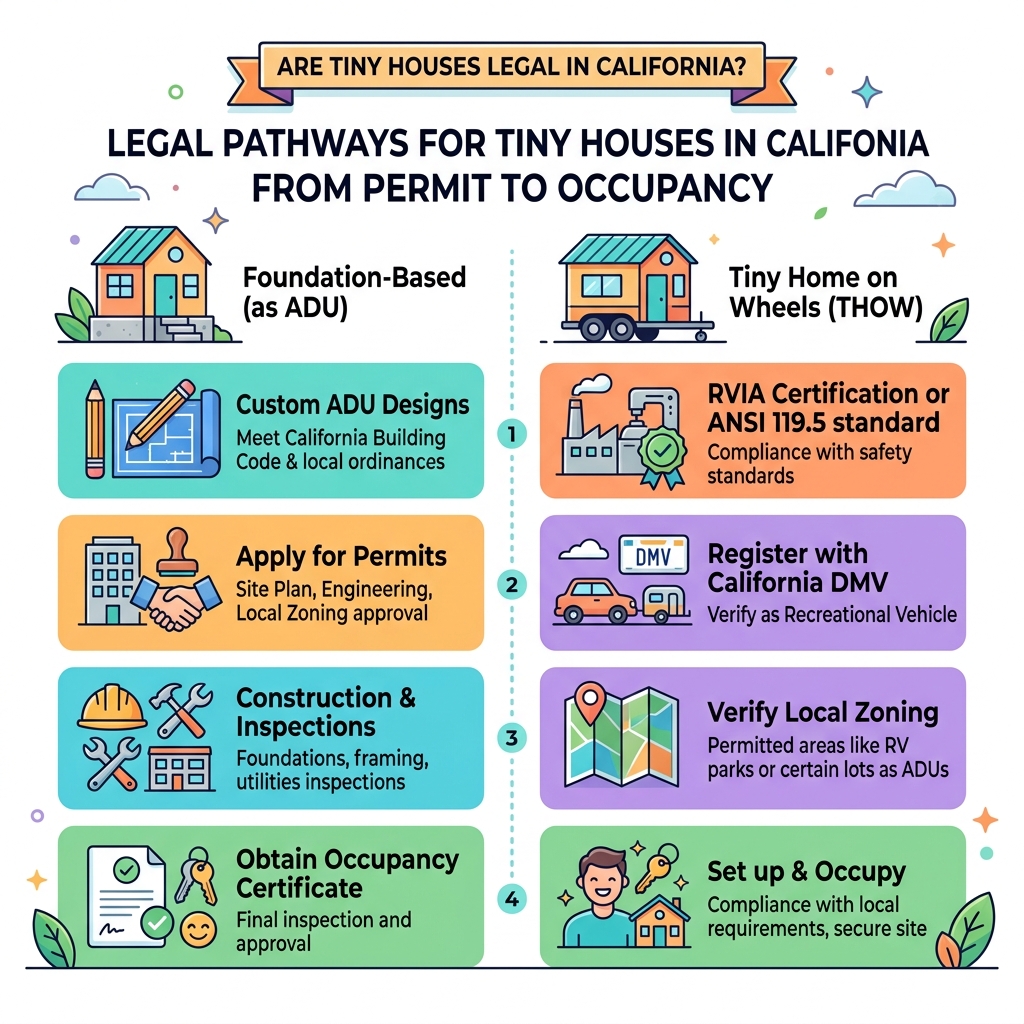
A Tiny Home on Wheels (THOW) is technically classified as a recreational vehicle (RV). A Park Model is a specific type of THOW that is often larger (up to 400 square feet) but still built on a chassis. If you’re wondering about the nuances, our guide on ADU vs Tiny House dives deeper into these distinctions.
The Legal Status of Movable Tiny Houses
For a THOW to be legal in California as a permanent residence, it generally needs to meet two criteria:
- ANSI 119.5 or NFPA 1192 Standards: It must be certified by a third party (like RVIA or NOAH) to show it was built to national safety standards for vehicles. This certification is what separates a “home” from a “homemade trailer.”
- DMV Registration: It must be registered as a trailer or RV with the California Department of Motor Vehicles. You will need to pay annual registration fees, similar to a car or a standard travel trailer.
In cities like Los Angeles and San Diego, you can legally park a THOW in your backyard and live in it full-time as an ADU, provided it’s connected to water and sewer and meets local “skirting” requirements to hide the wheels. However, in other areas, a THOW might only be legal for “temporary occupancy” (often 30 to 180 days). Always check the RVIA Standards to ensure your manufacturer is compliant.
Backyard Placement and Utility Connections
When placing a THOW as a “Movable ADU,” you cannot just run an extension cord from the main house. Most cities require:
- Dedicated Utility Hookups: A proper sewer cleanout connection, a dedicated electrical sub-panel, and a permanent water line.
- Setbacks: Even though it has wheels, it must usually sit at least 4 feet from the rear and side property lines.
- Paving: Some cities require the THOW to sit on a paved or gravel pad rather than bare dirt to prevent sinking and ensure stability.
Converting a THOW to a Permanent ADU
Can you take a tiny house off its wheels and make it a permanent ADU? Yes, but it’s a complex process. You’ll need to:
- Remove the wheels, axles, and the tow hitch (or conceal the hitch).
- Place the unit on a state-approved permanent foundation (like a concrete slab or pier system).
- Install proper skirting that matches the aesthetic of the home.
- Get a “change of use” permit from your local building department, which involves proving the structure meets the California Building Code (not just RV standards). This path is often chosen by homeowners in the San Francisco Bay Area who want the flexibility of a pre-built unit but the legal permanence and property value increase of a standard home.
Local Regulations and Friendly Counties
California is a patchwork of regulations. While we focus on our core areas like San Jose and Los Angeles, it’s helpful to see how other regions compare. The “friendliness” of a county often depends on how desperately they need to solve their local housing crisis.
Northern California: The Tech and Delta Hubs
- San Jose: Often called the “ADU Capital,” San Jose has streamlined the process with “pre-approved” ADU plans and a dedicated help desk. They were among the first to allow Movable Tiny Houses as ADUs.
- Oakland and Berkeley: These cities have very progressive ADU laws, often allowing for higher density on smaller lots. They are particularly friendly to “Junior ADUs” (JADUs) which are units created within the existing footprint of a home.
- Delta Bay (Isleton): This is a unique case. It is the first legal tiny house community in Northern California. It operates more like a high-end RV park but is specifically designed for long-term tiny house living in the beautiful Delta region.
Southern California: The Urban Pioneers
- Los Angeles: Since late 2019, LA has allowed THOWs as ADUs, provided they meet specific size limits (150–430 sq ft). The city has processed thousands of applications, making it one of the most active markets in the country.
- San Diego: They have embraced “Movable Tiny Houses” as a valid way to fight the housing crisis. San Diego’s ordinance is often cited as a model for other cities because of its clarity regarding utility connections and setbacks.
- San Luis Obispo: SLO has implemented a “Tiny House on Wheels” pilot program that has since become a permanent part of their housing strategy.
If you are looking for specific spots, check out our resource on Places in Southern California That Allow Tiny Houses.
Rural and Mountain Communities
- Fresno County: One of the most “tiny-friendly” places in the state. They have clear bulletins for both foundation-based and park model homes, recognizing them as a solution for rural housing needs.
- Tiny House Block (Mt. Laguna): A famous spot near San Diego for those wanting a mountain lifestyle. It offers a community-centric approach where people can rent or bring their own tiny homes.
- Paradise (Butte County): Following the devastating Camp Fire, Paradise became a laboratory for alternative housing. Tiny houses provided a fast, affordable way for residents to return to their land.
Counties with Restrictive or Unclear Regulations
Not every county has caught up to the movement. In Alameda County or San Mateo County, regulations can be more “grey.” You might find that you need a “Special Use Permit” or a zoning variance, which can be costly and time-consuming. In these areas, we strongly recommend sticking to a foundation-based ADU, as the state laws protecting ADUs are much stronger than those protecting THOWs. Without a clear local ordinance for wheels, you are at the mercy of code enforcement officers.
The Financials of Tiny Living
Let’s talk numbers. Living tiny is often a financial decision as much as a lifestyle one. In California, where the median home price often exceeds $800,000, tiny houses offer a rare path to debt-free living or a high-yield investment.
| Feature | Tiny House on Wheels (THOW) | Foundation Tiny House (ADU) |
|---|---|---|
| Average Build Cost | $60,000 – $120,000 | $150,000 – $300,000 |
| Permit Fees | $500 – $2,000 | $5,000 – $15,000 |
| Construction Time | 2 – 4 months | 6 – 12 months |
| Property Tax | Personal Property (DMV) | Real Property (County) |
| Residency Rule | Varies by City | Permanent |
Cost Breakdown: Building vs. Buying
A basic DIY tiny home might cost you $30,000 in materials, but most high-quality, code-compliant units from professional builders start around $80,000. If you’re looking for luxury park models with high-end finishes, quartz countertops, and custom cabinetry, expect to pay $100,000 to $150,000.
Don’t forget the “hidden” costs that can catch first-time builders off guard:
- Utility Connections: Running sewer, water, and power lines to a backyard can cost $5,000 to $15,000, depending on the distance from the main line and the capacity of your existing electrical panel.
- Impact Fees: While SB 477 has reduced these, some cities still charge fees for units over 750 square feet. Units under 750 sq ft are generally exempt from these heavy fees.
- Land Prep: Grading, soil testing, and foundation pouring for a permanent unit can add $10,000 to $25,000 to your budget.
Financing and Insurance for Tiny Homes
Financing a tiny home is different than a traditional mortgage because the collateral (the house) is unique.
- THOWs: Usually financed via RV loans or personal loans. Because they aren’t real estate, you can’t get a 30-year fixed mortgage. Interest rates are typically higher, and terms are shorter (5-15 years).
- Foundation ADUs: Can often be financed through Home Equity Lines of Credit (HELOC), cash-out refinances, or specialized ADU construction loans. These are treated as home improvements and can be rolled into your property’s value.
- Insurance: You’ll need specialty insurance. For THOWs, this is often a hybrid of auto and homeowners insurance (often called “Inland Marine” or specialized RV insurance). For permanent units, it’s usually an add-on to your existing homeowners’ policy, though you must notify your provider of the additional structure.
Return on Investment (ROI)
In markets like Menlo Park or Sunnyvale, adding a tiny house ADU can increase property value by significantly more than the cost of construction. Many homeowners find that the rental income from a tiny house (ranging from $1,500 to $3,500 a month in California) covers their entire primary mortgage, leading to a “house hacking” lifestyle that builds wealth rapidly.
Frequently Asked Questions about Tiny Living
Do I need a permit for a tiny home in California?
Yes. Whether it’s a building permit for a foundation-based unit or a “Temporary Occupancy” or “ADU Permit” for a THOW, you must engage with your local planning department. Building without a permit can lead to heavy fines, an order to remove the structure, and potential issues when you try to sell your property. In some cases, unpermitted units may even be uninsurable.
Can I use a tiny house as an Airbnb or short-term rental?
It depends on your local city. Many cities, like San Francisco and Santa Monica, have strict rules about short-term rentals (STRs). In some areas, ADUs built under certain state grants or using specific density bonuses cannot be used for short-term rentals for a set number of years. Always check your local STR ordinance before planning your business model.
Are there minimum lot size requirements for tiny houses?
State law has largely abolished minimum lot size requirements for ADUs. If you have a legal lot with a primary residence, you generally have the right to add an ADU regardless of the lot’s total square footage, provided you meet setback requirements (usually 4 feet from the side and rear property lines). This has made tiny houses viable even on small urban lots in Los Angeles and Oakland.
Can I build a tiny house myself (DIY)?
Yes, but it must still meet all building codes. If it’s on a foundation, it will be inspected at various stages (foundation, framing, electrical, plumbing, final). If it’s on wheels and you want it to be legal in a city that requires ANSI certification, you may need to work with a certified manufacturer or use a third-party inspection service like NOAH to certify your build process.
How do I handle sewage for a tiny house?
For a legal, permanent tiny house in California, you generally cannot use a composting toilet unless your local jurisdiction specifically allows it (which is rare in urban areas). Most tiny houses must be connected to the municipal sewer system or a permitted septic system. For THOWs, this usually involves a standard RV-style hookup that drains into a legal sewer cleanout.
Conclusion
Navigating the question of are tiny houses legal in california can feel like a full-time job. Between state mandates, local zoning, and building codes, there is a lot to track. But the “Big Truth” is that California has become one of the most welcoming places in the world for tiny living. The combination of Appendix AQ and the state’s aggressive ADU laws has created a legal pathway that was unthinkable a decade ago.
Whether you are looking to house an aging parent, provide a home for a grown child, or create a new stream of rental income, the tiny house movement offers a flexible and sustainable solution. The key to success is doing your homework: understand your local zoning, choose the right foundation or chassis, and ensure you are fully permitted from day one.
At ADU Marketing Pros, we are proud to be based in San Jose, CA, the heart of the ADU revolution. We don’t build the homes—we build the businesses that do. We provide highly specialized digital marketing solutions for ADU construction and architecture firms across Los Angeles, San Diego, and the San Francisco Bay Area.
If you are an ADU builder or architect looking to stand out in this competitive market, we help you showcase your expertise and attract high-quality leads. By staying on top of evolving regulations and consumer behaviors, we ensure our clients are always one step ahead. Ready to grow your revenue and dominate your niche? Let’s talk about ADU Marketing Solutions that actually drive measurable growth and help more Californians find the small-space solutions they need.