
Why Backyard Grannys Price Varies More Than You’d Expect
In the current California housing landscape, the backyard grannys price is a topic of intense discussion and significant financial weight. As homeowners in cities like San Jose, Los Angeles, and San Diego look for ways to combat the housing crisis, secondary dwellings—commonly known as Accessory Dwelling Units (ADUs)—have emerged as a premier solution. However, the financial commitment required to bring these projects to life is often misunderstood, leading to significant budget overruns for the unprepared. The “California Dream” is evolving, and for many, that dream now includes a high-quality, self-contained unit in the backyard to house aging parents, adult children, or to generate much-needed rental income.
California has undergone a legislative revolution since 2020, with state laws like SB 9 and SB 10 making it easier than ever to build in your own backyard. These laws were designed to bypass restrictive local zoning that previously made ADUs nearly impossible to permit. Despite this legislative progress, the cost of construction in the Golden State remains among the highest in the nation due to labor shortages, strict environmental regulations, and the high cost of raw materials. Understanding the nuances of pricing is essential for any property owner considering this investment, as the market is flooded with “budget” options that often fail to account for the reality of California’s building codes.
Here’s a quick breakdown of current market rates for turnkey ADUs in California:
| ADU Type | Starting Price (Shell Only) | Complete Turnkey Price (CA Market) |
|---|---|---|
| Studio / 1-Bedroom | ~$140,000 – $180,000 | $220,000 – $280,000 |
| 2-Bedroom | ~$190,000 – $230,000 | $300,000 – $380,000 |
| 3-Bedroom | ~$240,000 – $280,000 | $380,000 – $480,000 |
| Two-Storey / Custom | ~$300,000 – $350,000 | $450,000 – $600,000+ |
The gap between “starting from” and what you actually pay at handover can be $80,000 to $120,000 or more in California. This difference covers critical “soft costs” such as architectural drafting, structural engineering, Title 24 energy reports, city permit fees, and utility connection upgrades—none of which are typically included in a builder’s base advertised price. Homeowners must also account for the “Solar Mandate,” which requires almost all new detached ADUs in California to have solar panels installed, adding a significant but valuable upfront cost.
So why is there such a big gap? And is the final price actually worth it? For homeowners in high-value markets like Palo Alto, Mountain View, and Menlo Park, the answer is almost always yes. With rental yields in the San Francisco Bay Area reaching record highs and the ability to house multi-generational families, a well-built secondary dwelling is a powerful wealth-building tool. This guide breaks down exactly where the money goes, what drives costs up in the California market, and how to read a builder’s quote without getting caught off guard by hidden expenses. We will explore the technical requirements, the investment potential, and the legal hurdles that define the modern ADU journey.
Understanding the Backyard Grannys Price: Starting vs. Turnkey Costs
When you first start browsing for a secondary dwelling in California, those shiny “Starting From $150,000” banners look incredibly tempting. However, we’ve found that many homeowners in the San Francisco Bay Area and Los Angeles feel a significant amount of “sticker shock” when the final contract arrives. To understand the backyard grannys price structure, we have to distinguish between a base build and a turnkey solution. A base build is often just the “box” itself, while a turnkey solution is a habitable home ready for occupancy.
A “starting price” usually refers to the vertical construction of the unit itself—the walls, roof, and basic interior—on a perfectly flat, clear piece of land. It often excludes the “invisible” work required to make the building legal and functional under California’s strict building codes. In contrast, a turnkey price is the “move-in ready” figure. This includes everything from the initial soil test and topographic survey to the moment you turn the key in the front door. In California, the “invisible” costs can easily account for 30% of the total project budget.
To get a better idea of how these numbers stack up for your specific project, you can use an ADU cost calculator to estimate your potential investment based on California labor and material rates. This tool helps bridge the gap between marketing fluff and construction reality.
| Feature | Advertised “Starting” Price | Actual Complete Turnkey Price |
|---|---|---|
| Design & Drafting | Often Excluded | Included (Architectural & Structural) |
| Permitting & Impact Fees | Excluded | Included (City & School District) |
| Site Preparation | Basic Only | Full Excavation, Grading & Leveling |
| Utility Connections | To 5-10 feet | Full Connection to Mains & Panel Upgrades |
| Internal Finishes | Builder Grade | High-Quality/Ready to Live |
| Inclusions | Minimal | Full Kitchen, Bath, Flooring, HVAC |
The Hidden Costs of “Starting From” Quotes
Why is there such a discrepancy? In California, it comes down to the “unpredictables” and the regulatory environment. No two backyards in Sunnyvale or San Jose are the same. One might have ancient oak trees that require protection, while another might have a significant slope requiring complex drainage. Furthermore, California’s Title 24 energy standards require specific insulation, window ratings, and HVAC efficiencies that are rarely included in a “base” price.
- Site Preparation: This involves clearing old structures, removing trees, or leveling the ground. If your site has poor soil quality, you might need extra piering or specialized foundations to meet seismic requirements. In areas like the Hollywood Hills, site prep alone can cost $50,000 or more.
- Utility Connections: Running sewer, water, and electricity from the main house to the new unit isn’t always straightforward. In many older California neighborhoods, the existing electrical panel must be upgraded to 200 amps to handle the additional load of an ADU, which can cost $3,000 to $5,000.
- Development Impact Fees: While California state law now waives impact fees for ADUs under 750 square feet, units larger than this can trigger significant fees paid to the city to fund local infrastructure like parks and schools. These fees can range from $5,000 to $20,000 depending on the municipality.
- Design and Approval Fees: Navigating the local planning department requires professional planners, architects, and sometimes discretionary review processes, even with the “ministerial” approval mandates currently in place. You are paying for the expertise to get the project through the city’s bureaucracy.
Why Turnkey Packages Offer Better Value
While the upfront number of a turnkey package looks higher, it often saves you money and sanity in the long run. By choosing a builder who manages the entire project from concept to completion, you benefit from a streamlined workflow that minimizes delays. In a market where labor is scarce, having a single point of contact is invaluable.
- Fixed-Price Contracts: You know exactly what the backyard grannys price will be before the first shovel hits the dirt, protecting you from the volatile material costs seen in recent years. This is crucial for financing and peace of mind.
- Project Management: You don’t have to spend your weekdays chasing subcontractors or arguing with city inspectors in Menlo Park or Palo Alto. The builder handles the scheduling of trades and the timing of inspections.
- Quality Consistency: The builder uses a trusted team of tradespeople who understand the specific requirements of California’s Title 24 energy standards and seismic codes. This ensures the unit is built to last and meets all safety requirements.
- Faster Completion: Streamlined processes usually mean construction is finished within 6 to 9 months, including the permitting phase, which is significantly faster than managing separate contractors. Every month saved is a month of potential rental income earned.
Cost Breakdown by Size and Bedroom Count
The size of the unit is the most obvious driver of the backyard grannys price, but it isn’t a linear calculation. A 1,000 sq ft unit isn’t double the price of a 500 sq ft unit because both require the same expensive “wet areas”—the kitchen and bathroom. In California, the cost per square foot often decreases as the unit size increases, but the total investment remains substantial. This is due to the economies of scale; once the foundation is poured and the utilities are run, adding extra square footage of “dry space” (bedrooms and living areas) is relatively cost-effective.
When selecting a layout, look at various granny flat designs to see how space is optimized. In many California jurisdictions, the maximum allowable size for a detached secondary dwelling is 1,200 square feet, though many homeowners opt for the 800-1,000 sq ft range to balance cost and utility. It is also important to consider the “Junior ADU” (JADU) option, which is a unit of no more than 500 square feet created within the walls of a single-family residence.
The 1-Bedroom Backyard Grannys Price and Layout
A 1-bedroom unit or a studio is the entry point for most families and investors in the San Diego and Los Angeles markets. These typically range from 400 to 600 square feet. They are perfect for a single elderly relative or a young professional rental. Because they are often under the 750 sq ft threshold, they avoid many city impact fees, making them the most budget-friendly detached option.
- Price Range: $220,000 to $280,000 (Turnkey)
- Layout: Usually features an open-plan living/dining area, a separate bedroom with a walk-in closet, and a full bathroom with laundry hookups. Smart storage solutions are key in these smaller footprints.
- Value: These are the fastest to permit and build, offering the lowest barrier to entry for investors looking for high cash flow in expensive urban centers. They provide a high rent-to-cost ratio.
2-Bedroom and 3-Bedroom Backyard Grannys Price Variations
The 2-bedroom model is the “gold standard” for California ADUs. It offers the best balance between livability and resale value. It allows for a small family, a couple with a home office, or two roommates to live comfortably. This versatility makes it the most popular choice for long-term rental strategies.
- 2-Bedroom Price: $300,000 to $380,000 (Turnkey)
- 3-Bedroom Price: $380,000 to $480,000 (Turnkey)
One interesting consideration is the maximum secondary dwelling lot size and floor area restrictions. While state law allows for larger units, if you choose a 3-bedroom design within a smaller footprint (like 800 sq ft), you will need to reduce the size of the common areas. This is a popular choice for investors in college towns or high-density areas of the San Francisco Bay Area, where maximizing the number of bedrooms can significantly increase rental income, even if the living space feels more compact. However, for family use, a 2-bedroom layout with a larger living room is often preferred.
Two-Storey Designs and Premium Customizations
If you have a small backyard in a dense area like San Francisco or San Jose, or if you want to preserve your yard space, going up is the answer. Two-storey ADUs are becoming increasingly popular for homeowners who want to maintain their garden or pool while still adding significant living space. They also offer the opportunity for better views and privacy.
- Price Range: $450,000 to $600,000+ (Turnkey)
- Why so expensive? You are essentially building a custom small home. You need structural engineering for the second floor to meet California’s seismic codes, stairs (which take up valuable square footage), additional scaffolding, and more complex plumbing and HVAC systems. However, the architectural appeal and the ability to capture views can significantly boost your property’s overall market value and appeal to high-end tenants.
Key Factors Influencing the Final Build Cost
Beyond size, the physical characteristics of your land play a massive role in the final backyard grannys price. In California, we often tell our clients that what’s under the ground is just as important as what’s on it, especially given the state’s diverse geography and soil conditions. From the clay soils of the East Bay to the sandy terrain of San Diego, every site presents unique engineering challenges that must be addressed during the design phase.
Understanding the accessory dwelling unit costs involves looking at site-specific variables like soil classification, seismic zone requirements, and slope management. California is divided into various Seismic Design Categories, and if your property is near a fault line, your foundation and framing requirements will be significantly more stringent and expensive.
Foundation Choices: Concrete Slab vs. Bearers and Joists
The foundation is the literal bedrock of your investment and a major cost variable. The choice depends largely on the topography of your backyard and the results of your soil report.
- Concrete Slab: This is generally the most affordable and popular option for flat sites in Southern California. It provides excellent thermal mass and a solid feel. However, if the site is sloped, the cost of “cut and fill” (excavating and leveling the earth) can skyrocket due to California’s strict grading regulations and the need for retaining walls. Slab foundations also require all plumbing to be set before the pour, leaving little room for error.
- Raised Foundation (Bearers and Joists): If your backyard in the Hollywood Hills or the hills of Los Gatos looks like a ski slope, this is your best friend. By using a timber or steel sub-floor on piers, you avoid massive excavation costs and complex drainage issues. While the material cost is higher than a slab, the labor and site-prep savings on a steep block often make it the more cost-effective choice. It also allows for easier access to plumbing and electrical systems for future repairs.
Materials, Finishes, and Energy Efficiency
The choices you make during the design phase will ripple through your budget. Opting for premium cladding or stone countertops will obviously increase the cost to build ADU projects, but in California, some “upgrades” are actually mandatory. The state’s commitment to sustainability means that even a “basic” ADU is built to a higher standard than most homes in other parts of the country.
- Energy Efficiency (Title 24): California’s Title 24 requirements are the strictest in the nation. Investing in high-quality insulation, double-glazed windows, and mandatory solar panels might add $15,000 to $25,000 to the build, but it makes the unit much more attractive to tenants and drastically reduces long-term utility costs. Many homeowners opt for all-electric designs to future-proof the building against changing gas regulations.
- Standard Inclusions: Most reputable builders in the San Jose area include luxury vinyl plank (LVP) flooring and standard cabinetry in their base price. LVP is particularly popular for ADUs because it is durable, waterproof, and looks like real wood. If you want high-end hardwood or custom European joinery, expect the price to reflect the premium nature of those materials. Exterior finishes also matter; fire-resistant siding like James Hardie board is often required in Wildland-Urban Interface (WUI) zones.
Investment Potential and Financial Benefits
Is the backyard grannys price worth it? For many California homeowners, the answer is a resounding yes. Whether you are looking for a “positively geared” investment or a way to keep family close in an expensive market, the numbers often stack up better than traditional property investing. In a state where the median home price continues to climb, adding an ADU is often the most cost-effective way to increase your real estate footprint without the need to purchase a new, expensive lot.
When you look at ADU building costs, you have to weigh them against the potential for long-term wealth. Beyond just rent, there are significant depreciation entitlements and tax benefits that can provide massive relief for property owners. While some resources on the topic originate from international markets like Australia where the granny flat trend first exploded, the core principles of property depreciation and value-add remain highly relevant to the US market.
Rental Income and Cash Flow
The California rental market is currently one of the tightest in the world, and self-contained units are in high demand. Tenants are increasingly looking for private, modern spaces rather than shared apartments, and ADUs fit this niche perfectly. This demand translates into strong monthly cash flow for the homeowner.
- Monthly Rent: Depending on your location (especially in areas like San Jose, Palo Alto, or the San Francisco Bay Area), you can expect between $2,500 and $4,500 per month for a modern 2-bedroom ADU. In Southern California, coastal cities like Santa Monica or San Diego command similar premiums.
- ROI: Most owners in high-demand California coastal cities see a return on investment of between 10% and 15% annually. When you consider that the mortgage on a $300,000 ADU might be $2,000 a month, but the rent is $3,500, the “positive gearing” becomes clear.
- Market Statistics: Research shows that renting your secondary dwelling could bank you a significant amount in extra income per week or month, helping to pay down your primary mortgage faster and building equity at an accelerated rate.
Granny Flats vs. Assisted Living Costs
For families looking after elderly parents in California, an ADU is often a much better financial move than a nursing home or assisted living facility. The emotional benefits of keeping family close are immeasurable, but the financial benefits are equally stark. Many high-end facilities in the Bay Area require an upfront Refundable Accommodation Deposit or similar entry fees that can cost hundreds of thousands of dollars, with monthly fees exceeding $6,000.
Instead of giving that money to a facility, you can spend $250,000 on a beautiful, private unit in your own backyard. You keep the asset, your parents keep their independence, and the value of your property increases. In a state where the median home price is nearly $800,000, adding a second unit is one of the most effective ways to increase your net worth while providing a social good. Furthermore, when the unit is no longer needed for family, it can transition into a high-yield rental property, providing a legacy of income for the next generation.
Navigating Legal Requirements and Construction Timelines
One of the biggest contributors to the backyard grannys price in California isn’t the wood or the nails—it’s the red tape. Navigating the legal landscape requires patience and professional guidance, even with the state’s recent efforts to streamline the process. California has passed several “ADU Reform” bills (like AB 68 and AB 881) that limit the ability of local cities to block these projects, but the administrative process remains complex.
The 6-9 Month Construction Journey
A professional ADU build in California typically follows a structured timeline, which is longer than in other regions due to strict inspections and the high volume of permit applications. Understanding this timeline helps manage expectations and financial planning.
- Design and Site Inspection (Weeks 1-6): This phase includes soil tests, topographic surveys, and architectural drafting. It’s the foundation of a successful project. If you skip a proper survey, you risk costly delays later if the city finds a setback violation.
- Approvals and Permitting (Weeks 7-16): Submitting plans to the city planning department. Under California law, cities must act on ADU applications within 60 days, but “acting” often means requesting revisions, which can extend the process. This is where a builder’s experience with local planners is vital.
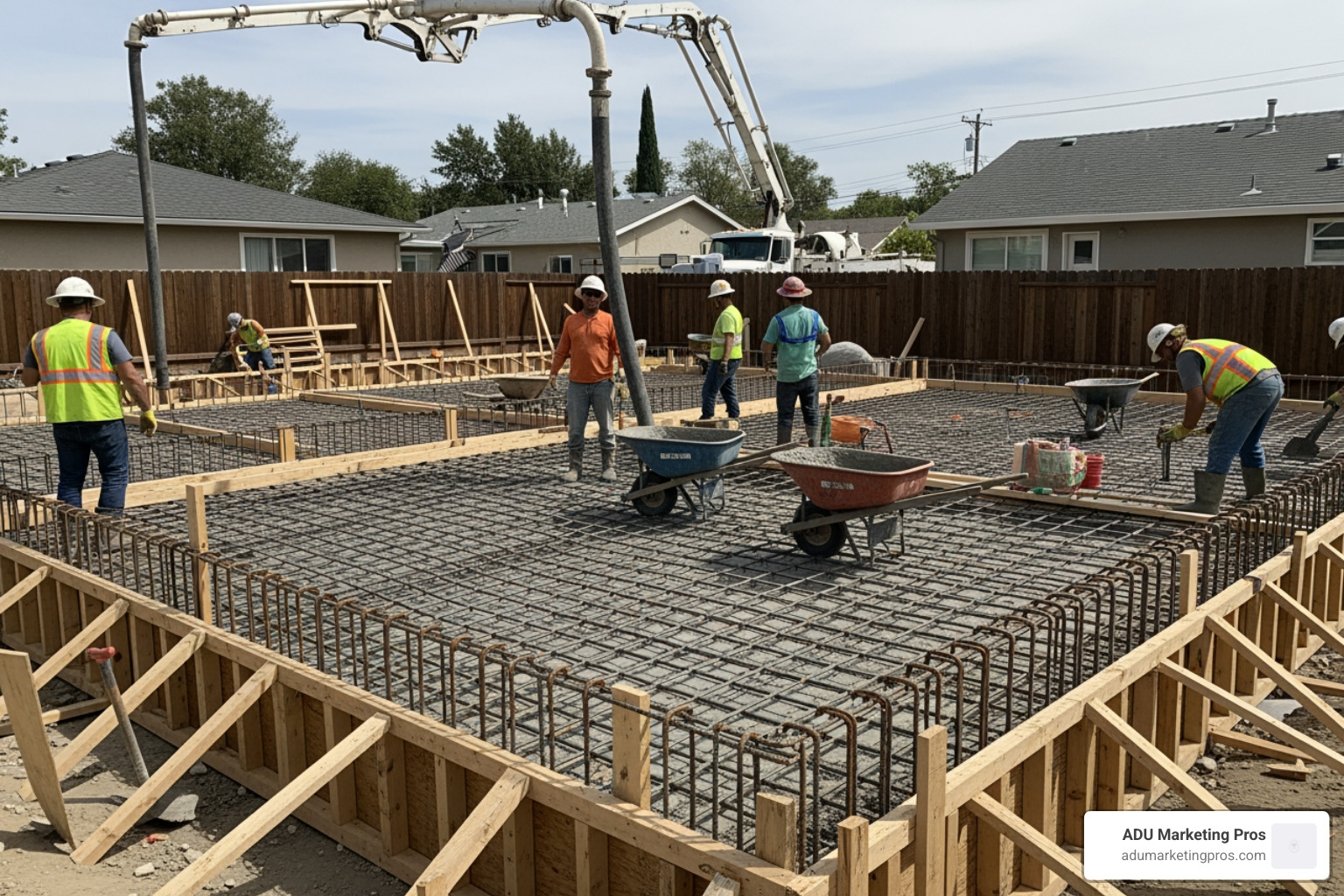
- Site Works and Foundation (Weeks 17-20): Clearing the site, trenching for utilities, and pouring the slab or setting piers. This is the messiest part of the project and requires heavy machinery.
- Construction to Lock-up (Weeks 21-28): Framing, roofing, and external cladding. This is when the accessory dwelling unit costs become most visible as the structure takes shape. Once the unit is “locked up,” internal work can proceed regardless of weather.
- Internal Fit-out and Handover (Weeks 29-36): Painting, tiling, utility connections, and the final building inspector sign-off. The final inspection is a critical milestone, as it allows the unit to be legally occupied.
State-Specific Regulations and Size Limits
Regulations in California have been standardized by the HCD (Housing and Community Development), but local nuances remain. For example, while the “housing crisis” has led to streamlined approvals, homeowners must still adhere to specific local fire codes and utility requirements. The state has made it clear that ADUs are a key part of the solution to the housing shortage.
- Minimum Lot Size: California state law generally prohibits cities from requiring a minimum lot size for ADUs, but setbacks still apply. This has opened up thousands of smaller lots for development that were previously ineligible.
- Floor Area: Usually capped at 1,200 sq ft for detached units, though some cities like San Jose have specific local ordinances that may offer more flexibility or incentives for larger units on larger lots.
- Setbacks: State law mandates a maximum of 4-foot side and rear yard setbacks for ADUs, a major win for homeowners with smaller lots. This allows for much better utilization of the backyard space.
- Historical Trends: Legislative changes in 2016 and late 2023 have mirrored global trends in urban infill, making it easier for homeowners to build secondary dwellings to ease housing shortages in major metropolitan areas. California is now seen as a leader in ADU policy, with other states looking to the Golden State for a blueprint on how to increase housing density.
Frequently Asked Questions about Granny Flat Pricing
How can I reduce the total backyard grannys price?
The best way to save in the California market is to keep the design simple and stay under 750 square feet to avoid development impact fees. Every “corner” or “bump out” in a floor plan adds structural complexity and cost. Stick to a rectangular footprint, use standard materials (like LVP flooring instead of custom tile), and choose a site that is already flat and clear. If you’re handy, you can also take on tasks like landscaping or interior painting yourself after the builder has finished the structural work. Additionally, choosing a “pre-approved” plan from your city’s planning department can sometimes save thousands in architectural fees.
Is a 3-bedroom granny flat worth the extra cost?
It depends on your goal. If you are an investor in a high-rent area like San Diego or Los Angeles looking to rent to a family or a group of roommates, the third bedroom can significantly increase your monthly rent. However, because you are often capped at 1,000 or 1,200 sq ft, you will have a smaller living area. If the unit is for an elderly couple, a 2-bedroom design with a larger, more accessible living space is usually a better choice for long-term comfort. Always consider the “highest and best use” for your specific neighborhood.
Does a granny flat increase property taxes?
In California, a secondary dwelling will trigger a “blended assessment.” This means your primary home’s tax value stays the same (thanks to Proposition 13), but the value of the new ADU is added to your total property value. This usually leads to a moderate increase in property taxes, typically around 1% of the construction cost. If you rent the unit out, it may also affect your tax situation, so we always recommend speaking with a qualified accountant familiar with California real estate law to understand the specific implications for your investment strategy.
Can I finance the backyard grannys price with a loan?
Yes, there are several ways to finance an ADU in California. The most common methods include Home Equity Lines of Credit (HELOCs), Home Equity Loans, and cash-out refinances. Some homeowners also use specialized ADU construction loans, which are based on the “as-completed” value of the property. This is particularly useful if you don’t have enough current equity to cover the full cost of construction. Some local governments also offer low-interest loan programs to encourage the creation of affordable housing.
What is the impact of the California Solar Mandate on price?
Since 2020, California has required solar panels on all new detached ADUs. This typically adds between $8,000 and $15,000 to the backyard grannys price. While this is an added upfront cost, it significantly reduces the utility bills for the occupant and increases the overall value of the property. Some builders offer the option to lease the panels to reduce the initial cost, but most experts recommend purchasing them outright to maximize the long-term return on investment and tax credits.
Conclusion
Understanding the backyard grannys price is about looking past the “starting from” stickers and recognizing the value of a complete, high-quality build in the California market. While $250,000 to $350,000 is a significant investment, the combination of high rental income, property value increase, and family flexibility makes it one of the smartest financial moves a homeowner in the San Francisco Bay Area or Los Angeles can make. The long-term equity gains alone often far outweigh the initial construction costs within just a few years.
At ADU Marketing Pros, we help construction and architecture firms showcase this value to homeowners across California. We believe that in a competitive market, expertise and transparency always win over the “cheapest” quote. If you’re looking to grow your firm and reach more high-quality leads in San Jose, Sunnyvale, or Palo Alto, explore our ADU Marketing Solutions today. Whether you are building in the heart of Silicon Valley or the coastal neighborhoods of San Diego, we are here to help you stand out as the authority in the ADU space and help homeowners realize the full potential of their property.