
Why a Granny Flat Foundation Is the Most Critical Decision in Your ADU Build
Building an Accessory Dwelling Unit (ADU) is a complex undertaking that involves architectural design, permitting, and interior finishing. However, the most critical decision you will make occurs before the first wall is ever framed. A granny flat foundation is the structural base that supports your investment — and getting it wrong can cost you far more than getting it right from the start. In the current construction landscape of April 2026, where material costs are volatile and labor is at a premium, the foundation choice dictates the entire project’s trajectory.
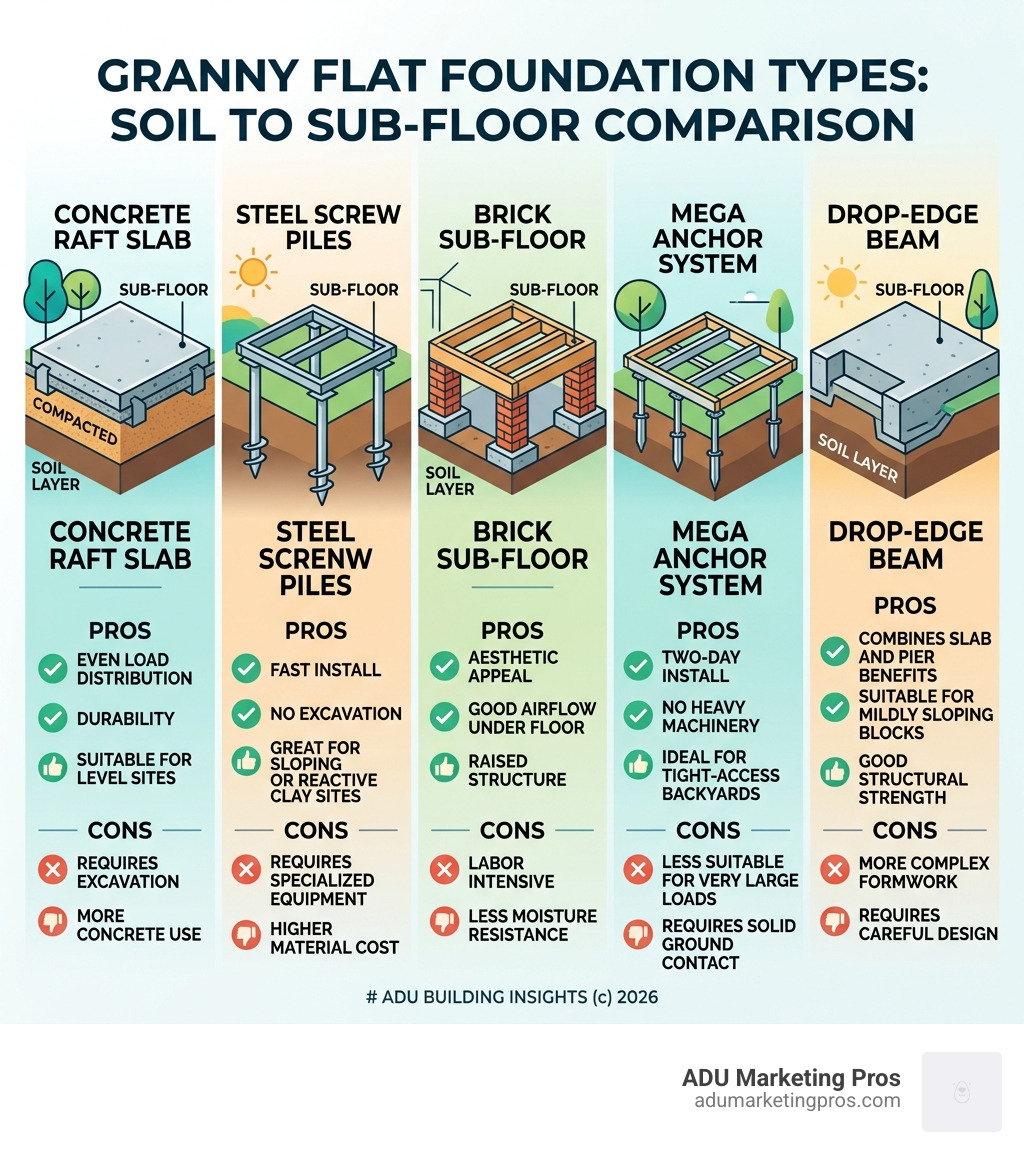
Here’s a quick overview of the primary foundation systems used in modern ADU construction:
| Foundation Type | Best For | Key Benefit |
|---|---|---|
| Concrete Raft Slab | Level, stable sites | Even load distribution, durability |
| Steel Screw Piles | Sloping or reactive clay sites | Fast install, no excavation |
| Brick Sub-Floor | Raised or uneven terrain | Aesthetic appeal, good airflow |
| Mega Anchor System | Tight-access backyards | Two-day install, no heavy machinery |
| Drop-Edge Beam | Mildly sloping blocks | Combines slab and pier benefits |
The foundation type you choose affects everything — build speed, total cost, long-term safety, and whether your project meets local building codes. Most granny flats are built in backyards with limited access, often referred to as “landlocked” sites. That alone rules out several traditional approaches that require heavy machinery. Add in variables like soil type, slope, and the specific weight of the structure, and it becomes clear why foundation selection is far more nuanced than most homeowners expect.
As we navigate the housing demands of 2026, choosing the right foundation from day one is no longer just a structural decision — it’s a financial one. A poorly chosen foundation can lead to structural failure, moisture ingress, and a total loss of property value. Conversely, a well-engineered system provides a stable, energy-efficient base that lasts for generations. This guide breaks down every major foundation system, compares them side by side, and helps you understand which option fits your specific site conditions and budget.
Common Granny flat foundation vocab:
Understanding the Importance of a Granny Flat Foundation
When we talk about building an Accessory Dwelling Unit (ADU) in the San Francisco Bay Area or San Diego, the conversation usually starts with floor plans and finishes. However, the most vital component is hidden beneath the floorboards. The granny flat foundation serves as the anchor for your investment, ensuring that the structure remains level and safe for decades. It is the interface between the man-made structure and the natural earth, and it must be engineered to handle the unique stresses of both.

The Physics of Load-Bearing Capacity
The primary role of the foundation is to manage load-bearing capacity. A professional foundation must support the “dead load” (the weight of the building materials), the “live load” (occupants and furniture), and “environmental loads” (wind, snow, or seismic activity). In California, seismic activity is a major factor for our clients in San Jose and Los Angeles. Without proper engineering, you risk soil subsidence, where the ground sinks or shifts unevenly. This leads to differential settlement, which manifests as cracked drywall, jammed doors, and compromised structural integrity.
Moisture Protection and Thermal Integrity
Moisture barriers are another critical element. In California’s varied climate, preventing ground moisture from seeping into the structure is essential for preventing mold, rot, and termite infestations. A high-quality foundation includes a vapor barrier that prevents capillary action from drawing water into the sub-floor. According to SnapADU, understanding these technical details early in the Adu Building Process is the difference between a seamless build and a logistical nightmare. Furthermore, the foundation plays a role in the thermal envelope of the home. A well-insulated foundation prevents heat loss through the floor, which is vital for meeting California’s strict Title 24 energy requirements.
Structural Warranties and Compliance
A professional foundation often comes with a structural warranty—typically lasting 10 years—offering peace of mind that your secondary dwelling is compliant with strict California building codes. This warranty is not just a piece of paper; it is a guarantee that the engineering has been vetted by local authorities. When you consider the Adu Building Costs, the foundation represents a relatively small percentage of the total spend, yet it carries 100% of the risk if it fails.
Traditional vs. Modern Granny Flat Foundation Systems
Choosing between traditional and modern systems often comes down to site access and environmental impact. Many backyard projects are “landlocked,” meaning heavy machinery like excavators or concrete pump trucks can’t easily reach the build site without destroying existing landscaping, removing fences, or requiring expensive crane lifts. This has led to a surge in modern, low-impact foundation technologies.
| Feature | Concrete Slab (Traditional) | Steel/Screw Piles (Modern) |
|---|---|---|
| Installation Speed | 1–2 weeks (including curing) | 2–3 days |
| Site Impact | High (excavation required) | Minimal (no-dig options) |
| Cost | Moderate to High | Low to Moderate |
| Machinery Needed | Excavators, Pump Trucks | Handheld tools or small drills |
Modern systems have revolutionized Adu Construction Cost by reducing the labor hours required for site preparation. While traditional methods are incredibly sturdy, they often carry a higher environmental footprint due to the carbon intensity of concrete and the need for extensive soil removal and disposal.
The Concrete Raft Slab: A Time-Tested Granny Flat Foundation
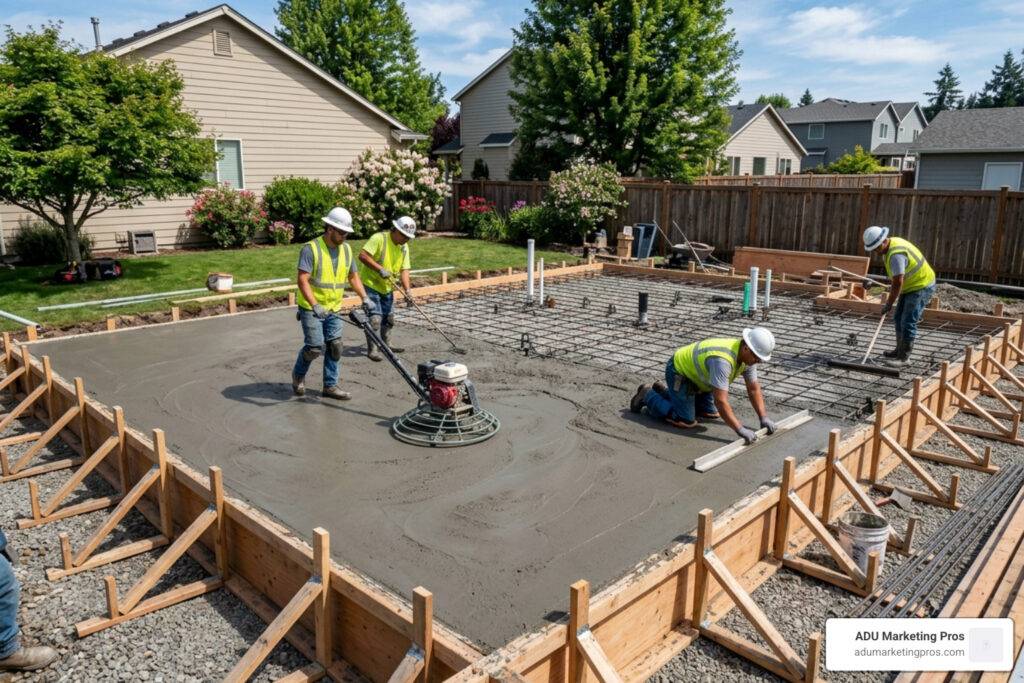
The concrete raft slab remains the “gold standard” for level sites with stable soil. This method involves a monolithic pour where the footings, piers, and slab are created in one single event. For a high-quality granny flat foundation, builders typically use 25MPa concrete reinforced with steel mesh to ensure maximum durability.
One of the greatest advantages of a Concrete Slab is its thermal mass. In regions like Sunnyvale or Mountain View, a concrete slab can absorb heat during the day and release it at night, helping to regulate indoor temperatures naturally. However, slabs require a level site. If your backyard has a significant slope, the cost of leveling the ground and installing retaining walls can skyrocket. Additionally, slabs require specialized termite protection, such as physical barriers or chemical reticulation systems, because cracks in the concrete can provide a hidden highway for pests. As noted in the Slabs vs. Piers comparison, slabs are used in roughly 95% of standard builds where the ground is flat and stable.
Modern Steel and Screw Pile Alternatives
For sites with difficult access or reactive soil, modern steel systems are changing the game. Systems like the GroundPlug® Twister™ allow for a “no-dig” solution. These screw piles work similarly to a giant wood screw, driven deep into the earth to find stable ground strata. This eliminates the need for massive excavation and the removal of tons of dirt.
Alternative systems like Mega Anchor, Uni-Pier, and Surefoot offer incredible speed. In fact, one or two semi-skilled workers can install a Mega Anchor system in just two days using portable equipment. For those looking at a Prefab Granny Flat California, these steel footings are often the preferred choice because they allow the home to be “bolted” onto the foundation almost immediately after installation. According to All Footings Solutions, these steel options are mess-free and ideal for narrow lots where you don’t want a concrete truck idling in your driveway for hours, potentially cracking your main home’s driveway.
Key Factors in Selecting Your Granny Flat Foundation
Selecting the right system isn’t just about what’s cheapest; it’s about what the land allows. We always recommend a thorough site analysis, including a geotechnical report, before committing to a design. This report identifies the soil’s composition and its ability to support weight.
Key factors we consider for our clients include:
- Site Accessibility: Can we get a bobcat into the backyard, or do we need man-portable steel piers? If access is less than 3 feet wide, traditional concrete becomes significantly more expensive.
- Building Weight: A heavy brick-and-mortar ADU needs a different base than a lightweight Modular Granny Flat.
- Local Regulations: Cities like San Jose or Palo Alto have specific seismic and drainage requirements that may dictate foundation depth and reinforcement.
- Future Flexibility: If you might want to relocate the structure later, screw piles are reusable and removable, making them a more sustainable choice.
Soil Type and Reactive Clay Challenges
Soil is rarely just “dirt.” In many parts of California, we deal with reactive clay—soil that expands when wet and shrinks when dry. This movement can snap a standard concrete slab if it isn’t engineered correctly. For these challenging conditions, helical piles or deepened footings are often required to bypass the “active” top layer of soil and anchor the building into stable strata. This prevents differential settlement, where one corner of the ADU sinks faster than the others. Understanding these Adu Building Costs early prevents expensive repairs down the line. Soil is classified from Class A (stable rock) to Class E (extremely reactive), and each requires a specific foundation design.
Sloping Sites and Bushfire Zones
If you are building on a hill in the San Francisco Bay Area, a concrete slab might be impractical due to the sheer volume of fill and retaining walls needed. Instead, we often look at:
- Raised Steel Piers: These allow the ADU to sit “above” the slope, minimizing the need for excavation and preserving the natural drainage of the land.
- Drop-Edge Beams: A hybrid solution that acts as a retaining wall and a foundation in one, allowing for a level slab on a sloping site.
- Brick Sub-Floors: A Brick Sub-Floor provides a traditional look and excellent ventilation, though it requires more manual labor and skilled masonry.
In bushfire-prone areas (common in some California regions), the foundation must also meet specific BAL (Bushfire Attack Level) ratings. This often means enclosing the sub-floor space with fire-resistant materials like fiber cement sheeting to prevent embers from igniting the underside of the Modern Prefab Granny Flat.
Cost and Timeline Implications of Foundation Choices
In 2026, time is money. Labor costs continue to rise, and the longer a crew is in your backyard, the higher the bill. The foundation is the first major phase of construction, and any delays here ripple through the entire schedule.
A traditional slab might seem cheaper on paper, but when you factor in the cost of soil removal, pump truck rental, and the 7–28 day curing time for concrete, modern steel systems often come out ahead. For example, GroundPlug® Twister™ screw piles can be installed in just 5–10 minutes per pile using an impact wrench. This rapid deployment allows the rest of the construction to start immediately, shaving weeks off the total timeline. This is particularly beneficial for homeowners who are financing their build and want to start generating rental income as quickly as possible.
When using an Adu Cost Calculator, ensure you are accounting for “site works.” This includes clearing vegetation, leveling the ground, and managing drainage. If you are doing a Garage Conversion, you might assume the existing foundation is sufficient. However, most garage slabs were never intended for residential living; they often lack the necessary moisture barriers, perimeter footings, or structural reinforcement required by modern residential codes. Upgrading an existing slab can sometimes be more expensive than starting fresh with a new foundation system.
Frequently Asked Questions about Granny Flat Foundations
What is the most cost-effective granny flat foundation in 2026?
For a perfectly level site with easy street access, a concrete raft slab is usually the most cost-effective. However, for 90% of backyard builds in established neighborhoods like Menlo Park or San Diego, adjustable steel pier systems or screw piles are more economical because they eliminate the need for heavy machinery and extensive site prep. You can explore more on Adu Cost Per Square Foot to see how these choices impact your bottom line.
Can I build a granny flat foundation on reactive clay?
Yes, but it requires specific engineering. In reactive clay, you want a foundation that isn’t affected by the soil’s expansion. Screw piles (helical piles) or the Mega Anchor system are excellent because they anchor deep into the ground, bypassing the shifting surface layers. Always start with a professional soil test to determine your soil classification.
How does the foundation impact ADU sustainability?
Sustainability starts with the ground. Concrete has a high carbon footprint. By opting for steel screw piles or “no-dig” systems, you reduce the environmental impact in three ways:
- Less Concrete: Reducing the total volume of cement used, which is a major source of CO2 emissions.
- Minimal Disturbance: Preserving existing trees and root systems in your backyard, which is vital for local ecology.
- Reusability: Steel piles can often be removed and recycled, whereas a concrete slab is permanent and eventually becomes landfill waste. Modern Prefab Granny Flats paired with steel foundations are the pinnacle of eco-conscious ADU construction.
How long does a granny flat foundation last?
A properly engineered foundation should last the lifetime of the building, typically 50 to 100 years. Concrete slabs are incredibly durable but can crack if the soil shifts. Steel systems are galvanized to prevent rust and are designed to withstand the elements for decades. Regular inspections of the sub-floor area (if applicable) can help identify issues like moisture or pests before they become major problems.
Do I need a permit for the foundation alone?
In most California jurisdictions, the foundation is part of the overall building permit for the ADU. You cannot legally pour a slab or install piers without an approved set of plans and a permit from your local building department. Inspections are typically required after the footings are dug but before the concrete is poured or the piles are finalized.
Conclusion
Building a granny flat is a significant investment, and the granny flat foundation you choose today will dictate the health of that building for the next fifty years. It is the literal and figurative base of your project. Whether you opt for the thermal benefits of a concrete slab or the rapid, low-impact installation of a steel screw pile system, the key is professional engineering and site-specific selection. Never cut corners on the foundation; a beautiful kitchen or a modern bathroom cannot compensate for a sinking or cracking home.
At ADU Marketing Pros, we understand that the ADU market is more competitive than ever. We specialize in helping construction and architecture firms in San Jose, San Diego, and across the Bay Area showcase their technical expertise. By focusing on the “boring” but essential details—like foundation integrity—we help firms stand out to homeowners who value quality over the lowest bid.
If you are a builder looking to grow your revenue and attract high-quality leads, we are here to help you scale. Your expertise in building solid foundations deserves a marketing strategy that is just as structurally sound. Explore our insights on Modern Prefab Granny Flats to see how we position our clients as the go-to authorities in the California ADU sector. A solid foundation is the start of every great build, and a solid marketing strategy is the start of every great business.