
Is Converting Your Garage to a Mother-in-Law Suite Worth It?
Converting a garage to a mother-in-law suite is one of the smartest ways to add independent living space to your property — without the cost or disruption of new construction.
Here’s a quick overview of what the process involves:
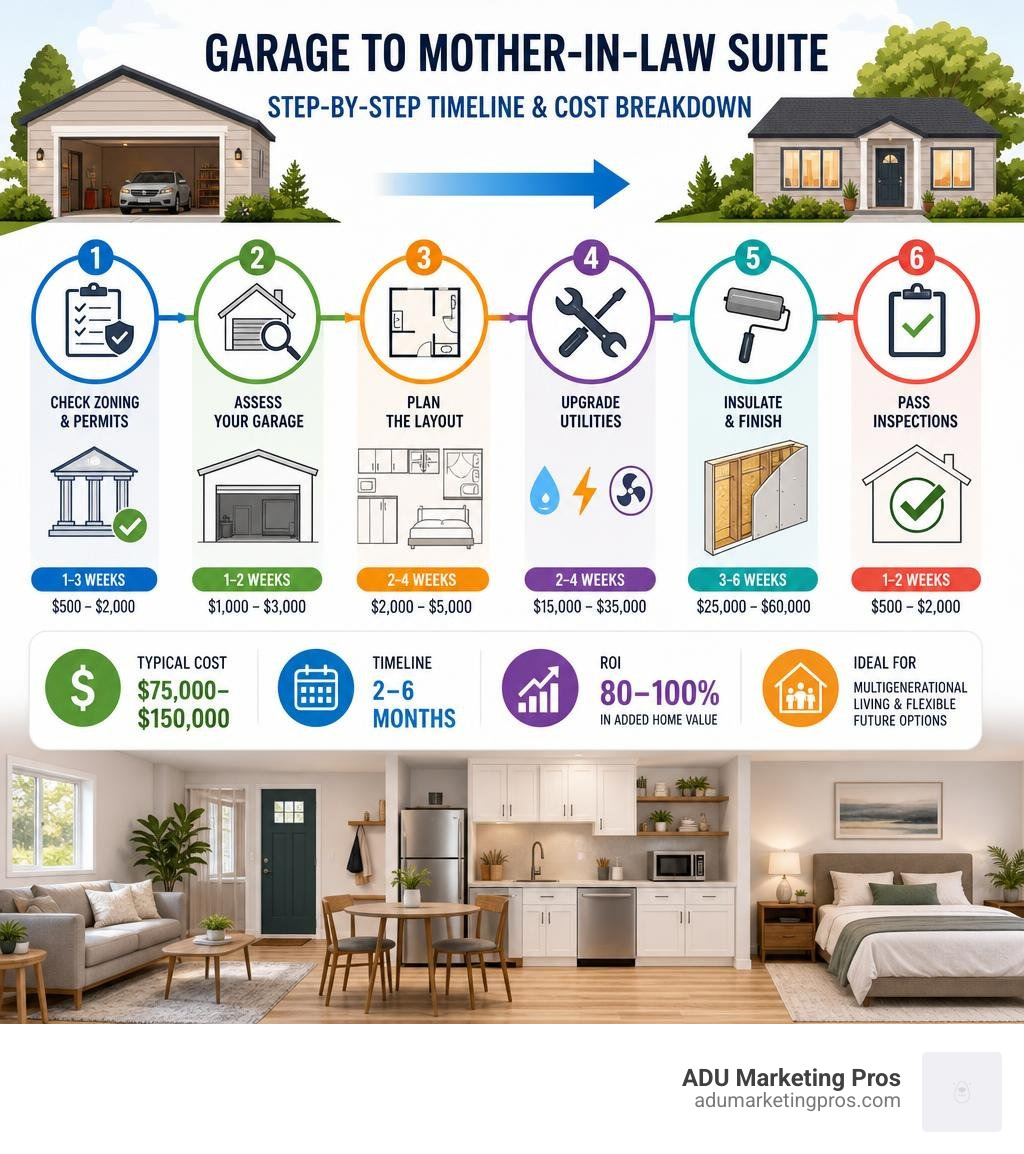
- Check zoning and permits — Confirm your local rules allow a garage conversion ADU
- Assess your garage — Evaluate foundation, ceiling height, and structural condition
- Plan the layout — Include a bedroom, bathroom, kitchenette, and separate entrance
- Upgrade utilities — Add plumbing, electrical, and HVAC systems
- Insulate and finish — Install vapor barriers, drywall, flooring, and windows
- Pass inspections — Schedule required building, plumbing, and electrical inspections
Typical cost: $75,000–$150,000 | Timeline: 2–6 months | ROI: 80–100% in added home value
Nearly 60 million Americans now live in multigenerational households — a number that has quadrupled since the 1970s. Rising assisted living costs (averaging around $59,000 per year) and a tight housing market are pushing more families to look closer to home for solutions.
A garage conversion hits a sweet spot: it uses an existing structure, keeps costs down by 40–60% compared to new construction, and can generate $800–$2,200 per month in rental income if your situation changes.
But getting it right takes planning. Zoning rules, building codes, structural requirements, and design choices all affect how your project turns out — and whether it adds real value to your home.
This guide walks you through every step, so you can move forward with confidence.
Must-know convert garage to mother in law suite terms:
The Benefits of Multigenerational Living in an ADU

Multigenerational living is undergoing a major renaissance across California. From the bustling neighborhoods of Los Angeles and San Diego to the tech-forward suburbs of the San Francisco Bay Area, San Jose, Sunnyvale, Palo Alto, Mountain View, and Menlo Park, families are searching for creative ways to stay connected. Converting an underutilized garage into an accessory dwelling unit (ADU) is one of the most practical answers to this modern housing challenge.
When we look at the soaring costs of senior care, the appeal of an in-law suite becomes instantly clear. Assisted living facilities in California routinely cost upwards of $59,000 annually, with high-end nursing homes easily exceeding $110,000 per year. By investing in a garage conversion, families can redirect those recurring monthly fees into a permanent property asset.
An ADU provides a beautifully balanced lifestyle. It allows aging parents to downsize and live close to their children and grandchildren while maintaining their cherished independence behind their own front door. If you want to dive deeper into how this transition works, check out our guide on From Cars to Comfort: Turning Your Garage Into a Granny Flat.
Beyond the immediate lifestyle benefits, converting your garage dramatically boosts your property value. According to real estate market data, homes with permitted ADUs can be priced up to 35% higher than comparable properties without them. For a comprehensive look at how these spaces are structured, you can refer to the Garage to In-Law Suite Conversion Guide.
Financial Advantages of Converting Existing Structures
One of the most compelling reasons we recommend a garage conversion over building a brand-new, detached backyard cottage is the sheer cost savings. By utilizing the existing foundation, framing, and roof structure, you can expect to save 40% to 60% compared to starting a new construction project from scratch.
Additionally, well-executed garage conversions typically return 80% to 100% of their investment costs in immediate home equity. If the space is ever vacant, it also serves as a powerful engine for passive wealth. Depending on your local market—whether you are in San Jose, Sunnyvale, or San Diego—the rental income potential for a permitted studio or one-bedroom suite ranges from $800 to $2,200 (and sometimes up to $2,500) per month. For a detailed breakdown of these financial dynamics, explore our resource on the Average Cost of Garage Conversion to Granny Flat.
Emotional and Practical Benefits for Families
The financial metrics are impressive, but the emotional return on investment is often what matters most to our clients. Having grandparents living just steps away in a converted garage fosters deep, lifelong bonds with grandchildren and offers built-in, trusted childcare support.
At the same time, it provides adult children with immense peace of mind. You no longer have to worry about long commutes to check on an aging parent or coordinate emergency care from afar. Because the suite is entirely self-contained with its own kitchen and bathroom, everyone enjoys their private retreat at the end of the day. To learn about alternative styles of independent units, see our article on Granny Flats, Guest Houses, and More: Your Guide to Prefab In-Law Suites.
How to Convert Garage to Mother-in-Law Suite

The journey to convert garage to mother in law suite begins with a clear understanding of your local regulatory landscape. Because our focus is strictly on California communities like Los Angeles, San Diego, and the San Francisco Bay Area, we have a unique advantage. California has some of the most progressive ADU laws in the nation, which heavily favor homeowners looking to convert existing garages.
State legislation has stripped away many of the traditional hurdles. For example, in most cases, municipalities can no longer force you to replace the off-street parking spaces you lose when you convert your garage. However, you must still navigate local building permits, zoning ordinances, and specific homeowner association (HOA) rules.
Before swinging a single hammer, you must submit detailed architectural plans to your local planning department. These plans must demonstrate compliance with strict state and local building codes, including structural integrity, fire safety, and energy efficiency standards. Working with a team that understands these nuances is critical. To learn more about the legal distinctions and processes, read our breakdown on Garage Conversion to ADU.
Budget and Cost to Convert Garage to Mother-in-Law Suite
While a garage conversion is highly cost-effective, it is still a major construction project that requires realistic budgeting. On average, homeowners in California can expect to invest between $80,000 and $120,000 for a standard two-car garage conversion, with high-end custom projects ranging up to $150,000.
To help you visualize where the money goes, here is a breakdown of the typical costs associated with these projects:
| Expense Category | Typical Cost Range | Percentage of Budget |
|---|---|---|
| Soft Costs (Design, Engineering, & Permits) | $3,500 – $14,000 | 5% – 10% |
| Structural & Site Work (Foundation, Framing, Openings) | $15,000 – $30,000 | 20% – 25% |
| Plumbing & Electrical Upgrades | $12,000 – $25,000 | 15% – 20% |
| HVAC Installation (Ductless Mini-Split) | $3,000 – $8,000 | 4% – 8% |
| Insulation & Drywall | $5,000 – $10,000 | 6% – 10% |
| Interior Finishes (Flooring, Cabinets, Fixtures) | $20,000 – $50,000 | 25% – 35% |
It is important to note that labor makes up roughly 50% to 60% of your total budget. Additionally, detached garages generally incur higher plumbing costs because new sewer and water lines must be trenched across your yard. For more details on budgeting for a two-car space, read the comprehensive guide on Converting a 2-Car Garage Into an ADU.
Layout and Design Ideas to Convert Garage to Mother-in-Law Suite
A standard two-car garage provides roughly 400 to 600 square feet of blank-canvas space. Maximizing this footprint requires intelligent, deliberate design.
Here are the three most popular layout configurations:
- The Studio Layout: An open-concept design where the living area, kitchen, and bedroom flow together seamlessly. This layout maximizes the feeling of spaciousness and is highly cost-effective.
- The One-Bedroom Layout: By adding a single partition wall, you can separate the sleeping quarters from the living space. This is ideal for privacy and mimics a traditional apartment.
- The Open Plan with Defined Zones: Utilizing partial dividers, double-sided bookshelves, or smart furniture placement to create distinct “zones” for cooking, relaxing, and sleeping without blocking natural light.
To make the space feel larger, we highly recommend vaulting the ceiling to expose the roofline if your garage’s framing allows it. Additionally, replacing the old garage door with a large glass slider or a series of French doors will flood the suite with natural light and establish a beautiful connection to the outdoors. For a deep dive into double-car layouts, see The Ultimate Guide to Double Garage Granny Flat Conversions.
Essential Structural, Utility, and HVAC Upgrades
Garages are originally built to house vehicles and lawnmowers, not people. Transitioning these structures into comfortable, code-compliant homes requires major behind-the-scenes upgrades.
Foundation and Structural Integrity
First, we must evaluate the concrete slab foundation. Garage floors are often poured with a slope toward the door to allow water drainage, and they rarely contain the vapor barriers required for residential spaces. To fix this, contractors must level the floor using self-leveling underlayment or by pouring a new topping slab, and apply a high-quality moisture barrier before laying down finished flooring.
Additionally, we must ensure your garage meets the minimum residential ceiling height requirements—typically 7 to 7.5 feet of finished clearance. If your current joists are too low, structural modifications to the roof framing, such as raising the collar ties or installing engineered trusses, may be necessary. To read more about transforming these structures, check out How to Turn Your Double Garage Into a Deluxe Suite.
Plumbing and Electrical Infrastructure
Plumbing is often the most complex and expensive phase of a garage conversion. To support a fully functional kitchen and bathroom, we must run new water supply lines and connect to your home’s existing sewer main. This often involves trenching through the concrete slab or the backyard. A smart design trick to minimize these costs is to place the kitchen and bathroom back-to-back along a shared plumbing wall, which concentrates the wet walls in one area.
On the electrical side, a standard garage circuit is entirely inadequate for a modern living space. You will need to install a dedicated electrical subpanel (typically 100 amps) within or near the suite. This ensures the occupant can safely run appliances, lighting, and HVAC systems without overloading your main home’s electrical panel. For an expert look at setting up these utilities safely, see Building a Mother-In-Law Suite: A Practical Guide.
Insulation, Drywall, and Climate Control
To comply with California’s strict Title 24 energy standards, your converted garage must be exceptionally well-insulated. This means installing high-R-value insulation in the walls, ceiling, and beneath the finished flooring. Proper insulation also acts as an excellent sound barrier, which is essential if the garage shares a wall with the main house.
For climate control, we almost always recommend a ductless mini-split HVAC system. These units are incredibly energy-efficient, whisper-quiet, and allow the occupant of the suite to control their own heating and cooling independently from the main house. If you are starting with a smaller space, you can read our guide on how to Convert Single Garage to Granny Flat.
Designing for Accessibility, Privacy, and Comfort
When we design a mother-in-law suite, we look far beyond basic construction requirements. We focus heavily on “universal design”—creating a space that is safe, comfortable, and accessible for individuals of all ages and mobility levels. Planning for these features during the initial framing phase is incredibly cost-effective and prevents expensive retrofitting down the road.
Universal Design and Accessibility Features
Key accessibility features to include:
- Step-Free Entryways: Ramps or flush thresholds that eliminate tripping hazards at the entrance.
- Wide Doorways: Ensuring all interior and exterior doors are at least 32 to 36 inches wide to comfortably accommodate walkers or wheelchairs.
- Curbless Showers: A walk-in, roll-in shower design with slip-resistant flooring, integrated bench seating, and hand-held showerheads.
- Wall Reinforcement: Installing solid wood blocking behind the bathroom drywall during construction so grab bars can be easily and securely mounted whenever they are needed.
- Lever-Style Handles: Replacing traditional round doorknobs and faucets with lever-style handles that are much easier to operate for individuals with arthritis or limited hand strength.
Soundproofing and Privacy Solutions
To ensure long-term comfort, privacy must also be prioritized. If your garage is attached, we recommend using advanced sound-dampening drywall and double-stud wall assemblies along the shared wall. This prevents noise transfer between the main house and the suite, allowing both households to maintain their daily routines without disruption.
Strategic window placement is another vital design tool; by positioning windows to face private side yards or garden patios rather than your main home’s high-traffic outdoor spaces, you create a peaceful sanctuary for everyone on the property. For creative inspiration on optimizing these spaces, explore Unleash Your Home’s Potential: Top Ideas for Converting a Garage Into Living Space.
Frequently Asked Questions About Garage Conversions
Do I need a permit to convert my garage into a living space?
Yes, absolutely. In California, converting a garage into a habitable living space without a permit is illegal and highly risky. Unpermitted conversions can lead to severe code enforcement fines, complicate your ability to sell your home, and void your homeowner’s insurance policy in the event of a fire or water damage. Obtaining proper building, plumbing, electrical, and mechanical permits ensures your mother-in-law suite is safe, legal, and fully recognized in your home’s official square footage.
How does a garage conversion affect my property taxes and home value?
A permitted garage conversion will increase your property value, which in turn can lead to a minor reassessment of your property taxes. However, under California law, your entire home is not reassessed at current market value. Instead, the county assessor will typically perform a “blended assessment,” adding only the construction value of the new ADU to your existing tax base. This tax increase is usually very small compared to the massive boost in equity and potential rental income the suite provides.
What are the parking and storage alternatives when losing a garage?
Losing your garage means finding new homes for your cars, tools, and holiday decorations. For parking, you can utilize your existing driveway, install a stylish carport, or rely on street parking (where permitted by your local municipality or HOA). Under current California ADU laws, you are generally not required to replace the off-street parking spaces lost during a garage conversion if your property is located within a half-mile of public transit. For storage, we recommend installing a dedicated backyard shed, maximizing attic space in your main home, or incorporating clever built-in storage solutions—like floor-to-ceiling closets and overhead racks—directly into the design of your new suite.
Conclusion
Converting your garage into a mother-in-law suite is one of the most rewarding home improvement projects you can undertake. It creates a beautiful, functional space that preserves family closeness, protects independent living, and builds substantial financial equity right in your backyard.
While the construction process requires careful planning—from securing permits in San Jose to upgrading plumbing systems in San Diego—the long-term benefits of multigenerational harmony are priceless.
If you are an ADU builder, designer, or contractor looking to connect with homeowners who are ready to take this step, we can help. At ADU Marketing Pros, we specialize in helping ADU construction and architecture firms stand out in California’s competitive market. We build high-impact marketing strategies that highlight your unique expertise, helping you attract high-quality leads and grow your business.
Ready to elevate your business? Transform Your Property with ADU Marketing Pros and let us help you build the connections that matter.