
The Smartest Way to Build More Living Space on One Block
As urban land becomes increasingly scarce and property prices continue to climb across major metropolitan areas, homeowners and property investors are seeking smarter ways to maximize the utility of their land. A double storey house with attached granny flat represents one of the most innovative and efficient architectural solutions available today. This dual-living configuration allows you to construct a spacious, premium family home while simultaneously integrating a fully self-contained secondary dwelling under the exact same roofline.
Quick answer: What is a double storey house with attached granny flat?
| Feature | Details |
|---|---|
| What it is | A two-storey main home with a self-contained dwelling attached at ground level or side |
| Who it suits | Multi-generational families, investors, homeowners wanting rental income |
| Typical size | 180m² to 350m²+ total floor area |
| Granny flat size (NSW) | Up to 60m² |
| Minimum lot width | From 14.5m depending on design |
| Value added | 5% to 20% increase in property value |
| Key benefit | Two independent living spaces on a single title |
Whether your goal is to provide a comfortable, step-free home for aging parents, offer your adult children a private launchpad as they save for their own first home, or generate a reliable stream of rental income to offset your mortgage, this integrated dual-living format delivers exceptional results. Best of all, it achieves these goals without sacrificing your entire backyard—a common drawback of traditional, detached backyard granny flats.
In Australia, the demand for secondary dwellings is surging. Driven by a combination of housing affordability challenges, changing demographic structures, and a growing preference for multi-generational living, leading home builders have completely reimagined what a secondary dwelling can be. Gone are the days of the poorly insulated, detached backyard “granny cabin” that looks like an afterthought. Today’s leading designs integrate the secondary dwelling seamlessly into the primary structure from day one, ensuring cohesive aesthetics, shared structural efficiencies, and optimized privacy.
However, the difference between an exceptional dual-living property and a frustrating one always comes down to the details of planning, privacy zoning, and smart floor plan design. This comprehensive guide explores the benefits of multi-level dual occupancy, analyzes the financial and regulatory landscapes, and highlights some of the best builder designs currently on the market.
Important double storey house with attached granny flat terms:
Why Choose a Double Storey House with Attached Granny Flat?
When you choose to build upward rather than outward, you unlock a completely different level of property potential. On typical suburban blocks, backyard space is at an absolute premium. Traditional detached granny flats require significant rear setbacks and often consume the entire backyard, leaving no room for children to play, pets to roam, or for the installation of outdoor entertaining areas like decks, gardens, or swimming pools. Opting for a double storey house with attached granny flat allows you to preserve your precious outdoor living areas while still gaining a fully functional, independent secondary residence.
Integrating the secondary dwelling directly into the main building envelope also yields significant cost efficiencies during the construction phase. By sharing structural elements—such as a single, continuous roofline, a unified concrete slab foundation, and shared structural framing—you can dramatically reduce overall site preparation and construction expenses compared to building a completely detached backyard structure. Furthermore, utility connections (water, sewer, electricity, and gas) can be run from a centralized point, avoiding the expensive trenching and independent service runs that detached units require. This shared infrastructure not only lowers initial capital expenditure but also simplifies ongoing maintenance.
From an environmental perspective, an integrated double-storey design is inherently more sustainable. Shared walls and floors act as thermal buffers, reducing heat loss in winter and heat gain in summer. This natural insulation effect lowers the overall energy consumption of both households, leading to reduced utility bills and a smaller carbon footprint. Additionally, consolidating two homes into a single footprint minimizes soil disruption and preserves local biodiversity by leaving more of the natural ground uncovered.
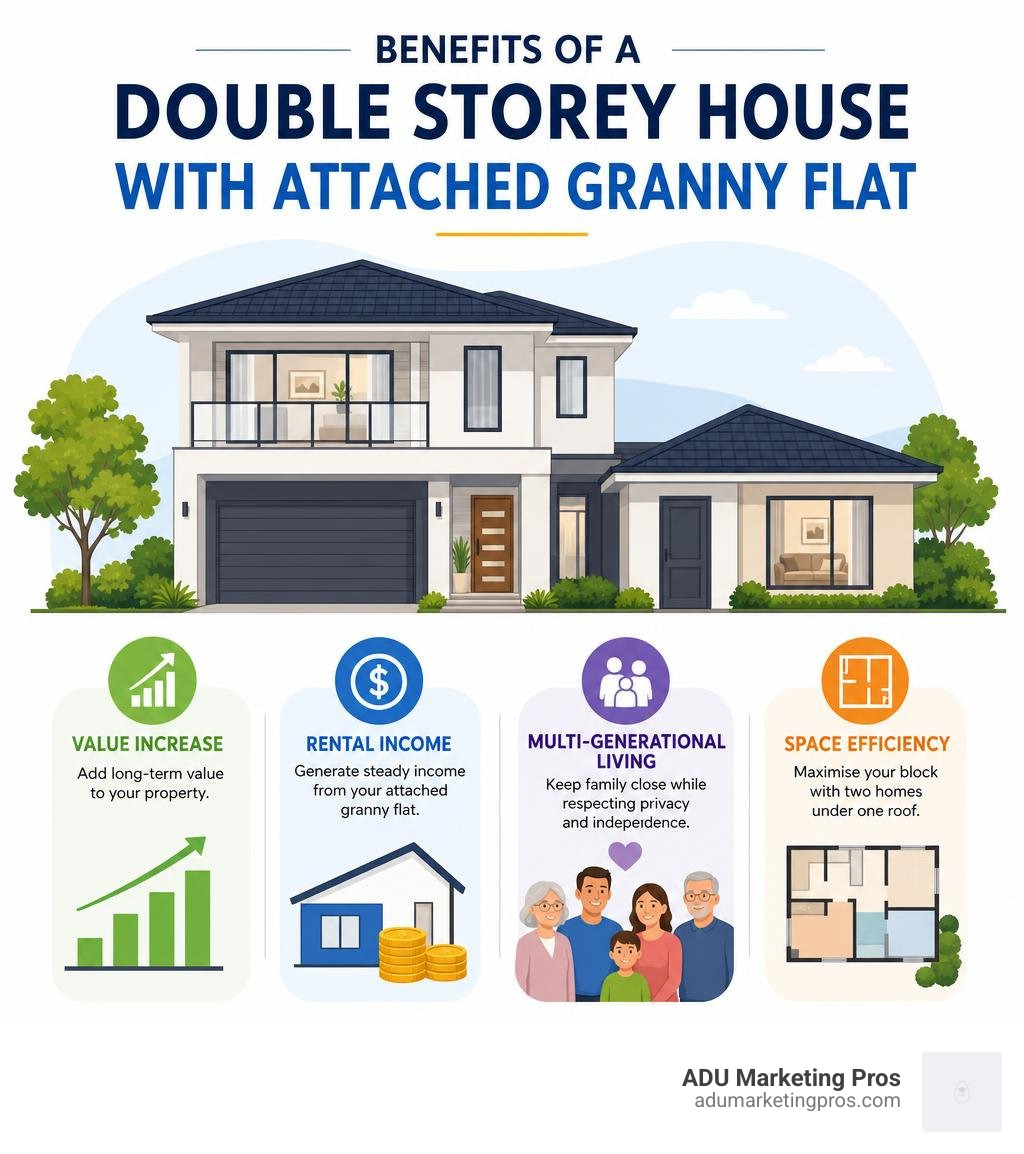
Property valuation is another major driver for this style of build. Real estate data consistently demonstrates that integrating an attached granny flat can boost your property’s overall market value by anywhere from 5% to 20%, depending on the location and quality of the build. This makes it a highly lucrative strategy for long-term wealth building. Whether you plan to leverage the equity to expand your investment portfolio or sell the property down the track to buyers seeking multi-generational living solutions, an integrated double-storey design represents a premium asset that stands out in any market.
Maximising Space and Privacy: Key Floor Plan Features
The ultimate success of a dual occupancy home hinges on how well it balances connection with independence. A poorly thought-out floor plan can make both residences feel cramped, noisy, or awkwardly exposed to one another, leading to friction between occupants. Successful designs rely on smart architectural zoning to ensure absolute peace, quiet, and privacy for both households.
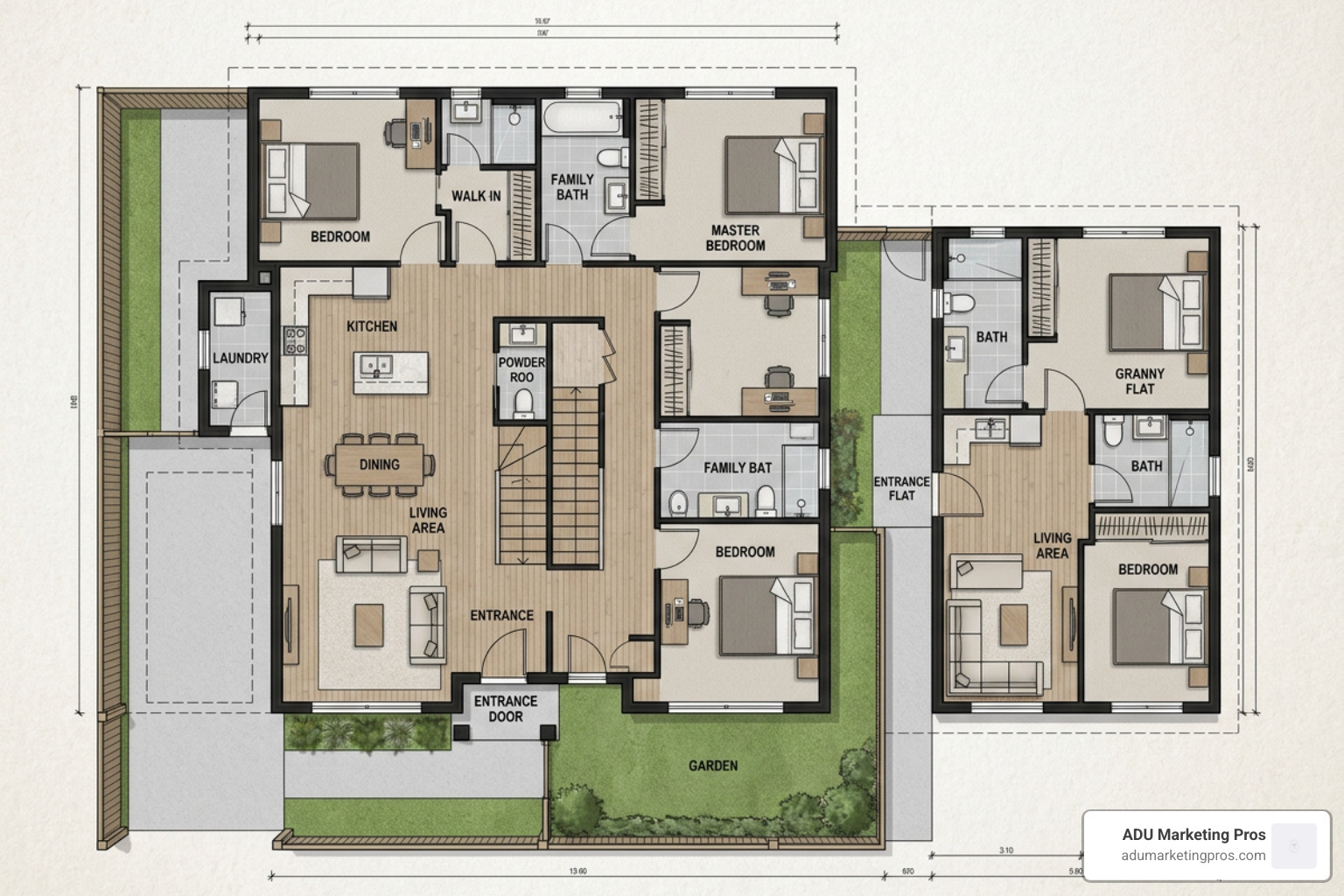
- Separate Entrances: To maintain true independence, the granny flat must have its own dedicated external entry. This ensures that tenants, guests, or family members can come and go at any hour without walking through the main home’s living areas or disturbing the primary household. Ideally, this entrance is located on a different side of the home or accessed via a dedicated, landscaped pathway with independent lighting.
- Acoustic Zoning: Shared walls should ideally be placed against low-activity zones of the main house, such as garages, laundries, walk-in wardrobes, or hallways, rather than bedrooms or primary living areas. Utilizing double-stud walls, high-performance acoustic insulation batts, and fire-rated plasterboard is essential to prevent sound transmission between the two homes. Achieving a high Sound Transmission Class (STC) rating ensures that daily activities in one home do not disrupt the peace in the other.
- Strategic Window Placement: Windows in the granny flat should face away from the main home’s private outdoor entertainment areas, such as alfresco dining spaces or pools, to prevent direct lines of sight and maintain visual privacy for both parties. High-level highlight windows or frosted glass can also be used to let in natural light without compromising privacy.
- Independent Outdoor Spaces: Even a small, dedicated courtyard or patio for the granny flat can dramatically improve the quality of life for its occupants, giving them a private outdoor area to enjoy without feeling like they are intruding on the main household.
For inspiration on how to structure these layouts, you can explore curated house plans with granny flat ideas to see how modern builders balance these competing needs. Selecting the right arrangement depends on whether you prioritize shared backyard access or complete visual separation. Learn more about optimizing these footprints in our guide on smart layouts for dual living.
Designing a Double Storey House with Attached Granny Flat for Multi-Generational Living
Multi-generational living is no longer just a cultural preference; in June 2026, it is a highly practical response to rising living costs, an aging population, and the desire for closer family ties. A double-storey layout with a ground-floor attached flat is the ultimate setup for this lifestyle, offering a perfect balance of proximity and privacy.
This layout allows grandparents to reside comfortably on the ground level, eliminating the need to navigate stairs as they age. They retain their own kitchen, living room, bathroom, and laundry, maintaining a strong sense of autonomy and dignity. At the same time, adult children and grandchildren occupy the upper levels of the main home. This setup offers the perfect balance: close enough for daily contact, spontaneous dinners, and mutual support, yet separate enough to prevent anyone from feeling like they are living in each other’s pockets.
For families planning this transition, designing a dedicated ADU for aging parents ensures that accessibility features—such as wider doorways (minimum 900mm to accommodate wheelchairs), step-free showers with built-in seating, slip-resistant flooring, and reinforced walls for future grab rails—are integrated early in the design phase. Architects are proving that these secondary spaces do not have to look clinical; in fact, as highlighted in this piece on how a granny flat can be cool, modern designs are highly stylish, light-filled, and architecturally sophisticated, blending seamlessly with the main home’s high-end aesthetic.
Smart Layouts for a Double Storey House with Attached Granny Flat on Narrow Lots
Building a dual occupancy home on a narrow suburban lot requires clever spatial geometry and creative design solutions. When lot width is restricted, traditional side-by-side configurations are rarely feasible due to boundary setback requirements and the need to maintain adequate natural light.
Instead, builders often utilize tandem or L-shaped designs. An L-shaped floor plan allows the main house to wrap around a central courtyard, with the attached granny flat positioned at the rear or side. This creates a natural physical barrier that enhances privacy and maximizes natural light penetration into both dwellings.
- Go Vertical with the Main Home: Keep the main home’s footprint narrow and tall, placing the primary living areas on the ground floor and all bedrooms upstairs to free up ground-level space for the granny flat.
- Utilize Zero-Lot-Line Walls: Where local zoning permits, building up to the boundary line on one side can unlock valuable central living space and allow for wider internal layouts.
- Opt for Shared Utility Zones: Place the garages, laundries, or bathrooms of both units adjacent to each other to act as a natural acoustic buffer zone between the active living spaces.
- Incorporate Light Wells and Skylights: Narrow lots can suffer from dark central zones. Introducing skylights, high ceilings, and internal light wells ensures that both the main home and the attached flat receive abundant natural light throughout the day.
For visual inspiration on how to utilize these shapes, check out these l-shape plan ideas to see how architects make tight blocks feel incredibly spacious and functional.
Comparing Dual Living Options: Double Storey vs. Single Storey and Detached ADUs
Deciding on the right structure for your dual living arrangement depends heavily on your budget, block size, and lifestyle goals. Below is a comparison of how a double storey house with attached granny flat stacks up against single-storey attached options and completely detached backyard accessory dwelling units (ADUs).
| Feature | Double Storey Attached | Single Storey Attached | Detached ADU / Granny Flat |
|---|---|---|---|
| Land Footprint | Low (maximises backyard) | High (consumes yard space) | High (requires separate yard space) |
| Construction Cost | Moderate-High (due to multi-level engineering) | Moderate | High (requires independent utility runs) |
| Privacy Level | High (vertical and horizontal separation) | Moderate (shares single-level walls) | Very High (completely separate building) |
| Council Setback Ease | Requires careful height and overlooking checks | Easier setback compliance | Must meet strict rear/side setback rules |
| Aesthetic Integration | High (designed as one cohesive home) | High | Variable (can look disconnected) |
Analyzing the Options
While a detached unit offers the ultimate privacy, it completely dissects your backyard and often requires expensive civil works to run independent sewer, water, and power lines. On the other hand, single-storey attached designs can eat up so much ground space that you are left with virtually no outdoor living area.
The double-storey attached option represents the golden middle ground for urban and suburban lots. By utilizing vertical space, you preserve the backyard for landscaping, swimming pools, or children’s play areas. Furthermore, the vertical separation means that the upper level of the main home remains completely private and isolated from the daily activities of the ground-floor granny flat. If you are still weighing these options, read our comprehensive breakdown on what is a granny flat? to understand the core differences in construction, utility, and long-term flexibility.
Regulations, Costs, and Popular Builder Designs
Navigating the regulatory landscape is the most critical phase of your building journey. In New South Wales (NSW), the State Environmental Planning Policy (SEPP) provides a streamlined pathway for granny flats (secondary dwellings). Under the SEPP, an attached granny flat can often be approved via a Complying Development Certificate (CDC), bypassing lengthy local council approval times, provided it meets specific criteria:
- The granny flat must not exceed a maximum floor area of 60 square metres.
- The total lot must be at least 450 square metres.
- The design must comply with standard boundary setbacks, height limits, and landscaped area requirements.
In our key California locations, such as San Jose, Sunnyvale, Palo Alto, and San Diego, similar zoning updates have made building attached accessory dwelling units (ADUs) much easier. For instance, you can review the specific municipal codes and permitting pathways in our guide to granny flat regulations in San Jose to see how local rules impact setbacks, height limits, and owner-occupancy requirements.
On the financial front, building an integrated double-storey home with an attached flat offers excellent value. While custom high-end builds vary, standard package designs from leading builders provide highly competitive pricing structures. For a breakdown of baseline building costs, check out our granny flat price guide.
Several prominent builders offer exceptional dual living designs that can be customized to suit your block:
- Eagle Homes (The Currawong): The Currawong series is a premier example of a modern double-storey home featuring an integrated granny flat. The Currawong Traditional with Granny Flat variant offers a 5-bedroom main residence paired with a fully self-contained 1-bedroom flat, totaling over 319m² of highly functional space. This design is perfect for large families who want to maintain a grand street presence while incorporating a private living zone. You can view the full floor plans and 3D walkthroughs on the Currawong Home Design With Attached Granny Flat page.
- King Homes NSW: Known for their premium inclusions, King Homes NSW offers a dedicated House and Granny Flat Collection. Popular models like the Brooklyn, Verona, and Ascot integrate a secondary residence seamlessly into the primary facade, ensuring the property maintains the cohesive look of a grand single-family home. Their designs focus on high ceilings, premium finishes, and clever acoustic separation. Explore their full range via the King Homes NSW House and Granny Flat Collection.
- New Living Homes: If you are looking for functional layouts optimized for specific lot widths, New Living Homes provides excellent dual occupancy designs. Their plans are engineered to maximize rental yield and multi-generational flexibility, offering affordable yet highly durable construction options. Take a look at their available models on the Dual Occupancy House Plans with Attached Granny Flat portal.
Frequently Asked Questions about Dual Living Designs
Can a granny flat be attached to a double storey house?
Yes, absolutely. An attached granny flat can be integrated into a double-storey design, usually positioned on the ground level. This requires careful structural engineering, appropriate fire-separation barriers between the two dwellings, and acoustic insulation to comply with local building codes.
How much value does an attached granny flat add to a property?
Typically, an attached granny flat adds between 5% and 20% to the overall value of a property. The exact figure depends on your local real estate market, the quality of the finishes, and whether the flat features a private entrance and dedicated outdoor space.
What is the maximum size for an attached granny flat in NSW?
Under the NSW SEPP guidelines, the maximum allowable internal floor area for a secondary dwelling (granny flat) is 60 square metres. This limit excludes unenclosed spaces like verandahs, patios, or carports.
Do I need separate utility meters for an attached granny flat?
While not always legally required, installing separate meters for electricity, gas, and water is highly recommended if you plan to rent out the granny flat to private tenants. This allows for accurate billing and avoids disputes over utility usage.
Can I subdivide and sell the attached granny flat separately?
Generally, no. An attached granny flat is classified as a secondary dwelling on a single title. To sell it separately, you would need to undergo a formal subdivision or strata-titling process, which is subject to strict local council zoning laws, minimum lot sizes, and planning controls that often prohibit subdivision for standard granny flats.
What are the parking requirements for an attached granny flat?
Parking requirements vary by jurisdiction. In NSW, under the SEPP, there is often no requirement to provide an additional off-street parking space for a granny flat. However, in California, while state laws have relaxed parking requirements for ADUs located near public transit, providing a dedicated driveway space or carport is highly recommended to maintain harmony between both households.
Conclusion
Building a double storey house with attached granny flat is one of the smartest property decisions you can make in June 2026. It perfectly balances the need for more living space with the realities of modern land sizes and construction costs, giving you twice the house with half the headache of building detached structures.
At ADU Marketing Pros, we specialize in helping ADU builders, designers, and architecture firms stand out in this rapidly growing market. We deliver highly targeted digital marketing, SEO, and lead-generation strategies tailored specifically to the ADU and dual occupancy construction sectors. If you want to grow your building business and connect with high-value clients looking for premium home designs, we are here to help.
Ready to scale your construction or architecture firm? Grow your ADU business with ADU Marketing Pros today.